Announcements


     Quiz 4 will be on Thurs Feb 18 on sec 3.3, 5.1 and 5.2.
     "Curved" quiz grades (3 point curve as I mentioned in the
     email) will be posted by today evening.
     I have updated the homework set (again!!). I decided to skip
     5.5 and start chap 6 after 5.3.
Last Week

    1. Dened eigenvalues and eigenvectors of a square matrix
Last Week

    1. Dened eigenvalues and eigenvectors of a square matrix
    2. How to test whether a given vector is an eigenvector of a given
       matrix (multiply and check whether we get a scalar multiple of
       the original vector)
Last Week

    1. Dened eigenvalues and eigenvectors of a square matrix
    2. How to test whether a given vector is an eigenvector of a given
       matrix (multiply and check whether we get a scalar multiple of
       the original vector)
    3. How to test whether a given number λ is an eigenvalue (check
       whether the matrix A − λI has linearly dependent columns)
Last Week

    1. Dened eigenvalues and eigenvectors of a square matrix
    2. How to test whether a given vector is an eigenvector of a given
       matrix (multiply and check whether we get a scalar multiple of
       the original vector)
    3. How to test whether a given number λ is an eigenvalue (check
       whether the matrix A − λI has linearly dependent columns)
    4. How to nd the eigenvectors of a given eigenvalue (row reduce
       A − λI and solve for basic in terms of free variables).
Last Week

    1. Dened eigenvalues and eigenvectors of a square matrix
    2. How to test whether a given vector is an eigenvector of a given
       matrix (multiply and check whether we get a scalar multiple of
       the original vector)
    3. How to test whether a given number λ is an eigenvalue (check
       whether the matrix A − λI has linearly dependent columns)
    4. How to nd the eigenvectors of a given eigenvalue (row reduce
       A − λI and solve for basic in terms of free variables).
    5. Eigenvalues of any triangular matrix are the entries of the
       main diagonal
Last Week

    1. Dened eigenvalues and eigenvectors of a square matrix
    2. How to test whether a given vector is an eigenvector of a given
       matrix (multiply and check whether we get a scalar multiple of
       the original vector)
    3. How to test whether a given number λ is an eigenvalue (check
       whether the matrix A − λI has linearly dependent columns)
    4. How to nd the eigenvectors of a given eigenvalue (row reduce
       A − λI and solve for basic in terms of free variables).
    5. Eigenvalues of any triangular matrix are the entries of the
       main diagonal
    6. Zero is an eigenvalue of A if and only if A is not invertible.
Last Week

    1. Dened eigenvalues and eigenvectors of a square matrix
    2. How to test whether a given vector is an eigenvector of a given
       matrix (multiply and check whether we get a scalar multiple of
       the original vector)
    3. How to test whether a given number λ is an eigenvalue (check
       whether the matrix A − λI has linearly dependent columns)
    4. How to nd the eigenvectors of a given eigenvalue (row reduce
       A − λI and solve for basic in terms of free variables).
    5. Eigenvalues of any triangular matrix are the entries of the
       main diagonal
    6. Zero is an eigenvalue of A if and only if A is not invertible.
    7. We did not see how to nd eigenvalues of a general square
       matrix.
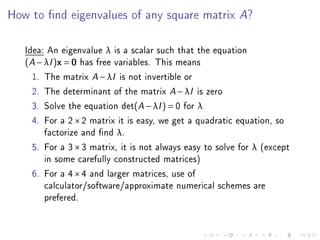
How to nd eigenvalues of any square matrix A?

   Idea: An eigenvalue λ is a scalar such that the equation
   (A − λI )x = 0 has free variables. This means
     1. The matrix A − λI is not invertible or
How to nd eigenvalues of any square matrix A?

   Idea: An eigenvalue λ is a scalar such that the equation
   (A − λI )x = 0 has free variables. This means
     1. The matrix A − λI is not invertible or
     2. The determinant of the matrix A − λI is zero
How to nd eigenvalues of any square matrix A?

   Idea: An eigenvalue λ is a scalar such that the equation
   (A − λI )x = 0 has free variables. This means
     1. The matrix A − λI is not invertible or
     2. The determinant of the matrix A − λI is zero
     3. Solve the equation det(A − λI ) = 0 for λ
How to nd eigenvalues of any square matrix A?

   Idea: An eigenvalue λ is a scalar such that the equation
   (A − λI )x = 0 has free variables. This means
     1. The matrix A − λI is not invertible or
     2. The determinant of the matrix A − λI is zero
     3. Solve the equation det(A − λI ) = 0 for λ
     4. For a 2 × 2 matrix it is easy, we get a quadratic equation, so
        factorize and nd λ.
How to nd eigenvalues of any square matrix A?

   Idea: An eigenvalue λ is a scalar such that the equation
   (A − λI )x = 0 has free variables. This means
     1. The matrix A − λI is not invertible or
     2. The determinant of the matrix A − λI is zero
     3. Solve the equation det(A − λI ) = 0 for λ
     4. For a 2 × 2 matrix it is easy, we get a quadratic equation, so
        factorize and nd λ.
     5. For a 3 × 3 matrix, it is not always easy to solve for λ (except
        in some carefully constructed matrices)
How to nd eigenvalues of any square matrix A?

   Idea: An eigenvalue λ is a scalar such that the equation
   (A − λI )x = 0 has free variables. This means
     1. The matrix A − λI is not invertible or
     2. The determinant of the matrix A − λI is zero
     3. Solve the equation det(A − λI ) = 0 for λ
     4. For a 2 × 2 matrix it is easy, we get a quadratic equation, so
        factorize and nd λ.
     5. For a 3 × 3 matrix, it is not always easy to solve for λ (except
        in some carefully constructed matrices)
     6. For a 4 × 4 and larger matrices, use of
        calculator/software/approximate numerical schemes are
        prefered.
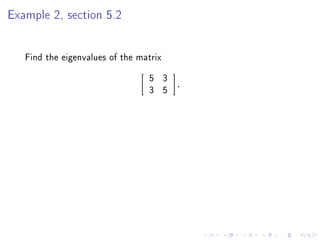
Example 2, section 5.2


   Find the eigenvalues of the matrix
                                 5 3
                                        .
                                 3 5
Example 2, section 5.2


   Find the eigenvalues of the matrix
                                 5 3
                                            .
                                 3 5
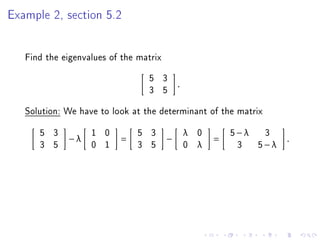
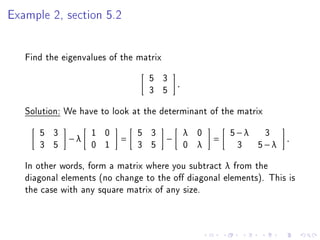
   Solution: We have to look at the determinant of the matrix
      5 3          1 0         5 3              λ   0       5−λ 3
             −λ           =             −               =            .
      3 5          0 1         3 5              0   λ        3 5−λ
Example 2, section 5.2


   Find the eigenvalues of the matrix
                                 5 3
                                            .
                                 3 5
   Solution: We have to look at the determinant of the matrix
      5 3          1 0         5 3              λ   0       5−λ 3
             −λ           =             −               =            .
      3 5          0 1         3 5              0   λ        3 5−λ
   In other words, form a matrix where you subtract λ from the
   diagonal elements (no change to the o diagonal elements). This is
   the case with any square matrix of any size.
Example 2, section 5.2
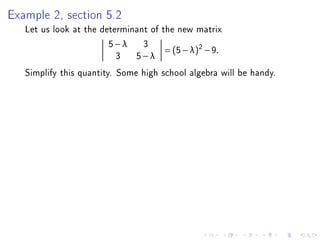
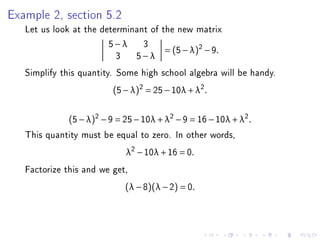
   Let us look at the determinant of the new matrix
                        5−λ 3
                                      = (5 − λ )2 − 9 .
                          3 5−λ
   Simplify this quantity. Some high school algebra will be handy.
Example 2, section 5.2
   Let us look at the determinant of the new matrix
                        5−λ 3
                                      = (5 − λ )2 − 9 .
                          3 5−λ
   Simplify this quantity. Some high school algebra will be handy.
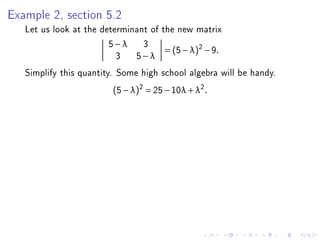
                          (5 − λ)2 = 25 − 10λ + λ2 .
Example 2, section 5.2
   Let us look at the determinant of the new matrix
                        5−λ 3
                                      = (5 − λ )2 − 9 .
                          3 5−λ
   Simplify this quantity. Some high school algebra will be handy.
                          (5 − λ)2 = 25 − 10λ + λ2 .


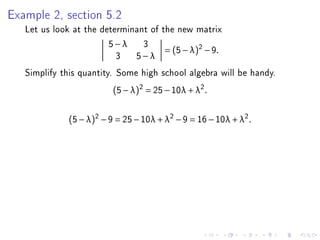
              (5 − λ)2 − 9 = 25 − 10λ + λ2 − 9 = 16 − 10λ + λ2 .
Example 2, section 5.2
   Let us look at the determinant of the new matrix
                        5−λ 3
                                      = (5 − λ )2 − 9 .
                          3 5−λ
   Simplify this quantity. Some high school algebra will be handy.
                          (5 − λ)2 = 25 − 10λ + λ2 .


              (5 − λ)2 − 9 = 25 − 10λ + λ2 − 9 = 16 − 10λ + λ2 .
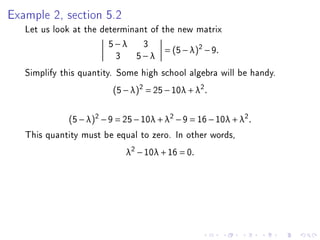
   This quantity must be equal to zero. In other words,
                             λ2 − 10λ + 16 = 0.
Example 2, section 5.2
   Let us look at the determinant of the new matrix
                        5−λ 3
                                      = (5 − λ )2 − 9 .
                          3 5−λ
   Simplify this quantity. Some high school algebra will be handy.
                          (5 − λ)2 = 25 − 10λ + λ2 .


              (5 − λ)2 − 9 = 25 − 10λ + λ2 − 9 = 16 − 10λ + λ2 .
   This quantity must be equal to zero. In other words,
                             λ2 − 10λ + 16 = 0.
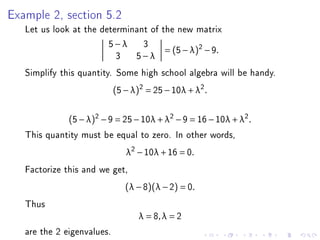
   Factorize this and we get,
                             (λ − 8)(λ − 2) = 0.
Example 2, section 5.2
   Let us look at the determinant of the new matrix
                        5−λ 3
                                      = (5 − λ )2 − 9 .
                          3 5−λ
   Simplify this quantity. Some high school algebra will be handy.
                            (5 − λ)2 = 25 − 10λ + λ2 .


              (5 − λ)2 − 9 = 25 − 10λ + λ2 − 9 = 16 − 10λ + λ2 .
   This quantity must be equal to zero. In other words,
                               λ2 − 10λ + 16 = 0.
   Factorize this and we get,
                               (λ − 8)(λ − 2) = 0.
   Thus
                                   λ = 8, λ = 2
   are the 2 eigenvalues.
Comments


   1. The equation det(A − λI ) = 0 is called the characteristic
      equation of A.
Comments


   1. The equation det(A − λI ) = 0 is called the characteristic
      equation of A.
   2. The polynomial involving λ you get after computing the
      determinant (and simplifying) in step 1 is called the
      characteristic polynomial of A.
Comments


   1. The equation det(A − λI ) = 0 is called the characteristic
      equation of A.
   2. The polynomial involving λ you get after computing the
      determinant (and simplifying) in step 1 is called the
      characteristic polynomial of A.
   3. Thus the characteristic polynomial of A is a quadratic equation
      if A is a 2 × 2 matrix, a cubic equation if A is a 3 × 3 matrix etc.
Comments


   1. The equation det(A − λI ) = 0 is called the characteristic
      equation of A.
   2. The polynomial involving λ you get after computing the
      determinant (and simplifying) in step 1 is called the
      characteristic polynomial of A.
   3. Thus the characteristic polynomial of A is a quadratic equation
      if A is a 2 × 2 matrix, a cubic equation if A is a 3 × 3 matrix etc.
   4. The characteristic polynomial may not be nicely factorizable in
      all cases. In that case you may need your high school
      quadratic formula.
Back to High School

   If you have a quadratic equation
                               2
                             ax + bx + c = 0,

   the 2 roots (values of x that solve the above equation) are given by
Back to High School

   If you have a quadratic equation
                               2
                             ax + bx + c = 0,

   the 2 roots (values of x that solve the above equation) are given by
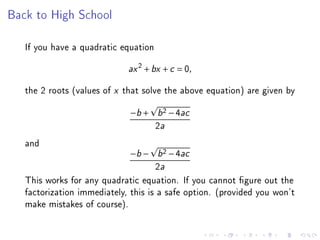
                             −b + b 2 − 4ac
                                      2a
   and
                             −b − b 2 − 4ac
                                     2a
   This works for any quadratic equation. If you cannot gure out the
   factorization immediately, this is a safe option. (provided you won't
   make mistakes of course).
Trace of a Matrix


   Denition
   Trace of any square matrix A is the sum of the diagonal elements
   of A. It is denoted by tr A.
Trace of a Matrix


   Denition
   Trace of any square matrix A is the sum of the diagonal elements
   of A. It is denoted by tr A.


   Why is the trace useful? The trace of any square matrix is equal to
   the sum of the eigenvalues of A (irrespective of the size of A).
   Thus, it is a good check to your eigenvalue calculations.
Trace of a Matrix


   Denition
   Trace of any square matrix A is the sum of the diagonal elements
   of A. It is denoted by tr A.


   Why is the trace useful? The trace of any square matrix is equal to
   the sum of the eigenvalues of A (irrespective of the size of A).
   Thus, it is a good check to your eigenvalue calculations.


   The product of the eigenvalues of A = det A.
How many eigenvalues?


   A quadratic equation has exactly 2 roots, if complex roots are
   included. (could be the same root repeated)
How many eigenvalues?


   A quadratic equation has exactly 2 roots, if complex roots are
   included. (could be the same root repeated)
   A cubic equation has exactly 3 roots, if complex roots are included
   (one or more roots could be repeated)
How many eigenvalues?


   A quadratic equation has exactly 2 roots, if complex roots are
   included. (could be the same root repeated)
   A cubic equation has exactly 3 roots, if complex roots are included
   (one or more roots could be repeated)
   In general, a square matrix of size n × n will have exactly   n
   eigenvalues.
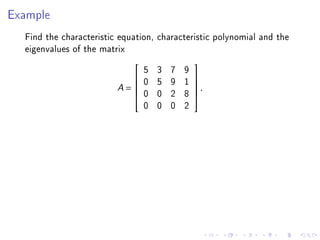
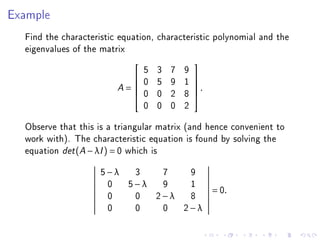
Example
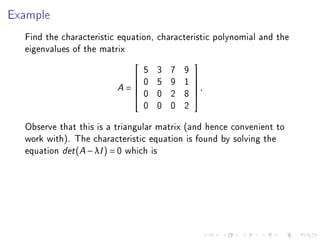
  Find the characteristic equation, characteristic polynomial and the
  eigenvalues of the matrix
                                 5   3   7   9
                                                
                                0   5   9   1   
                         A=                     .
                                                
                                0   0   2   8   
                                 0   0   0   2
Example
  Find the characteristic equation, characteristic polynomial and the
  eigenvalues of the matrix
                                 5   3   7   9
                                                
                                0   5   9   1   
                         A=                     .
                                                
                                0   0   2   8   
                                 0   0   0   2
  Observe that this is a triangular matrix (and hence convenient to
  work with). The characteristic equation is found by solving the
  equation det (A − λI ) = 0 which is
Example
  Find the characteristic equation, characteristic polynomial and the
  eigenvalues of the matrix
                                 5   3   7   9
                                                
                                0   5   9   1   
                         A=                     .
                                                
                                0   0   2   8   
                                 0   0   0   2
  Observe that this is a triangular matrix (and hence convenient to
  work with). The characteristic equation is found by solving the
  equation det (A − λI ) = 0 which is
                     5−λ 3  7  9
                      0 5−λ 9  1
                                                      = 0.
                      0  0 2−λ 8
                      0  0  0 2−λ
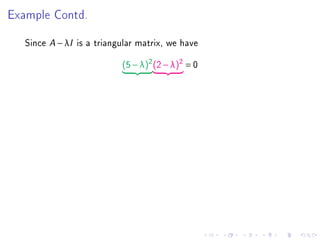
Example Contd.

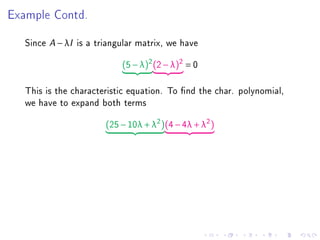
   Since A − λI is a triangular matrix, we have
                           (5 − λ)2 (2 − λ)2 = 0
Example Contd.

   Since A − λI is a triangular matrix, we have
                           (5 − λ)2 (2 − λ)2 = 0

   This is the characteristic equation. To nd the char. polynomial,
   we have to expand both terms
                       (25 − 10λ + λ2 )(4 − 4λ + λ2 )
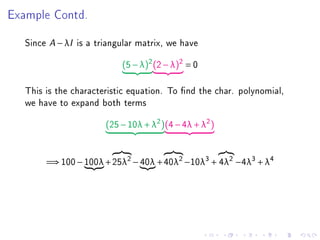
Example Contd.

   Since A − λI is a triangular matrix, we have
                           (5 − λ)2 (2 − λ)2 = 0

   This is the characteristic equation. To nd the char. polynomial,
   we have to expand both terms
                       (25 − 10λ + λ2 )(4 − 4λ + λ2 )


        =⇒ 100 − 100λ + 25λ2 − 40λ + 40λ2 −10λ3 + 4λ2 −4λ3 + λ4
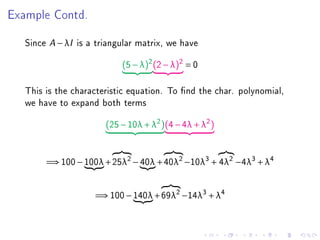
Example Contd.

   Since A − λI is a triangular matrix, we have
                           (5 − λ)2 (2 − λ)2 = 0

   This is the characteristic equation. To nd the char. polynomial,
   we have to expand both terms
                       (25 − 10λ + λ2 )(4 − 4λ + λ2 )


        =⇒ 100 − 100λ + 25λ2 − 40λ + 40λ2 −10λ3 + 4λ2 −4λ3 + λ4


                    =⇒ 100 − 140λ + 69λ2 −14λ3 + λ4
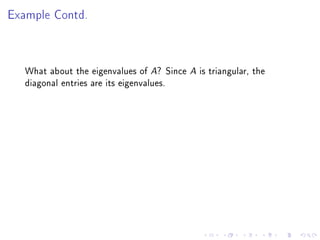
Example Contd.


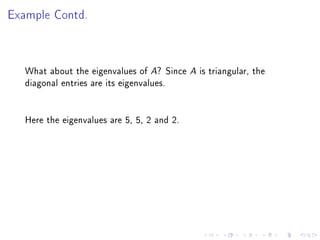
   What about the eigenvalues of A? Since A is triangular, the
   diagonal entries are its eigenvalues.
Example Contd.


   What about the eigenvalues of A? Since A is triangular, the
   diagonal entries are its eigenvalues.


   Here the eigenvalues are 5, 5, 2 and 2.
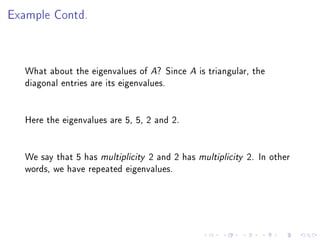
Example Contd.


   What about the eigenvalues of A? Since A is triangular, the
   diagonal entries are its eigenvalues.


   Here the eigenvalues are 5, 5, 2 and 2.


   We say that 5 has multiplicity 2 and 2 has multiplicity 2. In other
   words, we have repeated eigenvalues.
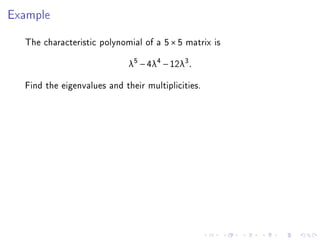
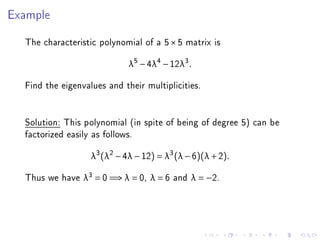
Example

  The characteristic polynomial of a 5 × 5 matrix is
                             λ5 − 4λ4 − 12λ3 .

  Find the eigenvalues and their multiplicities.
Example

  The characteristic polynomial of a 5 × 5 matrix is
                             λ5 − 4λ4 − 12λ3 .

  Find the eigenvalues and their multiplicities.


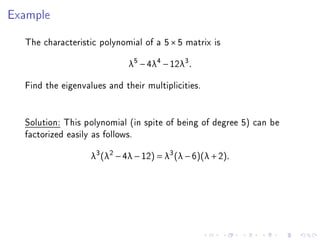
  Solution: This polynomial (in spite of being of degree 5) can be
  factorized easily as follows.
                   λ3 (λ2 − 4λ − 12) = λ3 (λ − 6)(λ + 2).
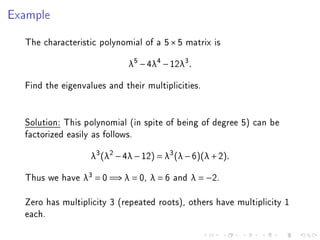
Example

  The characteristic polynomial of a 5 × 5 matrix is
                             λ5 − 4λ4 − 12λ3 .

  Find the eigenvalues and their multiplicities.


  Solution: This polynomial (in spite of being of degree 5) can be
  factorized easily as follows.
                   λ3 (λ2 − 4λ − 12) = λ3 (λ − 6)(λ + 2).

  Thus we have λ3 = 0 =⇒ λ = 0, λ = 6 and λ = −2.
Example

  The characteristic polynomial of a 5 × 5 matrix is
                             λ5 − 4λ4 − 12λ3 .

  Find the eigenvalues and their multiplicities.


  Solution: This polynomial (in spite of being of degree 5) can be
  factorized easily as follows.
                   λ3 (λ2 − 4λ − 12) = λ3 (λ − 6)(λ + 2).

  Thus we have λ3 = 0 =⇒ λ = 0, λ = 6 and λ = −2.

  Zero has multiplicity 3 (repeated roots), others have multiplicity 1
  each.
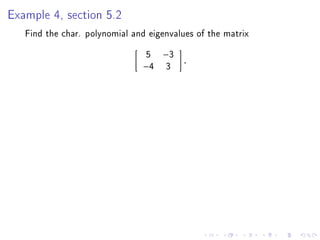
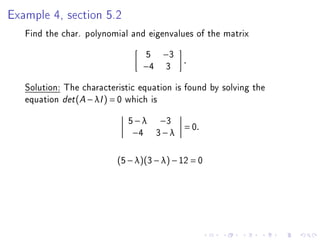
Example 4, section 5.2
   Find the char. polynomial and eigenvalues of the matrix
                                5   −3
                                          .
                               −4    3
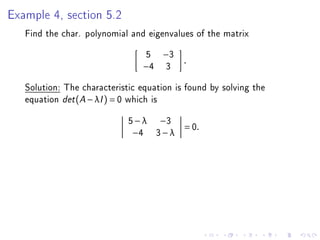
Example 4, section 5.2
   Find the char. polynomial and eigenvalues of the matrix
                                 5    −3
                                           .
                                −4    3
   Solution: The characteristic equation is found by solving the
   equation det (A − λI ) = 0 which is
                             5 − λ −3
                                           = 0.
                              −4 3 − λ
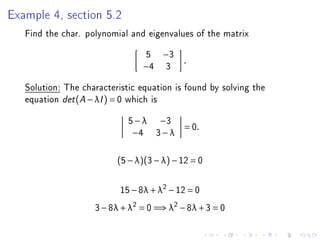
Example 4, section 5.2
   Find the char. polynomial and eigenvalues of the matrix
                                 5    −3
                                           .
                                −4     3
   Solution: The characteristic equation is found by solving the
   equation det (A − λI ) = 0 which is
                             5 − λ −3
                                           = 0.
                              −4 3 − λ


                          (5 − λ)(3 − λ) − 12 = 0
Example 4, section 5.2
   Find the char. polynomial and eigenvalues of the matrix
                                 5    −3
                                           .
                                −4     3
   Solution: The characteristic equation is found by solving the
   equation det (A − λI ) = 0 which is
                             5 − λ −3
                                           = 0.
                              −4 3 − λ


                          (5 − λ)(3 − λ) − 12 = 0


                           15 − 8λ + λ2 − 12 = 0
                    3 − 8λ + λ2 = 0 =⇒ λ2 − 8λ + 3 = 0
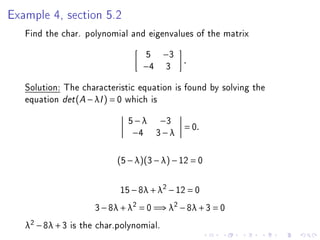
Example 4, section 5.2
   Find the char. polynomial and eigenvalues of the matrix
                                    5      −3
                                                .
                                   −4      3
   Solution: The characteristic equation is found by solving the
   equation det (A − λI ) = 0 which is
                               5 − λ −3
                                                = 0.
                                −4 3 − λ


                             (5 − λ)(3 − λ) − 12 = 0


                             15 − 8λ + λ2 − 12 = 0
                       3 − 8λ + λ2 = 0 =⇒ λ2 − 8λ + 3 = 0
   λ2 − 8λ + 3   is the char.polynomial.
Example 4, section 5.2

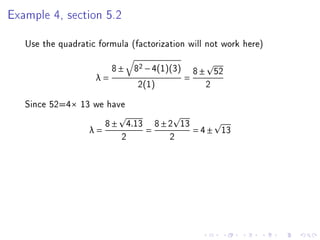
   Use the quadratic formula (factorization will not work here)
Example 4, section 5.2

   Use the quadratic formula (factorization will not work here)

                         8 ± 82 − 4(1)(3) 8 ± 52
                    λ=                   =
                              2(1)           2
   Since 52=4× 13 we have
                        8 ± 4.13 8 ± 2 13
                   λ=           =         = 4 ± 13
                           2         2
Example 4, section 5.2

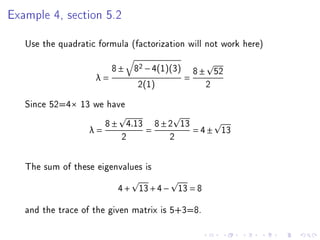
   Use the quadratic formula (factorization will not work here)

                         8 ± 82 − 4(1)(3) 8 ± 52
                    λ=                   =
                              2(1)           2
   Since 52=4× 13 we have
                        8 ± 4.13 8 ± 2 13
                   λ=           =         = 4 ± 13
                           2         2

   The sum of these eigenvalues is
                          4 + 13 + 4 − 13 = 8
   and the trace of the given matrix is 5+3=8.
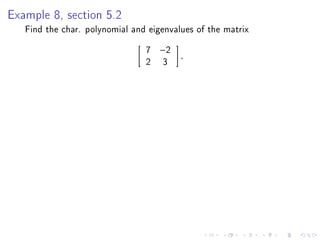
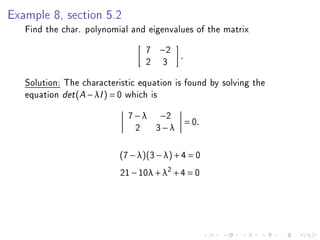
Example 8, section 5.2
   Find the char. polynomial and eigenvalues of the matrix
                                7   −2
                                         .
                                2   3
Example 8, section 5.2
   Find the char. polynomial and eigenvalues of the matrix
                                 7   −2
                                          .
                                 2    3
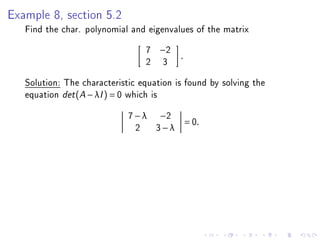
   Solution: The characteristic equation is found by solving the
   equation det (A − λI ) = 0 which is
                             7 − λ −2
                                              = 0.
                               2 3−λ
Example 8, section 5.2
   Find the char. polynomial and eigenvalues of the matrix
                                  7   −2
                                           .
                                  2   3
   Solution: The characteristic equation is found by solving the
   equation det (A − λI ) = 0 which is
                             7 − λ −2
                                               = 0.
                               2 3−λ

                           (7 − λ)(3 − λ) + 4 = 0
                           21 − 10λ + λ2 + 4 = 0
Example 8, section 5.2
   Find the char. polynomial and eigenvalues of the matrix
                                     7   −2
                                              .
                                     2   3
   Solution: The characteristic equation is found by solving the
   equation det (A − λI ) = 0 which is
                                7 − λ −2
                                                  = 0.
                                  2 3−λ

                              (7 − λ)(3 − λ) + 4 = 0
                              21 − 10λ + λ2 + 4 = 0

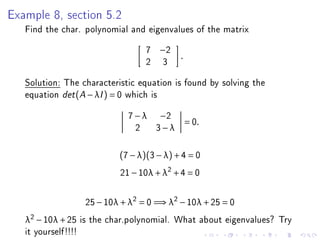
                      25 − 10λ + λ2 = 0 =⇒ λ2 − 10λ + 25 = 0
   λ2 − 10λ + 25     is the char.polynomial. What about eigenvalues? Try
   it yourself!!!!
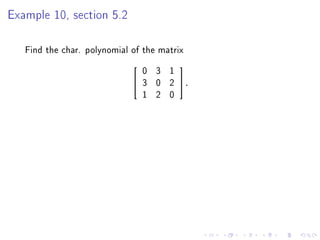
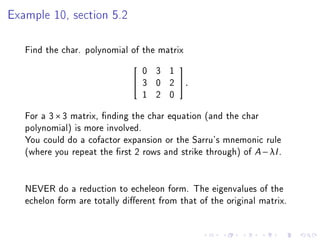
Example 10, section 5.2

   Find the char. polynomial of the matrix
                                 0 3 1
                                        
                                3 0 2   .
                                 1 2 0
Example 10, section 5.2

   Find the char. polynomial of the matrix
                                  0 3 1
                                         
                                 3 0 2   .
                                  1 2 0
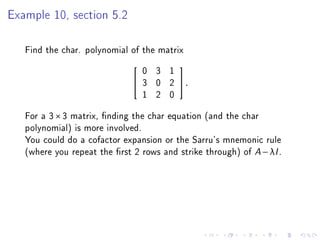
   For a 3 × 3 matrix, nding the char equation (and the char
   polynomial) is more involved.
   You could do a cofactor expansion or the Sarru's mnemonic rule
   (where you repeat the rst 2 rows and strike through) of A − λI .
Example 10, section 5.2

   Find the char. polynomial of the matrix
                                  0 3 1
                                         
                                 3 0 2   .
                                  1 2 0
   For a 3 × 3 matrix, nding the char equation (and the char
   polynomial) is more involved.
   You could do a cofactor expansion or the Sarru's mnemonic rule
   (where you repeat the rst 2 rows and strike through) of A − λI .


   NEVER do a reduction to echeleon form. The eigenvalues of the
   echelon form are totally dierent from that of the original matrix.
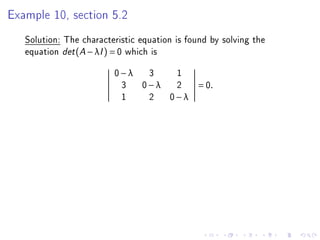
Example 10, section 5.2
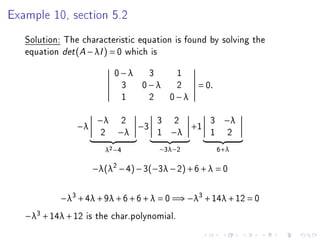
   Solution: The characteristic equation is found by solving the
   equation det (A − λI ) = 0 which is
                         0−λ 3  1
                          3 0−λ 2             = 0.
                          1  2 0−λ
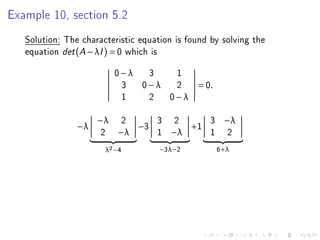
Example 10, section 5.2
   Solution: The characteristic equation is found by solving the
   equation det (A − λI ) = 0 which is
                          0−λ 3  1
                           3 0−λ 2            = 0.
                           1  2 0−λ

                     −λ    2        3   2         3    −λ
                −λ             −3            +1
                      2   −λ        1   −λ        1     2
                       λ2 −4         −3λ−2            6+λ
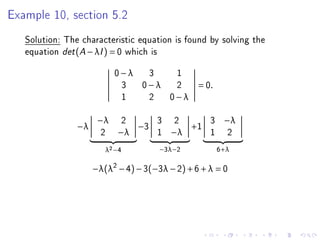
Example 10, section 5.2
   Solution: The characteristic equation is found by solving the
   equation det (A − λI ) = 0 which is
                           0−λ 3  1
                            3 0−λ 2             = 0.
                            1  2 0−λ

                      −λ    2        3    2        3    −λ
                −λ              −3            +1
                       2   −λ        1   −λ        1     2
                        λ2 −4         −3λ−2            6+λ

                     −λ(λ2 − 4) − 3(−3λ − 2) + 6 + λ = 0
Example 10, section 5.2
   Solution: The characteristic equation is found by solving the
   equation det (A − λI ) = 0 which is
                           0−λ 3  1
                            3 0−λ 2             = 0.
                            1  2 0−λ

                      −λ    2         3   2         3    −λ
                −λ               −3            +1
                       2    −λ        1   −λ        1     2
                        λ2 −4         −3λ−2             6+λ

                     −λ(λ2 − 4) − 3(−3λ − 2) + 6 + λ = 0


            −λ3 + 4λ + 9λ + 6 + 6 + λ = 0 =⇒ −λ3 + 14λ + 12 = 0
   −λ3 + 14λ + 12   is the char.polynomial.
Example 14, section 5.2
   Find the char. polynomial of the matrix
                                5   −2   3
                                             
                               0   1     0   .
                                6   7    −2

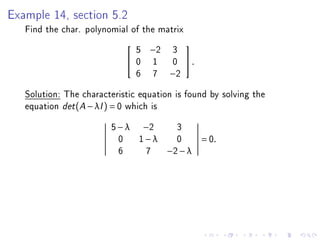
   Solution: The characteristic equation is found by solving the
   equation det (A − λI ) = 0 which is
                        5 − λ −2           3
                          0 1−λ            0       = 0.
                          6    7         −2 − λ
Example 14, section 5.2
   Find the char. polynomial of the matrix
                                   5   −2   3
                                                 
                                  0   1     0    .
                                   6   7    −2

   Solution: The characteristic equation is found by solving the
   equation det (A − λI ) = 0 which is
                           5 − λ −2           3
                             0 1−λ            0        = 0.
                             6    7         −2 − λ

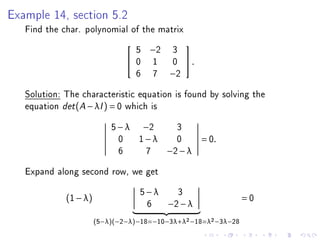
   Expand along second row, we get
                                   5−λ        3
             (1 − λ)                                            =0
                                    6       −2 − λ
                       (5−λ)(−2−λ)−18=−10−3λ+λ2 −18=λ2 −3λ−28
Example 14, section 5.2


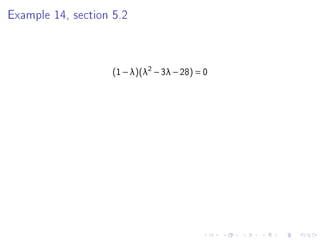
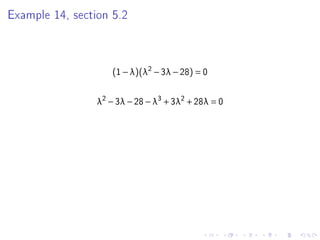
                    (1 − λ)(λ2 − 3λ − 28) = 0
Example 14, section 5.2


                     (1 − λ)(λ2 − 3λ − 28) = 0


                 λ2 − 3λ − 28 − λ3 + 3λ2 + 28λ = 0
Example 14, section 5.2


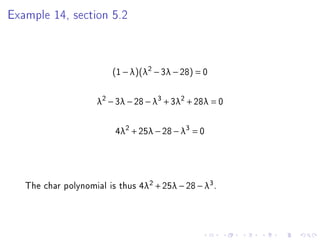
                         (1 − λ)(λ2 − 3λ − 28) = 0


                     λ2 − 3λ − 28 − λ3 + 3λ2 + 28λ = 0


                          4λ2 + 25λ − 28 − λ3 = 0


   The char polynomial is thus 4λ2 + 25λ − 28 − λ3 .
Similarity


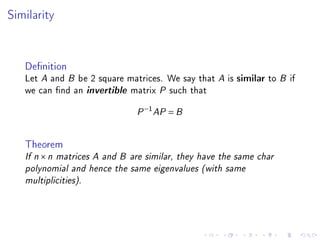
   Denition
   Let A and B be 2 square matrices. We say that A is similar to B if
   we can nd an invertible matrix P such that
                                  −1
                              P        AP = B


   Theorem
   If n × n matrices A and B are similar, they have the same char
   polynomial and hence the same eigenvalues (with same
   multiplicities).

Finding eigenvalues, char poly

  • 1.
    Announcements Quiz 4 will be on Thurs Feb 18 on sec 3.3, 5.1 and 5.2. "Curved" quiz grades (3 point curve as I mentioned in the email) will be posted by today evening. I have updated the homework set (again!!). I decided to skip 5.5 and start chap 6 after 5.3.
  • 2.
    Last Week 1. Dened eigenvalues and eigenvectors of a square matrix
  • 3.
    Last Week 1. Dened eigenvalues and eigenvectors of a square matrix 2. How to test whether a given vector is an eigenvector of a given matrix (multiply and check whether we get a scalar multiple of the original vector)
  • 4.
    Last Week 1. Dened eigenvalues and eigenvectors of a square matrix 2. How to test whether a given vector is an eigenvector of a given matrix (multiply and check whether we get a scalar multiple of the original vector) 3. How to test whether a given number λ is an eigenvalue (check whether the matrix A − λI has linearly dependent columns)
  • 5.
    Last Week 1. Dened eigenvalues and eigenvectors of a square matrix 2. How to test whether a given vector is an eigenvector of a given matrix (multiply and check whether we get a scalar multiple of the original vector) 3. How to test whether a given number λ is an eigenvalue (check whether the matrix A − λI has linearly dependent columns) 4. How to nd the eigenvectors of a given eigenvalue (row reduce A − λI and solve for basic in terms of free variables).
  • 6.
    Last Week 1. Dened eigenvalues and eigenvectors of a square matrix 2. How to test whether a given vector is an eigenvector of a given matrix (multiply and check whether we get a scalar multiple of the original vector) 3. How to test whether a given number λ is an eigenvalue (check whether the matrix A − λI has linearly dependent columns) 4. How to nd the eigenvectors of a given eigenvalue (row reduce A − λI and solve for basic in terms of free variables). 5. Eigenvalues of any triangular matrix are the entries of the main diagonal
  • 7.
    Last Week 1. Dened eigenvalues and eigenvectors of a square matrix 2. How to test whether a given vector is an eigenvector of a given matrix (multiply and check whether we get a scalar multiple of the original vector) 3. How to test whether a given number λ is an eigenvalue (check whether the matrix A − λI has linearly dependent columns) 4. How to nd the eigenvectors of a given eigenvalue (row reduce A − λI and solve for basic in terms of free variables). 5. Eigenvalues of any triangular matrix are the entries of the main diagonal 6. Zero is an eigenvalue of A if and only if A is not invertible.
  • 8.
    Last Week 1. Dened eigenvalues and eigenvectors of a square matrix 2. How to test whether a given vector is an eigenvector of a given matrix (multiply and check whether we get a scalar multiple of the original vector) 3. How to test whether a given number λ is an eigenvalue (check whether the matrix A − λI has linearly dependent columns) 4. How to nd the eigenvectors of a given eigenvalue (row reduce A − λI and solve for basic in terms of free variables). 5. Eigenvalues of any triangular matrix are the entries of the main diagonal 6. Zero is an eigenvalue of A if and only if A is not invertible. 7. We did not see how to nd eigenvalues of a general square matrix.
  • 9.
    How to ndeigenvalues of any square matrix A? Idea: An eigenvalue λ is a scalar such that the equation (A − λI )x = 0 has free variables. This means 1. The matrix A − λI is not invertible or
  • 10.
    How to ndeigenvalues of any square matrix A? Idea: An eigenvalue λ is a scalar such that the equation (A − λI )x = 0 has free variables. This means 1. The matrix A − λI is not invertible or 2. The determinant of the matrix A − λI is zero
  • 11.
    How to ndeigenvalues of any square matrix A? Idea: An eigenvalue λ is a scalar such that the equation (A − λI )x = 0 has free variables. This means 1. The matrix A − λI is not invertible or 2. The determinant of the matrix A − λI is zero 3. Solve the equation det(A − λI ) = 0 for λ
  • 12.
    How to ndeigenvalues of any square matrix A? Idea: An eigenvalue λ is a scalar such that the equation (A − λI )x = 0 has free variables. This means 1. The matrix A − λI is not invertible or 2. The determinant of the matrix A − λI is zero 3. Solve the equation det(A − λI ) = 0 for λ 4. For a 2 × 2 matrix it is easy, we get a quadratic equation, so factorize and nd λ.
  • 13.
    How to ndeigenvalues of any square matrix A? Idea: An eigenvalue λ is a scalar such that the equation (A − λI )x = 0 has free variables. This means 1. The matrix A − λI is not invertible or 2. The determinant of the matrix A − λI is zero 3. Solve the equation det(A − λI ) = 0 for λ 4. For a 2 × 2 matrix it is easy, we get a quadratic equation, so factorize and nd λ. 5. For a 3 × 3 matrix, it is not always easy to solve for λ (except in some carefully constructed matrices)
  • 14.
    How to ndeigenvalues of any square matrix A? Idea: An eigenvalue λ is a scalar such that the equation (A − λI )x = 0 has free variables. This means 1. The matrix A − λI is not invertible or 2. The determinant of the matrix A − λI is zero 3. Solve the equation det(A − λI ) = 0 for λ 4. For a 2 × 2 matrix it is easy, we get a quadratic equation, so factorize and nd λ. 5. For a 3 × 3 matrix, it is not always easy to solve for λ (except in some carefully constructed matrices) 6. For a 4 × 4 and larger matrices, use of calculator/software/approximate numerical schemes are prefered.
  • 15.
    Example 2, section5.2 Find the eigenvalues of the matrix 5 3 . 3 5
  • 16.
    Example 2, section5.2 Find the eigenvalues of the matrix 5 3 . 3 5 Solution: We have to look at the determinant of the matrix 5 3 1 0 5 3 λ 0 5−λ 3 −λ = − = . 3 5 0 1 3 5 0 λ 3 5−λ
  • 17.
    Example 2, section5.2 Find the eigenvalues of the matrix 5 3 . 3 5 Solution: We have to look at the determinant of the matrix 5 3 1 0 5 3 λ 0 5−λ 3 −λ = − = . 3 5 0 1 3 5 0 λ 3 5−λ In other words, form a matrix where you subtract λ from the diagonal elements (no change to the o diagonal elements). This is the case with any square matrix of any size.
  • 18.
    Example 2, section5.2 Let us look at the determinant of the new matrix 5−λ 3 = (5 − λ )2 − 9 . 3 5−λ Simplify this quantity. Some high school algebra will be handy.
  • 19.
    Example 2, section5.2 Let us look at the determinant of the new matrix 5−λ 3 = (5 − λ )2 − 9 . 3 5−λ Simplify this quantity. Some high school algebra will be handy. (5 − λ)2 = 25 − 10λ + λ2 .
  • 20.
    Example 2, section5.2 Let us look at the determinant of the new matrix 5−λ 3 = (5 − λ )2 − 9 . 3 5−λ Simplify this quantity. Some high school algebra will be handy. (5 − λ)2 = 25 − 10λ + λ2 . (5 − λ)2 − 9 = 25 − 10λ + λ2 − 9 = 16 − 10λ + λ2 .
  • 21.
    Example 2, section5.2 Let us look at the determinant of the new matrix 5−λ 3 = (5 − λ )2 − 9 . 3 5−λ Simplify this quantity. Some high school algebra will be handy. (5 − λ)2 = 25 − 10λ + λ2 . (5 − λ)2 − 9 = 25 − 10λ + λ2 − 9 = 16 − 10λ + λ2 . This quantity must be equal to zero. In other words, λ2 − 10λ + 16 = 0.
  • 22.
    Example 2, section5.2 Let us look at the determinant of the new matrix 5−λ 3 = (5 − λ )2 − 9 . 3 5−λ Simplify this quantity. Some high school algebra will be handy. (5 − λ)2 = 25 − 10λ + λ2 . (5 − λ)2 − 9 = 25 − 10λ + λ2 − 9 = 16 − 10λ + λ2 . This quantity must be equal to zero. In other words, λ2 − 10λ + 16 = 0. Factorize this and we get, (λ − 8)(λ − 2) = 0.
  • 23.
    Example 2, section5.2 Let us look at the determinant of the new matrix 5−λ 3 = (5 − λ )2 − 9 . 3 5−λ Simplify this quantity. Some high school algebra will be handy. (5 − λ)2 = 25 − 10λ + λ2 . (5 − λ)2 − 9 = 25 − 10λ + λ2 − 9 = 16 − 10λ + λ2 . This quantity must be equal to zero. In other words, λ2 − 10λ + 16 = 0. Factorize this and we get, (λ − 8)(λ − 2) = 0. Thus λ = 8, λ = 2 are the 2 eigenvalues.
  • 24.
    Comments 1. The equation det(A − λI ) = 0 is called the characteristic equation of A.
  • 25.
    Comments 1. The equation det(A − λI ) = 0 is called the characteristic equation of A. 2. The polynomial involving λ you get after computing the determinant (and simplifying) in step 1 is called the characteristic polynomial of A.
  • 26.
    Comments 1. The equation det(A − λI ) = 0 is called the characteristic equation of A. 2. The polynomial involving λ you get after computing the determinant (and simplifying) in step 1 is called the characteristic polynomial of A. 3. Thus the characteristic polynomial of A is a quadratic equation if A is a 2 × 2 matrix, a cubic equation if A is a 3 × 3 matrix etc.
  • 27.
    Comments 1. The equation det(A − λI ) = 0 is called the characteristic equation of A. 2. The polynomial involving λ you get after computing the determinant (and simplifying) in step 1 is called the characteristic polynomial of A. 3. Thus the characteristic polynomial of A is a quadratic equation if A is a 2 × 2 matrix, a cubic equation if A is a 3 × 3 matrix etc. 4. The characteristic polynomial may not be nicely factorizable in all cases. In that case you may need your high school quadratic formula.
  • 28.
    Back to HighSchool If you have a quadratic equation 2 ax + bx + c = 0, the 2 roots (values of x that solve the above equation) are given by
  • 29.
    Back to HighSchool If you have a quadratic equation 2 ax + bx + c = 0, the 2 roots (values of x that solve the above equation) are given by −b + b 2 − 4ac 2a and −b − b 2 − 4ac 2a This works for any quadratic equation. If you cannot gure out the factorization immediately, this is a safe option. (provided you won't make mistakes of course).
  • 30.
    Trace of aMatrix Denition Trace of any square matrix A is the sum of the diagonal elements of A. It is denoted by tr A.
  • 31.
    Trace of aMatrix Denition Trace of any square matrix A is the sum of the diagonal elements of A. It is denoted by tr A. Why is the trace useful? The trace of any square matrix is equal to the sum of the eigenvalues of A (irrespective of the size of A). Thus, it is a good check to your eigenvalue calculations.
  • 32.
    Trace of aMatrix Denition Trace of any square matrix A is the sum of the diagonal elements of A. It is denoted by tr A. Why is the trace useful? The trace of any square matrix is equal to the sum of the eigenvalues of A (irrespective of the size of A). Thus, it is a good check to your eigenvalue calculations. The product of the eigenvalues of A = det A.
  • 33.
    How many eigenvalues? A quadratic equation has exactly 2 roots, if complex roots are included. (could be the same root repeated)
  • 34.
    How many eigenvalues? A quadratic equation has exactly 2 roots, if complex roots are included. (could be the same root repeated) A cubic equation has exactly 3 roots, if complex roots are included (one or more roots could be repeated)
  • 35.
    How many eigenvalues? A quadratic equation has exactly 2 roots, if complex roots are included. (could be the same root repeated) A cubic equation has exactly 3 roots, if complex roots are included (one or more roots could be repeated) In general, a square matrix of size n × n will have exactly n eigenvalues.
  • 36.
    Example Findthe characteristic equation, characteristic polynomial and the eigenvalues of the matrix 5 3 7 9    0 5 9 1  A= .    0 0 2 8  0 0 0 2
  • 37.
    Example Findthe characteristic equation, characteristic polynomial and the eigenvalues of the matrix 5 3 7 9    0 5 9 1  A= .    0 0 2 8  0 0 0 2 Observe that this is a triangular matrix (and hence convenient to work with). The characteristic equation is found by solving the equation det (A − λI ) = 0 which is
  • 38.
    Example Findthe characteristic equation, characteristic polynomial and the eigenvalues of the matrix 5 3 7 9    0 5 9 1  A= .    0 0 2 8  0 0 0 2 Observe that this is a triangular matrix (and hence convenient to work with). The characteristic equation is found by solving the equation det (A − λI ) = 0 which is 5−λ 3 7 9 0 5−λ 9 1 = 0. 0 0 2−λ 8 0 0 0 2−λ
  • 39.
    Example Contd. Since A − λI is a triangular matrix, we have (5 − λ)2 (2 − λ)2 = 0
  • 40.
    Example Contd. Since A − λI is a triangular matrix, we have (5 − λ)2 (2 − λ)2 = 0 This is the characteristic equation. To nd the char. polynomial, we have to expand both terms (25 − 10λ + λ2 )(4 − 4λ + λ2 )
  • 41.
    Example Contd. Since A − λI is a triangular matrix, we have (5 − λ)2 (2 − λ)2 = 0 This is the characteristic equation. To nd the char. polynomial, we have to expand both terms (25 − 10λ + λ2 )(4 − 4λ + λ2 ) =⇒ 100 − 100λ + 25λ2 − 40λ + 40λ2 −10λ3 + 4λ2 −4λ3 + λ4
  • 42.
    Example Contd. Since A − λI is a triangular matrix, we have (5 − λ)2 (2 − λ)2 = 0 This is the characteristic equation. To nd the char. polynomial, we have to expand both terms (25 − 10λ + λ2 )(4 − 4λ + λ2 ) =⇒ 100 − 100λ + 25λ2 − 40λ + 40λ2 −10λ3 + 4λ2 −4λ3 + λ4 =⇒ 100 − 140λ + 69λ2 −14λ3 + λ4
  • 43.
    Example Contd. What about the eigenvalues of A? Since A is triangular, the diagonal entries are its eigenvalues.
  • 44.
    Example Contd. What about the eigenvalues of A? Since A is triangular, the diagonal entries are its eigenvalues. Here the eigenvalues are 5, 5, 2 and 2.
  • 45.
    Example Contd. What about the eigenvalues of A? Since A is triangular, the diagonal entries are its eigenvalues. Here the eigenvalues are 5, 5, 2 and 2. We say that 5 has multiplicity 2 and 2 has multiplicity 2. In other words, we have repeated eigenvalues.
  • 46.
    Example Thecharacteristic polynomial of a 5 × 5 matrix is λ5 − 4λ4 − 12λ3 . Find the eigenvalues and their multiplicities.
  • 47.
    Example Thecharacteristic polynomial of a 5 × 5 matrix is λ5 − 4λ4 − 12λ3 . Find the eigenvalues and their multiplicities. Solution: This polynomial (in spite of being of degree 5) can be factorized easily as follows. λ3 (λ2 − 4λ − 12) = λ3 (λ − 6)(λ + 2).
  • 48.
    Example Thecharacteristic polynomial of a 5 × 5 matrix is λ5 − 4λ4 − 12λ3 . Find the eigenvalues and their multiplicities. Solution: This polynomial (in spite of being of degree 5) can be factorized easily as follows. λ3 (λ2 − 4λ − 12) = λ3 (λ − 6)(λ + 2). Thus we have λ3 = 0 =⇒ λ = 0, λ = 6 and λ = −2.
  • 49.
    Example Thecharacteristic polynomial of a 5 × 5 matrix is λ5 − 4λ4 − 12λ3 . Find the eigenvalues and their multiplicities. Solution: This polynomial (in spite of being of degree 5) can be factorized easily as follows. λ3 (λ2 − 4λ − 12) = λ3 (λ − 6)(λ + 2). Thus we have λ3 = 0 =⇒ λ = 0, λ = 6 and λ = −2. Zero has multiplicity 3 (repeated roots), others have multiplicity 1 each.
  • 50.
    Example 4, section5.2 Find the char. polynomial and eigenvalues of the matrix 5 −3 . −4 3
  • 51.
    Example 4, section5.2 Find the char. polynomial and eigenvalues of the matrix 5 −3 . −4 3 Solution: The characteristic equation is found by solving the equation det (A − λI ) = 0 which is 5 − λ −3 = 0. −4 3 − λ
  • 52.
    Example 4, section5.2 Find the char. polynomial and eigenvalues of the matrix 5 −3 . −4 3 Solution: The characteristic equation is found by solving the equation det (A − λI ) = 0 which is 5 − λ −3 = 0. −4 3 − λ (5 − λ)(3 − λ) − 12 = 0
  • 53.
    Example 4, section5.2 Find the char. polynomial and eigenvalues of the matrix 5 −3 . −4 3 Solution: The characteristic equation is found by solving the equation det (A − λI ) = 0 which is 5 − λ −3 = 0. −4 3 − λ (5 − λ)(3 − λ) − 12 = 0 15 − 8λ + λ2 − 12 = 0 3 − 8λ + λ2 = 0 =⇒ λ2 − 8λ + 3 = 0
  • 54.
    Example 4, section5.2 Find the char. polynomial and eigenvalues of the matrix 5 −3 . −4 3 Solution: The characteristic equation is found by solving the equation det (A − λI ) = 0 which is 5 − λ −3 = 0. −4 3 − λ (5 − λ)(3 − λ) − 12 = 0 15 − 8λ + λ2 − 12 = 0 3 − 8λ + λ2 = 0 =⇒ λ2 − 8λ + 3 = 0 λ2 − 8λ + 3 is the char.polynomial.
  • 55.
    Example 4, section5.2 Use the quadratic formula (factorization will not work here)
  • 56.
    Example 4, section5.2 Use the quadratic formula (factorization will not work here) 8 ± 82 − 4(1)(3) 8 ± 52 λ= = 2(1) 2 Since 52=4× 13 we have 8 ± 4.13 8 ± 2 13 λ= = = 4 ± 13 2 2
  • 57.
    Example 4, section5.2 Use the quadratic formula (factorization will not work here) 8 ± 82 − 4(1)(3) 8 ± 52 λ= = 2(1) 2 Since 52=4× 13 we have 8 ± 4.13 8 ± 2 13 λ= = = 4 ± 13 2 2 The sum of these eigenvalues is 4 + 13 + 4 − 13 = 8 and the trace of the given matrix is 5+3=8.
  • 58.
    Example 8, section5.2 Find the char. polynomial and eigenvalues of the matrix 7 −2 . 2 3
  • 59.
    Example 8, section5.2 Find the char. polynomial and eigenvalues of the matrix 7 −2 . 2 3 Solution: The characteristic equation is found by solving the equation det (A − λI ) = 0 which is 7 − λ −2 = 0. 2 3−λ
  • 60.
    Example 8, section5.2 Find the char. polynomial and eigenvalues of the matrix 7 −2 . 2 3 Solution: The characteristic equation is found by solving the equation det (A − λI ) = 0 which is 7 − λ −2 = 0. 2 3−λ (7 − λ)(3 − λ) + 4 = 0 21 − 10λ + λ2 + 4 = 0
  • 61.
    Example 8, section5.2 Find the char. polynomial and eigenvalues of the matrix 7 −2 . 2 3 Solution: The characteristic equation is found by solving the equation det (A − λI ) = 0 which is 7 − λ −2 = 0. 2 3−λ (7 − λ)(3 − λ) + 4 = 0 21 − 10λ + λ2 + 4 = 0 25 − 10λ + λ2 = 0 =⇒ λ2 − 10λ + 25 = 0 λ2 − 10λ + 25 is the char.polynomial. What about eigenvalues? Try it yourself!!!!
  • 62.
    Example 10, section5.2 Find the char. polynomial of the matrix 0 3 1    3 0 2 . 1 2 0
  • 63.
    Example 10, section5.2 Find the char. polynomial of the matrix 0 3 1    3 0 2 . 1 2 0 For a 3 × 3 matrix, nding the char equation (and the char polynomial) is more involved. You could do a cofactor expansion or the Sarru's mnemonic rule (where you repeat the rst 2 rows and strike through) of A − λI .
  • 64.
    Example 10, section5.2 Find the char. polynomial of the matrix 0 3 1    3 0 2 . 1 2 0 For a 3 × 3 matrix, nding the char equation (and the char polynomial) is more involved. You could do a cofactor expansion or the Sarru's mnemonic rule (where you repeat the rst 2 rows and strike through) of A − λI . NEVER do a reduction to echeleon form. The eigenvalues of the echelon form are totally dierent from that of the original matrix.
  • 65.
    Example 10, section5.2 Solution: The characteristic equation is found by solving the equation det (A − λI ) = 0 which is 0−λ 3 1 3 0−λ 2 = 0. 1 2 0−λ
  • 66.
    Example 10, section5.2 Solution: The characteristic equation is found by solving the equation det (A − λI ) = 0 which is 0−λ 3 1 3 0−λ 2 = 0. 1 2 0−λ −λ 2 3 2 3 −λ −λ −3 +1 2 −λ 1 −λ 1 2 λ2 −4 −3λ−2 6+λ
  • 67.
    Example 10, section5.2 Solution: The characteristic equation is found by solving the equation det (A − λI ) = 0 which is 0−λ 3 1 3 0−λ 2 = 0. 1 2 0−λ −λ 2 3 2 3 −λ −λ −3 +1 2 −λ 1 −λ 1 2 λ2 −4 −3λ−2 6+λ −λ(λ2 − 4) − 3(−3λ − 2) + 6 + λ = 0
  • 68.
    Example 10, section5.2 Solution: The characteristic equation is found by solving the equation det (A − λI ) = 0 which is 0−λ 3 1 3 0−λ 2 = 0. 1 2 0−λ −λ 2 3 2 3 −λ −λ −3 +1 2 −λ 1 −λ 1 2 λ2 −4 −3λ−2 6+λ −λ(λ2 − 4) − 3(−3λ − 2) + 6 + λ = 0 −λ3 + 4λ + 9λ + 6 + 6 + λ = 0 =⇒ −λ3 + 14λ + 12 = 0 −λ3 + 14λ + 12 is the char.polynomial.
  • 69.
    Example 14, section5.2 Find the char. polynomial of the matrix 5 −2 3    0 1 0 . 6 7 −2 Solution: The characteristic equation is found by solving the equation det (A − λI ) = 0 which is 5 − λ −2 3 0 1−λ 0 = 0. 6 7 −2 − λ
  • 70.
    Example 14, section5.2 Find the char. polynomial of the matrix 5 −2 3    0 1 0 . 6 7 −2 Solution: The characteristic equation is found by solving the equation det (A − λI ) = 0 which is 5 − λ −2 3 0 1−λ 0 = 0. 6 7 −2 − λ Expand along second row, we get 5−λ 3 (1 − λ) =0 6 −2 − λ (5−λ)(−2−λ)−18=−10−3λ+λ2 −18=λ2 −3λ−28
  • 71.
    Example 14, section5.2 (1 − λ)(λ2 − 3λ − 28) = 0
  • 72.
    Example 14, section5.2 (1 − λ)(λ2 − 3λ − 28) = 0 λ2 − 3λ − 28 − λ3 + 3λ2 + 28λ = 0
  • 73.
    Example 14, section5.2 (1 − λ)(λ2 − 3λ − 28) = 0 λ2 − 3λ − 28 − λ3 + 3λ2 + 28λ = 0 4λ2 + 25λ − 28 − λ3 = 0 The char polynomial is thus 4λ2 + 25λ − 28 − λ3 .
  • 74.
    Similarity Denition Let A and B be 2 square matrices. We say that A is similar to B if we can nd an invertible matrix P such that −1 P AP = B Theorem If n × n matrices A and B are similar, they have the same char polynomial and hence the same eigenvalues (with same multiplicities).