Announcements


     Quiz 4 after lecture.
     Exam 2 on Thurs, Feb 25 in class.
     Exam 2 will cover material taught after exam 1 and upto what
     is covered on Monday Feb 22.
     Practice Exam will be uploaded on Monday after I nish the
     material.
     I will do some misc. topics (sec 5.5 and some applications) on
     Tuesday. These WILL NOT be covered on the exam but are
     useful for MA 3521. Attendance not mandatory.
     Review on Wednesday in class. I will have oce hours on Wed
     from 1-4 pm.
Yesterday


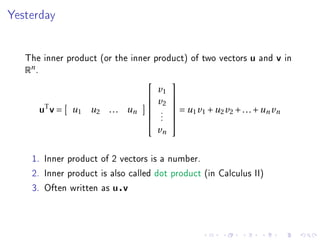
   The inner product (or the inner product) of two vectors        u   and   v   in
   Rn .
                                       
                                     v1
                                    v2 
                                       
       T                            .  = u1 v 1 + u2 v 2 + . . . + un v n
      u v=    u1   u2   . . . un    . 
                                    . 
                                     vn


    1. Inner product of 2 vectors is a number.
    2. Inner product is also called dot product (in Calculus II)
    3. Often written as u v
Yesterday


   Denition
   The length (or the norm) of   v   is the nonnegative scalar   v   dened
   by
                                        2    2            2
                      v   =   v v=     v1 + v2 + . . . + vn


   Denition
   A vector of length 1 is called a unit vector.
Yesterday


   Denition
   For any two vectors u and v in Rn , the distance between        u   and   v
   written as dist(u,v) is the length of the vector u-v.

                                   dist(u, v) =   u-v


   Denition
   Two vectors   u   and   v   in Rn are orthogonal (to each other) if

                                        u v=0
Yesterday


   Consider a set of vectors u1 , u2 , . . . , up in Rn . If each pair of
   distinct vectors from the set is orthogonal (that is u1 u2 = 0,
   u1 u3 = 0, u2 u3 = 0 etc etc) then the set is called an orthogonal
   set.
   An orthogonal basis for a subspace W of Rn is a set
     1. spans W and
     2. is linearly independent and
     3. is orthogonal
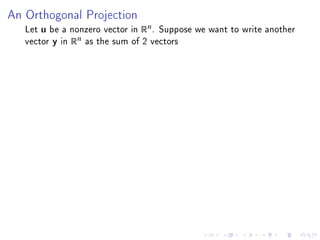
An Orthogonal Projection

   Let u be a nonzero vector in Rn . Suppose we want to write another
   vector y in Rn as the sum of 2 vectors
An Orthogonal Projection

   Let u be a nonzero vector in Rn . Suppose we want to write another
   vector y in Rn as the sum of 2 vectors
     1. one vector a multiple of u
An Orthogonal Projection

   Let u be a nonzero vector in Rn . Suppose we want to write another
   vector y in Rn as the sum of 2 vectors
     1. one vector a multiple of u
     2. the second vector orthogonal to u
An Orthogonal Projection

   Let u be a nonzero vector in Rn . Suppose we want to write another
   vector y in Rn as the sum of 2 vectors
     1. one vector a multiple of u
     2. the second vector orthogonal to u
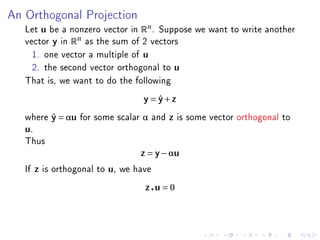
   That is, we want to do the following
                                y = y+z
                                    ˆ

   where y = αu for some scalar α and
         ˆ                              z   is some vector orthogonal to
   u.
An Orthogonal Projection

   Let u be a nonzero vector in Rn . Suppose we want to write another
   vector y in Rn as the sum of 2 vectors
     1. one vector a multiple of u
     2. the second vector orthogonal to u
   That is, we want to do the following
                                y = y+z
                                    ˆ

   where y = αu for some scalar α and
         ˆ                              z   is some vector orthogonal to
   u.
   Thus
                               z = y − αu
An Orthogonal Projection

   Let u be a nonzero vector in Rn . Suppose we want to write another
   vector y in Rn as the sum of 2 vectors
     1. one vector a multiple of u
     2. the second vector orthogonal to u
   That is, we want to do the following
                                     y = y+z
                                         ˆ

   where y = αu for some scalar α and
         ˆ                                 z   is some vector orthogonal to
   u.
   Thus
                                    z = y − αu

   If   z   is orthogonal to u, we have
                                     z u=0
An Orthogonal Projection

   Let u be a nonzero vector in Rn . Suppose we want to write another
   vector y in Rn as the sum of 2 vectors
     1. one vector a multiple of u
     2. the second vector orthogonal to u
   That is, we want to do the following
                                     y = y+z
                                         ˆ

   where y = αu for some scalar α and
         ˆ                                  z   is some vector orthogonal to
   u.
   Thus
                                     z = y − αu

   If   z   is orthogonal to u, we have
                                      z u=0


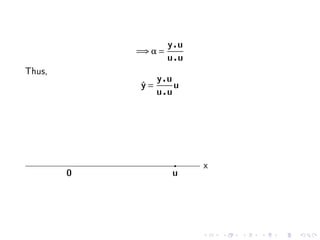
                       =⇒ (y − αu)   u = 0 =⇒ y u = α(u u)
y u
            =⇒ α =
                     u u
Thus,
                  y u
             y=
             ˆ          u
                  u u


                            x
        0               u
y u
                =⇒ α =
                         u u
Thus,
                      y u
                 y=
                 ˆ          u
                      u u

            y


                                x
        0                   u
y u
                  =⇒ α =
                            u u
Thus,
                          y u
                     y=
                     ˆ          u
                          u u

              y


                                    x
        0   y = αy
            ˆ                   u
y u
                        =⇒ α =
                                  u u
Thus,
                                y u
                           y=
                           ˆ          u
                                u u

        z = y−y
              ˆ     y


                                          x
         0        y = αy
                  ˆ                   u
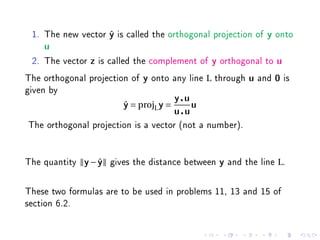
1. The new vector y is called the orthogonal projection of
                  ˆ                                              y    onto
   u

2. The vector   z   is called the complement of   y   orthogonal to   u
1. The new vector y is called the orthogonal projection of
                   ˆ                                                    y   onto
    u

 2. The vector   z   is called the complement of     y   orthogonal to      u

The orthogonal projection of    y   onto any line L through       u   and   0   is
given by
                                           y u
                           y = projL y =
                           ˆ                     u
                                           u u
The orthogonal projection is a vector (not a number).


The quantity   y−y
                 ˆ     gives the distance between        y   and the line L.
1. The new vector y is called the orthogonal projection of
                   ˆ                                                    y   onto
    u

 2. The vector   z   is called the complement of     y   orthogonal to      u

The orthogonal projection of    y   onto any line L through       u   and   0   is
given by
                                           y u
                           y = projL y =
                           ˆ                     u
                                           u u
The orthogonal projection is a vector (not a number).


The quantity   y−y
                 ˆ     gives the distance between        y   and the line L.

These two formulas are to be used in problems 11, 13 and 15 of
section 6.2.
Example 12, section 6.2


                                           1
   Compute the orthogonal projection of        onto the line through
                                          −1
     −1
          and the origin.
      3
Example 12, section 6.2


                                                       1
   Compute the orthogonal projection of                      onto the line through
                                                      −1
     −1
            and the origin.
      3


                              1                  −1
   Solution: Here y =              and   u=            . So,   y u = −1 − 3 = −4
                             −1                   3
   and   u u = 1 + 9 = 10.   The orthogonal projection of         y   onto   u   is
                          y u          −4   −1              0.4
                     y=
                     ˆ            u=              =
                          u u          10   3              −1.2
Example 14, section 6.2
             2              7
   Let y =       and   u=       . Write   y   as the sum of 2 orthogonal
             6              1
   vectors, one in Span{u} and one orthogonal to      u
Example 14, section 6.2
             2              7
   Let y =       and   u=       . Write   y   as the sum of 2 orthogonal
             6              1
   vectors, one in Span{u} and one orthogonal to      u


   Solution: A vector in Span{u} is the orthogonal projection of    y   onto
   the line containing u and the origin.
Example 14, section 6.2
              2                 7
   Let y =        and   u=              . Write   y   as the sum of 2 orthogonal
              6                 1
   vectors, one in Span{u} and one orthogonal to              u


   Solution: A vector in Span{u} is the orthogonal projection of            y   onto
   the line containing u and the origin.
                2                   7
   Here y =          and   u=            . So,   y u = 14 + 6 = 20   and
                6                   1
   u   u = 49 + 1 = 50.
Example 14, section 6.2
              2               7
   Let y =        and   u=         . Write   y   as the sum of 2 orthogonal
              6               1
   vectors, one in Span{u} and one orthogonal to         u


   Solution: A vector in Span{u} is the orthogonal projection of       y   onto
   the line containing u and the origin.
                2              7
   Here y =          and u =      . So, y u = 14 + 6 = 20 and
                6              1
   u   u = 49 + 1 = 50. The orthogonal projection of y onto u is

                             y u        20   7        2.8
                        y=
                        ˆ          u=             =
                             u u        50   1        0.4
Example 14, section 6.2
               2               7
   Let y =         and   u=         . Write   y   as the sum of 2 orthogonal
               6               1
   vectors, one in Span{u} and one orthogonal to              u


   Solution: A vector in Span{u} is the orthogonal projection of        y   onto
   the line containing u and the origin.
                2              7
   Here y =          and u =      . So, y u = 14 + 6 = 20 and
                6              1
   u   u = 49 + 1 = 50. The orthogonal projection of y onto u is

                              y u        20   7             2.8
                         y=
                         ˆ          u=              =
                              u u        50   1             0.4

   The vector orthogonal to     u   will be
                                    2         2.8            −0.8
                    z = y−y =
                          ˆ              −              =
                                    6         0.4             5.6

   (Check:    z u = 0.   )
Example 16, section 6.2
             −3                  1
   Let y =            and   u=          . Compute the distance from   y   to the
              9                  2
   line through   u   and the origin.
Example 16, section 6.2
             −3                  1
   Let y =            and   u=          . Compute the distance from   y   to the
              9                  2
   line through   u   and the origin.


   Solution: We have to compute           y−y
                                            ˆ
Example 16, section 6.2
             −3                  1
   Let y =            and   u=          . Compute the distance from   y   to the
              9                  2
   line through   u   and the origin.


   Solution: We have to compute     y−yˆ
               −3             1
   Here y =          and u =      . So, y u = −3 + 18 = 15 and
                9             2
   u u = 1 + 4 = 5. The orthogonal projection of y onto u is

                               y u        15   1       3
                          y=
                          ˆ          u=            =
                               u u         5   2       6
Example 16, section 6.2
             −3                    1
   Let y =            and   u=          . Compute the distance from        y   to the
              9                    2
   line through   u   and the origin.


   Solution: We have to compute     y−yˆ
               −3             1
   Here y =          and u =      . So, y u = −3 + 18 = 15 and
                9             2
   u u = 1 + 4 = 5. The orthogonal projection of y onto u is

                                y u         15   1           3
                          y=
                          ˆ            u=            =
                                u u          5   2           6
   The distance from      y   to the line containing     u   and the origin will be
    y−y
      ˆ
                                    −3           3           −6
                        y−y =
                          ˆ                 −        =
                                     9           6            3
                                y−y
                                  ˆ     =    36 + 9 =    45

Orthogonal Projection

  • 1.
    Announcements Quiz 4 after lecture. Exam 2 on Thurs, Feb 25 in class. Exam 2 will cover material taught after exam 1 and upto what is covered on Monday Feb 22. Practice Exam will be uploaded on Monday after I nish the material. I will do some misc. topics (sec 5.5 and some applications) on Tuesday. These WILL NOT be covered on the exam but are useful for MA 3521. Attendance not mandatory. Review on Wednesday in class. I will have oce hours on Wed from 1-4 pm.
  • 2.
    Yesterday The inner product (or the inner product) of two vectors u and v in Rn .   v1  v2    T  .  = u1 v 1 + u2 v 2 + . . . + un v n u v= u1 u2 . . . un  .   .  vn 1. Inner product of 2 vectors is a number. 2. Inner product is also called dot product (in Calculus II) 3. Often written as u v
  • 3.
    Yesterday Denition The length (or the norm) of v is the nonnegative scalar v dened by 2 2 2 v = v v= v1 + v2 + . . . + vn Denition A vector of length 1 is called a unit vector.
  • 4.
    Yesterday Denition For any two vectors u and v in Rn , the distance between u and v written as dist(u,v) is the length of the vector u-v. dist(u, v) = u-v Denition Two vectors u and v in Rn are orthogonal (to each other) if u v=0
  • 5.
    Yesterday Consider a set of vectors u1 , u2 , . . . , up in Rn . If each pair of distinct vectors from the set is orthogonal (that is u1 u2 = 0, u1 u3 = 0, u2 u3 = 0 etc etc) then the set is called an orthogonal set. An orthogonal basis for a subspace W of Rn is a set 1. spans W and 2. is linearly independent and 3. is orthogonal
  • 6.
    An Orthogonal Projection Let u be a nonzero vector in Rn . Suppose we want to write another vector y in Rn as the sum of 2 vectors
  • 7.
    An Orthogonal Projection Let u be a nonzero vector in Rn . Suppose we want to write another vector y in Rn as the sum of 2 vectors 1. one vector a multiple of u
  • 8.
    An Orthogonal Projection Let u be a nonzero vector in Rn . Suppose we want to write another vector y in Rn as the sum of 2 vectors 1. one vector a multiple of u 2. the second vector orthogonal to u
  • 9.
    An Orthogonal Projection Let u be a nonzero vector in Rn . Suppose we want to write another vector y in Rn as the sum of 2 vectors 1. one vector a multiple of u 2. the second vector orthogonal to u That is, we want to do the following y = y+z ˆ where y = αu for some scalar α and ˆ z is some vector orthogonal to u.
  • 10.
    An Orthogonal Projection Let u be a nonzero vector in Rn . Suppose we want to write another vector y in Rn as the sum of 2 vectors 1. one vector a multiple of u 2. the second vector orthogonal to u That is, we want to do the following y = y+z ˆ where y = αu for some scalar α and ˆ z is some vector orthogonal to u. Thus z = y − αu
  • 11.
    An Orthogonal Projection Let u be a nonzero vector in Rn . Suppose we want to write another vector y in Rn as the sum of 2 vectors 1. one vector a multiple of u 2. the second vector orthogonal to u That is, we want to do the following y = y+z ˆ where y = αu for some scalar α and ˆ z is some vector orthogonal to u. Thus z = y − αu If z is orthogonal to u, we have z u=0
  • 12.
    An Orthogonal Projection Let u be a nonzero vector in Rn . Suppose we want to write another vector y in Rn as the sum of 2 vectors 1. one vector a multiple of u 2. the second vector orthogonal to u That is, we want to do the following y = y+z ˆ where y = αu for some scalar α and ˆ z is some vector orthogonal to u. Thus z = y − αu If z is orthogonal to u, we have z u=0 =⇒ (y − αu) u = 0 =⇒ y u = α(u u)
  • 13.
    y u =⇒ α = u u Thus, y u y= ˆ u u u x 0 u
  • 14.
    y u =⇒ α = u u Thus, y u y= ˆ u u u y x 0 u
  • 15.
    y u =⇒ α = u u Thus, y u y= ˆ u u u y x 0 y = αy ˆ u
  • 16.
    y u =⇒ α = u u Thus, y u y= ˆ u u u z = y−y ˆ y x 0 y = αy ˆ u
  • 17.
    1. The newvector y is called the orthogonal projection of ˆ y onto u 2. The vector z is called the complement of y orthogonal to u
  • 18.
    1. The newvector y is called the orthogonal projection of ˆ y onto u 2. The vector z is called the complement of y orthogonal to u The orthogonal projection of y onto any line L through u and 0 is given by y u y = projL y = ˆ u u u The orthogonal projection is a vector (not a number). The quantity y−y ˆ gives the distance between y and the line L.
  • 19.
    1. The newvector y is called the orthogonal projection of ˆ y onto u 2. The vector z is called the complement of y orthogonal to u The orthogonal projection of y onto any line L through u and 0 is given by y u y = projL y = ˆ u u u The orthogonal projection is a vector (not a number). The quantity y−y ˆ gives the distance between y and the line L. These two formulas are to be used in problems 11, 13 and 15 of section 6.2.
  • 20.
    Example 12, section6.2 1 Compute the orthogonal projection of onto the line through −1 −1 and the origin. 3
  • 21.
    Example 12, section6.2 1 Compute the orthogonal projection of onto the line through −1 −1 and the origin. 3 1 −1 Solution: Here y = and u= . So, y u = −1 − 3 = −4 −1 3 and u u = 1 + 9 = 10. The orthogonal projection of y onto u is y u −4 −1 0.4 y= ˆ u= = u u 10 3 −1.2
  • 22.
    Example 14, section6.2 2 7 Let y = and u= . Write y as the sum of 2 orthogonal 6 1 vectors, one in Span{u} and one orthogonal to u
  • 23.
    Example 14, section6.2 2 7 Let y = and u= . Write y as the sum of 2 orthogonal 6 1 vectors, one in Span{u} and one orthogonal to u Solution: A vector in Span{u} is the orthogonal projection of y onto the line containing u and the origin.
  • 24.
    Example 14, section6.2 2 7 Let y = and u= . Write y as the sum of 2 orthogonal 6 1 vectors, one in Span{u} and one orthogonal to u Solution: A vector in Span{u} is the orthogonal projection of y onto the line containing u and the origin. 2 7 Here y = and u= . So, y u = 14 + 6 = 20 and 6 1 u u = 49 + 1 = 50.
  • 25.
    Example 14, section6.2 2 7 Let y = and u= . Write y as the sum of 2 orthogonal 6 1 vectors, one in Span{u} and one orthogonal to u Solution: A vector in Span{u} is the orthogonal projection of y onto the line containing u and the origin. 2 7 Here y = and u = . So, y u = 14 + 6 = 20 and 6 1 u u = 49 + 1 = 50. The orthogonal projection of y onto u is y u 20 7 2.8 y= ˆ u= = u u 50 1 0.4
  • 26.
    Example 14, section6.2 2 7 Let y = and u= . Write y as the sum of 2 orthogonal 6 1 vectors, one in Span{u} and one orthogonal to u Solution: A vector in Span{u} is the orthogonal projection of y onto the line containing u and the origin. 2 7 Here y = and u = . So, y u = 14 + 6 = 20 and 6 1 u u = 49 + 1 = 50. The orthogonal projection of y onto u is y u 20 7 2.8 y= ˆ u= = u u 50 1 0.4 The vector orthogonal to u will be 2 2.8 −0.8 z = y−y = ˆ − = 6 0.4 5.6 (Check: z u = 0. )
  • 27.
    Example 16, section6.2 −3 1 Let y = and u= . Compute the distance from y to the 9 2 line through u and the origin.
  • 28.
    Example 16, section6.2 −3 1 Let y = and u= . Compute the distance from y to the 9 2 line through u and the origin. Solution: We have to compute y−y ˆ
  • 29.
    Example 16, section6.2 −3 1 Let y = and u= . Compute the distance from y to the 9 2 line through u and the origin. Solution: We have to compute y−yˆ −3 1 Here y = and u = . So, y u = −3 + 18 = 15 and 9 2 u u = 1 + 4 = 5. The orthogonal projection of y onto u is y u 15 1 3 y= ˆ u= = u u 5 2 6
  • 30.
    Example 16, section6.2 −3 1 Let y = and u= . Compute the distance from y to the 9 2 line through u and the origin. Solution: We have to compute y−yˆ −3 1 Here y = and u = . So, y u = −3 + 18 = 15 and 9 2 u u = 1 + 4 = 5. The orthogonal projection of y onto u is y u 15 1 3 y= ˆ u= = u u 5 2 6 The distance from y to the line containing u and the origin will be y−y ˆ −3 3 −6 y−y = ˆ − = 9 6 3 y−y ˆ = 36 + 9 = 45