STATISTICS
Anjan Mahanta
anjan_mahanta@hotmail.com
International Education Institute
Course Outline
 Definitions, Scope and Limitations
 Introduction to sampling methods
 Collection of data, Classification and Tabulation
 Frequency Distribution
 Diagrammatic and Graphical Representation
 Measures of Central Tendency
2
Chapter 1
Definitions, Scope and Limitations
3
Introduction
 In the modern world of computers and information
technology, the importance of statistics is very well
recognized by all the disciplines.
 Statistics has originated as a science of statehood and
found applications slowly and steadily in
◦ Agriculture,
◦ Economics,
◦ Commerce,
◦ Biology,
◦ Medicine,
◦ Industry,
◦ Planning, education and so on.
 As on date there is no other human walk of life, where
statistics cannot be applied.
4
Origin and Growth of Statistics

5
Origin and Growth of Statistics
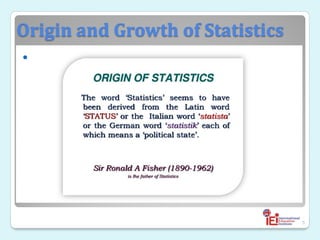
 The word ‘ Statistics’ and ‘ Statistical’ are all derived from the
Latin word Status, means a political state.
 Statistics is concerned with scientific methods for
◦ collecting,
◦ organising,
◦ summarising,
◦ presenting and analysing data
◦ as well as deriving valid conclusions and making
reasonable decisions on the basis of this analysis.
6
Meaning of Statistics
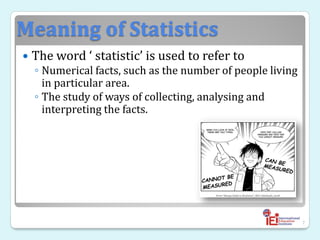
 The word ‘ statistic’ is used to refer to
◦ Numerical facts, such as the number of people living
in particular area.
◦ The study of ways of collecting, analysing and
interpreting the facts.
7
Definition by A.L.Bowley
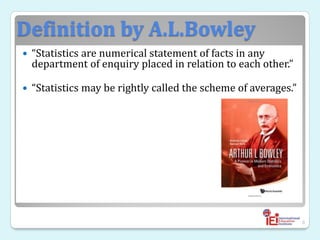
 “Statistics are numerical statement of facts in any
department of enquiry placed in relation to each other.”
 “Statistics may be rightly called the scheme of averages.”
8
Definition by Croxton and Cowden
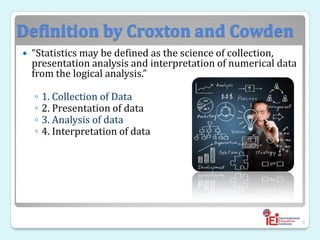
 “Statistics may be defined as the science of collection,
presentation analysis and interpretation of numerical data
from the logical analysis.”
◦ 1. Collection of Data
◦ 2. Presentation of data
◦ 3. Analysis of data
◦ 4. Interpretation of data
9
Functions of Statistics
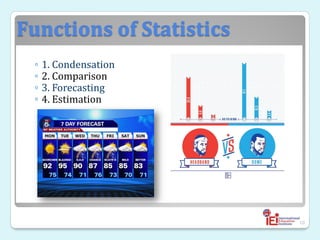
◦ 1. Condensation
◦ 2. Comparison
◦ 3. Forecasting
◦ 4. Estimation
10
Scope of Statistics
◦ 1. Statistics and Industry
◦ 2. Statistics and Commerce
◦ 3. Statistics and Agriculture
◦ 4. Statistics and Economics
◦ 5. Statistics and Education
◦ 6. Statistics and Planning
◦ 7. Statistics and Medicine
◦ 8. Statistics and Modern applications
11
Limitations of Statistics
◦ Statistics is not suitable to the study of qualitative
phenomenon
◦ Statistics does not study individuals
◦ Statistics laws are not exact
◦ Statistics table may be misused
◦ Statistics is only, one of the methods of studying a
problem
◦
12
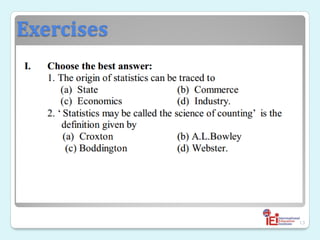
Exercises
◦
13
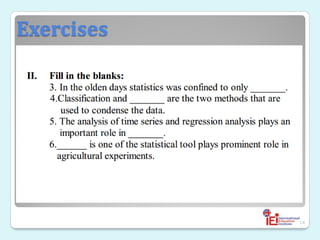
Exercises
◦
14
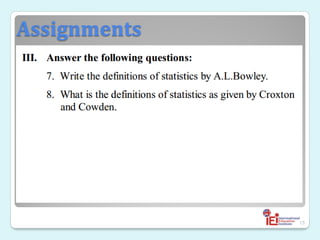
Assignments
◦
15
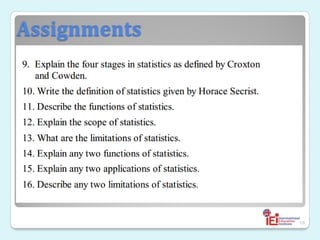
Assignments
◦
16
Assignments
◦
17
Project Example
PROJECT TITLE - WIMBLEDON
18
Information from Magazines
PROJECT TITLE - WIMBLEDON
19
Information from Newspaper
20
Information from Television
21
Information from Television
22
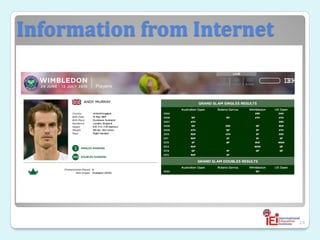
Information from Internet
23
Information from Internet
24
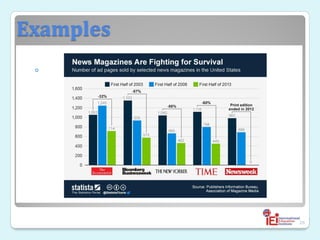
Examples
◦
25
Examples
◦
26
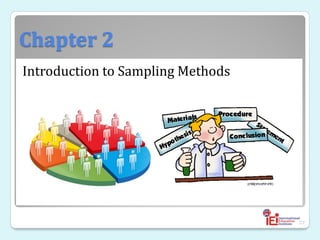
Chapter 2
Introduction to Sampling Methods
27
Introduction
Sampling is very often used in our daily life.
For example:
While purchasing food grains from a shop we usually examine a
handful from the bag to assess the quality of the commodity.
A doctor examines a few drops of blood as sample and draws
conclusion about the blood constitution of the whole body.
28
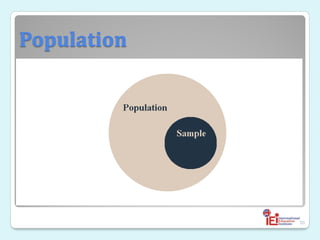
Population
In a statistical enquiry, all the items, which fall
within the purview of enquiry, are known as
Population or Universe.
Examples: Total number of students studying in a
school or college, total number of books in a
library, etc.
29
Population
30
Population
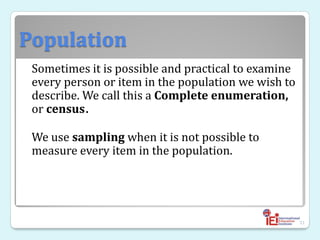
Sometimes it is possible and practical to examine
every person or item in the population we wish to
describe. We call this a Complete enumeration,
or census.
We use sampling when it is not possible to
measure every item in the population.
31
Sampling
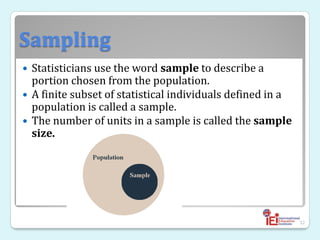
 Statisticians use the word sample to describe a
portion chosen from the population.
 A finite subset of statistical individuals defined in a
population is called a sample.
 The number of units in a sample is called the sample
size.
32
Reasons for selecting a sample
 Complete enumerations are practically impossible when
the population is infinite.
 When the results are required in a short time.
 When the area of survey is wide.
 When resources for survey are limited particularly in
respect of money and trained persons.
 When the item or unit is destroyed under investigation.
33
Sampling
Representing Size
Mathematically, A capital N is used to represent the size of a population.
A lowercase n is used to represent the size of a sample.
Let’s say you want to find the average GPA of a student at your university.
Your university has 20,000 students, and you select 100 students and ask
them their GPAs.
What are N and n in this example?
N, the size of your population, is 20,000
n, the size of your sample, is 100
34
Principles of Sampling
 Principle of statistical regularity
 Principle of Inertia of large numbers
 Principle of Validity
 Principle of Optimization

35
Methods of selection of samples
 Simple Random Sampling
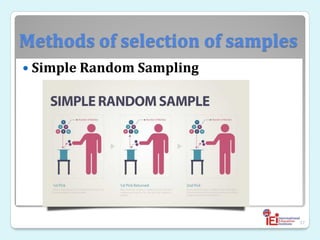
Every member of the population(N) has an equal
chance of being selected for your sample(n).
This is arguably the best sampling method, as your
sample is almost guaranteed to be representative of
your population. However, it is rarely ever used due
to being too impractical.
36
Methods of selection of samples
 Simple Random Sampling
37
Methods of selection of samples
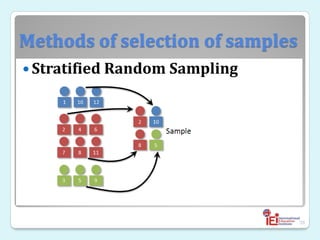
 Stratified Random Sampling
With this method, the population(N) is split into non-
overlapping groups ("strata"), then simple random
sampling is done on each group to form a sample(n).
One example of this would be splitting a population
of students into men and women, then sampling from
each of the two groups. This may allow us to collect
the same amount of information as simple random
sampling, but use less people.
38
Methods of selection of samples
 Stratified Random Sampling
39
Methods of selection of samples
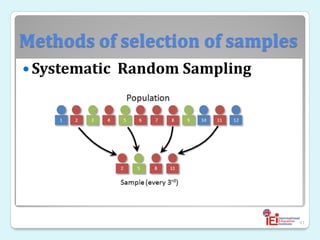
 Systematic Random Sampling
In this method, every nth individual from the
population(N) is placed in the sample(n).
For example, if you add every 7th individual to
walk out of a supermarket to your sample, you are
performing systematic sampling.
40
Methods of selection of samples
 Systematic Random Sampling
41
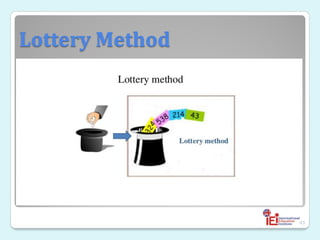
Lottery Method
 This is the most popular and simplest method.
 In this method all the items of the population are
numbered on separate slips of paper of same size, shape
and colour.
 They are folded and mixed up in a container.
 The required numbers of slips are selected at random for
the desire sample size.
 If the universe is infinite this method is inapplicable.
42
Lottery Method
43
Table of Random Numbers
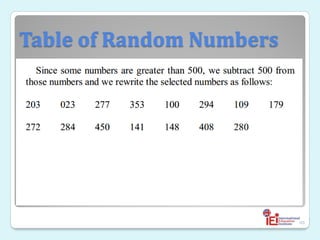
 A random number table is so constructed that all
digits 0 to 9 appear independent of each other with
equal frequency.
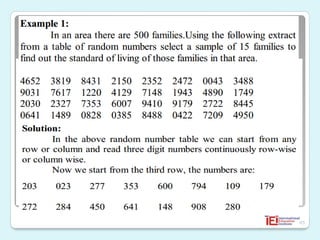
 If we have to select a sample from population of size
N= 100, then the numbers can be combined three by
three to give the numbers from 001 to 100.
 When the size of the population is less than thousand,
three digit number 000,001,002,….. 999 are assigned.
 If any random number is greater than the population
size N, then N can be subtracted from the random
number drawn.
44
Table of Random Numbers
45
Table of Random Numbers
46
Random Number selection using
calculators and computers
 Random number can be
generated through scientific
calculator or computers.
 For each press of the key get a
new random numbers.
 The ways of selection of sample
is similar to that of using
random number table.
47
Merits of using random numbers
 Personal bias is eliminated as a selection depends solely on
chance.
 A random sample is in general a representative sample for a
homogenous population.
 There is no need for the thorough knowledge of the units of
the population.
 The accuracy of a sample can be tested by examining another
sample from the same universe when the universe is
unknown.
 This method is also used in other methods of sampling.
48
Limitations of using random numbers
 Preparing lots or using random number tables is tedious
when the population is large.
 When there is large difference between the units of
population, the simple random sampling may not be a
representative sample.
 The size of the sample required under this method is more
than that required by stratified random sampling.
 It is generally seen that the units of a simple random sample
lie apart geographically. The cost and time of collection of
data are more.
49
Stratified Random Sampling
 There are two types of stratified sampling. They
are proportional and non-proportional.
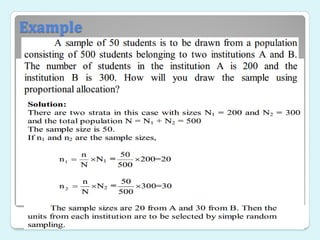
 In the proportional sampling 20 equal and
proportionate representation is given to
subgroups
 The population size is denoted by N and the
sample size is denoted by ‘ n’
 The sample fractions is a constant for each
stratum. That is given by n/N = c.
50
Example

51
Stratified Random Sampling
Merits
 It is more representative.
 It ensures greater accuracy.
 It is easy to administer as the universe is sub - divided.
 Greater geographical concentration reduces time and
expenses.
 When the original population is badly skewed, this method
is appropriate.
 For non – homogeneous population, it may field good
results.
52
Stratified Random Sampling
Limitations
 To divide the population into homogeneous strata,
it requires more money, time and statistical
experience which is a difficult one.
 Improper stratification leads to bias, if the
different strata overlap such a sample will not be a
representative one.
53
Systematic Sampling
 This method is widely employed because of its
ease and convenience.
 A frequently used method of sampling when a
complete list of the population is available is
systematic sampling.
 It is also called Quasi-random sampling.
54
Systematic Sampling
Selection Procedure
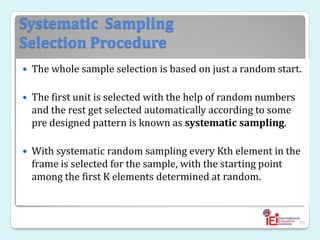
 The whole sample selection is based on just a random start.
 The first unit is selected with the help of random numbers
and the rest get selected automatically according to some
pre designed pattern is known as systematic sampling.
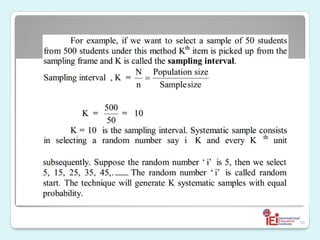
 With systematic random sampling every Kth element in the
frame is selected for the sample, with the starting point
among the first K elements determined at random.
55
56
Systematic Sampling
Merits
 This method is simple and convenient.
 Time and work is reduced much.
 If proper care is taken result will be accurate.
 It can be used in infinite population.
57
Systematic Sampling
Limitations
 Systematic sampling may not represent the
whole population.
 There is a chance of personal bias of the
investigators.
58
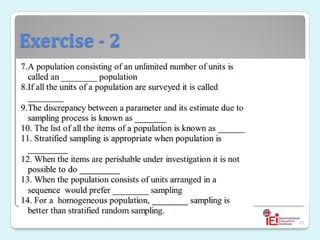
Exercise - 2

59
Exercise - 2

60
Exercise - 2

61
Chapter 3
Collection of Data, Classification and Tabulation
62
Collection of Data, Classification and Tabulation
Introduction
 Everybody collects, interprets and uses information, much
of it in a numerical or statistical forms in day-to-day life.
 In everyday life, in business and industry, certain
statistical information is necessary and it is independent
to know where to find it how to collect it.
 As employees of any firm, people want to compare their
salaries and working conditions, promotion opportunities
and so on.
63
Collection of Data, Classification and Tabulation
Nature of Data
 Time Series Data
 Spatial Data (place)
 Spacio-temporal data (time & place)
64
Nature of Data
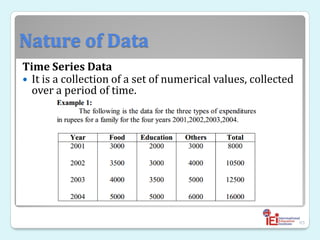
Time Series Data
 It is a collection of a set of numerical values, collected
over a period of time.
65
Nature of Data
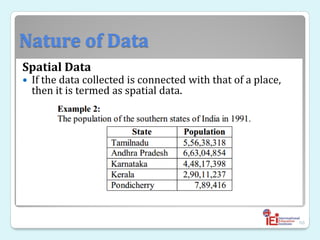
Spatial Data
 If the data collected is connected with that of a place,
then it is termed as spatial data.
66
Nature of Data
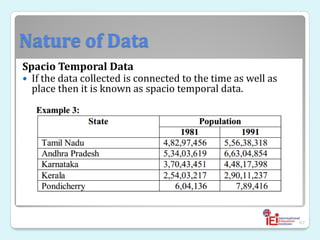
Spacio Temporal Data
 If the data collected is connected to the time as well as
place then it is known as spacio temporal data.
67
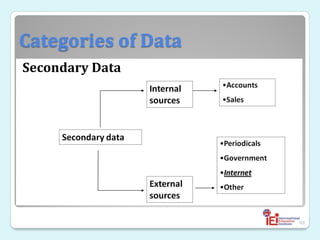
Categories of Data
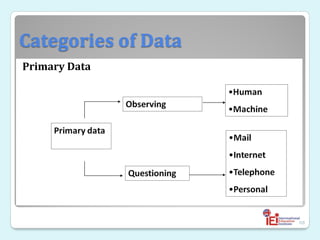
Primary Data
68
Categories of Data
Secondary Data
69
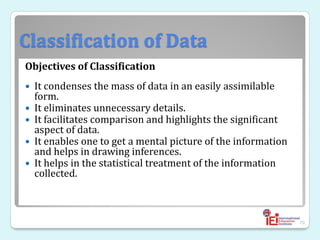
Classification of Data
Objectives of Classification
 It condenses the mass of data in an easily assimilable
form.
 It eliminates unnecessary details.
 It facilitates comparison and highlights the significant
aspect of data.
 It enables one to get a mental picture of the information
and helps in drawing inferences.
 It helps in the statistical treatment of the information
collected.
70
Types of Classification
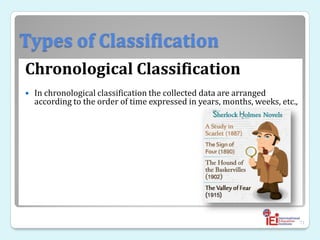
Chronological Classification
 In chronological classification the collected data are arranged
according to the order of time expressed in years, months, weeks, etc.,
71
Chronological Classification
72
Types of Classification
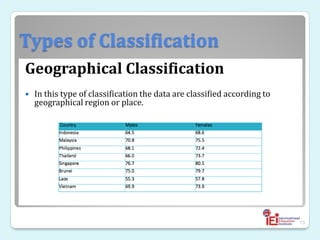
Geographical Classification
 In this type of classification the data are classified according to
geographical region or place.
73
Types of Classification
Qualitative Classification
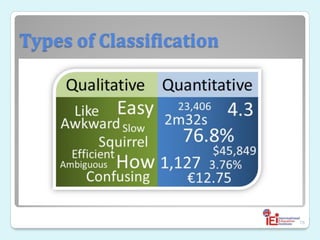
 In this type of classification data are classified on the basis
of same attributes or quality like sex, literacy, religion,
employment etc., Such attributes cannot be measured
along with a scale.
 Examples:
◦ He is brown and black
◦ He has long hair
◦ He has lots of energy
◦ He is clever

74
Types of Classification
Quantitative Classification
 Quantitative classification refers to the classification of
data according to some characteristics that can be
measured such as height, weight, etc.
 Examples:
◦ He has 4 legs
◦ He has 2 brothers
◦ He weighs 25.5 kg
◦ He is 170 cm tall
75
Types of Classification
76
Tabulation
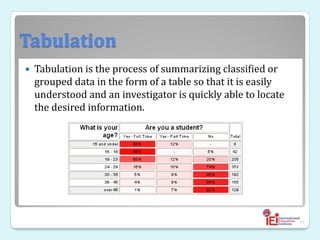
 Tabulation is the process of summarizing classified or
grouped data in the form of a table so that it is easily
understood and an investigator is quickly able to locate
the desired information.
77
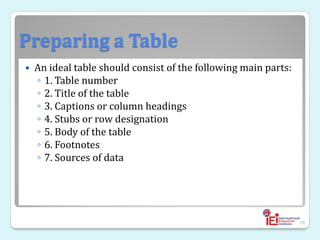
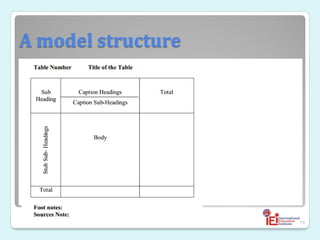
Preparing a Table
 An ideal table should consist of the following main parts:
◦ 1. Table number
◦ 2. Title of the table
◦ 3. Captions or column headings
◦ 4. Stubs or row designation
◦ 5. Body of the table
◦ 6. Footnotes
◦ 7. Sources of data
78
A model structure

79
Types of Table
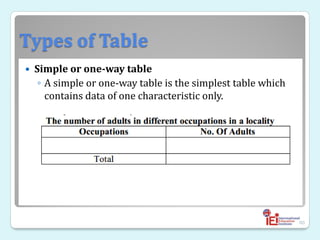
 Simple or one-way table
◦ A simple or one-way table is the simplest table which
contains data of one characteristic only.
80
Types of Table
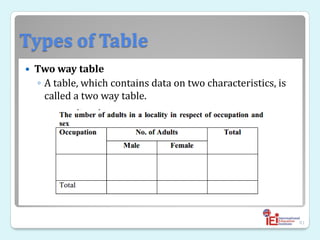
 Two way table
◦ A table, which contains data on two characteristics, is
called a two way table.
81
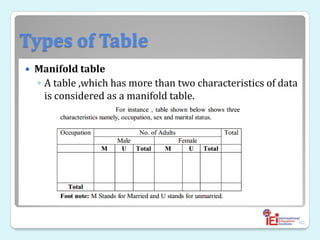
Types of Table
 Manifold table
◦ A table ,which has more than two characteristics of data
is considered as a manifold table.
82
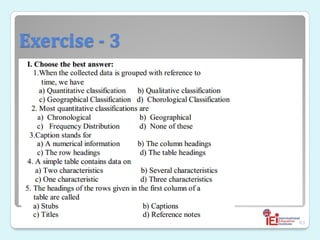
Exercise - 3

83
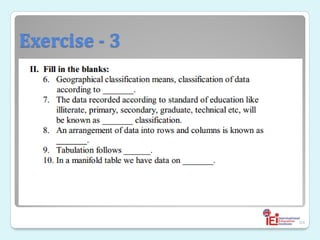
Exercise - 3

84
Data Collection Project
 Prepare a questionnaire
 Collect the data
 Separate the data into qualitative and quantitative
types
 Display data in graphs
 Project Examples –
◦ 24 hour activities of our students
◦ Money spending habits of our students
85
Chapter 4
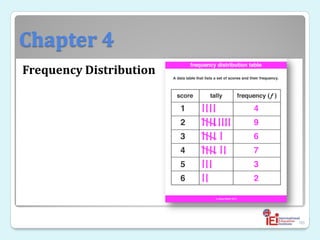
Frequency Distribution
86
Frequency Distribution
Introduction
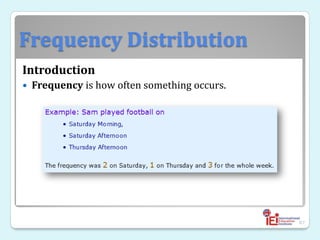
 Frequency is how often something occurs.
87
Frequency Distribution
Introduction
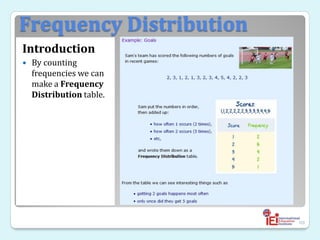
 By counting
frequencies we can
make a Frequency
Distribution table.
88
Frequency Distribution
A frequency distribution is constructed for three main reasons:
1. To facilitate the analysis of data.
2. To estimate frequencies of the unknown population
distribution from the distribution of sample data and
3. To facilitate the computation of various statistical
measures
89
Frequency Distribution
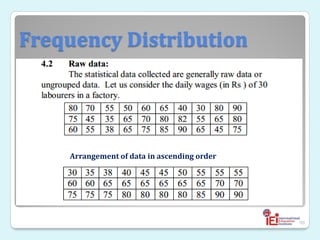
90
Arrangement of data in ascending order
Frequency Distribution
91
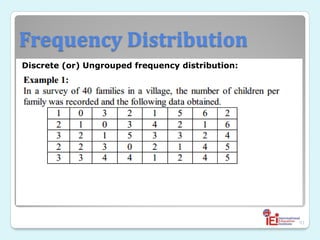
Discrete (or) Ungrouped frequency distribution:
Frequency Distribution
92
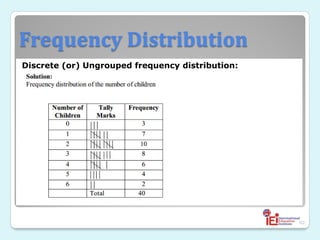
Discrete (or) Ungrouped frequency distribution:
Frequency Distribution
93
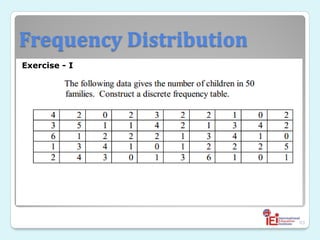
Exercise - I
Frequency Distribution
Continuous frequency distribution: In this form of distribution
refers to groups of values.
Wage distribution of 100 employees
94
Nature of Class
Class Limit
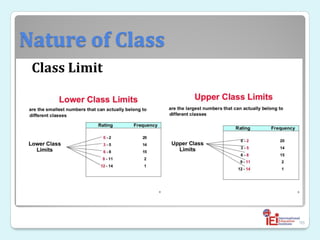
◦ The class limits are the lowest and the highest values that can
be included in the class. For example, take the class 30-40.
The lowest value of the class is 30 and highest class is 40.
◦ In statistical calculations, lower class limit is denoted by L
and upper class limit by U.
95
Nature of Class
Class Limit
◦
96
Nature of Class
Class Interval
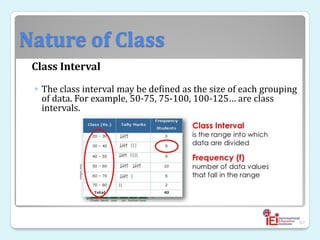
◦ The class interval may be defined as the size of each grouping
of data. For example, 50-75, 75-100, 100-125… are class
intervals.
97
Nature of Class
Width or size of the class interval
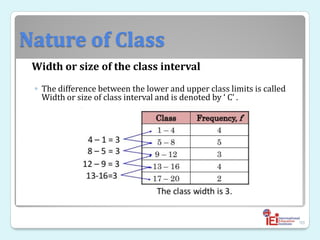
◦ The difference between the lower and upper class limits is called
Width or size of class interval and is denoted by ‘ C’ .
98
Nature of Class
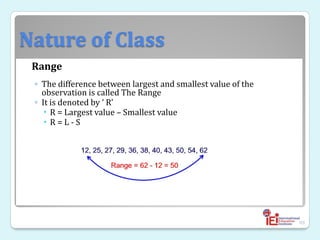
Range
◦ The difference between largest and smallest value of the
observation is called The Range
◦ It is denoted by ‘ R’
 R = Largest value – Smallest value
 R = L - S
99
Nature of Class
Mid-value or Middle Point
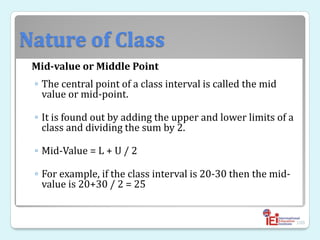
◦ The central point of a class interval is called the mid
value or mid-point.
◦ It is found out by adding the upper and lower limits of a
class and dividing the sum by 2.
◦ Mid-Value = L + U / 2
◦ For example, if the class interval is 20-30 then the mid-
value is 20+30 / 2 = 25
100