Paper 2 – Exam Revision
AS Level | Grade 11
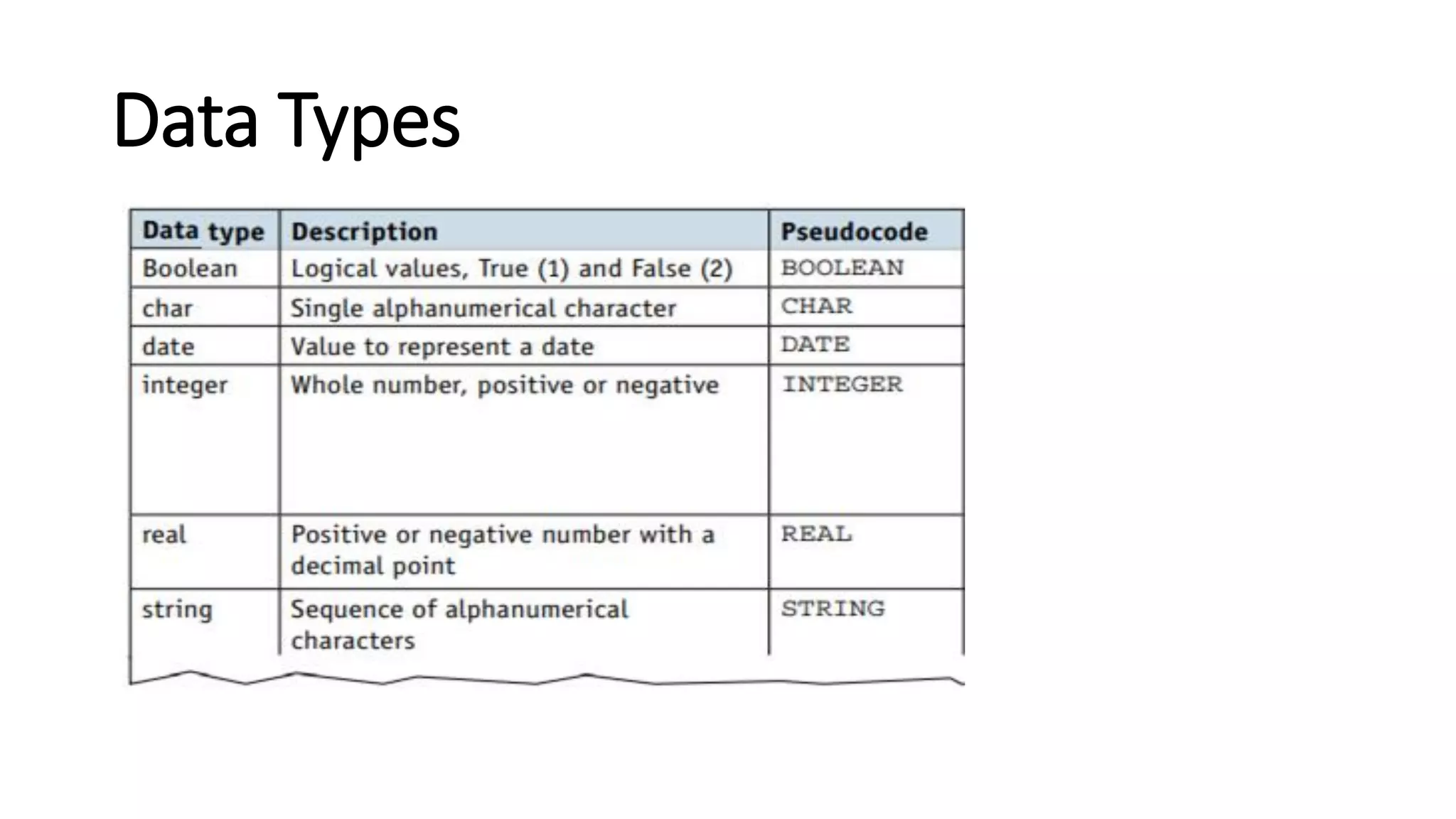
Data Types
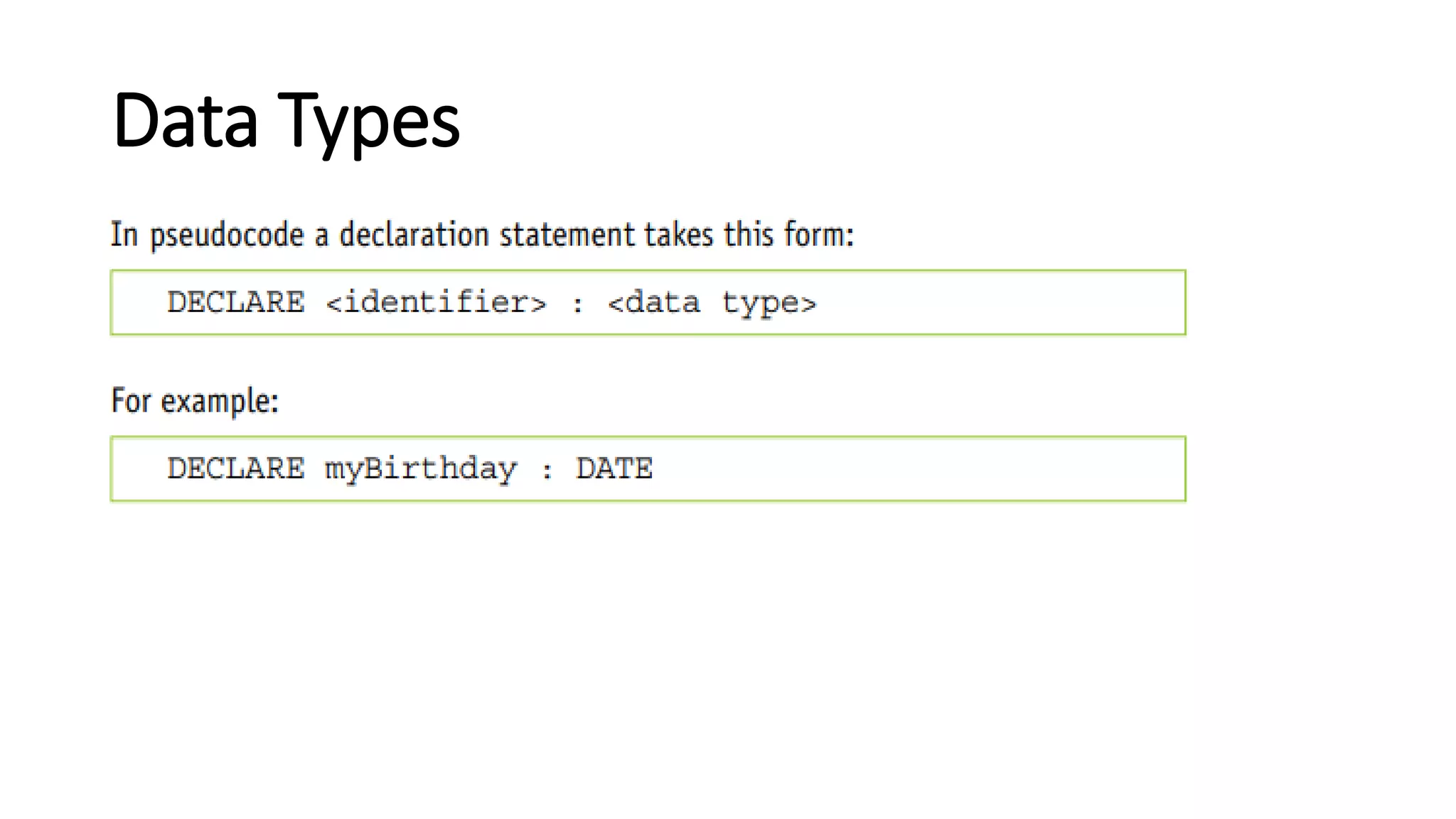
Data Types
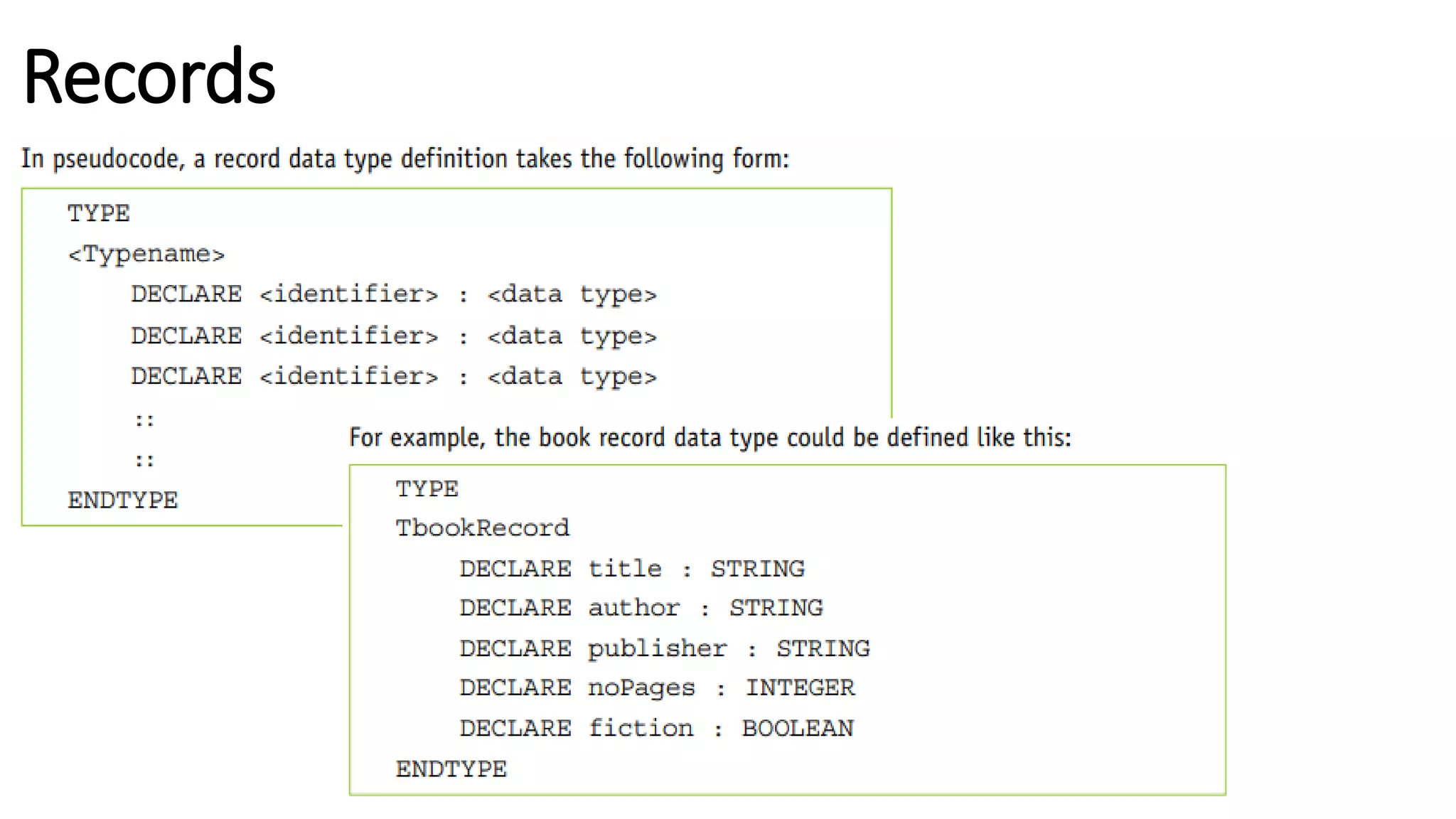
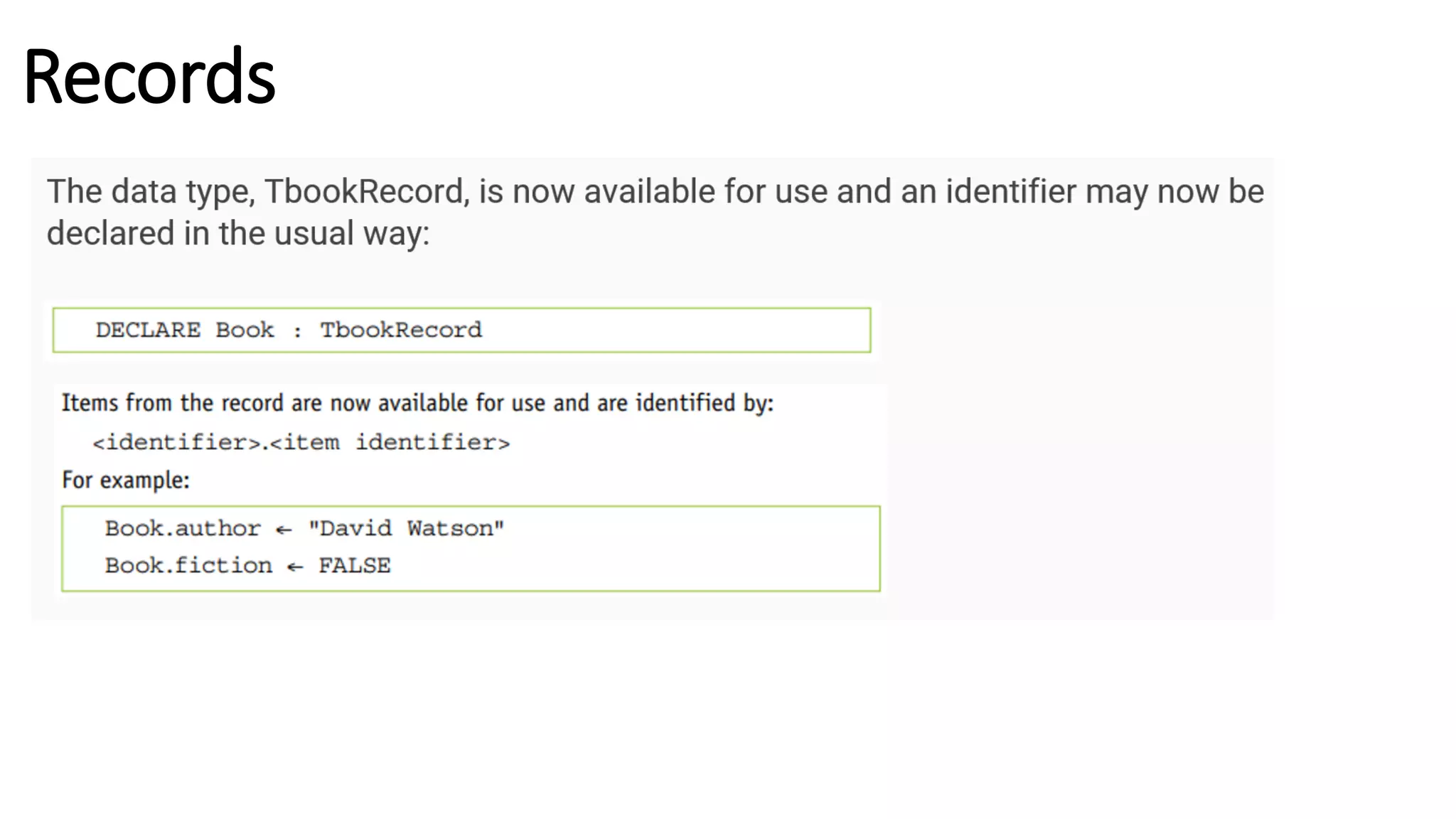
Records
Records
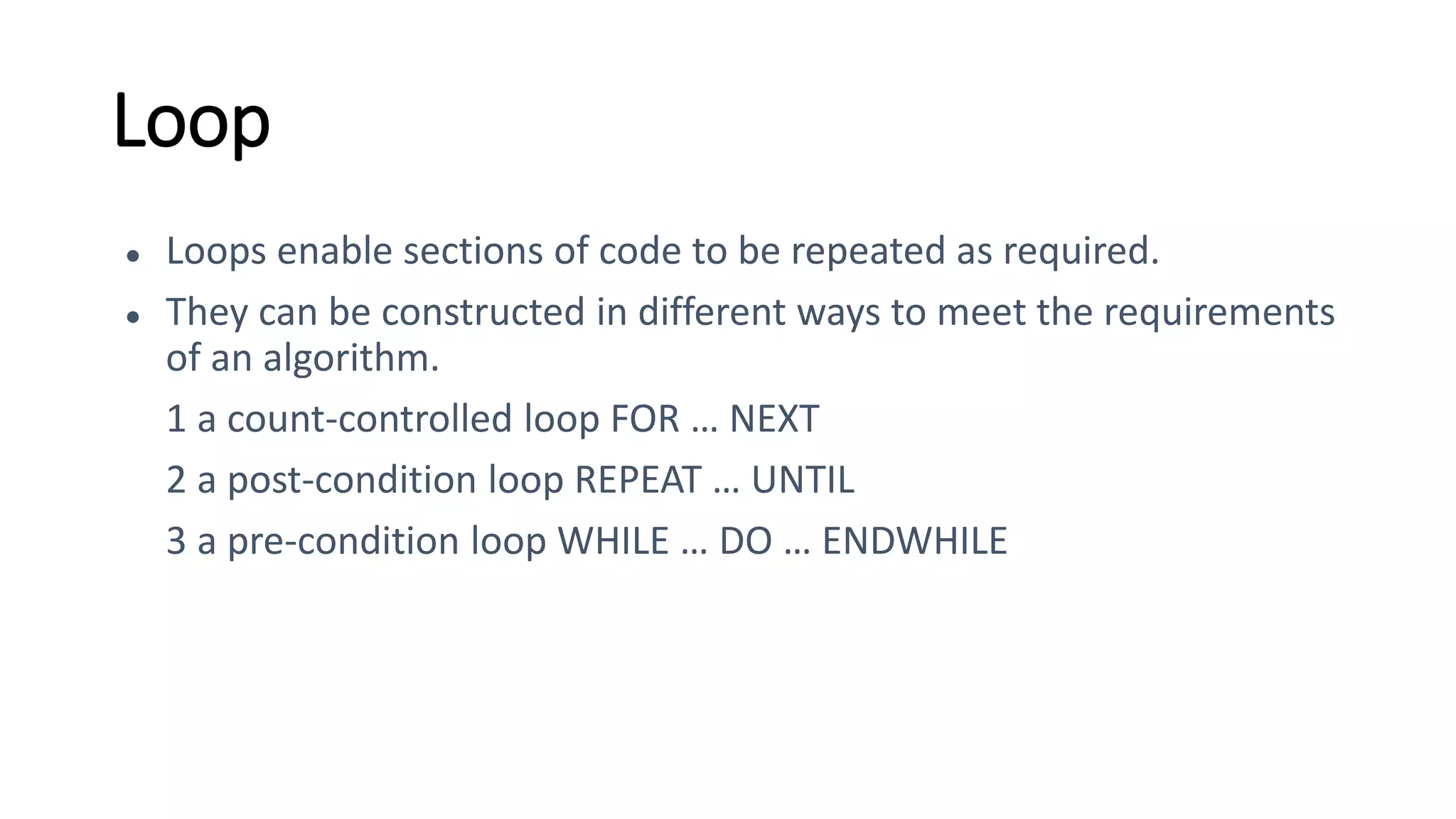
Loop
● Loops enable sections of code to be repeated as required.
● They can be constructed in different ways to meet the requirements
of an algorithm.
1 a count-controlled loop FOR … NEXT
2 a post-condition loop REPEAT … UNTIL
3 a pre-condition loop WHILE … DO … ENDWHILE
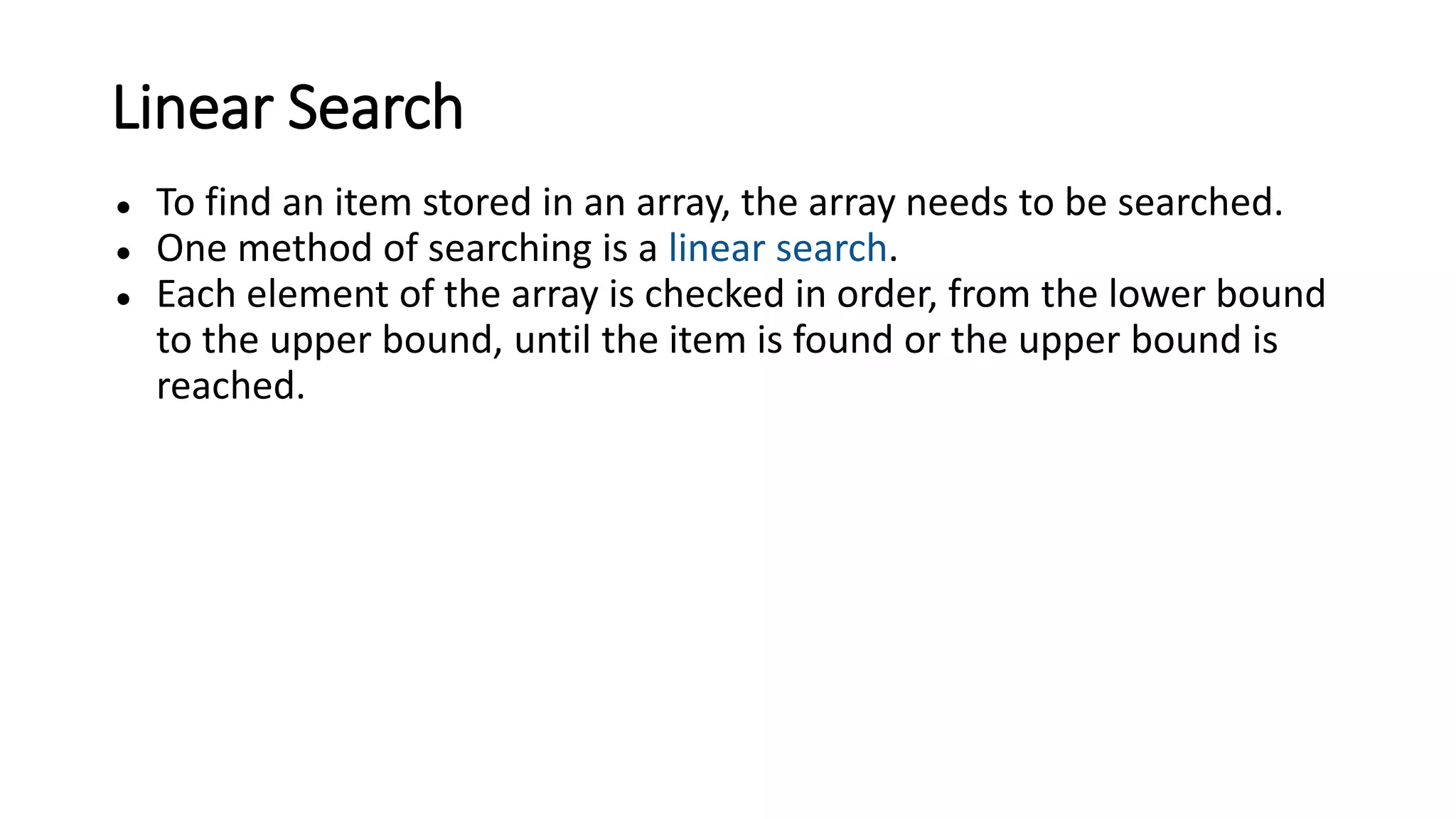
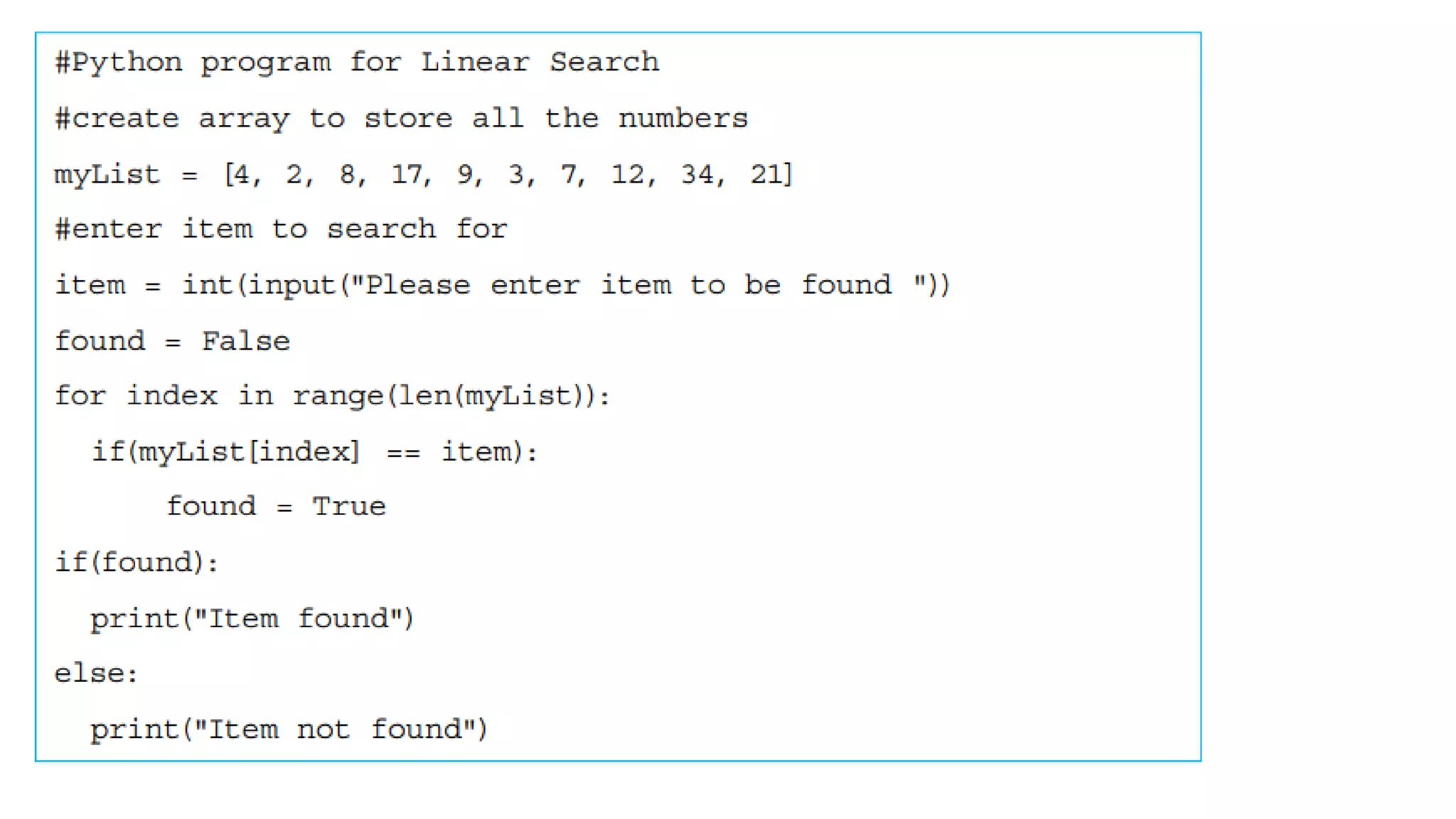
Linear Search
● To find an item stored in an array, the array needs to be searched.
● One method of searching is a linear search.
● Each element of the array is checked in order, from the lower bound
to the upper bound, until the item is found or the upper bound is
reached.
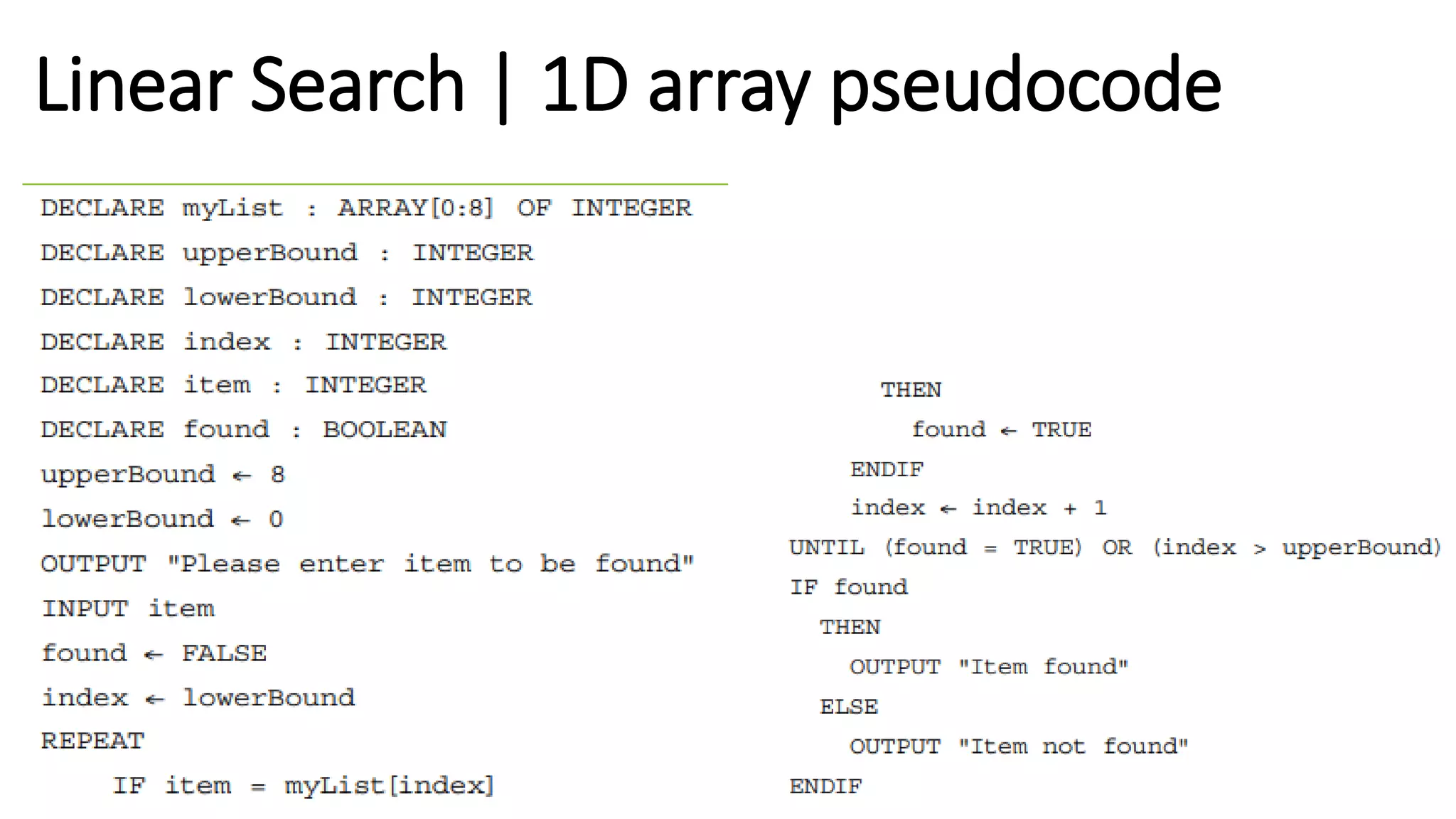
Linear Search | 1D array pseudocode
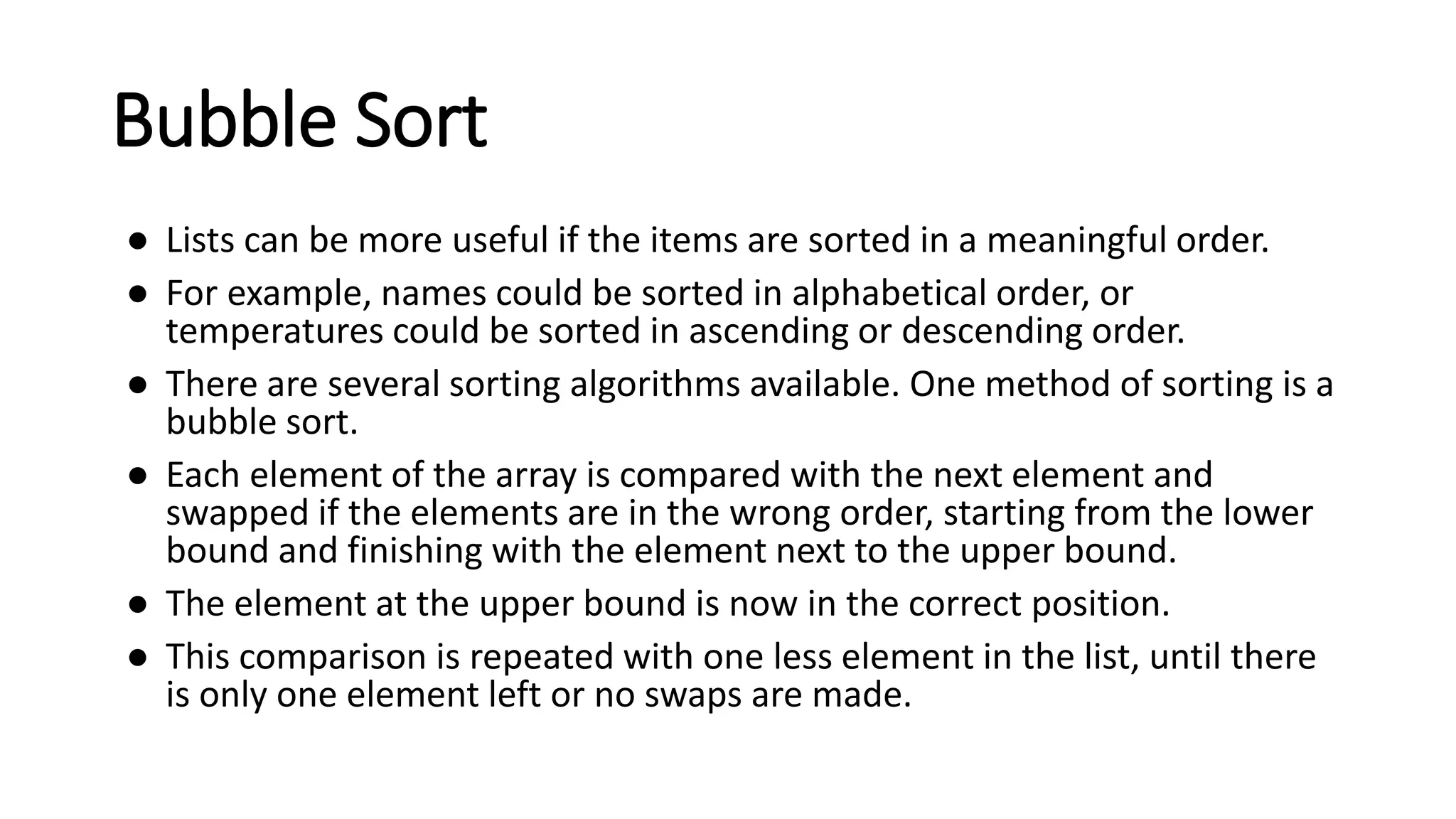
Bubble Sort
● Lists can be more useful if the items are sorted in a meaningful order.
● For example, names could be sorted in alphabetical order, or
temperatures could be sorted in ascending or descending order.
● There are several sorting algorithms available. One method of sorting is a
bubble sort.
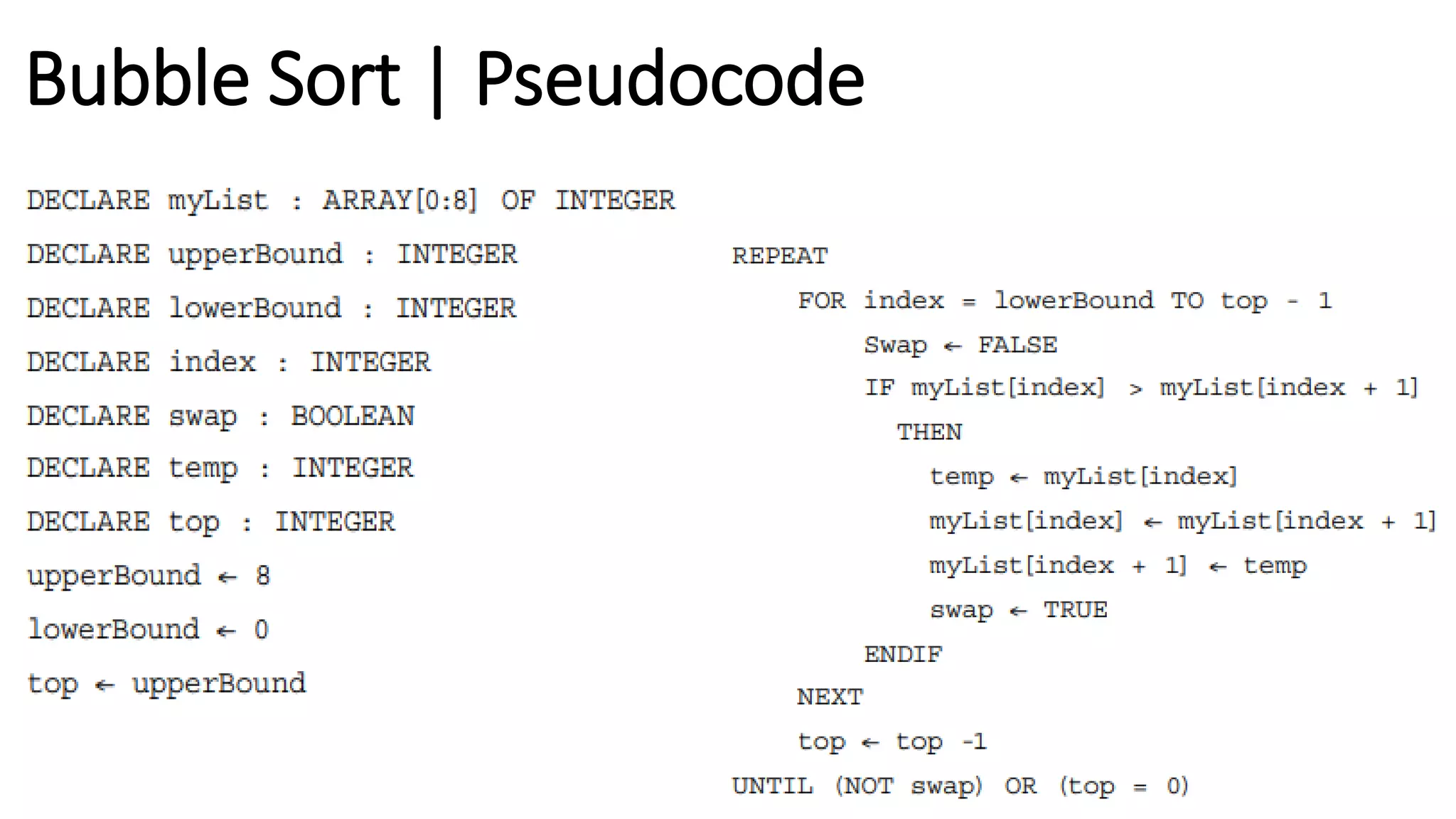
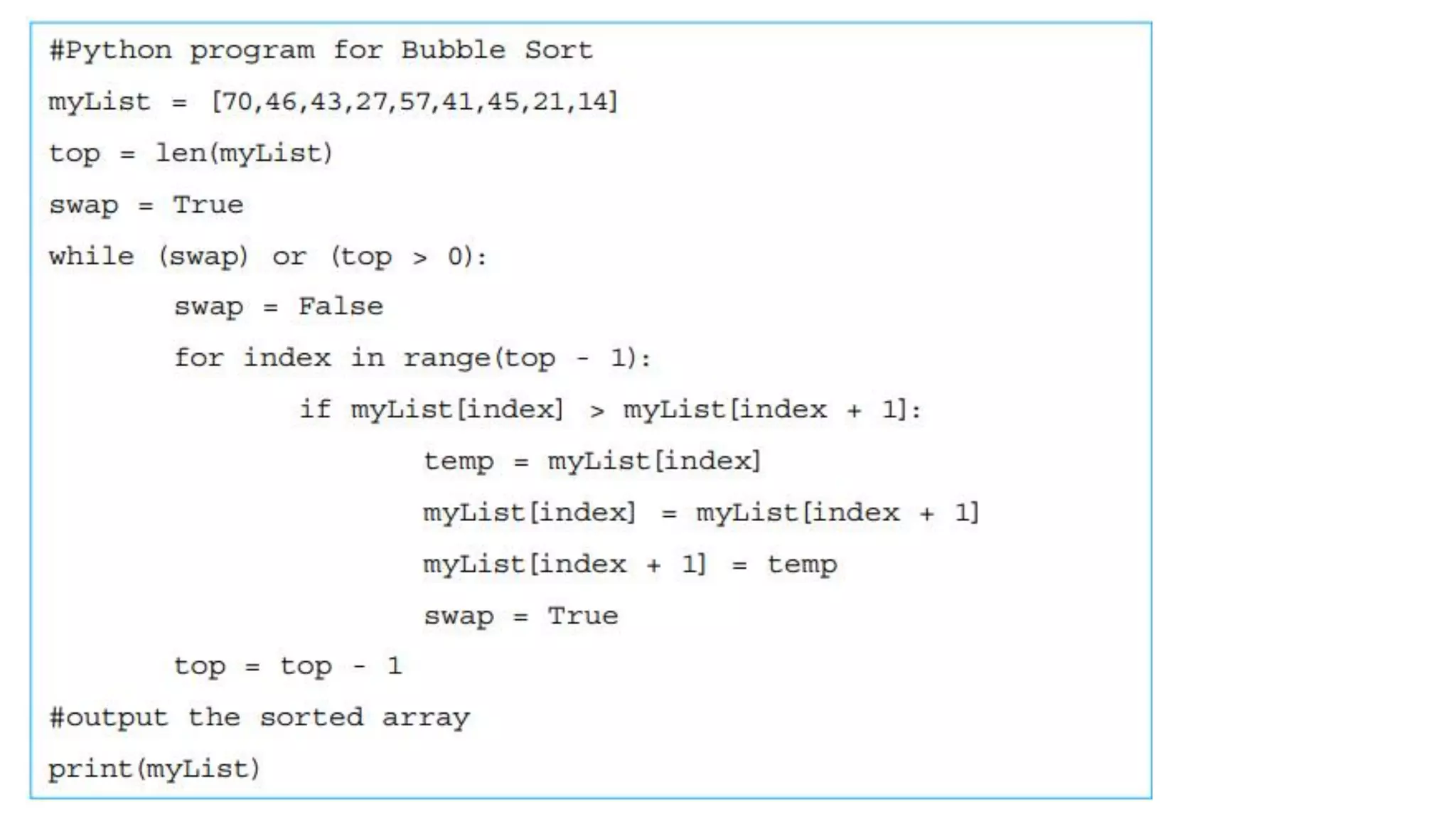
● Each element of the array is compared with the next element and
swapped if the elements are in the wrong order, starting from the lower
bound and finishing with the element next to the upper bound.
● The element at the upper bound is now in the correct position.
● This comparison is repeated with one less element in the list, until there
is only one element left or no swaps are made.
Bubble Sort | Pseudocode
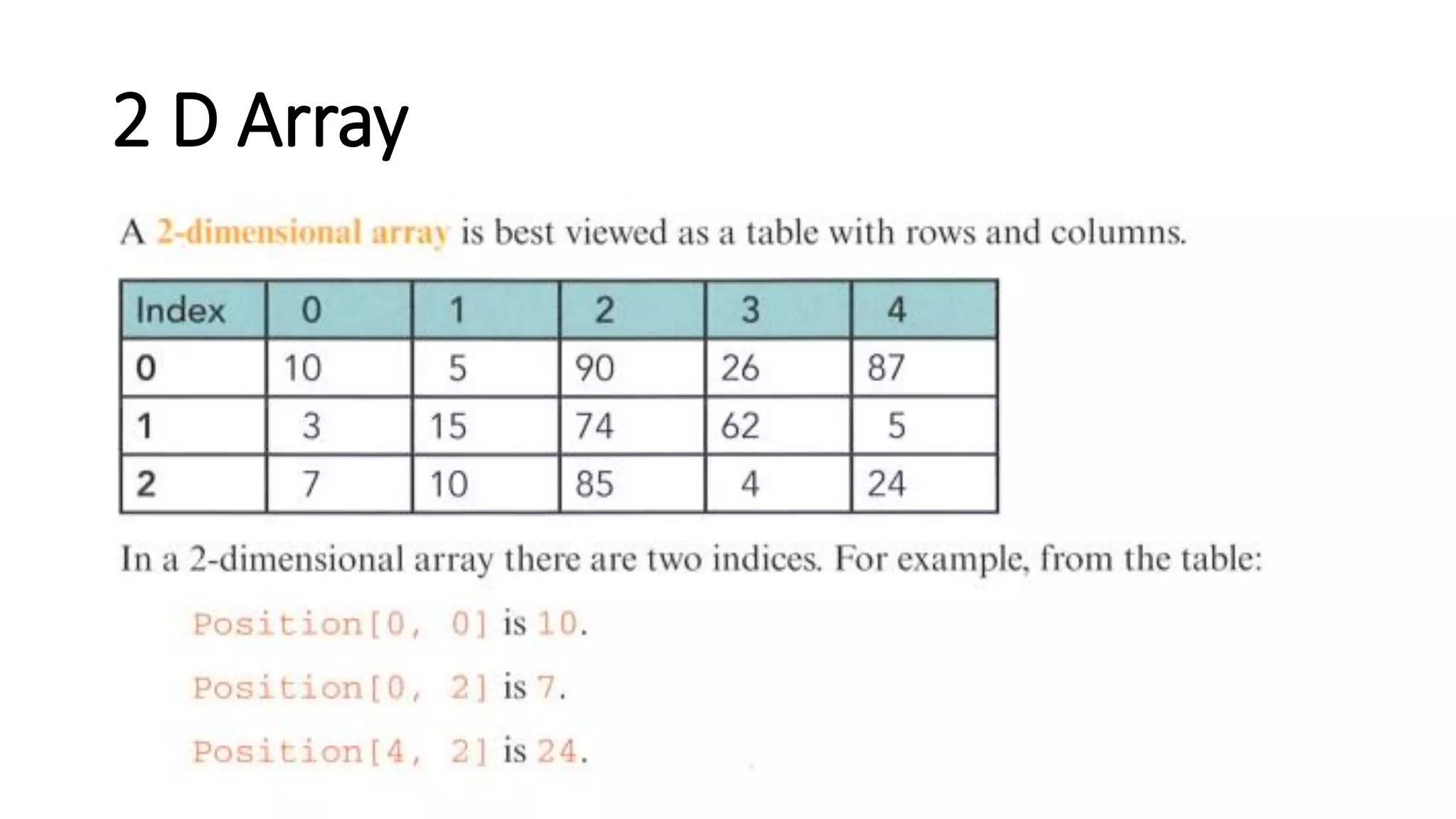
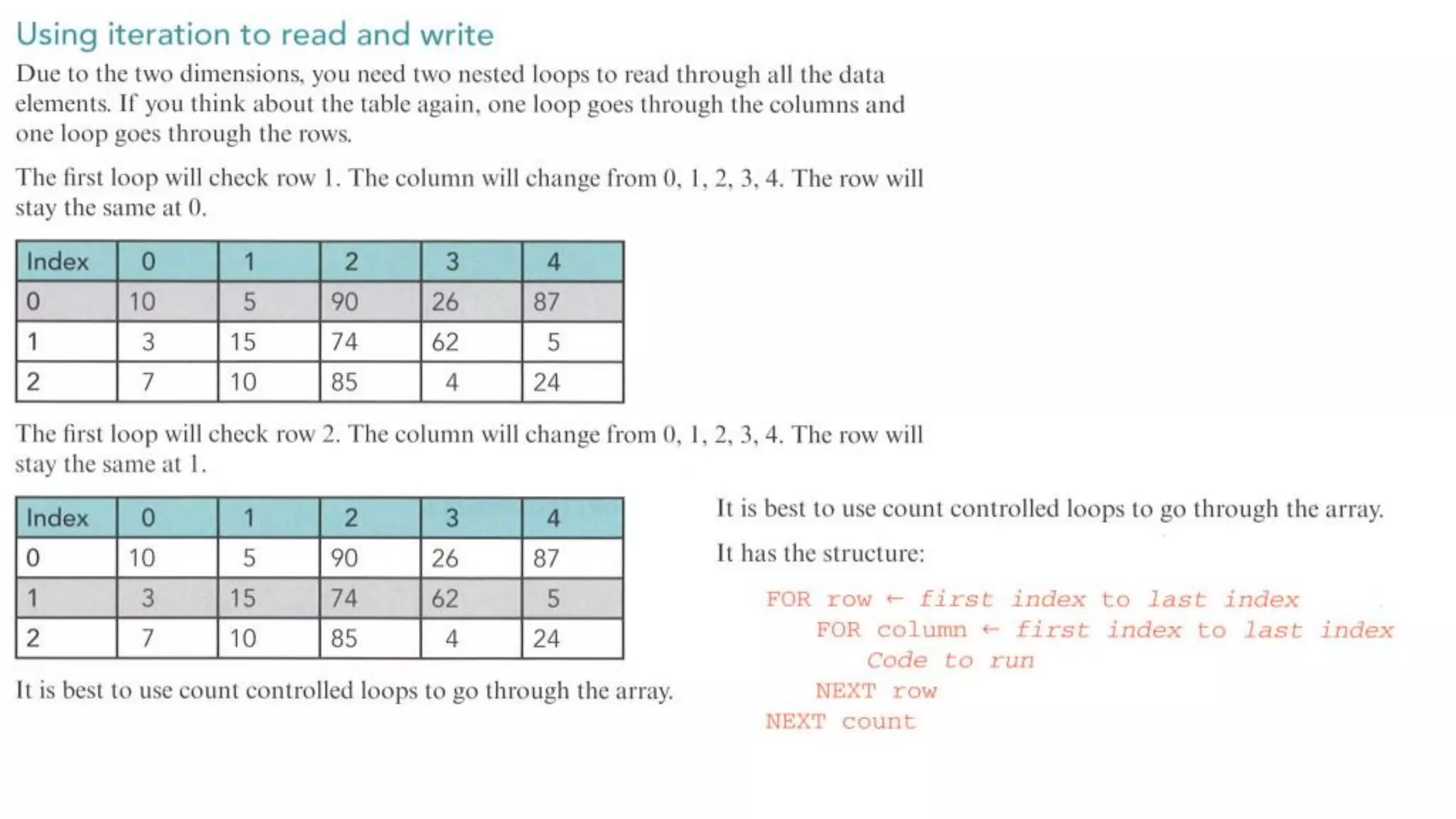
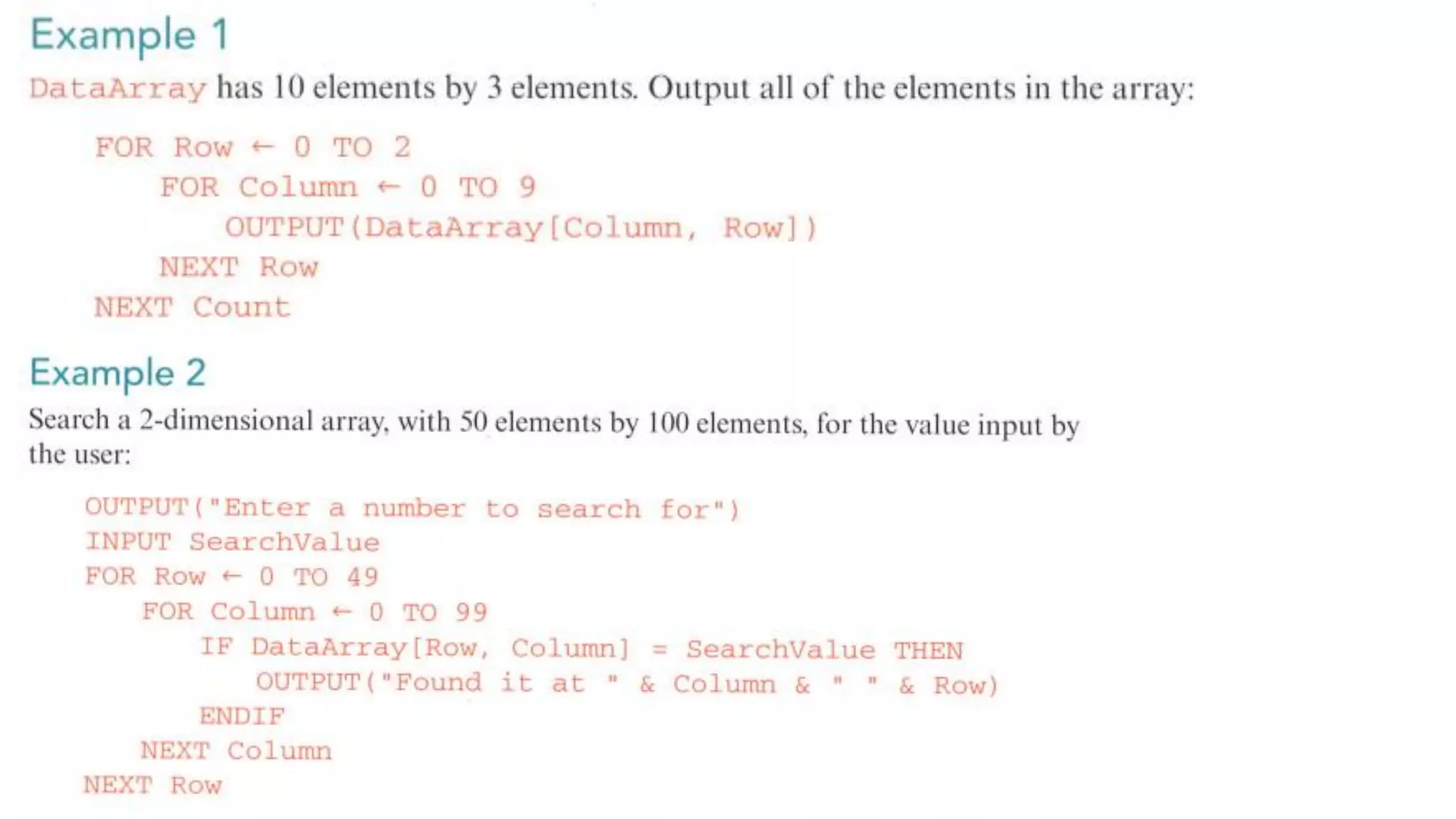
2 D Array
2 D Array
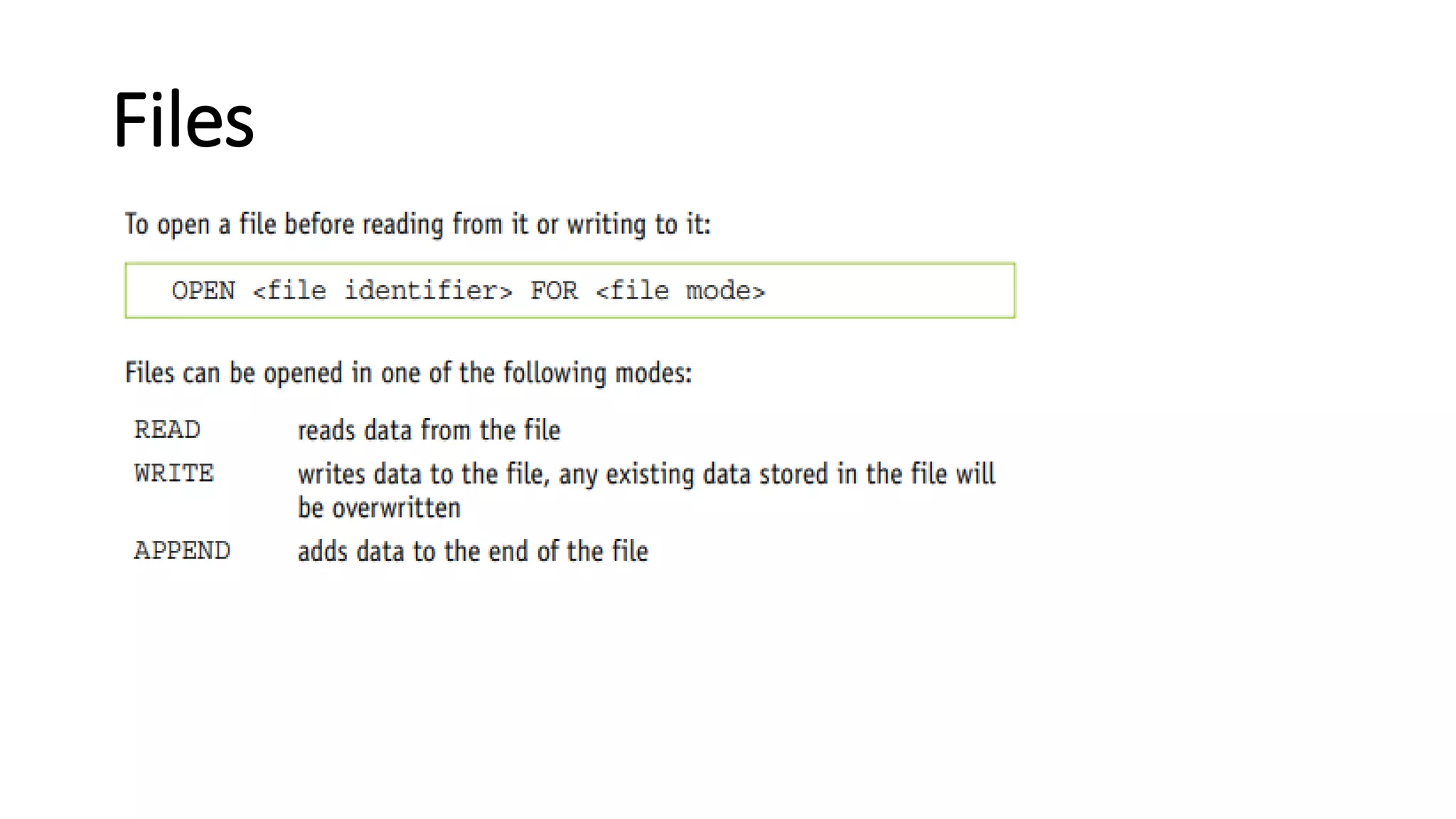
Files
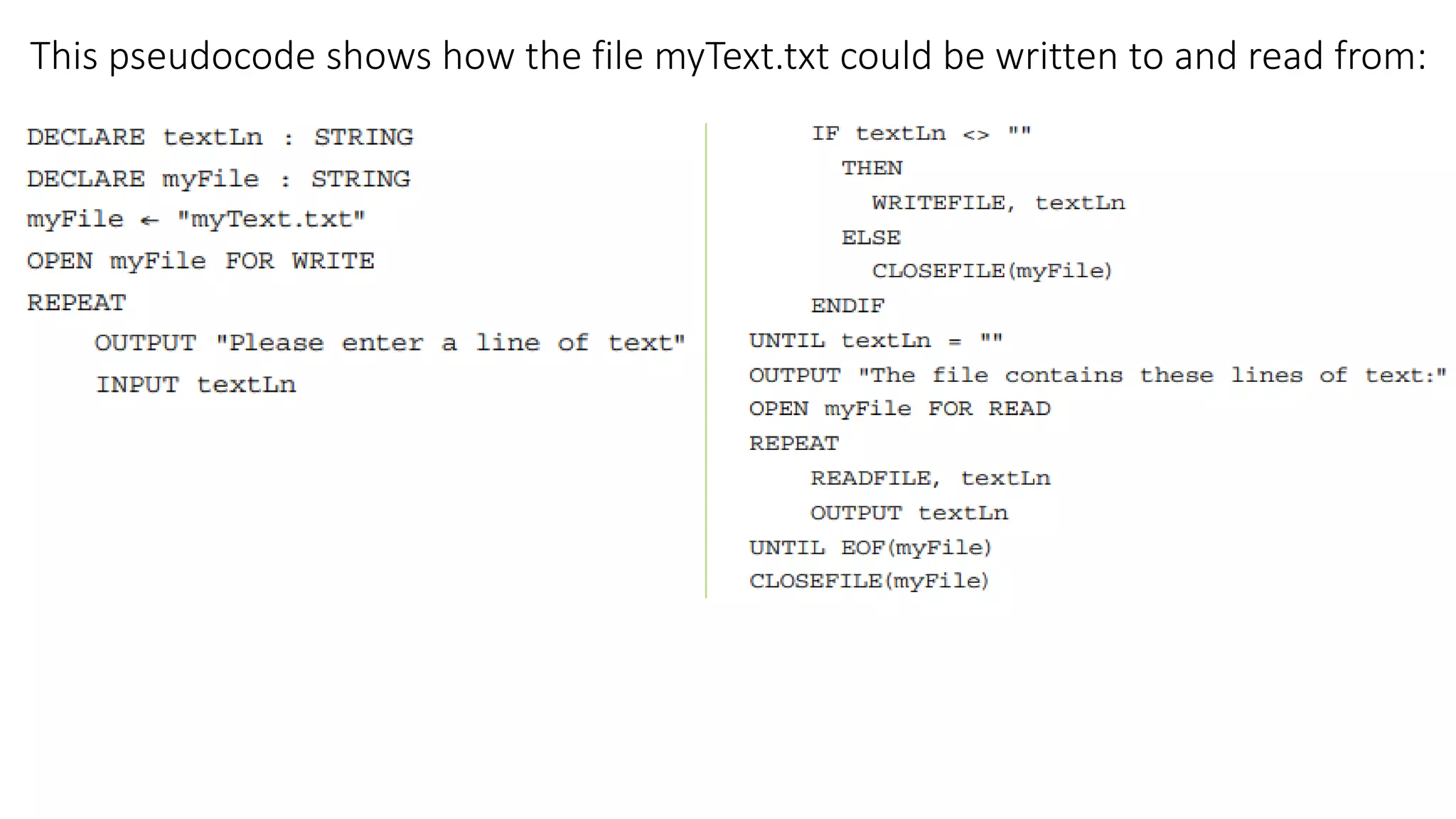
This pseudocode shows how the file myText.txt could be written to and read from:
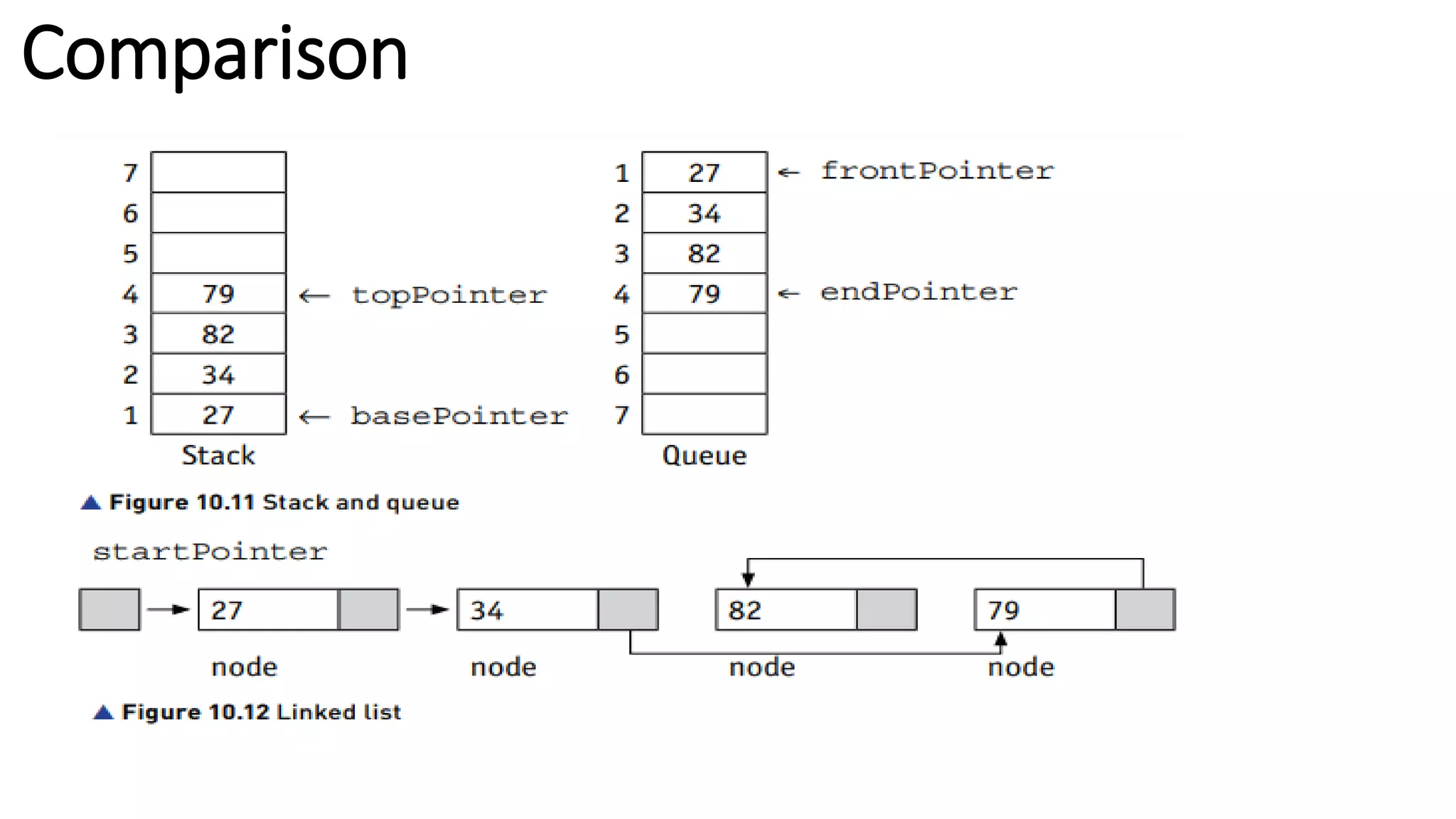
Stack
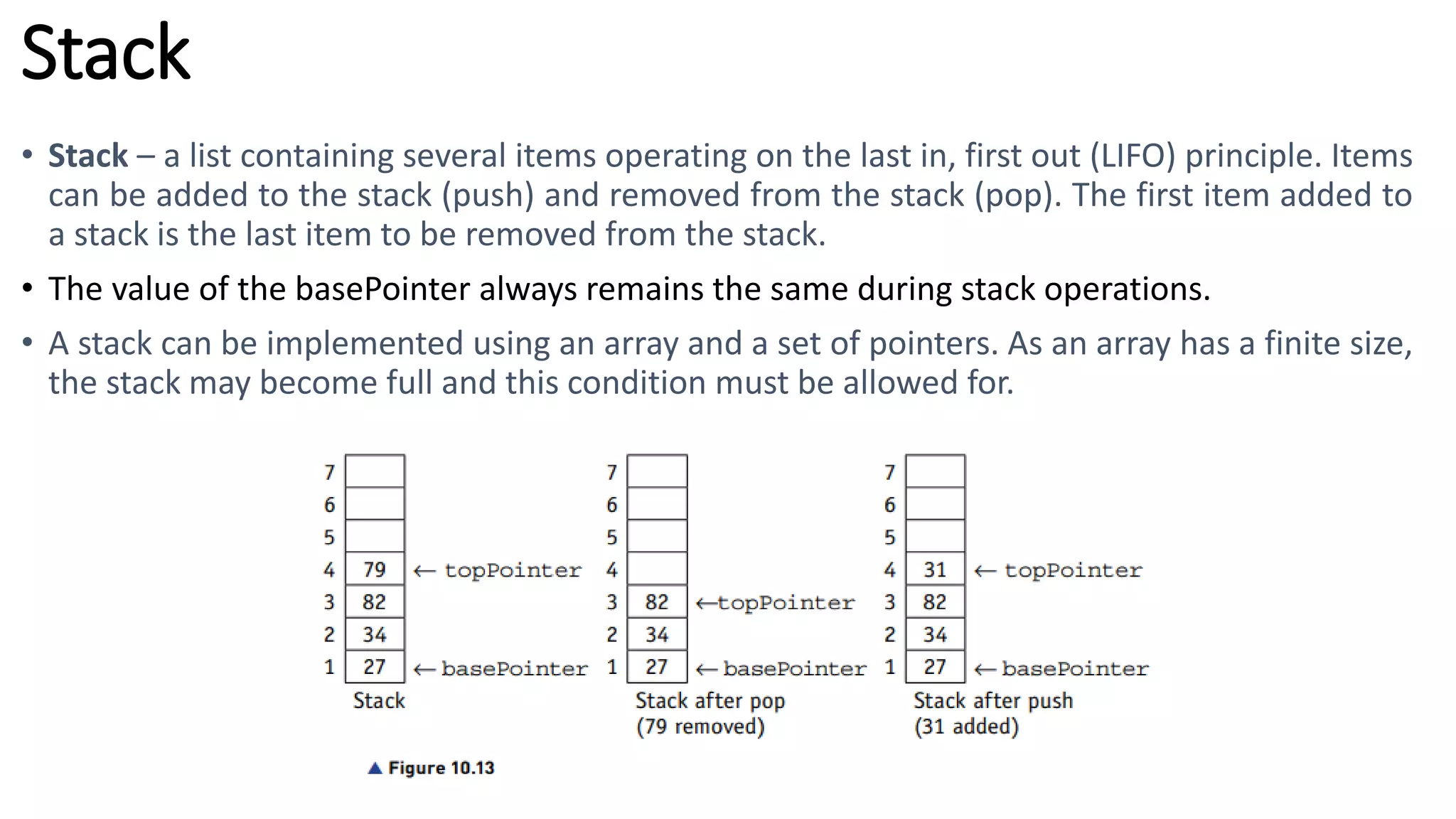
• Stack – a list containing several items operating on the last in, first out (LIFO) principle. Items
can be added to the stack (push) and removed from the stack (pop). The first item added to
a stack is the last item to be removed from the stack.
• The value of the basePointer always remains the same during stack operations.
• A stack can be implemented using an array and a set of pointers. As an array has a finite size,
the stack may become full and this condition must be allowed for.
Queue
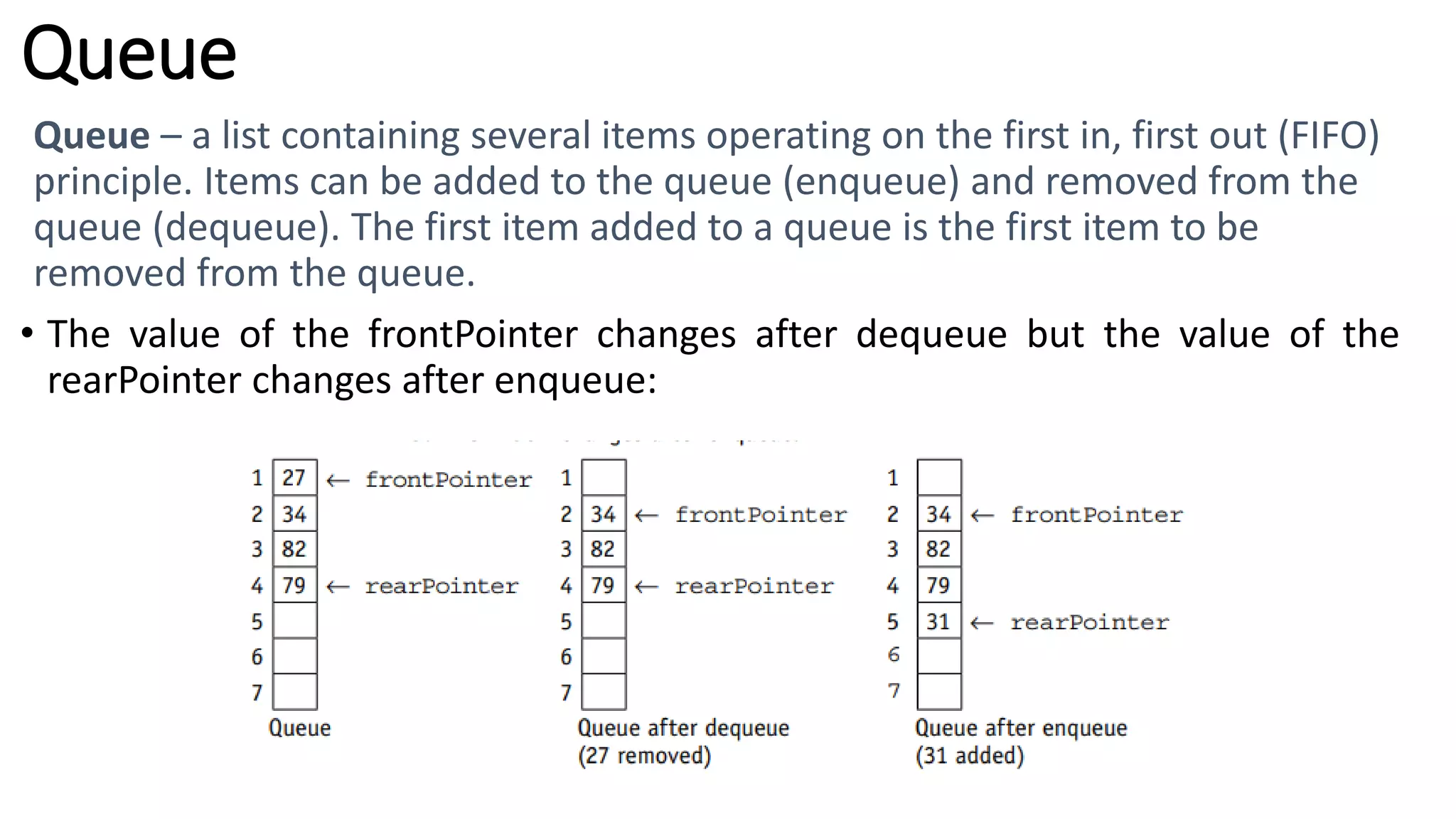
Queue – a list containing several items operating on the first in, first out (FIFO)
principle. Items can be added to the queue (enqueue) and removed from the
queue (dequeue). The first item added to a queue is the first item to be
removed from the queue.
• The value of the frontPointer changes after dequeue but the value of the
rearPointer changes after enqueue:
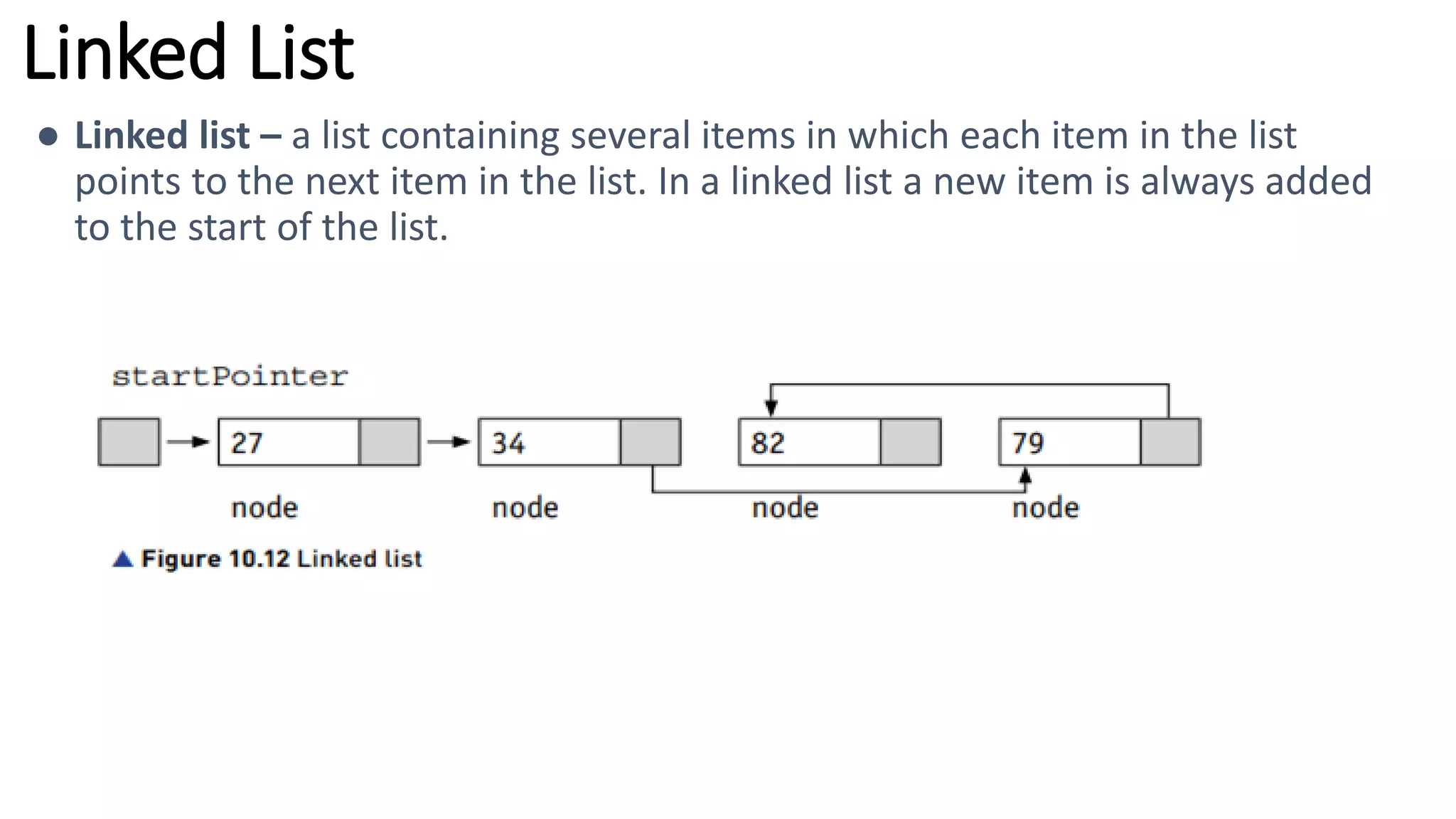
Linked List
● Linked list – a list containing several items in which each item in the list
points to the next item in the list. In a linked list a new item is always added
to the start of the list.
Comparison

Paper 2 – Exam Revision Notes.pdf

  • 1.
    Paper 2 –Exam Revision AS Level | Grade 11
  • 2.
  • 3.
  • 4.
  • 5.
  • 6.
    Loop ● Loops enablesections of code to be repeated as required. ● They can be constructed in different ways to meet the requirements of an algorithm. 1 a count-controlled loop FOR … NEXT 2 a post-condition loop REPEAT … UNTIL 3 a pre-condition loop WHILE … DO … ENDWHILE
  • 7.
    Linear Search ● Tofind an item stored in an array, the array needs to be searched. ● One method of searching is a linear search. ● Each element of the array is checked in order, from the lower bound to the upper bound, until the item is found or the upper bound is reached.
  • 8.
    Linear Search |1D array pseudocode
  • 10.
    Bubble Sort ● Listscan be more useful if the items are sorted in a meaningful order. ● For example, names could be sorted in alphabetical order, or temperatures could be sorted in ascending or descending order. ● There are several sorting algorithms available. One method of sorting is a bubble sort. ● Each element of the array is compared with the next element and swapped if the elements are in the wrong order, starting from the lower bound and finishing with the element next to the upper bound. ● The element at the upper bound is now in the correct position. ● This comparison is repeated with one less element in the list, until there is only one element left or no swaps are made.
  • 11.
    Bubble Sort |Pseudocode
  • 13.
  • 14.
  • 17.
  • 19.
    This pseudocode showshow the file myText.txt could be written to and read from:
  • 20.
    Stack • Stack –a list containing several items operating on the last in, first out (LIFO) principle. Items can be added to the stack (push) and removed from the stack (pop). The first item added to a stack is the last item to be removed from the stack. • The value of the basePointer always remains the same during stack operations. • A stack can be implemented using an array and a set of pointers. As an array has a finite size, the stack may become full and this condition must be allowed for.
  • 21.
    Queue Queue – alist containing several items operating on the first in, first out (FIFO) principle. Items can be added to the queue (enqueue) and removed from the queue (dequeue). The first item added to a queue is the first item to be removed from the queue. • The value of the frontPointer changes after dequeue but the value of the rearPointer changes after enqueue:
  • 22.
    Linked List ● Linkedlist – a list containing several items in which each item in the list points to the next item in the list. In a linked list a new item is always added to the start of the list.
  • 23.