
STATISTICS INTRODUCTION


             Dr.R.VARADHARAJAN
          Associate Professor in Statistics
               Department of MBA
             Vels University, chennai.
Dr.R.VARADHARAJAN, MBA DEPT, VELS UNIVERSITY


Origin and Development
 It is not a new discipline.
 It has been used right from the existence
  of life on earth, through its use was very
  much limited.
 In the good old days Statistics was
  regarded as the ‘Science of Statecraft’
  and was the by – product of the
  administrative activity of the state.
                                                                2
Dr.R.VARADHARAJAN, MBA DEPT, VELS UNIVERSITY


Origin and Development
Contd…
 It has been the traditional function of the
  governments to keep records of population,
  births, deaths, taxes, crop yields and many
  other types of activities

 Also  Statistics originated as a science of
  kings.

                                                               3
Dr.R.VARADHARAJAN, MBA DEPT, VELS UNIVERSITY


Definition:

 “Statisticsmay be called the science of
  counting” – A.L.BOWLEY

 According    to Croxton and Cowden
  Statistics may be defined as “The science
  of collection, organization, presentation,
  analysis and interpretation of numerical
  data”.
Dr.R.VARADHARAJAN, MBA DEPT, VELS UNIVERSITY


Descriptive Statistics
 Descriptive   statistics are methods for
  organizing and summarizing data.
 For example, tables or graphs are used to
  organize data, and descriptive values such
  as the average score are used to summarize
  data.
 A descriptive value for a population is
  called a parameter and a descriptive value
  for a sample is called a statistic.
                                                               5
Dr.R.VARADHARAJAN, MBA DEPT, VELS UNIVERSITY


 Inferential Statistics
 Inferential  statistics are methods for using
  sample data to make general conclusions
  (inferences) about populations.
 Because a sample is typically only a part of
  the whole population, sample data provide
  only limited information about the
  population. As a result, sample statistics are
  generally imperfect representatives of the
  corresponding population parameters.       6
Dr.R.VARADHARAJAN, MBA DEPT, VELS UNIVERSITY


Collection:

 Utmost   care must be exercised in
 collecting data because they form the
 fundamental of Statistical analysis. If the
 are faulty, the conclusions drawn can
 never reliable.
Dr.R.VARADHARAJAN, MBA DEPT, VELS UNIVERSITY


Organization:

A   large mass figures that are collected
  from     a    survey    frequently   needs
  organization.
 The collected data must be edited very
  carefully    so    that    the   omissions,
  inconsistencies, irrelevant answers and
  wrong computations in the returns from a
  survey may be corrected or adjusted
Dr.R.VARADHARAJAN, MBA DEPT, VELS UNIVERSITY


Organization Contd…

 Thenext step is to classify them .
 (Arrange the data according to some
 common characteristics)

 The last step in the organization is
 tabulation.
 (Arrange the data in rows and columns)
Dr.R.VARADHARAJAN, MBA DEPT, VELS UNIVERSITY


Presentation:
 After   the data have been collected and
  organized they are ready for presentation.
  Data presented in an orderly manner
  facilitate statistical analysis. There are two
  different models in which the collected
  data may be presented:
 Diagrams, and
 Graphs.
Dr.R.VARADHARAJAN, MBA DEPT, VELS UNIVERSITY


Analysis:

 The  purpose of analyzing data is to dig
  out information useful for decision –
  making.
 Ex: Measures of Central tendency,
  Measures of Variation, Correlation and
  regressions etc…
Dr.R.VARADHARAJAN, MBA DEPT, VELS UNIVERSITY


 Interpretation:
 Drawing   conclusions from the data collected
  and analyzed.
 The interpretation of data is difficult task
  and necessitates a high degree of skill and
  experience.
 If the data that have been analyzed are not
  properly interpreted, the whole object of the
  investigation may be defeated and fallacious
  conclusion be drawn.
Dr.R.VARADHARAJAN, MBA DEPT, VELS UNIVERSITY


Functions of Statistics
 These  are the important functions of
 Statistics
  • It presents facts in a definite form.
  • It simplifies mass of figures.
  • It facilitates comparison.
  • It helps in formulating and testing
    hypothesis.
  • It helps in prediction.                                     13
Dr.R.VARADHARAJAN, MBA DEPT, VELS UNIVERSITY


Applications of Statistics
 Thefollowing are the important
 Applications of Statistics
 • Statistics and the State
 • Statistics and business
 • Statistics and Economics
 • Physical sciences
 • Natural sciences
 • Statistics and Research                                  14
Dr.R.VARADHARAJAN, MBA DEPT, VELS UNIVERSITY


Data
 The measurements obtained in a research
  study are called the data.
 The goal of statistics is to help researchers
  organize and interpret the data.
 Data may be obtained either from the
  primary source or the secondary source.


                                                                15
Dr.R.VARADHARAJAN, MBA DEPT, VELS UNIVERSITY


Data Contd…
A primary source is one that itself
 collects the data.

A secondary source is one that makes
 available data which were collected by
 some other agency.


                                                              16
Dr.R.VARADHARAJAN, MBA DEPT, VELS UNIVERSITY


Methods of collecting Primary Data


 Direct personal interviews
 Indirect oral interviews
 Information from correspondents
 Mailed questionnaire method
 Schedule sent through enumerators


                                                            17
Dr.R.VARADHARAJAN, MBA DEPT, VELS UNIVERSITY


    Direct Personal Interviews
 There is a face to face contact with the persons
  from whom the information is to be obtained
  (informants).
 First hand information or original in
  character.
   Example:
   A person wants to collect data about the working conditions of
    the workers of the Tata textile mill, chennai, he would go to
    the mill, contact     the workers and obtain the desired
    information.                                             18
Dr.R.VARADHARAJAN, MBA DEPT, VELS UNIVERSITY


    Indirect Oral Interviews
 The    investigator contacts third parties called
    witnesses capable of supplying the necessary
    information.
   Example:
   In an enquiry regarding addiction to drugs, alcohol, etc.,
    people may be reluctant to supply information about their
    own habits. In that situation, this type information is collected
    from their neighbours, friends etc.,
   Clues about thefts
   Murders
                                                                               19
Dr.R.VARADHARAJAN, MBA DEPT, VELS UNIVERSITY


    Information From Correspondents
 The   investigator appoints local agents or
  correspondents in different places to collect
  information.
 These correspondents collect and transmit the
  information to the central office where the
  data are processed.
   Example:
   News paper agencies generally adopt this method.
   Correspondents in different places supply information
    relating to such events as accidents, riots, strikes etc., 20
Dr.R.VARADHARAJAN, MBA DEPT, VELS UNIVERSITY


  Mailed Questionnaire Method

A    list of questions pertaining to the survey
  (Questionnaire) is prepared and sent to the various
  informants by post.
 The questionnaire contains questions and provides
  space for answers.
 Request is made to the informants through a
  covering letter to fill up the questionnaire and send
  back within a specified time.
 Example: This method is appropriate in cases where
  informants are spread over a wide area, i.e., in case of
                                                      21
  extensive surveys.
Mailed Questionnaire Method         Dr.R.VARADHARAJAN, MBA DEPT, VELS UNIVERSITY


  Contd…
 Covering  letter
 Number of Questions should be small
 Questions should be arranged logically
 Questions should be short and simple to understand
 Personal Questions should be avoided
 Instructions to the informants
 Questions should be capable of objective answer
 Yes or No Questions
 Questions should look attractive                22
Dr.R.VARADHARAJAN, MBA DEPT, VELS UNIVERSITY


   Schedule Sent Through Enumerators

 The   enumerators contact the informants, get replies
  to the questions contained in a schedule and fill them
  in their own handwriting in the questionnaire form.
 It can be adopted in those cases where informants are
  illiterate.
 This method is costly among the above discussed
  method.
 Some special skills are required to collect the
  information from the respondents.
                                                                      23
Dr.R.VARADHARAJAN, MBA DEPT, VELS UNIVERSITY


Sources of secondary data:

 Published   sources

 Unpublished   sources


                                                        24
Dr.R.VARADHARAJAN, MBA DEPT, VELS UNIVERSITY


  Published Sources


 Reports   and official publications
 Semi-official publications of various local
  bodies such as municipal corporations and
  district boards.
 Financial and economic journals.
 Annual report of joint stock companies and
  corporations.
                                                                25
Dr.R.VARADHARAJAN, MBA DEPT, VELS UNIVERSITY


  Unpublished Sources


 All statistical   material   is   not           always
 published.

 There are various sources of unpublished
 data such as records maintained by various
 Government and Private offices, studies
 made by research institutions, scholars, etc.,
 such sources can be used where necessary. 26
Dr.R.VARADHARAJAN, MBA DEPT, VELS UNIVERSITY


Classification:

 Classification  is the grouping of related
  facts into classes.
  Ex: Sorting letters in a post office.
  (according to their destination like
  Mumbai, Calcutta etc…)
Dr.R.VARADHARAJAN, MBA DEPT, VELS UNIVERSITY


Classification Contd…

 Types    of Classification:
  •   Geographical (ie) Area – wise
  •   Chronological (ie) on the basis of time
  •   Quantitative (ie) in terms of magnitudes
  •   Qualitative (ie) according to some
      attributes
Dr.R.VARADHARAJAN, MBA DEPT, VELS UNIVERSITY


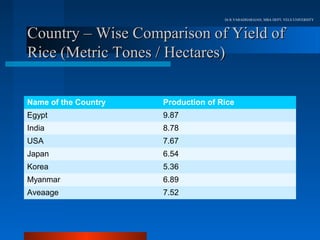
Geographical Classification

 The   data are classified on the basis of
  geographical or vocational differences
  between the various items.
 Like countries, states, cities, zones, areas,
  etc.,
Dr.R.VARADHARAJAN, MBA DEPT, VELS UNIVERSITY


Country – Wise Comparison of Yield of
Rice (Metric Tones / Hectares)

Name of the Country   Production of Rice
Egypt                 9.87
India                 8.78
USA                   7.67
Japan                 6.54
Korea                 5.36
Myanmar               6.89
Aveaage               7.52
Dr.R.VARADHARAJAN, MBA DEPT, VELS UNIVERSITY


Chronological Classification

 When    data are observed over a period of
  time the type of classification is known as
  chronological classification
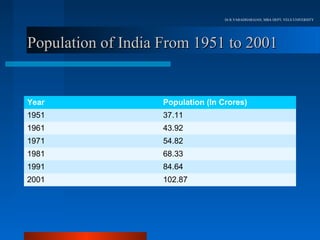
 We may present the figures of population
  as follows:
Dr.R.VARADHARAJAN, MBA DEPT, VELS UNIVERSITY


Population of India From 1951 to 2001


Year                Population (In Crores)
1951                37.11
1961                43.92
1971                54.82
1981                68.33
1991                84.64
2001                102.87
Dr.R.VARADHARAJAN, MBA DEPT, VELS UNIVERSITY


Quantitative Classification

 Thedata are classified according to some
 characteristics that can be measured.

 Such  as height, weight, income, sales,
 profits, production, etc.,
Dr.R.VARADHARAJAN, MBA DEPT, VELS UNIVERSITY


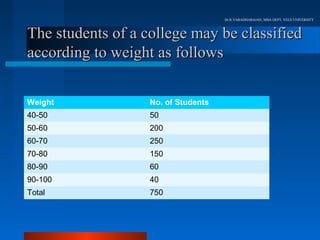
The students of a college may be classified
according to weight as follows

Weight             No. of Students
40-50              50
50-60              200
60-70              250
70-80              150
80-90              60
90-100             40
Total              750
Dr.R.VARADHARAJAN, MBA DEPT, VELS UNIVERSITY


Qualitative Classification

 The  data are classified on the basis of some
  attribute or quality.
 Such as sex, colour of hair, literacy,
  religion, etc.,
 The point to note in this type of
  classification is that the attribute under
  study cannot be measured.
Dr.R.VARADHARAJAN, MBA DEPT, VELS UNIVERSITY


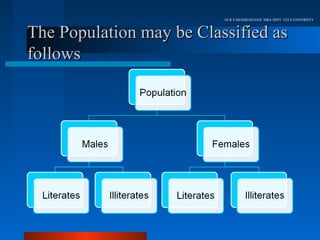
The Population may be Classified as
follows
Dr.R.VARADHARAJAN, MBA DEPT, VELS UNIVERSITY


Tabulation:

A   table is a systematic arrangement
  of Statistical data in columns and
  rows.      Rows     are     horizontal
  arrangements whereas columns are
  vertical ones.
 The purpose of a table is to simplify
  the presentation and to facilitate
  comparisons.
Dr.R.VARADHARAJAN, MBA DEPT, VELS UNIVERSITY


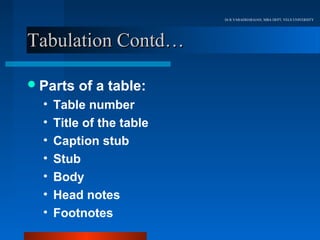
Tabulation Contd…

 Parts   of a table:
  •   Table number
  •   Title of the table
  •   Caption stub
  •   Stub
  •   Body
  •   Head notes
  •   Footnotes
Dr.R.VARADHARAJAN, MBA DEPT, VELS UNIVERSITY


Types of Tables

 Simple   and complex tables.

 General
        purpose and special
 purpose tables.


                                                           39
Dr.R.VARADHARAJAN, MBA DEPT, VELS UNIVERSITY


Diagrams and Graphs
 Diagramsand graphs are extremely
 useful because of the following
 reasons.
  • They give birds eye view of the entire
    data and, therefore, the information
    presented is easily understood.
  • Pictorial presentation helps in proper
    understanding of the data as it gives an
    interesting form to it.
                                                              40
Dr.R.VARADHARAJAN, MBA DEPT, VELS UNIVERSITY


Types of Diagrams
 One  – dimensional diagrams
  Ex: Bar diagrams.
 Two – dimensional diagrams

  Ex: Rectangles, squares and circles.
 Three – dimensional diagrams

  Ex: Cubes, cylinders and spheres.
 Pictograms and cartograms
                                                           41
Dr.R.VARADHARAJAN, MBA DEPT, VELS UNIVERSITY


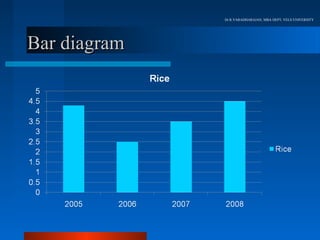
Bar diagram
Dr.R.VARADHARAJAN, MBA DEPT, VELS UNIVERSITY


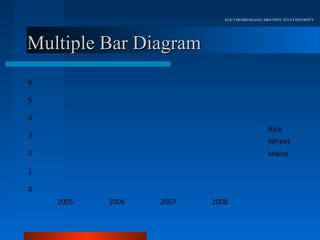
Multiple Bar Diagram
6

5

4
                                                 Rice
3
                                                 Wheat
2                                                Maize

1

0
    2005   2006   2007   2008
Dr.R.VARADHARAJAN, MBA DEPT, VELS UNIVERSITY


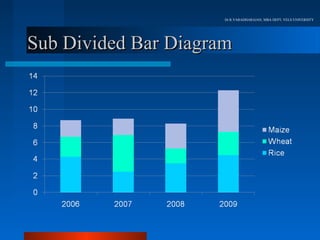
Sub Divided Bar Diagram
Dr.R.VARADHARAJAN, MBA DEPT, VELS UNIVERSITY


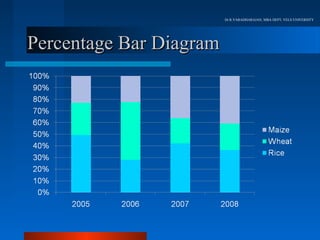
Percentage Bar Diagram
Dr.R.VARADHARAJAN, MBA DEPT, VELS UNIVERSITY


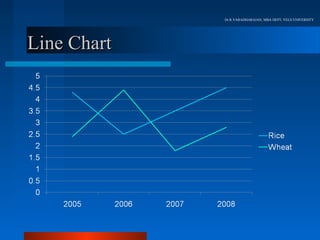
Line Chart
Dr.R.VARADHARAJAN, MBA DEPT, VELS UNIVERSITY


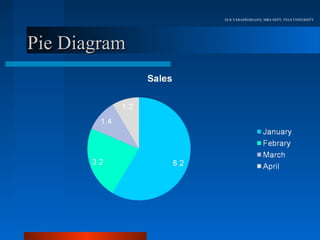
Pie Diagram
Dr.R.VARADHARAJAN, MBA DEPT, VELS UNIVERSITY


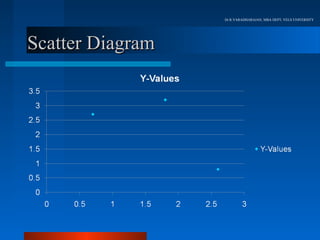
Scatter Diagram
Dr.R.VARADHARAJAN, MBA DEPT, VELS UNIVERSITY


Variables
A  variable is a characteristic or
  condition that can change or take on
  different values.
 Most research begins with a general
  question about the relationship
  between two variables for a specific
  group of individuals.

                                                          49
Dr.R.VARADHARAJAN, MBA DEPT, VELS UNIVERSITY


 Types of Variables
 Variables  can be classified as discrete or
    continuous.

  Discrete variables (such as class size)
  consist of indivisible categories, and
  continuous variables (such as time or
  weight) are infinitely divisible into
  whatever units a researcher may choose.
 For example, time can be measured to the
  nearest minute, second, half-second, etc.
                                                                 50
Dr.R.VARADHARAJAN, MBA DEPT, VELS UNIVERSITY


Continuous variable
 Can take any value in the given
  range of numbers
 Can be measured
 Ex:
  • Hb level
  • Height
  • Weight etc

                                                           51

Statistics Introduction

  • 1.
    STATISTICS INTRODUCTION Dr.R.VARADHARAJAN Associate Professor in Statistics Department of MBA Vels University, chennai.
  • 2.
    Dr.R.VARADHARAJAN, MBA DEPT,VELS UNIVERSITY Origin and Development  It is not a new discipline.  It has been used right from the existence of life on earth, through its use was very much limited.  In the good old days Statistics was regarded as the ‘Science of Statecraft’ and was the by – product of the administrative activity of the state. 2
  • 3.
    Dr.R.VARADHARAJAN, MBA DEPT,VELS UNIVERSITY Origin and Development Contd…  It has been the traditional function of the governments to keep records of population, births, deaths, taxes, crop yields and many other types of activities  Also Statistics originated as a science of kings. 3
  • 4.
    Dr.R.VARADHARAJAN, MBA DEPT,VELS UNIVERSITY Definition:  “Statisticsmay be called the science of counting” – A.L.BOWLEY  According to Croxton and Cowden Statistics may be defined as “The science of collection, organization, presentation, analysis and interpretation of numerical data”.
  • 5.
    Dr.R.VARADHARAJAN, MBA DEPT,VELS UNIVERSITY Descriptive Statistics  Descriptive statistics are methods for organizing and summarizing data.  For example, tables or graphs are used to organize data, and descriptive values such as the average score are used to summarize data.  A descriptive value for a population is called a parameter and a descriptive value for a sample is called a statistic. 5
  • 6.
    Dr.R.VARADHARAJAN, MBA DEPT,VELS UNIVERSITY Inferential Statistics  Inferential statistics are methods for using sample data to make general conclusions (inferences) about populations.  Because a sample is typically only a part of the whole population, sample data provide only limited information about the population. As a result, sample statistics are generally imperfect representatives of the corresponding population parameters. 6
  • 7.
    Dr.R.VARADHARAJAN, MBA DEPT,VELS UNIVERSITY Collection:  Utmost care must be exercised in collecting data because they form the fundamental of Statistical analysis. If the are faulty, the conclusions drawn can never reliable.
  • 8.
    Dr.R.VARADHARAJAN, MBA DEPT,VELS UNIVERSITY Organization: A large mass figures that are collected from a survey frequently needs organization.  The collected data must be edited very carefully so that the omissions, inconsistencies, irrelevant answers and wrong computations in the returns from a survey may be corrected or adjusted
  • 9.
    Dr.R.VARADHARAJAN, MBA DEPT,VELS UNIVERSITY Organization Contd…  Thenext step is to classify them . (Arrange the data according to some common characteristics)  The last step in the organization is tabulation. (Arrange the data in rows and columns)
  • 10.
    Dr.R.VARADHARAJAN, MBA DEPT,VELS UNIVERSITY Presentation:  After the data have been collected and organized they are ready for presentation. Data presented in an orderly manner facilitate statistical analysis. There are two different models in which the collected data may be presented:  Diagrams, and  Graphs.
  • 11.
    Dr.R.VARADHARAJAN, MBA DEPT,VELS UNIVERSITY Analysis:  The purpose of analyzing data is to dig out information useful for decision – making.  Ex: Measures of Central tendency, Measures of Variation, Correlation and regressions etc…
  • 12.
    Dr.R.VARADHARAJAN, MBA DEPT,VELS UNIVERSITY Interpretation:  Drawing conclusions from the data collected and analyzed.  The interpretation of data is difficult task and necessitates a high degree of skill and experience.  If the data that have been analyzed are not properly interpreted, the whole object of the investigation may be defeated and fallacious conclusion be drawn.
  • 13.
    Dr.R.VARADHARAJAN, MBA DEPT,VELS UNIVERSITY Functions of Statistics  These are the important functions of Statistics • It presents facts in a definite form. • It simplifies mass of figures. • It facilitates comparison. • It helps in formulating and testing hypothesis. • It helps in prediction. 13
  • 14.
    Dr.R.VARADHARAJAN, MBA DEPT,VELS UNIVERSITY Applications of Statistics  Thefollowing are the important Applications of Statistics • Statistics and the State • Statistics and business • Statistics and Economics • Physical sciences • Natural sciences • Statistics and Research 14
  • 15.
    Dr.R.VARADHARAJAN, MBA DEPT,VELS UNIVERSITY Data  The measurements obtained in a research study are called the data.  The goal of statistics is to help researchers organize and interpret the data.  Data may be obtained either from the primary source or the secondary source. 15
  • 16.
    Dr.R.VARADHARAJAN, MBA DEPT,VELS UNIVERSITY Data Contd… A primary source is one that itself collects the data. A secondary source is one that makes available data which were collected by some other agency. 16
  • 17.
    Dr.R.VARADHARAJAN, MBA DEPT,VELS UNIVERSITY Methods of collecting Primary Data  Direct personal interviews  Indirect oral interviews  Information from correspondents  Mailed questionnaire method  Schedule sent through enumerators 17
  • 18.
    Dr.R.VARADHARAJAN, MBA DEPT,VELS UNIVERSITY Direct Personal Interviews  There is a face to face contact with the persons from whom the information is to be obtained (informants).  First hand information or original in character.  Example:  A person wants to collect data about the working conditions of the workers of the Tata textile mill, chennai, he would go to the mill, contact the workers and obtain the desired information. 18
  • 19.
    Dr.R.VARADHARAJAN, MBA DEPT,VELS UNIVERSITY Indirect Oral Interviews  The investigator contacts third parties called witnesses capable of supplying the necessary information.  Example:  In an enquiry regarding addiction to drugs, alcohol, etc., people may be reluctant to supply information about their own habits. In that situation, this type information is collected from their neighbours, friends etc.,  Clues about thefts  Murders 19
  • 20.
    Dr.R.VARADHARAJAN, MBA DEPT,VELS UNIVERSITY Information From Correspondents  The investigator appoints local agents or correspondents in different places to collect information.  These correspondents collect and transmit the information to the central office where the data are processed.  Example:  News paper agencies generally adopt this method.  Correspondents in different places supply information relating to such events as accidents, riots, strikes etc., 20
  • 21.
    Dr.R.VARADHARAJAN, MBA DEPT,VELS UNIVERSITY Mailed Questionnaire Method A list of questions pertaining to the survey (Questionnaire) is prepared and sent to the various informants by post.  The questionnaire contains questions and provides space for answers.  Request is made to the informants through a covering letter to fill up the questionnaire and send back within a specified time.  Example: This method is appropriate in cases where informants are spread over a wide area, i.e., in case of 21 extensive surveys.
  • 22.
    Mailed Questionnaire Method Dr.R.VARADHARAJAN, MBA DEPT, VELS UNIVERSITY Contd…  Covering letter  Number of Questions should be small  Questions should be arranged logically  Questions should be short and simple to understand  Personal Questions should be avoided  Instructions to the informants  Questions should be capable of objective answer  Yes or No Questions  Questions should look attractive 22
  • 23.
    Dr.R.VARADHARAJAN, MBA DEPT,VELS UNIVERSITY Schedule Sent Through Enumerators  The enumerators contact the informants, get replies to the questions contained in a schedule and fill them in their own handwriting in the questionnaire form.  It can be adopted in those cases where informants are illiterate.  This method is costly among the above discussed method.  Some special skills are required to collect the information from the respondents. 23
  • 24.
    Dr.R.VARADHARAJAN, MBA DEPT,VELS UNIVERSITY Sources of secondary data:  Published sources  Unpublished sources 24
  • 25.
    Dr.R.VARADHARAJAN, MBA DEPT,VELS UNIVERSITY Published Sources  Reports and official publications  Semi-official publications of various local bodies such as municipal corporations and district boards.  Financial and economic journals.  Annual report of joint stock companies and corporations. 25
  • 26.
    Dr.R.VARADHARAJAN, MBA DEPT,VELS UNIVERSITY Unpublished Sources  All statistical material is not always published.  There are various sources of unpublished data such as records maintained by various Government and Private offices, studies made by research institutions, scholars, etc., such sources can be used where necessary. 26
  • 27.
    Dr.R.VARADHARAJAN, MBA DEPT,VELS UNIVERSITY Classification:  Classification is the grouping of related facts into classes. Ex: Sorting letters in a post office. (according to their destination like Mumbai, Calcutta etc…)
  • 28.
    Dr.R.VARADHARAJAN, MBA DEPT,VELS UNIVERSITY Classification Contd…  Types of Classification: • Geographical (ie) Area – wise • Chronological (ie) on the basis of time • Quantitative (ie) in terms of magnitudes • Qualitative (ie) according to some attributes
  • 29.
    Dr.R.VARADHARAJAN, MBA DEPT,VELS UNIVERSITY Geographical Classification  The data are classified on the basis of geographical or vocational differences between the various items.  Like countries, states, cities, zones, areas, etc.,
  • 30.
    Dr.R.VARADHARAJAN, MBA DEPT,VELS UNIVERSITY Country – Wise Comparison of Yield of Rice (Metric Tones / Hectares) Name of the Country Production of Rice Egypt 9.87 India 8.78 USA 7.67 Japan 6.54 Korea 5.36 Myanmar 6.89 Aveaage 7.52
  • 31.
    Dr.R.VARADHARAJAN, MBA DEPT,VELS UNIVERSITY Chronological Classification  When data are observed over a period of time the type of classification is known as chronological classification  We may present the figures of population as follows:
  • 32.
    Dr.R.VARADHARAJAN, MBA DEPT,VELS UNIVERSITY Population of India From 1951 to 2001 Year Population (In Crores) 1951 37.11 1961 43.92 1971 54.82 1981 68.33 1991 84.64 2001 102.87
  • 33.
    Dr.R.VARADHARAJAN, MBA DEPT,VELS UNIVERSITY Quantitative Classification  Thedata are classified according to some characteristics that can be measured.  Such as height, weight, income, sales, profits, production, etc.,
  • 34.
    Dr.R.VARADHARAJAN, MBA DEPT,VELS UNIVERSITY The students of a college may be classified according to weight as follows Weight No. of Students 40-50 50 50-60 200 60-70 250 70-80 150 80-90 60 90-100 40 Total 750
  • 35.
    Dr.R.VARADHARAJAN, MBA DEPT,VELS UNIVERSITY Qualitative Classification  The data are classified on the basis of some attribute or quality.  Such as sex, colour of hair, literacy, religion, etc.,  The point to note in this type of classification is that the attribute under study cannot be measured.
  • 36.
    Dr.R.VARADHARAJAN, MBA DEPT,VELS UNIVERSITY The Population may be Classified as follows
  • 37.
    Dr.R.VARADHARAJAN, MBA DEPT,VELS UNIVERSITY Tabulation: A table is a systematic arrangement of Statistical data in columns and rows. Rows are horizontal arrangements whereas columns are vertical ones.  The purpose of a table is to simplify the presentation and to facilitate comparisons.
  • 38.
    Dr.R.VARADHARAJAN, MBA DEPT,VELS UNIVERSITY Tabulation Contd…  Parts of a table: • Table number • Title of the table • Caption stub • Stub • Body • Head notes • Footnotes
  • 39.
    Dr.R.VARADHARAJAN, MBA DEPT,VELS UNIVERSITY Types of Tables  Simple and complex tables.  General purpose and special purpose tables. 39
  • 40.
    Dr.R.VARADHARAJAN, MBA DEPT,VELS UNIVERSITY Diagrams and Graphs  Diagramsand graphs are extremely useful because of the following reasons. • They give birds eye view of the entire data and, therefore, the information presented is easily understood. • Pictorial presentation helps in proper understanding of the data as it gives an interesting form to it. 40
  • 41.
    Dr.R.VARADHARAJAN, MBA DEPT,VELS UNIVERSITY Types of Diagrams  One – dimensional diagrams Ex: Bar diagrams.  Two – dimensional diagrams Ex: Rectangles, squares and circles.  Three – dimensional diagrams Ex: Cubes, cylinders and spheres.  Pictograms and cartograms 41
  • 42.
    Dr.R.VARADHARAJAN, MBA DEPT,VELS UNIVERSITY Bar diagram
  • 43.
    Dr.R.VARADHARAJAN, MBA DEPT,VELS UNIVERSITY Multiple Bar Diagram 6 5 4 Rice 3 Wheat 2 Maize 1 0 2005 2006 2007 2008
  • 44.
    Dr.R.VARADHARAJAN, MBA DEPT,VELS UNIVERSITY Sub Divided Bar Diagram
  • 45.
    Dr.R.VARADHARAJAN, MBA DEPT,VELS UNIVERSITY Percentage Bar Diagram
  • 46.
    Dr.R.VARADHARAJAN, MBA DEPT,VELS UNIVERSITY Line Chart
  • 47.
    Dr.R.VARADHARAJAN, MBA DEPT,VELS UNIVERSITY Pie Diagram
  • 48.
    Dr.R.VARADHARAJAN, MBA DEPT,VELS UNIVERSITY Scatter Diagram
  • 49.
    Dr.R.VARADHARAJAN, MBA DEPT,VELS UNIVERSITY Variables A variable is a characteristic or condition that can change or take on different values.  Most research begins with a general question about the relationship between two variables for a specific group of individuals. 49
  • 50.
    Dr.R.VARADHARAJAN, MBA DEPT,VELS UNIVERSITY Types of Variables  Variables can be classified as discrete or continuous.  Discrete variables (such as class size) consist of indivisible categories, and continuous variables (such as time or weight) are infinitely divisible into whatever units a researcher may choose.  For example, time can be measured to the nearest minute, second, half-second, etc. 50
  • 51.
    Dr.R.VARADHARAJAN, MBA DEPT,VELS UNIVERSITY Continuous variable  Can take any value in the given range of numbers  Can be measured  Ex: • Hb level • Height • Weight etc 51