BIO STATISTICS
INTRODUCTION
CHAPTER ONE
2
Objectives of the chapter
 Demonstrate knowledge of statistical terms.
 Differentiate between the two branches of
statistics.
 Identify types of data.
 Identify the measurement level for each
variable.
 Identify the basic sampling techniques.
3
* Biostatistics:
4
 The tools of statistics are employed in many
fields:
business, education, psychology, agriculture,
economics, … etc.
 When the data analyzed are derived from the
biological science and medicine,
 we use the term biostatistics to distinguish this
particular application of statistical tools and
concepts.
Definition of Statistics?
 Statistics is the science of conducting studies
to collect, organize, summarize, analyze, and
draw conclusions from data.
 Statistics The science of collecting, describing,
and interpreting data.
 Statistics is the study of how to collect,
organize, analyze, and interpret numerical
information from data.
 Bio-statistics is the branch of applied statistics
that applies statistical methods to biological
science and medicine.
5
Types of Statistics
The two areas of Statistics are: Descriptive
statistics and Inferential statistic.
 Descriptive statistics involves methods of
collection, organizing, picturing, and
summarizing information from samples or
populations.
 Inferential statistics consists of generalizing
from samples to populations, performing
estimations and hypothesis tests, determining
relationships among variables, and making
predictions.
6
 In descriptive statistics the statistician tries to
describe a situation. Consider the national
census conducted by the Somaliland
government every 10 years. Results of this
census give you the average age, income, and
other characteristics of the Somaliland
population.
 The area of inferential statistics called
hypothesis testing is a decision-making
process for evaluating claims about a
population, based on information obtained
7
Reasons to study Statistics
 Statistics is an important tool for Planning, research, decision
making and problem solving.
 In diverse areas such as business, financial management, education
policy, we use statistical analysis to make decisions.
 It is a tool for scientific description and inference.
 It helps to know how to properly present information.
 It helps to recognize problems with published information.
 It helps to know how to draw appropriate conclusions from data.
 It helps to improve processes.
 To obtain reliable forecasts.
8
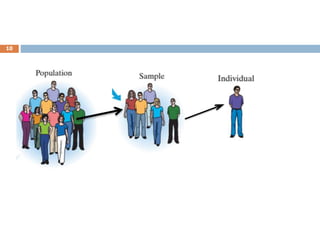
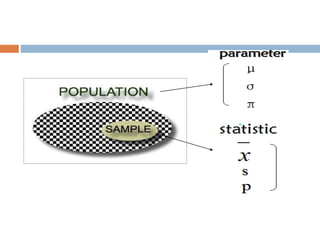
 A population consists of all subjects (human
or otherwise) that are being studied.
 Most of the time, due to the expense, time,
size of population, etc. it is not possible to use
the entire population for a statistical study;
therefore, researchers use samples.
 A sample is a group of subjects selected from
a population.
 An individual is a person or object that is a
member of the population being studied.
9
10
Sampling
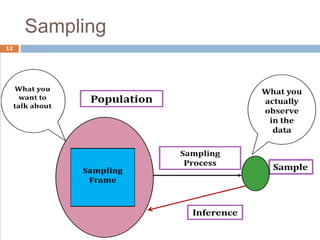
 Sampling is the process of selecting
observations (a sample) to provide an
adequate description and inferences of the
population.
 Sample
 It is a unit that is selected from population
 Represents the whole population
 Purpose to draw the inference
 Why Sample?
Sampling Frame Listing of population from
which a sample is chosen
11
Sampling
12
Sampling
14
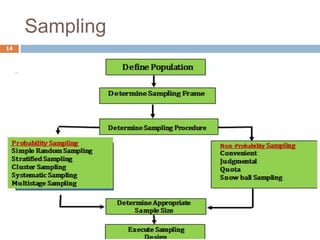
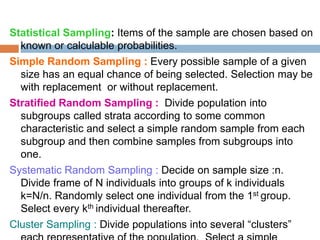
Statistical Sampling: Items of the sample are chosen based on
known or calculable probabilities.
Simple Random Sampling : Every possible sample of a given
size has an equal chance of being selected. Selection may be
with replacement or without replacement.
Stratified Random Sampling : Divide population into
subgroups called strata according to some common
characteristic and select a simple random sample from each
subgroup and then combine samples from subgroups into
one.
Systematic Random Sampling : Decide on sample size :n.
Divide frame of N individuals into groups of k individuals
k=N/n. Randomly select one individual from the 1st group.
Select every kth individual thereafter.
Cluster Sampling : Divide populations into several “clusters”
Non Probability sampling
 Convenience Sampling
 Quota Sampling
 Judgmental Sampling (Purposive
Sampling)
 Snowball sampling
16
Non Probability sampling
 Convenience Sampling
 Convenience sampling involves choosing
respondents at the convenience of the
researcher
 Judgmental Sampling (Purposive Sampling
 Researcher employs his or her own "expert”
judgment about.
 Quota Sampling
 The population is first segmented into mutually
exclusive sub-groups, just as in stratified
17
Non Probability sampling
 Snowball sampling
 The research starts with a key person and
introduce the next one to become a chain
18
Variables and Types of Data
 To gain knowledge about seemingly
haphazard situations, statisticians collect
information for variables, which describe the
situation.
 A variable In statistics, variables are
measurable characteristics of things (persons,
objects, places, etc) that vary within a group of
such things
 Data is a collection of facts or measurements
attributed to an entity.
 Examples are a list of percentage scores of
19
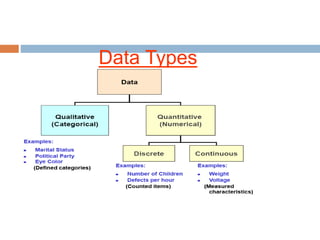
Data Types
21
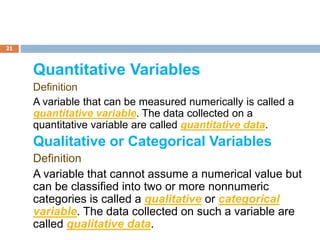
Quantitative Variables
Definition
A variable that can be measured numerically is called a
quantitative variable. The data collected on a
quantitative variable are called quantitative data.
Qualitative or Categorical Variables
Definition
A variable that cannot assume a numerical value but
can be classified into two or more nonnumeric
categories is called a qualitative or categorical
variable. The data collected on such a variable are
called qualitative data.
22
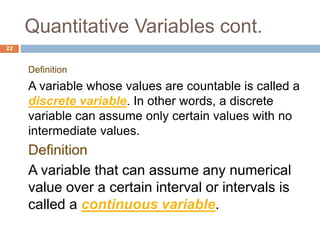
Quantitative Variables cont.
Definition
A variable whose values are countable is called a
discrete variable. In other words, a discrete
variable can assume only certain values with no
intermediate values.
Definition
A variable that can assume any numerical
value over a certain interval or intervals is
called a continuous variable.
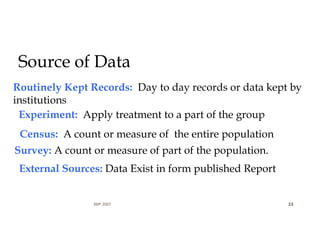
Source of Data
JWP 2007 23
Routinely Kept Records: Day to day records or data kept by
institutions
Census: A count or measure of the entire population
Survey: A count or measure of part of the population.
Experiment: Apply treatment to a part of the group
External Sources: Data Exist in form published Report
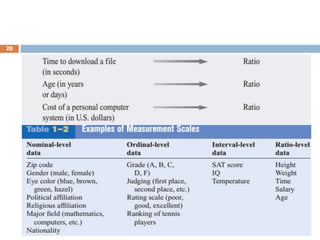
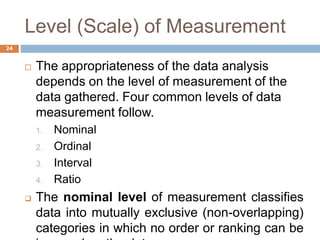
Level (Scale) of Measurement
 The appropriateness of the data analysis
depends on the level of measurement of the
data gathered. Four common levels of data
measurement follow.
1. Nominal
2. Ordinal
3. Interval
4. Ratio
 The nominal level of measurement classifies
data into mutually exclusive (non-overlapping)
categories in which no order or ranking can be
24
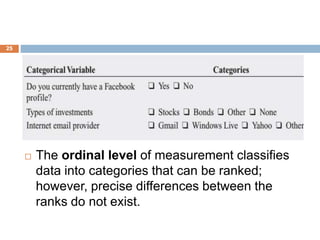
 The ordinal level of measurement classifies
data into categories that can be ranked;
however, precise differences between the
ranks do not exist.
25
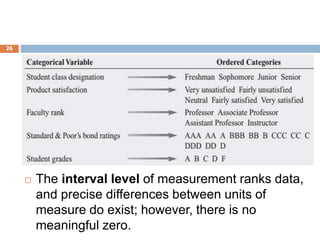
 The interval level of measurement ranks data,
and precise differences between units of
measure do exist; however, there is no
meaningful zero.
26
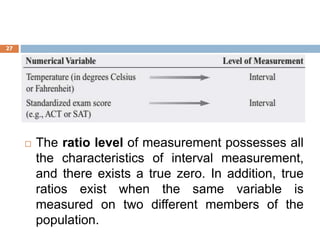
 The ratio level of measurement possesses all
the characteristics of interval measurement,
and there exists a true zero. In addition, true
ratios exist when the same variable is
measured on two different members of the
population.
27
28
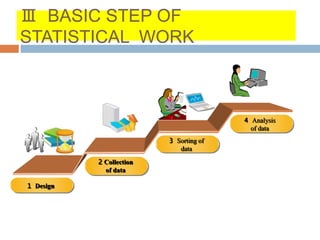
1 Design
2 Collection
of data
3 Sorting of
data
4 Analysis
of data
Ⅲ BASIC STEP OF
STATISTICAL WORK
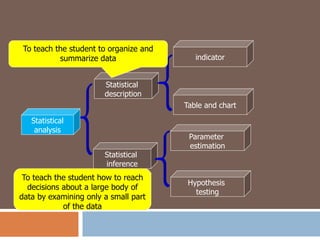
Statistical
description
Statistical
inference
indicator
Table and chart
Parameter
estimation
Hypothesis
testing
Statistical
analysis
To teach the student to organize and
summarize data
To teach the student how to reach
decisions about a large body of
data by examining only a small part
of the data
ANY QUESTION?
THANK YOU
31

chapter 1.pptx

  • 1.
  • 2.
  • 3.
    Objectives of thechapter  Demonstrate knowledge of statistical terms.  Differentiate between the two branches of statistics.  Identify types of data.  Identify the measurement level for each variable.  Identify the basic sampling techniques. 3
  • 4.
    * Biostatistics: 4  Thetools of statistics are employed in many fields: business, education, psychology, agriculture, economics, … etc.  When the data analyzed are derived from the biological science and medicine,  we use the term biostatistics to distinguish this particular application of statistical tools and concepts.
  • 5.
    Definition of Statistics? Statistics is the science of conducting studies to collect, organize, summarize, analyze, and draw conclusions from data.  Statistics The science of collecting, describing, and interpreting data.  Statistics is the study of how to collect, organize, analyze, and interpret numerical information from data.  Bio-statistics is the branch of applied statistics that applies statistical methods to biological science and medicine. 5
  • 6.
    Types of Statistics Thetwo areas of Statistics are: Descriptive statistics and Inferential statistic.  Descriptive statistics involves methods of collection, organizing, picturing, and summarizing information from samples or populations.  Inferential statistics consists of generalizing from samples to populations, performing estimations and hypothesis tests, determining relationships among variables, and making predictions. 6
  • 7.
     In descriptivestatistics the statistician tries to describe a situation. Consider the national census conducted by the Somaliland government every 10 years. Results of this census give you the average age, income, and other characteristics of the Somaliland population.  The area of inferential statistics called hypothesis testing is a decision-making process for evaluating claims about a population, based on information obtained 7
  • 8.
    Reasons to studyStatistics  Statistics is an important tool for Planning, research, decision making and problem solving.  In diverse areas such as business, financial management, education policy, we use statistical analysis to make decisions.  It is a tool for scientific description and inference.  It helps to know how to properly present information.  It helps to recognize problems with published information.  It helps to know how to draw appropriate conclusions from data.  It helps to improve processes.  To obtain reliable forecasts. 8
  • 9.
     A populationconsists of all subjects (human or otherwise) that are being studied.  Most of the time, due to the expense, time, size of population, etc. it is not possible to use the entire population for a statistical study; therefore, researchers use samples.  A sample is a group of subjects selected from a population.  An individual is a person or object that is a member of the population being studied. 9
  • 10.
  • 11.
    Sampling  Sampling isthe process of selecting observations (a sample) to provide an adequate description and inferences of the population.  Sample  It is a unit that is selected from population  Represents the whole population  Purpose to draw the inference  Why Sample? Sampling Frame Listing of population from which a sample is chosen 11
  • 12.
  • 14.
  • 15.
    Statistical Sampling: Itemsof the sample are chosen based on known or calculable probabilities. Simple Random Sampling : Every possible sample of a given size has an equal chance of being selected. Selection may be with replacement or without replacement. Stratified Random Sampling : Divide population into subgroups called strata according to some common characteristic and select a simple random sample from each subgroup and then combine samples from subgroups into one. Systematic Random Sampling : Decide on sample size :n. Divide frame of N individuals into groups of k individuals k=N/n. Randomly select one individual from the 1st group. Select every kth individual thereafter. Cluster Sampling : Divide populations into several “clusters”
  • 16.
    Non Probability sampling Convenience Sampling  Quota Sampling  Judgmental Sampling (Purposive Sampling)  Snowball sampling 16
  • 17.
    Non Probability sampling Convenience Sampling  Convenience sampling involves choosing respondents at the convenience of the researcher  Judgmental Sampling (Purposive Sampling  Researcher employs his or her own "expert” judgment about.  Quota Sampling  The population is first segmented into mutually exclusive sub-groups, just as in stratified 17
  • 18.
    Non Probability sampling Snowball sampling  The research starts with a key person and introduce the next one to become a chain 18
  • 19.
    Variables and Typesof Data  To gain knowledge about seemingly haphazard situations, statisticians collect information for variables, which describe the situation.  A variable In statistics, variables are measurable characteristics of things (persons, objects, places, etc) that vary within a group of such things  Data is a collection of facts or measurements attributed to an entity.  Examples are a list of percentage scores of 19
  • 20.
  • 21.
    21 Quantitative Variables Definition A variablethat can be measured numerically is called a quantitative variable. The data collected on a quantitative variable are called quantitative data. Qualitative or Categorical Variables Definition A variable that cannot assume a numerical value but can be classified into two or more nonnumeric categories is called a qualitative or categorical variable. The data collected on such a variable are called qualitative data.
  • 22.
    22 Quantitative Variables cont. Definition Avariable whose values are countable is called a discrete variable. In other words, a discrete variable can assume only certain values with no intermediate values. Definition A variable that can assume any numerical value over a certain interval or intervals is called a continuous variable.
  • 23.
    Source of Data JWP2007 23 Routinely Kept Records: Day to day records or data kept by institutions Census: A count or measure of the entire population Survey: A count or measure of part of the population. Experiment: Apply treatment to a part of the group External Sources: Data Exist in form published Report
  • 24.
    Level (Scale) ofMeasurement  The appropriateness of the data analysis depends on the level of measurement of the data gathered. Four common levels of data measurement follow. 1. Nominal 2. Ordinal 3. Interval 4. Ratio  The nominal level of measurement classifies data into mutually exclusive (non-overlapping) categories in which no order or ranking can be 24
  • 25.
     The ordinallevel of measurement classifies data into categories that can be ranked; however, precise differences between the ranks do not exist. 25
  • 26.
     The intervallevel of measurement ranks data, and precise differences between units of measure do exist; however, there is no meaningful zero. 26
  • 27.
     The ratiolevel of measurement possesses all the characteristics of interval measurement, and there exists a true zero. In addition, true ratios exist when the same variable is measured on two different members of the population. 27
  • 28.
  • 29.
    1 Design 2 Collection ofdata 3 Sorting of data 4 Analysis of data Ⅲ BASIC STEP OF STATISTICAL WORK
  • 30.
    Statistical description Statistical inference indicator Table and chart Parameter estimation Hypothesis testing Statistical analysis Toteach the student to organize and summarize data To teach the student how to reach decisions about a large body of data by examining only a small part of the data
  • 31.

Editor's Notes