Control of DC Drives
BY: Keval Patel(100110111007)
Sandip Dobariya(100110111013)
Introduction:
 The most common form of variable speed D.C. drive
is based on the control of armature voltage.
 The speed of D.C. motor has to be controlled from
an A.C. or D.C. source.
 More commonly controlled rectifier is used to supply
the motor armature.
 Phase locked loop control techniques are employed in
some D.C. Drives to provide the precise speed
control.
Types of configuration:
 Series exited D.C. motors:
 Series motors are traditionally employed for traction application.
 Separately exited D.C. motors:
 At present, separately exited D.C. motors controlled by thyristor
convertors are the most widely used motor drive system in industry.
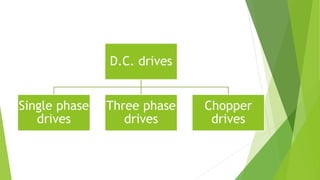
D.C. drives
Single phase
drives
Three phase
drives
Chopper
drives
Single phase and three phase D.C.
drives:
 The converter used for particular application depends on
such factors as supply available one phase or three phase.
D.C. chopper drives:
 To control the speed of DC motors, we can control the motor
terminal voltages. The chopper output voltage is proportional
to the chopper switching frequency and its duty cycle, so the
magnitude of voltages entering the terminal motors can be
adjusted, and so the motor speed.
 Control of D.C. motor’s speed by a chopper is required where
the supply is D.C. (as from a battery) or an A.C. voltage that
has already been rectified to a D.C. voltage.
 The most important application of choppers are in the speed
control of D.C. motors used in industrial or traction drives.
D.C. chopper drives:
 Choppers are used for the control of D.C. motors because
of number of advantages, such as high efficiency,
flexibility in control, light weight, small size, quick
response.
 Chopper control D.C. drive has also application in servos
in battery operated vehicles such as forkflift, trolleys so
on.
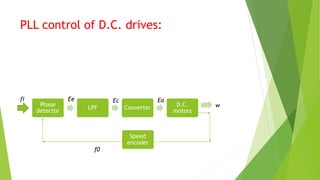
PLL control of D.C. drives:
 In the phase-locked loop method, motor speed is
converted to a digital pulse train, which is synchronized
with a reference digital pulse train. In this way, by locking
onto a reference frequency, precise control of motor
speed is achieved.
PLL control of D.C. drives:
Phase
detector
LPF Converter
D.C.
motors
Speed
encoder
fi
f0
Ee Ec Ea
w
Advantages:
 Smaller in size
 Very efficient
 Highly reliable
Applications:
1. Rolling mills
2. Paper mills
3. Printing press
4. Mine winders
5. Machine tools
THANK YOU

Control of dc drives

  • 1.
    Control of DCDrives BY: Keval Patel(100110111007) Sandip Dobariya(100110111013)
  • 2.
    Introduction:  The mostcommon form of variable speed D.C. drive is based on the control of armature voltage.  The speed of D.C. motor has to be controlled from an A.C. or D.C. source.  More commonly controlled rectifier is used to supply the motor armature.  Phase locked loop control techniques are employed in some D.C. Drives to provide the precise speed control.
  • 3.
    Types of configuration: Series exited D.C. motors:  Series motors are traditionally employed for traction application.  Separately exited D.C. motors:  At present, separately exited D.C. motors controlled by thyristor convertors are the most widely used motor drive system in industry.
  • 4.
    D.C. drives Single phase drives Threephase drives Chopper drives
  • 5.
    Single phase andthree phase D.C. drives:  The converter used for particular application depends on such factors as supply available one phase or three phase.
  • 6.
    D.C. chopper drives: To control the speed of DC motors, we can control the motor terminal voltages. The chopper output voltage is proportional to the chopper switching frequency and its duty cycle, so the magnitude of voltages entering the terminal motors can be adjusted, and so the motor speed.  Control of D.C. motor’s speed by a chopper is required where the supply is D.C. (as from a battery) or an A.C. voltage that has already been rectified to a D.C. voltage.  The most important application of choppers are in the speed control of D.C. motors used in industrial or traction drives.
  • 7.
    D.C. chopper drives: Choppers are used for the control of D.C. motors because of number of advantages, such as high efficiency, flexibility in control, light weight, small size, quick response.  Chopper control D.C. drive has also application in servos in battery operated vehicles such as forkflift, trolleys so on.
  • 8.
    PLL control ofD.C. drives:  In the phase-locked loop method, motor speed is converted to a digital pulse train, which is synchronized with a reference digital pulse train. In this way, by locking onto a reference frequency, precise control of motor speed is achieved.
  • 9.
    PLL control ofD.C. drives: Phase detector LPF Converter D.C. motors Speed encoder fi f0 Ee Ec Ea w
  • 10.
    Advantages:  Smaller insize  Very efficient  Highly reliable
  • 11.
    Applications: 1. Rolling mills 2.Paper mills 3. Printing press 4. Mine winders 5. Machine tools
  • 12.