Drives
Drives (Actuation Systems)
Instructor:- Mr. K. B. Kolhapure
Learning Objectives & Outcomes
Learning objectives:-
1. Student should able to understand different types of motors with their construction,
Working & applications
Upon completion of this chapter, the student should be able to:
1.Student should will be able to Explain different types of motors with their
construction, Working & applications.
Prerequisites:-
1) Permanent & Electromagnet
2) Lorentz law
3) Fleming Left hand Rule
4) Faradays Law of Induction
5) Lenz Law
Working Principle of DC motor
• https://youtu.be/Ylgb8FFMgd4
• https://youtu.be/fWyzPdyCAzU
Electrical drives (Electric Actuators)
Actuator:- The devices whose output is mechanical motion (linear or rotational)
Types of actuator:- 1) Mechanical Actuators 2) Electromechanical Actuators 3) Hydraulic & Pneumatic
Actuators
Electromechanical Actuators:-
⮚ The devices that converts electrical energy into mechanical energy.
Fig:- Classification of Electric Motor
DC Motor
DC Motor :- The DC motor is the device which converts the direct current into the mechanical work.
Principle of DC Motor:- It works on the principle of Lorentz Law, which states that “If a current carrying
conductor is placed in a magnetic field ,then the conductor experiences a force”
The Fleming left-hand rule gives the direction of the force
⮚ The current in the coil changes every half-cycle as the coil rotates which is found by Fleming’s Right-
hand Rule , in order to obtain a unidirectional current, commutator segments are attached to the brushes
Magnitude of the force,
Construction of D C Motor
Construction (Main Parts) :-
1. Stator/Field magnet (NS): Horse shoe magnet but for strong field electromagnet is used.
2. Rotor/Armature : Insulated copper wire, wound on soft iron core.
3. Split ring commutator: copper ring split into halves
4. Brushes (B1​,B2​): Carbon strips which slide against the split rings
⮚ The current induced in the armature flows through these brushes in the eternal circuit.
1. Stator
2. Rotor
3& 4 Commutator & Brushes
Working of D C Motor
⮚ For simplicity, consider that the armature has only one coil which is placed between the magnetic field
shown below in the figure.
⮚ When the DC supply is given to the armature coil the current starts flowing through it. This current
develops its own field around the coil.
⮚ By the interaction of the fields (produced by the coil and the magnet), the resultant field develops across
the conductor.
⮚ This resultant field tends to regain its original position, i.e. in the axis of the main field. This field exerts
the force at the ends of the conductor, and thus the coil starts rotating.
Working of D C Motor
Cont….
Advantages of brushed DC motor:
• The design of the brushed DC motor is quite simple
• Controlling the speed of a Brush DC Motor is easy
• Very cost effective
Disadvantages of brushed DC motor:
• High maintenance
• Performance decreases with dust particles
• Less reliable in control at lower speeds
• The brushes wear off with usage
https://www.youtube.com/watch?v=BaEHVpKc-1Q
https://www.youtube.com/watch?v=WUal9LXc0iM
• Working (How Works)
• https://youtu.be/wxG3cwugXgs
• https://youtu.be/LAtPHANEfQo (imp)
• https://youtu.be/CWulQ1ZSE3c (cont)
Types Of DC Motor
Depending upon power source 1. Separately excited 2. Self Excited
Types Of DC Motor
Depending upon arrangement of stator & rotor Self Excited motor classified as
2. Brushless DC motor
• A brushless DC motor has a rotor with permanent magnets and a stator with windings (same
as Brush Motor). The rotor can be of ceramic permanent magnet type.
• The brushes and commutator are eliminated and the windings are connected to the control
electronics. The control electronics replace the commutator and brushes and energize the
stator sequentially.
• Here the conductor is fixed and the magnet moves
• The current supplied to the stator is based on the position of rotor. It is switched in sequence
using transistors.
❖ Working (Inner Rotor)
BLDC Types
The position of the rotor is sensed by Hall effect sensors, Thus a continuous rotation is obtained.
Operation of BLDC
Operation of BLDC
Operation of BLDC
⮚ The Operation of Outer Runner BLDC is based on the simple force inreaction between the permanent
magnet and electromagnet.
⮚ in this condition when coil A is energized, the opposite poles of rotor and stator are attracted to each
other (the attractive force is shown with green arrow) as the result the rotor poles move near to the
energized stator.
⮚ As the rotor nears coil A, coil B energized. As the rotor nears coil B Coil C energized. after that coil A is
energized with opposite polarity
Operation of BLDC
This Process is repeated, and rotor continuous to rotate, The DC current required in each coil is shown with
following group
2. Brushless DC motor
Advantages:-
• More precise due to computer control
• More efficient
• No sparking due to absence of brushes
• Less electrical noise
• No brushes to wear out
• Electromagnets are situated on the stator hence easy to cool
• Motor can operate at speeds above 10,000 rpm under loaded and unloaded conditions
• Responsiveness and quick acceleration due to low rotor inertia
Disadvantages of brushless DC motor:
• Higher initial cost
• Complex due to presence of computer controller
• Brushless DC motor also requires additional system wiring in order to power the electronic
commutation circuitry
• https://youtu.be/bCEiOnuODac (brushless DC Motor)
AC motors
⮚ AC motors convert AC current into the rotation of a mechanical element (mechanical energy).
DC Vs AC Motor
Typical components include a stator and a rotor.
The stator is formed by electromagnets similar to DC motors, and armature of rotor is a magnet
unlike DC motors
1. Synchronous Motor
Definition: The motor which runs at synchronous speed is known as the synchronous motor.
Construction of Synchronous Motor
Main Parts:- 1) Stator :- Electromagnets (similar to DC stator but with AC Supply)
2) Rotor :- Phase wound with squirrel case housing on rotor (rotor winding with Dc supply)
Construction
a) Salient Pole Rotor- b) Non- Salient Pole Rotor or Cylindrical Rotor:-
C) Miscellaneous Parts
• Brushes: -
• Bearings: -
• Shaft:
Working Principle
Faraday Law of Induction
Working Principle
Working Synchronous Motor (3 Phase)
⮚ The stator and rotor both are excited separately.
⮚ When the three phase supply is given to the stator, the rotating magnetic field developed
between the stator and rotor gap. The field having moving polarities is known as the
rotating magnetic field.
⮚ Because of the rotating magnetic field, the north and south poles develop on the stator.
⮚ The rotor is excited by the DC supply. The DC supply induces the north and south poles on
the rotor.
⮚ As the DC supply remains constant, the flux induces on the rotor remains same. Thus, the
flux has fixed polarity.
⮚ The north pole develops on one end of the rotor, and the south pole develops on another end.
Working Synchronous Motor (3 Phase)
Why Synchronous Motor are not self starting
⮚ The AC is sinusoidal. The polarity of the wave changes in every half cycle, i.e., the wave remains positive in the first
half cycle and becomes negative in the second half cycle. The positive and negative half cycle of the wave develops the
north and south pole on the stator respectively.
⮚ When the rotor and stator both have the same pole on the same side, they repel each other. If they have opposite poles,
they attract each other. This can easily be understood with the help of the figure shown below.
⮚ The rotor attracts towards the pole of the stator for the first half cycle of the supply and repulse for the second
half cycle. Thus the rotor becomes pulsated only at one place. This is the reason because of which the synchronous
motor is not self-starting.
How to Over come problem of Self Starting
1. By giving initial manual jerk to rotor
2. By using Squirrel cage type of casing is used over the phase wound rotor
Synchronous speed of an AC motor is determined by the following formula:
• 𝑁𝑠= 120∗𝑓/𝑃
• Ns = Revolutions per minute
• P = Number of pole pairs
• f = Applied frequency
Main Features of Synchronous Motor
⮚ The speed of the synchronous motor is independent of the load, i.e.,
the variation of the load does not affect the speed of the motor.
⮚ The synchronous motor is not self-starting. The prime mover is used
for rotating the motor at their synchronous speed.
⮚ The synchronous motor operates both for leading and lagging power
factor.
⮚ The synchronous motor can also be started with the help of the
damper windings.
2. Induction motor
Definition:- The machine which converts the AC electric power into mechanical power by using an
electromagnetic induction phenomenon in called an induction motor
Construction:-
The stator is similar to synchronous motor with windings but the rotors’ construction is different.
1. Stator:-
2. Rotor:-
⮚ The slip rings are mounted on the shaft with brushes resting on them. The brushes are connected to the variable
resistor.
⮚ The function of the slip rings and the brushes is to provide a means of connecting external resistors in the rotor
circuit. The resistor enables the variation of each rotor phase resistance to serve the following purposes given
below.
• It increases the starting torque and decreases the starting current.
• It is used to control the speed of the motor.
2. Induction motor (Asynchronous Machine)
Working Principle of an Induction Motor
Working of Induction Motor
Induction motors can be classified into two types:
• Single-phase induction motor: It has one stator winding and a squirrel cage rotor. It operates with a single-
phase power supply and requires a device to start the motor.
• Three-phase induction motor: The rotating magnetic field is produced by the balanced three-phase power
supply. These motors can have squirrel cage or wound rotors and are self-starting.
Principle and working of 3 phase Motor
When 3 phase supply is given to the motor, the resulting current generates a magnetic flux “Ø”.
Due to the switching sequence of 3 phase current in R, Y, and B, the generated flux rotates around the rotor
conductor.
According to Faraday’s law, which states that –“an emf induced in any closed circuit is due to the rate of
change of magnetic flux through the circuit”, Emf is induced in the Copper bar and due to this, current
flows in the rotor. The direction of the rotor can be given by Lenz law which states that – “the direction
of induced current will be in the opposite of the motion causing it.”
Here the relative velocity between the rotating flux and static rotor conductor is the cause of current
generation; hence the rotor will rotate in the same direction to reduce the cause i.e. the relative velocity,
thus rotating the rotor of the induction motor.
Working of Induction Motor
AC Motors
Advantages of AC induction motors
• It has a simple design, low initial cost, rugged construction almost unbreakable
• The operation is simple with less maintenance (as there are no brushes)
• The efficiency of these motors is very high, as there are no frictional losses, with reasonably good power
factor
• The control gear for the starting purpose of these motors is minimum and thus simple and reliable operation
Disadvantages of AC induction motors
• The speed control of these motors is at the expense of their efficiency
• As the load on the motor increases, the speed decreases
• The starting torque is inferior when compared to DC motors
Applications:-
1. Single phase induction motor is usually built in small size (up to 3 H.P). In all the domestic appliances
such as refrigerators, fans, washing machines, hair dryers, mixer grinder, etc., single phase induction
motor are used.
2. Three phase induction motors are mainly used in the industry for power conversion, i.e., electrical to
mechanical power conversion in bulk or large quantity. But for small power conversion single phase
induction motors are used. The induction motors perform a variety of services in the home, office,
business, factories, etc.
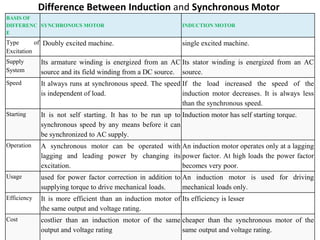
Difference Between Induction and Synchronous Motor
BASIS OF
DIFFERENC
E
SYNCHRONOUS MOTOR INDUCTION MOTOR
Type of
Excitation
Doubly excited machine. single excited machine.
Supply
System
Its armature winding is energized from an AC
source and its field winding from a DC source.
Its stator winding is energized from an AC
source.
Speed It always runs at synchronous speed. The speed
is independent of load.
If the load increased the speed of the
induction motor decreases. It is always less
than the synchronous speed.
Starting It is not self starting. It has to be run up to
synchronous speed by any means before it can
be synchronized to AC supply.
Induction motor has self starting torque.
Operation A synchronous motor can be operated with
lagging and leading power by changing its
excitation.
An induction motor operates only at a lagging
power factor. At high loads the power factor
becomes very poor.
Usage used for power factor correction in addition to
supplying torque to drive mechanical loads.
An induction motor is used for driving
mechanical loads only.
Efficiency It is more efficient than an induction motor of
the same output and voltage rating.
Its efficiency is lesser
Cost costlier than an induction motor of the same
output and voltage rating
cheaper than the synchronous motor of the
same output and voltage rating.
Stepper motors
Stepper motor :- a pulse-driven motor that changes the angular position
of the rotor in steps.
-It is a brushless, synchronous electric motor that can divide a full
rotation into an expansive number of steps.
-The motor’s position can be controlled accurately without any feedback
mechanism, as long as the motor is carefully sized to the application.
Stepper motors are similar to switched reluctance motors.
Working Principle
Driving Modes
Driving Modes
Driving Modes
• Another way of increasing the resolution of the stepper motor is by increasing the numbers of the poles
of the rotor and the numbers of the pole of the stator.
Stepper Motor Types by Construction
By construction there are 3 different types of stepper motors:
Types of stepper motors:
1. Permanent magnet stepper
2. Variable reluctance stepper
3. Hybrid synchronous stepper
Permanent magnet stepper
The Permanent Magnet stepper has a permanent magnet rotor which is driven by the stators windings. They
create opposite polarity poles compared to the poles of the rotor which propels the rotor.
Variable Reluctant stepper
The Variable Reluctant stepper motor uses a non-magnetizes soft iron rotor. The rotor has teeth that are
offset from the stator and as we active the windings in a particular order the rotor moves respectively so
that it has minimum gab between the stator and the teeth of the rotor
Hybrid Synchronous motor
The Hybrid Synchronous motor is combinations of the previous two steppers. It has permanent magnet
toothed rotor and also a toothed stator. The rotor has two sections, which are opposite in polarity and
their teeth are offset as shown here.
This is a front view of a commonly used hybrid stepper motor which has 8 poles on the stator that are
activated by 2 windings, A and B. So if we activate the winding A, we will magnetize 4 poles of which
two of them will have South polarity and two of them North polarity.
Hybrid Synchronous motor
• We can see that in such a way the rotors teeth are aligned with the teeth of poles A and unaligned with
the teeth of the poles B. That means that in the next step when we turn off the A poles and activate the B
poles, the rotor will move counter clock wise and its teeth will align with the teeth of the B poles.
If we keep activating the poles in a particular order the rotor will move continuously. Here we can also use
different driving modes like the wave drive, full step drive, half step drive and microstepping for even
further increasing the resolution of the stepper motor.
Cont….
• Advantages of stepper motors
• Low cost
• Ruggedness
• Simplicity of construction
• Low maintenance
• Less likely to stall or slip
• Will work in any environment
• Excellent start-stop and reversing responses
Disadvantages of stepper motors
• Low torque capacity compared to DC motors
• Limited speed
• During overloading, the synchronization will be broken. Vibration and noise occur when running at high
speed.
• Applications:
• Industrial Machines – Stepper motors are used in automotive gauges and machine tooling automated
production equipment.
• Security – new surveillance products for the security industry.
• Medical – Stepper motors are used inside medical scanners, samplers, and also found inside digital
dental photography, fluid pumps, respirators, and blood analysis machinery.
• Consumer Electronics – Stepper motors in cameras for automatic digital camera focus and zoom
functions.
• And also have business machines applications, computer peripherals applications.
Servomotor
⮚ Servomotors are special electromechanical devices that produce precise degrees of rotation. A servo
motor is a DC or AC or brushless DC motor combined with a position sensing device.
⮚ Servomotors are also called control motors as they are involved in controlling a mechanical system. The
servomotors are used in a closed-loop servo system as shown in Figure A reference input is sent to the
servo amplifier, which controls the speed of the servomotor.
Servomotor
• Classification of Servo Motor
• DC Servo Motors are separately excited DC motor or permanent magnet DC motors. The figure (a)
shows the connection of Separately Excited DC Servo motor and the figure (b) shows the armature MMF
and the excitation field MMF in quadrature in a DC machine.
DC Servomotor
A servo motor is a rotary actuator or a motor that allows for a precise control in terms of the
angular position, acceleration, and velocity. Basically it has certain capabilities that a regular
motor does not have.
Consequently it makes use of a regular motor and pairs it with a sensor for position feedback .
⮚ The basic operating principle of DC motor is the same as other electromagnetic motors.
⮚ The design, construction, and the modes of operation are different.
⮚ The rotors of this kind of motor are designed with long rotor length and smaller diameters.
Their size is larger than that of conventional motors of same power ratings.
AC Servomotor
• AC Servomotor is basically two phase induction motor
• It consist of Two winding which displaced at 900 to each other with phase
• Torque speed characteristics are linear as compared to normal induction motor due to some
constructional modification such as
1) Length of rotor increased & low weight material is used for rotor due to this inertia of rotor is low as
compared
2) X/R Ratio is small as compared to normal induction motor

Drives.pptx

  • 1.
  • 2.
    Learning Objectives &Outcomes Learning objectives:- 1. Student should able to understand different types of motors with their construction, Working & applications Upon completion of this chapter, the student should be able to: 1.Student should will be able to Explain different types of motors with their construction, Working & applications. Prerequisites:- 1) Permanent & Electromagnet 2) Lorentz law 3) Fleming Left hand Rule 4) Faradays Law of Induction 5) Lenz Law Working Principle of DC motor • https://youtu.be/Ylgb8FFMgd4 • https://youtu.be/fWyzPdyCAzU
  • 3.
    Electrical drives (ElectricActuators) Actuator:- The devices whose output is mechanical motion (linear or rotational) Types of actuator:- 1) Mechanical Actuators 2) Electromechanical Actuators 3) Hydraulic & Pneumatic Actuators Electromechanical Actuators:- ⮚ The devices that converts electrical energy into mechanical energy. Fig:- Classification of Electric Motor
  • 4.
    DC Motor DC Motor:- The DC motor is the device which converts the direct current into the mechanical work. Principle of DC Motor:- It works on the principle of Lorentz Law, which states that “If a current carrying conductor is placed in a magnetic field ,then the conductor experiences a force” The Fleming left-hand rule gives the direction of the force ⮚ The current in the coil changes every half-cycle as the coil rotates which is found by Fleming’s Right- hand Rule , in order to obtain a unidirectional current, commutator segments are attached to the brushes Magnitude of the force,
  • 5.
    Construction of DC Motor Construction (Main Parts) :- 1. Stator/Field magnet (NS): Horse shoe magnet but for strong field electromagnet is used. 2. Rotor/Armature : Insulated copper wire, wound on soft iron core. 3. Split ring commutator: copper ring split into halves 4. Brushes (B1​,B2​): Carbon strips which slide against the split rings ⮚ The current induced in the armature flows through these brushes in the eternal circuit.
  • 6.
  • 7.
  • 8.
    3& 4 Commutator& Brushes
  • 9.
    Working of DC Motor ⮚ For simplicity, consider that the armature has only one coil which is placed between the magnetic field shown below in the figure. ⮚ When the DC supply is given to the armature coil the current starts flowing through it. This current develops its own field around the coil. ⮚ By the interaction of the fields (produced by the coil and the magnet), the resultant field develops across the conductor. ⮚ This resultant field tends to regain its original position, i.e. in the axis of the main field. This field exerts the force at the ends of the conductor, and thus the coil starts rotating.
  • 10.
    Working of DC Motor
  • 11.
    Cont…. Advantages of brushedDC motor: • The design of the brushed DC motor is quite simple • Controlling the speed of a Brush DC Motor is easy • Very cost effective Disadvantages of brushed DC motor: • High maintenance • Performance decreases with dust particles • Less reliable in control at lower speeds • The brushes wear off with usage https://www.youtube.com/watch?v=BaEHVpKc-1Q https://www.youtube.com/watch?v=WUal9LXc0iM • Working (How Works) • https://youtu.be/wxG3cwugXgs • https://youtu.be/LAtPHANEfQo (imp) • https://youtu.be/CWulQ1ZSE3c (cont)
  • 12.
    Types Of DCMotor Depending upon power source 1. Separately excited 2. Self Excited
  • 13.
    Types Of DCMotor Depending upon arrangement of stator & rotor Self Excited motor classified as
  • 14.
    2. Brushless DCmotor • A brushless DC motor has a rotor with permanent magnets and a stator with windings (same as Brush Motor). The rotor can be of ceramic permanent magnet type. • The brushes and commutator are eliminated and the windings are connected to the control electronics. The control electronics replace the commutator and brushes and energize the stator sequentially. • Here the conductor is fixed and the magnet moves • The current supplied to the stator is based on the position of rotor. It is switched in sequence using transistors. ❖ Working (Inner Rotor)
  • 15.
    BLDC Types The positionof the rotor is sensed by Hall effect sensors, Thus a continuous rotation is obtained.
  • 16.
  • 17.
  • 18.
    Operation of BLDC ⮚The Operation of Outer Runner BLDC is based on the simple force inreaction between the permanent magnet and electromagnet. ⮚ in this condition when coil A is energized, the opposite poles of rotor and stator are attracted to each other (the attractive force is shown with green arrow) as the result the rotor poles move near to the energized stator. ⮚ As the rotor nears coil A, coil B energized. As the rotor nears coil B Coil C energized. after that coil A is energized with opposite polarity
  • 19.
    Operation of BLDC ThisProcess is repeated, and rotor continuous to rotate, The DC current required in each coil is shown with following group
  • 20.
    2. Brushless DCmotor Advantages:- • More precise due to computer control • More efficient • No sparking due to absence of brushes • Less electrical noise • No brushes to wear out • Electromagnets are situated on the stator hence easy to cool • Motor can operate at speeds above 10,000 rpm under loaded and unloaded conditions • Responsiveness and quick acceleration due to low rotor inertia Disadvantages of brushless DC motor: • Higher initial cost • Complex due to presence of computer controller • Brushless DC motor also requires additional system wiring in order to power the electronic commutation circuitry • https://youtu.be/bCEiOnuODac (brushless DC Motor)
  • 21.
    AC motors ⮚ ACmotors convert AC current into the rotation of a mechanical element (mechanical energy).
  • 22.
    DC Vs ACMotor Typical components include a stator and a rotor. The stator is formed by electromagnets similar to DC motors, and armature of rotor is a magnet unlike DC motors
  • 23.
    1. Synchronous Motor Definition:The motor which runs at synchronous speed is known as the synchronous motor. Construction of Synchronous Motor Main Parts:- 1) Stator :- Electromagnets (similar to DC stator but with AC Supply) 2) Rotor :- Phase wound with squirrel case housing on rotor (rotor winding with Dc supply)
  • 24.
    Construction a) Salient PoleRotor- b) Non- Salient Pole Rotor or Cylindrical Rotor:- C) Miscellaneous Parts • Brushes: - • Bearings: - • Shaft:
  • 25.
  • 26.
  • 27.
    Working Synchronous Motor(3 Phase) ⮚ The stator and rotor both are excited separately. ⮚ When the three phase supply is given to the stator, the rotating magnetic field developed between the stator and rotor gap. The field having moving polarities is known as the rotating magnetic field. ⮚ Because of the rotating magnetic field, the north and south poles develop on the stator. ⮚ The rotor is excited by the DC supply. The DC supply induces the north and south poles on the rotor. ⮚ As the DC supply remains constant, the flux induces on the rotor remains same. Thus, the flux has fixed polarity. ⮚ The north pole develops on one end of the rotor, and the south pole develops on another end.
  • 28.
  • 29.
    Why Synchronous Motorare not self starting ⮚ The AC is sinusoidal. The polarity of the wave changes in every half cycle, i.e., the wave remains positive in the first half cycle and becomes negative in the second half cycle. The positive and negative half cycle of the wave develops the north and south pole on the stator respectively. ⮚ When the rotor and stator both have the same pole on the same side, they repel each other. If they have opposite poles, they attract each other. This can easily be understood with the help of the figure shown below. ⮚ The rotor attracts towards the pole of the stator for the first half cycle of the supply and repulse for the second half cycle. Thus the rotor becomes pulsated only at one place. This is the reason because of which the synchronous motor is not self-starting. How to Over come problem of Self Starting 1. By giving initial manual jerk to rotor 2. By using Squirrel cage type of casing is used over the phase wound rotor Synchronous speed of an AC motor is determined by the following formula: • 𝑁𝑠= 120∗𝑓/𝑃 • Ns = Revolutions per minute • P = Number of pole pairs • f = Applied frequency
  • 30.
    Main Features ofSynchronous Motor ⮚ The speed of the synchronous motor is independent of the load, i.e., the variation of the load does not affect the speed of the motor. ⮚ The synchronous motor is not self-starting. The prime mover is used for rotating the motor at their synchronous speed. ⮚ The synchronous motor operates both for leading and lagging power factor. ⮚ The synchronous motor can also be started with the help of the damper windings.
  • 31.
    2. Induction motor Definition:-The machine which converts the AC electric power into mechanical power by using an electromagnetic induction phenomenon in called an induction motor Construction:- The stator is similar to synchronous motor with windings but the rotors’ construction is different. 1. Stator:- 2. Rotor:- ⮚ The slip rings are mounted on the shaft with brushes resting on them. The brushes are connected to the variable resistor. ⮚ The function of the slip rings and the brushes is to provide a means of connecting external resistors in the rotor circuit. The resistor enables the variation of each rotor phase resistance to serve the following purposes given below. • It increases the starting torque and decreases the starting current. • It is used to control the speed of the motor.
  • 32.
    2. Induction motor(Asynchronous Machine) Working Principle of an Induction Motor
  • 33.
    Working of InductionMotor Induction motors can be classified into two types: • Single-phase induction motor: It has one stator winding and a squirrel cage rotor. It operates with a single- phase power supply and requires a device to start the motor. • Three-phase induction motor: The rotating magnetic field is produced by the balanced three-phase power supply. These motors can have squirrel cage or wound rotors and are self-starting. Principle and working of 3 phase Motor When 3 phase supply is given to the motor, the resulting current generates a magnetic flux “Ø”. Due to the switching sequence of 3 phase current in R, Y, and B, the generated flux rotates around the rotor conductor. According to Faraday’s law, which states that –“an emf induced in any closed circuit is due to the rate of change of magnetic flux through the circuit”, Emf is induced in the Copper bar and due to this, current flows in the rotor. The direction of the rotor can be given by Lenz law which states that – “the direction of induced current will be in the opposite of the motion causing it.” Here the relative velocity between the rotating flux and static rotor conductor is the cause of current generation; hence the rotor will rotate in the same direction to reduce the cause i.e. the relative velocity, thus rotating the rotor of the induction motor.
  • 34.
  • 35.
  • 36.
    AC Motors Advantages ofAC induction motors • It has a simple design, low initial cost, rugged construction almost unbreakable • The operation is simple with less maintenance (as there are no brushes) • The efficiency of these motors is very high, as there are no frictional losses, with reasonably good power factor • The control gear for the starting purpose of these motors is minimum and thus simple and reliable operation Disadvantages of AC induction motors • The speed control of these motors is at the expense of their efficiency • As the load on the motor increases, the speed decreases • The starting torque is inferior when compared to DC motors Applications:- 1. Single phase induction motor is usually built in small size (up to 3 H.P). In all the domestic appliances such as refrigerators, fans, washing machines, hair dryers, mixer grinder, etc., single phase induction motor are used. 2. Three phase induction motors are mainly used in the industry for power conversion, i.e., electrical to mechanical power conversion in bulk or large quantity. But for small power conversion single phase induction motors are used. The induction motors perform a variety of services in the home, office, business, factories, etc.
  • 37.
    Difference Between Inductionand Synchronous Motor BASIS OF DIFFERENC E SYNCHRONOUS MOTOR INDUCTION MOTOR Type of Excitation Doubly excited machine. single excited machine. Supply System Its armature winding is energized from an AC source and its field winding from a DC source. Its stator winding is energized from an AC source. Speed It always runs at synchronous speed. The speed is independent of load. If the load increased the speed of the induction motor decreases. It is always less than the synchronous speed. Starting It is not self starting. It has to be run up to synchronous speed by any means before it can be synchronized to AC supply. Induction motor has self starting torque. Operation A synchronous motor can be operated with lagging and leading power by changing its excitation. An induction motor operates only at a lagging power factor. At high loads the power factor becomes very poor. Usage used for power factor correction in addition to supplying torque to drive mechanical loads. An induction motor is used for driving mechanical loads only. Efficiency It is more efficient than an induction motor of the same output and voltage rating. Its efficiency is lesser Cost costlier than an induction motor of the same output and voltage rating cheaper than the synchronous motor of the same output and voltage rating.
  • 38.
    Stepper motors Stepper motor:- a pulse-driven motor that changes the angular position of the rotor in steps. -It is a brushless, synchronous electric motor that can divide a full rotation into an expansive number of steps. -The motor’s position can be controlled accurately without any feedback mechanism, as long as the motor is carefully sized to the application. Stepper motors are similar to switched reluctance motors.
  • 39.
  • 40.
  • 41.
  • 42.
    Driving Modes • Anotherway of increasing the resolution of the stepper motor is by increasing the numbers of the poles of the rotor and the numbers of the pole of the stator.
  • 43.
    Stepper Motor Typesby Construction By construction there are 3 different types of stepper motors: Types of stepper motors: 1. Permanent magnet stepper 2. Variable reluctance stepper 3. Hybrid synchronous stepper
  • 44.
    Permanent magnet stepper ThePermanent Magnet stepper has a permanent magnet rotor which is driven by the stators windings. They create opposite polarity poles compared to the poles of the rotor which propels the rotor.
  • 45.
    Variable Reluctant stepper TheVariable Reluctant stepper motor uses a non-magnetizes soft iron rotor. The rotor has teeth that are offset from the stator and as we active the windings in a particular order the rotor moves respectively so that it has minimum gab between the stator and the teeth of the rotor
  • 46.
    Hybrid Synchronous motor TheHybrid Synchronous motor is combinations of the previous two steppers. It has permanent magnet toothed rotor and also a toothed stator. The rotor has two sections, which are opposite in polarity and their teeth are offset as shown here. This is a front view of a commonly used hybrid stepper motor which has 8 poles on the stator that are activated by 2 windings, A and B. So if we activate the winding A, we will magnetize 4 poles of which two of them will have South polarity and two of them North polarity.
  • 47.
    Hybrid Synchronous motor •We can see that in such a way the rotors teeth are aligned with the teeth of poles A and unaligned with the teeth of the poles B. That means that in the next step when we turn off the A poles and activate the B poles, the rotor will move counter clock wise and its teeth will align with the teeth of the B poles. If we keep activating the poles in a particular order the rotor will move continuously. Here we can also use different driving modes like the wave drive, full step drive, half step drive and microstepping for even further increasing the resolution of the stepper motor.
  • 48.
    Cont…. • Advantages ofstepper motors • Low cost • Ruggedness • Simplicity of construction • Low maintenance • Less likely to stall or slip • Will work in any environment • Excellent start-stop and reversing responses Disadvantages of stepper motors • Low torque capacity compared to DC motors • Limited speed • During overloading, the synchronization will be broken. Vibration and noise occur when running at high speed. • Applications: • Industrial Machines – Stepper motors are used in automotive gauges and machine tooling automated production equipment. • Security – new surveillance products for the security industry. • Medical – Stepper motors are used inside medical scanners, samplers, and also found inside digital dental photography, fluid pumps, respirators, and blood analysis machinery. • Consumer Electronics – Stepper motors in cameras for automatic digital camera focus and zoom functions. • And also have business machines applications, computer peripherals applications.
  • 49.
    Servomotor ⮚ Servomotors arespecial electromechanical devices that produce precise degrees of rotation. A servo motor is a DC or AC or brushless DC motor combined with a position sensing device. ⮚ Servomotors are also called control motors as they are involved in controlling a mechanical system. The servomotors are used in a closed-loop servo system as shown in Figure A reference input is sent to the servo amplifier, which controls the speed of the servomotor.
  • 50.
    Servomotor • Classification ofServo Motor • DC Servo Motors are separately excited DC motor or permanent magnet DC motors. The figure (a) shows the connection of Separately Excited DC Servo motor and the figure (b) shows the armature MMF and the excitation field MMF in quadrature in a DC machine.
  • 51.
    DC Servomotor A servomotor is a rotary actuator or a motor that allows for a precise control in terms of the angular position, acceleration, and velocity. Basically it has certain capabilities that a regular motor does not have. Consequently it makes use of a regular motor and pairs it with a sensor for position feedback . ⮚ The basic operating principle of DC motor is the same as other electromagnetic motors. ⮚ The design, construction, and the modes of operation are different. ⮚ The rotors of this kind of motor are designed with long rotor length and smaller diameters. Their size is larger than that of conventional motors of same power ratings.
  • 52.
    AC Servomotor • ACServomotor is basically two phase induction motor • It consist of Two winding which displaced at 900 to each other with phase • Torque speed characteristics are linear as compared to normal induction motor due to some constructional modification such as 1) Length of rotor increased & low weight material is used for rotor due to this inertia of rotor is low as compared 2) X/R Ratio is small as compared to normal induction motor