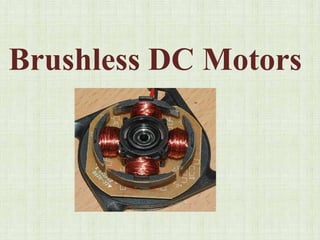
Brushless DC Motors
Presented by
Kumaresan A (161me527)
Moutheepan S (161me542)
Brushless DC Motors
Contents…
• Introduction
• Motor basics
• Principles of BLDC motor
• Construction
• Hall sensors
• Dismantling of BLDC motor
• Advantages
• Disadvantages
• Applications
• Conclusion
Introduction…
• Classical DC motors are no doubt good and
simple but inefficient in some ways.
• Although dc motors possess good control
characteristics and ruggedness, their performance
and applications are inhibited due to sparking and
commutation problems.
• The Permanent Magnet Brushless DC
(PMBLDC) motor is able to overcome the
limitations mentioned above and satisfy the
requirements of a variable speed drive.
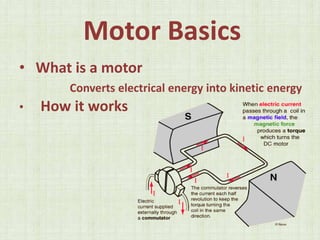
• What is a motor
Converts electrical energy into kinetic energy
• How it works
Motor Basics
Brushless DC Motor(BLDC)
Principles
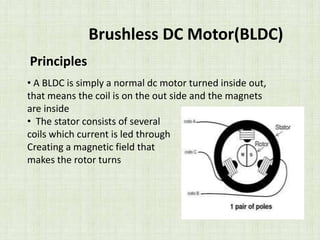
• A BLDC is simply a normal dc motor turned inside out,
that means the coil is on the out side and the magnets
are inside
• The stator consists of several
coils which current is led through
Creating a magnetic field that
makes the rotor turns
Construction
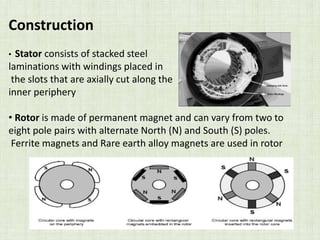
• Stator consists of stacked steel
laminations with windings placed in
the slots that are axially cut along the
inner periphery
• Rotor is made of permanent magnet and can vary from two to
eight pole pairs with alternate North (N) and South (S) poles.
Ferrite magnets and Rare earth alloy magnets are used in rotor
Unlike a brushed DC motor, the commutation
of a BLDC motor is controlled electronically.
It is important to know the rotor position in order
to understand which winding will be energized
following the energizing sequence.
Rotor position is sensed by different ways some
of them are
1) Hall sensors
2) Optical encoders
Hall Sensors
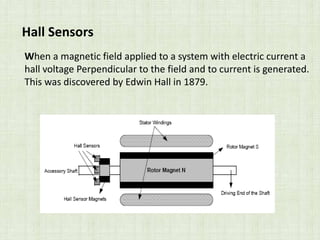
When a magnetic field applied to a system with electric current a
hall voltage Perpendicular to the field and to current is generated.
This was discovered by Edwin Hall in 1879.
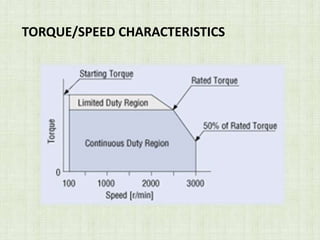
TORQUE/SPEED CHARACTERISTICS
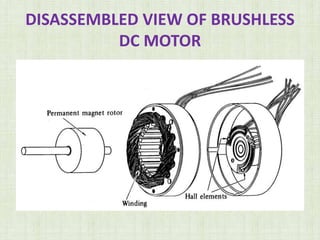
DISASSEMBLED VIEW OF BRUSHLESS
DC MOTOR
Advantages
• Increased Reliability & Efficiency
• Longer Life
• Elimination of Sparks from Commutator
• Reduced Friction
• Faster Rate of Voltage & Current
Disadvantages
• Requires Complex Drive Circuitry
• Requires additional Sensors
• Higher Cost
• Some designs require manual labor
(Hand wound Stator Coils)
Applications
Consumer: Hard Drives, CD/DVD
Drives, PC Cooling Fans, toys, RC
airplanes, air conditioners
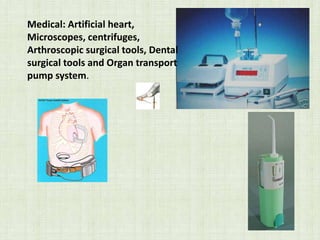
Medical: Artificial heart,
Microscopes, centrifuges,
Arthroscopic surgical tools, Dental
surgical tools and Organ transport
pump system.
Conclusion
• Although Brushless DC Motors are more expensive of
the same kW rating than conventional DC Motor but
there are many advantages.
• Brushless DC Motors can run when submerged in
fluids.
• Brushless DC Motor does not produce brush or
commutator particles or gases as by-products of
operation.
Brushless dc motor
Brushless dc motor

Brushless dc motor

  • 1.
    Brushless DC Motors Presentedby Kumaresan A (161me527) Moutheepan S (161me542)
  • 2.
  • 3.
    Contents… • Introduction • Motorbasics • Principles of BLDC motor • Construction • Hall sensors • Dismantling of BLDC motor • Advantages • Disadvantages • Applications • Conclusion
  • 4.
    Introduction… • Classical DCmotors are no doubt good and simple but inefficient in some ways. • Although dc motors possess good control characteristics and ruggedness, their performance and applications are inhibited due to sparking and commutation problems. • The Permanent Magnet Brushless DC (PMBLDC) motor is able to overcome the limitations mentioned above and satisfy the requirements of a variable speed drive.
  • 5.
    • What isa motor Converts electrical energy into kinetic energy • How it works Motor Basics
  • 6.
    Brushless DC Motor(BLDC) Principles •A BLDC is simply a normal dc motor turned inside out, that means the coil is on the out side and the magnets are inside • The stator consists of several coils which current is led through Creating a magnetic field that makes the rotor turns
  • 7.
    Construction • Stator consistsof stacked steel laminations with windings placed in the slots that are axially cut along the inner periphery • Rotor is made of permanent magnet and can vary from two to eight pole pairs with alternate North (N) and South (S) poles. Ferrite magnets and Rare earth alloy magnets are used in rotor
  • 8.
    Unlike a brushedDC motor, the commutation of a BLDC motor is controlled electronically. It is important to know the rotor position in order to understand which winding will be energized following the energizing sequence. Rotor position is sensed by different ways some of them are 1) Hall sensors 2) Optical encoders
  • 9.
    Hall Sensors When amagnetic field applied to a system with electric current a hall voltage Perpendicular to the field and to current is generated. This was discovered by Edwin Hall in 1879.
  • 10.
  • 11.
    DISASSEMBLED VIEW OFBRUSHLESS DC MOTOR
  • 12.
    Advantages • Increased Reliability& Efficiency • Longer Life • Elimination of Sparks from Commutator • Reduced Friction • Faster Rate of Voltage & Current
  • 13.
    Disadvantages • Requires ComplexDrive Circuitry • Requires additional Sensors • Higher Cost • Some designs require manual labor (Hand wound Stator Coils)
  • 14.
    Applications Consumer: Hard Drives,CD/DVD Drives, PC Cooling Fans, toys, RC airplanes, air conditioners
  • 15.
    Medical: Artificial heart, Microscopes,centrifuges, Arthroscopic surgical tools, Dental surgical tools and Organ transport pump system.
  • 16.
    Conclusion • Although BrushlessDC Motors are more expensive of the same kW rating than conventional DC Motor but there are many advantages. • Brushless DC Motors can run when submerged in fluids. • Brushless DC Motor does not produce brush or commutator particles or gases as by-products of operation.