Topic : “Classification of Motor”
PREPARED BY :
 Yash Contractor
 Bijohn Joseph
 Kundan Parmar
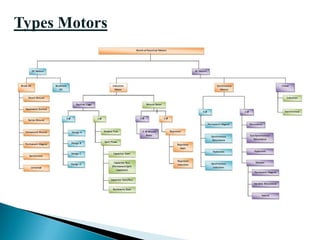
Types Motors
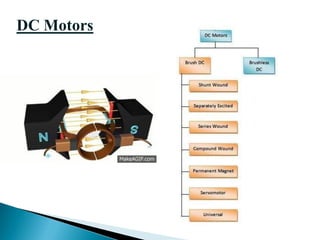
DC Motors
Advantages of DC Motor
 Easy to control their speed in a wide range
 Their reduced overall dimensions permit a considerable space saving
which let the manufacturer of the machines or of plants not to be
conditioned by the exaggerated dimensions of circular motors.
Disadvantages of DC Motor
 Sparks from the brushes may cause explosion if the environment contains
explosive materials.
 RF noise from the brushes may interfere with nearby TV sets, or
electronic devices, Etc.
 DC motors are also expensive relative to AC motors.
1. Shunt Wound
Advantages
 Motors have excellent speed control.
 Loss of magnetism is not an issue in SHWDC
motors so they are generally more robust than
PMDC motors.
 Shunt-wound Brushed DC (SHWDC) motors have drawbacks in
reversing applications, however, because winding direction relative to
the shunt winding must be reversed when armature voltage is reversed.
Here, reversing contactors must be used.
Disadvantages
2. Series Wound
Advantages
 The torque is proportional to I2 so it gives
the highest torque per current ratio over
all other DC motors.
Disadvantages
 Speed is restricted to 5000 RPM.
 It must be avoided to run a series motor with no load because the motor
will accelerate uncontrollably.
3. Compound Wound
Advantages
Disadvantages
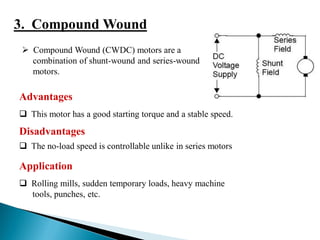
 Compound Wound (CWDC) motors are a
combination of shunt-wound and series-wound
motors.
 This motor has a good starting torque and a stable speed.
 The no-load speed is controllable unlike in series motors
Application
 Rolling mills, sudden temporary loads, heavy machine
tools, punches, etc.
Disadvantages
4. Permanent Magnet
 Widely used in low power application.
 Simple construction and less space
 No requirement on external excitation.
 Since no external field circuit is needed, there are no field copper losses.
 Since no field windings are needed, these motors can be considerable smaller.
Advantages
 Since permanent magnets produces weaker flux densities then externally
supported shunt fields, such motors have lower induced torque.
 There is always a risk of demagnetization
5. Servo Motor
 Servo Motors are mechanical devices that
can be instructed to move the output shaft
attached to a servo wheel or arm to a
specified position.
 Involving position control, velocity control and torque control.
 It consists of a DC motor, gear system, a position sensor which is
mostly a potentiometer, and control electronics.
Application
6. Universal Motor
 The series motor is designed to move large
loads with high torque in applications such
as crane motor or lift hoist.
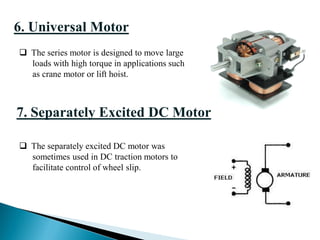
 The separately excited DC motor was
sometimes used in DC traction motors to
facilitate control of wheel slip.
7. Separately Excited DC Motor
AC Motor
Induction Motor
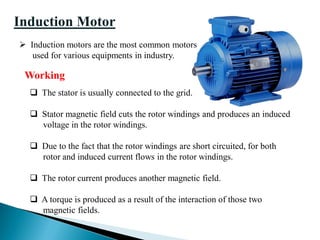
 Induction motors are the most common motors
used for various equipments in industry.
 The stator is usually connected to the grid.
 Stator magnetic field cuts the rotor windings and produces an induced
voltage in the rotor windings.
 Due to the fact that the rotor windings are short circuited, for both
rotor and induced current flows in the rotor windings.
 The rotor current produces another magnetic field.
 A torque is produced as a result of the interaction of those two
magnetic fields.
Working
Advantages
Disadvantages
 Simple design, rugged, low-price, easy maintenance.
 Very robust in construction.
 Wide range of power ratings: fractional horsepower to 10 MW.
 Run essentially as constant speed from no-load to full load.
 Its speed depends on the frequency of the power source.
 Most popular motor today in the low and medium horsepower range.
 Not easy to have variable speed control.
 Requires a variable-frequency power-electronic drive for optimal speed
control.
 Most of them run with a lagging power factor
Shaded-Pole Induction Motors
 The speed can be controlled merely by varying
voltage, or through a multi tap winding.
 Mechanically, the shaded-pole motor construction
allows high-volume production.
 These are usually considered as “disposable” motors,
meaning they are much cheaper to replace than to repair.
 It’s low starting torque is typically 25% to 75% of the rated torque.
 It is a high slip motor with a running speed 7% to 10% below the
synchronous speed.
 Generally, efficiency of this motor type is very low (below 20%).
Advantages
Disadvantages
 The starting torque is low, typically 100% to 175% of the rated torque.
 The motor draws high starting current, approximately 700% to 1,000%
of the rated current.
 The maximum generated torque ranges from 250% to 350% of the rated
torque.
Advantages & Disadvantages
 Use in small grinders, small fans and
blowers and other low starting torque
Application
 Capacitor-Start.
 Capacitor Run AC I.M.
 Capacitor Start/Capacitor Run AC I.M.
 Resistance-Start
Types :-
Split-Phase AC Induction Motor
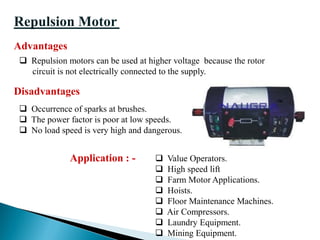
Repulsion Motor
 Repulsion motors can be used at higher voltage because the rotor
circuit is not electrically connected to the supply.
Advantages
 Occurrence of sparks at brushes.
 The power factor is poor at low speeds.
 No load speed is very high and dangerous.
Disadvantages
 Value Operators.
 High speed lift
 Farm Motor Applications.
 Hoists.
 Floor Maintenance Machines.
 Air Compressors.
 Laundry Equipment.
 Mining Equipment.
Application : -
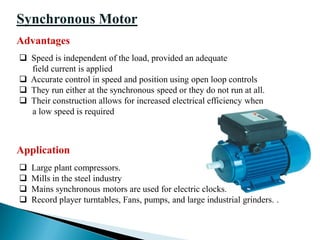
Synchronous Motor
Advantages
 Speed is independent of the load, provided an adequate
field current is applied
 Accurate control in speed and position using open loop controls
 They run either at the synchronous speed or they do not run at all.
 Their construction allows for increased electrical efficiency when
a low speed is required
 Large plant compressors.
 Mills in the steel industry
 Mains synchronous motors are used for electric clocks.
 Record player turntables, Fans, pumps, and large industrial grinders. .
Application
 As rotor has no teeth there are no mechanical vibrations.
 Due to the absence of the vibrations the operation is quiet and noiseless.
 Possibility of multispeed operation by employing gear train
 Costlier.
 Low efficiency.
 Available in very small sizes.
 Air conditioners.
 Due to the noiseless operation it is used in
sound recording instruments , sound producing
equipments high quality record players.
Hysteresis Motor
Advantages
Disadvantages
Application : -
Permanent-Magnet Synchronous Motors
Advantages
 Simplification of construction and maintenance.
 Reduction of prices for some types of machines.
 Higher magnetic flux density in the air gap
 No electrical energy is absorbed by the field excitation
system and thus there are no excitation losses
 High cost of permanent magnets.
 Magnet corrosion and possible demagnetization.
 Large air gap in surface mount PM machines.
Disadvantages
Application : -  Industrial drives e.g., pumps, fans, blowers,
mills, hoists, handling systems, light railways
and streetcars electric road vehicles
Stepper Motors
 Low cost.
 Excellent torque at low speeds.
 Low maintenance (brushless).
 Very rugged - any environment.
 Can work in an open loop (no feedback required).
 Excellent holding torque (eliminated brakes/clutches).
 Excellent for precise positioning control.
 No tuning required.
Advantages
 Rough performance at low speeds unless you use micro-stepping.
 Consume current regardless of load.
 Limited sizes available.
 Noisy.
 Torque decreases with speed
 Stepper motors can stall or lose position running without a control loop.
Disadvantages
 Cruise control.
 Auto air vents.
 Light leveling.
 Printers.
 Industrial machines.
 Automotive gauges.
 Office equipment.
 Computer drives.
 Medical scanners.
 Scientific Instrumentation.
Application : -
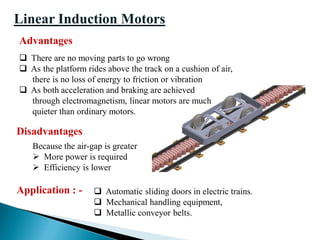
Linear Induction Motors
 There are no moving parts to go wrong
 As the platform rides above the track on a cushion of air,
there is no loss of energy to friction or vibration
 As both acceleration and braking are achieved
through electromagnetism, linear motors are much
quieter than ordinary motors.
Because the air-gap is greater
 More power is required
 Efficiency is lower
Advantages
Disadvantages
 Automatic sliding doors in electric trains.
 Mechanical handling equipment,
 Metallic conveyor belts.
Application : -
Motors

Motors

  • 1.
    Topic : “Classificationof Motor” PREPARED BY :  Yash Contractor  Bijohn Joseph  Kundan Parmar
  • 2.
  • 3.
  • 4.
    Advantages of DCMotor  Easy to control their speed in a wide range  Their reduced overall dimensions permit a considerable space saving which let the manufacturer of the machines or of plants not to be conditioned by the exaggerated dimensions of circular motors. Disadvantages of DC Motor  Sparks from the brushes may cause explosion if the environment contains explosive materials.  RF noise from the brushes may interfere with nearby TV sets, or electronic devices, Etc.  DC motors are also expensive relative to AC motors.
  • 5.
    1. Shunt Wound Advantages Motors have excellent speed control.  Loss of magnetism is not an issue in SHWDC motors so they are generally more robust than PMDC motors.  Shunt-wound Brushed DC (SHWDC) motors have drawbacks in reversing applications, however, because winding direction relative to the shunt winding must be reversed when armature voltage is reversed. Here, reversing contactors must be used. Disadvantages
  • 6.
    2. Series Wound Advantages The torque is proportional to I2 so it gives the highest torque per current ratio over all other DC motors. Disadvantages  Speed is restricted to 5000 RPM.  It must be avoided to run a series motor with no load because the motor will accelerate uncontrollably.
  • 7.
    3. Compound Wound Advantages Disadvantages Compound Wound (CWDC) motors are a combination of shunt-wound and series-wound motors.  This motor has a good starting torque and a stable speed.  The no-load speed is controllable unlike in series motors Application  Rolling mills, sudden temporary loads, heavy machine tools, punches, etc.
  • 8.
    Disadvantages 4. Permanent Magnet Widely used in low power application.  Simple construction and less space  No requirement on external excitation.  Since no external field circuit is needed, there are no field copper losses.  Since no field windings are needed, these motors can be considerable smaller. Advantages  Since permanent magnets produces weaker flux densities then externally supported shunt fields, such motors have lower induced torque.  There is always a risk of demagnetization
  • 9.
    5. Servo Motor Servo Motors are mechanical devices that can be instructed to move the output shaft attached to a servo wheel or arm to a specified position.  Involving position control, velocity control and torque control.  It consists of a DC motor, gear system, a position sensor which is mostly a potentiometer, and control electronics. Application
  • 10.
    6. Universal Motor The series motor is designed to move large loads with high torque in applications such as crane motor or lift hoist.  The separately excited DC motor was sometimes used in DC traction motors to facilitate control of wheel slip. 7. Separately Excited DC Motor
  • 11.
  • 12.
    Induction Motor  Inductionmotors are the most common motors used for various equipments in industry.  The stator is usually connected to the grid.  Stator magnetic field cuts the rotor windings and produces an induced voltage in the rotor windings.  Due to the fact that the rotor windings are short circuited, for both rotor and induced current flows in the rotor windings.  The rotor current produces another magnetic field.  A torque is produced as a result of the interaction of those two magnetic fields. Working
  • 13.
    Advantages Disadvantages  Simple design,rugged, low-price, easy maintenance.  Very robust in construction.  Wide range of power ratings: fractional horsepower to 10 MW.  Run essentially as constant speed from no-load to full load.  Its speed depends on the frequency of the power source.  Most popular motor today in the low and medium horsepower range.  Not easy to have variable speed control.  Requires a variable-frequency power-electronic drive for optimal speed control.  Most of them run with a lagging power factor
  • 14.
    Shaded-Pole Induction Motors The speed can be controlled merely by varying voltage, or through a multi tap winding.  Mechanically, the shaded-pole motor construction allows high-volume production.  These are usually considered as “disposable” motors, meaning they are much cheaper to replace than to repair.  It’s low starting torque is typically 25% to 75% of the rated torque.  It is a high slip motor with a running speed 7% to 10% below the synchronous speed.  Generally, efficiency of this motor type is very low (below 20%). Advantages Disadvantages
  • 15.
     The startingtorque is low, typically 100% to 175% of the rated torque.  The motor draws high starting current, approximately 700% to 1,000% of the rated current.  The maximum generated torque ranges from 250% to 350% of the rated torque. Advantages & Disadvantages  Use in small grinders, small fans and blowers and other low starting torque Application  Capacitor-Start.  Capacitor Run AC I.M.  Capacitor Start/Capacitor Run AC I.M.  Resistance-Start Types :- Split-Phase AC Induction Motor
  • 16.
    Repulsion Motor  Repulsionmotors can be used at higher voltage because the rotor circuit is not electrically connected to the supply. Advantages  Occurrence of sparks at brushes.  The power factor is poor at low speeds.  No load speed is very high and dangerous. Disadvantages  Value Operators.  High speed lift  Farm Motor Applications.  Hoists.  Floor Maintenance Machines.  Air Compressors.  Laundry Equipment.  Mining Equipment. Application : -
  • 17.
    Synchronous Motor Advantages  Speedis independent of the load, provided an adequate field current is applied  Accurate control in speed and position using open loop controls  They run either at the synchronous speed or they do not run at all.  Their construction allows for increased electrical efficiency when a low speed is required  Large plant compressors.  Mills in the steel industry  Mains synchronous motors are used for electric clocks.  Record player turntables, Fans, pumps, and large industrial grinders. . Application
  • 18.
     As rotorhas no teeth there are no mechanical vibrations.  Due to the absence of the vibrations the operation is quiet and noiseless.  Possibility of multispeed operation by employing gear train  Costlier.  Low efficiency.  Available in very small sizes.  Air conditioners.  Due to the noiseless operation it is used in sound recording instruments , sound producing equipments high quality record players. Hysteresis Motor Advantages Disadvantages Application : -
  • 19.
    Permanent-Magnet Synchronous Motors Advantages Simplification of construction and maintenance.  Reduction of prices for some types of machines.  Higher magnetic flux density in the air gap  No electrical energy is absorbed by the field excitation system and thus there are no excitation losses  High cost of permanent magnets.  Magnet corrosion and possible demagnetization.  Large air gap in surface mount PM machines. Disadvantages Application : -  Industrial drives e.g., pumps, fans, blowers, mills, hoists, handling systems, light railways and streetcars electric road vehicles
  • 20.
    Stepper Motors  Lowcost.  Excellent torque at low speeds.  Low maintenance (brushless).  Very rugged - any environment.  Can work in an open loop (no feedback required).  Excellent holding torque (eliminated brakes/clutches).  Excellent for precise positioning control.  No tuning required. Advantages
  • 21.
     Rough performanceat low speeds unless you use micro-stepping.  Consume current regardless of load.  Limited sizes available.  Noisy.  Torque decreases with speed  Stepper motors can stall or lose position running without a control loop. Disadvantages  Cruise control.  Auto air vents.  Light leveling.  Printers.  Industrial machines.  Automotive gauges.  Office equipment.  Computer drives.  Medical scanners.  Scientific Instrumentation. Application : -
  • 22.
    Linear Induction Motors There are no moving parts to go wrong  As the platform rides above the track on a cushion of air, there is no loss of energy to friction or vibration  As both acceleration and braking are achieved through electromagnetism, linear motors are much quieter than ordinary motors. Because the air-gap is greater  More power is required  Efficiency is lower Advantages Disadvantages  Automatic sliding doors in electric trains.  Mechanical handling equipment,  Metallic conveyor belts. Application : -