Seminar Presentation
On
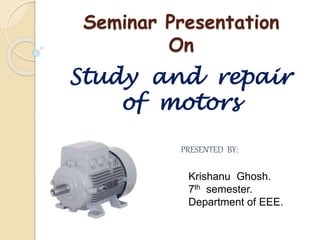
Study and repair
of motors
PRESENTED BY:
Krishanu Ghosh.
7th semester.
Department of EEE.
Contents:
1. Introduction
2. Classification of motors
3. Constructional features
4. Insulation used for motors
5. Why do motors fail?
6. Rewinding Process
7. Replacement of Bearings
8. Repair of a 1550 kW, 6.3 kv HT motor
9. Benefits
10. Conclusion
Introduction:
An electric motor is a machine which converts electrical
energy into mechanical energy. Its action is based on the
Principle that when a current carrying conductor is placed
in a magnetic field, it experiences a mechanical force whos
direction is given by Fleming’s Left Hand rule & whose
Magnitude is given by F=BIl Newton. Motors never fail a
good times. Production stops; workers stand idle; deliveries
are missed. The pressure to get back in operation quickly o
leads to snap decisions to repair or replace the failed moto
Rewind or otherwise repair a motor when it is cheaper than
buying a new motor.
Classification of motors:
On general purpose there are three types of motor availab
 DC motors
 AC motors
 Universal motors
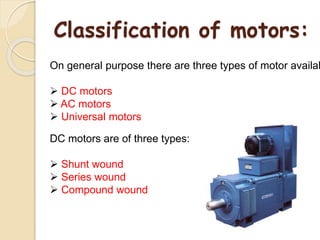
DC motors are of three types:
 Shunt wound
 Series wound
 Compound wound
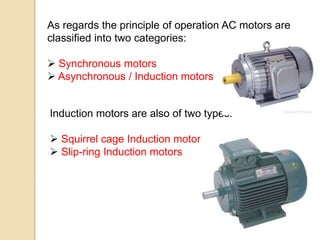
As regards the principle of operation AC motors are
classified into two categories:
 Synchronous motors
 Asynchronous / Induction motors
Induction motors are also of two types:
 Squirrel cage Induction motors
 Slip-ring Induction motors
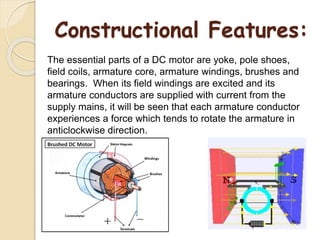
Constructional Features:
The essential parts of a DC motor are yoke, pole shoes,
field coils, armature core, armature windings, brushes and
bearings. When its field windings are excited and its
armature conductors are supplied with current from the
supply mains, it will be seen that each armature conductor
experiences a force which tends to rotate the armature in
anticlockwise direction.
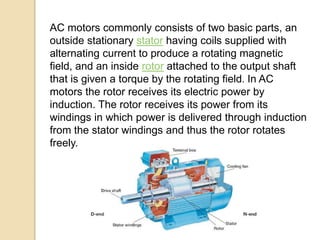
AC motors commonly consists of two basic parts, an
outside stationary stator having coils supplied with
alternating current to produce a rotating magnetic
field, and an inside rotor attached to the output shaft
that is given a torque by the rotating field. In AC
motors the rotor receives its electric power by
induction. The rotor receives its power from its
windings in which power is delivered through induction
from the stator windings and thus the rotor rotates
freely.
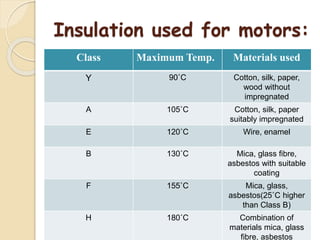
Insulation used for motors:
Class Maximum Temp. Materials used
Y 90˚C Cotton, silk, paper,
wood without
impregnated
A 105˚C Cotton, silk, paper
suitably impregnated
E 120˚C Wire, enamel
B 130˚C Mica, glass fibre,
asbestos with suitable
coating
F 155˚C Mica, glass,
asbestos(25˚C higher
than Class B)
H 180˚C Combination of
materials mica, glass
fibre, asbestos
Why do motors fail?
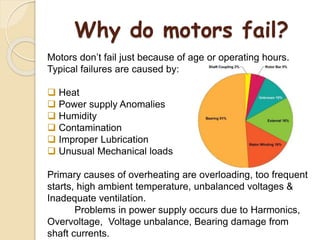
Motors don’t fail just because of age or operating hours.
Typical failures are caused by:
 Heat
 Power supply Anomalies
 Humidity
 Contamination
 Improper Lubrication
 Unusual Mechanical loads
Primary causes of overheating are overloading, too frequent
starts, high ambient temperature, unbalanced voltages &
Inadequate ventilation.
Problems in power supply occurs due to Harmonics,
Overvoltage, Voltage unbalance, Bearing damage from
shaft currents.
Humidity becomes a problem when the motor is de-
energized long enough to drop near the dew point
temperature. Moisture weakens the dielectric strength of
electrical varnish and other insulating materials, contributes
to corrosion of bearings.
Contamination destroys motors by abrasion, corrosion
and overheating. Different motors pose different
requirements for the introduction of lubricant and removal of
old lubricant. Improper lubrication may lead to the damaging
of motor.
A variety of mechanical conditions can either overstress
bearings, leading to early failure, or distort the motor frame
causing asymmetric air gap, which in turn can cause
vibration and bearing failure or winding overheating.
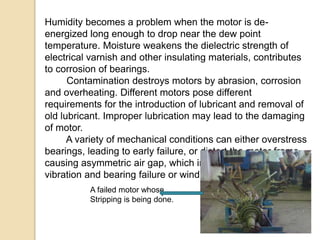
A failed motor whose
Stripping is being done.
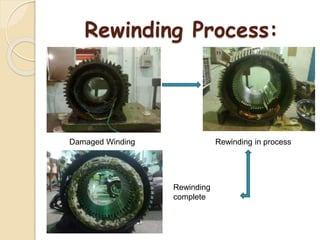
Rewinding Process:
Damaged Winding Rewinding in process
Rewinding
complete
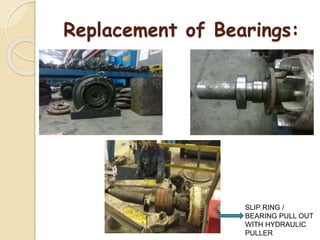
Replacement of Bearings:
SLIP RING /
BEARING PULL OUT
WITH HYDRAULIC
PULLER
Repair of a 1550 kW, 6.3 kv
HT motor:
Problem
Statement:
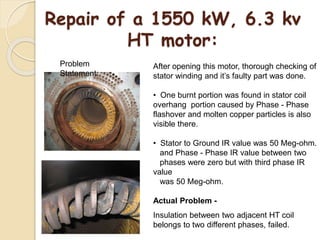
After opening this motor, thorough checking of
stator winding and it’s faulty part was done.
• One burnt portion was found in stator coil
overhang portion caused by Phase - Phase
flashover and molten copper particles is also
visible there.
• Stator to Ground IR value was 50 Meg-ohm.
and Phase - Phase IR value between two
phases were zero but with third phase IR
value
was 50 Meg-ohm.
Actual Problem -
Insulation between two adjacent HT coil
belongs to two different phases, failed.
Goal statement:
In normal condition, complete rewinding of such type of HT stator takes 6
months time and total cost will be approximately 20 lakhs. For a 2-pole
motor rewinding with new copper is also very difficult and more time
consuming.
But this case was different. as it was a very critical condition, Customer
wanted to get back the motor after repair as early as possible.
Keeping the urgency in mind, the risk of part repair was discussed and
decided to go for Part Repair of the Stator with all precautions.
Part Repair, in this case, means that defective portion of stator coil will be
cut off, new copper strip will be brazed to the both ends of the conductors
turn by turn, insulate individual conductors and finally overall insulation will
be provided over the coils.
Reasons for failure and identifying corrective actions:
Problem - Insulation between two adjacent HT coil belongs to two
different phases failed.
Probable reasons -
• Excessive dirty stator
• High resistive phase to phase fault occurred.
• Localized heat took place due to resistive fault.
• Inter phase insulation failed & phase fault occurred.
• Molten copper drops out.
Corrective actions -
• Damaged portion of conductors to be cut-off at both ends
• New pieces of copper conductors are to be brazed at both ends of cut
off coils
• Insulate individual conductors
• Shaping up the repaired portion and insulate completely
• Do varnishing, heating and conduct testing of stator.
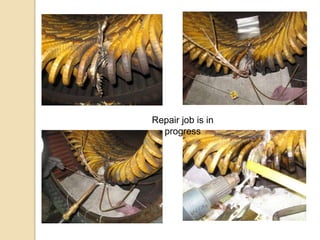
Repair job is in
progress
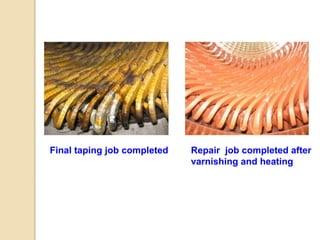
Final taping job completed Repair job completed after
varnishing and heating
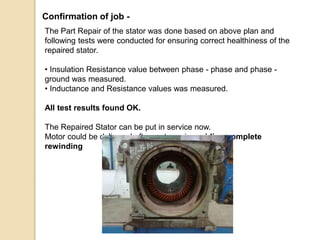
Confirmation of job -
The Part Repair of the stator was done based on above plan and
following tests were conducted for ensuring correct healthiness of the
repaired stator.
• Insulation Resistance value between phase - phase and phase -
ground was measured.
• Inductance and Resistance values was measured.
All test results found OK.
The Repaired Stator can be put in service now.
Motor could be delivered after part repair avoiding complete
rewinding
Benefits:
Tangible:
Saved the cost of rewinding, approximately 20 la
Intangible:
1.Availability Improved.
2.Quality Improved.
3.Customer Satisfied.
4.Creadibility improved.
5. Moral of people enhanced.
Conclusion:
Hence we can draw out a conclusion that
regardless the type of motor, it should be studied
and examined carefully before its repairing or
replacement. It should not only serve the purpose
but also it should be economical from every
aspect. Better materials should be used for
insulation. Proper bearings should be installed.
Proper rewinding is required at the time of repair
of motor. Efficiency should be improved.

Seminar report

  • 1.
    Seminar Presentation On Study andrepair of motors PRESENTED BY: Krishanu Ghosh. 7th semester. Department of EEE.
  • 2.
    Contents: 1. Introduction 2. Classificationof motors 3. Constructional features 4. Insulation used for motors 5. Why do motors fail? 6. Rewinding Process 7. Replacement of Bearings 8. Repair of a 1550 kW, 6.3 kv HT motor 9. Benefits 10. Conclusion
  • 3.
    Introduction: An electric motoris a machine which converts electrical energy into mechanical energy. Its action is based on the Principle that when a current carrying conductor is placed in a magnetic field, it experiences a mechanical force whos direction is given by Fleming’s Left Hand rule & whose Magnitude is given by F=BIl Newton. Motors never fail a good times. Production stops; workers stand idle; deliveries are missed. The pressure to get back in operation quickly o leads to snap decisions to repair or replace the failed moto Rewind or otherwise repair a motor when it is cheaper than buying a new motor.
  • 4.
    Classification of motors: Ongeneral purpose there are three types of motor availab  DC motors  AC motors  Universal motors DC motors are of three types:  Shunt wound  Series wound  Compound wound
  • 5.
    As regards theprinciple of operation AC motors are classified into two categories:  Synchronous motors  Asynchronous / Induction motors Induction motors are also of two types:  Squirrel cage Induction motors  Slip-ring Induction motors
  • 6.
    Constructional Features: The essentialparts of a DC motor are yoke, pole shoes, field coils, armature core, armature windings, brushes and bearings. When its field windings are excited and its armature conductors are supplied with current from the supply mains, it will be seen that each armature conductor experiences a force which tends to rotate the armature in anticlockwise direction.
  • 7.
    AC motors commonlyconsists of two basic parts, an outside stationary stator having coils supplied with alternating current to produce a rotating magnetic field, and an inside rotor attached to the output shaft that is given a torque by the rotating field. In AC motors the rotor receives its electric power by induction. The rotor receives its power from its windings in which power is delivered through induction from the stator windings and thus the rotor rotates freely.
  • 8.
    Insulation used formotors: Class Maximum Temp. Materials used Y 90˚C Cotton, silk, paper, wood without impregnated A 105˚C Cotton, silk, paper suitably impregnated E 120˚C Wire, enamel B 130˚C Mica, glass fibre, asbestos with suitable coating F 155˚C Mica, glass, asbestos(25˚C higher than Class B) H 180˚C Combination of materials mica, glass fibre, asbestos
  • 9.
    Why do motorsfail? Motors don’t fail just because of age or operating hours. Typical failures are caused by:  Heat  Power supply Anomalies  Humidity  Contamination  Improper Lubrication  Unusual Mechanical loads Primary causes of overheating are overloading, too frequent starts, high ambient temperature, unbalanced voltages & Inadequate ventilation. Problems in power supply occurs due to Harmonics, Overvoltage, Voltage unbalance, Bearing damage from shaft currents.
  • 10.
    Humidity becomes aproblem when the motor is de- energized long enough to drop near the dew point temperature. Moisture weakens the dielectric strength of electrical varnish and other insulating materials, contributes to corrosion of bearings. Contamination destroys motors by abrasion, corrosion and overheating. Different motors pose different requirements for the introduction of lubricant and removal of old lubricant. Improper lubrication may lead to the damaging of motor. A variety of mechanical conditions can either overstress bearings, leading to early failure, or distort the motor frame causing asymmetric air gap, which in turn can cause vibration and bearing failure or winding overheating. A failed motor whose Stripping is being done.
  • 11.
    Rewinding Process: Damaged WindingRewinding in process Rewinding complete
  • 12.
    Replacement of Bearings: SLIPRING / BEARING PULL OUT WITH HYDRAULIC PULLER
  • 13.
    Repair of a1550 kW, 6.3 kv HT motor: Problem Statement: After opening this motor, thorough checking of stator winding and it’s faulty part was done. • One burnt portion was found in stator coil overhang portion caused by Phase - Phase flashover and molten copper particles is also visible there. • Stator to Ground IR value was 50 Meg-ohm. and Phase - Phase IR value between two phases were zero but with third phase IR value was 50 Meg-ohm. Actual Problem - Insulation between two adjacent HT coil belongs to two different phases, failed.
  • 14.
    Goal statement: In normalcondition, complete rewinding of such type of HT stator takes 6 months time and total cost will be approximately 20 lakhs. For a 2-pole motor rewinding with new copper is also very difficult and more time consuming. But this case was different. as it was a very critical condition, Customer wanted to get back the motor after repair as early as possible. Keeping the urgency in mind, the risk of part repair was discussed and decided to go for Part Repair of the Stator with all precautions. Part Repair, in this case, means that defective portion of stator coil will be cut off, new copper strip will be brazed to the both ends of the conductors turn by turn, insulate individual conductors and finally overall insulation will be provided over the coils.
  • 15.
    Reasons for failureand identifying corrective actions: Problem - Insulation between two adjacent HT coil belongs to two different phases failed. Probable reasons - • Excessive dirty stator • High resistive phase to phase fault occurred. • Localized heat took place due to resistive fault. • Inter phase insulation failed & phase fault occurred. • Molten copper drops out. Corrective actions - • Damaged portion of conductors to be cut-off at both ends • New pieces of copper conductors are to be brazed at both ends of cut off coils • Insulate individual conductors • Shaping up the repaired portion and insulate completely • Do varnishing, heating and conduct testing of stator.
  • 16.
    Repair job isin progress
  • 17.
    Final taping jobcompleted Repair job completed after varnishing and heating
  • 18.
    Confirmation of job- The Part Repair of the stator was done based on above plan and following tests were conducted for ensuring correct healthiness of the repaired stator. • Insulation Resistance value between phase - phase and phase - ground was measured. • Inductance and Resistance values was measured. All test results found OK. The Repaired Stator can be put in service now. Motor could be delivered after part repair avoiding complete rewinding
  • 19.
    Benefits: Tangible: Saved the costof rewinding, approximately 20 la Intangible: 1.Availability Improved. 2.Quality Improved. 3.Customer Satisfied. 4.Creadibility improved. 5. Moral of people enhanced.
  • 20.
    Conclusion: Hence we candraw out a conclusion that regardless the type of motor, it should be studied and examined carefully before its repairing or replacement. It should not only serve the purpose but also it should be economical from every aspect. Better materials should be used for insulation. Proper bearings should be installed. Proper rewinding is required at the time of repair of motor. Efficiency should be improved.