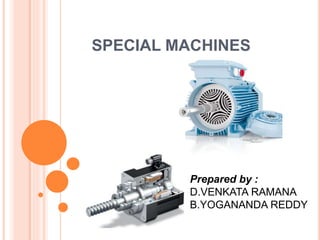
SPECIAL MACHINES
Prepared by :
D.VENKATA RAMANA
B.YOGANANDA REDDY
OBJECTIVES:
INTRODUCTION
TYPES
PRINCIPLE OF OPERATION
ADVANTAGES
APPLICATIONS
TYPES OF SPECIAL MACHINES:
 Reluctance Motors
 Hysteresis Motors
 Servo Motors
 Linear Induction Motors(LIM)
 Printed Circuit Board(PCB) Motors
 Permanent Magnet DC Motors
 Stepper Motors
 Synchros
RELUCTANCE MOTORS:
PRINCIPLE OF OPERATION:
1. A single phase reluctance motors is basically the
same as the single phase cage type induction
motor.
2. The rotor bars are kept intact even in the spaces
from where the teeth are removed.
3. When the stator is connected to a single phase
supply, the motor starts as a single phase induction
motor.
4. At a speed, of about 75 percent of the synchronous
speed, a centrifugal switch disconnects the
auxiliary winding and the motor continues to speed
up as a single phase motor with the main winding in
operation.
5
ADVANTAGES:
EASY CONSTRUCTION
LOW COST
SIMPLE MAINTENANCE
APPLICATIONS:
CONSTANT SPEED APPLICATIONS
ELECTRIC CLOCK TIMERS
RECORDING INSTRUMENTS
PHONOGRAPHS
HYSTERESIS MOTORS:
~>The eddy current losses are produced by the stator magnetic field.
~>Hysteresis losses are produced by the rotor.
Advantages:
~>Small size
~>Its operation is quiet and noiseless as there is
no vibration.
~>It is suitable to accelerate inertia loads.
~>Multispeed operation can be achieved by
employing gear train.
Applications:
~> Electric clocks
~> Record players
~>Tape recorders
SERVO MOTORS(CONTROL MOTORS):
 AC Servo Motors:
AC SERVOMOTORS:
1.At present most of the ac servomotors of the two-
phase squirrel cage induction type for lower power
applications, three phase are used in high power
servomotors.
2.Two phase ac servomotors , the stator has two
distributed windings . One winding called reference
phase and other constant phase. are displaced by 90
electrical degrees.
3.The speed and These torque of the rotor are controlled
by phase difference between the control voltage and the
reference voltage.
The rotation of rotor can be reversed by reversing the
phase difference from lead to lag.
4.Because of negative slope there by furnishes the motor
with positive damping for good stability.
DC SERVO MOTOR:
PRINCIPLE OF OPERATION:
DC SERVOMOTORS:
 Dc servomotors are separately excited dc
motors or permanent magnet dc motors.
 The speed of dc servomotors is normally
controlled by varying he armature voltage.
 The armature MFF and the excitation field MFF
are in quadrature in a dc machine.
 This provides a fast torque response because
torque and the flux become decoupled.
 The dc servomotors can vary from a few watts
to several hundred watts.
Advantages:
~>High speed
~>Low cost
~>Smooth rotation at low speeds
~>No power is used at standstill
Applications:
~>Computers
~>Robotics
~>Machine tools
~>Process controllers
LINEAR INDUCTION MOTOR:
ADVANTAGES
SIMPLE IN CONSTRUCTION
LOW INITIAL COST
NO LIMITATION OF MAXIMUM SPEED DUE TO CENTRIFUGAL
FORCE
APPLICATIONS
ELECTRIC TRACTION,
CRANES,
HV CIRCUIT BREAKERS,
PUMPING OF LIQUID METAL.
PRINTED CIRCUIT
BOARD(PCB)MOTOR:
ADVANTAGES:
1. LOW INERTIA .
2. QUICK ACCELERATION AND RETARDATION.
3.LOWER INDUCTANCE REDUCES SPARKING AND
SIGNIFICANTLY INCREASES BRUSH LIFE
4.HIGH OVER LOAD CURRENT CAPACITY.
APPLICATIONS:
1.HIGH SPEED TAPE READERS, POINT TO POINT
TOOL POSITIONERS, ROBOTS AND OTHER SERVO
DEVICES.
UNIVERSAL MOTOR:
•Universal motor can operated both A.C and D.C
Power supply
•Special construction of D.C series Motor
•Characteristics is similar to D.C series motor
APPLICATIONS:
Vacuum cleaner
Hair dryers
Grinders
Table fan
Kitchen appliances
ANY
QUIRIES…??

THANK
YOU….!!!


AMRUTHA2223 (1)

  • 1.
    SPECIAL MACHINES Prepared by: D.VENKATA RAMANA B.YOGANANDA REDDY
  • 2.
  • 3.
    TYPES OF SPECIALMACHINES:  Reluctance Motors  Hysteresis Motors  Servo Motors  Linear Induction Motors(LIM)  Printed Circuit Board(PCB) Motors  Permanent Magnet DC Motors  Stepper Motors  Synchros
  • 4.
  • 5.
    PRINCIPLE OF OPERATION: 1.A single phase reluctance motors is basically the same as the single phase cage type induction motor. 2. The rotor bars are kept intact even in the spaces from where the teeth are removed. 3. When the stator is connected to a single phase supply, the motor starts as a single phase induction motor. 4. At a speed, of about 75 percent of the synchronous speed, a centrifugal switch disconnects the auxiliary winding and the motor continues to speed up as a single phase motor with the main winding in operation. 5
  • 6.
    ADVANTAGES: EASY CONSTRUCTION LOW COST SIMPLEMAINTENANCE APPLICATIONS: CONSTANT SPEED APPLICATIONS ELECTRIC CLOCK TIMERS RECORDING INSTRUMENTS PHONOGRAPHS
  • 7.
    HYSTERESIS MOTORS: ~>The eddycurrent losses are produced by the stator magnetic field. ~>Hysteresis losses are produced by the rotor.
  • 8.
    Advantages: ~>Small size ~>Its operationis quiet and noiseless as there is no vibration. ~>It is suitable to accelerate inertia loads. ~>Multispeed operation can be achieved by employing gear train. Applications: ~> Electric clocks ~> Record players ~>Tape recorders
  • 9.
  • 10.
    AC SERVOMOTORS: 1.At presentmost of the ac servomotors of the two- phase squirrel cage induction type for lower power applications, three phase are used in high power servomotors. 2.Two phase ac servomotors , the stator has two distributed windings . One winding called reference phase and other constant phase. are displaced by 90 electrical degrees. 3.The speed and These torque of the rotor are controlled by phase difference between the control voltage and the reference voltage. The rotation of rotor can be reversed by reversing the phase difference from lead to lag. 4.Because of negative slope there by furnishes the motor with positive damping for good stability.
  • 11.
  • 12.
    DC SERVOMOTORS:  Dcservomotors are separately excited dc motors or permanent magnet dc motors.  The speed of dc servomotors is normally controlled by varying he armature voltage.  The armature MFF and the excitation field MFF are in quadrature in a dc machine.  This provides a fast torque response because torque and the flux become decoupled.  The dc servomotors can vary from a few watts to several hundred watts.
  • 13.
    Advantages: ~>High speed ~>Low cost ~>Smoothrotation at low speeds ~>No power is used at standstill Applications: ~>Computers ~>Robotics ~>Machine tools ~>Process controllers
  • 14.
  • 15.
    ADVANTAGES SIMPLE IN CONSTRUCTION LOWINITIAL COST NO LIMITATION OF MAXIMUM SPEED DUE TO CENTRIFUGAL FORCE APPLICATIONS ELECTRIC TRACTION, CRANES, HV CIRCUIT BREAKERS, PUMPING OF LIQUID METAL.
  • 16.
  • 17.
    ADVANTAGES: 1. LOW INERTIA. 2. QUICK ACCELERATION AND RETARDATION. 3.LOWER INDUCTANCE REDUCES SPARKING AND SIGNIFICANTLY INCREASES BRUSH LIFE 4.HIGH OVER LOAD CURRENT CAPACITY. APPLICATIONS: 1.HIGH SPEED TAPE READERS, POINT TO POINT TOOL POSITIONERS, ROBOTS AND OTHER SERVO DEVICES.
  • 18.
  • 19.
    •Universal motor canoperated both A.C and D.C Power supply •Special construction of D.C series Motor •Characteristics is similar to D.C series motor APPLICATIONS: Vacuum cleaner Hair dryers Grinders Table fan Kitchen appliances
  • 20.
  • 21.