Analog Communications
UNIT – II
DSBSC Modulation: Time domain and frequency domain
description, Generation of DSBSC Wave - Balanced
Modulators, Ring Modulator. Coherent detection of
DSBSC Modulated wave , COSTAS Loop.
SSB Modulation: Frequency domain description,
Frequency discrimination method for generation of AM
SSB Modulated wave, Time domain description, Phase
discrimination method for generating AM SSB Modulated
wave. Demodulation of SSB wave, VSB Modulation,
Comparison of AM Techniques.
UNIT- II
1) Explain the balanced modulator method to generate
DSBSC waveform with neat diagram. (CO2)
2) Explain the demodulation of DSB-SC using
Synchronous detection method. (CO2)
3) Explain about COSTAS loop with a neat block diagram
for demodulating DSB-SC wave.(CO2)
4) Explain the Frequency discrimination method for
generating SSB signal. (CO2)
5) Explain the phase discrimination method of generating
SSB modulated wave with neat diagram. (CO2)
6) With neat diagrams, explain about the VSB modulation
system and also explain its Applications. (CO2)
Limitations of Amplitude Modulation
 The standard AM modulated signal contains a sinusoidal
component at the carrier frequency which does not
convey any of the baseband message information.
 The amplitude modulation with full carrier defined earlier
suffers from two major practical limitations:
1.Amplitude modulation is wasteful of transmitted power, PT
2.Amplitude modulation is wasteful of channel bandwidth, BT
 To overcome these two limitations of AM, we must make
certain changes that result in increased system
complexity of the amplitude modulation process.
Types of Amplitude Modulation
Double side band-suppressed carrier modulation
Single sideband (SSB) modulation,
Vestigial sideband (VSB) modulation
Double sideband-suppressed carrier modulation
The transmitted wave consists of only the upper and lower
sidebands
But the channel bandwidth requirement is the same as
before.
Single sideband (SSB) modulation
The modulation wave consists only of the upper sideband
or the lower sideband.
To translate the spectrum of the modulating signal to a
new location in the frequency domain.
Vestigial sideband (VSB) modulation
One sideband is passed almost completely and just a trace
of the other sideband is retained.
The required channel bandwidth is slightly in excess of the
message bandwidth by an amount equal to the width of
the vestigial sideband.
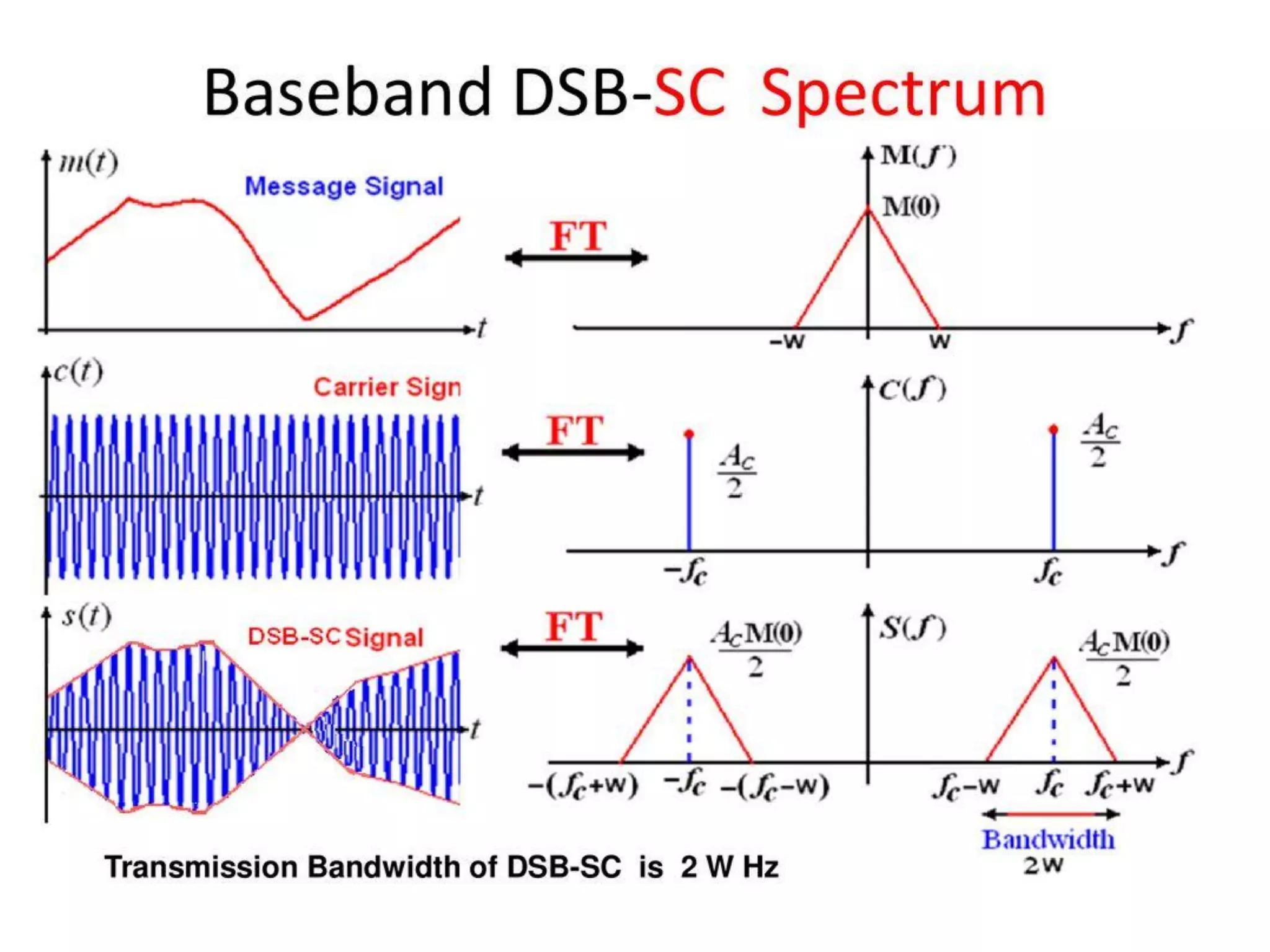
Double sideband suppressed carrier (DSB-SC) modulation
 To overcome the drawback of power wastage in AM wave,
suppress the carrier component from the modulated wave,
resulting in DSB-SC modulation.
 A double-sideband suppressed carrier AM signal is
obtained by multiplying the message signal m(t) with the
carrier signal.
 Let the modulating signal be,
m(t)=Amcos(2πfmt)
 and the carrier signal be,
c(t) Ac cos(2πfct)
 S(t) = m(t)c(t) S(t) = Ac cos(2πfct) m(t)
 For the above equation Applying Fourier transform then
S(f) = Ac/2 [M(f – fc) + M(f + fc)]
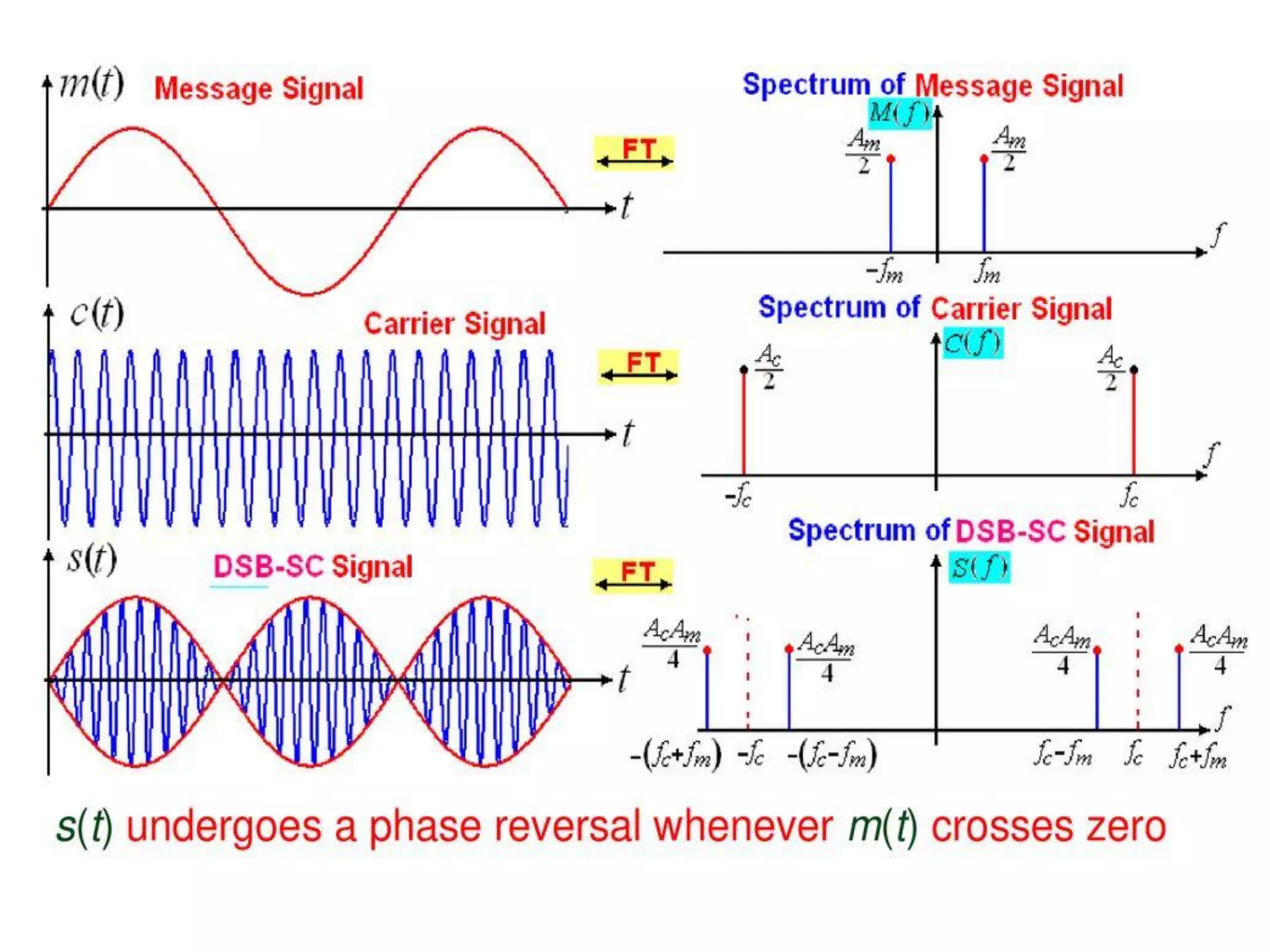
The spectrum of DSB-SC modulated wave consists of
impulse functions located at fc ±fm and − fc ±fm.
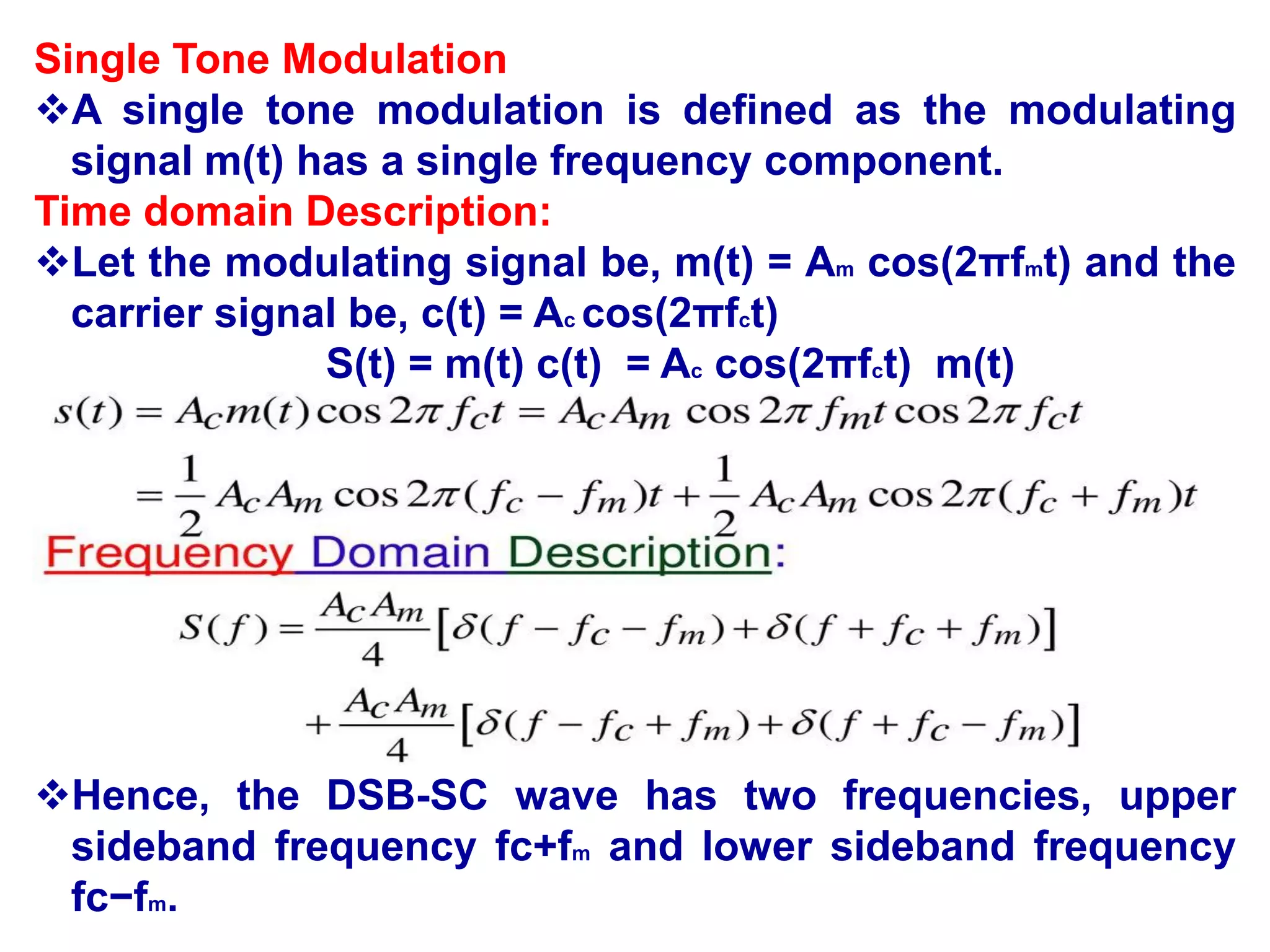
Single Tone Modulation
A single tone modulation is defined as the modulating
signal m(t) has a single frequency component.
Time domain Description:
Let the modulating signal be, m(t) = Am cos(2πfmt) and the
carrier signal be, c(t) = Ac cos(2πfct)
S(t) = m(t) c(t) = Ac cos(2πfct) m(t)
Hence, the DSB-SC wave has two frequencies, upper
sideband frequency fc+fm and lower sideband frequency
fc−fm.
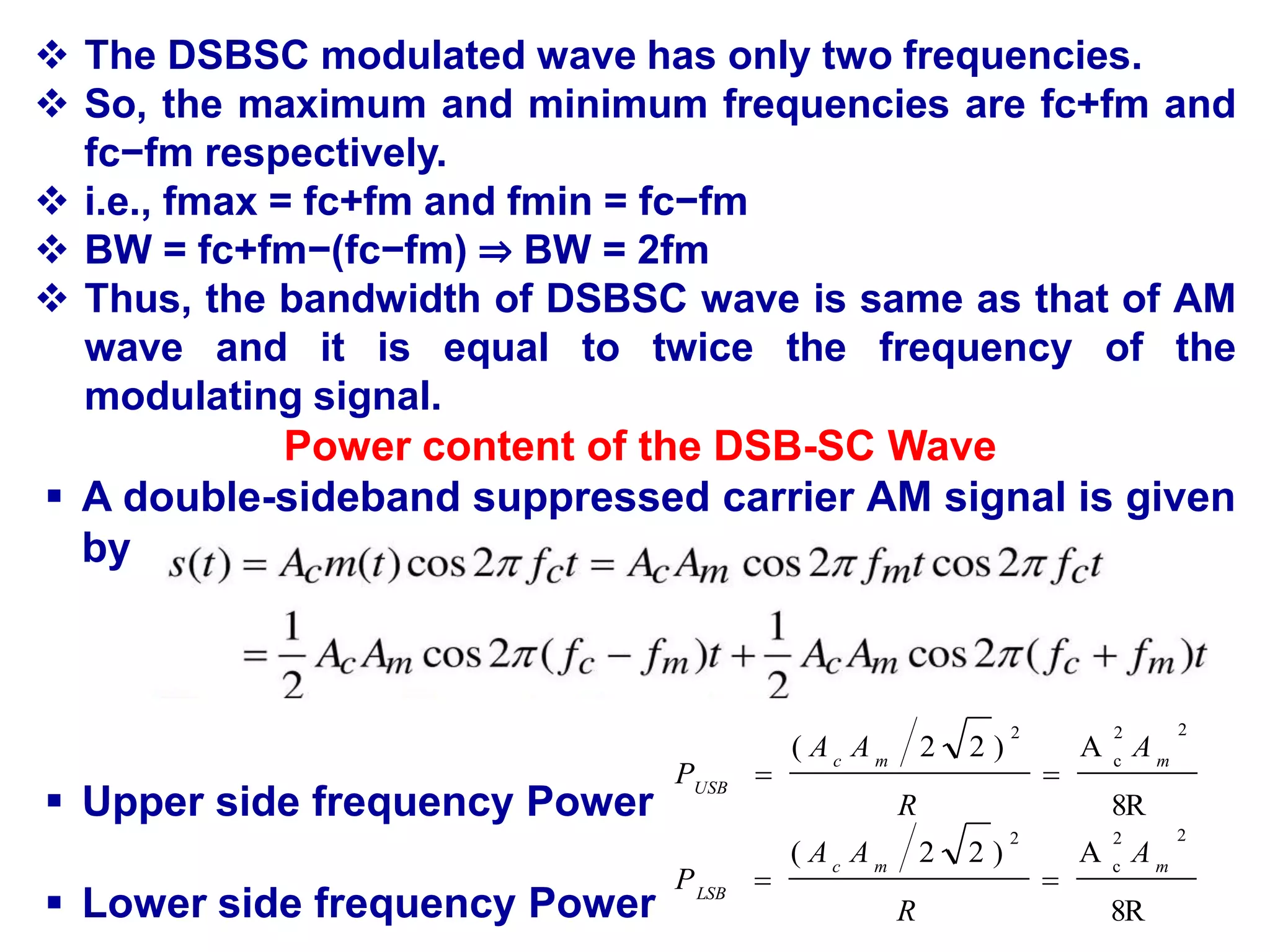
Power content of the DSB-SC Wave
 A double-sideband suppressed carrier AM signal is given
by
 Upper side frequency Power
 Lower side frequency Power
8R
A
)
2
2
(
2
2
c
2
m
m
c
USB
A
R
A
A
P 

8R
A
)
2
2
(
2
2
c
2
m
m
c
LSB
A
R
A
A
P 

 The DSBSC modulated wave has only two frequencies.
 So, the maximum and minimum frequencies are fc+fm and
fc−fm respectively.
 i.e., fmax = fc+fm and fmin = fc−fm
 BW = fc+fm−(fc−fm) ⇒ BW = 2fm
 Thus, the bandwidth of DSBSC wave is same as that of AM
wave and it is equal to twice the frequency of the
modulating signal.
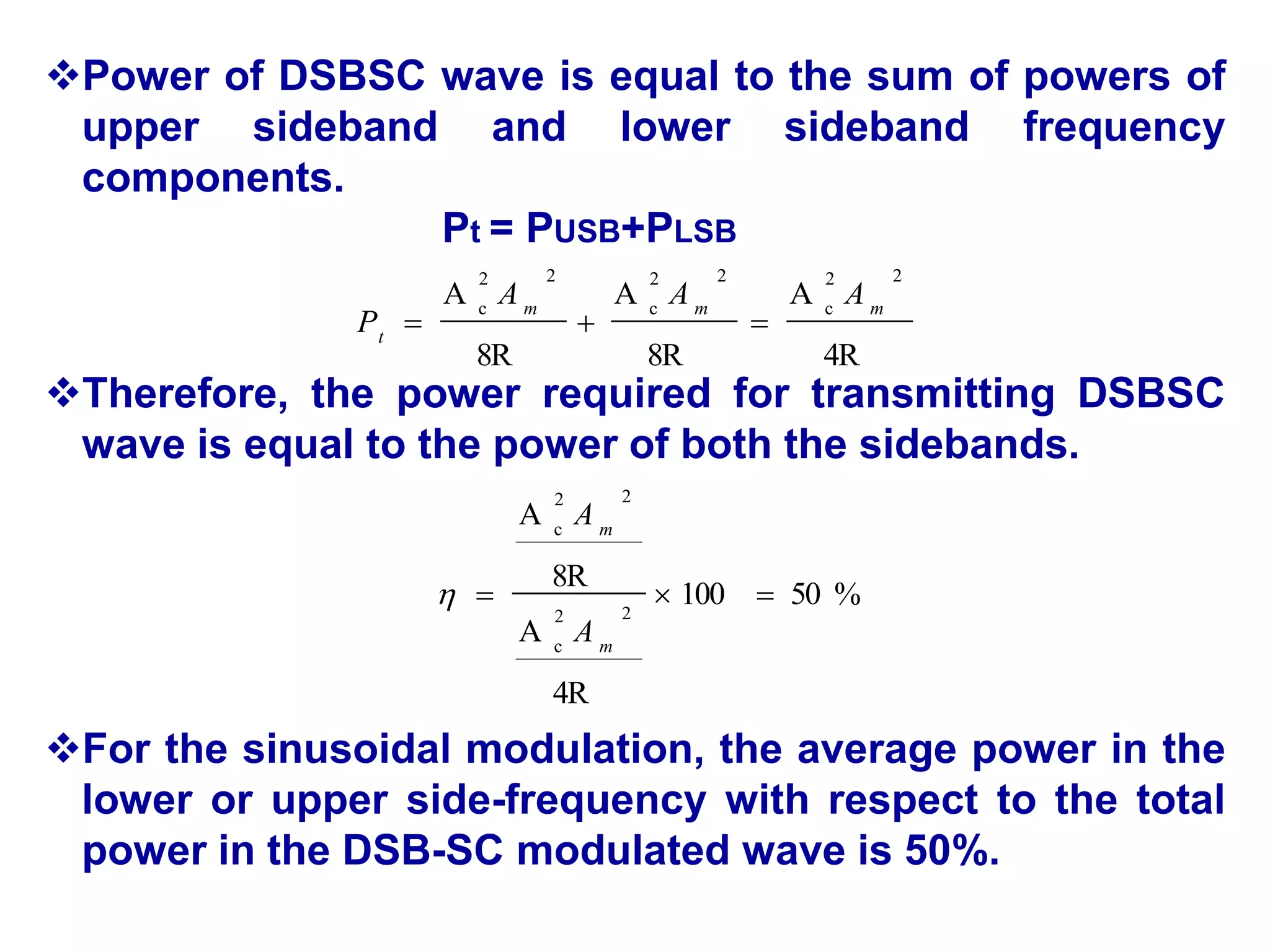
Power of DSBSC wave is equal to the sum of powers of
upper sideband and lower sideband frequency
components.
Pt = PUSB+PLSB
Therefore, the power required for transmitting DSBSC
wave is equal to the power of both the sidebands.
For the sinusoidal modulation, the average power in the
lower or upper side-frequency with respect to the total
power in the DSB-SC modulated wave is 50%.
4R
A
8R
A
8R
A
2
2
c
2
2
c
2
2
c m
m
m
t
A
A
A
P 


%
50
100
4R
A
8R
A
2
2
c
2
2
c



m
m
A
A

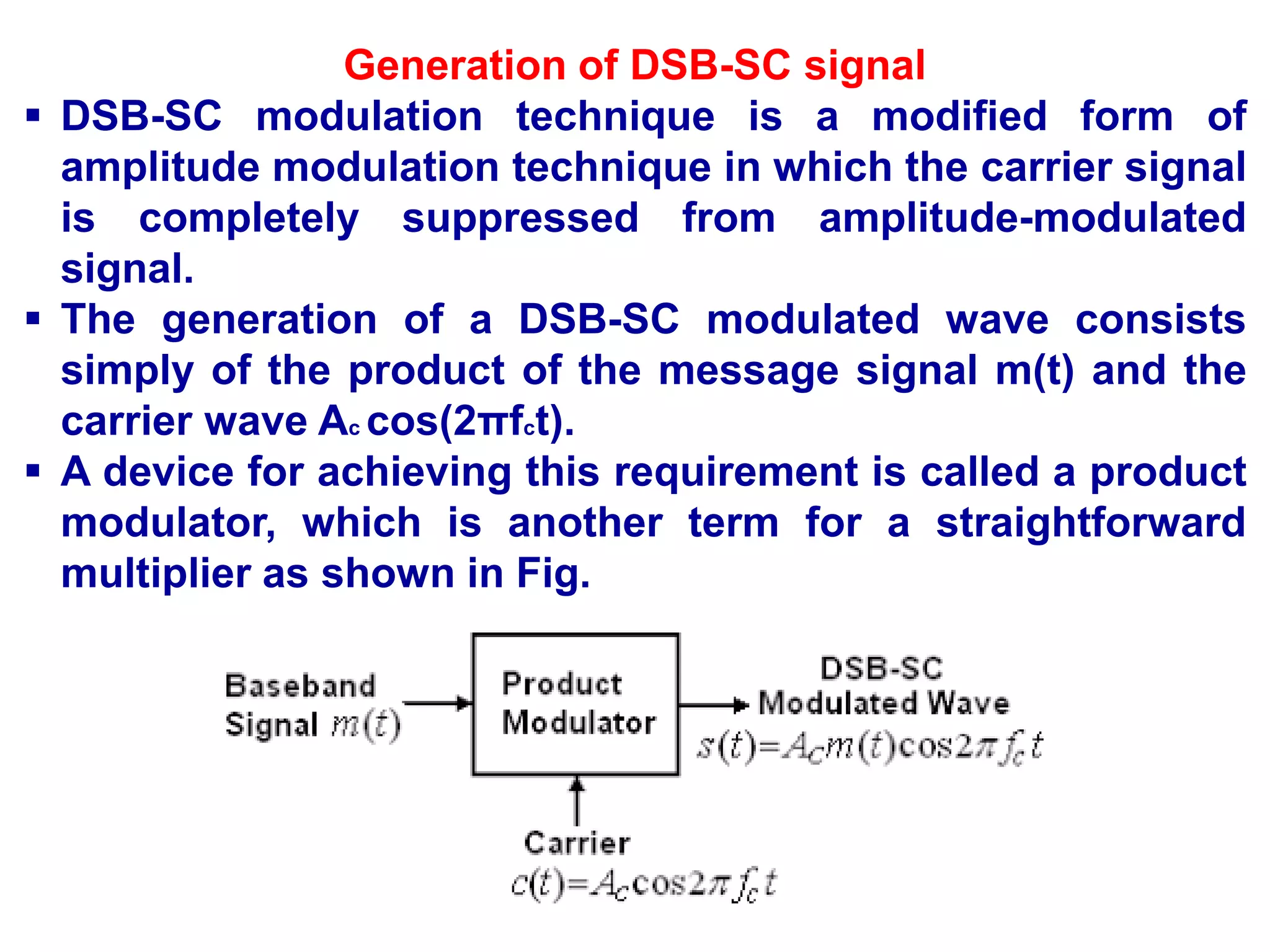
Generation of DSB-SC signal
 DSB-SC modulation technique is a modified form of
amplitude modulation technique in which the carrier signal
is completely suppressed from amplitude-modulated
signal.
 The generation of a DSB-SC modulated wave consists
simply of the product of the message signal m(t) and the
carrier wave Ac cos(2πfct).
 A device for achieving this requirement is called a product
modulator, which is another term for a straightforward
multiplier as shown in Fig.
 This form of linear modulation is generated by using a
Product Modulator that simply multiplies the message
m(t) by the carrier c(t)
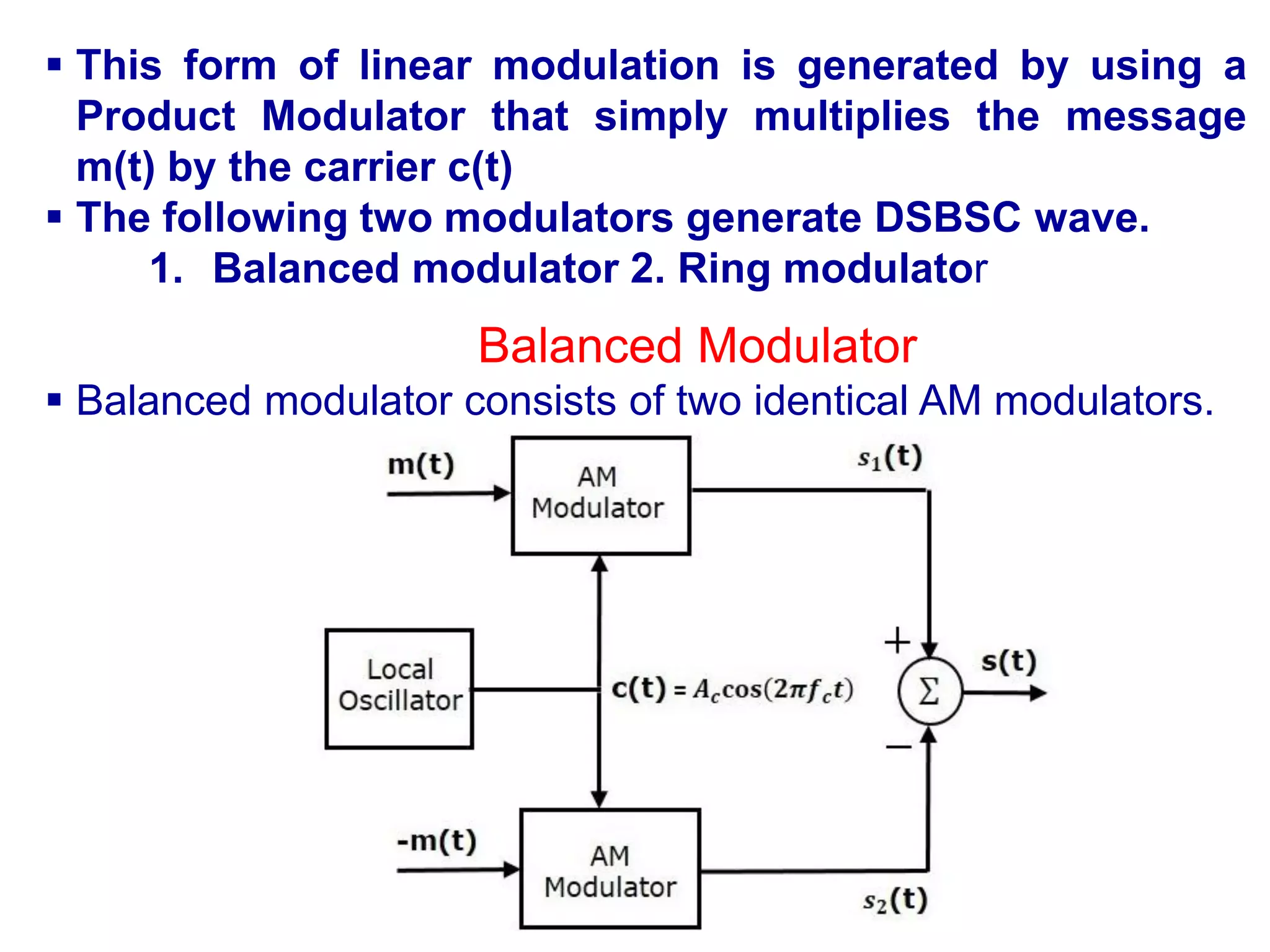
 The following two modulators generate DSBSC wave.
1. Balanced modulator 2. Ring modulator
Balanced Modulator
 Balanced modulator consists of two identical AM modulators.
 These two modulators are arranged in a balanced
configuration in order to suppress the carrier signal.
 Hence, it is called as Balanced modulator.
 The same carrier signal c(t) = Ac cos(2πfct) is applied as
one of the inputs to these two AM modulators.
 The modulating signal m(t) is applied as another input to
the upper AM modulator.
 Whereas, the modulating signal m(t) with opposite
polarity, i.e., −m(t) is applied as another input to the lower
AM modulator.
 Output of the upper AM modulator is
s1(t)=Ac[1+kam(t)]cos(2πfct)
 Output of the lower AM modulator is
s2(t)=Ac[1−kam(t)]cos(2πfct)
 The summer block is used to perform this operation.
 s1(t) with positive sign and s2(t) with negative sign are
applied as inputs to summer block.
 Thus, the summer block produces an output s(t) which is
the difference of s1(t) and s2(t).
 s(t) = Ac[1+kam(t)]cos(2πfct)−Ac[1−kam(t)]cos(2πfct)
⇒s(t)=Accos(2πfct)+Ackam(t)cos(2πfct)−Accos(2πfct)+
Ackam(t)cos(2πfct) ⇒s(t)=2Ackam(t)cos(2πfct)
 The standard equation of DSBSC wave is
s(t)=Acm(t)cos(2πfct)
 By comparing the output of summer block with the
standard equation of DSBSC wave, we will get the scaling
factor as 2ka.
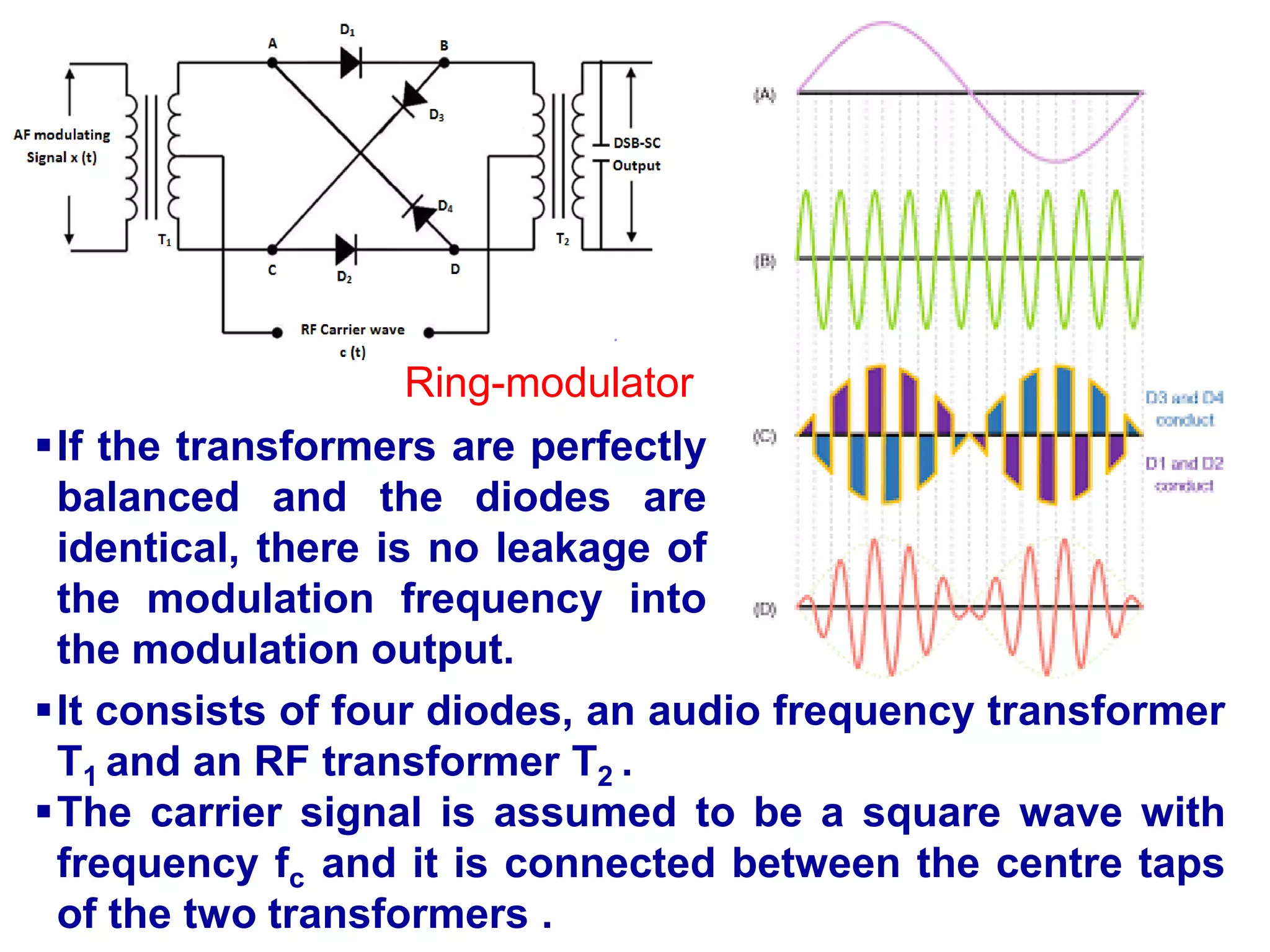
Ring modulator
The four diodes form a ring in which they all point in the
same direction.
Ring modulator is one of the most useful product
modulator, well suited for generating a DSB-SC wave.
The diodes are controlled by square-wave carrier c(t) of
frequency fc , which is applied longitudinally by means of
two center-tapped transformers.
Ring-modulator
If the transformers are perfectly
balanced and the diodes are
identical, there is no leakage of
the modulation frequency into
the modulation output.
It consists of four diodes, an audio frequency transformer
T1 and an RF transformer T2 .
The carrier signal is assumed to be a square wave with
frequency fc and it is connected between the centre taps
of the two transformers .
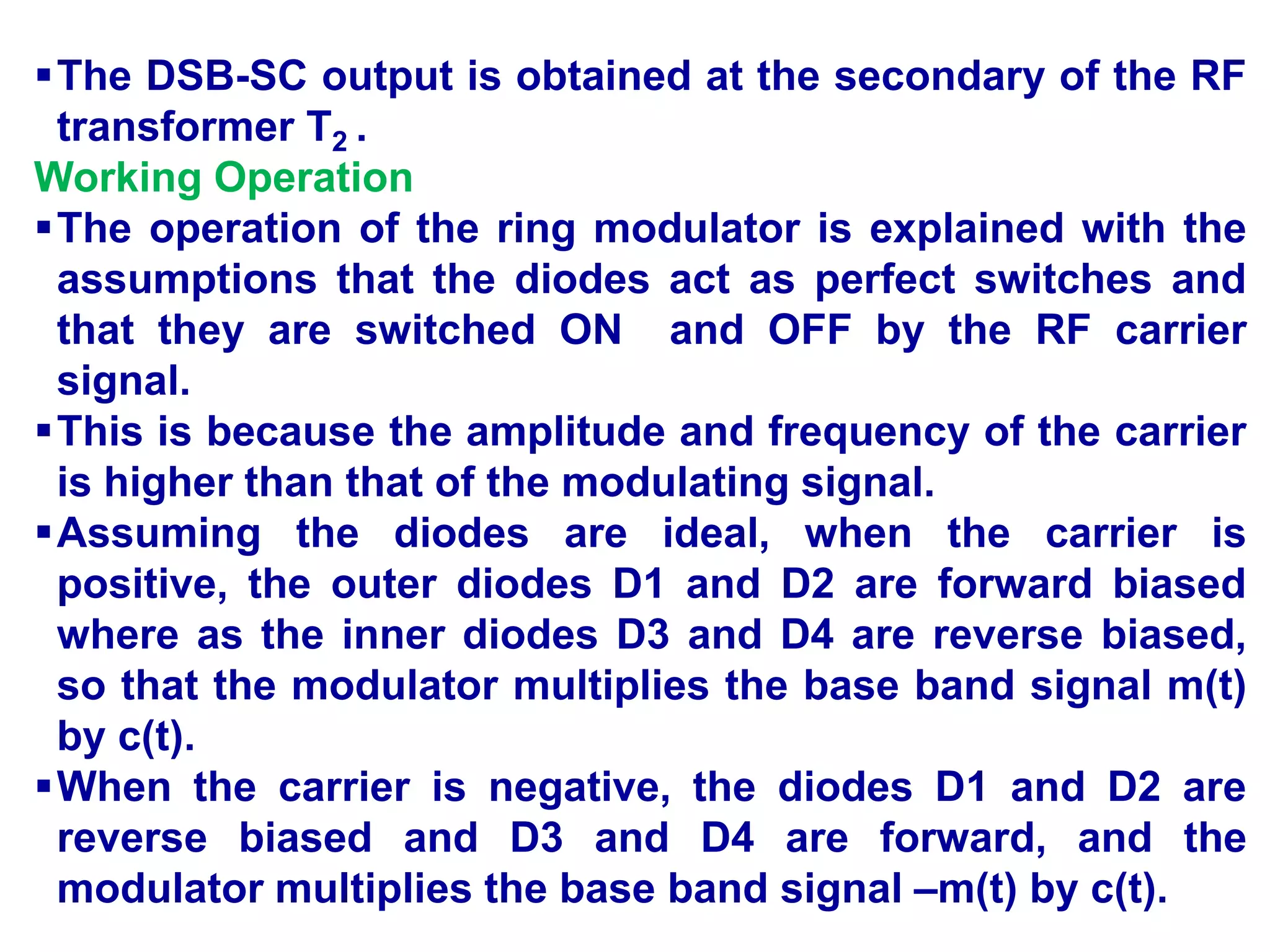
The DSB-SC output is obtained at the secondary of the RF
transformer T2 .
Working Operation
The operation of the ring modulator is explained with the
assumptions that the diodes act as perfect switches and
that they are switched ON and OFF by the RF carrier
signal.
This is because the amplitude and frequency of the carrier
is higher than that of the modulating signal.
Assuming the diodes are ideal, when the carrier is
positive, the outer diodes D1 and D2 are forward biased
where as the inner diodes D3 and D4 are reverse biased,
so that the modulator multiplies the base band signal m(t)
by c(t).
When the carrier is negative, the diodes D1 and D2 are
reverse biased and D3 and D4 are forward, and the
modulator multiplies the base band signal –m(t) by c(t).
Thus the ring modulator in its ideal form is a product
modulator for square wave carrier and the base band
signal m(t).
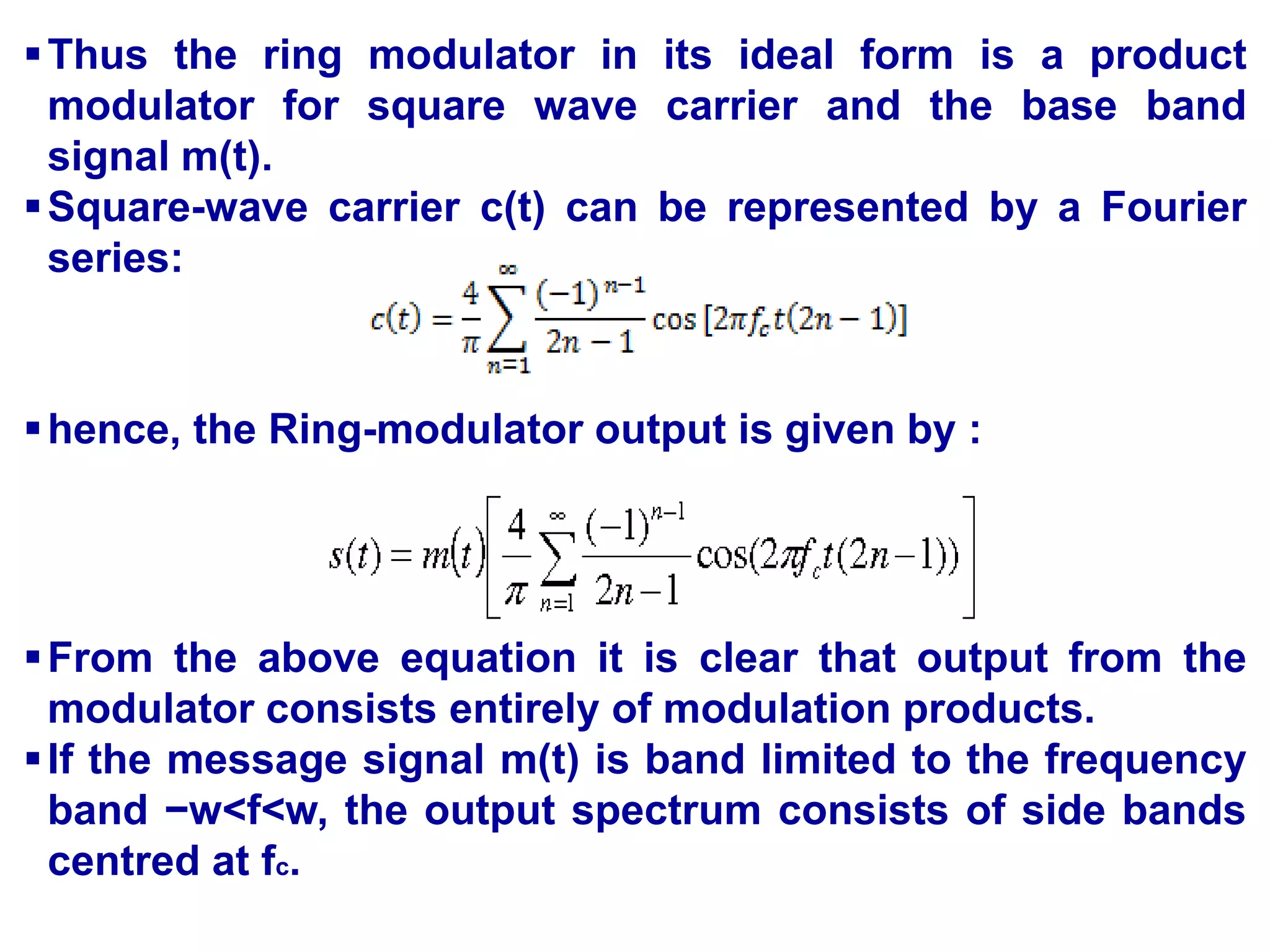
Square-wave carrier c(t) can be represented by a Fourier
series:
hence, the Ring-modulator output is given by :
From the above equation it is clear that output from the
modulator consists entirely of modulation products.
If the message signal m(t) is band limited to the frequency
band −w<f<w, the output spectrum consists of side bands
centred at fc.
COHERENT (SYNCHRONOUS) DETECTOR
 It is assumed that the local oscillator signal is exactly
coherent or synchronized, in both frequency and phase,
with carrier wave c(t) used in the product modulator to
generate s(t).
 This method of demodulation is known as coherent
detection or synchronous demodulation.
 The message signal m(t) may be recovered from a DSB -
SC modulated wave s(t) with a locally generated
sinusoidal wave and then low-pass filtering the product
as shown in Fig
We know that, S(t) = m(t )c(t)
S(t) = m(t) cos(2πfct)
t
f
t
f
t
m
t
s c
c
c

 2
cos
]
2
cos
)
(
[
)
( 

t
f
t
m
t
m
t
f
t
m
t
s c
c
c

 4
cos
)
(
)
(
]
4
cos
1
[
)
(
)
( 2
1
2
1
2
1




)
(
)
( 2
1
t
m
t
s o

DSB-SC modulated spectrum is multiplied using local
oscillator.
This resulting signal is passed through the Low Pass Filter
to retrieve back the message signal.
The first term in Eq. is removed by low-pass filter,
provided that the cut-off frequency of this filter is greater
than w but less than 2𝑓𝑐 - w. This is satisfied by choosing 𝑓
𝑐 >w
Information is contained in the first part i.e. (1/2)m(t) which
is low pass filtered and extracted.
S(t) = m(t)c(t)
S(t) = cos(2πfct) m(t)
)
2
(
cos
]
2
cos
)
(
[
)
( 

 

 t
f
A
t
f
t
m
t
v c
c
c
)
2
(
cos
)
(
cos
)
(
)
(
cos
)
(
)
2
(
cos
)
(
)
(
2
2
2
2












t
t
m
t
m
t
m
t
t
m
t
v
c
A
A
A
c
A
c
c
c
c

cos
)
(
)
( 2
c
A
o
t
m
t
v 
The phase error φ in the local oscillator causes the
detector output to be attenuated by a factor equal to cosφ.
As long as the phase error φ is constant, the detector
output provides an undistorted version of the original
signal m(t).
In practice, we usually find that the phase error ∅ varies
randomly with time, due to random variations in
communication channel. The result is that at the detector
output, the multiplying factor cos ∅ also varies randomly
with time, which is obviously undesired.
Provision must be made in the system to maintain the local
oscillator in the receiver in perfect synchronism, in both
frequency and phase, with the carrier wave used to
generate the DSB-SC modulated signal in the transmitter.
The resulting system complexity is the price that must be
paid for suppressing the carrier wave to save transmitter
power.
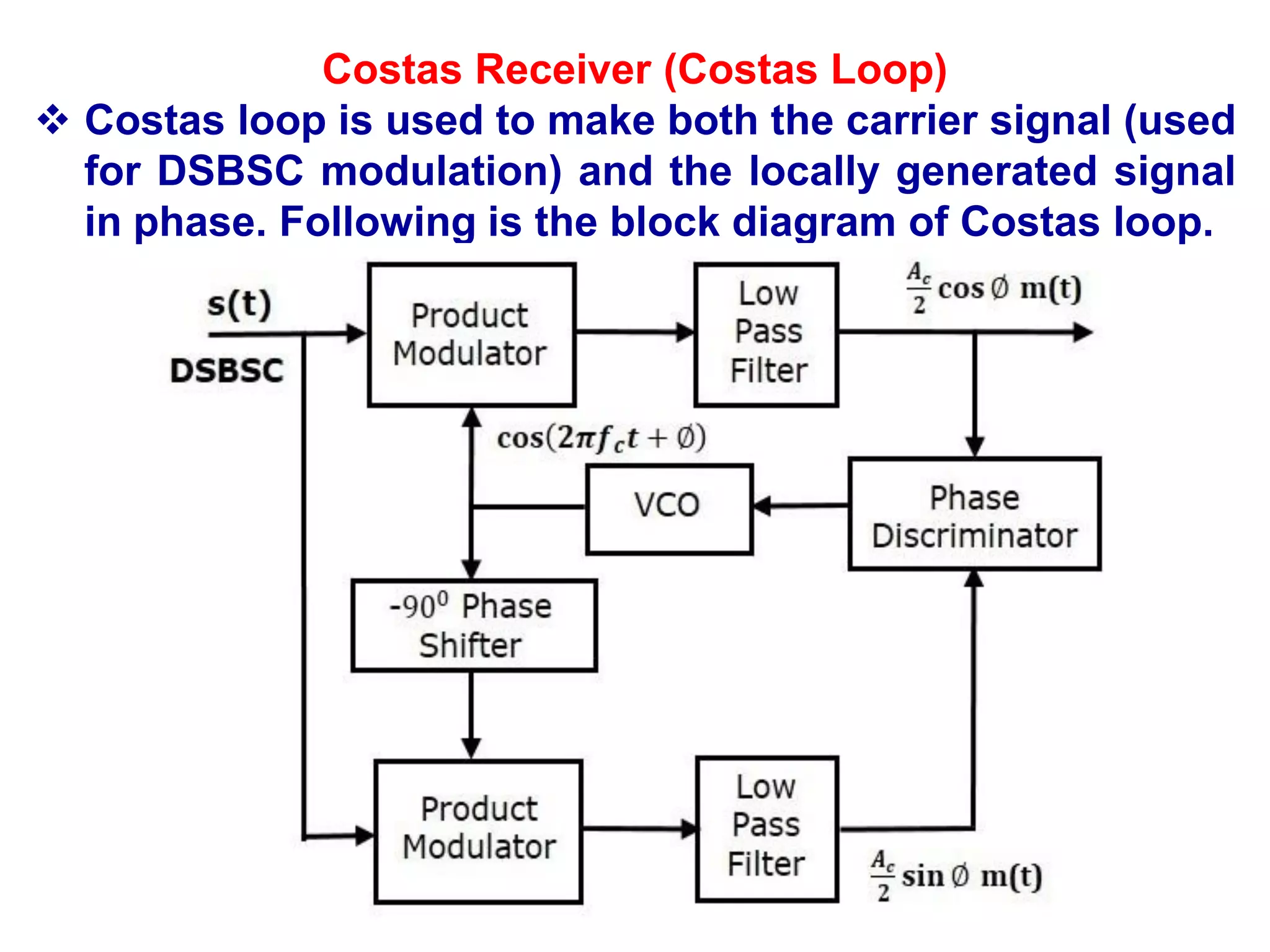
Costas Receiver (Costas Loop)
 Costas loop is used to make both the carrier signal (used
for DSBSC modulation) and the locally generated signal
in phase. Following is the block diagram of Costas loop.
Costas receiver is a synchronous receiver system,
suitable for demodulating DSBSC waves.
It consists of two coherent detectors supplied with the
same input signal.
The frequency of the local oscillator is adjusted to be the
same as the carrier frequency fc.
In the upper path is referred to as the in-phase coherent
detector or I-channel, and that in the lower path is
referred to as the quadrature-phase coherent detector or
Q-channel.
These two detectors are coupled together to from a
negative feedback system designed in such a way as to
maintain the local oscillator synchronous with the carrier-
wave.
By combining the I- and Q-channel outputs in phase
discriminator (which consists of a multiplier followed by
a low-pass filter), a dc control signal is obtained that
automatically corrects for local phase errors in the VCO.
 The equation of DSBSC wave is s(t) = Ac cos(2πfct)m(t)
 Let the output of VCO be c1(t) = cos(2πfct+ϕ)
 This output of VCO is applied as the carrier input of the
upper product modulator. Hence, the output of the upper
product modulator is v1(t)=s(t)c1(t)
 Substitute, s(t) and c1(t) values in the above equation.
⇒v1(t)=A ccos(2πfct) m(t) cos(2πfct+ϕ)
 After simplifying,
v1(t) = Ac/2 cosϕ m(t) + Ac/2 cos(4πfct+ϕ) m(t)
 This signal is applied as an input of the upper low pass
filter.
 The output of this low pass filter is, v01(t) = Ac/2 cosϕ m(t)
 Therefore, the output of this low pass filter is the scaled
version of the modulating signal.
 The output of −90 degree phase shifter is
c2(t)=cos(2πfct+ϕ−90)=sin(2πfct+ϕ)
 This signal is applied as the carrier input of the lower
product modulator.
 The output of the lower product modulator is v2(t)=s(t)c2(t)
 Substitute, s(t) and c2(t) values in the above equation.
⇒v2(t)=Ac cos(2πfct )m(t) sin(2πfct+ϕ)
 After simplifying, v2(t)=Ac/2sinϕm(t)+Ac/2sin(4πfct+ϕ) m(t)
 This signal is applied as an input of the lower low pass
filter.
 The output of this low pass filter is v02(t)=Ac/2sinϕ m(t)
 The output of this Low pass filter has −90 degree phase
difference with the output of the upper low pass filter.
 The outputs of these two low pass filters are applied as
inputs of the phase discriminator.
 Based on the phase difference between these two signals,
the phase discriminator produces a DC control signal.
 This signal is applied as an input of VCO to correct the
phase error in VCO output.
 Therefore, the carrier signal (used for DSBSC modulation)
and the locally generated signal (VCO output) are in
phase.
SSB
Single Side Band Suppressed Carrier modulation
 Standard AM and DSBSC require transmission bandwidth
equal to twice the message bandwidth.
 In both the cases spectrum contains two side bands of
width W Hz, each.
 But the upper and lower sides are uniquely related to each
other by the virtue of their symmetry about the carrier
frequency.
 Thus if only one side band is transmitted, and if both the
carrier and the other side band are suppressed at the
transmitter, no information is lost. This kind of modulation
is called SSBSC.
Advantages: Bandwidth is lesser than AM and DSBSC
waves.
 Power is saved.
 High power signal can be transmitted.
 Less amount of noise is present.
 Signal fading is less likely to occur.
Disadvantages
 The generation and detection of SSBSC wave is a complex
process.
 The quality of the signal gets affected unless the SSB
transmitter and receiver have an excellent frequency
stability.
SSBSC wave
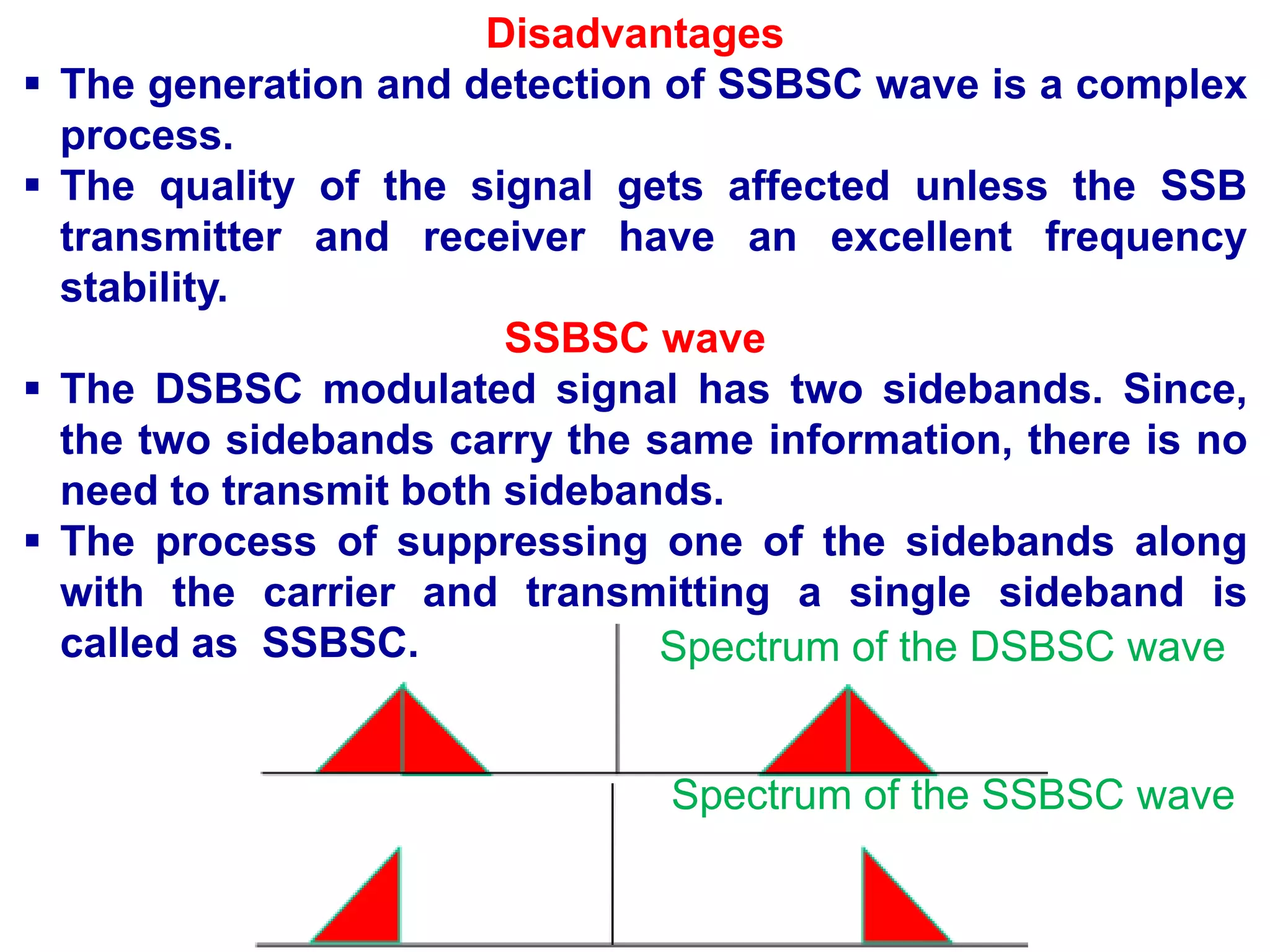
 The DSBSC modulated signal has two sidebands. Since,
the two sidebands carry the same information, there is no
need to transmit both sidebands.
 The process of suppressing one of the sidebands along
with the carrier and transmitting a single sideband is
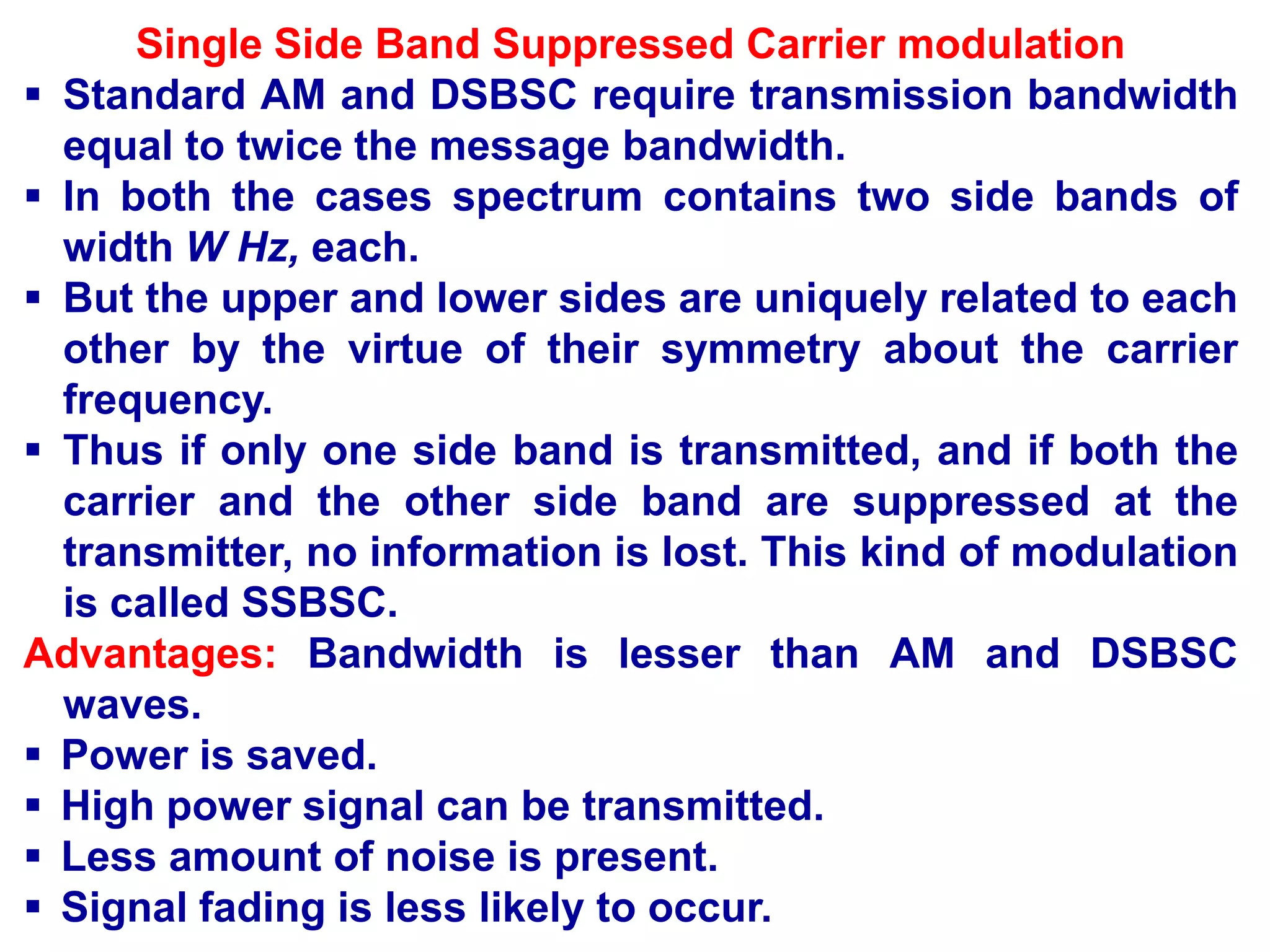
called as SSBSC. Spectrum of the DSBSC wave
Spectrum of the SSBSC wave
Frequency-domain description
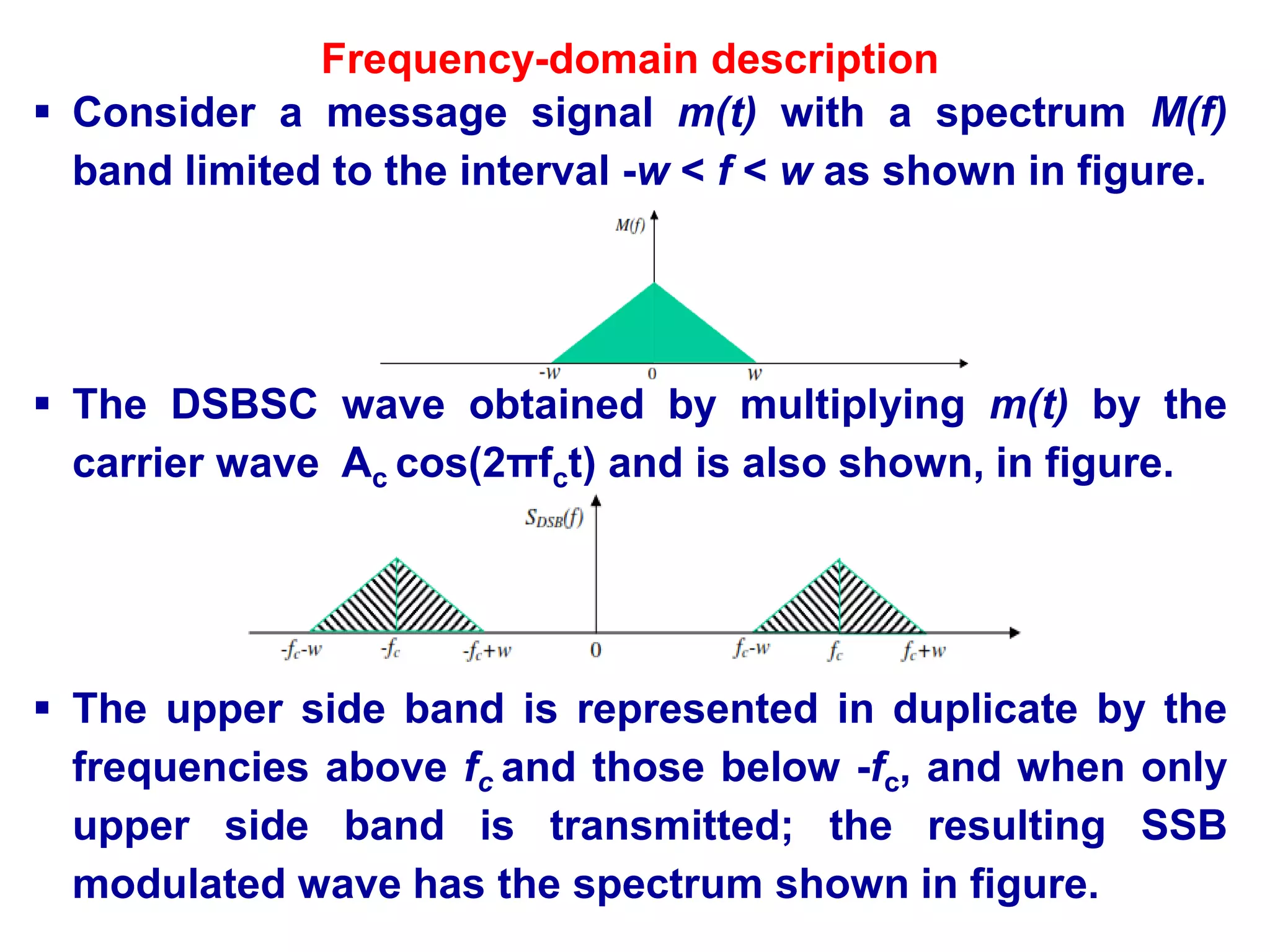
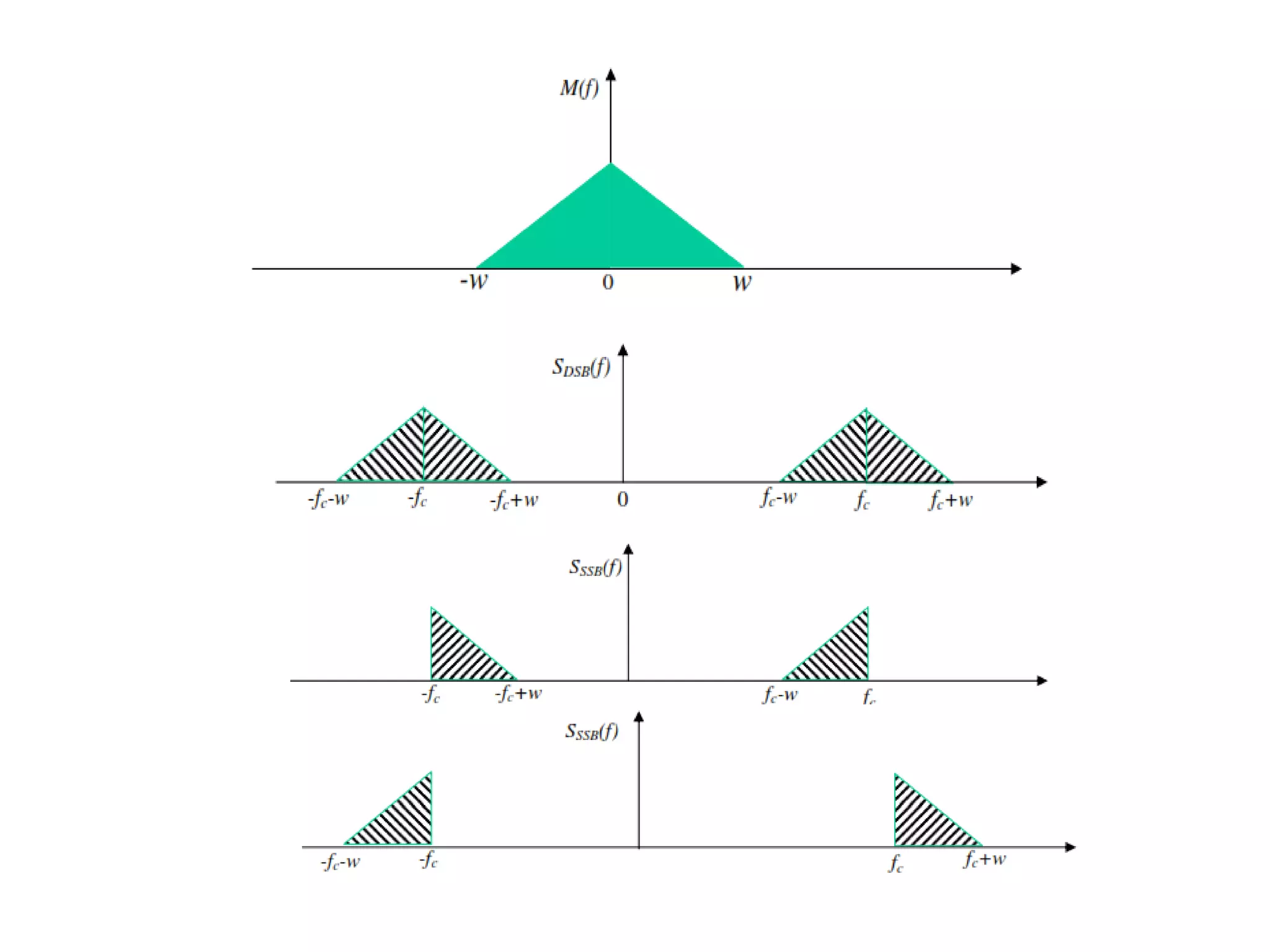
 Consider a message signal m(t) with a spectrum M(f)
band limited to the interval -w < f < w as shown in figure.
 The DSBSC wave obtained by multiplying m(t) by the
carrier wave Ac cos(2πfct) and is also shown, in figure.
 The upper side band is represented in duplicate by the
frequencies above fc and those below -fc, and when only
upper side band is transmitted; the resulting SSB
modulated wave has the spectrum shown in figure.
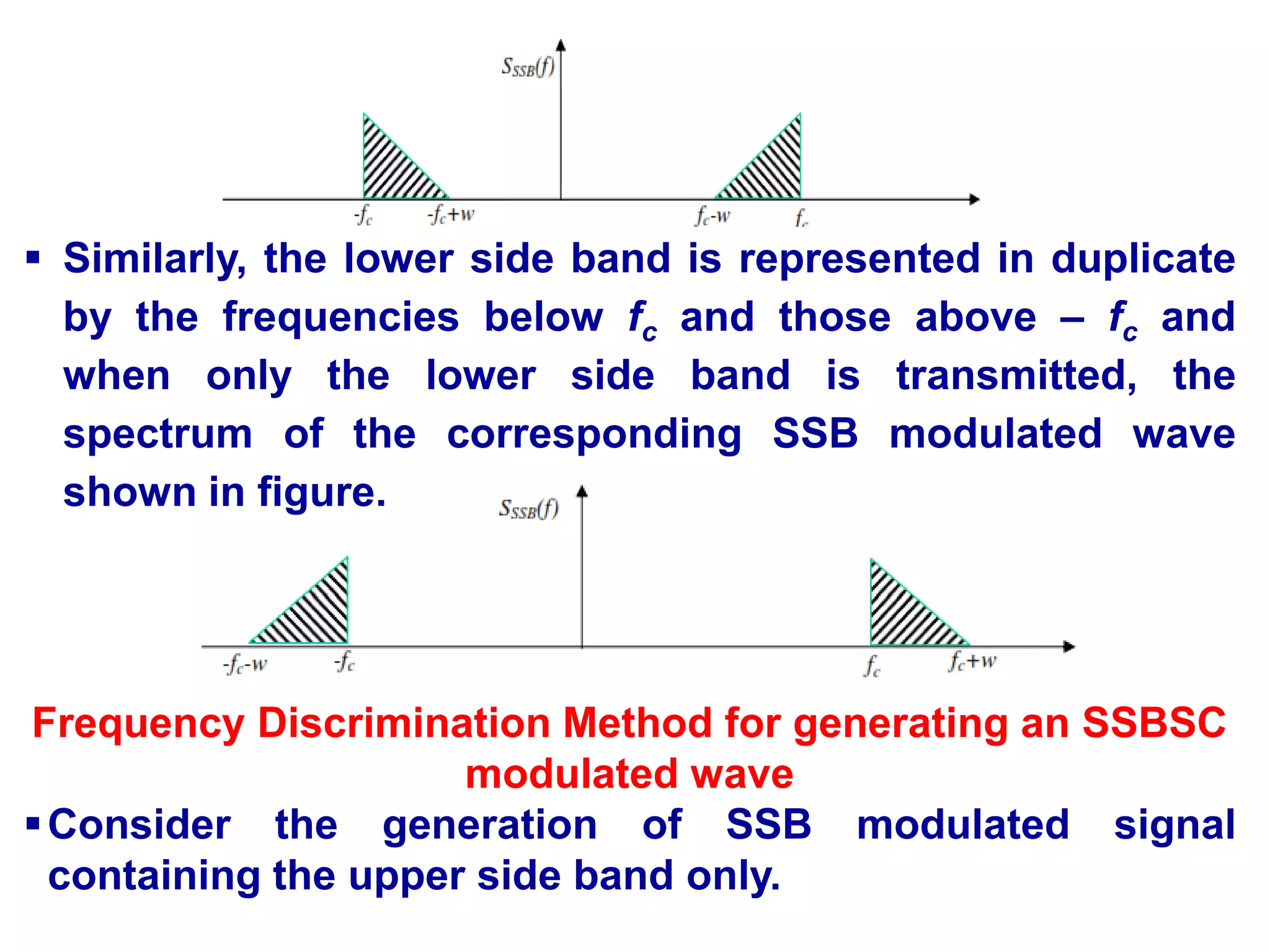
 Similarly, the lower side band is represented in duplicate
by the frequencies below fc and those above – fc and
when only the lower side band is transmitted, the
spectrum of the corresponding SSB modulated wave
shown in figure.
Frequency Discrimination Method for generating an SSBSC
modulated wave
Consider the generation of SSB modulated signal
containing the upper side band only.
From a practical point of view, the most severe requirement
of SSB generation arises from the unwanted sideband, the
nearest component of which is separated from the desired
side band by twice the lowest frequency component of the
message signal.
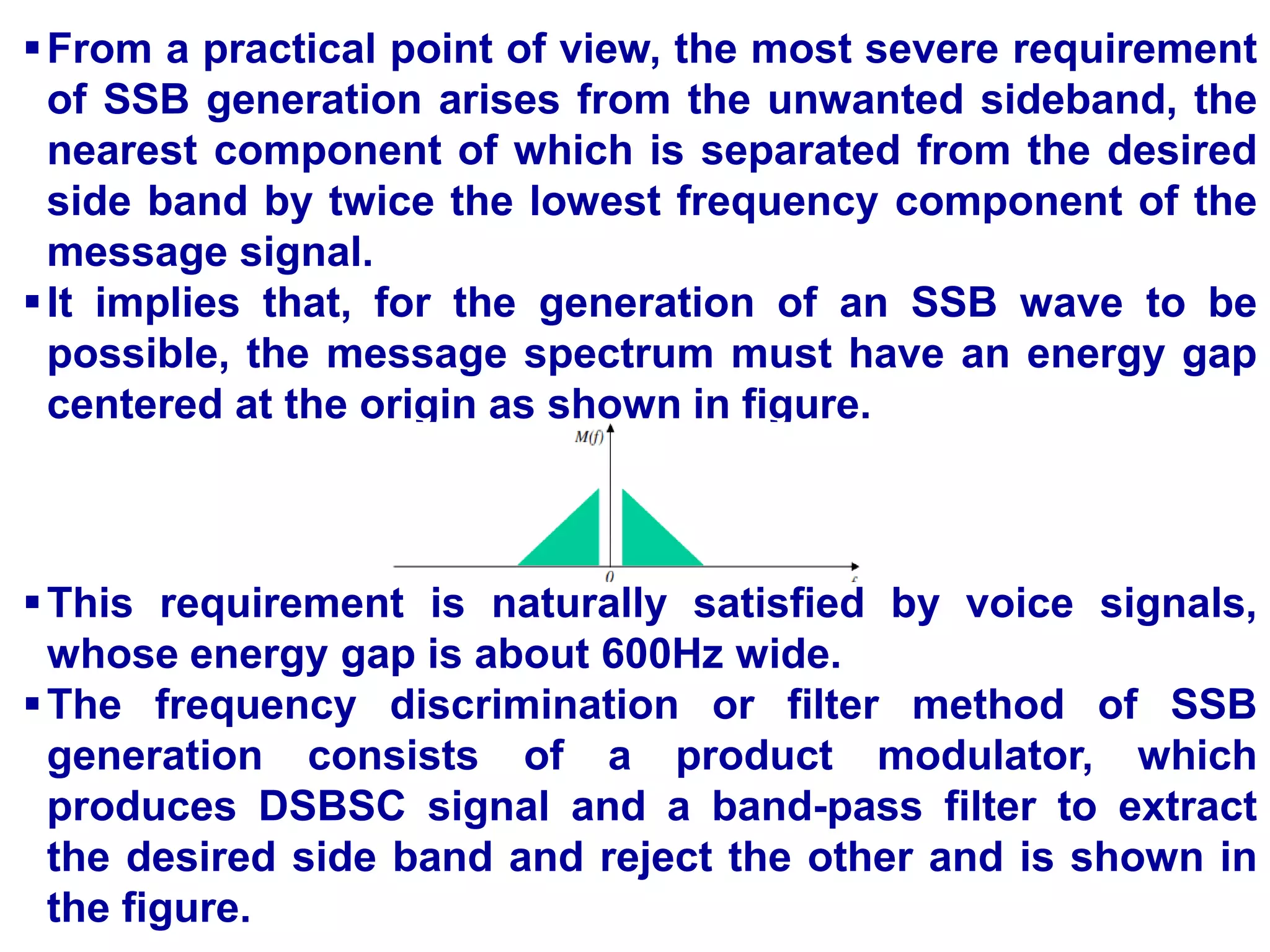
It implies that, for the generation of an SSB wave to be
possible, the message spectrum must have an energy gap
centered at the origin as shown in figure.
This requirement is naturally satisfied by voice signals,
whose energy gap is about 600Hz wide.
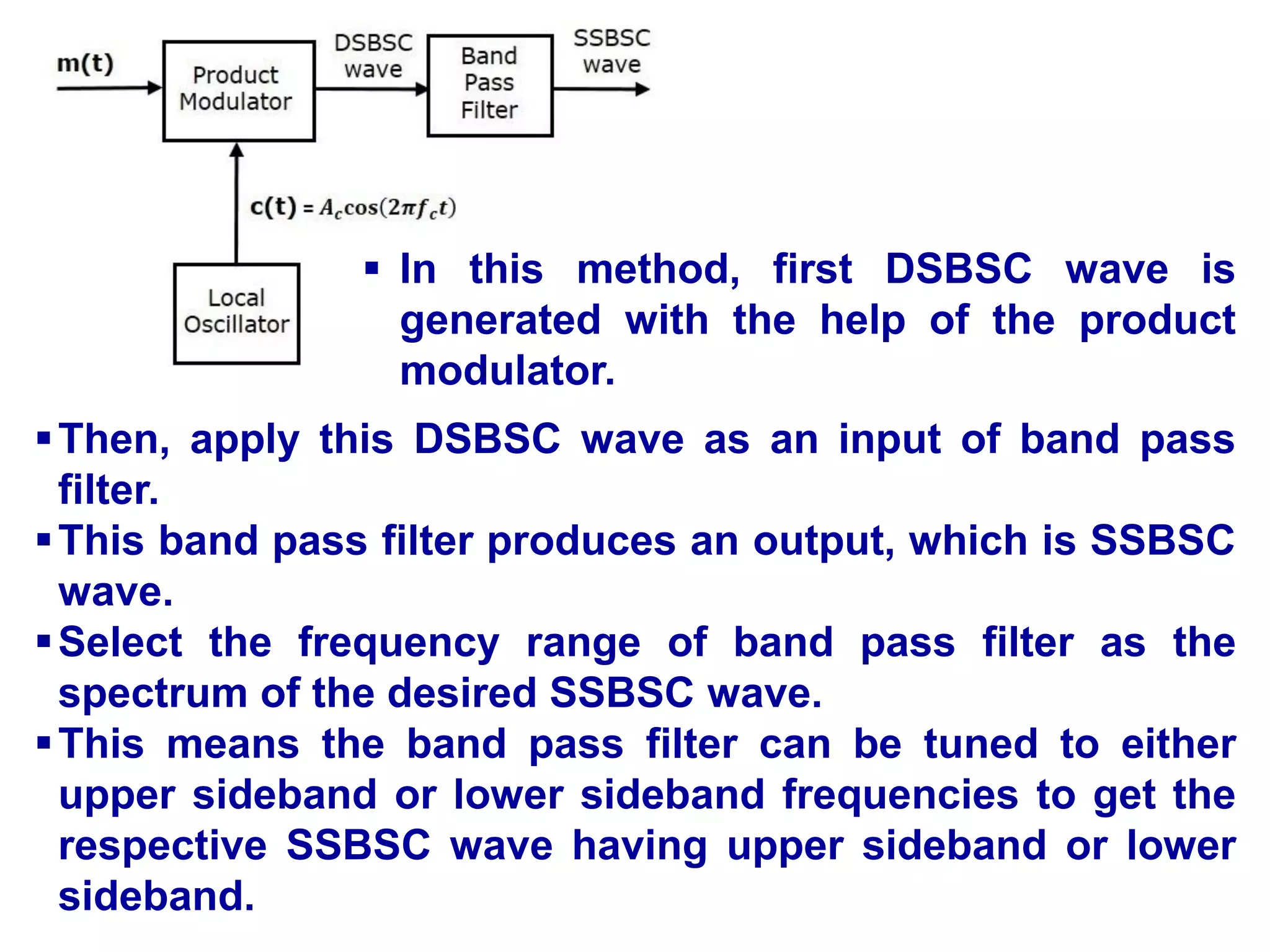
The frequency discrimination or filter method of SSB
generation consists of a product modulator, which
produces DSBSC signal and a band-pass filter to extract
the desired side band and reject the other and is shown in
the figure.
Then, apply this DSBSC wave as an input of band pass
filter.
This band pass filter produces an output, which is SSBSC
wave.
Select the frequency range of band pass filter as the
spectrum of the desired SSBSC wave.
This means the band pass filter can be tuned to either
upper sideband or lower sideband frequencies to get the
respective SSBSC wave having upper sideband or lower
sideband.
 In this method, first DSBSC wave is
generated with the help of the product
modulator.
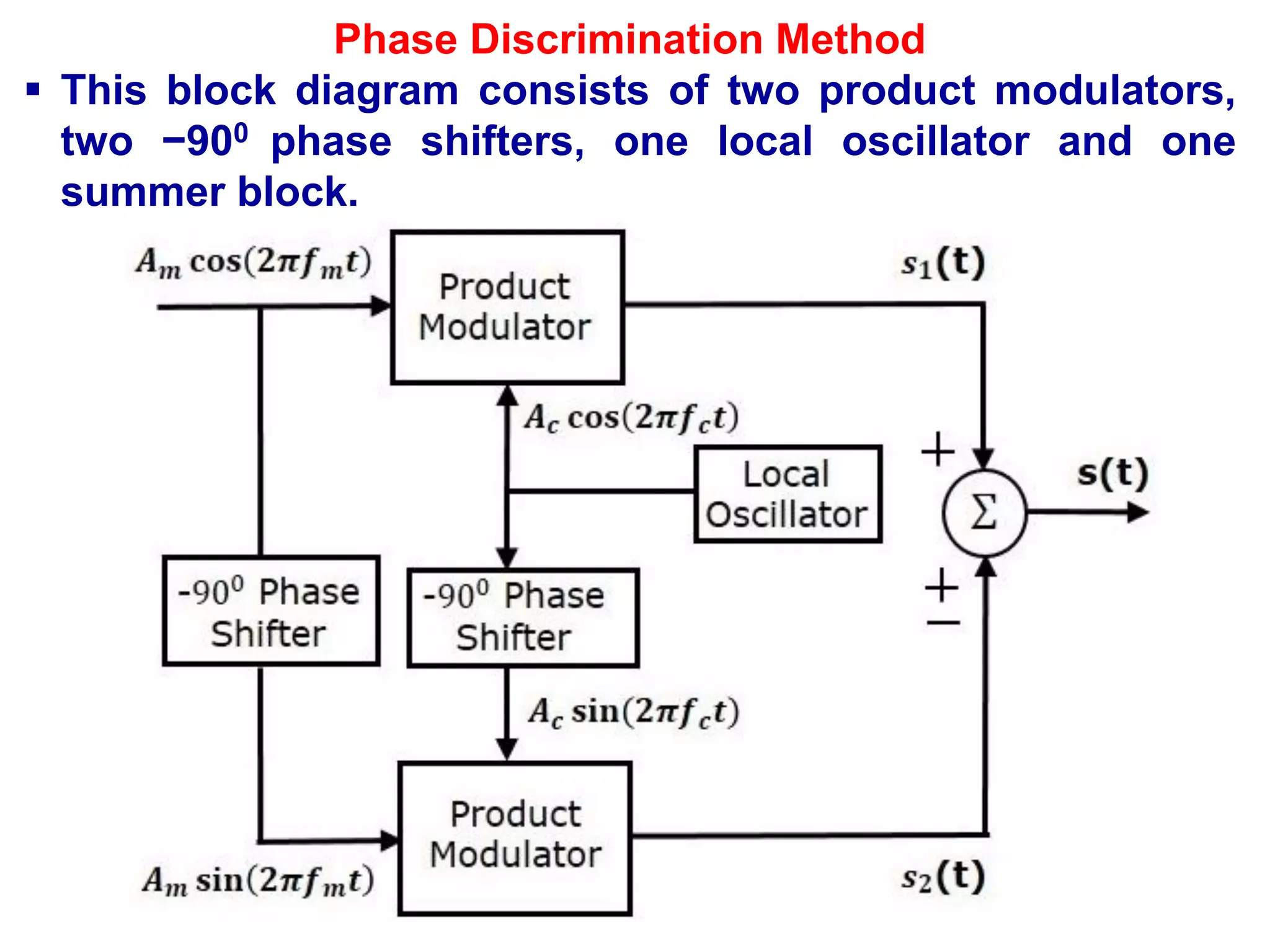
Phase Discrimination Method
 This block diagram consists of two product modulators,
two −900 phase shifters, one local oscillator and one
summer block.
 The product modulator produces an output, which is the
product of two inputs.
 The −900 phase shifter produces an output, which has a
phase lag of −900 with respect to the input.
 The local oscillator is used to generate the carrier signal.
 Summer block produces an output, which is either the
sum of two inputs or the difference of two inputs based
on the polarity of inputs.
 The modulating signal Am cos(2πfmt) and the carrier
signal Ac cos(2πfct) are directly applied as inputs to the
upper product modulator.
 So, the upper product modulator produces an output,
which is the product of these two inputs.
 The output of upper product modulator is
 s1(t) = AmAc cos(2πfmt) cos(2πfct)
 ⇒s1(t) = AmAc/2 {cos[2π(fc+fm)t] + cos[2π(fc−fm)t]}
 The modulating signal Am cos(2πfmt) and the carrier
signal Ac cos(2πfct) are phase shifted by −900 before
applying as inputs to the lower product modulator.
 So, the lower product modulator produces an output,
which is the product of these two inputs.
 The output of lower product modulator is
s2(t) = AmAc cos(2πfmt−900) cos(2πfct−900)
⇒ s2(t) = AmAc sin(2πfmt) sin(2πfct)
⇒s2(t)=AmAc/2{cos[2π(fc−fm)t] − cos[2π(fc+fm)t]}
 Add s1(t) and s2(t) in order to get the SSBSC modulated
wave s(t) having a lower sideband.
s(t) = AmAc/2 {cos[2π(fc+fm)t] + cos[2π(fc−fm)t]} +
AmAc/2 {cos[2π(fc−fm)t] − cos[2π(fc+fm)t]}
⇒ s(t )= AmAc cos[2π(fc−fm)t]
 Subtract s2(t) from s1(t) in order to get the SSBSC
modulated wave s(t) having a upper sideband.
s(t)=AmAc/2 {cos[2π(fc+fm)t] + cos[2π(fc−fm)t]} −
AmAc/2 {cos[2π(fc−fm)t] − cos[2π(fc+fm)t]}
⇒ s(t) = AmA ccos[2π(fc+fm)t]
 Hence, by properly choosing the polarities of inputs at
summer block, we will get SSBSC wave having a upper
sideband or a lower sideband.
Coherent Detector
 The process of extracting an original message signal
from SSBSC wave is known as detection or
demodulation of SSBSC.
 Coherent detector is used for demodulating SSBSC
wave.
 Here, the same carrier signal (which is used for
generating SSBSC wave) is used to detect the message
signal.
 Hence, this process of detection is called
as coherent or synchronous detection.
 In this process, the message signal can be extracted from
SSBSC wave by multiplying it with a carrier, having the
same frequency and the phase of the carrier used in
SSBSC modulation.
 Consider the following SSBSC wave having a lower
sideband.
s(t) = AmAc/2 cos[2π(fc−fm)t]
 The output of the local oscillator isc(t) = Ac cos(2πfct)
 The output of product modulator as v(t) = s(t) c(t)
 Substitute s(t) and c(t) values in the above equation.
The resulting signal is
then passed through a
Low Pass Filter.
The output of this filter is
the desired message
signal.
v(t) = AmAc/2 cos[2π(fc−fm)t] Accos(2πfct)
= AmAc
2/2 cos[2π(fc−fm)t] cos(2πfct)
= AmAc
2/4 {cos[2π(2fc−fm)] + cos(2πfm)t}
v(t) = AmAc
2/4 cos(2πfmt) + AmAc
2/4 cos[2π(2fc−fm)t]
 In the above equation, the first term is the scaled
version of the message signal.
 It can be extracted by passing the above signal through
a low pass filter.
 Therefore, the output of low pass filter is
v0(t) = AmAc
2/4cos(2πfmt)
 Here, the scaling factor is Ac
2/4.
Vestigial Sideband Modulation
 In case of SSB modulation, when a sideband is passed
through the filters, the band pass filter may not work
perfectly in practice.
 As a result of which, some of the information may get lost.
 Hence to avoid this loss, a technique is chosen, which is a
compromise between DSB-SC and SSB, called
as Vestigial Sideband (VSB) technique.
 The word vestige which means “a part” from which the
name is derived.
Vestigial Sideband: Both of the sidebands are not required
for the transmission, as it is a waste.
 But a single band if transmitted, leads to loss of
information. Hence, this technique has evolved.
 VSB Modulation is the process where a part of the signal
called as vestige is modulated, along with one sideband.
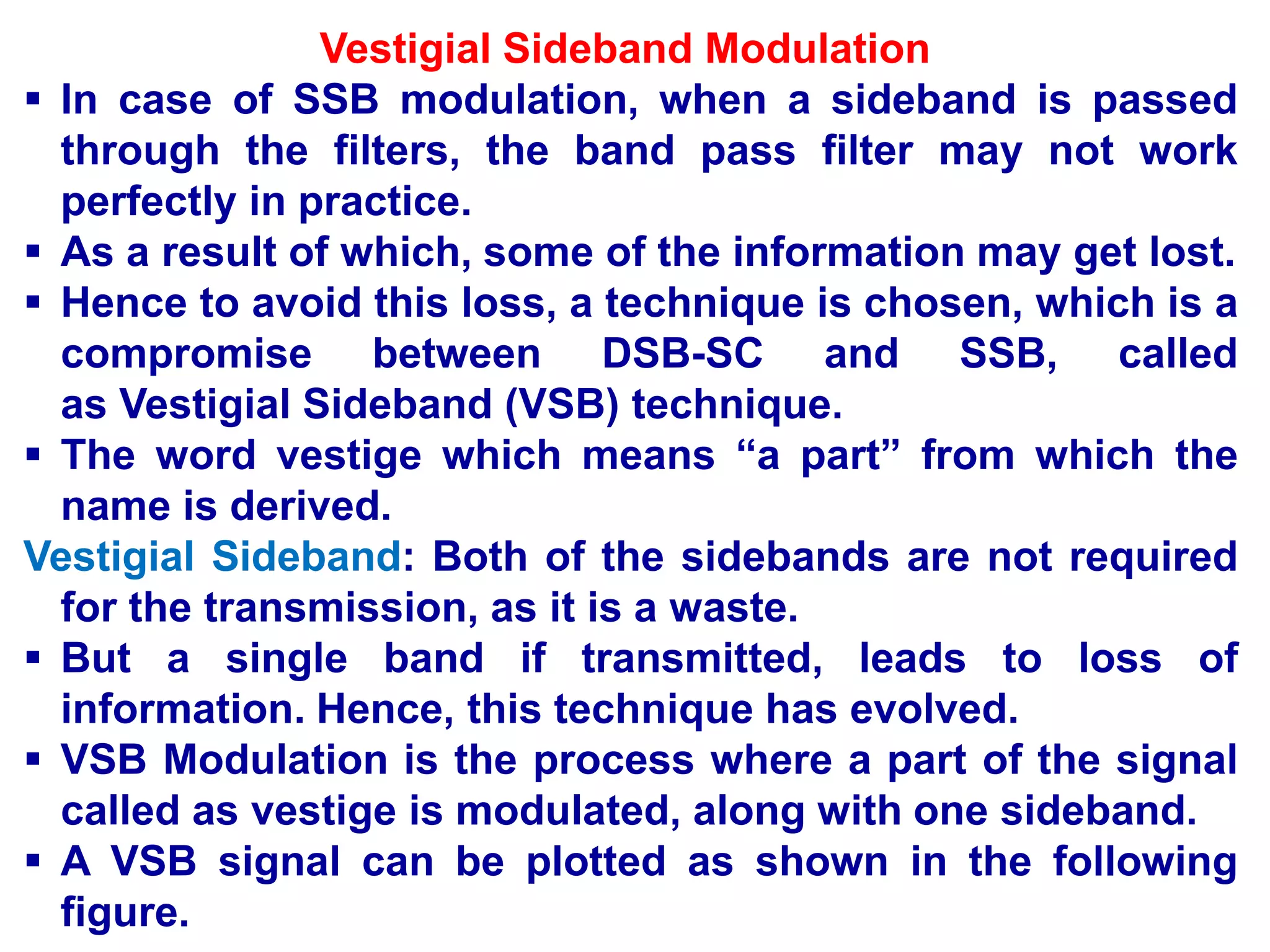
 A VSB signal can be plotted as shown in the following
figure.
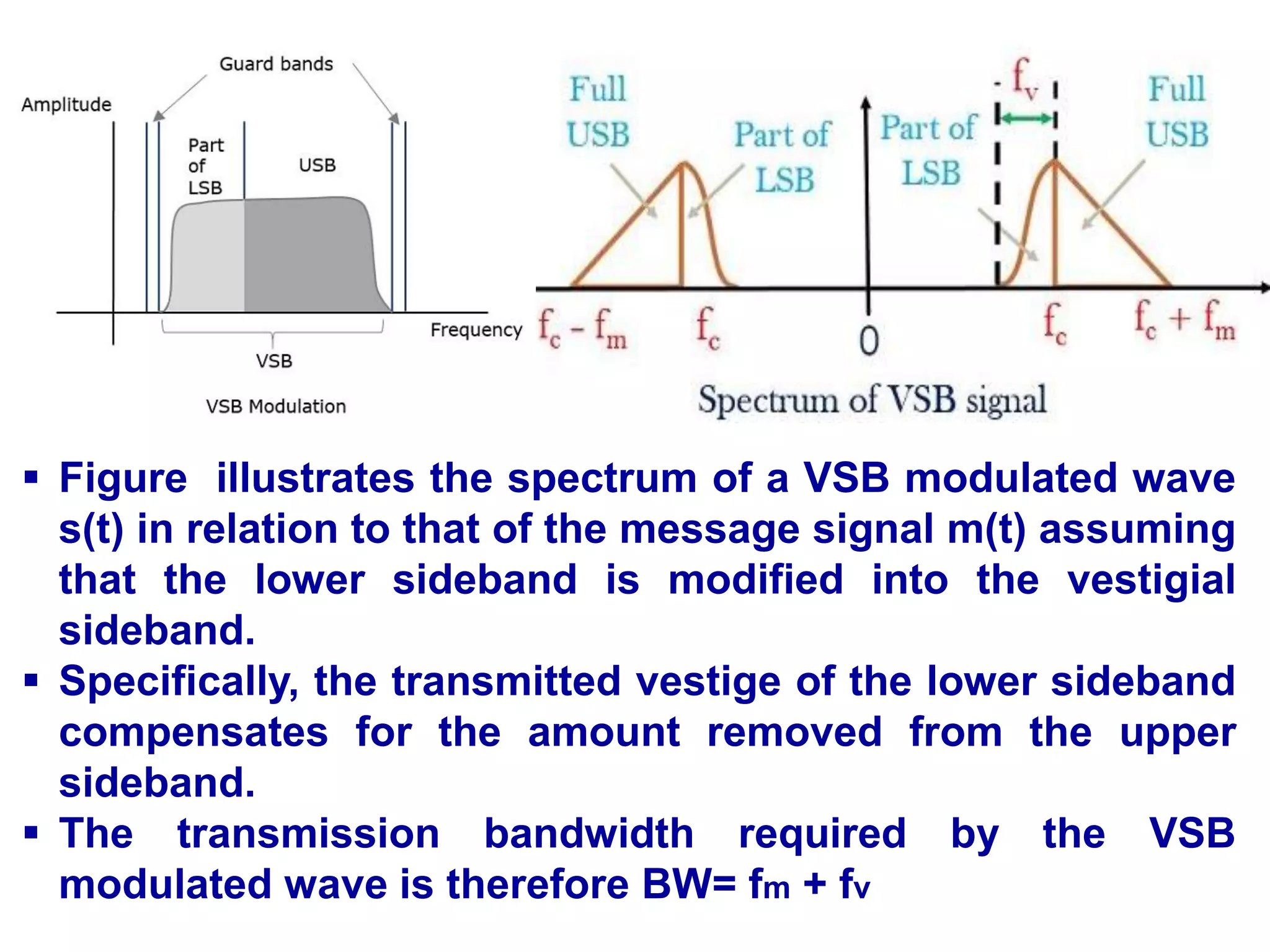
 Figure illustrates the spectrum of a VSB modulated wave
s(t) in relation to that of the message signal m(t) assuming
that the lower sideband is modified into the vestigial
sideband.
 Specifically, the transmitted vestige of the lower sideband
compensates for the amount removed from the upper
sideband.
 The transmission bandwidth required by the VSB
modulated wave is therefore BW= fm + fv
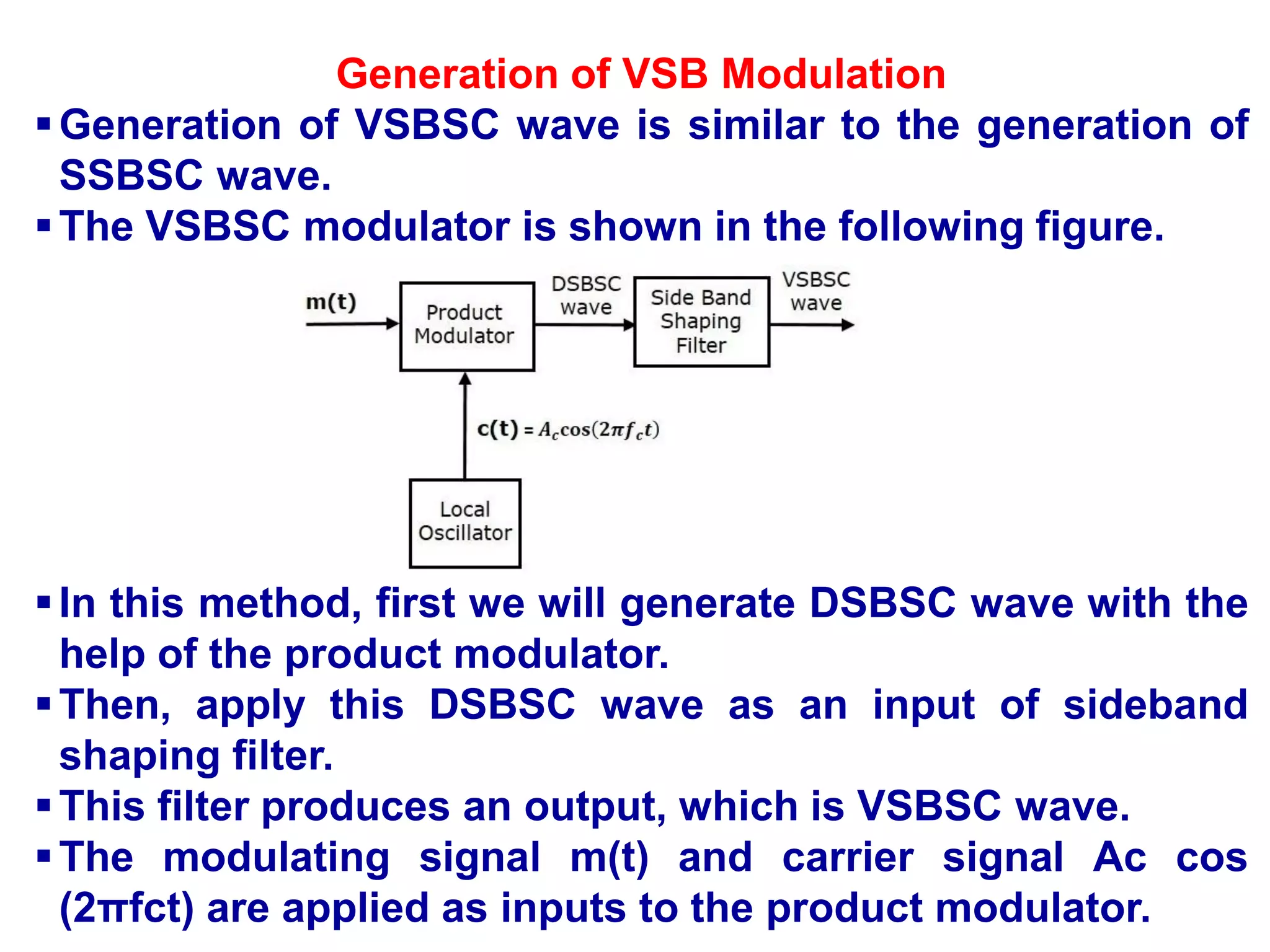
Generation of VSB Modulation
Generation of VSBSC wave is similar to the generation of
SSBSC wave.
The VSBSC modulator is shown in the following figure.
In this method, first we will generate DSBSC wave with the
help of the product modulator.
Then, apply this DSBSC wave as an input of sideband
shaping filter.
This filter produces an output, which is VSBSC wave.
The modulating signal m(t) and carrier signal Ac cos
(2πfct) are applied as inputs to the product modulator.
 Hence, the product modulator produces an output, which
is the product of these two inputs.
 Therefore, the output of the product modulator is
v(t)=Accos(2πfct)m(t)
 Apply Fourier transform on both sides
V(f)=Ac/2[M(f−fc)+M(f+fc)]
 The above equation represents the equation of DSBSC
frequency spectrum.
 Let the transfer function of the sideband shaping filter
be H(f).
 This filter has the input v(t) and the output is VSBSC
modulated wave s(t).
 The Fourier transforms of v(t) and s(t) are V(f) and S(f)
respectively.
 Mathematically, we can write S(f) as S(f)=V(f)H(f)
 Substitute V(f) value in the above equation.
S(f)=Ac/2[M(f−fc)+M(f+fc)]H(f)
The above equation represents the equation of VSBSC
frequency spectrum.
The condition for frequency response of filter is
[H(f−fc)+H(f+fc)]=1
Detection of VSB Modulation
Demodulation of VSBSC wave is similar to the
demodulation of SSBSC wave.
Here, the same carrier signal (which is used for generating
VSBSC wave) is used to detect the message signal.
Hence, this process of detection is called
as coherent or synchronous detection.
The VSBSC demodulator is shown in the following figure.
The resulting signal is then passed through a Low Pass
Filter.
The output of this filter is the desired message signal.
Let the VSBSC wave be s(t) and the carrier signal
is Accos(2πfct).
From the figure, we can write the output of the product
modulator as v(t)=Accos(2πfct)s(t)
Apply Fourier transform on both sides
V(f)=Ac/2[S(f−fc)+S(f+fc)]
We know that S(f)=Ac/2[M(f−fc)+M(f+fc)]H(f)
 In this process, the message signal can
be extracted from VSBSC wave by
multiplying it with a carrier, which is
having the same frequency and the phase
of the carrier used in VSBSC modulation.
From the above equation, let us find S(f−fc) and S(f+fc).
⇒S(f−fc)=Ac/2[M(f−2fc)+M(f)]H(f−fc)
⇒S(f+fc)=Ac/2[M(f)+M(f+2fc)]H(f+fc)
Substitute, S(f−fc) and S(f+fc) values in V(f).
V(f)=Ac/2[Ac/2[M(f−2fc)+M(f)]H(f−fc)+
Ac/2[M(f)+M(f+2fc)]H(f+fc)]
⇒V(f)=Ac/4 M(f)[H(f−fc)+H(f+fc)]+
Ac/4[M(f−2fc)H(f−fc)+M(f+2fc)H(f+fc)]
In the above equation, the first term represents the scaled
version of the desired message signal frequency
spectrum.
It can be extracted by passing the above signal through a
low pass filter.
V0(f)=Ac/4 M(f)[H(f−fc)+H(f+fc)]
The condition for frequency response of filter is
[H(f−fc)+H(f+fc)]=1
Therefore V0(f)=Ac/4M(f) Apply Inverse Fourier transform
on both sides v0(t)=Ac/4m(t)
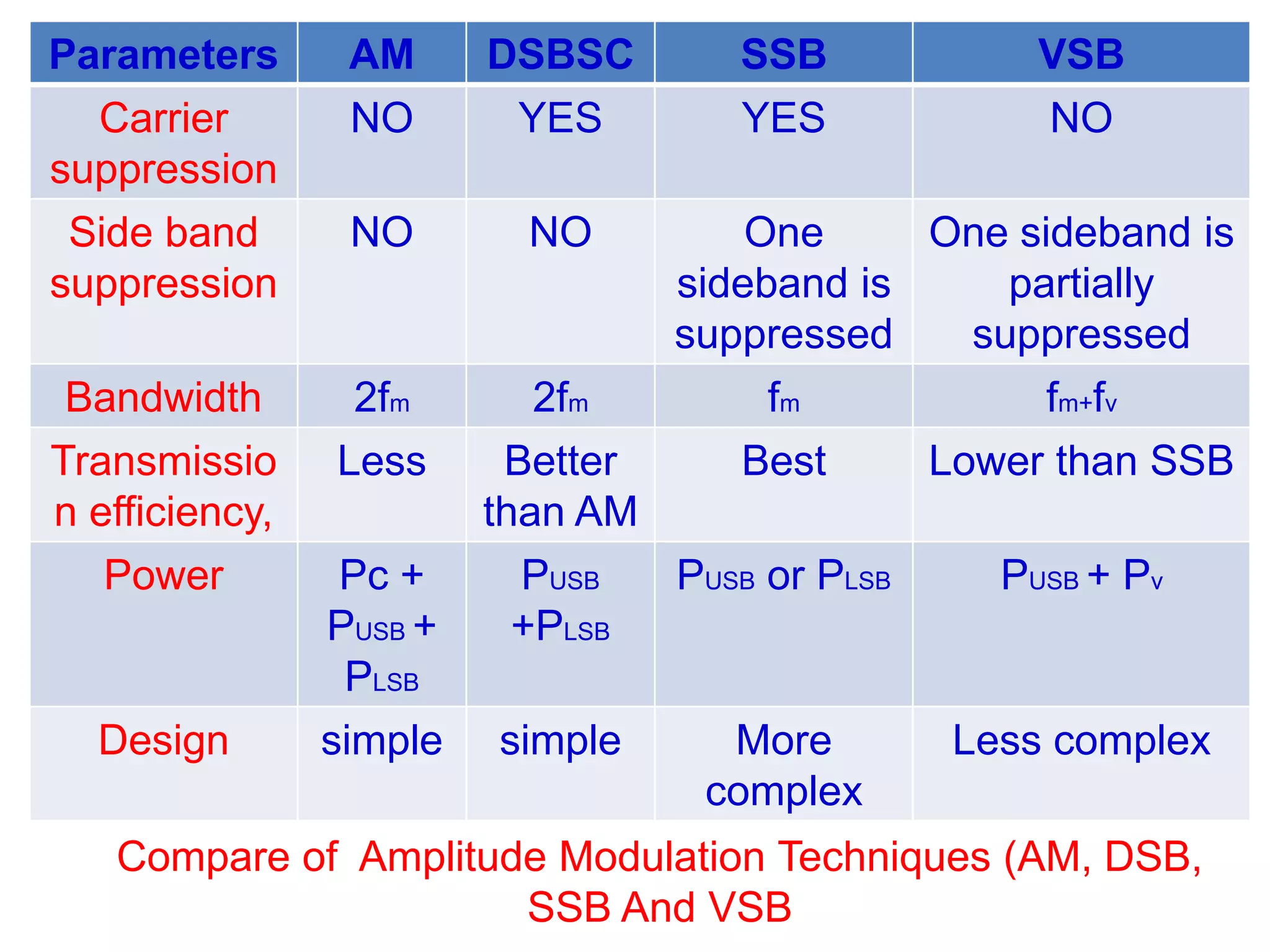
Parameters AM DSBSC SSB VSB
Carrier
suppression
NO YES YES NO
Side band
suppression
NO NO One
sideband is
suppressed
One sideband is
partially
suppressed
Bandwidth 2fm 2fm fm fm+fv
Transmissio
n efficiency,
Less Better
than AM
Best Lower than SSB
Power Pc +
PUSB +
PLSB
PUSB
+PLSB
PUSB or PLSB PUSB + Pv
Design simple simple More
complex
Less complex
Compare of Amplitude Modulation Techniques (AM, DSB,
SSB And VSB
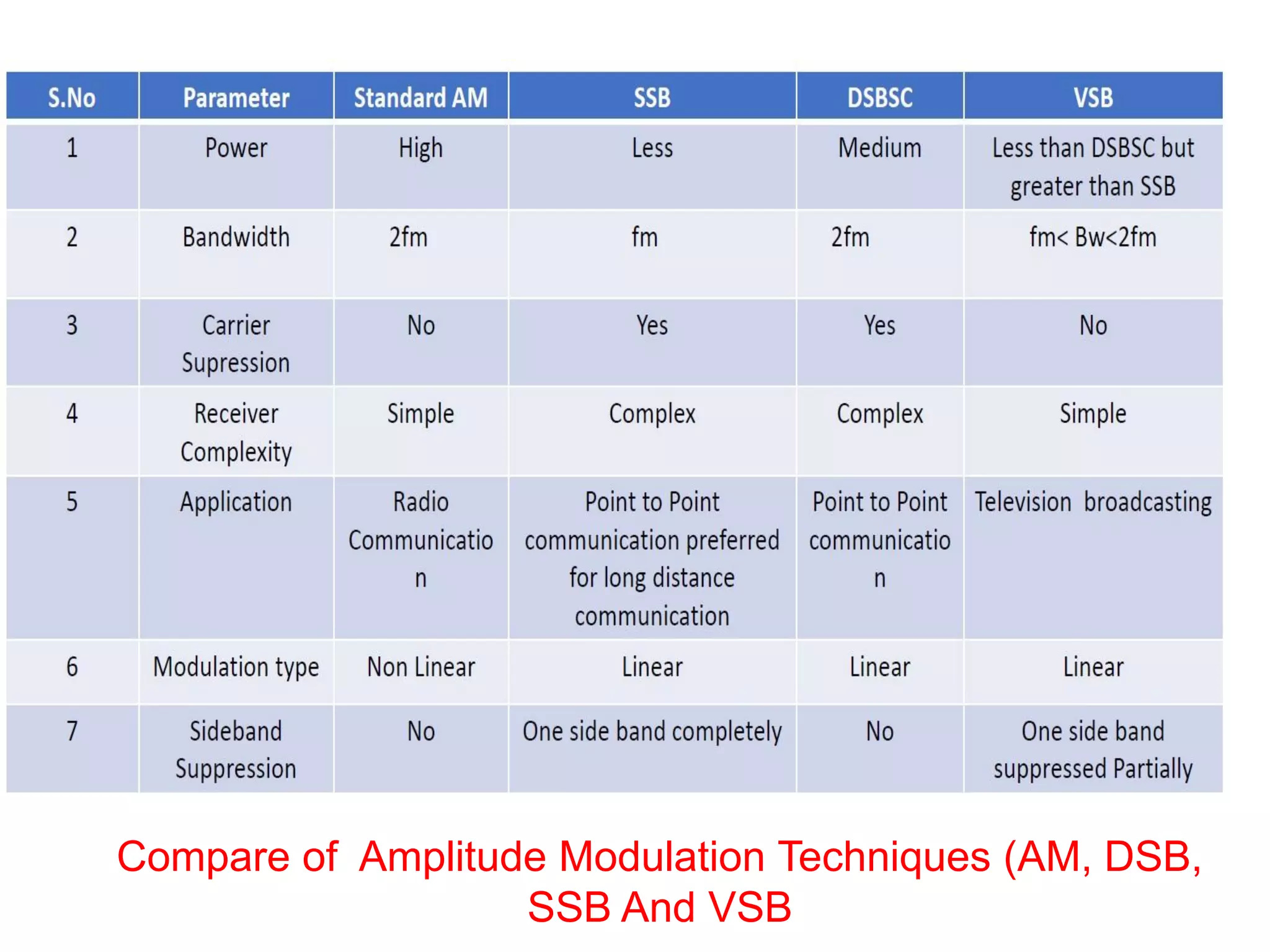
Compare of Amplitude Modulation Techniques (AM, DSB,
SSB And VSB
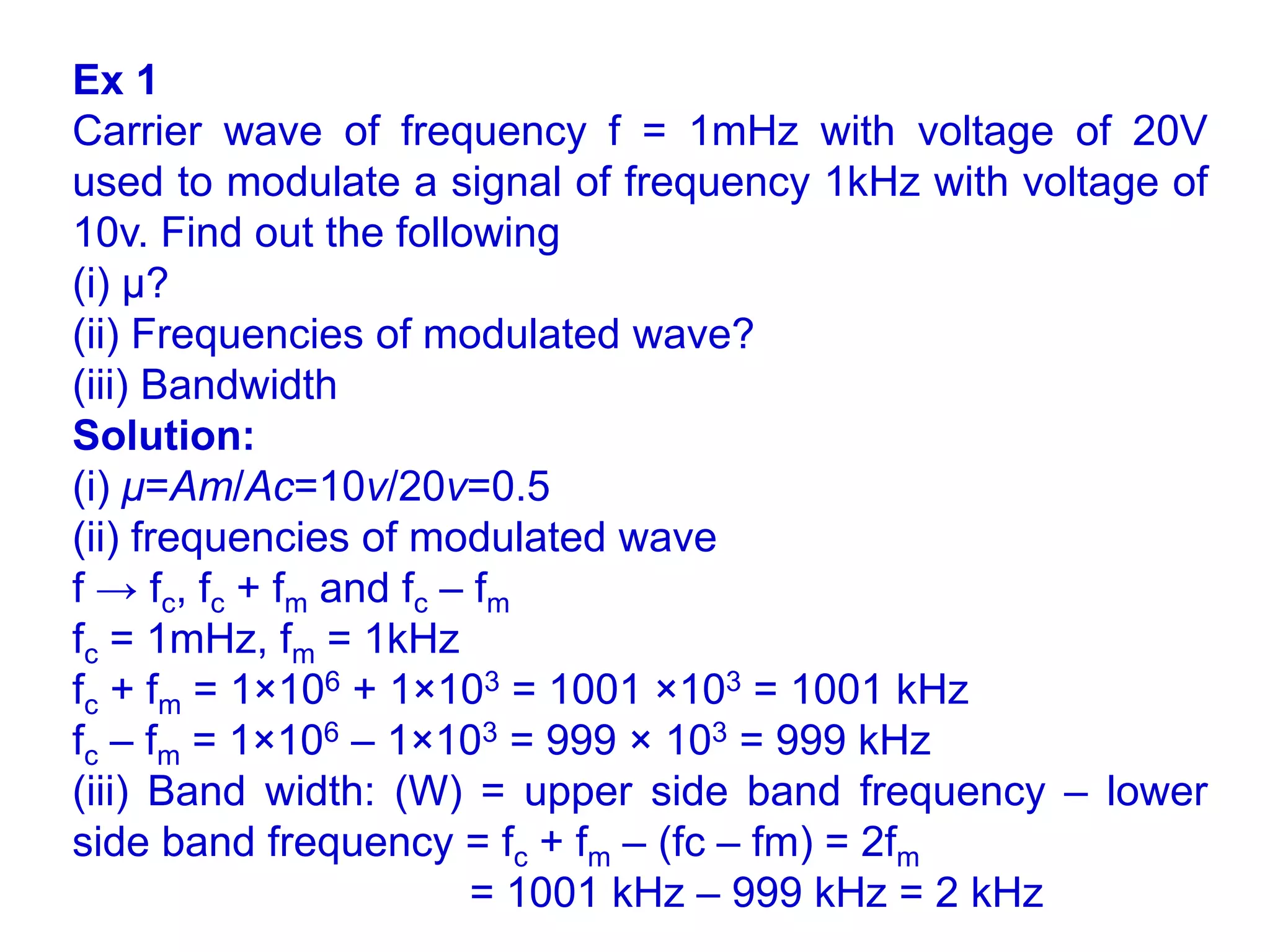
Ex 1
Carrier wave of frequency f = 1mHz with voltage of 20V
used to modulate a signal of frequency 1kHz with voltage of
10v. Find out the following
(i) μ?
(ii) Frequencies of modulated wave?
(iii) Bandwidth
Solution:
(i) μ=Am​​/Ac​=10v​/20v=0.5
(ii) frequencies of modulated wave
f → fc, fc + fm and fc – fm
fc = 1mHz, fm = 1kHz
fc + fm = 1×10⁶ + 1×103 = 1001 ×103 = 1001 kHz
fc – fm = 1×10⁶ – 1×103 = 999 × 103 = 999 kHz
(iii) Band width: (W) = upper side band frequency – lower
side band frequency = fc + fm – (fc – fm) = 2fm
= 1001 kHz – 999 kHz = 2 kHz

AC UINT 2 (02-02-2023)-1.pdf

  • 1.
    Analog Communications UNIT –II DSBSC Modulation: Time domain and frequency domain description, Generation of DSBSC Wave - Balanced Modulators, Ring Modulator. Coherent detection of DSBSC Modulated wave , COSTAS Loop. SSB Modulation: Frequency domain description, Frequency discrimination method for generation of AM SSB Modulated wave, Time domain description, Phase discrimination method for generating AM SSB Modulated wave. Demodulation of SSB wave, VSB Modulation, Comparison of AM Techniques.
  • 2.
    UNIT- II 1) Explainthe balanced modulator method to generate DSBSC waveform with neat diagram. (CO2) 2) Explain the demodulation of DSB-SC using Synchronous detection method. (CO2) 3) Explain about COSTAS loop with a neat block diagram for demodulating DSB-SC wave.(CO2) 4) Explain the Frequency discrimination method for generating SSB signal. (CO2) 5) Explain the phase discrimination method of generating SSB modulated wave with neat diagram. (CO2) 6) With neat diagrams, explain about the VSB modulation system and also explain its Applications. (CO2)
  • 3.
    Limitations of AmplitudeModulation  The standard AM modulated signal contains a sinusoidal component at the carrier frequency which does not convey any of the baseband message information.  The amplitude modulation with full carrier defined earlier suffers from two major practical limitations: 1.Amplitude modulation is wasteful of transmitted power, PT 2.Amplitude modulation is wasteful of channel bandwidth, BT  To overcome these two limitations of AM, we must make certain changes that result in increased system complexity of the amplitude modulation process. Types of Amplitude Modulation Double side band-suppressed carrier modulation Single sideband (SSB) modulation, Vestigial sideband (VSB) modulation
  • 4.
    Double sideband-suppressed carriermodulation The transmitted wave consists of only the upper and lower sidebands But the channel bandwidth requirement is the same as before. Single sideband (SSB) modulation The modulation wave consists only of the upper sideband or the lower sideband. To translate the spectrum of the modulating signal to a new location in the frequency domain. Vestigial sideband (VSB) modulation One sideband is passed almost completely and just a trace of the other sideband is retained. The required channel bandwidth is slightly in excess of the message bandwidth by an amount equal to the width of the vestigial sideband.
  • 5.
    Double sideband suppressedcarrier (DSB-SC) modulation  To overcome the drawback of power wastage in AM wave, suppress the carrier component from the modulated wave, resulting in DSB-SC modulation.  A double-sideband suppressed carrier AM signal is obtained by multiplying the message signal m(t) with the carrier signal.  Let the modulating signal be, m(t)=Amcos(2πfmt)  and the carrier signal be, c(t) Ac cos(2πfct)  S(t) = m(t)c(t) S(t) = Ac cos(2πfct) m(t)  For the above equation Applying Fourier transform then S(f) = Ac/2 [M(f – fc) + M(f + fc)] The spectrum of DSB-SC modulated wave consists of impulse functions located at fc ±fm and − fc ±fm.
  • 7.
    Single Tone Modulation Asingle tone modulation is defined as the modulating signal m(t) has a single frequency component. Time domain Description: Let the modulating signal be, m(t) = Am cos(2πfmt) and the carrier signal be, c(t) = Ac cos(2πfct) S(t) = m(t) c(t) = Ac cos(2πfct) m(t) Hence, the DSB-SC wave has two frequencies, upper sideband frequency fc+fm and lower sideband frequency fc−fm.
  • 9.
    Power content ofthe DSB-SC Wave  A double-sideband suppressed carrier AM signal is given by  Upper side frequency Power  Lower side frequency Power 8R A ) 2 2 ( 2 2 c 2 m m c USB A R A A P   8R A ) 2 2 ( 2 2 c 2 m m c LSB A R A A P    The DSBSC modulated wave has only two frequencies.  So, the maximum and minimum frequencies are fc+fm and fc−fm respectively.  i.e., fmax = fc+fm and fmin = fc−fm  BW = fc+fm−(fc−fm) ⇒ BW = 2fm  Thus, the bandwidth of DSBSC wave is same as that of AM wave and it is equal to twice the frequency of the modulating signal.
  • 10.
    Power of DSBSCwave is equal to the sum of powers of upper sideband and lower sideband frequency components. Pt = PUSB+PLSB Therefore, the power required for transmitting DSBSC wave is equal to the power of both the sidebands. For the sinusoidal modulation, the average power in the lower or upper side-frequency with respect to the total power in the DSB-SC modulated wave is 50%. 4R A 8R A 8R A 2 2 c 2 2 c 2 2 c m m m t A A A P    % 50 100 4R A 8R A 2 2 c 2 2 c    m m A A 
  • 11.
    Generation of DSB-SCsignal  DSB-SC modulation technique is a modified form of amplitude modulation technique in which the carrier signal is completely suppressed from amplitude-modulated signal.  The generation of a DSB-SC modulated wave consists simply of the product of the message signal m(t) and the carrier wave Ac cos(2πfct).  A device for achieving this requirement is called a product modulator, which is another term for a straightforward multiplier as shown in Fig.
  • 12.
     This formof linear modulation is generated by using a Product Modulator that simply multiplies the message m(t) by the carrier c(t)  The following two modulators generate DSBSC wave. 1. Balanced modulator 2. Ring modulator Balanced Modulator  Balanced modulator consists of two identical AM modulators.
  • 13.
     These twomodulators are arranged in a balanced configuration in order to suppress the carrier signal.  Hence, it is called as Balanced modulator.  The same carrier signal c(t) = Ac cos(2πfct) is applied as one of the inputs to these two AM modulators.  The modulating signal m(t) is applied as another input to the upper AM modulator.  Whereas, the modulating signal m(t) with opposite polarity, i.e., −m(t) is applied as another input to the lower AM modulator.  Output of the upper AM modulator is s1(t)=Ac[1+kam(t)]cos(2πfct)  Output of the lower AM modulator is s2(t)=Ac[1−kam(t)]cos(2πfct)  The summer block is used to perform this operation.  s1(t) with positive sign and s2(t) with negative sign are applied as inputs to summer block.
  • 14.
     Thus, thesummer block produces an output s(t) which is the difference of s1(t) and s2(t).  s(t) = Ac[1+kam(t)]cos(2πfct)−Ac[1−kam(t)]cos(2πfct) ⇒s(t)=Accos(2πfct)+Ackam(t)cos(2πfct)−Accos(2πfct)+ Ackam(t)cos(2πfct) ⇒s(t)=2Ackam(t)cos(2πfct)  The standard equation of DSBSC wave is s(t)=Acm(t)cos(2πfct)  By comparing the output of summer block with the standard equation of DSBSC wave, we will get the scaling factor as 2ka. Ring modulator The four diodes form a ring in which they all point in the same direction. Ring modulator is one of the most useful product modulator, well suited for generating a DSB-SC wave. The diodes are controlled by square-wave carrier c(t) of frequency fc , which is applied longitudinally by means of two center-tapped transformers.
  • 15.
    Ring-modulator If the transformersare perfectly balanced and the diodes are identical, there is no leakage of the modulation frequency into the modulation output. It consists of four diodes, an audio frequency transformer T1 and an RF transformer T2 . The carrier signal is assumed to be a square wave with frequency fc and it is connected between the centre taps of the two transformers .
  • 16.
    The DSB-SC outputis obtained at the secondary of the RF transformer T2 . Working Operation The operation of the ring modulator is explained with the assumptions that the diodes act as perfect switches and that they are switched ON and OFF by the RF carrier signal. This is because the amplitude and frequency of the carrier is higher than that of the modulating signal. Assuming the diodes are ideal, when the carrier is positive, the outer diodes D1 and D2 are forward biased where as the inner diodes D3 and D4 are reverse biased, so that the modulator multiplies the base band signal m(t) by c(t). When the carrier is negative, the diodes D1 and D2 are reverse biased and D3 and D4 are forward, and the modulator multiplies the base band signal –m(t) by c(t).
  • 17.
    Thus the ringmodulator in its ideal form is a product modulator for square wave carrier and the base band signal m(t). Square-wave carrier c(t) can be represented by a Fourier series: hence, the Ring-modulator output is given by : From the above equation it is clear that output from the modulator consists entirely of modulation products. If the message signal m(t) is band limited to the frequency band −w<f<w, the output spectrum consists of side bands centred at fc.
  • 18.
    COHERENT (SYNCHRONOUS) DETECTOR It is assumed that the local oscillator signal is exactly coherent or synchronized, in both frequency and phase, with carrier wave c(t) used in the product modulator to generate s(t).  This method of demodulation is known as coherent detection or synchronous demodulation.  The message signal m(t) may be recovered from a DSB - SC modulated wave s(t) with a locally generated sinusoidal wave and then low-pass filtering the product as shown in Fig We know that, S(t) = m(t )c(t) S(t) = m(t) cos(2πfct) t f t f t m t s c c c   2 cos ] 2 cos ) ( [ ) (   t f t m t m t f t m t s c c c   4 cos ) ( ) ( ] 4 cos 1 [ ) ( ) ( 2 1 2 1 2 1     ) ( ) ( 2 1 t m t s o 
  • 19.
    DSB-SC modulated spectrumis multiplied using local oscillator. This resulting signal is passed through the Low Pass Filter to retrieve back the message signal. The first term in Eq. is removed by low-pass filter, provided that the cut-off frequency of this filter is greater than w but less than 2𝑓𝑐 - w. This is satisfied by choosing 𝑓 𝑐 >w Information is contained in the first part i.e. (1/2)m(t) which is low pass filtered and extracted. S(t) = m(t)c(t) S(t) = cos(2πfct) m(t) ) 2 ( cos ] 2 cos ) ( [ ) (       t f A t f t m t v c c c ) 2 ( cos ) ( cos ) ( ) ( cos ) ( ) 2 ( cos ) ( ) ( 2 2 2 2             t t m t m t m t t m t v c A A A c A c c c c  cos ) ( ) ( 2 c A o t m t v 
  • 20.
    The phase errorφ in the local oscillator causes the detector output to be attenuated by a factor equal to cosφ. As long as the phase error φ is constant, the detector output provides an undistorted version of the original signal m(t). In practice, we usually find that the phase error ∅ varies randomly with time, due to random variations in communication channel. The result is that at the detector output, the multiplying factor cos ∅ also varies randomly with time, which is obviously undesired. Provision must be made in the system to maintain the local oscillator in the receiver in perfect synchronism, in both frequency and phase, with the carrier wave used to generate the DSB-SC modulated signal in the transmitter. The resulting system complexity is the price that must be paid for suppressing the carrier wave to save transmitter power.
  • 21.
    Costas Receiver (CostasLoop)  Costas loop is used to make both the carrier signal (used for DSBSC modulation) and the locally generated signal in phase. Following is the block diagram of Costas loop.
  • 22.
    Costas receiver isa synchronous receiver system, suitable for demodulating DSBSC waves. It consists of two coherent detectors supplied with the same input signal. The frequency of the local oscillator is adjusted to be the same as the carrier frequency fc. In the upper path is referred to as the in-phase coherent detector or I-channel, and that in the lower path is referred to as the quadrature-phase coherent detector or Q-channel. These two detectors are coupled together to from a negative feedback system designed in such a way as to maintain the local oscillator synchronous with the carrier- wave. By combining the I- and Q-channel outputs in phase discriminator (which consists of a multiplier followed by a low-pass filter), a dc control signal is obtained that automatically corrects for local phase errors in the VCO.
  • 23.
     The equationof DSBSC wave is s(t) = Ac cos(2πfct)m(t)  Let the output of VCO be c1(t) = cos(2πfct+ϕ)  This output of VCO is applied as the carrier input of the upper product modulator. Hence, the output of the upper product modulator is v1(t)=s(t)c1(t)  Substitute, s(t) and c1(t) values in the above equation. ⇒v1(t)=A ccos(2πfct) m(t) cos(2πfct+ϕ)  After simplifying, v1(t) = Ac/2 cosϕ m(t) + Ac/2 cos(4πfct+ϕ) m(t)  This signal is applied as an input of the upper low pass filter.  The output of this low pass filter is, v01(t) = Ac/2 cosϕ m(t)  Therefore, the output of this low pass filter is the scaled version of the modulating signal.  The output of −90 degree phase shifter is c2(t)=cos(2πfct+ϕ−90)=sin(2πfct+ϕ)  This signal is applied as the carrier input of the lower product modulator.
  • 24.
     The outputof the lower product modulator is v2(t)=s(t)c2(t)  Substitute, s(t) and c2(t) values in the above equation. ⇒v2(t)=Ac cos(2πfct )m(t) sin(2πfct+ϕ)  After simplifying, v2(t)=Ac/2sinϕm(t)+Ac/2sin(4πfct+ϕ) m(t)  This signal is applied as an input of the lower low pass filter.  The output of this low pass filter is v02(t)=Ac/2sinϕ m(t)  The output of this Low pass filter has −90 degree phase difference with the output of the upper low pass filter.  The outputs of these two low pass filters are applied as inputs of the phase discriminator.  Based on the phase difference between these two signals, the phase discriminator produces a DC control signal.  This signal is applied as an input of VCO to correct the phase error in VCO output.  Therefore, the carrier signal (used for DSBSC modulation) and the locally generated signal (VCO output) are in phase.
  • 25.
  • 26.
    Single Side BandSuppressed Carrier modulation  Standard AM and DSBSC require transmission bandwidth equal to twice the message bandwidth.  In both the cases spectrum contains two side bands of width W Hz, each.  But the upper and lower sides are uniquely related to each other by the virtue of their symmetry about the carrier frequency.  Thus if only one side band is transmitted, and if both the carrier and the other side band are suppressed at the transmitter, no information is lost. This kind of modulation is called SSBSC. Advantages: Bandwidth is lesser than AM and DSBSC waves.  Power is saved.  High power signal can be transmitted.  Less amount of noise is present.  Signal fading is less likely to occur.
  • 27.
    Disadvantages  The generationand detection of SSBSC wave is a complex process.  The quality of the signal gets affected unless the SSB transmitter and receiver have an excellent frequency stability. SSBSC wave  The DSBSC modulated signal has two sidebands. Since, the two sidebands carry the same information, there is no need to transmit both sidebands.  The process of suppressing one of the sidebands along with the carrier and transmitting a single sideband is called as SSBSC. Spectrum of the DSBSC wave Spectrum of the SSBSC wave
  • 28.
    Frequency-domain description  Considera message signal m(t) with a spectrum M(f) band limited to the interval -w < f < w as shown in figure.  The DSBSC wave obtained by multiplying m(t) by the carrier wave Ac cos(2πfct) and is also shown, in figure.  The upper side band is represented in duplicate by the frequencies above fc and those below -fc, and when only upper side band is transmitted; the resulting SSB modulated wave has the spectrum shown in figure.
  • 29.
     Similarly, thelower side band is represented in duplicate by the frequencies below fc and those above – fc and when only the lower side band is transmitted, the spectrum of the corresponding SSB modulated wave shown in figure. Frequency Discrimination Method for generating an SSBSC modulated wave Consider the generation of SSB modulated signal containing the upper side band only.
  • 30.
    From a practicalpoint of view, the most severe requirement of SSB generation arises from the unwanted sideband, the nearest component of which is separated from the desired side band by twice the lowest frequency component of the message signal. It implies that, for the generation of an SSB wave to be possible, the message spectrum must have an energy gap centered at the origin as shown in figure. This requirement is naturally satisfied by voice signals, whose energy gap is about 600Hz wide. The frequency discrimination or filter method of SSB generation consists of a product modulator, which produces DSBSC signal and a band-pass filter to extract the desired side band and reject the other and is shown in the figure.
  • 31.
    Then, apply thisDSBSC wave as an input of band pass filter. This band pass filter produces an output, which is SSBSC wave. Select the frequency range of band pass filter as the spectrum of the desired SSBSC wave. This means the band pass filter can be tuned to either upper sideband or lower sideband frequencies to get the respective SSBSC wave having upper sideband or lower sideband.  In this method, first DSBSC wave is generated with the help of the product modulator.
  • 33.
    Phase Discrimination Method This block diagram consists of two product modulators, two −900 phase shifters, one local oscillator and one summer block.
  • 34.
     The productmodulator produces an output, which is the product of two inputs.  The −900 phase shifter produces an output, which has a phase lag of −900 with respect to the input.  The local oscillator is used to generate the carrier signal.  Summer block produces an output, which is either the sum of two inputs or the difference of two inputs based on the polarity of inputs.  The modulating signal Am cos(2πfmt) and the carrier signal Ac cos(2πfct) are directly applied as inputs to the upper product modulator.  So, the upper product modulator produces an output, which is the product of these two inputs.  The output of upper product modulator is  s1(t) = AmAc cos(2πfmt) cos(2πfct)  ⇒s1(t) = AmAc/2 {cos[2π(fc+fm)t] + cos[2π(fc−fm)t]}
  • 35.
     The modulatingsignal Am cos(2πfmt) and the carrier signal Ac cos(2πfct) are phase shifted by −900 before applying as inputs to the lower product modulator.  So, the lower product modulator produces an output, which is the product of these two inputs.  The output of lower product modulator is s2(t) = AmAc cos(2πfmt−900) cos(2πfct−900) ⇒ s2(t) = AmAc sin(2πfmt) sin(2πfct) ⇒s2(t)=AmAc/2{cos[2π(fc−fm)t] − cos[2π(fc+fm)t]}  Add s1(t) and s2(t) in order to get the SSBSC modulated wave s(t) having a lower sideband. s(t) = AmAc/2 {cos[2π(fc+fm)t] + cos[2π(fc−fm)t]} + AmAc/2 {cos[2π(fc−fm)t] − cos[2π(fc+fm)t]} ⇒ s(t )= AmAc cos[2π(fc−fm)t]  Subtract s2(t) from s1(t) in order to get the SSBSC modulated wave s(t) having a upper sideband.
  • 36.
    s(t)=AmAc/2 {cos[2π(fc+fm)t] +cos[2π(fc−fm)t]} − AmAc/2 {cos[2π(fc−fm)t] − cos[2π(fc+fm)t]} ⇒ s(t) = AmA ccos[2π(fc+fm)t]  Hence, by properly choosing the polarities of inputs at summer block, we will get SSBSC wave having a upper sideband or a lower sideband. Coherent Detector  The process of extracting an original message signal from SSBSC wave is known as detection or demodulation of SSBSC.  Coherent detector is used for demodulating SSBSC wave.  Here, the same carrier signal (which is used for generating SSBSC wave) is used to detect the message signal.  Hence, this process of detection is called as coherent or synchronous detection.
  • 37.
     In thisprocess, the message signal can be extracted from SSBSC wave by multiplying it with a carrier, having the same frequency and the phase of the carrier used in SSBSC modulation.  Consider the following SSBSC wave having a lower sideband. s(t) = AmAc/2 cos[2π(fc−fm)t]  The output of the local oscillator isc(t) = Ac cos(2πfct)  The output of product modulator as v(t) = s(t) c(t)  Substitute s(t) and c(t) values in the above equation. The resulting signal is then passed through a Low Pass Filter. The output of this filter is the desired message signal.
  • 38.
    v(t) = AmAc/2cos[2π(fc−fm)t] Accos(2πfct) = AmAc 2/2 cos[2π(fc−fm)t] cos(2πfct) = AmAc 2/4 {cos[2π(2fc−fm)] + cos(2πfm)t} v(t) = AmAc 2/4 cos(2πfmt) + AmAc 2/4 cos[2π(2fc−fm)t]  In the above equation, the first term is the scaled version of the message signal.  It can be extracted by passing the above signal through a low pass filter.  Therefore, the output of low pass filter is v0(t) = AmAc 2/4cos(2πfmt)  Here, the scaling factor is Ac 2/4.
  • 39.
    Vestigial Sideband Modulation In case of SSB modulation, when a sideband is passed through the filters, the band pass filter may not work perfectly in practice.  As a result of which, some of the information may get lost.  Hence to avoid this loss, a technique is chosen, which is a compromise between DSB-SC and SSB, called as Vestigial Sideband (VSB) technique.  The word vestige which means “a part” from which the name is derived. Vestigial Sideband: Both of the sidebands are not required for the transmission, as it is a waste.  But a single band if transmitted, leads to loss of information. Hence, this technique has evolved.  VSB Modulation is the process where a part of the signal called as vestige is modulated, along with one sideband.  A VSB signal can be plotted as shown in the following figure.
  • 40.
     Figure illustratesthe spectrum of a VSB modulated wave s(t) in relation to that of the message signal m(t) assuming that the lower sideband is modified into the vestigial sideband.  Specifically, the transmitted vestige of the lower sideband compensates for the amount removed from the upper sideband.  The transmission bandwidth required by the VSB modulated wave is therefore BW= fm + fv
  • 41.
    Generation of VSBModulation Generation of VSBSC wave is similar to the generation of SSBSC wave. The VSBSC modulator is shown in the following figure. In this method, first we will generate DSBSC wave with the help of the product modulator. Then, apply this DSBSC wave as an input of sideband shaping filter. This filter produces an output, which is VSBSC wave. The modulating signal m(t) and carrier signal Ac cos (2πfct) are applied as inputs to the product modulator.
  • 42.
     Hence, theproduct modulator produces an output, which is the product of these two inputs.  Therefore, the output of the product modulator is v(t)=Accos(2πfct)m(t)  Apply Fourier transform on both sides V(f)=Ac/2[M(f−fc)+M(f+fc)]  The above equation represents the equation of DSBSC frequency spectrum.  Let the transfer function of the sideband shaping filter be H(f).  This filter has the input v(t) and the output is VSBSC modulated wave s(t).  The Fourier transforms of v(t) and s(t) are V(f) and S(f) respectively.  Mathematically, we can write S(f) as S(f)=V(f)H(f)  Substitute V(f) value in the above equation. S(f)=Ac/2[M(f−fc)+M(f+fc)]H(f)
  • 43.
    The above equationrepresents the equation of VSBSC frequency spectrum. The condition for frequency response of filter is [H(f−fc)+H(f+fc)]=1 Detection of VSB Modulation Demodulation of VSBSC wave is similar to the demodulation of SSBSC wave. Here, the same carrier signal (which is used for generating VSBSC wave) is used to detect the message signal. Hence, this process of detection is called as coherent or synchronous detection. The VSBSC demodulator is shown in the following figure.
  • 44.
    The resulting signalis then passed through a Low Pass Filter. The output of this filter is the desired message signal. Let the VSBSC wave be s(t) and the carrier signal is Accos(2πfct). From the figure, we can write the output of the product modulator as v(t)=Accos(2πfct)s(t) Apply Fourier transform on both sides V(f)=Ac/2[S(f−fc)+S(f+fc)] We know that S(f)=Ac/2[M(f−fc)+M(f+fc)]H(f)  In this process, the message signal can be extracted from VSBSC wave by multiplying it with a carrier, which is having the same frequency and the phase of the carrier used in VSBSC modulation.
  • 45.
    From the aboveequation, let us find S(f−fc) and S(f+fc). ⇒S(f−fc)=Ac/2[M(f−2fc)+M(f)]H(f−fc) ⇒S(f+fc)=Ac/2[M(f)+M(f+2fc)]H(f+fc) Substitute, S(f−fc) and S(f+fc) values in V(f). V(f)=Ac/2[Ac/2[M(f−2fc)+M(f)]H(f−fc)+ Ac/2[M(f)+M(f+2fc)]H(f+fc)] ⇒V(f)=Ac/4 M(f)[H(f−fc)+H(f+fc)]+ Ac/4[M(f−2fc)H(f−fc)+M(f+2fc)H(f+fc)] In the above equation, the first term represents the scaled version of the desired message signal frequency spectrum. It can be extracted by passing the above signal through a low pass filter. V0(f)=Ac/4 M(f)[H(f−fc)+H(f+fc)] The condition for frequency response of filter is [H(f−fc)+H(f+fc)]=1 Therefore V0(f)=Ac/4M(f) Apply Inverse Fourier transform on both sides v0(t)=Ac/4m(t)
  • 47.
    Parameters AM DSBSCSSB VSB Carrier suppression NO YES YES NO Side band suppression NO NO One sideband is suppressed One sideband is partially suppressed Bandwidth 2fm 2fm fm fm+fv Transmissio n efficiency, Less Better than AM Best Lower than SSB Power Pc + PUSB + PLSB PUSB +PLSB PUSB or PLSB PUSB + Pv Design simple simple More complex Less complex Compare of Amplitude Modulation Techniques (AM, DSB, SSB And VSB
  • 48.
    Compare of AmplitudeModulation Techniques (AM, DSB, SSB And VSB
  • 49.
    Ex 1 Carrier waveof frequency f = 1mHz with voltage of 20V used to modulate a signal of frequency 1kHz with voltage of 10v. Find out the following (i) μ? (ii) Frequencies of modulated wave? (iii) Bandwidth Solution: (i) μ=Am​​/Ac​=10v​/20v=0.5 (ii) frequencies of modulated wave f → fc, fc + fm and fc – fm fc = 1mHz, fm = 1kHz fc + fm = 1×10⁶ + 1×103 = 1001 ×103 = 1001 kHz fc – fm = 1×10⁶ – 1×103 = 999 × 103 = 999 kHz (iii) Band width: (W) = upper side band frequency – lower side band frequency = fc + fm – (fc – fm) = 2fm = 1001 kHz – 999 kHz = 2 kHz