DATA COMMUNICATIONS &
NETWORKING
LECTURE-11
Course Instructor : Sehrish Rafiq
Department Of Computer Science
University Of Peshawar
LECTURE OVERVIEW
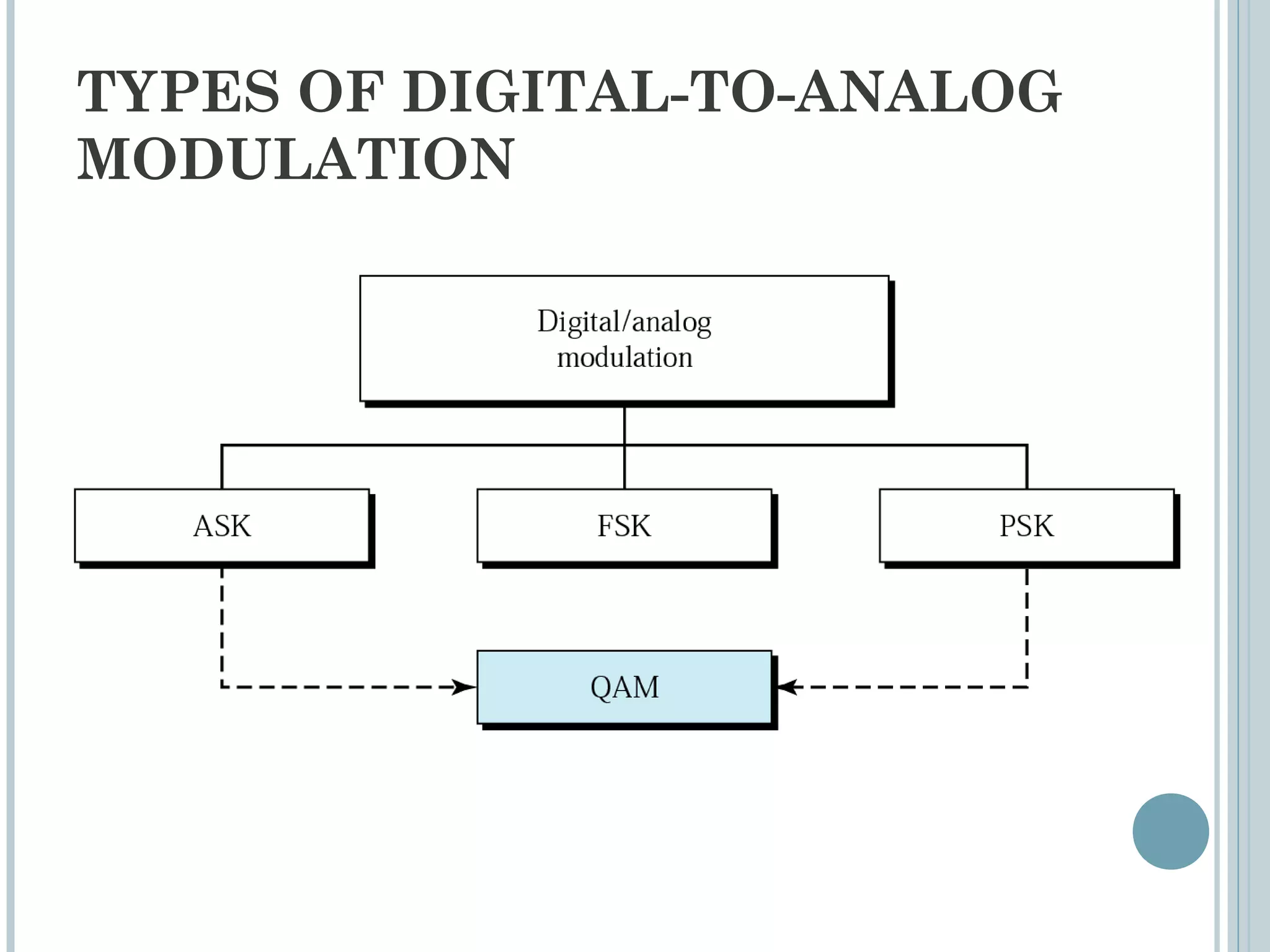
 Digital-To –Analog Modulation
 ASK
 FSK
 PSK
 QAM
DIGITAL-TO-ANALOG
MODULATION
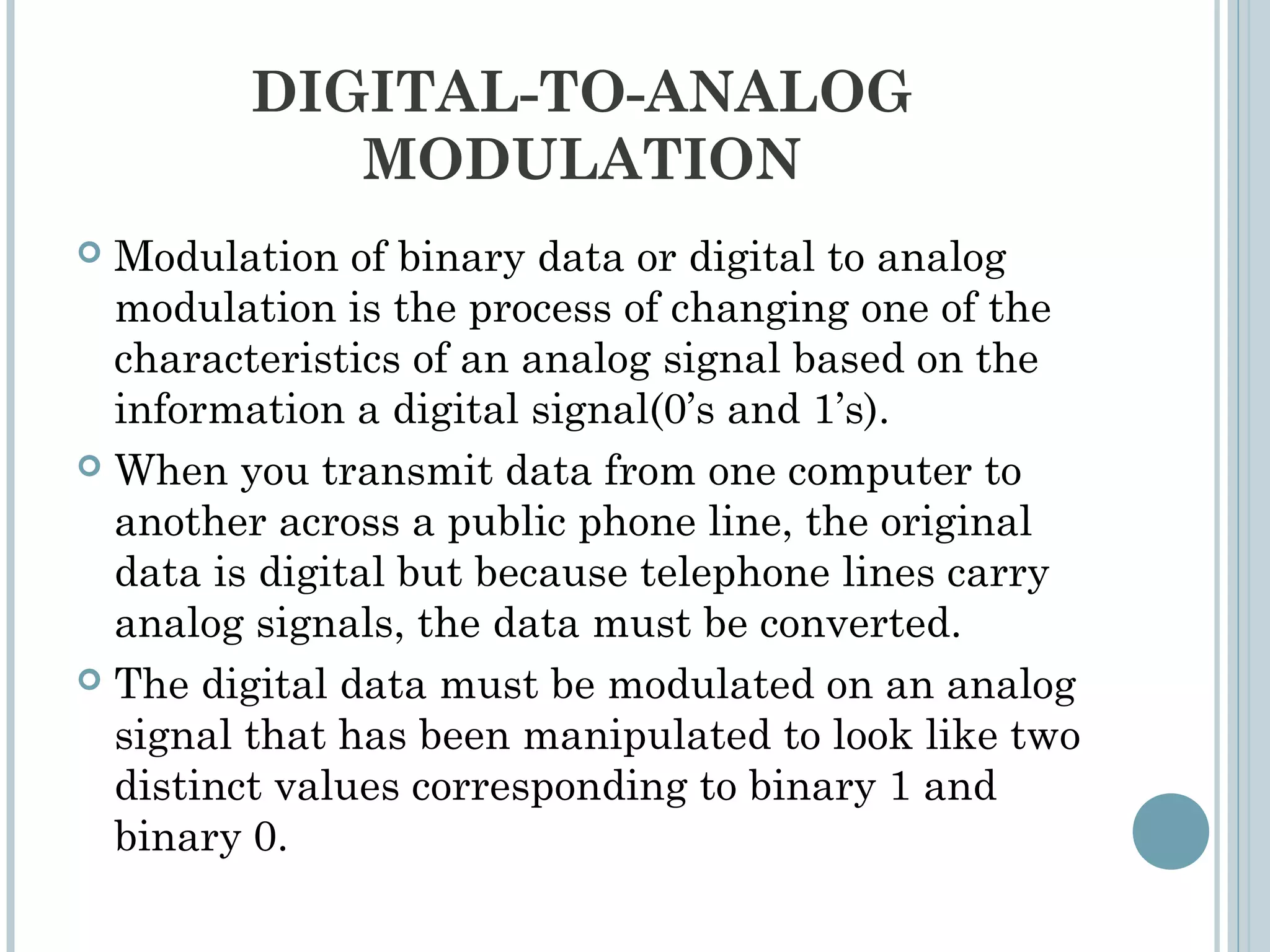
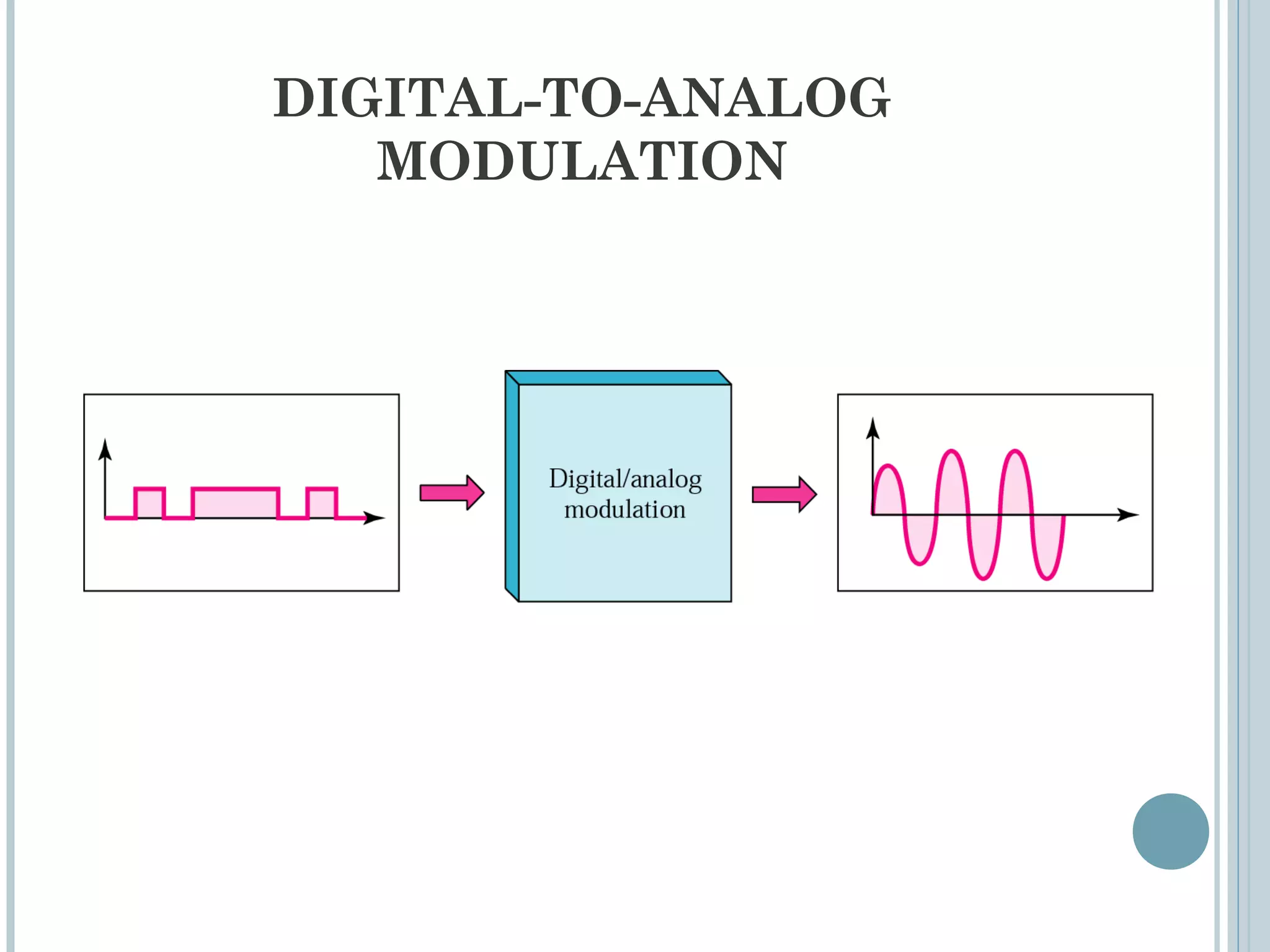
 Modulation of binary data or digital to analog
modulation is the process of changing one of the
characteristics of an analog signal based on the
information a digital signal(0’s and 1’s).
 When you transmit data from one computer to
another across a public phone line, the original
data is digital but because telephone lines carry
analog signals, the data must be converted.
 The digital data must be modulated on an analog
signal that has been manipulated to look like two
distinct values corresponding to binary 1 and
binary 0.
DIGITAL-TO-ANALOG
MODULATION
BIT RATE BAUD RATE & CARRIER
FREQUENCY
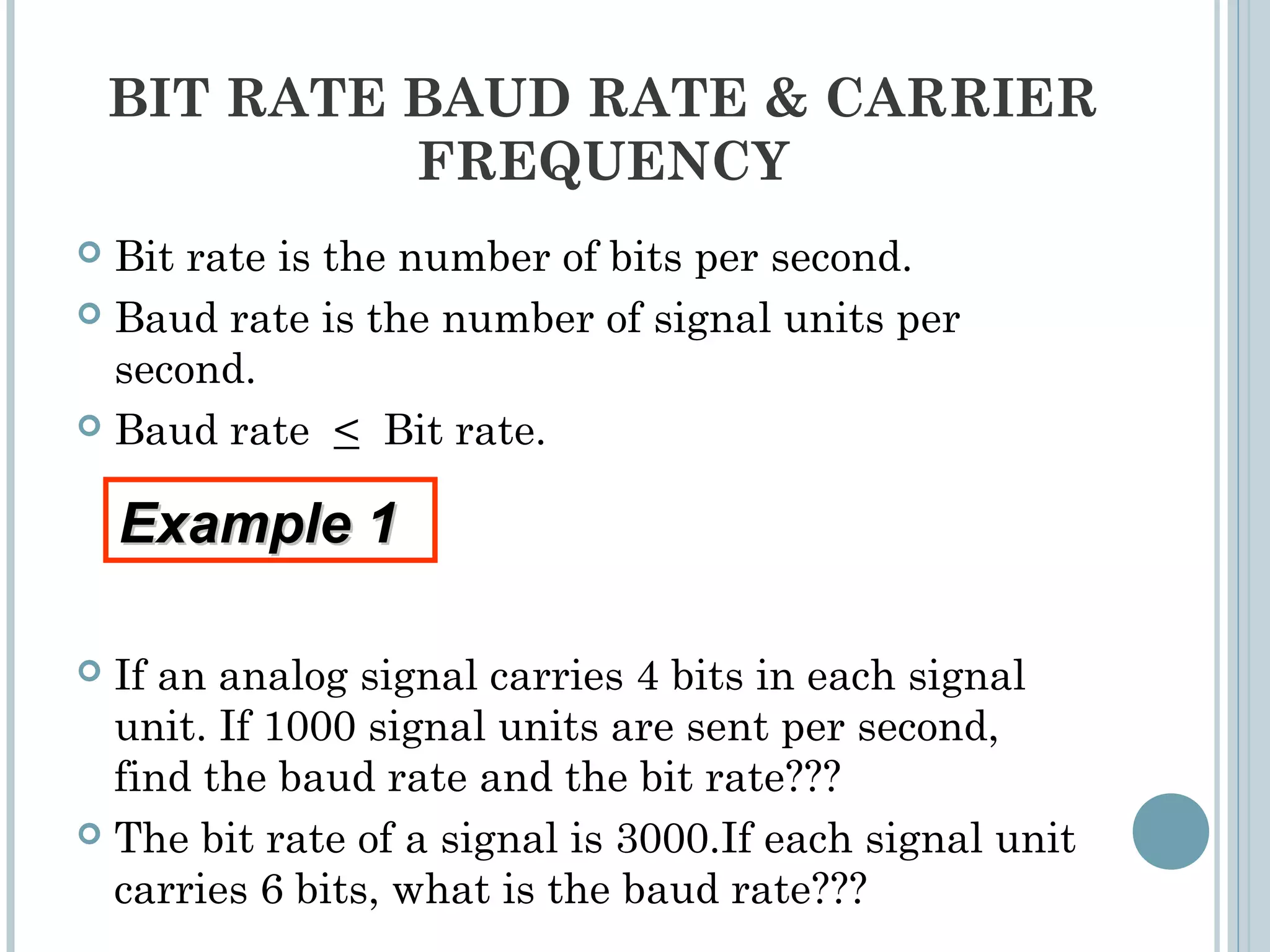
 Bit rate is the number of bits per second.
 Baud rate is the number of signal units per
second.
 Baud rate < Bit rate.
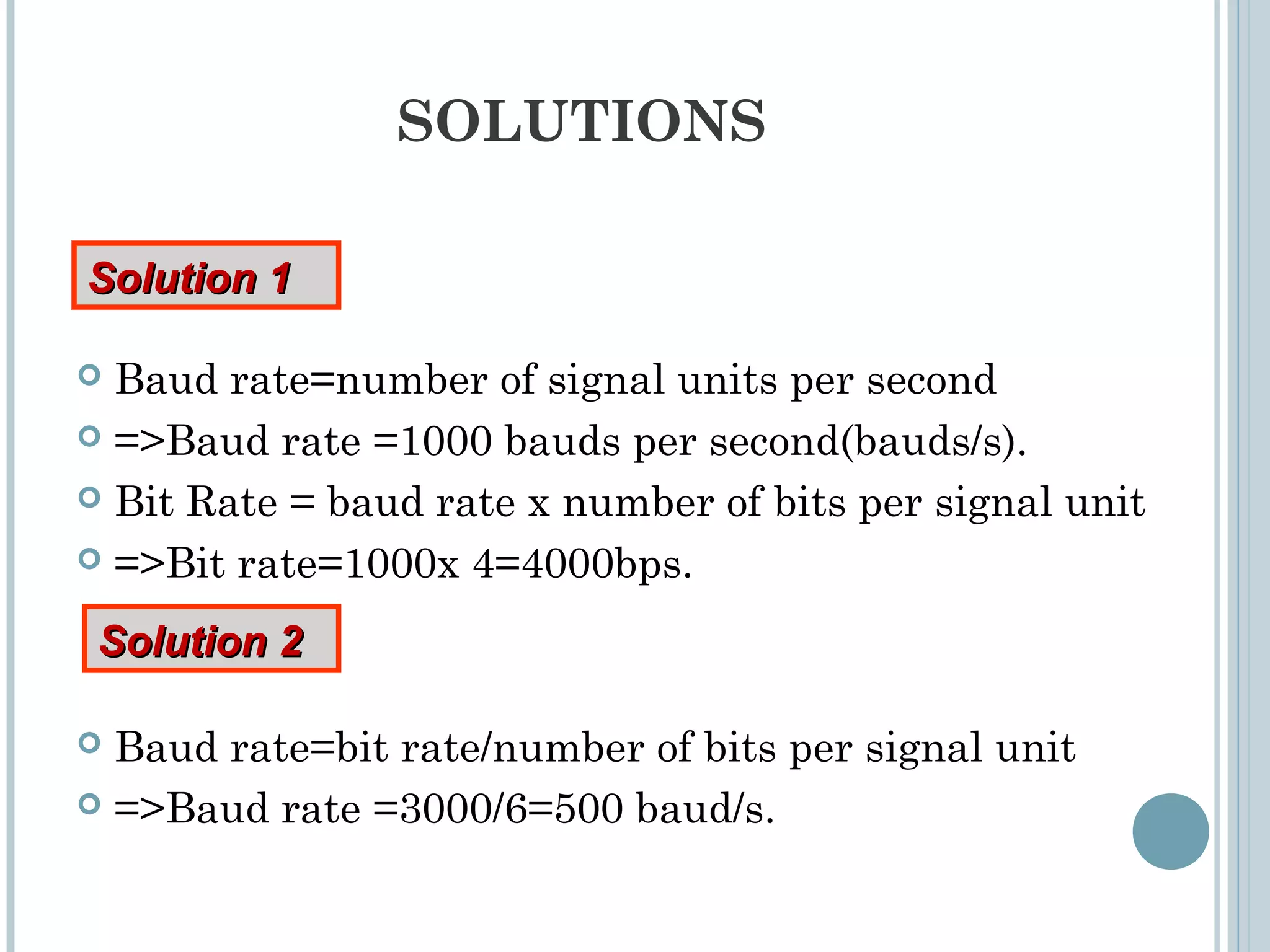
 If an analog signal carries 4 bits in each signal
unit. If 1000 signal units are sent per second,
find the baud rate and the bit rate???
 The bit rate of a signal is 3000.If each signal unit
carries 6 bits, what is the baud rate???
Example 1Example 1
SOLUTIONS
 Baud rate=number of signal units per second
 =>Baud rate =1000 bauds per second(bauds/s).
 Bit Rate = baud rate x number of bits per signal unit
 =>Bit rate=1000x 4=4000bps.
 Baud rate=bit rate/number of bits per signal unit
 =>Baud rate =3000/6=500 baud/s.
Solution 1Solution 1
Solution 2Solution 2
CARRIER FREQUENCY
 In analog transmission, the sending device produces
a high –frequency signal that acts a basis for the
information signal.
 This base signal is called the carrier signal or
carrier frequency.
 The receiving device is tuned to the frequency of the
carrier signal that it expects from the sender.
CARRIER FREQUENCY
 Digital information then modulates the carrier
signal by modifying one or more of its
characteristics( amplitude, frequency or phase).
 This kind of modification is called modulation or
shift keying.
 The information signal is called the modulating
signal.
TYPES OF DIGITAL-TO-ANALOG
MODULATION
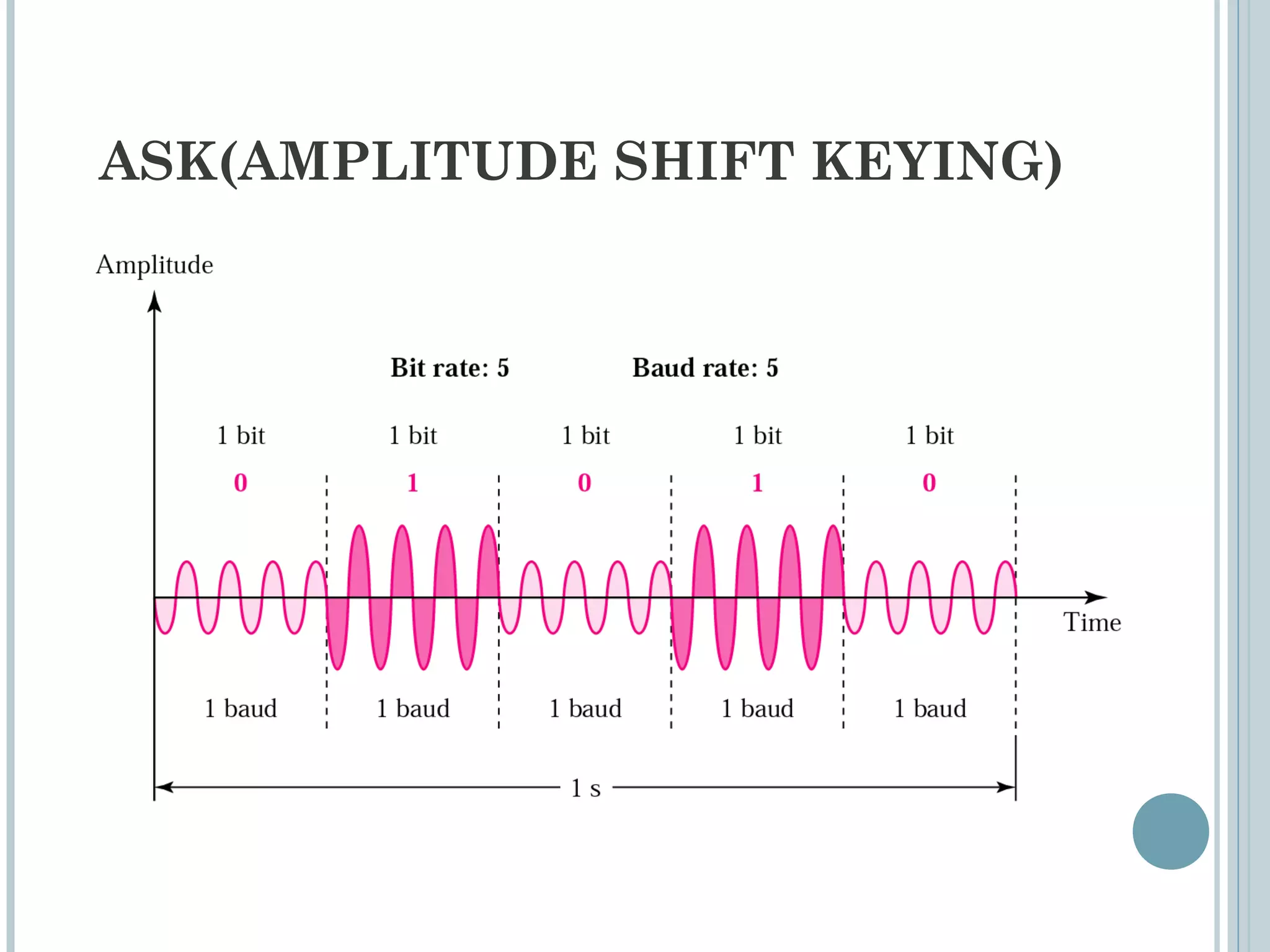
ASK(AMPLITUDE SHIFT KEYING)
 In amplitude shift keying,the strength of the carrier
signal is varied to represent binary 1 or 0.
 Both frequency and phase remain constant while the
amplitude changes.
 Which voltage represents 1 and which represents 0
are left to the system designers.
 A bit duration is the period of time that defines 1
bit.
 The peak amplitude of the signal during each bit
duration is constant and its value depends on the bit
(0 or 1).
ASK(AMPLITUDE SHIFT KEYING)
PROBLEMS WITH ASK
 ASK transmission is highly susceptible to
noise interference.
 The term noise refers to unintentional voltages
introduced on to a line by various phenomena
such as heat or electromagnetic induction created
by other sources.
 These unintentional voltages combine with the
signal to change the amplitude.
 A 0 can be changed to 1 and a 1 can be changed
to 0.
PROBLEMS WITH ASK
CONTINUED…
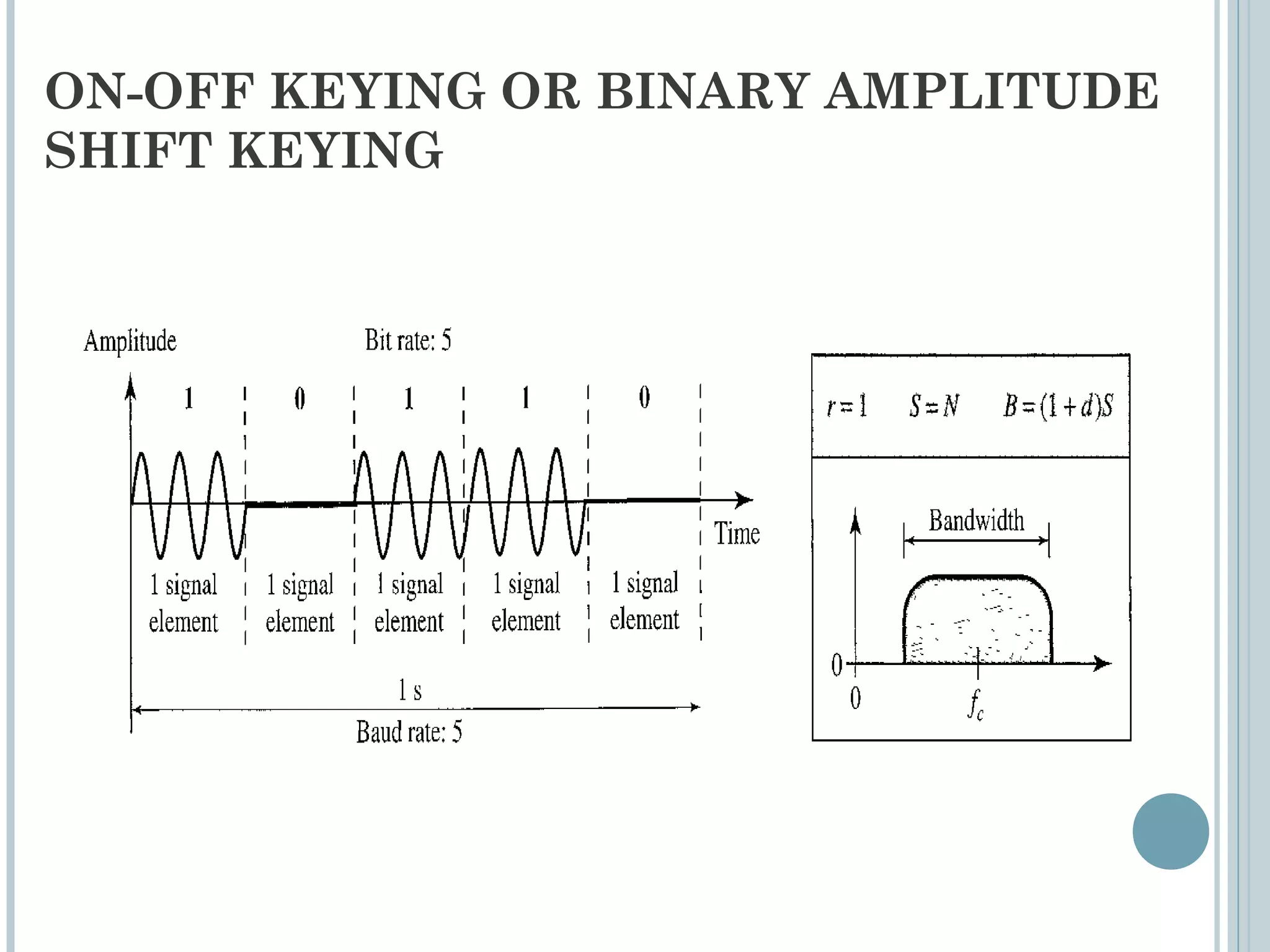
 High amount of energy is required.
 A popular ASK technique is called on/off
keying(OOK).
 In OOK one of the values is represented by no
voltage.
 The advantage is a reduction in the amount of
energy required to transmit information.
ON-OFF KEYING OR BINARY AMPLITUDE
SHIFT KEYING
BAND WIDTH FOR ASK
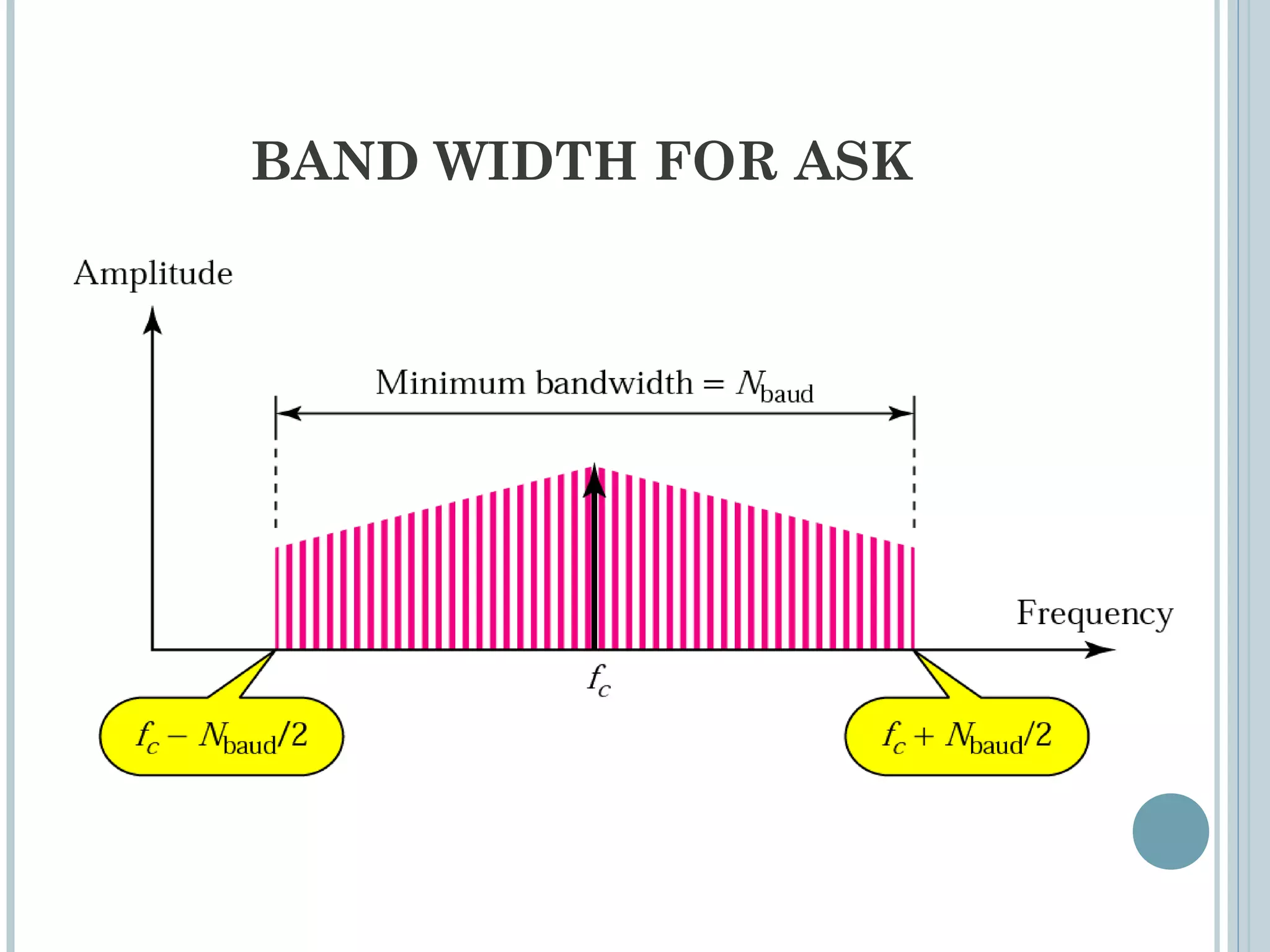
 Although there is only one carrier frequency, the
process of modulation produces a complex signal
that is a combination of many simple signals,
each with a different frequency.
 When we decompose an ASK-modulated
signal ,we get a spectrum of many simple
frequencies.
 However the most significant ones are those
between fc - N baud/2 and fc + N baud/2 with fc as the
carrier frequency and N baud as the baud rate.
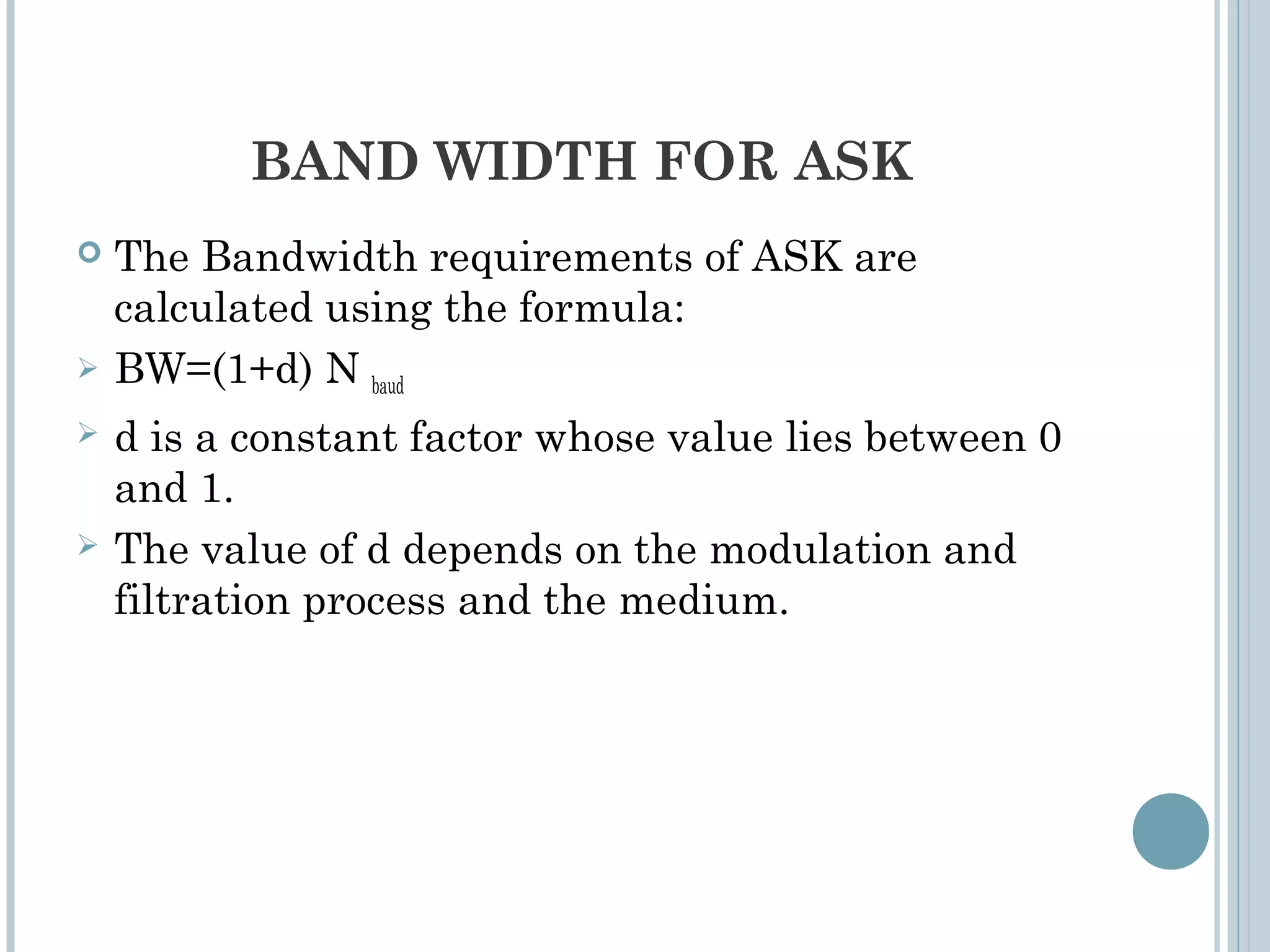
BAND WIDTH FOR ASK
 The Bandwidth requirements of ASK are
calculated using the formula:
 BW=(1+d) N baud
 d is a constant factor whose value lies between 0
and 1.
 The value of d depends on the modulation and
filtration process and the medium.
BAND WIDTH FOR ASK
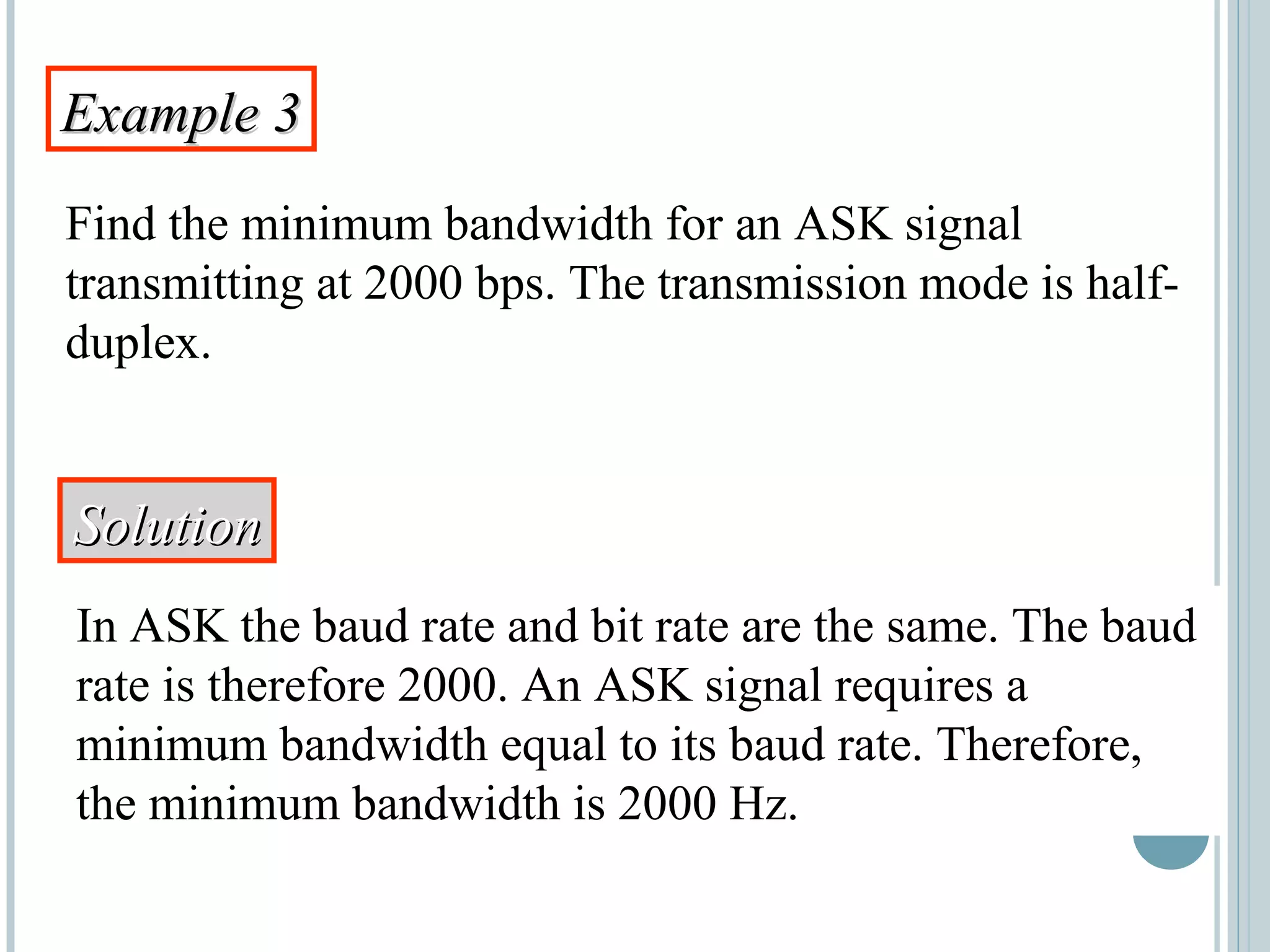
Example 3Example 3
Find the minimum bandwidth for an ASK signal
transmitting at 2000 bps. The transmission mode is half-
duplex.
SolutionSolution
In ASK the baud rate and bit rate are the same. The baud
rate is therefore 2000. An ASK signal requires a
minimum bandwidth equal to its baud rate. Therefore,
the minimum bandwidth is 2000 Hz.
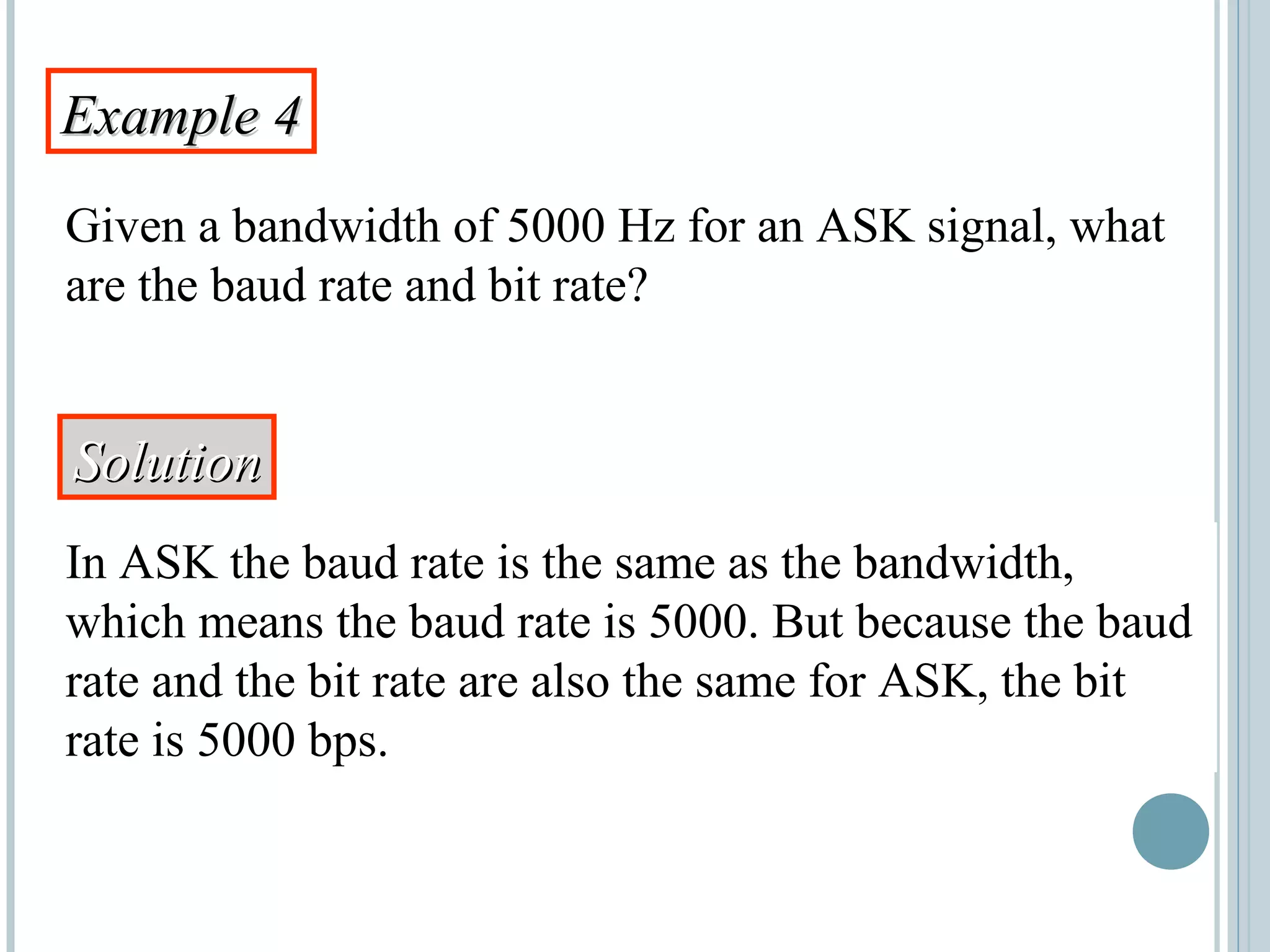
Example 4Example 4
Given a bandwidth of 5000 Hz for an ASK signal, what
are the baud rate and bit rate?
SolutionSolution
In ASK the baud rate is the same as the bandwidth,
which means the baud rate is 5000. But because the baud
rate and the bit rate are also the same for ASK, the bit
rate is 5000 bps.
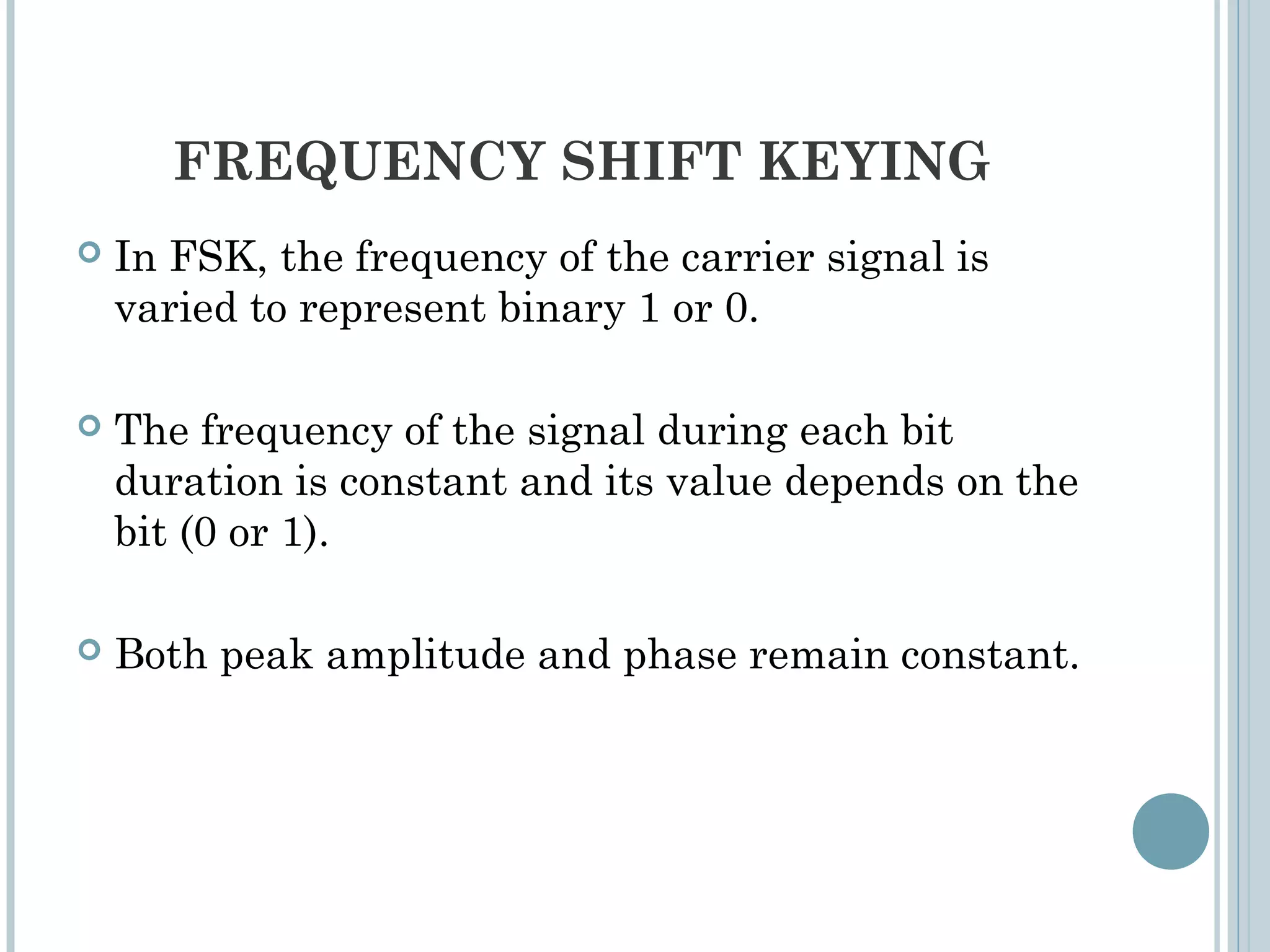
FREQUENCY SHIFT KEYING
 In FSK, the frequency of the carrier signal is
varied to represent binary 1 or 0.
 The frequency of the signal during each bit
duration is constant and its value depends on the
bit (0 or 1).
 Both peak amplitude and phase remain constant.
HOW FSK HANDLES NOISE
PROBLEM???
 FSK avoids most of the problems from noise.
 Because the receiving device is looking for
specific frequency changes over a given number
of periods, it can ignore voltage spikes.
 The limiting factors of FSK are the physical
capabilities of the medium.
BAND WIDTH REQUIREMENT FOR
FSK
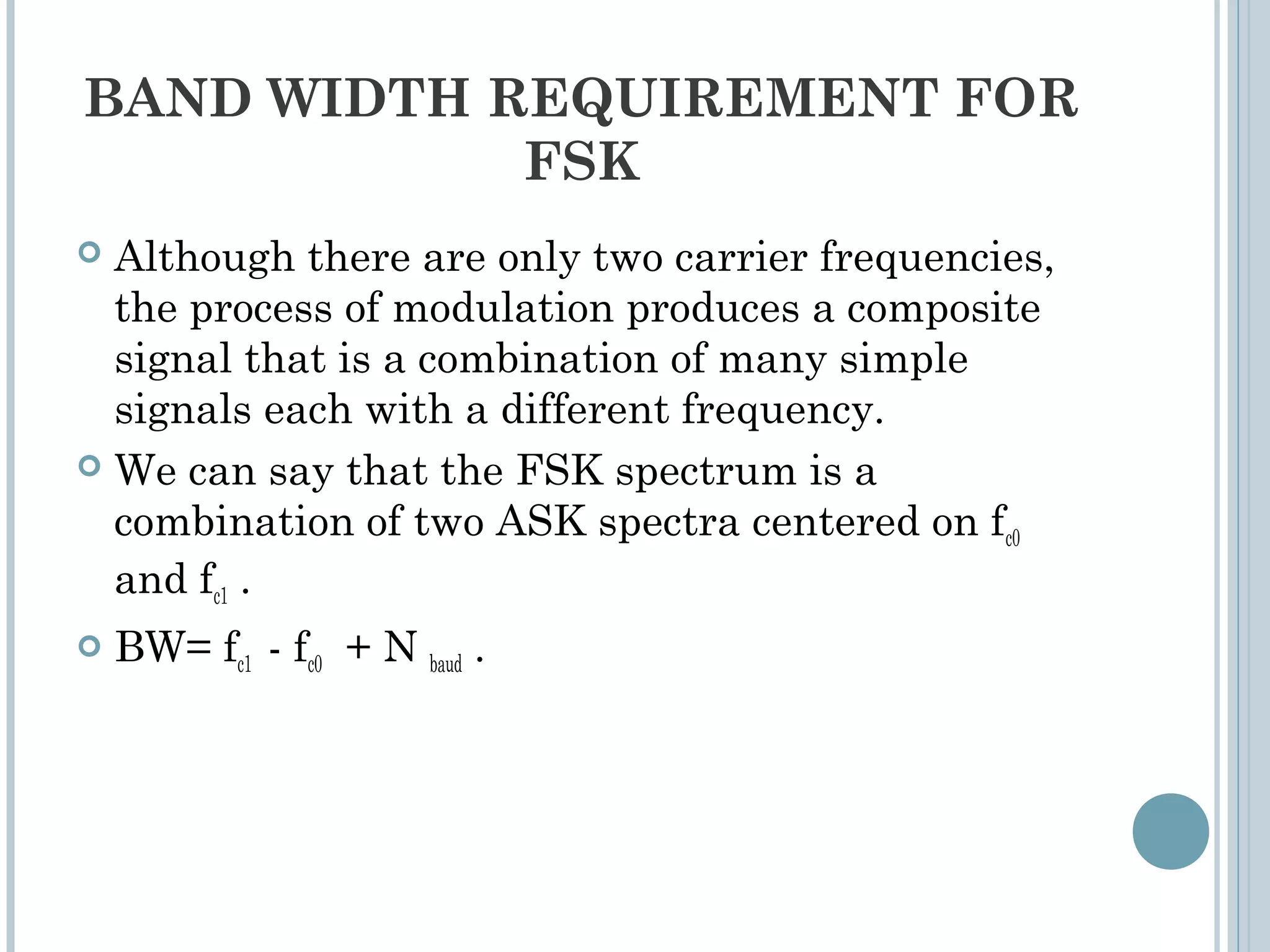
 Although there are only two carrier frequencies,
the process of modulation produces a composite
signal that is a combination of many simple
signals each with a different frequency.
 We can say that the FSK spectrum is a
combination of two ASK spectra centered on fc0
and fc1 .
 BW= fc1 - fc0 + N baud .
PSK
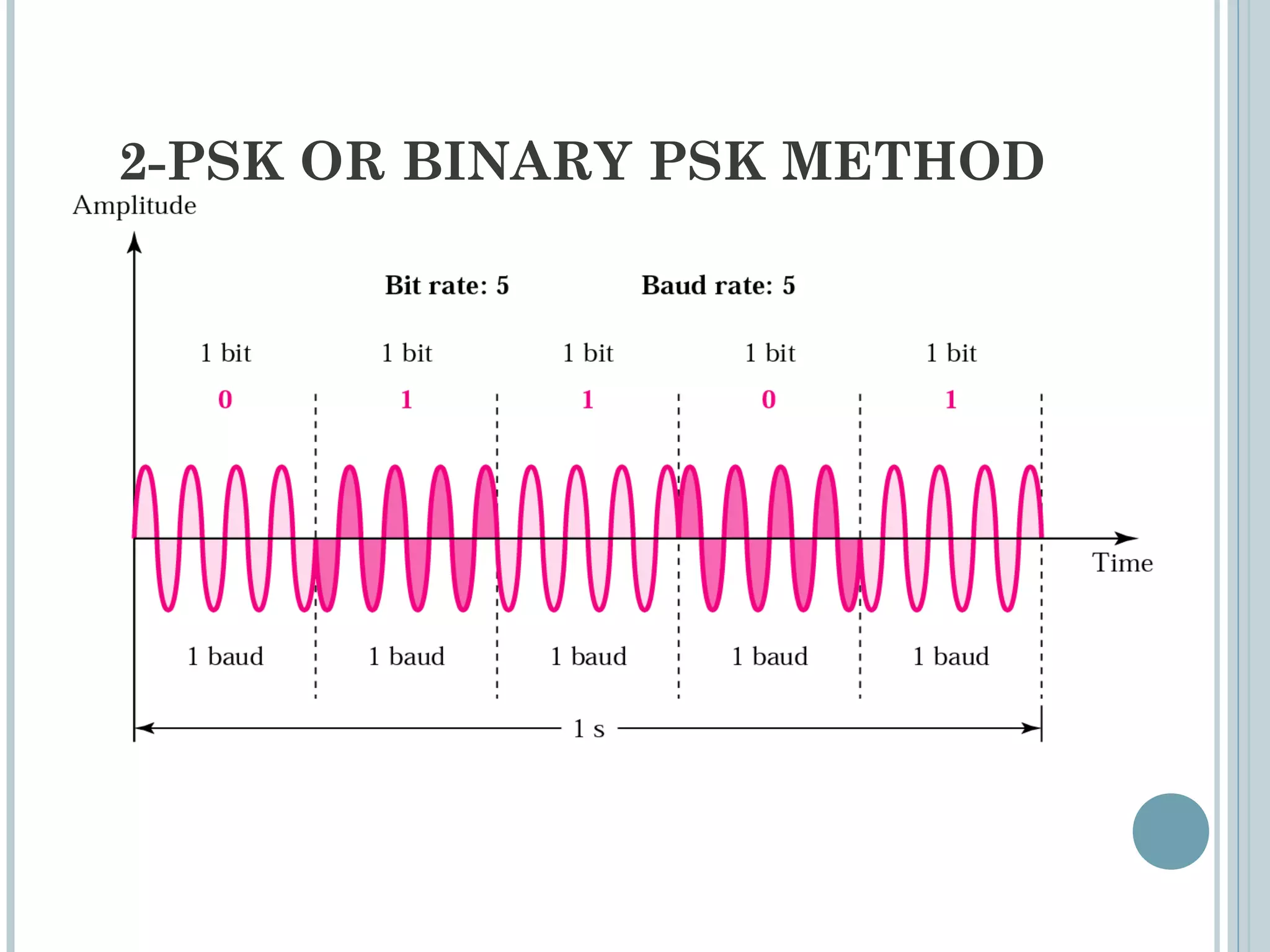
 In Phase shift keying, the phase of the carrier is
varied to represent binary 1 or 0.
 Both peak amplitude and frequency remain
constant as the phase changes.
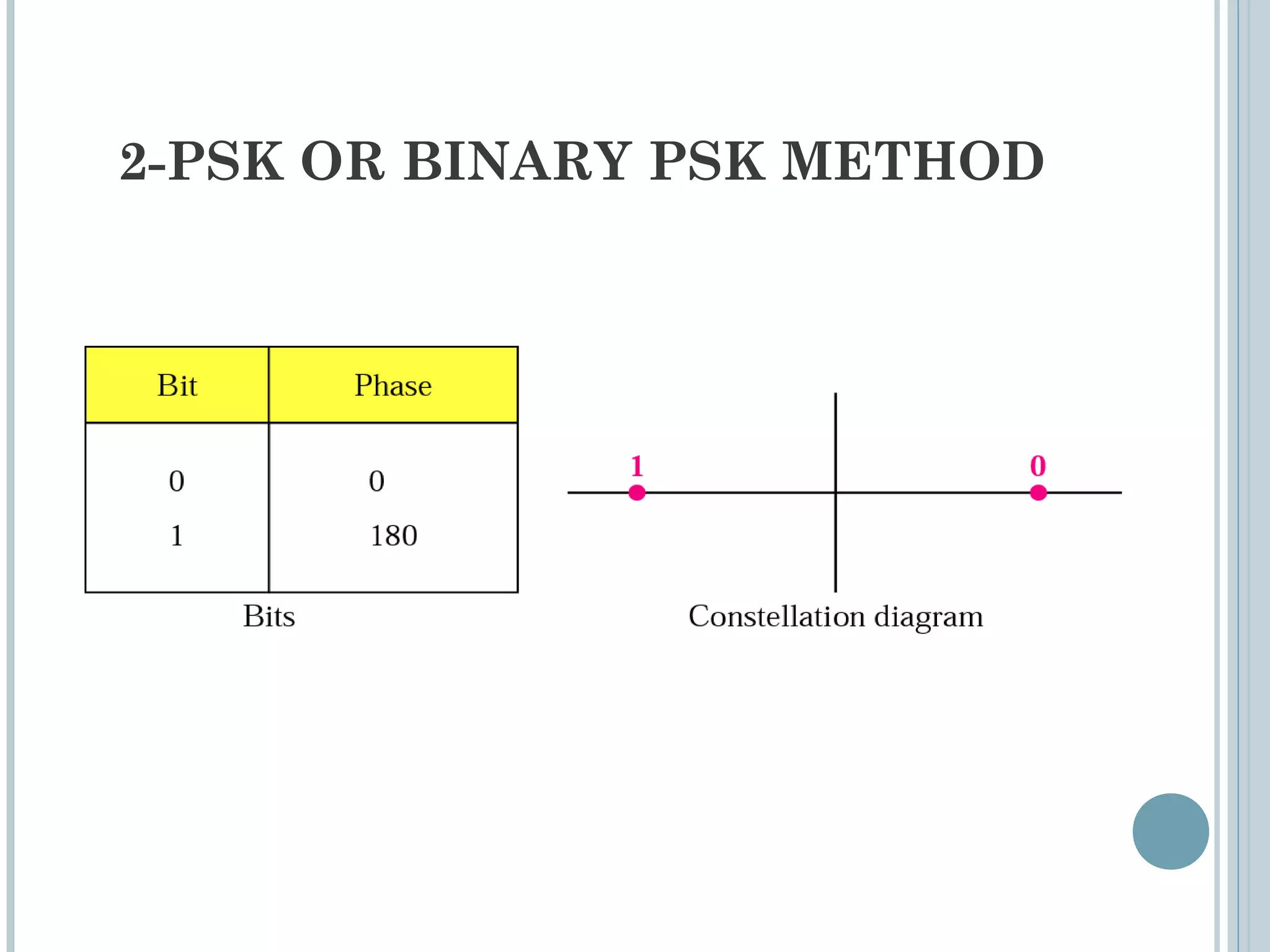
 For example we start with a phase of 0 degree to
represent binary 0 then we can change the phase
to 180 degree to represent binary 1.
 The phase of the signal during each bit duration
is constant and the value depends on the bit (0 or
1).
 This method is often called 2-PSK or binary
PSK , because two different phases(0 degree and
180 degree are used).
2-PSK OR BINARY PSK METHOD
4-PSK METHOD
4- PSK METHOD
8-PSK
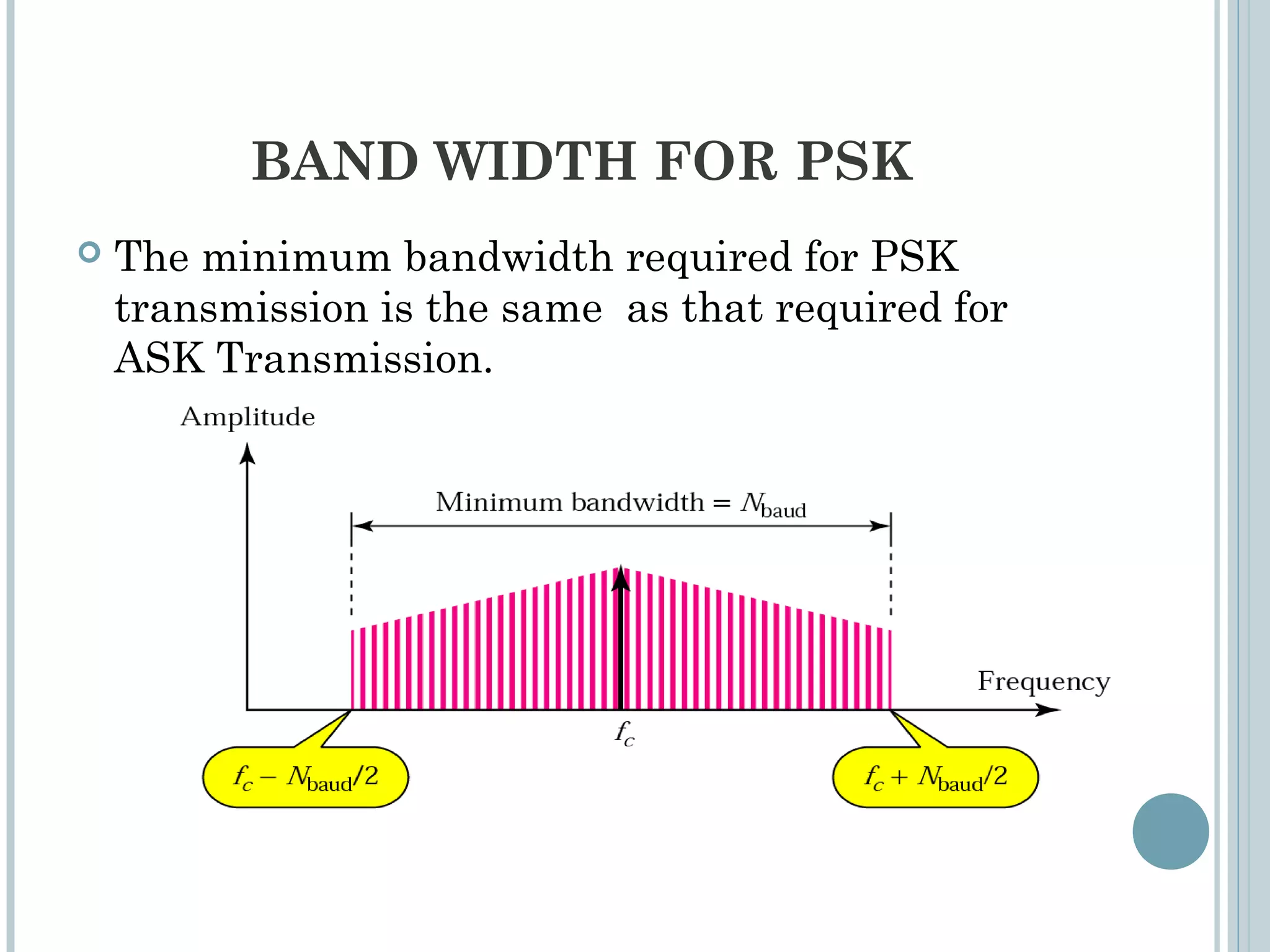
BAND WIDTH FOR PSK
 The minimum bandwidth required for PSK
transmission is the same as that required for
ASK Transmission.
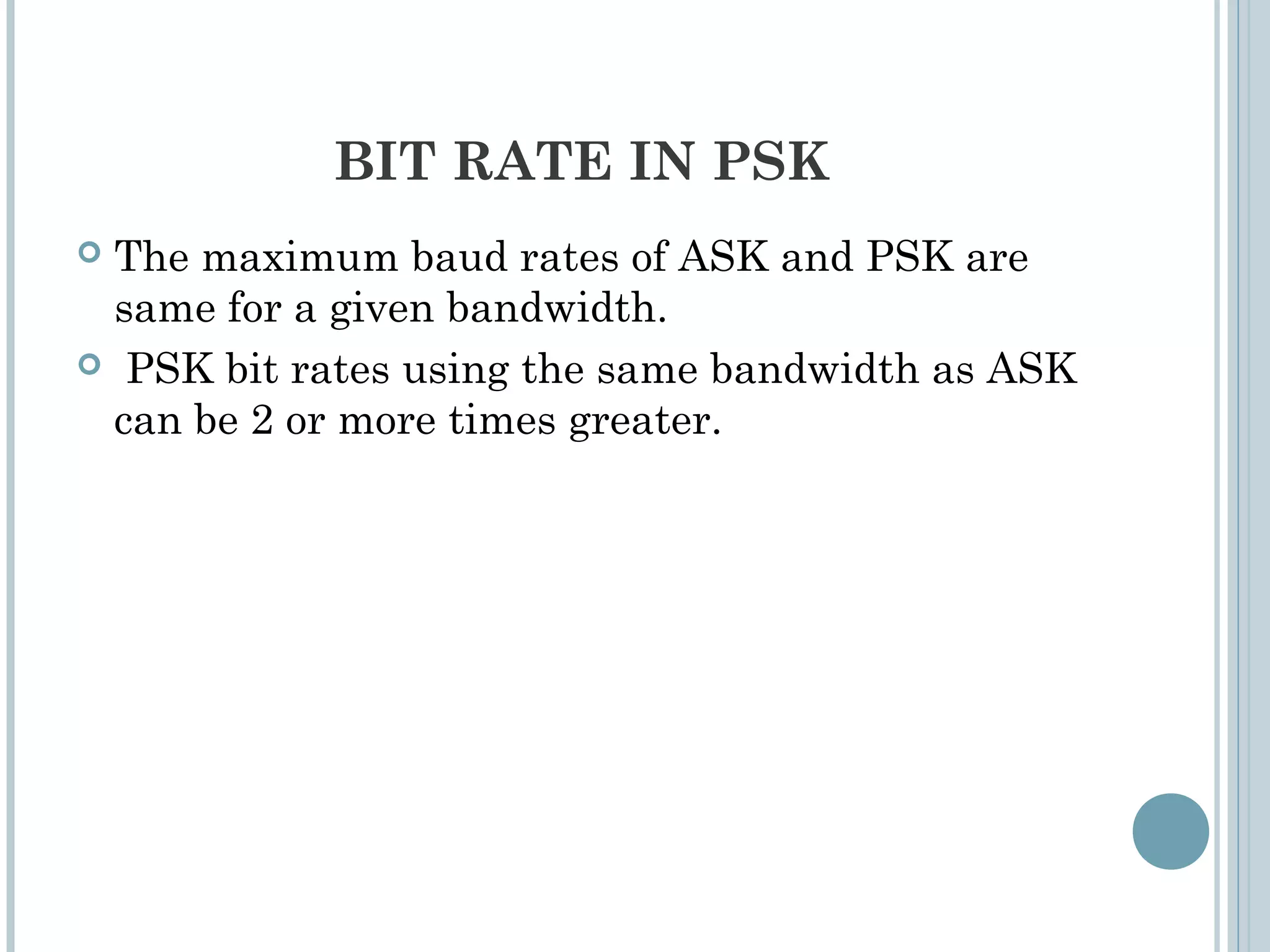
BIT RATE IN PSK
 The maximum baud rates of ASK and PSK are
same for a given bandwidth.
 PSK bit rates using the same bandwidth as ASK
can be 2 or more times greater.
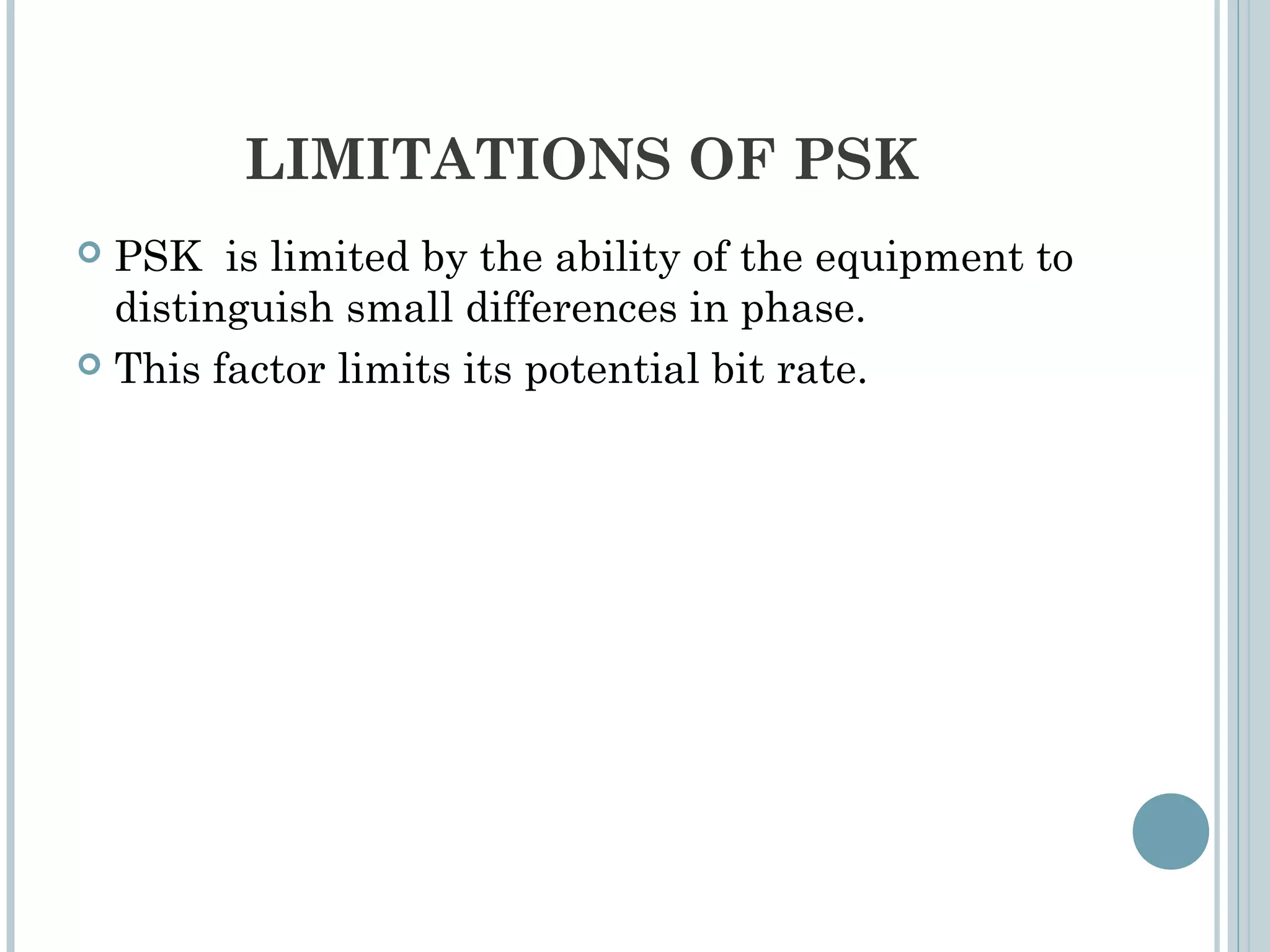
LIMITATIONS OF PSK
 PSK is limited by the ability of the equipment to
distinguish small differences in phase.
 This factor limits its potential bit rate.
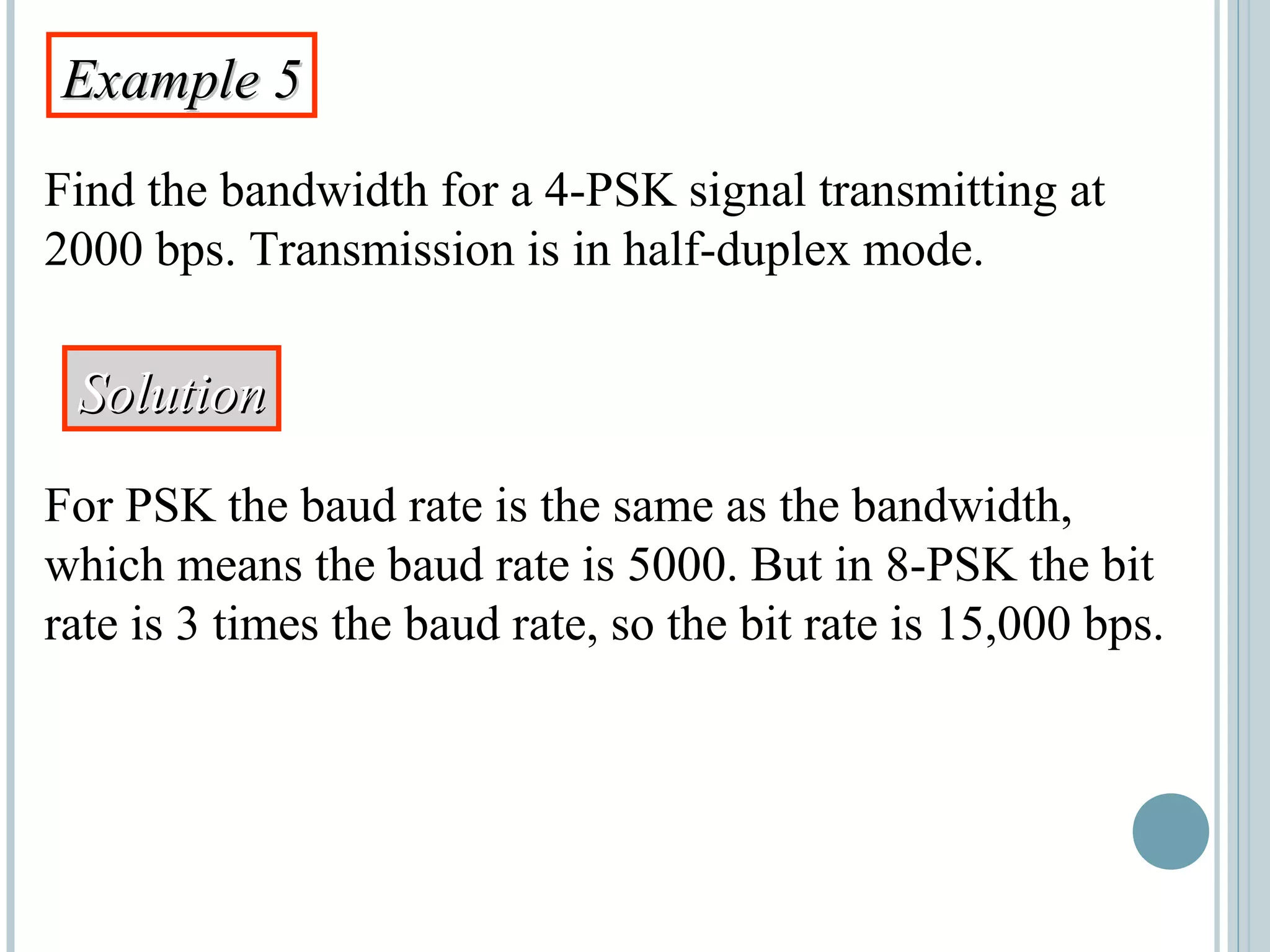
Example 5Example 5
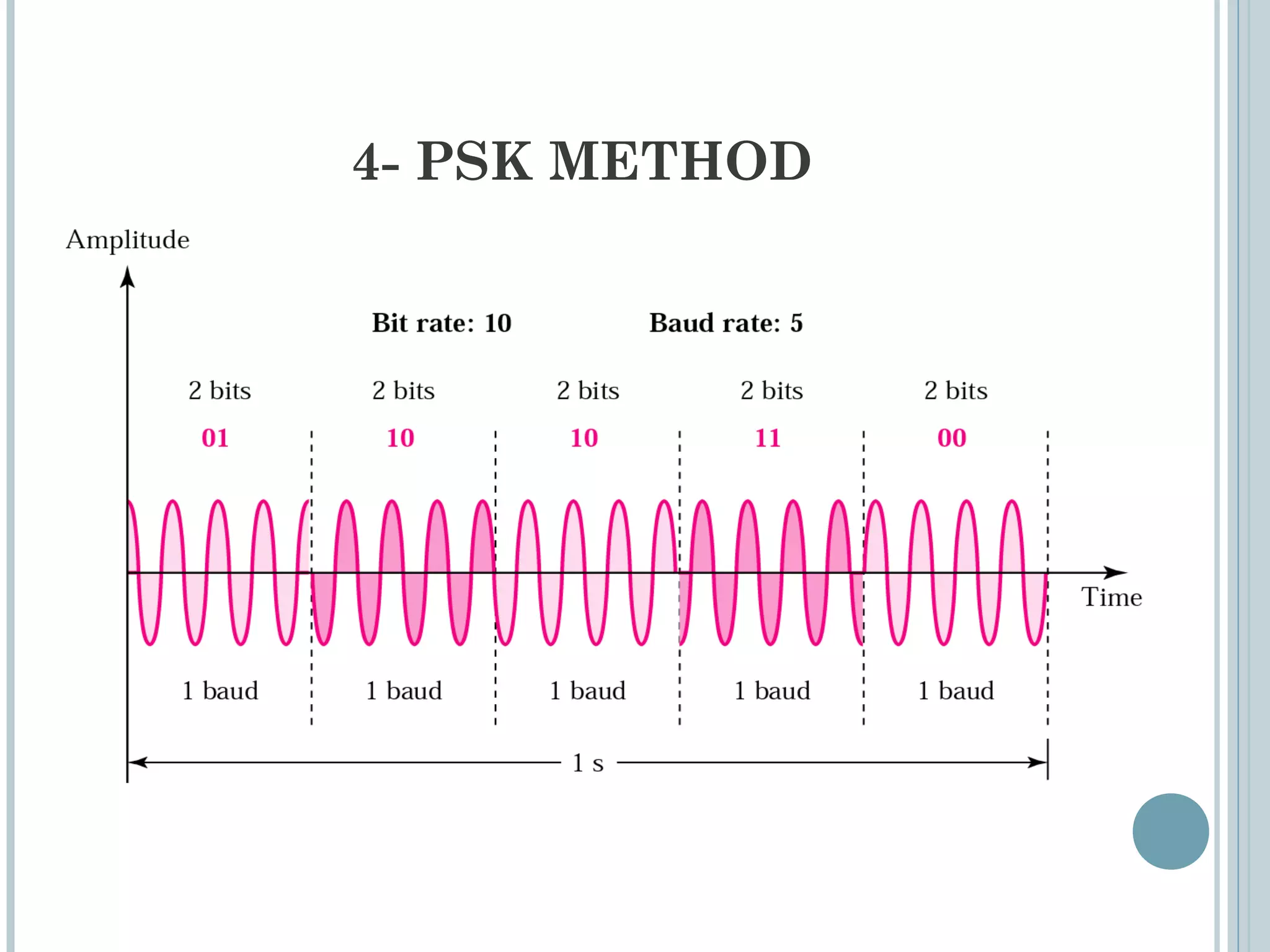
Find the bandwidth for a 4-PSK signal transmitting at
2000 bps. Transmission is in half-duplex mode.
SolutionSolution
For PSK the baud rate is the same as the bandwidth,
which means the baud rate is 5000. But in 8-PSK the bit
rate is 3 times the baud rate, so the bit rate is 15,000 bps.
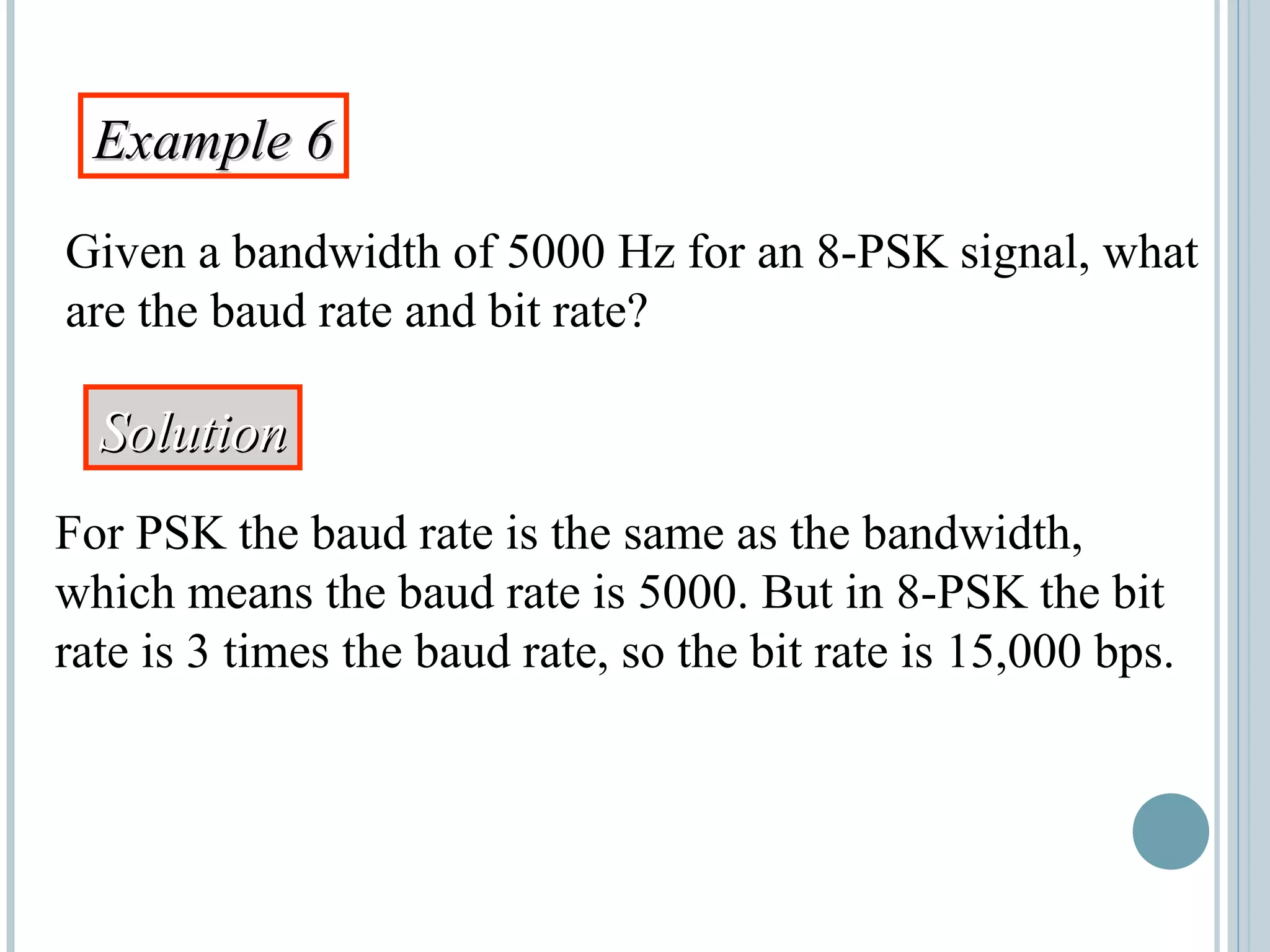
Given a bandwidth of 5000 Hz for an 8-PSK signal, what
are the baud rate and bit rate?
Example 6Example 6
SolutionSolution
For PSK the baud rate is the same as the bandwidth,
which means the baud rate is 5000. But in 8-PSK the bit
rate is 3 times the baud rate, so the bit rate is 15,000 bps.
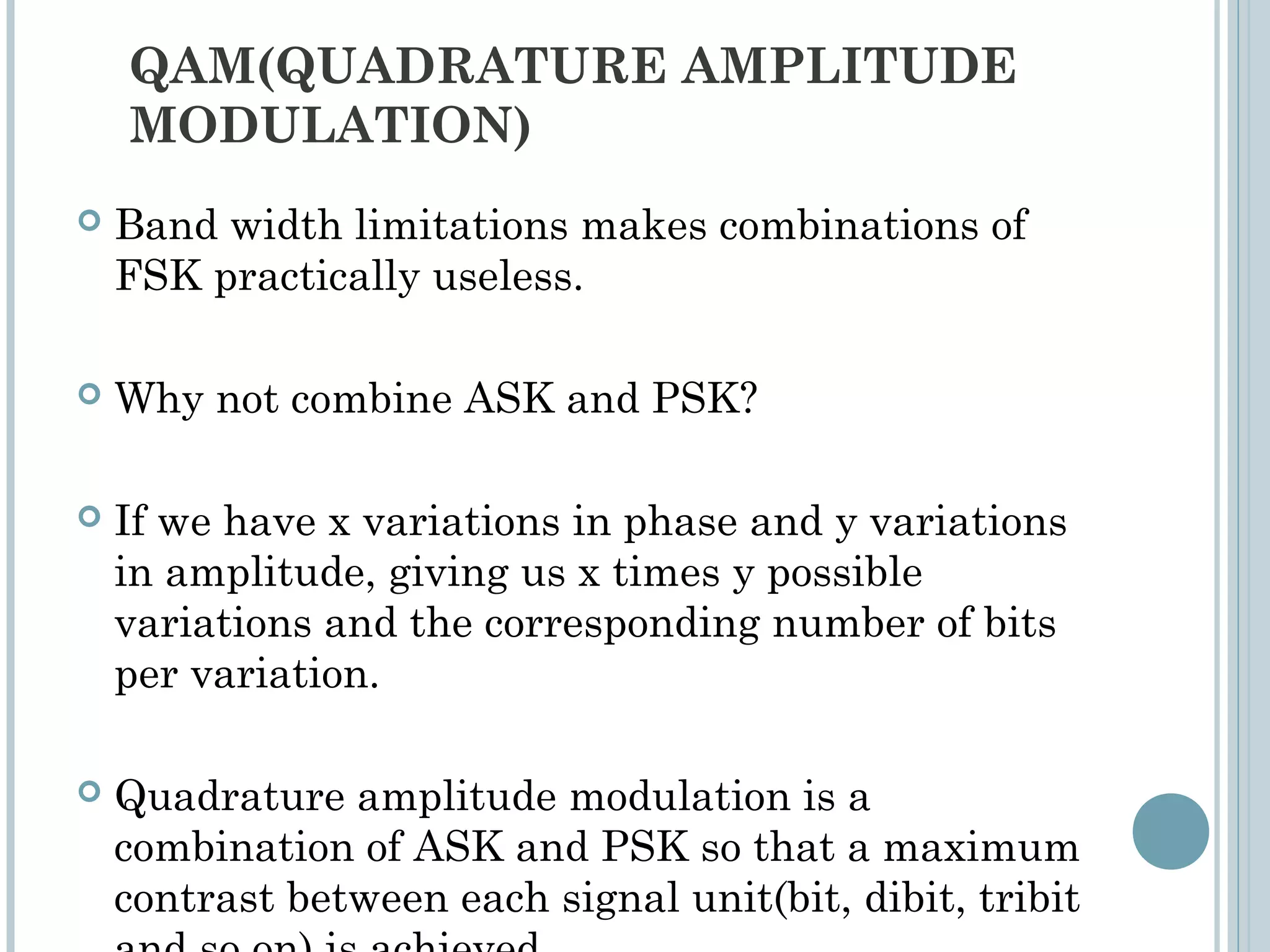
QAM(QUADRATURE AMPLITUDE
MODULATION)
 Band width limitations makes combinations of
FSK practically useless.
 Why not combine ASK and PSK?
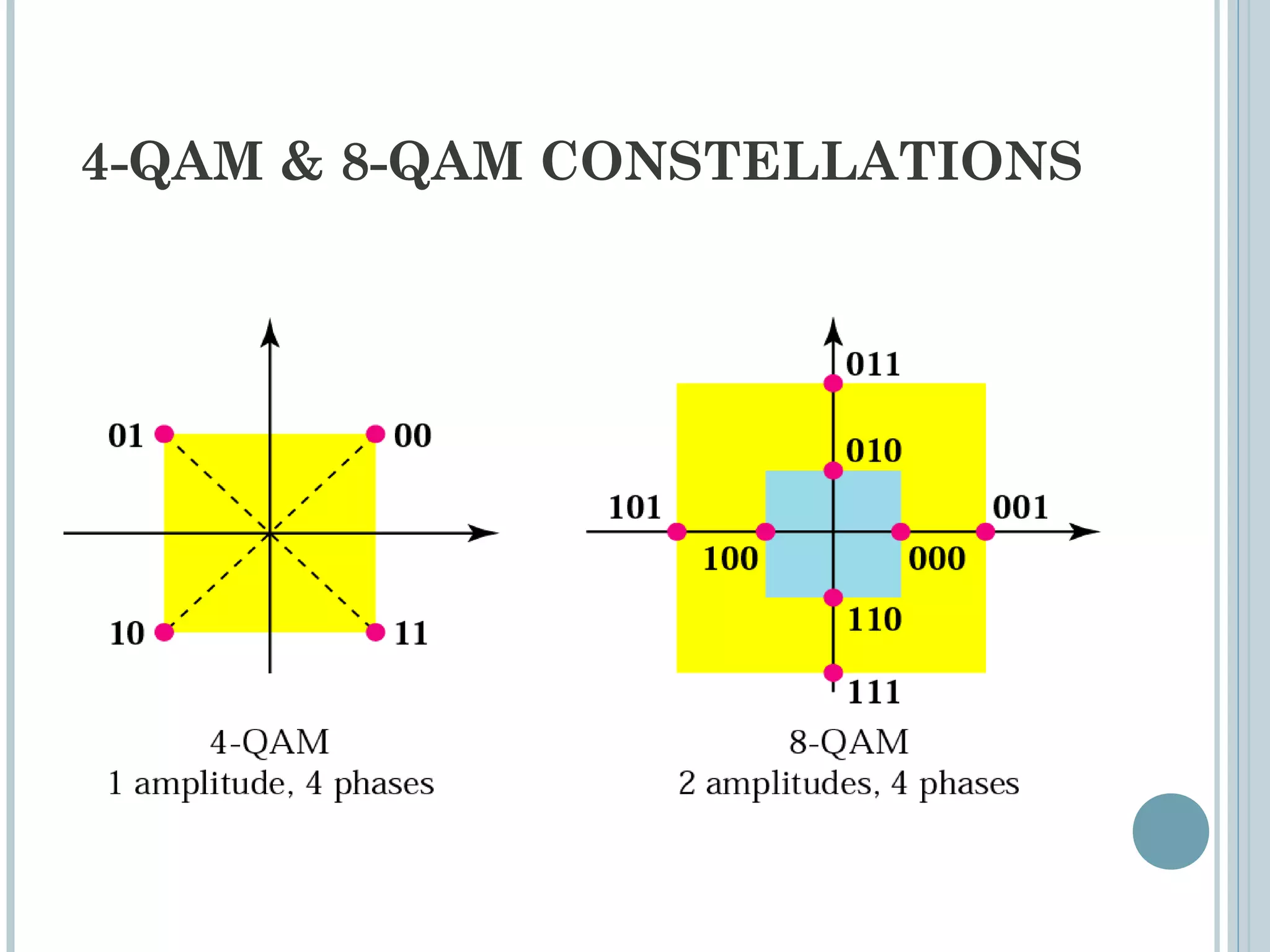
 If we have x variations in phase and y variations
in amplitude, giving us x times y possible
variations and the corresponding number of bits
per variation.
 Quadrature amplitude modulation is a
combination of ASK and PSK so that a maximum
contrast between each signal unit(bit, dibit, tribit
QAM CONTINUED…
 Theoretically, any measurable number of
changes in amplitude can be combined with any
measurable number of changes in phase.
4-QAM & 8-QAM CONSTELLATIONS
8-QAM SIGNAL
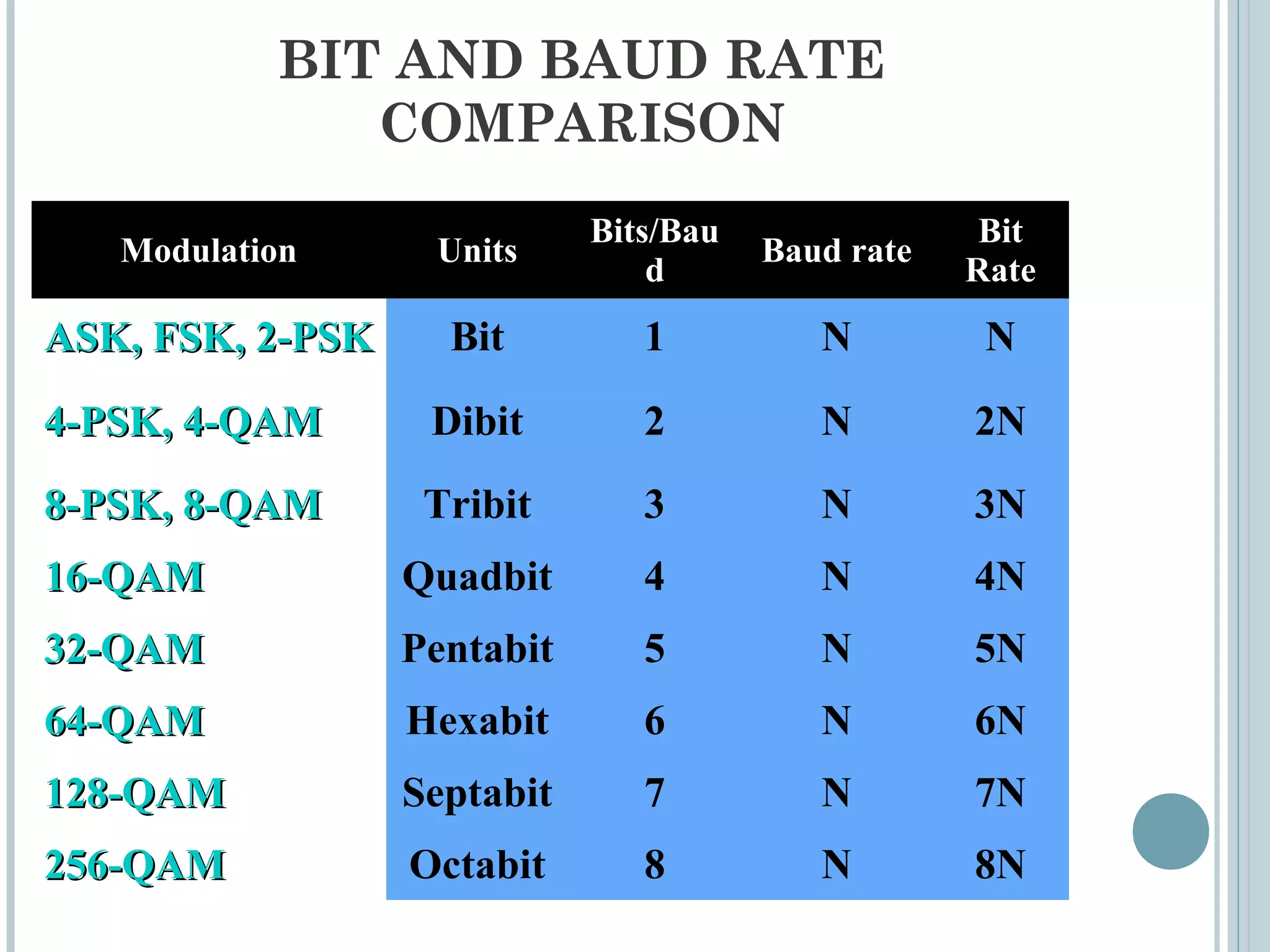
BIT AND BAUD RATE
COMPARISON
BIT AND BAUD RATE
COMPARISON
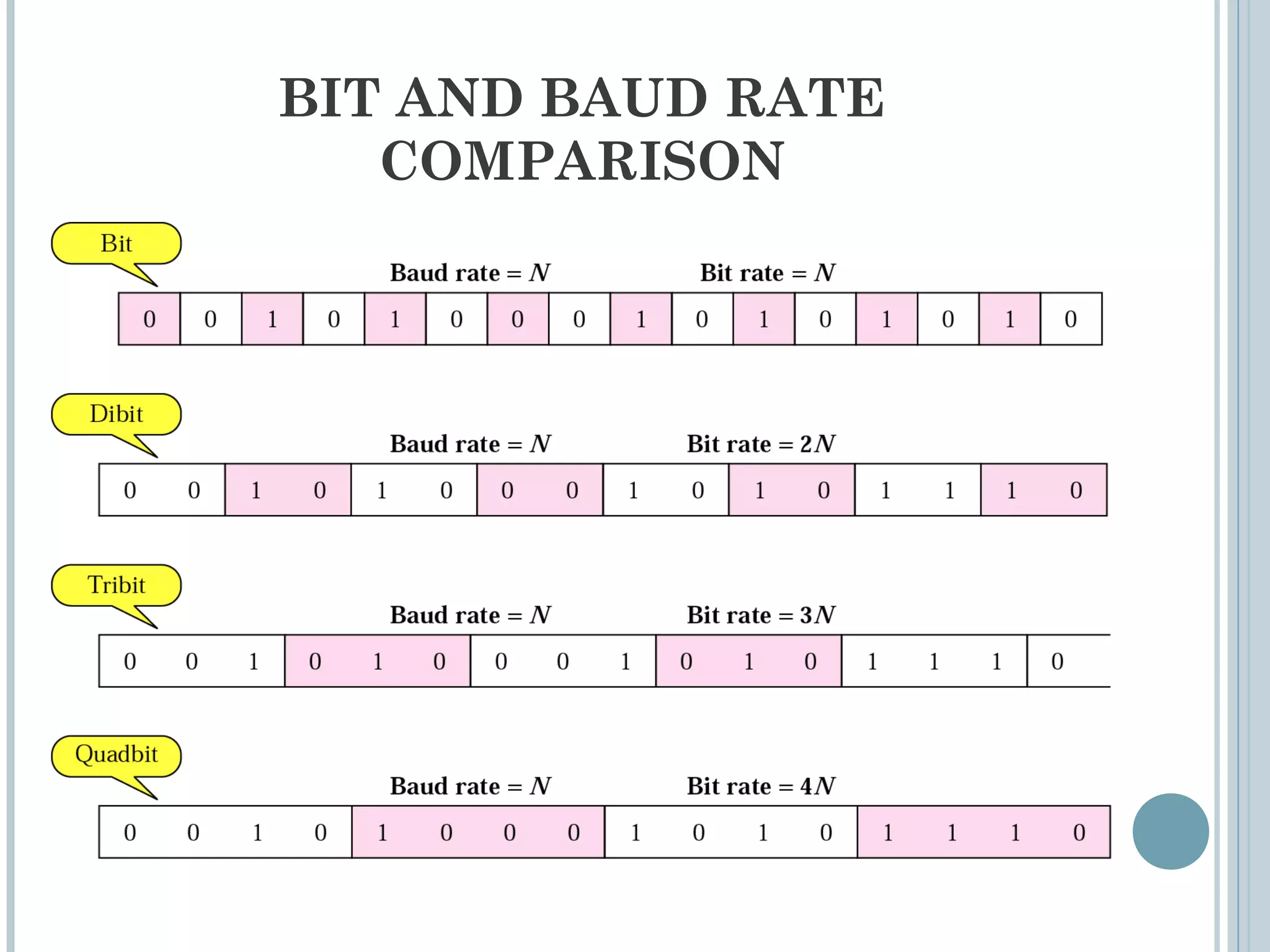
ModulationModulation UnitsUnits
Bits/BauBits/Bau
dd
Baud rateBaud rate
Bit
Rate
ASK, FSK, 2-PSKASK, FSK, 2-PSK Bit 1 N N
4-PSK, 4-QAM4-PSK, 4-QAM Dibit 2 N 2N
8-PSK, 8-QAM8-PSK, 8-QAM Tribit 3 N 3N
16-QAM16-QAM Quadbit 4 N 4N
32-QAM32-QAM Pentabit 5 N 5N
64-QAM64-QAM Hexabit 6 N 6N
128-QAM128-QAM Septabit 7 N 7N
256-QAM256-QAM Octabit 8 N 8N
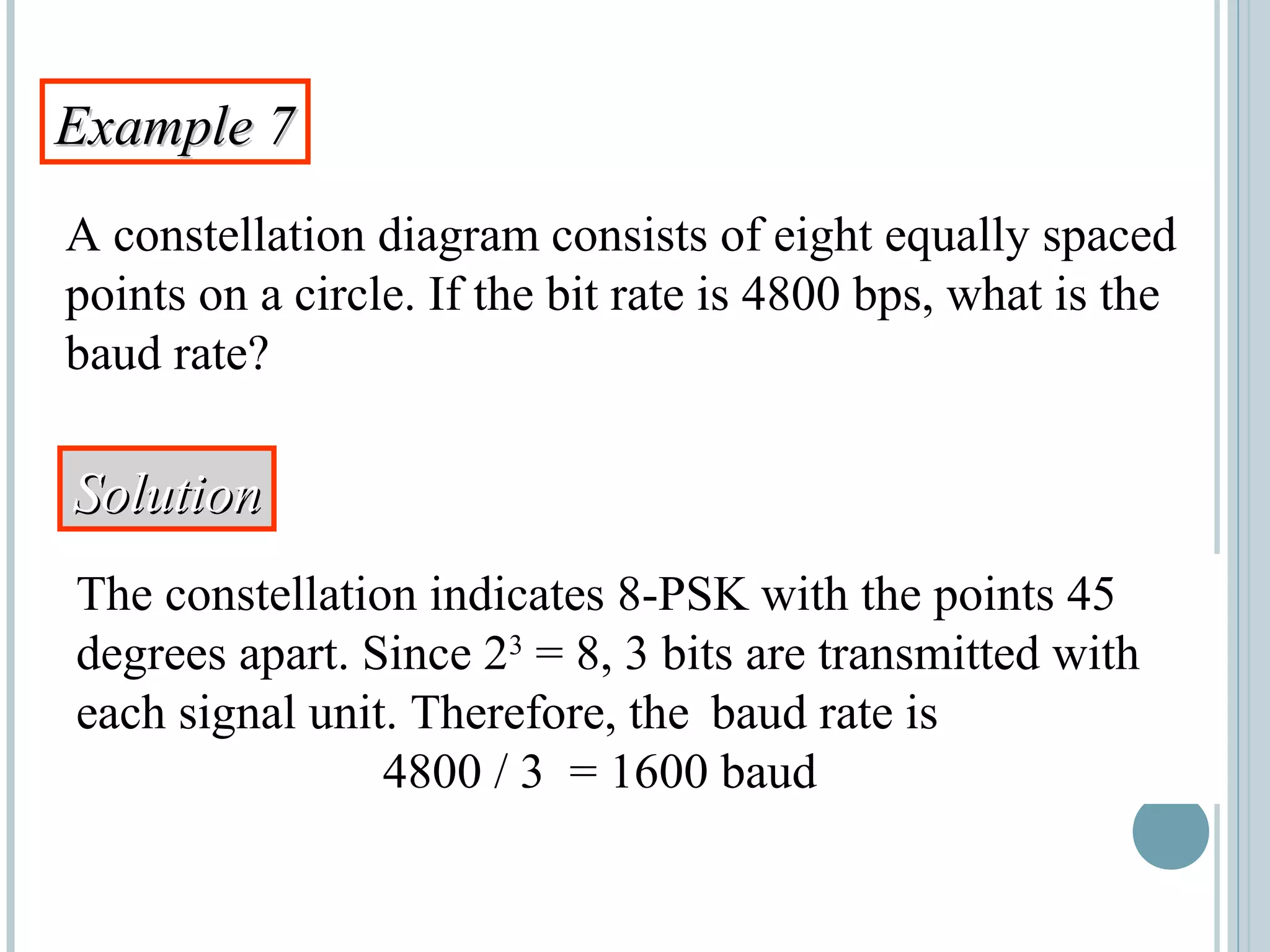
Example 7Example 7
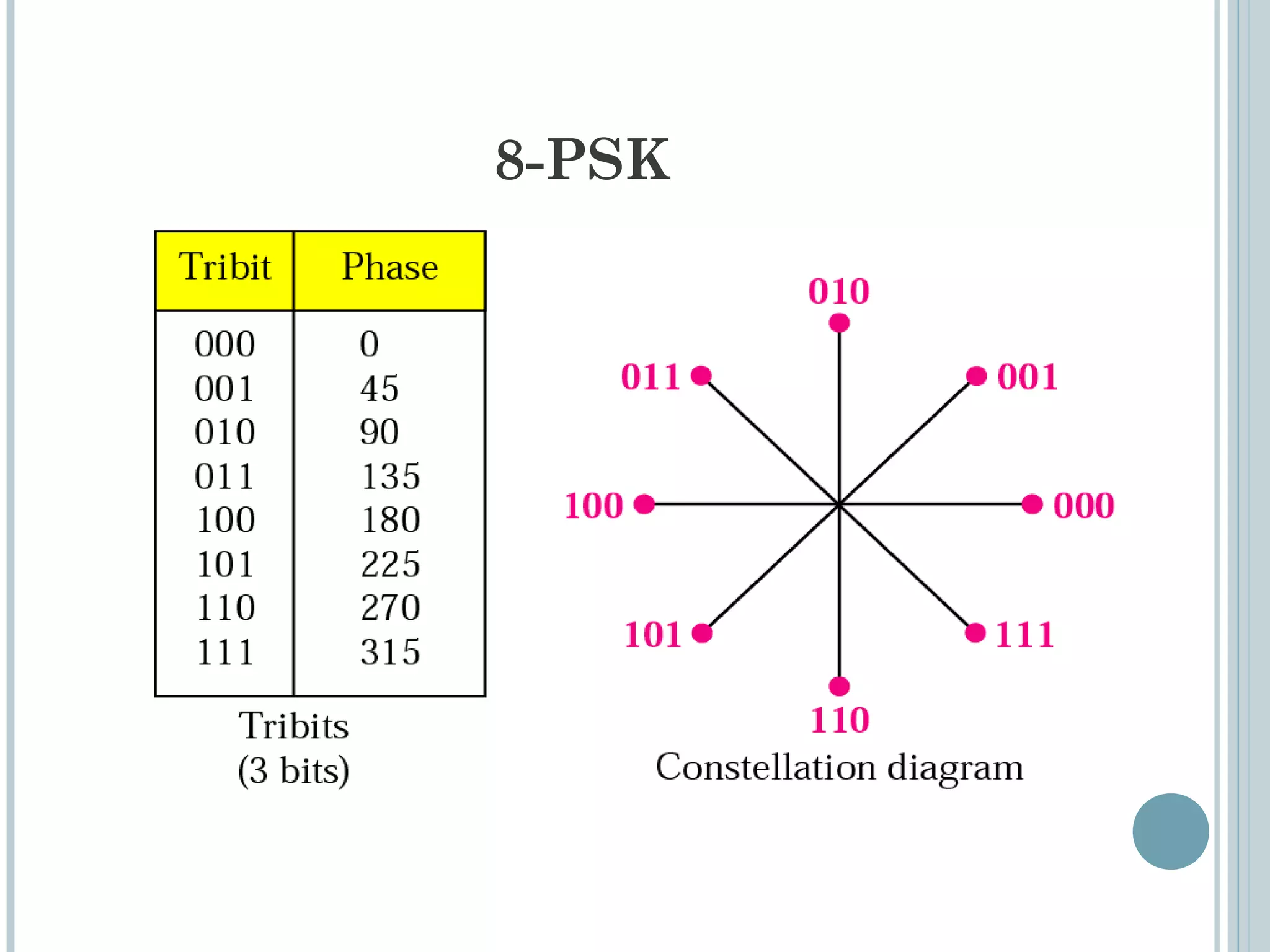
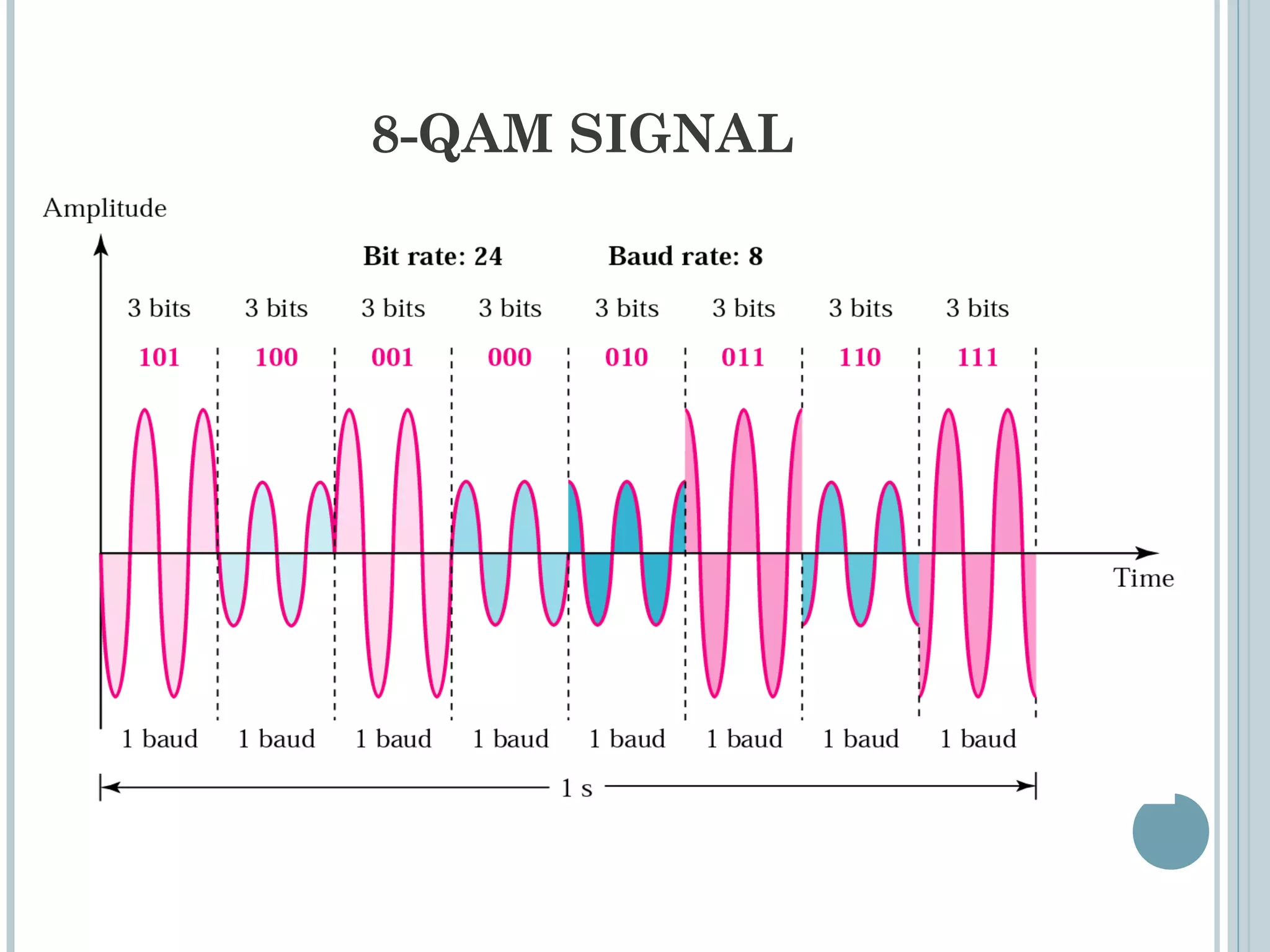
A constellation diagram consists of eight equally spaced
points on a circle. If the bit rate is 4800 bps, what is the
baud rate?
SolutionSolution
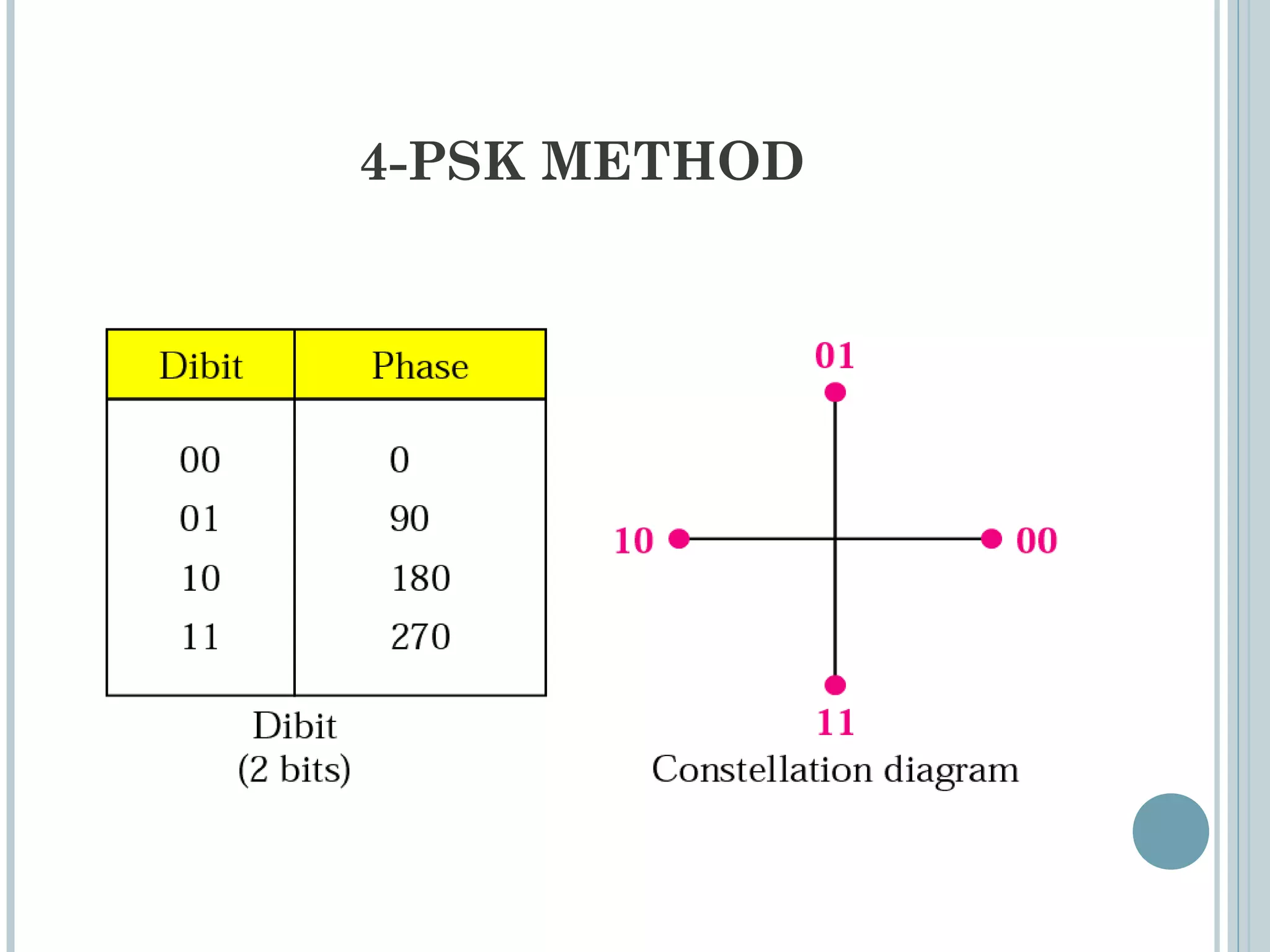
The constellation indicates 8-PSK with the points 45
degrees apart. Since 23
= 8, 3 bits are transmitted with
each signal unit. Therefore, the baud rate is
4800 / 3 = 1600 baud
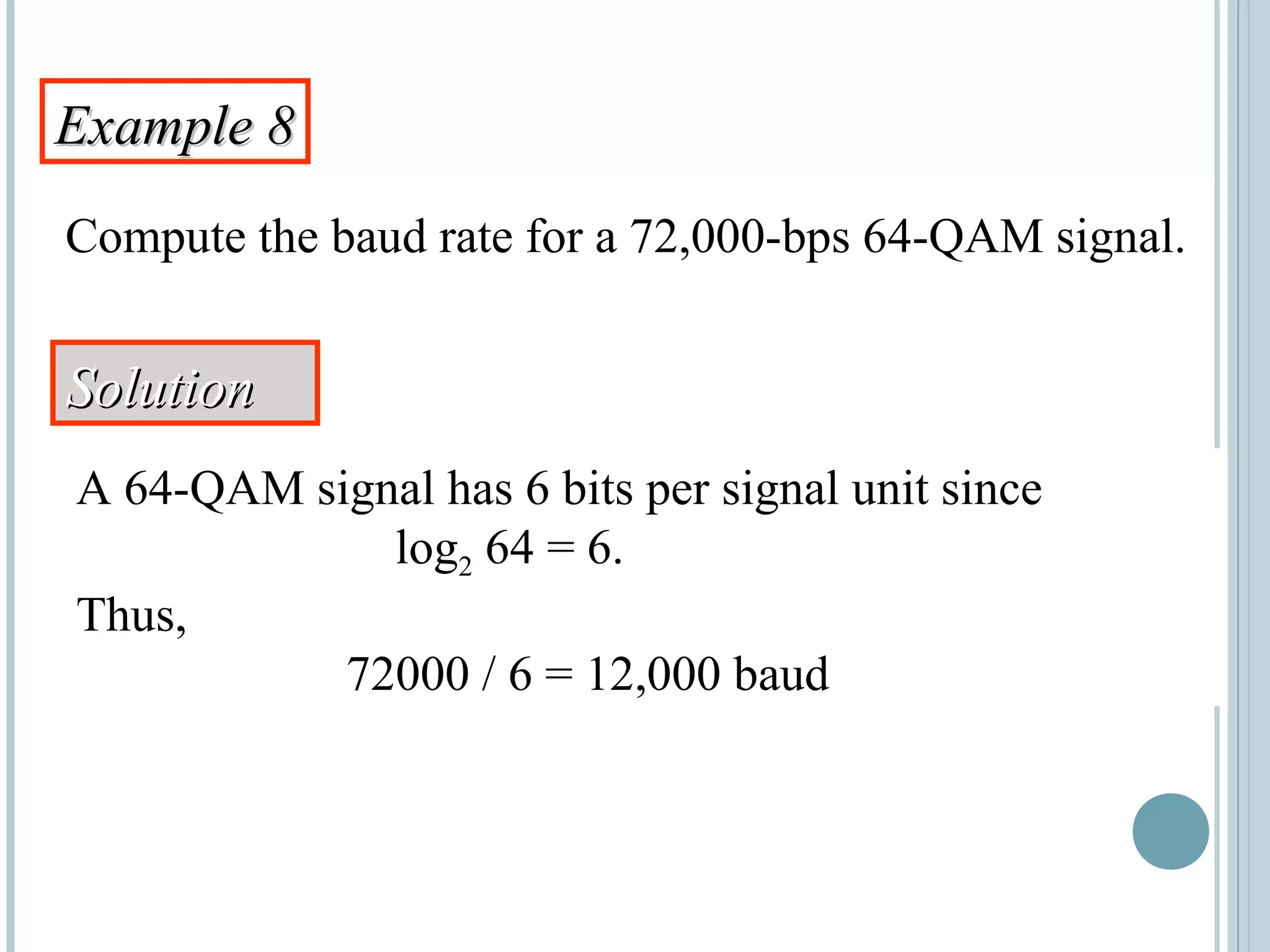
Example 8Example 8
Compute the baud rate for a 72,000-bps 64-QAM signal.
SolutionSolution
A 64-QAM signal has 6 bits per signal unit since
log2 64 = 6.
Thus,
72000 / 6 = 12,000 baud
THANKS
!!!

Lecture 11

  • 1.
    DATA COMMUNICATIONS & NETWORKING LECTURE-11 CourseInstructor : Sehrish Rafiq Department Of Computer Science University Of Peshawar
  • 2.
    LECTURE OVERVIEW  Digital-To–Analog Modulation  ASK  FSK  PSK  QAM
  • 3.
    DIGITAL-TO-ANALOG MODULATION  Modulation ofbinary data or digital to analog modulation is the process of changing one of the characteristics of an analog signal based on the information a digital signal(0’s and 1’s).  When you transmit data from one computer to another across a public phone line, the original data is digital but because telephone lines carry analog signals, the data must be converted.  The digital data must be modulated on an analog signal that has been manipulated to look like two distinct values corresponding to binary 1 and binary 0.
  • 4.
  • 5.
    BIT RATE BAUDRATE & CARRIER FREQUENCY  Bit rate is the number of bits per second.  Baud rate is the number of signal units per second.  Baud rate < Bit rate.  If an analog signal carries 4 bits in each signal unit. If 1000 signal units are sent per second, find the baud rate and the bit rate???  The bit rate of a signal is 3000.If each signal unit carries 6 bits, what is the baud rate??? Example 1Example 1
  • 6.
    SOLUTIONS  Baud rate=numberof signal units per second  =>Baud rate =1000 bauds per second(bauds/s).  Bit Rate = baud rate x number of bits per signal unit  =>Bit rate=1000x 4=4000bps.  Baud rate=bit rate/number of bits per signal unit  =>Baud rate =3000/6=500 baud/s. Solution 1Solution 1 Solution 2Solution 2
  • 7.
    CARRIER FREQUENCY  Inanalog transmission, the sending device produces a high –frequency signal that acts a basis for the information signal.  This base signal is called the carrier signal or carrier frequency.  The receiving device is tuned to the frequency of the carrier signal that it expects from the sender.
  • 8.
    CARRIER FREQUENCY  Digitalinformation then modulates the carrier signal by modifying one or more of its characteristics( amplitude, frequency or phase).  This kind of modification is called modulation or shift keying.  The information signal is called the modulating signal.
  • 9.
  • 10.
    ASK(AMPLITUDE SHIFT KEYING) In amplitude shift keying,the strength of the carrier signal is varied to represent binary 1 or 0.  Both frequency and phase remain constant while the amplitude changes.  Which voltage represents 1 and which represents 0 are left to the system designers.  A bit duration is the period of time that defines 1 bit.  The peak amplitude of the signal during each bit duration is constant and its value depends on the bit (0 or 1).
  • 11.
  • 12.
    PROBLEMS WITH ASK ASK transmission is highly susceptible to noise interference.  The term noise refers to unintentional voltages introduced on to a line by various phenomena such as heat or electromagnetic induction created by other sources.  These unintentional voltages combine with the signal to change the amplitude.  A 0 can be changed to 1 and a 1 can be changed to 0.
  • 13.
    PROBLEMS WITH ASK CONTINUED… High amount of energy is required.  A popular ASK technique is called on/off keying(OOK).  In OOK one of the values is represented by no voltage.  The advantage is a reduction in the amount of energy required to transmit information.
  • 14.
    ON-OFF KEYING ORBINARY AMPLITUDE SHIFT KEYING
  • 15.
    BAND WIDTH FORASK  Although there is only one carrier frequency, the process of modulation produces a complex signal that is a combination of many simple signals, each with a different frequency.  When we decompose an ASK-modulated signal ,we get a spectrum of many simple frequencies.  However the most significant ones are those between fc - N baud/2 and fc + N baud/2 with fc as the carrier frequency and N baud as the baud rate.
  • 16.
    BAND WIDTH FORASK  The Bandwidth requirements of ASK are calculated using the formula:  BW=(1+d) N baud  d is a constant factor whose value lies between 0 and 1.  The value of d depends on the modulation and filtration process and the medium.
  • 17.
  • 18.
    Example 3Example 3 Findthe minimum bandwidth for an ASK signal transmitting at 2000 bps. The transmission mode is half- duplex. SolutionSolution In ASK the baud rate and bit rate are the same. The baud rate is therefore 2000. An ASK signal requires a minimum bandwidth equal to its baud rate. Therefore, the minimum bandwidth is 2000 Hz.
  • 19.
    Example 4Example 4 Givena bandwidth of 5000 Hz for an ASK signal, what are the baud rate and bit rate? SolutionSolution In ASK the baud rate is the same as the bandwidth, which means the baud rate is 5000. But because the baud rate and the bit rate are also the same for ASK, the bit rate is 5000 bps.
  • 20.
    FREQUENCY SHIFT KEYING In FSK, the frequency of the carrier signal is varied to represent binary 1 or 0.  The frequency of the signal during each bit duration is constant and its value depends on the bit (0 or 1).  Both peak amplitude and phase remain constant.
  • 21.
    HOW FSK HANDLESNOISE PROBLEM???  FSK avoids most of the problems from noise.  Because the receiving device is looking for specific frequency changes over a given number of periods, it can ignore voltage spikes.  The limiting factors of FSK are the physical capabilities of the medium.
  • 22.
    BAND WIDTH REQUIREMENTFOR FSK  Although there are only two carrier frequencies, the process of modulation produces a composite signal that is a combination of many simple signals each with a different frequency.  We can say that the FSK spectrum is a combination of two ASK spectra centered on fc0 and fc1 .  BW= fc1 - fc0 + N baud .
  • 23.
    PSK  In Phaseshift keying, the phase of the carrier is varied to represent binary 1 or 0.  Both peak amplitude and frequency remain constant as the phase changes.  For example we start with a phase of 0 degree to represent binary 0 then we can change the phase to 180 degree to represent binary 1.  The phase of the signal during each bit duration is constant and the value depends on the bit (0 or 1).  This method is often called 2-PSK or binary PSK , because two different phases(0 degree and 180 degree are used).
  • 24.
    2-PSK OR BINARYPSK METHOD
  • 25.
    2-PSK OR BINARYPSK METHOD
  • 26.
  • 27.
  • 28.
  • 29.
    BAND WIDTH FORPSK  The minimum bandwidth required for PSK transmission is the same as that required for ASK Transmission.
  • 30.
    BIT RATE INPSK  The maximum baud rates of ASK and PSK are same for a given bandwidth.  PSK bit rates using the same bandwidth as ASK can be 2 or more times greater.
  • 31.
    LIMITATIONS OF PSK PSK is limited by the ability of the equipment to distinguish small differences in phase.  This factor limits its potential bit rate.
  • 32.
    Example 5Example 5 Findthe bandwidth for a 4-PSK signal transmitting at 2000 bps. Transmission is in half-duplex mode. SolutionSolution For PSK the baud rate is the same as the bandwidth, which means the baud rate is 5000. But in 8-PSK the bit rate is 3 times the baud rate, so the bit rate is 15,000 bps.
  • 33.
    Given a bandwidthof 5000 Hz for an 8-PSK signal, what are the baud rate and bit rate? Example 6Example 6 SolutionSolution For PSK the baud rate is the same as the bandwidth, which means the baud rate is 5000. But in 8-PSK the bit rate is 3 times the baud rate, so the bit rate is 15,000 bps.
  • 34.
    QAM(QUADRATURE AMPLITUDE MODULATION)  Bandwidth limitations makes combinations of FSK practically useless.  Why not combine ASK and PSK?  If we have x variations in phase and y variations in amplitude, giving us x times y possible variations and the corresponding number of bits per variation.  Quadrature amplitude modulation is a combination of ASK and PSK so that a maximum contrast between each signal unit(bit, dibit, tribit
  • 35.
    QAM CONTINUED…  Theoretically,any measurable number of changes in amplitude can be combined with any measurable number of changes in phase.
  • 36.
    4-QAM & 8-QAMCONSTELLATIONS
  • 37.
  • 38.
    BIT AND BAUDRATE COMPARISON
  • 39.
    BIT AND BAUDRATE COMPARISON ModulationModulation UnitsUnits Bits/BauBits/Bau dd Baud rateBaud rate Bit Rate ASK, FSK, 2-PSKASK, FSK, 2-PSK Bit 1 N N 4-PSK, 4-QAM4-PSK, 4-QAM Dibit 2 N 2N 8-PSK, 8-QAM8-PSK, 8-QAM Tribit 3 N 3N 16-QAM16-QAM Quadbit 4 N 4N 32-QAM32-QAM Pentabit 5 N 5N 64-QAM64-QAM Hexabit 6 N 6N 128-QAM128-QAM Septabit 7 N 7N 256-QAM256-QAM Octabit 8 N 8N
  • 40.
    Example 7Example 7 Aconstellation diagram consists of eight equally spaced points on a circle. If the bit rate is 4800 bps, what is the baud rate? SolutionSolution The constellation indicates 8-PSK with the points 45 degrees apart. Since 23 = 8, 3 bits are transmitted with each signal unit. Therefore, the baud rate is 4800 / 3 = 1600 baud
  • 41.
    Example 8Example 8 Computethe baud rate for a 72,000-bps 64-QAM signal. SolutionSolution A 64-QAM signal has 6 bits per signal unit since log2 64 = 6. Thus, 72000 / 6 = 12,000 baud
  • 42.