Adaptive Delta Modulation
Unit -2
Presented by
Mrs. M.P.Sasirekha
Reasons to use Adaptive Delta
Modulation
• In order to overcome the quantization errors due to slope
overload and granular noise, the step size (Δ) is made adaptive
to variations in the input signal x(t).
• Particularly in the step segment of the signal x(t), the step size
is increased. And the step is decreased when the input is
varying slowly.
• This method is known as Adaptive Delta Modulation (ADM).
• The adaptive delta modulators can take continuous changes in
step size or discrete changes in step size.
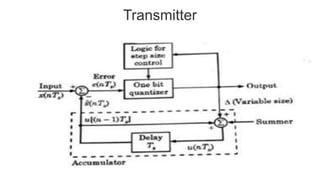
Transmitter
Transmitter
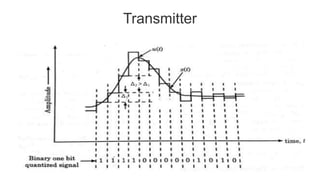
• The logic for step size control is added in the diagram.
• The step size increases or decreases according to a specified
rule depending on one bit quantizer output.
• For an example, if one bit quantizer output is high (i.e., 1), then
step size may be doubled for next sample.
• If one bit quantizer output is low, then step size may be reduced
by one step.
• Fig.2 shows the staircase waveforms of adaptive delta
modulator and sequence of bits to be transmitted.
Transmitter
Receiver
Receiver
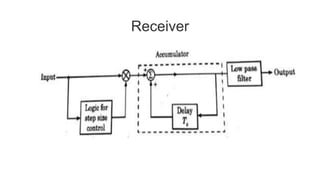
• The receiver has two portions. The first portion produces the
step size from each incoming bit. Exactly the same process is
followed as that in transmitter.
• The previous input and present input decide the step size.
• It is then applied to the second portion i.e., an accumulator
which builds up staircase waveform.
• The low pass filter then smoothens out the staircase waveform
to reconstruct the original signal.
Advantages of Adaptive Delta Modulation
• Adaptive delta modulation has certain advantages over delta
modulation as under :
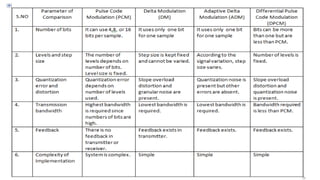
1.The signal to noise ratio of ADM is better than that of DM
because of the reduction in slope overload distortion and idle
noise.
2.Because of the variable step size , the dynamic range of
ADM is wider than DM.
3.Utilization of bandwidth is better in ADM than DM.
Thank you

Adaptive delta modulation

  • 1.
    Adaptive Delta Modulation Unit-2 Presented by Mrs. M.P.Sasirekha
  • 2.
    Reasons to useAdaptive Delta Modulation • In order to overcome the quantization errors due to slope overload and granular noise, the step size (Δ) is made adaptive to variations in the input signal x(t). • Particularly in the step segment of the signal x(t), the step size is increased. And the step is decreased when the input is varying slowly. • This method is known as Adaptive Delta Modulation (ADM). • The adaptive delta modulators can take continuous changes in step size or discrete changes in step size.
  • 3.
  • 4.
    Transmitter • The logicfor step size control is added in the diagram. • The step size increases or decreases according to a specified rule depending on one bit quantizer output. • For an example, if one bit quantizer output is high (i.e., 1), then step size may be doubled for next sample. • If one bit quantizer output is low, then step size may be reduced by one step. • Fig.2 shows the staircase waveforms of adaptive delta modulator and sequence of bits to be transmitted.
  • 5.
  • 6.
  • 7.
    Receiver • The receiverhas two portions. The first portion produces the step size from each incoming bit. Exactly the same process is followed as that in transmitter. • The previous input and present input decide the step size. • It is then applied to the second portion i.e., an accumulator which builds up staircase waveform. • The low pass filter then smoothens out the staircase waveform to reconstruct the original signal.
  • 8.
    Advantages of AdaptiveDelta Modulation • Adaptive delta modulation has certain advantages over delta modulation as under : 1.The signal to noise ratio of ADM is better than that of DM because of the reduction in slope overload distortion and idle noise. 2.Because of the variable step size , the dynamic range of ADM is wider than DM. 3.Utilization of bandwidth is better in ADM than DM.
  • 10.