ANGLE MODULATION
BY
G.GNANA PRIYA
AP/ECE
RAMCO INSTITUTE OF
TECHNOLOGY
2
ANGLE MODULATION
 Definition
 The angle of the carrier is varied in accordance with the
baseband signal.
 Angle modulation provides us with a practical
means of exchanging channel bandwidth for
improved noise performance.
 So, angle modulation can provide better discrimination
against noise and interference than the amplitude
modulation, at the expense of increased transmission
bandwidth.
ANGLE MODULATION
 Commonly used angle modulation :
 Phase modulation (PM)
 Frequency modulation (FM)
y.sensitivitphaseiswhere)],(2cos[)( ppcc ktmktfAts  
 
 
y.sensitivitfrequencyisrewhe
,)(22cos
))((2cos)(
0
0
f
t
fcc
t
fcc
k
dmktfA
dmkfAts






3
DIFFERENCES BETWEEN AMPLITUDE
MODULATION & ANGLE MODULATION
 Main differences between Amplitude Modulation
and Angle Modulation are
 Zero crossing spacing of angle modulation no longer
has a perfect regularity as amplitude modulation
does.
 Angle modulated signal has constant envelope; yet,
the envelope of amplitude modulated signal is
dependent on the message signal.
4
SIMILARITY BETWEEN PM AND FM
 Similarity between PM and FM is
 PM is simply an FM with in place of m(t).

t
dm
0
)( 



  
t
fccFM dmktfAts
0
)(22cos)( 
)](2cos[)( tmktfAts pccPM  
5
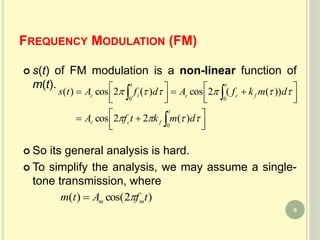
FREQUENCY MODULATION (FM)
 s(t) of FM modulation is a non-linear function of
m(t).
 So its general analysis is hard.
 To simplify the analysis, we may assume a single-
tone transmission, where
)2cos()( tfAtm mm 



 



 






t
fcc
t
fcc
t
ic
dmktfA
dmkfAdfAts
0
00
)(22cos
))((2cos)(2cos)(


6
From the formula in the previous slide,
deviation.frequencytheiswhere
)2cos(
)2cos(
)()(
mf
mc
mmfc
fci
Akf
tfff
tfAkf
tmkftf











 




 






)2sin(2cos
)]2cos([2cos
)(2cos)(
0
0
tf
f
f
tfA
dfffA
dfAts
m
m
cc
t
mcc
t
ic



signal.FMof
indexmodulationthecalledoftenis/where mff
7
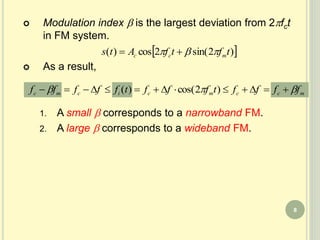
 Modulation index  is the largest deviation from 2fct
in FM system.
 As a result,
1. A small  corresponds to a narrowband FM.
2. A large  corresponds to a wideband FM.
 )2sin(2cos)( tftfAts mcc  
mccmcicmc fffftffftfffff   )2cos()(
8
NARROWBAND FREQUENCY MODULATION
 
)2sin()2sin()2cos(
)]2sin(sin[)2sin()]2sin(cos[)2cos(
)2sin(2cos)(
tftfAtfA
tftfAtftfA
tftfAts
mcccc
mccmcc
mcc






(Often,  < 0.3.)
9
NARROWBAND FREQUENCY MODULATION
 Comparison between approximate narrowband FM
modulation and AM (DSB-C) modulation
))(2cos(
2
))(2cos(
2
)2cos(
)2cos()]2cos(1[
)2cos()](1[)(
tff
Ak
tff
Ak
tfA
tftfAkA
tftmkAts
m
ma
m
ma
cc
cmmac
cacAM






))(2cos(
2
))(2cos(
2
)2cos(
)2sin()2sin()2cos()(
tff
A
tff
A
tfA
tftfAtfAts
mc
c
mc
c
cc
mccccFM








10
NARROWBAND FREQUENCY MODULATION
 Represent them in terms of their low-pass
isomorphism.
)]2sin()2[cos(
2
)]2sin()2[cos(
2
)0()(~
tfjtf
Ak
tfjtf
Ak
jAts
mm
ma
mm
ma
cAM




)]2sin()2[cos(
2
)]2sin()2[cos(
2
)0()(~
tfjtf
A
tfjtf
A
jAts
mm
c
mm
c
cFM






11
NARROWBAND FREQUENCY MODULATION
 Phasor diagram
)]2sin()2[cos(
2
tfjtf
A
mm
c



)0( jAc 
))2sin(
)2(cos(
2
tfj
tf
A
m
m
c




)(~ tsFM
)]2sin()2[cos(
2
tfjtf
A
mm
c



)(~ tsAM
.Let mac AkA 
12
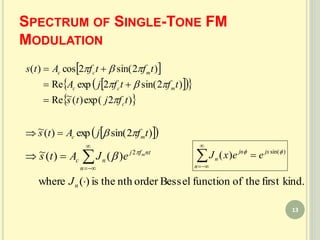
SPECTRUM OF SINGLE-TONE FM
MODULATION
 
   
 )2exp()(~Re
)2sin(2expRe
)2sin(2cos)(
tfjts
tftfjA
tftfAts
c
mcc
mcc






  )2sin(exp)(~ tfjAts mc 




n
ntfj
nc
m
eJAts 
 2
)()(~ )sin(
)(  jx
n
jn
n eexJ 


kind.firsttheoffunctionelorder Bessnththeis)(where nJ
13
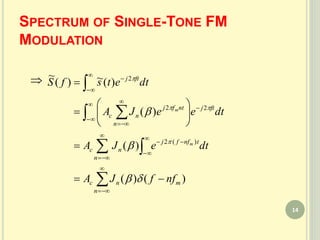
SPECTRUM OF SINGLE-TONE FM
MODULATION

 
 


























n
mnc
n
tnffj
nc
ftj
n
ntfj
nc
ftj
nffJA
dteJA
dteeJA
dtetsfS
m
m
)()(
)(
)(
)(~)(
~
)(2
22
2






14
SPECTRUM OF SINGLE-TONE FM
MODULATION
 
 
 








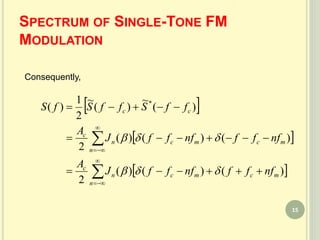
n
mcmcn
c
n
mcmcn
c
cc
nfffnfffJ
A
nfffnfffJ
A
ffSffSfS
)()()(
2
)()()(
2
)(
~
)(
~
2
1
)( *


Consequently,
15
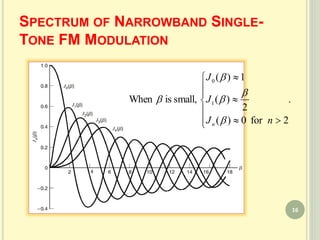
SPECTRUM OF NARROWBAND SINGLE-
TONE FM MODULATION
.
2for0)(
2
)(
1)(
small,isWhen 1
0










nJ
J
J
n 




16
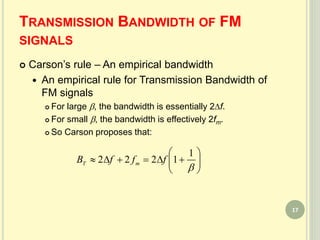
TRANSMISSION BANDWIDTH OF FM
SIGNALS
 Carson’s rule – An empirical bandwidth
 An empirical rule for Transmission Bandwidth of
FM signals
 For large , the bandwidth is essentially 2f.
 For small , the bandwidth is effectively 2fm.
 So Carson proposes that:








1
1222 fffB mT
17
TRANSMISSION BANDWIDTH OF FM
SIGNALS
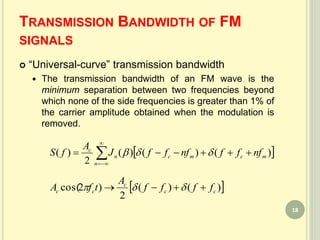
 “Universal-curve” transmission bandwidth
 The transmission bandwidth of an FM wave is the
minimum separation between two frequencies beyond
which none of the side frequencies is greater than 1% of
the carrier amplitude obtained when the modulation is
removed.
 



n
mcmcn
c
nfffnfffJ
A
fS )()()(
2
)( 
 )()(
2
)2cos( cc
c
cc ffff
A
tfA  
18
0.1
0.3
0.5
1.0
2.0
5.0
10.0
20.0
30.0
2
4
4
6
8
16
28
50
70
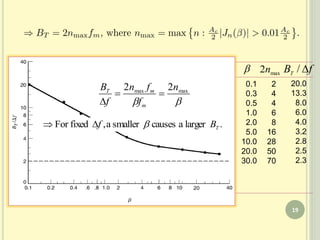
 max2n

maxmax 22 n
f
fn
f
B
m
mT


.largeracausessmallera,fixedFor TBf 
20.0
13.3
8.0
6.0
4.0
3.2
2.8
2.5
2.3
fBT /
19
Thank You
20

Angle modulation

  • 1.
  • 2.
    2 ANGLE MODULATION  Definition The angle of the carrier is varied in accordance with the baseband signal.  Angle modulation provides us with a practical means of exchanging channel bandwidth for improved noise performance.  So, angle modulation can provide better discrimination against noise and interference than the amplitude modulation, at the expense of increased transmission bandwidth.
  • 3.
    ANGLE MODULATION  Commonlyused angle modulation :  Phase modulation (PM)  Frequency modulation (FM) y.sensitivitphaseiswhere)],(2cos[)( ppcc ktmktfAts       y.sensitivitfrequencyisrewhe ,)(22cos ))((2cos)( 0 0 f t fcc t fcc k dmktfA dmkfAts       3
  • 4.
    DIFFERENCES BETWEEN AMPLITUDE MODULATION& ANGLE MODULATION  Main differences between Amplitude Modulation and Angle Modulation are  Zero crossing spacing of angle modulation no longer has a perfect regularity as amplitude modulation does.  Angle modulated signal has constant envelope; yet, the envelope of amplitude modulated signal is dependent on the message signal. 4
  • 5.
    SIMILARITY BETWEEN PMAND FM  Similarity between PM and FM is  PM is simply an FM with in place of m(t).  t dm 0 )(        t fccFM dmktfAts 0 )(22cos)(  )](2cos[)( tmktfAts pccPM   5
  • 6.
    FREQUENCY MODULATION (FM) s(t) of FM modulation is a non-linear function of m(t).  So its general analysis is hard.  To simplify the analysis, we may assume a single- tone transmission, where )2cos()( tfAtm mm                  t fcc t fcc t ic dmktfA dmkfAdfAts 0 00 )(22cos ))((2cos)(2cos)(   6
  • 7.
    From the formulain the previous slide, deviation.frequencytheiswhere )2cos( )2cos( )()( mf mc mmfc fci Akf tfff tfAkf tmkftf                          )2sin(2cos )]2cos([2cos )(2cos)( 0 0 tf f f tfA dfffA dfAts m m cc t mcc t ic    signal.FMof indexmodulationthecalledoftenis/where mff 7
  • 8.
     Modulation index is the largest deviation from 2fct in FM system.  As a result, 1. A small  corresponds to a narrowband FM. 2. A large  corresponds to a wideband FM.  )2sin(2cos)( tftfAts mcc   mccmcicmc fffftffftfffff   )2cos()( 8
  • 9.
    NARROWBAND FREQUENCY MODULATION  )2sin()2sin()2cos( )]2sin(sin[)2sin()]2sin(cos[)2cos( )2sin(2cos)( tftfAtfA tftfAtftfA tftfAts mcccc mccmcc mcc       (Often,  < 0.3.) 9
  • 10.
    NARROWBAND FREQUENCY MODULATION Comparison between approximate narrowband FM modulation and AM (DSB-C) modulation ))(2cos( 2 ))(2cos( 2 )2cos( )2cos()]2cos(1[ )2cos()](1[)( tff Ak tff Ak tfA tftfAkA tftmkAts m ma m ma cc cmmac cacAM       ))(2cos( 2 ))(2cos( 2 )2cos( )2sin()2sin()2cos()( tff A tff A tfA tftfAtfAts mc c mc c cc mccccFM         10
  • 11.
    NARROWBAND FREQUENCY MODULATION Represent them in terms of their low-pass isomorphism. )]2sin()2[cos( 2 )]2sin()2[cos( 2 )0()(~ tfjtf Ak tfjtf Ak jAts mm ma mm ma cAM     )]2sin()2[cos( 2 )]2sin()2[cos( 2 )0()(~ tfjtf A tfjtf A jAts mm c mm c cFM       11
  • 12.
    NARROWBAND FREQUENCY MODULATION Phasor diagram )]2sin()2[cos( 2 tfjtf A mm c    )0( jAc  ))2sin( )2(cos( 2 tfj tf A m m c     )(~ tsFM )]2sin()2[cos( 2 tfjtf A mm c    )(~ tsAM .Let mac AkA  12
  • 13.
    SPECTRUM OF SINGLE-TONEFM MODULATION        )2exp()(~Re )2sin(2expRe )2sin(2cos)( tfjts tftfjA tftfAts c mcc mcc         )2sin(exp)(~ tfjAts mc      n ntfj nc m eJAts   2 )()(~ )sin( )(  jx n jn n eexJ    kind.firsttheoffunctionelorder Bessnththeis)(where nJ 13
  • 14.
    SPECTRUM OF SINGLE-TONEFM MODULATION                                n mnc n tnffj nc ftj n ntfj nc ftj nffJA dteJA dteeJA dtetsfS m m )()( )( )( )(~)( ~ )(2 22 2       14
  • 15.
    SPECTRUM OF SINGLE-TONEFM MODULATION               n mcmcn c n mcmcn c cc nfffnfffJ A nfffnfffJ A ffSffSfS )()()( 2 )()()( 2 )( ~ )( ~ 2 1 )( *   Consequently, 15
  • 16.
    SPECTRUM OF NARROWBANDSINGLE- TONE FM MODULATION . 2for0)( 2 )( 1)( small,isWhen 1 0           nJ J J n      16
  • 17.
    TRANSMISSION BANDWIDTH OFFM SIGNALS  Carson’s rule – An empirical bandwidth  An empirical rule for Transmission Bandwidth of FM signals  For large , the bandwidth is essentially 2f.  For small , the bandwidth is effectively 2fm.  So Carson proposes that:         1 1222 fffB mT 17
  • 18.
    TRANSMISSION BANDWIDTH OFFM SIGNALS  “Universal-curve” transmission bandwidth  The transmission bandwidth of an FM wave is the minimum separation between two frequencies beyond which none of the side frequencies is greater than 1% of the carrier amplitude obtained when the modulation is removed.      n mcmcn c nfffnfffJ A fS )()()( 2 )(   )()( 2 )2cos( cc c cc ffff A tfA   18
  • 19.
    0.1 0.3 0.5 1.0 2.0 5.0 10.0 20.0 30.0 2 4 4 6 8 16 28 50 70  max2n  maxmax 22n f fn f B m mT   .largeracausessmallera,fixedFor TBf  20.0 13.3 8.0 6.0 4.0 3.2 2.8 2.5 2.3 fBT / 19
  • 20.