

DIT
Dar es Salaam institute of Technology (DIT)
ETU 07420
Switching Systems
Ally, J
jumannea@gmail.com
DIT
MPLS Fundamentals
DIT
MPLS Contents
 Data networking and need for MPLS
 Basic concepts and working of MPLS
 Label - Allocation and Distribution
 MPLS Forwarding
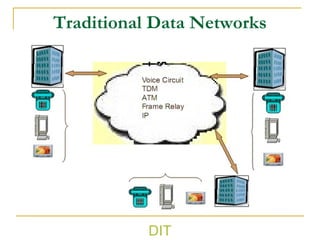
Traditional Data Networks
DIT
Data Network Concept
 A data network is a set of nodes connected by
links.
 Nodes could be Routers, Switches,
Multiplexers connected by links from 64 kbps
till 10 gigabit ethernet.
 Fundamental property of data networks is
multiplexing.
 Two main types of multiplexing are - Time
Division Multiplexing ( TDM ) Statistical
Multiplexing ( StatMux)
 Others are FDM , WDM etc.
DIT
Data Network Concept
 TDM is practice of allocating certain amount of
time on a physical circuit for a particular
connection. This translates to bandwidth
allocation as the circuits are fixed rate.
 Examples for TDM being E1 (2Mbps circuit) ,
SDH
 Bandwidth permanently allocated for a
connection whether connection used ( carrying
traffic) or not.
 No traffic congestion issues, bandwidth
guaranteed
DIT
Data Network Concept
 Statmux - is the practice of sharing available
bandwidth between all users.
 Examples are : IP , Frame Relay, ATM & now
MPLS.
 It works by way of dividing traffic (data) into
discrete units which are handled separately. IP
units are Packets, ATM units are Cells, Frame
Relay units are Frames.
 Better utilisation of bandwidth, allows
oversubscription.
DIT
Data Network Concept
 Introduces resource contention.
 Therefore statmux technologies have to deal with
 Buffering of data units
 Queuing of data units
 Dropping of data units
 Running one statmux technology over other eg. IP
over ATM . Mechanisms available in one
technology to deal with contention does not
translate properly into another.
 Requirement of translating Layer 3 contention
controls mechanisms to Layer 2.
DIT
Data Network Concept
DIT
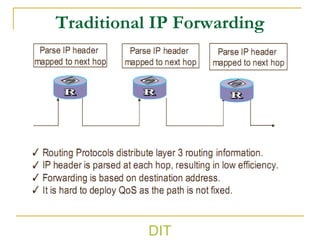
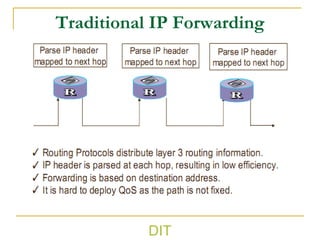
Traditional IP Forwarding
DIT
Traditional IP Forwarding
DIT
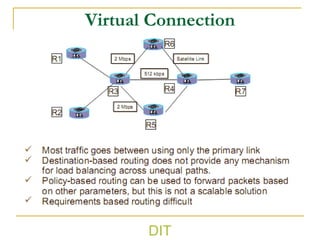
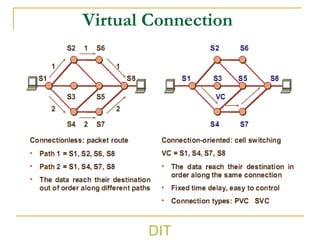
Virtual Connection
DIT
Virtual Connection
DIT
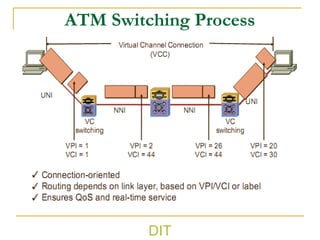
ATM Switching Process
DIT
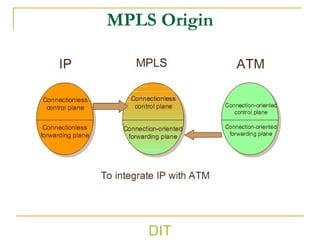
MPLS Origin
DIT
MPLS Origin
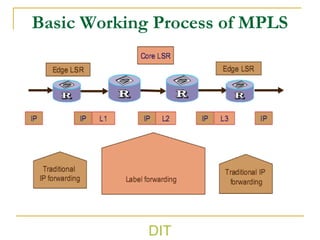
 To bring advantages of connection oriented
protocols to packet switched networks.
 Faster switching - Replace IP header with
short and fixed-length labels as forwarding
basis.
 To substitute ATM & Frame Relay & provide
Integrated services with QoS without the
overhead of call segmentation.
DIT
MPLS Origin
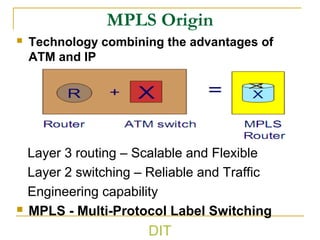
 Technology combining the advantages of
ATM and IP
Layer 3 routing – Scalable and Flexible
Layer 2 switching – Reliable and Traffic
Engineering capability
 MPLS - Multi-Protocol Label Switching
DIT
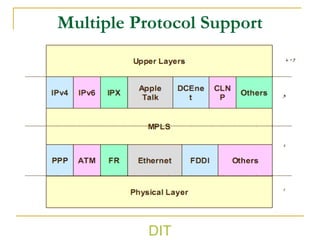
Multiple Protocol Support
DIT
MPLS
 MPLS is the binding of the control plane at the bottom
of the network layer with the data forwarding plane at
the top of data link layer.
 MPLS is a hybrid of a traditional network layer-3
routing protocols and layer-2 switching technologies
 MPLS is not a new network layer protocol because it
does not have its own routing capabilities and
addressing schemes
 MPLS is designed to work over many of the data layer
technologies that provides requisite layer-2
addressing and functionality
 MPLS is a “Layer 2.5 Technology”
DIT
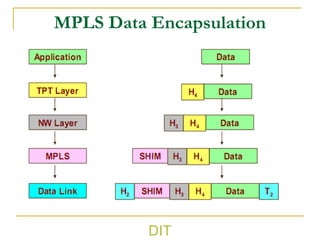
MPLS Data Encapsulation
DIT
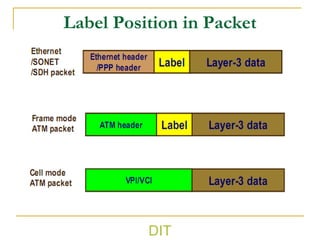
Label Position in Packet
DIT
Basic Working Process of MPLS
DIT
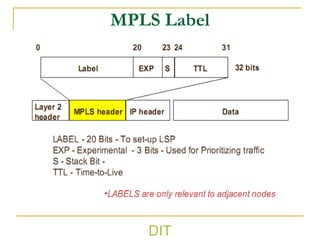
MPLS Label
DIT
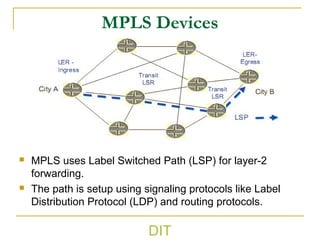
MPLS Devices
 MPLS uses Label Switched Path (LSP) for layer-2
forwarding.
 The path is setup using signaling protocols like Label
Distribution Protocol (LDP) and routing protocols.
DIT
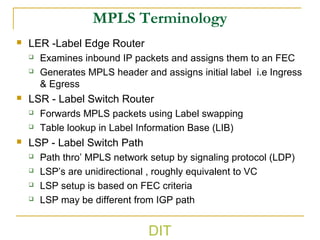
MPLS Terminology
 LER -Label Edge Router
 Examines inbound IP packets and assigns them to an FEC
 Generates MPLS header and assigns initial label i.e Ingress
& Egress
 LSR - Label Switch Router
 Forwards MPLS packets using Label swapping
 Table lookup in Label Information Base (LIB)
 LSP - Label Switch Path
 Path thro’ MPLS network setup by signaling protocol (LDP)
 LSP’s are unidirectional , roughly equivalent to VC
 LSP setup is based on FEC criteria
 LSP may be different from IGP path
DIT
MPLS Terminology
 Forwarding Equivalence Class (FEC) is a stream of
IP packets that are forwarded over the same path,
treated in the same manner and mapped to the
same label. ( Same QoS ; Same Next Hop; Same
Path)
 LDP ( Label Distribution Protocol) associates a set of
destinations with each LSP
 Packets could be assigned to a LSP based on
 Combination of destination address and
application type
 Combination of destination address and source
address
DIT
Label Processing
 Push
 Add a new label to the top of the packet
 The TTL, stack and CoS fields are derived from the IP packet
header
 Can be performed on an existing MPLS packet-Label
Stacking
 Pop
 Remove the label
 TTL is copied from the label to the IP header
 IP packet is forwarded as a native IP packet
 Swap

Replace the label at the top of the label stack with a new label
 The TTL, stack and CoS fields are copied from the previous label
DIT
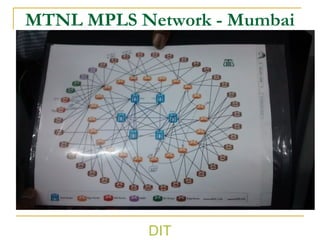
MTNL MPLS Network - Mumbai
DIT
DIT
Thanks!
Technology changes but communication lasts.

Switching systems lecture8 mpls

  • 1.
    DIT Dar es Salaaminstitute of Technology (DIT) ETU 07420 Switching Systems Ally, J jumannea@gmail.com
  • 2.
  • 3.
    DIT MPLS Contents  Datanetworking and need for MPLS  Basic concepts and working of MPLS  Label - Allocation and Distribution  MPLS Forwarding
  • 4.
  • 5.
    Data Network Concept A data network is a set of nodes connected by links.  Nodes could be Routers, Switches, Multiplexers connected by links from 64 kbps till 10 gigabit ethernet.  Fundamental property of data networks is multiplexing.  Two main types of multiplexing are - Time Division Multiplexing ( TDM ) Statistical Multiplexing ( StatMux)  Others are FDM , WDM etc. DIT
  • 6.
    Data Network Concept TDM is practice of allocating certain amount of time on a physical circuit for a particular connection. This translates to bandwidth allocation as the circuits are fixed rate.  Examples for TDM being E1 (2Mbps circuit) , SDH  Bandwidth permanently allocated for a connection whether connection used ( carrying traffic) or not.  No traffic congestion issues, bandwidth guaranteed DIT
  • 7.
    Data Network Concept Statmux - is the practice of sharing available bandwidth between all users.  Examples are : IP , Frame Relay, ATM & now MPLS.  It works by way of dividing traffic (data) into discrete units which are handled separately. IP units are Packets, ATM units are Cells, Frame Relay units are Frames.  Better utilisation of bandwidth, allows oversubscription. DIT
  • 8.
    Data Network Concept Introduces resource contention.  Therefore statmux technologies have to deal with  Buffering of data units  Queuing of data units  Dropping of data units  Running one statmux technology over other eg. IP over ATM . Mechanisms available in one technology to deal with contention does not translate properly into another.  Requirement of translating Layer 3 contention controls mechanisms to Layer 2. DIT
  • 9.
  • 10.
  • 11.
  • 12.
  • 13.
  • 14.
  • 15.
  • 16.
    MPLS Origin  Tobring advantages of connection oriented protocols to packet switched networks.  Faster switching - Replace IP header with short and fixed-length labels as forwarding basis.  To substitute ATM & Frame Relay & provide Integrated services with QoS without the overhead of call segmentation. DIT
  • 17.
    MPLS Origin  Technologycombining the advantages of ATM and IP Layer 3 routing – Scalable and Flexible Layer 2 switching – Reliable and Traffic Engineering capability  MPLS - Multi-Protocol Label Switching DIT
  • 18.
  • 19.
    MPLS  MPLS isthe binding of the control plane at the bottom of the network layer with the data forwarding plane at the top of data link layer.  MPLS is a hybrid of a traditional network layer-3 routing protocols and layer-2 switching technologies  MPLS is not a new network layer protocol because it does not have its own routing capabilities and addressing schemes  MPLS is designed to work over many of the data layer technologies that provides requisite layer-2 addressing and functionality  MPLS is a “Layer 2.5 Technology” DIT
  • 20.
  • 21.
  • 22.
  • 23.
  • 24.
    MPLS Devices  MPLSuses Label Switched Path (LSP) for layer-2 forwarding.  The path is setup using signaling protocols like Label Distribution Protocol (LDP) and routing protocols. DIT
  • 25.
    MPLS Terminology  LER-Label Edge Router  Examines inbound IP packets and assigns them to an FEC  Generates MPLS header and assigns initial label i.e Ingress & Egress  LSR - Label Switch Router  Forwards MPLS packets using Label swapping  Table lookup in Label Information Base (LIB)  LSP - Label Switch Path  Path thro’ MPLS network setup by signaling protocol (LDP)  LSP’s are unidirectional , roughly equivalent to VC  LSP setup is based on FEC criteria  LSP may be different from IGP path DIT
  • 26.
    MPLS Terminology  ForwardingEquivalence Class (FEC) is a stream of IP packets that are forwarded over the same path, treated in the same manner and mapped to the same label. ( Same QoS ; Same Next Hop; Same Path)  LDP ( Label Distribution Protocol) associates a set of destinations with each LSP  Packets could be assigned to a LSP based on  Combination of destination address and application type  Combination of destination address and source address DIT
  • 27.
    Label Processing  Push Add a new label to the top of the packet  The TTL, stack and CoS fields are derived from the IP packet header  Can be performed on an existing MPLS packet-Label Stacking  Pop  Remove the label  TTL is copied from the label to the IP header  IP packet is forwarded as a native IP packet  Swap  Replace the label at the top of the label stack with a new label  The TTL, stack and CoS fields are copied from the previous label DIT
  • 28.
    MTNL MPLS Network- Mumbai DIT
  • 29.