Introduction to Cells
  Mr. Hildebrandt - Biology
Early Cytology
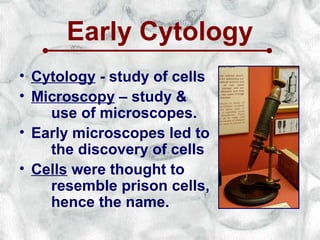
• Cytology - study of cells
• Microscopy – study &
    use of microscopes.
• Early microscopes led to
    the discovery of cells
• Cells were thought to
    resemble prison cells,
    hence the name.
The Cell Theory
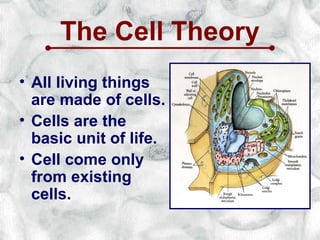
• All living things
  are made of cells.
• Cells are the
  basic unit of life.
• Cell come only
  from existing
  cells.
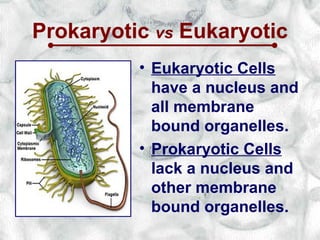
Prokaryotic vs Eukaryotic
          • Eukaryotic Cells
            have a nucleus and
            all membrane
            bound organelles.
          • Prokaryotic Cells
            lack a nucleus and
            other membrane
            bound organelles.
The Cell’s Jacket
Cell Membrane – a complex, semi-
 permeable, double-layered membrane
 that surrounds the cell.
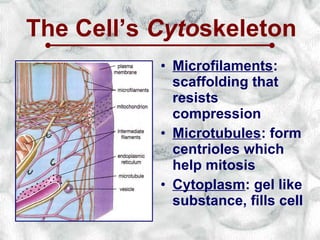
The Cell’s Cytoskeleton
           • Microfilaments:
             scaffolding that
             resists
             compression
           • Microtubules: form
             centrioles which
             help mitosis
           • Cytoplasm: gel like
             substance, fills cell
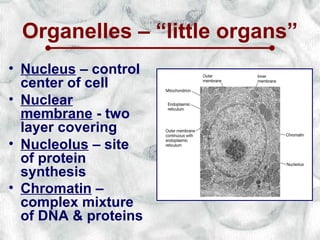
Organelles – “little organs”
• Nucleus – control
  center of cell
• Nuclear
  membrane - two
  layer covering
• Nucleolus – site
  of protein
  synthesis
• Chromatin –
  complex mixture
  of DNA & proteins
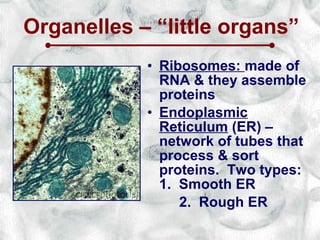
Organelles – “little organs”
            • Ribosomes: made of
              RNA & they assemble
              proteins
            • Endoplasmic
              Reticulum (ER) –
              network of tubes that
              process & sort
              proteins. Two types:
              1. Smooth ER
                 2. Rough ER
Organelles – “little organs”

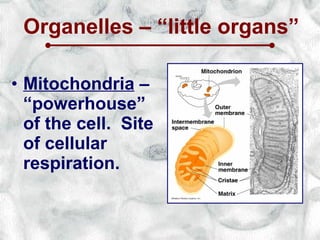
• Mitochondria –
  “powerhouse”
  of the cell. Site
  of cellular
  respiration.
Organelles – “little organs”

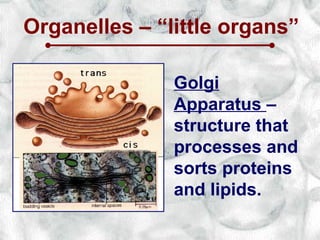
               Golgi
               Apparatus –
               structure that
               processes and
               sorts proteins
               and lipids.
Organelles – “little organs”

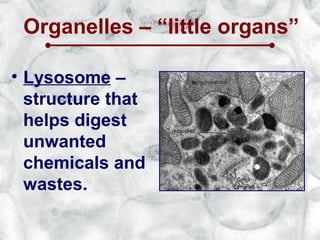
• Lysosome –
  structure that
  helps digest
  unwanted
  chemicals and
  wastes.
Organelles – “little organs”

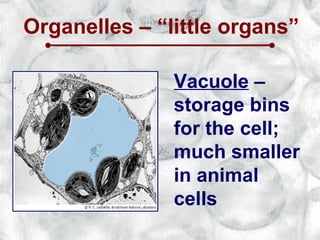
               Vacuole –
               storage bins
               for the cell;
               much smaller
               in animal
               cells
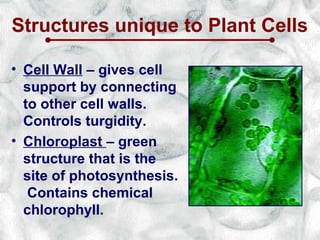
Structures unique to Plant Cells

• Cell Wall – gives cell
  support by connecting
  to other cell walls.
  Controls turgidity.
• Chloroplast – green
  structure that is the
  site of photosynthesis.
   Contains chemical
  chlorophyll.

Introduction to Cells

  • 1.
    Introduction to Cells Mr. Hildebrandt - Biology
  • 2.
    Early Cytology • Cytology- study of cells • Microscopy – study & use of microscopes. • Early microscopes led to the discovery of cells • Cells were thought to resemble prison cells, hence the name.
  • 3.
    The Cell Theory •All living things are made of cells. • Cells are the basic unit of life. • Cell come only from existing cells.
  • 4.
    Prokaryotic vs Eukaryotic • Eukaryotic Cells have a nucleus and all membrane bound organelles. • Prokaryotic Cells lack a nucleus and other membrane bound organelles.
  • 5.
    The Cell’s Jacket CellMembrane – a complex, semi- permeable, double-layered membrane that surrounds the cell.
  • 6.
    The Cell’s Cytoskeleton • Microfilaments: scaffolding that resists compression • Microtubules: form centrioles which help mitosis • Cytoplasm: gel like substance, fills cell
  • 7.
    Organelles – “littleorgans” • Nucleus – control center of cell • Nuclear membrane - two layer covering • Nucleolus – site of protein synthesis • Chromatin – complex mixture of DNA & proteins
  • 8.
    Organelles – “littleorgans” • Ribosomes: made of RNA & they assemble proteins • Endoplasmic Reticulum (ER) – network of tubes that process & sort proteins. Two types: 1. Smooth ER 2. Rough ER
  • 9.
    Organelles – “littleorgans” • Mitochondria – “powerhouse” of the cell. Site of cellular respiration.
  • 10.
    Organelles – “littleorgans” Golgi Apparatus – structure that processes and sorts proteins and lipids.
  • 11.
    Organelles – “littleorgans” • Lysosome – structure that helps digest unwanted chemicals and wastes.
  • 12.
    Organelles – “littleorgans” Vacuole – storage bins for the cell; much smaller in animal cells
  • 13.
    Structures unique toPlant Cells • Cell Wall – gives cell support by connecting to other cell walls. Controls turgidity. • Chloroplast – green structure that is the site of photosynthesis. Contains chemical chlorophyll.