
- Kavaj Burdak
Cell Membrane

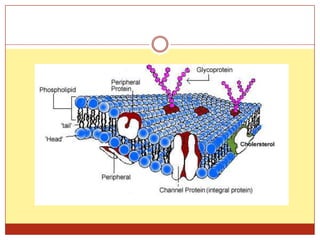
 The cell membrane is a biological
 membrane that separates the interior of all
 cells from the outside environment. The cell
 membrane is selectively permeable to ions
 and organic molecules and controls the
 movement of substances in and out of cells.
 It basically protects the cell from outside
 forces. It consists of the lipid bilayer with
 embedded proteins.
 Fungi, bacteria and plants also have the cell
 wall which provides a mechanical support for the
 cell and precludes the passage of larger molecules.
 The cell membrane also plays a role in anchoring
 the cytoskeleton to provide shape to the cell, and in
 attaching to the extracellular matrix and other cells
 to help group cells together to form tissues.
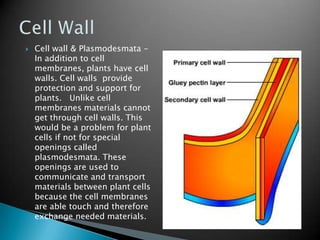
   Cell wall & Plasmodesmata -
    In addition to cell
    membranes, plants have cell
    walls. Cell walls provide
    protection and support for
    plants. Unlike cell
    membranes materials cannot
    get through cell walls. This
    would be a problem for plant
    cells if not for special
    openings called
    plasmodesmata. These
    openings are used to
    communicate and transport
    materials between plant cells
    because the cell membranes
    are able touch and therefore
    exchange needed materials.
   Organelles that help in the creation of
    proteins. Some ribosome's are found in the
    cytoplasm, but most are attached to the
    endoplasmic reticulum. While attached to the
    ER, ribosome's make proteins that the cell
    needs and also ones to be exported from the
    cell for work elsewhere in the body.
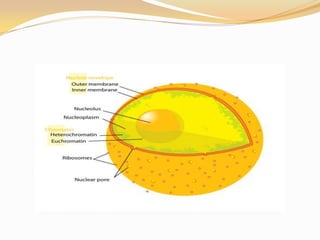
Nucleus
 In cell biology, the nucleus is a membrane-
  enclosed organelle found in eukaryotic cells. It
  contains most of the cell's genetic
  material, organized as multiple long linear DNA
 molecules in complex with a large variety
 of proteins, such as histones, to
 form chromosomes.
 The main function of the cell nucleus is to control gene
  expression and mediate the replication of DNA during
  the cell cycle. The nucleus provides a site for
  genetic transcription that is segregated from the location
  of translation in the cytoplasm, allowing levels of gene
  regulation that are not available to prokaryotes.
Vacuole
   A vacuole is a membrane-
    bound organelle which is present in
    all plant and fungal cells and
    some protist, animal and bacterial
    cells. Vacuoles are essentially
    enclosed compartments which are
    filled with water containing inorganic
    and organic molecules
    including enzymes in solution, though
    in certain cases they may contain
    solids which have been engulfed.
   Some Vacuole functions are as follows:

    1) Removing unwanted structural debris

    2) Isolating materials that might be harmful to the cell

    3) Containment of waste products

    4) Maintaining internal hydrostatic pressure or turgor
    within the cell

    5) Maintaining an acidic internal pH

    6) Containing small molecules

    7)Exporting unwanted substances from the cell.

    8)Enabling the cell to change shape.
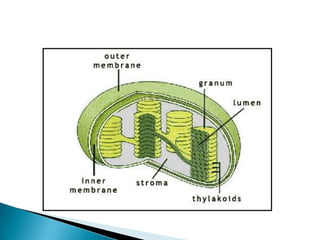
   The cell organelle in which photosynthesis
    takes place. In this organelle the light energy
    of the sun is converted into chemical
    energy. Chloroplasts are found only in plant
    cells not animal cells. The chemical energy
    that is produced by chloroplasts is finally
    used to make carbohydrates like starch, that
    get stored in the plant. Chloroplasts contain
    tiny pigments called chlorophylls .
    Chlorophylls are responsible for trapping the
    light energy from the sun.
   The cytoplasm is the gel-like substance
    residing between the cell membrane holding all
    the cell's internal sub-structures
    (organelles), except for the nucleus. All the
    contents of the cells of prokaryote organisms
    are contained within the cytoplasm. It is within
    the cytoplasm that most cellular activities
    occur, such as many metabolic
    pathways including glycolysis, and processes
    such as cell division.
              Cytoplasm
   The main function of the cytoplasm is to
    hold the cell organelles of the cell. Cell
    organelles are basically components of
    the cell which control all the activities of
    the cell.
    For example, mitochondria are cell
    organelles which control almost all of the
    cell's metabolic activities.
Endoplasmic reticulum
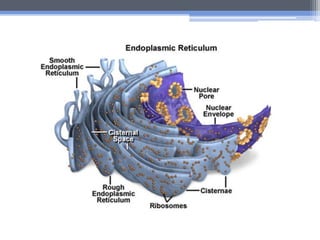
• Endoplasmic reticulum (ER) - when ribosomes
  are attached it is called rough ER and smooth
  ER when there are no ribosomes attached. The
  rough endoplasmic reticulum is where most
  protein are made in the cell. The function of the
  smooth endoplasmic reticulum is to help to get
  rid of harmful substances in the cell.
• The general structure of an endoplasmic
  reticulum is a membranous network
  of cisternae (sac-like structures) held together by
  the cytoskeleton. The endoplasmic reticulum
  serves many general functions, including the
  facilitation of protein folding and the transport
  of synthesized proteins in sacs called cisternae.
   The cytoplasm is the gel-like substance residing
    between the cell membrane holding all the cell's
    internal sub-structures (organelles), except for
    the nucleus. All the contents of the cells
    of prokaryote organisms are contained within the
    cytoplasm. It is within the cytoplasm that most
    cellular activities occur, such as many metabolic
    pathways including glycolysis, and processes such
    as cell division.
   The main function of the cytoplasm is to hold
    the cell organelles of the cell. Cell organelles
    are basically components of the cell which
    control all the activities of the cell.
    For example, mitochondria are cell organelles
    which control almost all of the cell's metabolic
    activities.
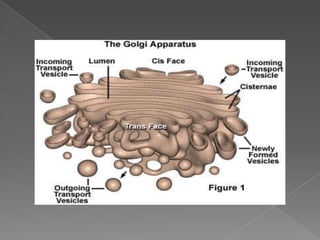
   The Golgi apparatus, is an organelle found in
    most eukaryotic cells. It was identified in 1898
    by the Italian physician Camillo Golgi and
    named after him. Part of the
    cellular endomembrane system, the Golgi
    apparatus packages proteins inside the cell
    before they are sent to their destination; it is
    particularly important in the processing of
    proteins for secretion. It synthesise a large
    number of different macromolecules.
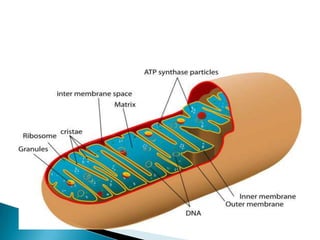
   In cell biology, a mitochondrion is a membrane-
    enclosed organelle found in
    most eukaryotic cells. These organelles range
    from 0.5 to 1.0 micrometre in diameter. The
    most prominent roles of mitochondria are to
    produce the energy currency of the cell
    ATP , through respiration, and to regulate
    cellular metabolism. The central set of reactions
    involved in ATP production are collectively known
    as the citric acid cycle, or the Krebs Cycle.
    However, the mitochondrion has many other
    functions in addition to the production of ATP.
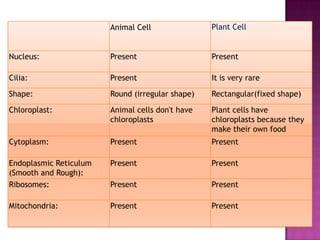
Animal Cell               Plant Cell


Nucleus:                Present                   Present

Cilia:                  Present                   It is very rare

Shape:                  Round (irregular shape)   Rectangular(fixed shape)

Chloroplast:            Animal cells don't have   Plant cells have
                        chloroplasts              chloroplasts because they
                                                  make their own food
Cytoplasm:              Present                   Present

Endoplasmic Reticulum   Present                   Present
(Smooth and Rough):
Ribosomes:              Present                   Present

Mitochondria:           Present                   Present
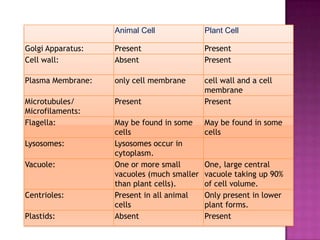
Animal Cell              Plant Cell

Golgi Apparatus:   Present                  Present
Cell wall:         Absent                   Present

Plasma Membrane:   only cell membrane       cell wall and a cell
                                            membrane
Microtubules/      Present                  Present
Microfilaments:
Flagella:          May be found in some     May be found in some
                   cells                    cells
Lysosomes:         Lysosomes occur in
                   cytoplasm.
Vacuole:           One or more small        One, large central
                   vacuoles (much smaller   vacuole taking up 90%
                   than plant cells).       of cell volume.
Centrioles:        Present in all animal    Only present in lower
                   cells                    plant forms.
Plastids:          Absent                   Present
THANK YOU

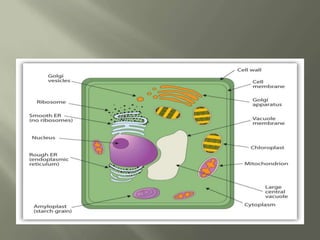
Plant cell

  • 1.
  • 3.
    Cell Membrane  Thecell membrane is a biological membrane that separates the interior of all cells from the outside environment. The cell membrane is selectively permeable to ions and organic molecules and controls the movement of substances in and out of cells. It basically protects the cell from outside forces. It consists of the lipid bilayer with embedded proteins.
  • 4.
     Fungi, bacteriaand plants also have the cell wall which provides a mechanical support for the cell and precludes the passage of larger molecules. The cell membrane also plays a role in anchoring the cytoskeleton to provide shape to the cell, and in attaching to the extracellular matrix and other cells to help group cells together to form tissues.
  • 6.
    Cell wall & Plasmodesmata - In addition to cell membranes, plants have cell walls. Cell walls provide protection and support for plants. Unlike cell membranes materials cannot get through cell walls. This would be a problem for plant cells if not for special openings called plasmodesmata. These openings are used to communicate and transport materials between plant cells because the cell membranes are able touch and therefore exchange needed materials.
  • 7.
    Organelles that help in the creation of proteins. Some ribosome's are found in the cytoplasm, but most are attached to the endoplasmic reticulum. While attached to the ER, ribosome's make proteins that the cell needs and also ones to be exported from the cell for work elsewhere in the body.
  • 8.
    Nucleus  In cellbiology, the nucleus is a membrane- enclosed organelle found in eukaryotic cells. It contains most of the cell's genetic material, organized as multiple long linear DNA molecules in complex with a large variety of proteins, such as histones, to form chromosomes.
  • 9.
     The mainfunction of the cell nucleus is to control gene expression and mediate the replication of DNA during the cell cycle. The nucleus provides a site for genetic transcription that is segregated from the location of translation in the cytoplasm, allowing levels of gene regulation that are not available to prokaryotes.
  • 11.
    Vacuole  A vacuole is a membrane- bound organelle which is present in all plant and fungal cells and some protist, animal and bacterial cells. Vacuoles are essentially enclosed compartments which are filled with water containing inorganic and organic molecules including enzymes in solution, though in certain cases they may contain solids which have been engulfed.
  • 12.
    Some Vacuole functions are as follows: 1) Removing unwanted structural debris 2) Isolating materials that might be harmful to the cell 3) Containment of waste products 4) Maintaining internal hydrostatic pressure or turgor within the cell 5) Maintaining an acidic internal pH 6) Containing small molecules 7)Exporting unwanted substances from the cell. 8)Enabling the cell to change shape.
  • 13.
    The cell organelle in which photosynthesis takes place. In this organelle the light energy of the sun is converted into chemical energy. Chloroplasts are found only in plant cells not animal cells. The chemical energy that is produced by chloroplasts is finally used to make carbohydrates like starch, that get stored in the plant. Chloroplasts contain tiny pigments called chlorophylls . Chlorophylls are responsible for trapping the light energy from the sun.
  • 15.
    The cytoplasm is the gel-like substance residing between the cell membrane holding all the cell's internal sub-structures (organelles), except for the nucleus. All the contents of the cells of prokaryote organisms are contained within the cytoplasm. It is within the cytoplasm that most cellular activities occur, such as many metabolic pathways including glycolysis, and processes such as cell division. Cytoplasm
  • 16.
    The main function of the cytoplasm is to hold the cell organelles of the cell. Cell organelles are basically components of the cell which control all the activities of the cell. For example, mitochondria are cell organelles which control almost all of the cell's metabolic activities.
  • 17.
    Endoplasmic reticulum • Endoplasmicreticulum (ER) - when ribosomes are attached it is called rough ER and smooth ER when there are no ribosomes attached. The rough endoplasmic reticulum is where most protein are made in the cell. The function of the smooth endoplasmic reticulum is to help to get rid of harmful substances in the cell.
  • 18.
    • The generalstructure of an endoplasmic reticulum is a membranous network of cisternae (sac-like structures) held together by the cytoskeleton. The endoplasmic reticulum serves many general functions, including the facilitation of protein folding and the transport of synthesized proteins in sacs called cisternae.
  • 20.
    The cytoplasm is the gel-like substance residing between the cell membrane holding all the cell's internal sub-structures (organelles), except for the nucleus. All the contents of the cells of prokaryote organisms are contained within the cytoplasm. It is within the cytoplasm that most cellular activities occur, such as many metabolic pathways including glycolysis, and processes such as cell division.
  • 21.
    The main function of the cytoplasm is to hold the cell organelles of the cell. Cell organelles are basically components of the cell which control all the activities of the cell. For example, mitochondria are cell organelles which control almost all of the cell's metabolic activities.
  • 22.
    The Golgi apparatus, is an organelle found in most eukaryotic cells. It was identified in 1898 by the Italian physician Camillo Golgi and named after him. Part of the cellular endomembrane system, the Golgi apparatus packages proteins inside the cell before they are sent to their destination; it is particularly important in the processing of proteins for secretion. It synthesise a large number of different macromolecules.
  • 24.
    In cell biology, a mitochondrion is a membrane- enclosed organelle found in most eukaryotic cells. These organelles range from 0.5 to 1.0 micrometre in diameter. The most prominent roles of mitochondria are to produce the energy currency of the cell ATP , through respiration, and to regulate cellular metabolism. The central set of reactions involved in ATP production are collectively known as the citric acid cycle, or the Krebs Cycle. However, the mitochondrion has many other functions in addition to the production of ATP.
  • 27.
    Animal Cell Plant Cell Nucleus: Present Present Cilia: Present It is very rare Shape: Round (irregular shape) Rectangular(fixed shape) Chloroplast: Animal cells don't have Plant cells have chloroplasts chloroplasts because they make their own food Cytoplasm: Present Present Endoplasmic Reticulum Present Present (Smooth and Rough): Ribosomes: Present Present Mitochondria: Present Present
  • 28.
    Animal Cell Plant Cell Golgi Apparatus: Present Present Cell wall: Absent Present Plasma Membrane: only cell membrane cell wall and a cell membrane Microtubules/ Present Present Microfilaments: Flagella: May be found in some May be found in some cells cells Lysosomes: Lysosomes occur in cytoplasm. Vacuole: One or more small One, large central vacuoles (much smaller vacuole taking up 90% than plant cells). of cell volume. Centrioles: Present in all animal Only present in lower cells plant forms. Plastids: Absent Present
  • 29.