Essentials of Human Anatomy & Physiology


  The Urinary System
      Anatomy & Physiology II


           Mr. Hildebrandt
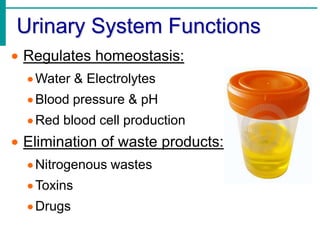
Urinary System Functions
Regulates homeostasis:
 Water & Electrolytes
 Blood pressure & pH
 Red blood cell production
Elimination of waste products:
 Nitrogenous wastes
 Toxins
 Drugs
Urinary system Organs


 Kidneys
 Ureters
 Urinary bladder
 Urethra
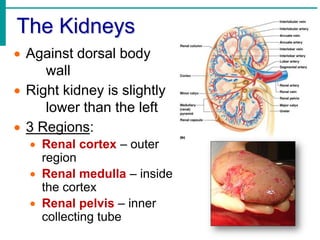
The Kidneys
Against dorsal body
   wall
Right kidney is slightly
   lower than the left
3 Regions:
  Renal cortex – outer
  region
  Renal medulla – inside
  the cortex
  Renal pelvis – inner
  collecting tube
Kidney Characteristics
Attached to ureters, renal
   blood vessels, and
   nerves at renal hilus
Atop each kidney is an
   adrenal gland
Renal capsule - Surrounds
  each kidney
Kidney stones – filtrate
   concentrates, crystallizes
   and forms stony masses
Ureters
Slender tubes attaching the
kidney to the bladder
 Continuous with the renal
 pelvis
 Enters posterior portion of the
 bladder
Runs behind the peritoneum
Peristalsis aids gravity in
urine transport
Urinary Bladder
 Smooth, collapsible, muscular sac
 Temporarily stores urine
Urethra
Thin-walled tube that carries
   urine from the bladder to
   the outside of the body by
   peristalsis
Release of urine is controlled
  by two sphincters
Both sphincter muscles must
  open to allow micturition
  (voiding)
Urethra Gender Differences
 Function:
  Females – only carries
   urine
  Males – carries urine &
   sperm cells
 Length:
   Females – 3–4 cm (1 inch)
   Males – 20 cm (8 inches)
Nephrons: filter “junk” out of blood
 Structural & functional units of kidneys
 Responsible for forming urine
 Nephron structures:
   Glomerulus
   Bowman’s capsule
   Proximal convoluted
   tubule
   Loop of Henle
   Distal convoluted tubule
   Collecting duct
Urine Formation Processes
Filtration - Water and
small solutes (filtrate) are
forced out of glomerulus &
into Bowman’s capsule
Reabsorption - Blood
capillaries reabsorb 99% of
water, glucose, amino acids,
& ions from renal tubule
Secretion - Hydrogen &
potassium move back into
renal tubules resulting in
urine
Formation of Urine
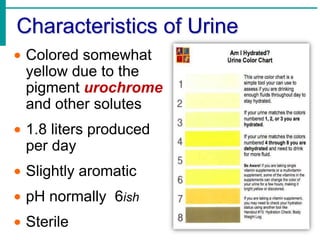
Characteristics of Urine
 Colored somewhat
 yellow due to the
 pigment urochrome
 and other solutes
 1.8 liters produced
 per day
 Slightly aromatic
 pH normally 6ish
 Sterile
Maintaining the Balance
 Water intake must equal water output
 Blood pH must remain between 7.35
 and 7.45 to maintain homeostasis
 Kidneys increase water volume &
 sodium in blood to control blood
 pressure
 Kidneys recognize hypoxia (low oxygen
 levels) & responds:
     Erythropoietin is released in blood
     Bone marrow produces more RBCs

Urinary System Notes

  • 1.
    Essentials of HumanAnatomy & Physiology The Urinary System Anatomy & Physiology II Mr. Hildebrandt
  • 2.
    Urinary System Functions Regulateshomeostasis: Water & Electrolytes Blood pressure & pH Red blood cell production Elimination of waste products: Nitrogenous wastes Toxins Drugs
  • 3.
    Urinary system Organs Kidneys Ureters Urinary bladder Urethra
  • 4.
    The Kidneys Against dorsalbody wall Right kidney is slightly lower than the left 3 Regions: Renal cortex – outer region Renal medulla – inside the cortex Renal pelvis – inner collecting tube
  • 5.
    Kidney Characteristics Attached toureters, renal blood vessels, and nerves at renal hilus Atop each kidney is an adrenal gland Renal capsule - Surrounds each kidney Kidney stones – filtrate concentrates, crystallizes and forms stony masses
  • 6.
    Ureters Slender tubes attachingthe kidney to the bladder Continuous with the renal pelvis Enters posterior portion of the bladder Runs behind the peritoneum Peristalsis aids gravity in urine transport
  • 7.
    Urinary Bladder Smooth,collapsible, muscular sac Temporarily stores urine
  • 8.
    Urethra Thin-walled tube thatcarries urine from the bladder to the outside of the body by peristalsis Release of urine is controlled by two sphincters Both sphincter muscles must open to allow micturition (voiding)
  • 9.
    Urethra Gender Differences Function: Females – only carries urine Males – carries urine & sperm cells Length: Females – 3–4 cm (1 inch) Males – 20 cm (8 inches)
  • 10.
    Nephrons: filter “junk”out of blood Structural & functional units of kidneys Responsible for forming urine Nephron structures: Glomerulus Bowman’s capsule Proximal convoluted tubule Loop of Henle Distal convoluted tubule Collecting duct
  • 11.
    Urine Formation Processes Filtration- Water and small solutes (filtrate) are forced out of glomerulus & into Bowman’s capsule Reabsorption - Blood capillaries reabsorb 99% of water, glucose, amino acids, & ions from renal tubule Secretion - Hydrogen & potassium move back into renal tubules resulting in urine
  • 12.
  • 13.
    Characteristics of Urine Colored somewhat yellow due to the pigment urochrome and other solutes 1.8 liters produced per day Slightly aromatic pH normally 6ish Sterile
  • 14.
    Maintaining the Balance Water intake must equal water output Blood pH must remain between 7.35 and 7.45 to maintain homeostasis Kidneys increase water volume & sodium in blood to control blood pressure Kidneys recognize hypoxia (low oxygen levels) & responds: Erythropoietin is released in blood Bone marrow produces more RBCs