Human Anatomy and Physiology
                     The Respiratory System
Basic functions of the respiratory system:

        Gas exchange –          supply oxygen to aerobic tissues in the
                                       body and remove carbon dioxide
as a                                   waste product.

                 -Pulmonary ventilation -     the physics of getting air
in- to and                                    out- of the lungs
(ventilation).
                 -External respiration - gas exchange between the lungs
                                         and blood (oxygen loading and
                                                CO2 unloading).
                 -Transport of respiratory gases -       movement of
blood (thus                                     gases) from the lungs to
the cell                                        and tissues.
                 -Internal respiration – gas exchange between the
capillaries                                     and the tissues (oxygen
Human Anatomy and Physiology
                        The Respiratory System
Functional anatomy of
the respiratory
system:
Conducting Zone
  Rigid conduits for air
  to reach site of gas
  exchange
        -nose
        -nasal cavity
        -pharynx
        -larynx
        -trachea
        -bronchi
-Respiratory Zone
   site of gas exchange
        -respiratory
bronchioles
Human Anatomy and Physiology
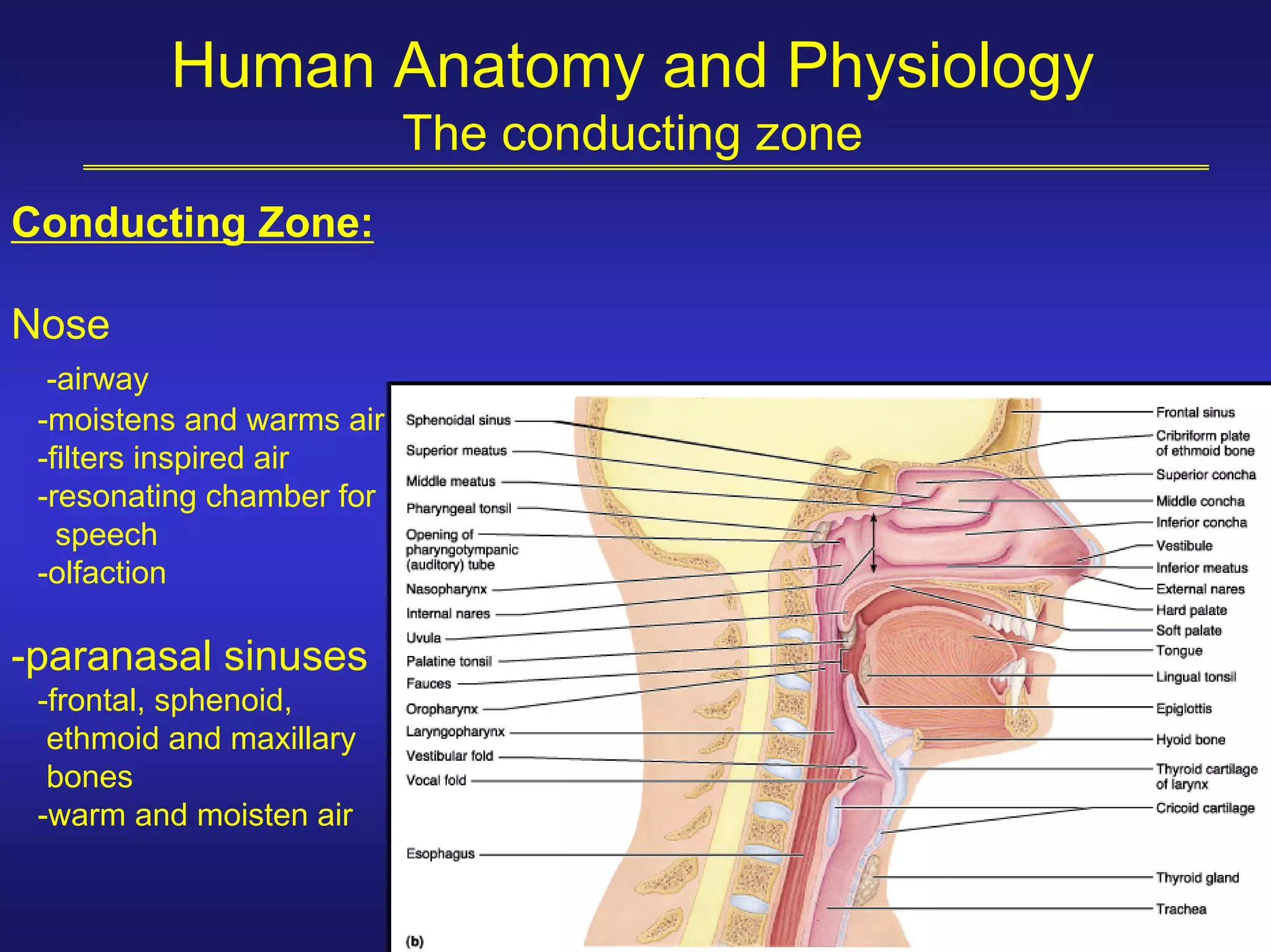
                           The conducting zone
Conducting Zone:

Nose
  -airway
 -moistens and warms air
 -filters inspired air
 -resonating chamber for
   speech
 -olfaction

-paranasal sinuses
 -frontal, sphenoid,
  ethmoid and maxillary
  bones
 -warm and moisten air
Human Anatomy and Physiology
                            The conducting zone
Conducting Zone:

Pharynx
 -connects the nasal
  cavity and mouth to the
  larynx and esophagus

 -common pathway for
  food and air (throat)

 -nasopharynx
 -oropharynx
 -laryngopharynx
Human Anatomy and Physiology
                   The conducting zone
Conducting Zone:

Laryngopharynx – common passage way for food and air
Larynx – voice box
Human Anatomy and Physiology
                               The conducting zone
Conducting Zone:

Trachea
  -windpipe
 -larynx at division forming
   two primary bronchi at
   midthorax

 -mucosa – pseudostratified
  epithelium (goblet cells)

 -submucosa – connective tissue
  seromucous glands – mucous

 -advantitia – CT hyaline cartilage
Human Anatomy and Physiology
                            The conducting zone
Conducting Zone:

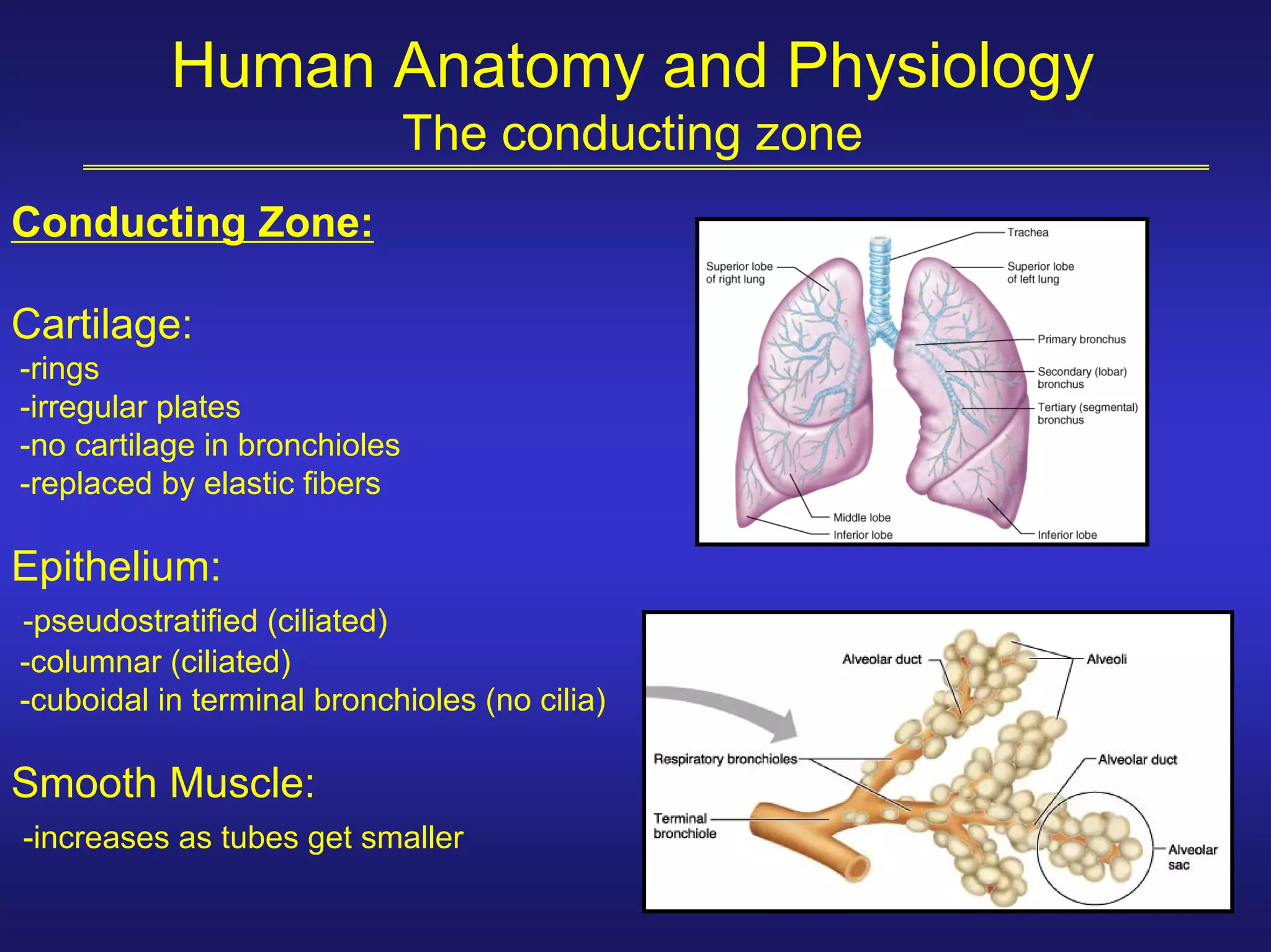
Bronchi
Bronchial tree
  -left and right primary bronchi
          -formed by divisions of the
            trachea
 -secondary bronchi (lobar)
          -inside the lungs
          -3 on the right
          -2 on the left
 -tertiary bronchi (segmental)
 -fourth-order
 -fifth-order
 -23 orders of branching air ways
 -bronchioles (under 1 mm in
  diameter
Human Anatomy and Physiology
                           The conducting zone
Conducting Zone:

Bronchioles
-bronchioles (under 1 mm in diameter)
-terminal bronchioiles (less than 0.5 mm)
Human Anatomy and Physiology
                               The conducting zone
Conducting Zone:

Cartilage:
-rings
-irregular plates
-no cartilage in bronchioles
-replaced by elastic fibers

Epithelium:
-pseudostratified (ciliated)
-columnar (ciliated)
-cuboidal in terminal bronchioles (no cilia)

Smooth Muscle:
-increases as tubes get smaller
Human Anatomy and Physiology
                       The respiratory zone
Respiratory Zone:
     Respiratory bronchioiles
     Alveoli (300 million)
     Alveolar ducts
     Alveolar sacs

Gas Exchange:
     respiratory membrane
Human Anatomy and Physiology
                            The respiratory zone
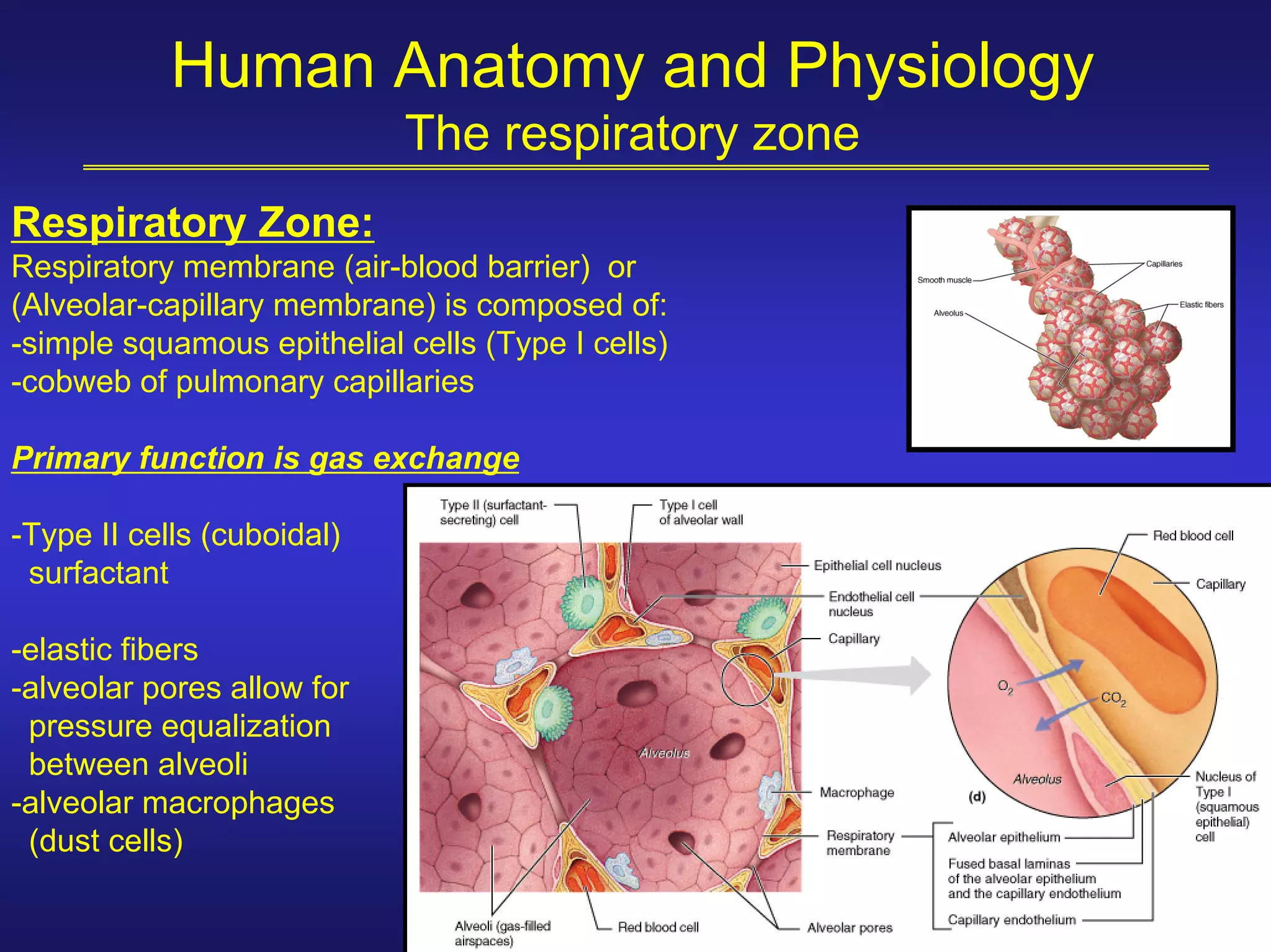
Respiratory Zone:
Respiratory membrane (air-blood barrier) or
(Alveolar-capillary membrane) is composed of:
-simple squamous epithelial cells (Type I cells)
-cobweb of pulmonary capillaries

Primary function is gas exchange

-Type II cells (cuboidal)
 surfactant

-elastic fibers
-alveolar pores allow for
 pressure equalization
 between alveoli
-alveolar macrophages
 (dust cells)
Human Anatomy and Physiology
                    Lungs and Pleural Coverings
Pleural Coverings:
-double layered serosa
-parietal pleura lines the thoracic wall
-pulmonary or visceral pleura which covers the
 lung surface
-pleural cavity is the space between
 the two layers
-pleural fluid fills the cavity
Human Anatomy and Physiology
          Blood Supply and Innervation of the Lungs
Blood supply:
-Pulmonary circulation
-Bronchial circulation

        Pulmonary arteries from the right side of the heart supply blood to the lungs.
               -pulmonary arteries branch profusely along with the bronchi
               -pulmonary capillary networks surrounding alveoli

                 -pulmonary veins form post alveoli to carry oxygenated blood back to
                  the heart

        Bronchial arteries come from the aorta and enter the lung at the hilus
                -the bronchial arteries run along the branching bronchi and supply
                  lung tissue except the alveoli
                -bronchial veins drain the bronchi but most moves into the pulmonary
                 circulation
Human Anatomy and Physiology
          Blood Supply and Innervation of the Lungs
Innervation:
-parasympathetic motor fibers (some sympathetic fibers)
-visceral sensory fibers

        Enter the lung through the pulmonary plexus on the lung root

                 parasympathetic fibers – constrict the air tubes
                 sympathetic fibers – dilate air tubes
Human Anatomy and Physiology
                         Respiratory Mechanics
Breathing:
Simply pressure changes driven by diaphragm and external intercostal muscle
contractions
Human Anatomy and Physiology
                    Respiratory Mechanics
Breathing:

             yellow is the increase in volume during inspiration
-

                                                         Volume during
                                                         Inspiration

                                Lungs                    Volume
                                                         At rest
Human Anatomy and Physiology
                     Respiratory Mechanics
Breathing:
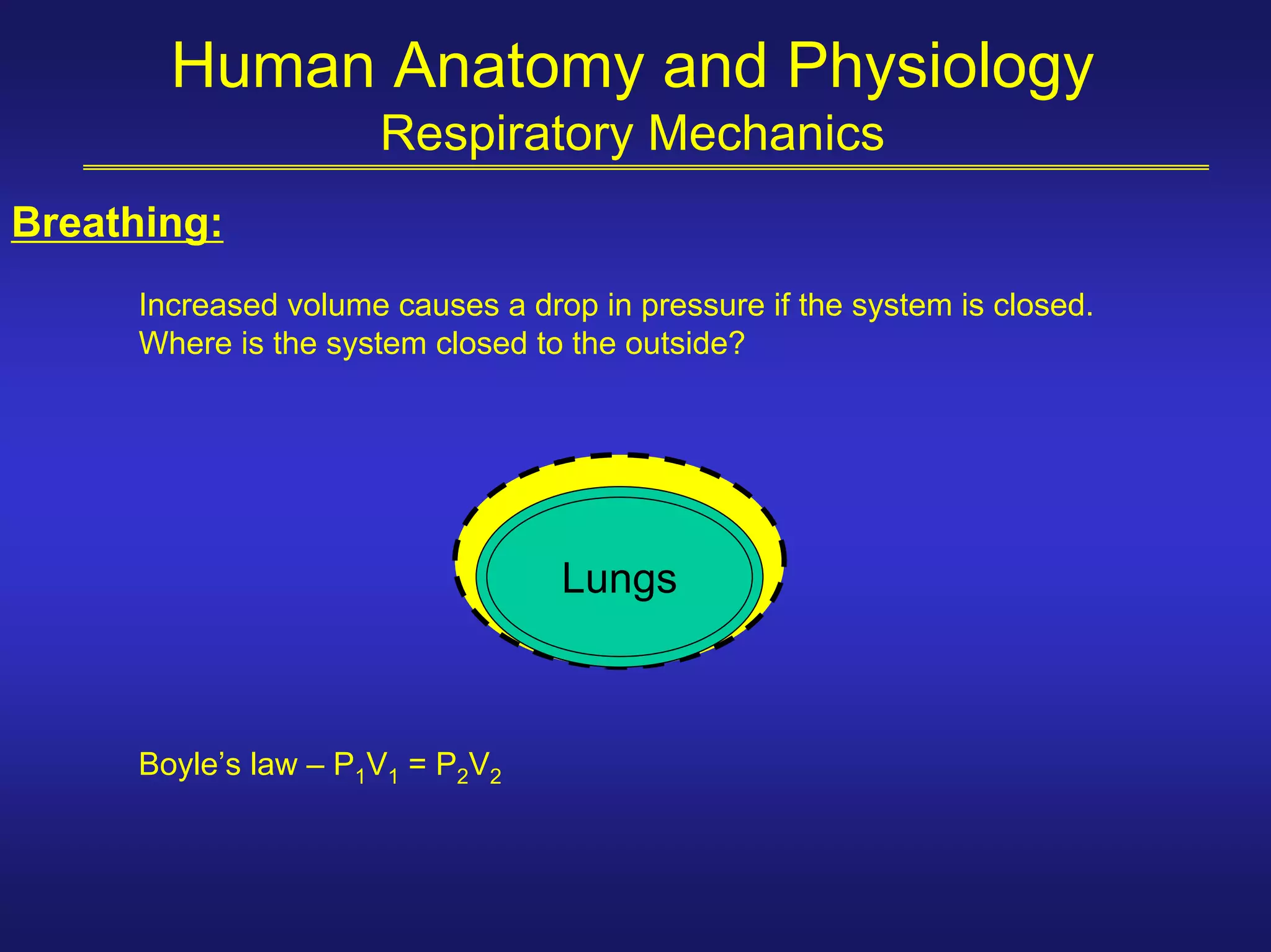
     Increased volume causes a drop in pressure if the system is closed.
     Where is the system closed to the outside?


                                  Lungs


     Boyle’s law – P1V1 = P2V2
Human Anatomy and Physiology
                      Respiratory Mechanics
Breathing:
     Increased volume causes a drop in pressure if the system is closed.
     Where is the system closed to the outside? The pleural cavity!


                                   Lungs

     The decrease in intrapleural cavity pressure is translated to the lungs via the
     inner visceral pleural membrane because it is attached to the outer surface of
     the lung
     Thus, an increase in volume causes a decrease in intrapleural pressure
     because it is a closed system.
Human Anatomy and Physiology
                      Respiratory Mechanics
Breathing:
     The lungs are an open system via the trachea and as such as intrapleural
     pressure drops lung volume increases and lung pressure also decreases.
     However, because the lungs are open to the outside, air rushes into the lungs
     to equalize the pressure. Thus, the drop in pulmonary pressure is transient.


                                  Lungs
                                                               trachea

     Pulmonary pressure returns to zero as air moves into the lungs to take up the
     volume change (drop in pressure).
Human Anatomy and Physiology
      Respiratory Mechanics
Human Anatomy and Physiology
                          Respiratory Mechanics
Breathing:

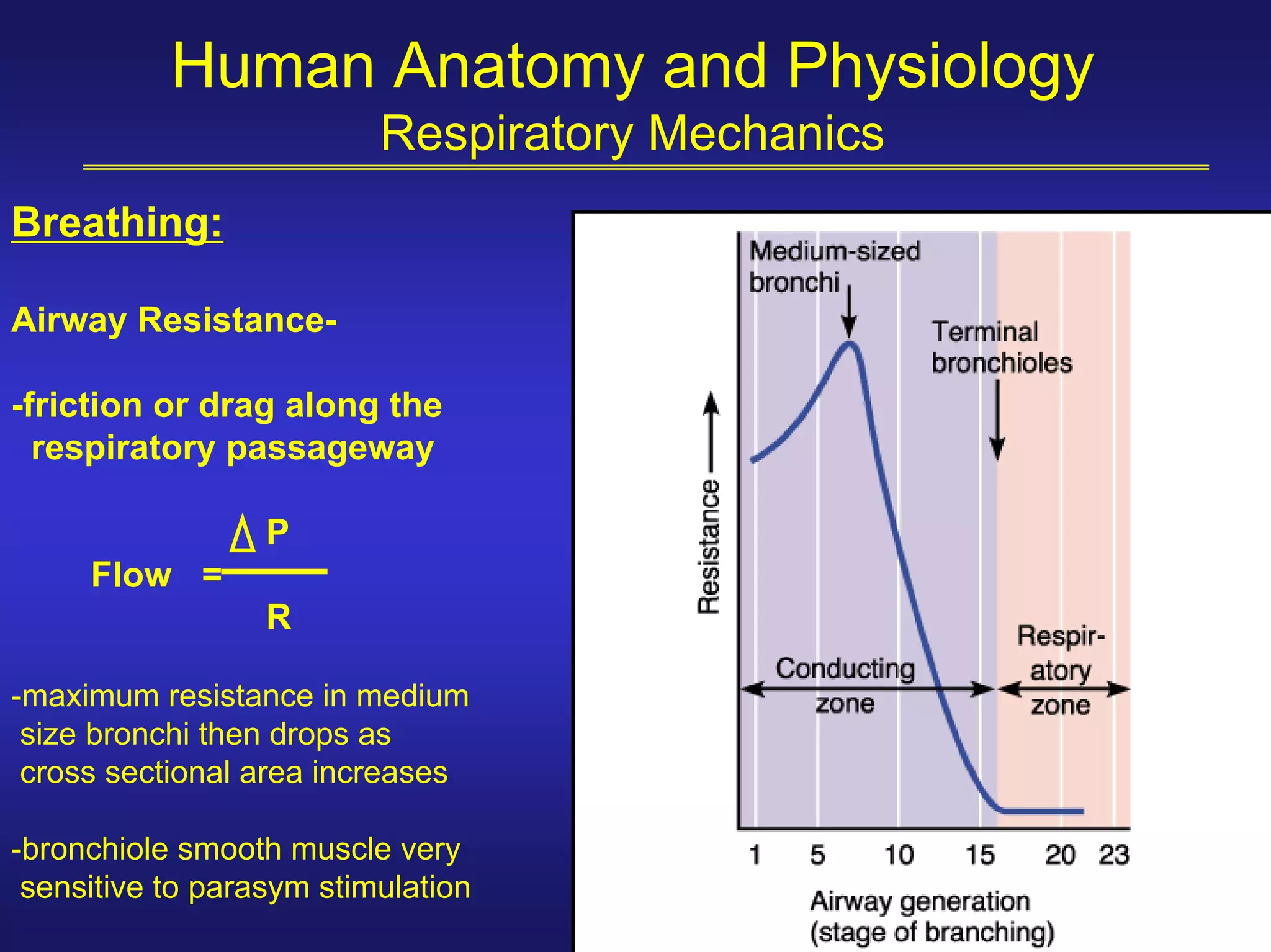
Airway Resistance-

-friction or drag along the
  respiratory passageway

                  P
     Flow =
                  R

-maximum resistance in medium
 size bronchi then drops as
 cross sectional area increases

-bronchiole smooth muscle very
 sensitive to parasym stimulation
Human Anatomy and Physiology
                      Respiratory Mechanics
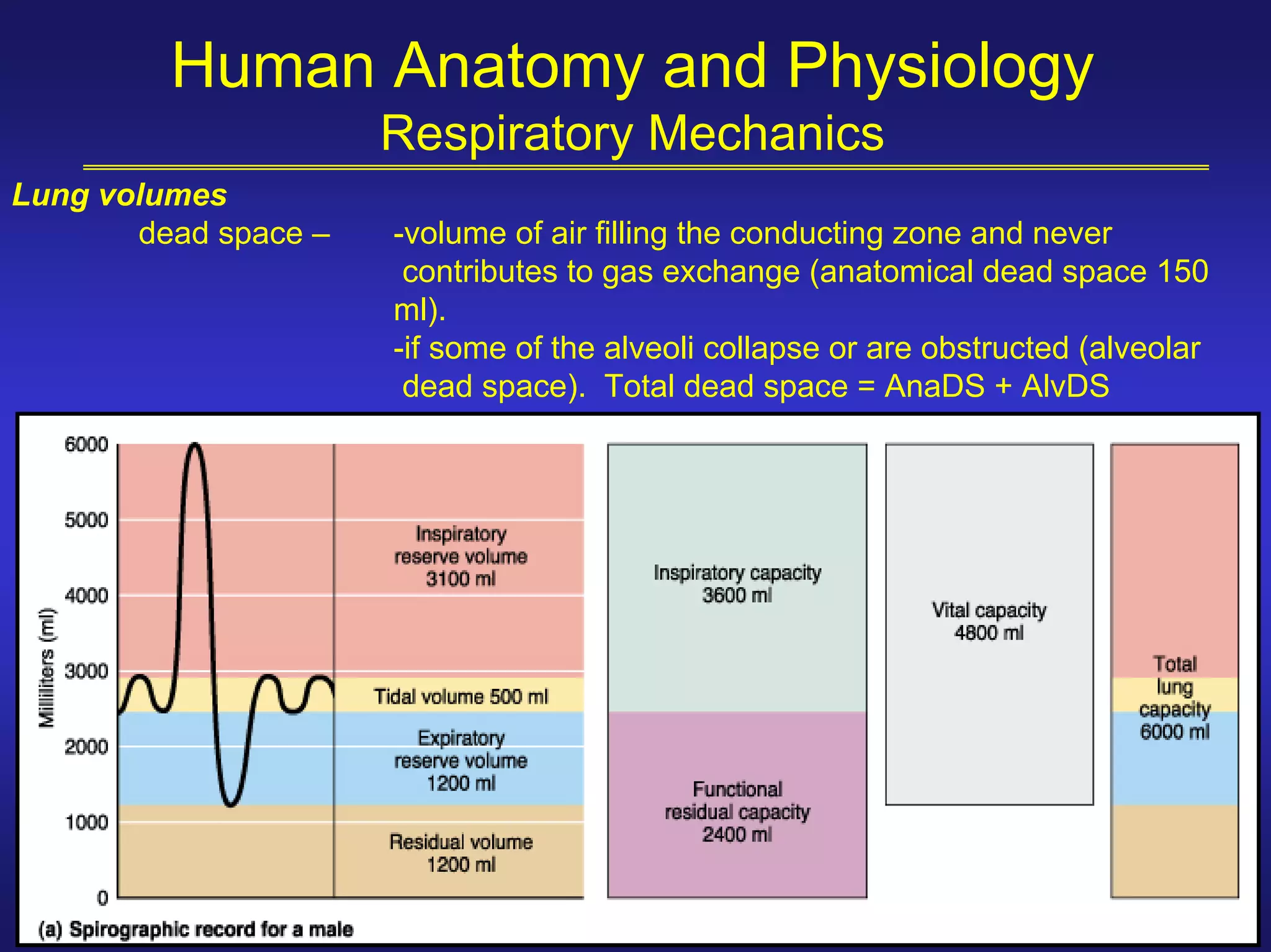
Lung volumes
       dead space –   -volume of air filling the conducting zone and never
                       contributes to gas exchange (anatomical dead space 150
                      ml).
                      -if some of the alveoli collapse or are obstructed (alveolar
                       dead space). Total dead space = AnaDS + AlvDS
Human Anatomy and Physiology
             Respiratory Mechanics
Breathing:
-
Human Anatomy and Physiology
                Gas Exchange
Gas exchange:
-
Human Anatomy&Physiology Respiratory S.

Human Anatomy&Physiology Respiratory S.

  • 1.
    Human Anatomy andPhysiology The Respiratory System Basic functions of the respiratory system: Gas exchange – supply oxygen to aerobic tissues in the body and remove carbon dioxide as a waste product. -Pulmonary ventilation - the physics of getting air in- to and out- of the lungs (ventilation). -External respiration - gas exchange between the lungs and blood (oxygen loading and CO2 unloading). -Transport of respiratory gases - movement of blood (thus gases) from the lungs to the cell and tissues. -Internal respiration – gas exchange between the capillaries and the tissues (oxygen
  • 2.
    Human Anatomy andPhysiology The Respiratory System Functional anatomy of the respiratory system: Conducting Zone Rigid conduits for air to reach site of gas exchange -nose -nasal cavity -pharynx -larynx -trachea -bronchi -Respiratory Zone site of gas exchange -respiratory bronchioles
  • 3.
    Human Anatomy andPhysiology The conducting zone Conducting Zone: Nose -airway -moistens and warms air -filters inspired air -resonating chamber for speech -olfaction -paranasal sinuses -frontal, sphenoid, ethmoid and maxillary bones -warm and moisten air
  • 4.
    Human Anatomy andPhysiology The conducting zone Conducting Zone: Pharynx -connects the nasal cavity and mouth to the larynx and esophagus -common pathway for food and air (throat) -nasopharynx -oropharynx -laryngopharynx
  • 5.
    Human Anatomy andPhysiology The conducting zone Conducting Zone: Laryngopharynx – common passage way for food and air Larynx – voice box
  • 6.
    Human Anatomy andPhysiology The conducting zone Conducting Zone: Trachea -windpipe -larynx at division forming two primary bronchi at midthorax -mucosa – pseudostratified epithelium (goblet cells) -submucosa – connective tissue seromucous glands – mucous -advantitia – CT hyaline cartilage
  • 7.
    Human Anatomy andPhysiology The conducting zone Conducting Zone: Bronchi Bronchial tree -left and right primary bronchi -formed by divisions of the trachea -secondary bronchi (lobar) -inside the lungs -3 on the right -2 on the left -tertiary bronchi (segmental) -fourth-order -fifth-order -23 orders of branching air ways -bronchioles (under 1 mm in diameter
  • 8.
    Human Anatomy andPhysiology The conducting zone Conducting Zone: Bronchioles -bronchioles (under 1 mm in diameter) -terminal bronchioiles (less than 0.5 mm)
  • 9.
    Human Anatomy andPhysiology The conducting zone Conducting Zone: Cartilage: -rings -irregular plates -no cartilage in bronchioles -replaced by elastic fibers Epithelium: -pseudostratified (ciliated) -columnar (ciliated) -cuboidal in terminal bronchioles (no cilia) Smooth Muscle: -increases as tubes get smaller
  • 10.
    Human Anatomy andPhysiology The respiratory zone Respiratory Zone: Respiratory bronchioiles Alveoli (300 million) Alveolar ducts Alveolar sacs Gas Exchange: respiratory membrane
  • 11.
    Human Anatomy andPhysiology The respiratory zone Respiratory Zone: Respiratory membrane (air-blood barrier) or (Alveolar-capillary membrane) is composed of: -simple squamous epithelial cells (Type I cells) -cobweb of pulmonary capillaries Primary function is gas exchange -Type II cells (cuboidal) surfactant -elastic fibers -alveolar pores allow for pressure equalization between alveoli -alveolar macrophages (dust cells)
  • 12.
    Human Anatomy andPhysiology Lungs and Pleural Coverings Pleural Coverings: -double layered serosa -parietal pleura lines the thoracic wall -pulmonary or visceral pleura which covers the lung surface -pleural cavity is the space between the two layers -pleural fluid fills the cavity
  • 13.
    Human Anatomy andPhysiology Blood Supply and Innervation of the Lungs Blood supply: -Pulmonary circulation -Bronchial circulation Pulmonary arteries from the right side of the heart supply blood to the lungs. -pulmonary arteries branch profusely along with the bronchi -pulmonary capillary networks surrounding alveoli -pulmonary veins form post alveoli to carry oxygenated blood back to the heart Bronchial arteries come from the aorta and enter the lung at the hilus -the bronchial arteries run along the branching bronchi and supply lung tissue except the alveoli -bronchial veins drain the bronchi but most moves into the pulmonary circulation
  • 14.
    Human Anatomy andPhysiology Blood Supply and Innervation of the Lungs Innervation: -parasympathetic motor fibers (some sympathetic fibers) -visceral sensory fibers Enter the lung through the pulmonary plexus on the lung root parasympathetic fibers – constrict the air tubes sympathetic fibers – dilate air tubes
  • 15.
    Human Anatomy andPhysiology Respiratory Mechanics Breathing: Simply pressure changes driven by diaphragm and external intercostal muscle contractions
  • 16.
    Human Anatomy andPhysiology Respiratory Mechanics Breathing: yellow is the increase in volume during inspiration - Volume during Inspiration Lungs Volume At rest
  • 17.
    Human Anatomy andPhysiology Respiratory Mechanics Breathing: Increased volume causes a drop in pressure if the system is closed. Where is the system closed to the outside? Lungs Boyle’s law – P1V1 = P2V2
  • 18.
    Human Anatomy andPhysiology Respiratory Mechanics Breathing: Increased volume causes a drop in pressure if the system is closed. Where is the system closed to the outside? The pleural cavity! Lungs The decrease in intrapleural cavity pressure is translated to the lungs via the inner visceral pleural membrane because it is attached to the outer surface of the lung Thus, an increase in volume causes a decrease in intrapleural pressure because it is a closed system.
  • 19.
    Human Anatomy andPhysiology Respiratory Mechanics Breathing: The lungs are an open system via the trachea and as such as intrapleural pressure drops lung volume increases and lung pressure also decreases. However, because the lungs are open to the outside, air rushes into the lungs to equalize the pressure. Thus, the drop in pulmonary pressure is transient. Lungs trachea Pulmonary pressure returns to zero as air moves into the lungs to take up the volume change (drop in pressure).
  • 20.
    Human Anatomy andPhysiology Respiratory Mechanics
  • 21.
    Human Anatomy andPhysiology Respiratory Mechanics Breathing: Airway Resistance- -friction or drag along the respiratory passageway P Flow = R -maximum resistance in medium size bronchi then drops as cross sectional area increases -bronchiole smooth muscle very sensitive to parasym stimulation
  • 22.
    Human Anatomy andPhysiology Respiratory Mechanics Lung volumes dead space – -volume of air filling the conducting zone and never contributes to gas exchange (anatomical dead space 150 ml). -if some of the alveoli collapse or are obstructed (alveolar dead space). Total dead space = AnaDS + AlvDS
  • 23.
    Human Anatomy andPhysiology Respiratory Mechanics Breathing: -
  • 24.
    Human Anatomy andPhysiology Gas Exchange Gas exchange: -