Miss. Sheetal Patil M. Pharm
Rani Chennamma College Of Pharmacy,
Belagavi
Cell Communication, Cell Junctions and Cell Signaling
Index
 Cell Communication
 Cell Junctions
 Cell Signaling
• Modes of cell-cell signaling
• Signaling molecules
 Intracellular signaling pathway activated by an extracellular signal molecule
Cellular Communication
 Cellular communication is the term to identify different types of
communication methods between living cells. This process allows millions of
cells to communicate and work together to perform important bodily
processes that are necessary for survival. Both multicellular and unicellular
organisms heavily rely on cell-cell communication.
 There are two kinds of communication in the living cells. Communication
between cells is called intercellular signaling, and communication within a
cell is called intracellular signaling.
 The originator of the communication generates a message called a signal.
The signal must be received by the target. The target cell then transduces the
signal into a response.
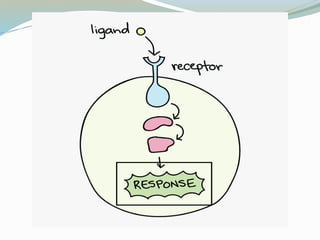
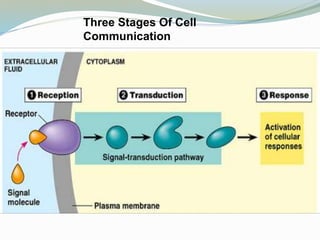
 There are three stages of cell communication
1. Reception
2. Transduction
3. Response
 Receptors And Ligands
 Receptors are protein molecules inside the target cell or on its surface that
receive a chemical signal.
 Chemical signals are released by signaling cells in the form of small, usually
volatile or soluble molecules called ligands.
 Signaling molecules are often called ligands, a general term for molecules
that bind specifically to the receptors.
 The signal carried by a ligand is often relayed through a chain of chemical
messengers inside the cell. Ultimately, it leads to a change in cell, such as
alteration in the activity of a gene or even the induction of a whole process,
such as cell division.
 There are two basic types of receptors:
1. Internal receptors
2. Cell surface receptors
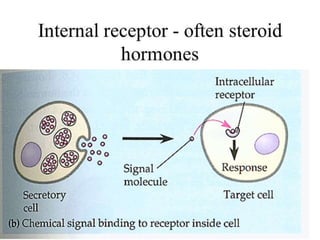
 Internal receptors are found in the cytoplasm of the cell and respond to
ligands that cross the cell membrane into the cell.
 Cell-surface receptors are found on the cell membrane. They bind to ligands
that do not cross the cell membrane. After the ligand binds, the receptor
responds in some way. One response is to open a channel to allow ions to
pass through the membrane. A second response is to activate an enzyme that
sets off a response inside the cell.
 There are several different types of ligands
 Small hydrophobic ligands can pass directly through the cell membrane.
They typically interact with internal receptors. Steroid hormones are an
example.
 Water soluble hydrophilic ligands can not pass directly through the cell
membrane. They typically interact with cell-surface receptors. Peptide
(protein) hormones are an example.
1. Reception
 Reception occurs when target cell detect a signal via binding of a signaling
molecule, or ligand to receptor.
 Receptor proteins present on cell’s plasma membrane they provide specific sites
for ligand to bind. These membrane receptors are able to transmit information
from outside the cell to the inside because they change conformation when a
specific ligand binds to the receptor.
 Ligand binding causes the receptor protein to undergo a change in shape.
 This may activate the receptor, this causes aggregation of receptor molecules,
leading to further molecular events inside the cell.
 There are three major types of receptors, G protein coupled receptors, receptor
tyrosine kinases and ion channel receptors.
2. Transduction
 After binding to the signaling molecule, receptor protein changes in some
way and starts the process of transduction. A specific cellular response is the
result of the newly converted signal.
 Transduction requires a series of changes in a sequence of different
molecules (called a signal transduction pathway) but sometimes can occur in
a single step.
 The molecules that compose these pathways are known as relay molecules.
The multistep process of the transduction stage is often composed of the
activation of proteins by addition or removal of phosphate groups or even the
release of other small molecules or ions that can act as messengers.
3. Response
 A specific cellular response is the result of the transduced signal in the final
stage of cell signaling. This response can essentially be any cellular activity
that is present in a body.
 It can spur the rearrangement of the cytoskeleton, or even as catalysis by an
enzyme.
 At the end, the end of a signal pathway leads to the regulation of a cellular
activity. This response can take place in the nucleus or in the cytoplasm of
the cell. A majority of signaling pathways control protein synthesis by
turning certain genes on and off in the nucleus.
Three Stages Of Cell
Communication
 Cell Junction
 Cell junctions are a class of cellular structures consisting of multi-protein
complexes that provide contact or adhesion between neighboring cells or
between a cell and the extracellular matrix.
 Combined with cell adhesion molecules and extracellular matrix, cell
junctions help hold cells together.
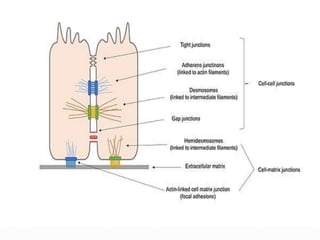
There are three types of cell junctions:
1. Adhesive (Anchoring) junctions
2. Tight Junctions
3. Gap Junactions
1. Anchoring junctions
 Cells adhere to the ECM, or to other cells, via complexes that can
collectively be called anchoring junctions. These multi-protein complexes are
found in all cell types where they stabilize the cells position, provide stability
and rigidity, and support tissue integrity by holding cell sheets together.
 Anchoring junctions also form a tight seal between neighboring cells to
restrict the flow of molecules between cells and from one side of the tissue to
the other.
 The two main kinds of adhesive cell-cell junctions are:
i. Adherens junctions
ii. Desmosomes
i. Adherens junctions
 Adherens junction is the cell to cell junction, which connects the actin filaments
of one cell to those of another cell. In some places like epithelial linings, this
junction forms a continuous adhesion (zonula adherens) just below the tight
junctions.
 In adherens junction, the membranes of the adjacent cells are held together by
some transmembrane proteins called cadherins.
 Adherens junction provides strong mechanical attachments of the adjacent cells.
Adherens junction is present in the intercalated disks between the branches
of cardiac muscles.
 During the contractions and relaxation of heart, the cardiac muscle fibers are
held together tightly by means of this junction.
ii. Desmosome
 Desmosome is a cell to cell junction, where the intermediate filaments
connect two adjacent cells. Desmosome is also called macula adherens.
 The membrane of two adjacent cells, which oppose each other, are thickened
and become spotlike patches.
 Desmosomes function like tight junctions. The trans-membrane proteins
involved in desmosome are mainly cadherins.
2. Tight Junctions
 Tight junctions are areas where the membranes of two adjacent cells join
together to form a barrier.
 The cell membranes are connected by strands of trans-membrane proteins
such as claudins and occludins.
 Tight junctions bind cells together, prevent molecules from passing in
between the cells, and also help to maintain the polarity of cells.
 Approximately 40 proteins identified to be involved in tight junctions. These
proteins can be classified into four major categories; scaffolding proteins,
signalling proteins, regulation proteins, and transmembrane proteins.
Functions of Tight Junctions:
 Tight Junctions helps the cells to form a barrier that prevents molecules from
getting through, and to stop proteins in the cell membrane from moving
around.
 Tight junctions are often found at epithelial cells, the cells that line the
surface of the body.
 Another function of tight junctions is simply to hold cells together.
3. Gap Junction
 Gap junctions are a type of cell junction in which adjacent cells are connected
through protein channels. These channels connect the cytoplasm of each cell and
allow molecules, ions, and electrical signals to pass between them.
 Gap junctions are found in between the vast majority of cells within the body
because they are found between all cells that are directly touching other cells.
 Gap junctions are made up of connexin proteins. Groups of six connexins form a
connexon, and two connexons are put together to form a channel that molecules
can pass through. Other channels in gap junctions are made up of pannexin
proteins.
Functions of Gap Junction
 The main function of gap junctions is to connect cells together so that
molecules may pass from one cell to other.
 This allows for cell-to-cell communication, so that molecules can directly
enter neighboring cells without having to go through the extracellular
fluid surrounding the cells.
 Cell Signaling
 Cell signaling is the process of cellular communication within the body. The
binding of extracellular signaling molecules to their receptors initiates a
series of intracellular reactions that regulate all aspect of cell behaviour,
including metabolism, movement, proliferation etc.
 Signaling molecule acts as ligands that binds to receptors by their target cells.
 Some signaling molecules carry signal over long distances, whether others
act locally to convey information between neighbouring cells.
 Some signaling molecules binds to receptors expresses on target cell surface,
and some signaling molecules are able to cross plasma membrane and bind to
intracellular receptors in the cytoplasm or nucleus.
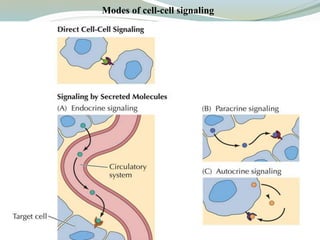
 Modes of cell-cell signaling
1. Direct cell-cell signaling
 Direct interaction of cell with its neighbor or from the action of signaling molecule.
 Signaling by direct cell-cell interaction plays role in regulating behavior of cell.
2. Signaling by secreted molecule
This type of signaling divided into three categories based on distance between
signaling and responder cell.
i. Endocrine signaling:
 Signaling molecule (hormone) secreted by endocrine cell and carried through
circulation to act on target cell at distant body site.
 E. g. hormones produced by endocrine glands including pituitary, pancreas,
adrenal, parathyroid glands etc.
ii. Paracrine signaling:
 Molecule released by one cell act on neighboring target cell.
 Signaling molecules act locally to affect the behavior of nearby cells.
 E.g. action of neurotransmitters in carrying signals between nerve cells at a
synapse.
iii. Autocrine signaling:
 Some cells respond to signaling molecules that they themselves produce.
 When interleukin-1 is produced in response to external stimuli, it can bind
to cell-surface receptors on the same cell that produced it.
iv. Synaptic signaling:
 Synaptic signaling is performed by neurons that transmit signals electrically
along their axons and release neurotransmitters at synapses.
 Synaptic signaling only occurs between cells with the synapse;
for example between a neuron and the muscle that is controlled by neural
activity.
Modes of cell-cell signaling
 Types of signaling molecules
1. Nitric oxide
 Nitric oxide is major paracrine signaling molecule in nervous, immune, and
circulatory systems.
 Involved in physiological and pathological process.
 Able to diffuse across plasma membrane.
 NO relaxes the blood vessels in the heart.
2. Carbon monoxide
 CO functions as signaling molecule in the nervous system.
 It can diffuse cellular membrane.
3. Neurotransmitter
 Signaling molecule of nervous system.
 The neurotransmitter carry signals between neurons or from neurons to other
types of target cells.
 Neurotransmitters are hydrophilic molecules, bind to cell surface receptors.
 E.g. dopamine, adrenaline, serotonin, histamine, glutamate, glycine and
(GABA).
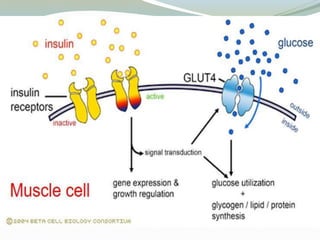
4. Peptide hormone
 These are water soluble molecule.
 They all bind to cell surface receptor.
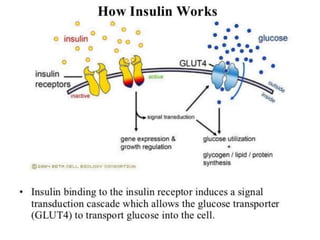
 Such as insulin, growth factor and glucagone, prolactin, follicle-stimulating
hormone.
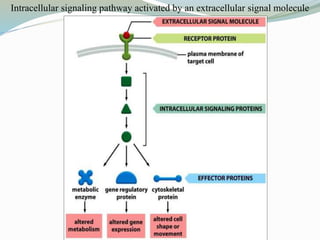
 Intracellular signaling pathway activated by an extracellular signal
molecule
1. The signal molecule usually binds to a receptor protein in the plasma
membrane of the target cell.
2. The receptor activates one or more intracellular signaling pathways,
involving a series of signaling proteins.
3. Finally, one or more of the intracellular signaling proteins alter the activity
of effector proteins and thereby the behaviour of the cell.
Intracellular signaling pathway activated by an extracellular signal molecule
Thank You

Cell Communication, Cell Junction and Cell Signaling.pptx

  • 1.
    Miss. Sheetal PatilM. Pharm Rani Chennamma College Of Pharmacy, Belagavi Cell Communication, Cell Junctions and Cell Signaling
  • 2.
    Index  Cell Communication Cell Junctions  Cell Signaling • Modes of cell-cell signaling • Signaling molecules  Intracellular signaling pathway activated by an extracellular signal molecule
  • 3.
    Cellular Communication  Cellularcommunication is the term to identify different types of communication methods between living cells. This process allows millions of cells to communicate and work together to perform important bodily processes that are necessary for survival. Both multicellular and unicellular organisms heavily rely on cell-cell communication.  There are two kinds of communication in the living cells. Communication between cells is called intercellular signaling, and communication within a cell is called intracellular signaling.  The originator of the communication generates a message called a signal. The signal must be received by the target. The target cell then transduces the signal into a response.
  • 4.
     There arethree stages of cell communication 1. Reception 2. Transduction 3. Response
  • 5.
     Receptors AndLigands  Receptors are protein molecules inside the target cell or on its surface that receive a chemical signal.  Chemical signals are released by signaling cells in the form of small, usually volatile or soluble molecules called ligands.  Signaling molecules are often called ligands, a general term for molecules that bind specifically to the receptors.  The signal carried by a ligand is often relayed through a chain of chemical messengers inside the cell. Ultimately, it leads to a change in cell, such as alteration in the activity of a gene or even the induction of a whole process, such as cell division.
  • 6.
     There aretwo basic types of receptors: 1. Internal receptors 2. Cell surface receptors  Internal receptors are found in the cytoplasm of the cell and respond to ligands that cross the cell membrane into the cell.  Cell-surface receptors are found on the cell membrane. They bind to ligands that do not cross the cell membrane. After the ligand binds, the receptor responds in some way. One response is to open a channel to allow ions to pass through the membrane. A second response is to activate an enzyme that sets off a response inside the cell.
  • 9.
     There areseveral different types of ligands  Small hydrophobic ligands can pass directly through the cell membrane. They typically interact with internal receptors. Steroid hormones are an example.  Water soluble hydrophilic ligands can not pass directly through the cell membrane. They typically interact with cell-surface receptors. Peptide (protein) hormones are an example.
  • 10.
    1. Reception  Receptionoccurs when target cell detect a signal via binding of a signaling molecule, or ligand to receptor.  Receptor proteins present on cell’s plasma membrane they provide specific sites for ligand to bind. These membrane receptors are able to transmit information from outside the cell to the inside because they change conformation when a specific ligand binds to the receptor.  Ligand binding causes the receptor protein to undergo a change in shape.  This may activate the receptor, this causes aggregation of receptor molecules, leading to further molecular events inside the cell.  There are three major types of receptors, G protein coupled receptors, receptor tyrosine kinases and ion channel receptors.
  • 11.
    2. Transduction  Afterbinding to the signaling molecule, receptor protein changes in some way and starts the process of transduction. A specific cellular response is the result of the newly converted signal.  Transduction requires a series of changes in a sequence of different molecules (called a signal transduction pathway) but sometimes can occur in a single step.  The molecules that compose these pathways are known as relay molecules. The multistep process of the transduction stage is often composed of the activation of proteins by addition or removal of phosphate groups or even the release of other small molecules or ions that can act as messengers.
  • 12.
    3. Response  Aspecific cellular response is the result of the transduced signal in the final stage of cell signaling. This response can essentially be any cellular activity that is present in a body.  It can spur the rearrangement of the cytoskeleton, or even as catalysis by an enzyme.  At the end, the end of a signal pathway leads to the regulation of a cellular activity. This response can take place in the nucleus or in the cytoplasm of the cell. A majority of signaling pathways control protein synthesis by turning certain genes on and off in the nucleus.
  • 13.
    Three Stages OfCell Communication
  • 15.
     Cell Junction Cell junctions are a class of cellular structures consisting of multi-protein complexes that provide contact or adhesion between neighboring cells or between a cell and the extracellular matrix.  Combined with cell adhesion molecules and extracellular matrix, cell junctions help hold cells together. There are three types of cell junctions: 1. Adhesive (Anchoring) junctions 2. Tight Junctions 3. Gap Junactions
  • 16.
    1. Anchoring junctions Cells adhere to the ECM, or to other cells, via complexes that can collectively be called anchoring junctions. These multi-protein complexes are found in all cell types where they stabilize the cells position, provide stability and rigidity, and support tissue integrity by holding cell sheets together.  Anchoring junctions also form a tight seal between neighboring cells to restrict the flow of molecules between cells and from one side of the tissue to the other.  The two main kinds of adhesive cell-cell junctions are: i. Adherens junctions ii. Desmosomes
  • 17.
    i. Adherens junctions Adherens junction is the cell to cell junction, which connects the actin filaments of one cell to those of another cell. In some places like epithelial linings, this junction forms a continuous adhesion (zonula adherens) just below the tight junctions.  In adherens junction, the membranes of the adjacent cells are held together by some transmembrane proteins called cadherins.  Adherens junction provides strong mechanical attachments of the adjacent cells. Adherens junction is present in the intercalated disks between the branches of cardiac muscles.  During the contractions and relaxation of heart, the cardiac muscle fibers are held together tightly by means of this junction.
  • 18.
    ii. Desmosome  Desmosomeis a cell to cell junction, where the intermediate filaments connect two adjacent cells. Desmosome is also called macula adherens.  The membrane of two adjacent cells, which oppose each other, are thickened and become spotlike patches.  Desmosomes function like tight junctions. The trans-membrane proteins involved in desmosome are mainly cadherins.
  • 19.
    2. Tight Junctions Tight junctions are areas where the membranes of two adjacent cells join together to form a barrier.  The cell membranes are connected by strands of trans-membrane proteins such as claudins and occludins.  Tight junctions bind cells together, prevent molecules from passing in between the cells, and also help to maintain the polarity of cells.  Approximately 40 proteins identified to be involved in tight junctions. These proteins can be classified into four major categories; scaffolding proteins, signalling proteins, regulation proteins, and transmembrane proteins.
  • 20.
    Functions of TightJunctions:  Tight Junctions helps the cells to form a barrier that prevents molecules from getting through, and to stop proteins in the cell membrane from moving around.  Tight junctions are often found at epithelial cells, the cells that line the surface of the body.  Another function of tight junctions is simply to hold cells together.
  • 21.
    3. Gap Junction Gap junctions are a type of cell junction in which adjacent cells are connected through protein channels. These channels connect the cytoplasm of each cell and allow molecules, ions, and electrical signals to pass between them.  Gap junctions are found in between the vast majority of cells within the body because they are found between all cells that are directly touching other cells.  Gap junctions are made up of connexin proteins. Groups of six connexins form a connexon, and two connexons are put together to form a channel that molecules can pass through. Other channels in gap junctions are made up of pannexin proteins.
  • 22.
    Functions of GapJunction  The main function of gap junctions is to connect cells together so that molecules may pass from one cell to other.  This allows for cell-to-cell communication, so that molecules can directly enter neighboring cells without having to go through the extracellular fluid surrounding the cells.
  • 24.
     Cell Signaling Cell signaling is the process of cellular communication within the body. The binding of extracellular signaling molecules to their receptors initiates a series of intracellular reactions that regulate all aspect of cell behaviour, including metabolism, movement, proliferation etc.  Signaling molecule acts as ligands that binds to receptors by their target cells.  Some signaling molecules carry signal over long distances, whether others act locally to convey information between neighbouring cells.  Some signaling molecules binds to receptors expresses on target cell surface, and some signaling molecules are able to cross plasma membrane and bind to intracellular receptors in the cytoplasm or nucleus.
  • 25.
     Modes ofcell-cell signaling 1. Direct cell-cell signaling  Direct interaction of cell with its neighbor or from the action of signaling molecule.  Signaling by direct cell-cell interaction plays role in regulating behavior of cell. 2. Signaling by secreted molecule This type of signaling divided into three categories based on distance between signaling and responder cell. i. Endocrine signaling:  Signaling molecule (hormone) secreted by endocrine cell and carried through circulation to act on target cell at distant body site.
  • 26.
     E. g.hormones produced by endocrine glands including pituitary, pancreas, adrenal, parathyroid glands etc. ii. Paracrine signaling:  Molecule released by one cell act on neighboring target cell.  Signaling molecules act locally to affect the behavior of nearby cells.  E.g. action of neurotransmitters in carrying signals between nerve cells at a synapse.
  • 27.
    iii. Autocrine signaling: Some cells respond to signaling molecules that they themselves produce.  When interleukin-1 is produced in response to external stimuli, it can bind to cell-surface receptors on the same cell that produced it. iv. Synaptic signaling:  Synaptic signaling is performed by neurons that transmit signals electrically along their axons and release neurotransmitters at synapses.  Synaptic signaling only occurs between cells with the synapse; for example between a neuron and the muscle that is controlled by neural activity.
  • 28.
  • 29.
     Types ofsignaling molecules 1. Nitric oxide  Nitric oxide is major paracrine signaling molecule in nervous, immune, and circulatory systems.  Involved in physiological and pathological process.  Able to diffuse across plasma membrane.  NO relaxes the blood vessels in the heart. 2. Carbon monoxide  CO functions as signaling molecule in the nervous system.  It can diffuse cellular membrane.
  • 30.
    3. Neurotransmitter  Signalingmolecule of nervous system.  The neurotransmitter carry signals between neurons or from neurons to other types of target cells.  Neurotransmitters are hydrophilic molecules, bind to cell surface receptors.  E.g. dopamine, adrenaline, serotonin, histamine, glutamate, glycine and (GABA). 4. Peptide hormone  These are water soluble molecule.  They all bind to cell surface receptor.  Such as insulin, growth factor and glucagone, prolactin, follicle-stimulating hormone.
  • 31.
     Intracellular signalingpathway activated by an extracellular signal molecule 1. The signal molecule usually binds to a receptor protein in the plasma membrane of the target cell. 2. The receptor activates one or more intracellular signaling pathways, involving a series of signaling proteins. 3. Finally, one or more of the intracellular signaling proteins alter the activity of effector proteins and thereby the behaviour of the cell.
  • 32.
    Intracellular signaling pathwayactivated by an extracellular signal molecule
  • 34.