By – Devendra Kumar Rawat
Assistant Professor
M.Pharm (Pharmacology)
B.M.S. College Of Pharmacy, Nasratpur, Tiloi, Distt.
Amethi
(Chapter – 1)
(Lecture – 2)
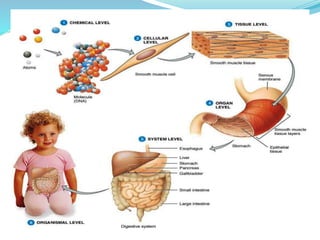
Levels of Structural Organization
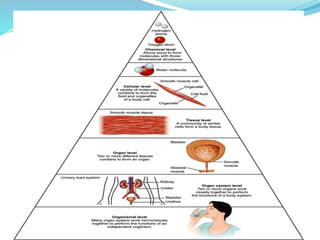
The human body contains multiple levels of structural
organization :
1. Chemical level
2. Cellular level
3. Tissue level
4. Organ level
5. Organ system level
6. Organism level
1. Chemical level
 The simplest level of structural organization of living
organisms is the chemical level.
 Atoms of various elements combine to form larger, more
complex structures termed Molecules.
 Organic molecules aggregate to form cellular organelles.
 Certain atoms such as Carbon, hydrogen, oxygen,
nitrogen, phosphorus, calcium, and sulfur, are essential for
maintaining life.
 Two familiar molecules found in our body are DNA and
Glucose.
2. Cellular level
 The cellular level is made up of the smallest unit of living
matter, i.e. cell.
 Molecules combine to form cells, the basic structural and
functional unit of an organism.
 Cells are building blocks of the human body.
3. Tissue level
 Cells of similar structure and function congregate to form
tissues.
 There are 4 principle types of tissues in the human
organism :
i. Epithelial tissue
ii. Connective tissue
iii. Muscular tissue
iv. Nervous tissue
4. Organ level
 Two or more types of tissues are combine within the same
structure to form an organ.
 Organs have specific functions and usually have
recognizable shapes.
 Examples of organs are the stomach, skin, bones, heart,
liver, lungs, and brain.
 Complex functions begin to emerge at this level.
 Most organs contain all 4 of the principle types of tissues.
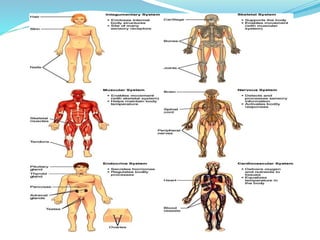
5. Organ system level
 Individual organs that function cooperatively to
accomplish a common purpose are grouped together into
organ system.
 An example of the system level is the Digestive system,
which breaks down and absorbs food.
 Digestive system includes many organs such as mouth,
salivary glands, pharynx, oesophagus, stomach, intestine,
liver, gallbladder, and pancreas.
 Other organ system of the body are integumantary system,
skeletal system, nervous system, muscular system,
endocrine system, respiratory system, lymphatic system,
urinary system and reproductive system.
6. Organism level
 An organism is any living individual, like microorganism
or human body. All the parts of the human body
functioning together constitute the whole organism.
 The organism level is the highest level of the organization.
It is the sum total of all structural levels working together.
 In short, it is the human being or organism as a whole.
 An organism is a living being that has a cellular structure
and that can independently perform all physiologic
functions necessary for life.
 In multi-cellular organisms, including humans, all cells,
tissues, organs, and organ systems of the body work
together to maintain the life and health of the organism.

Levels of structural organization

  • 1.
    By – DevendraKumar Rawat Assistant Professor M.Pharm (Pharmacology) B.M.S. College Of Pharmacy, Nasratpur, Tiloi, Distt. Amethi (Chapter – 1) (Lecture – 2)
  • 2.
    Levels of StructuralOrganization The human body contains multiple levels of structural organization : 1. Chemical level 2. Cellular level 3. Tissue level 4. Organ level 5. Organ system level 6. Organism level
  • 5.
    1. Chemical level The simplest level of structural organization of living organisms is the chemical level.  Atoms of various elements combine to form larger, more complex structures termed Molecules.  Organic molecules aggregate to form cellular organelles.  Certain atoms such as Carbon, hydrogen, oxygen, nitrogen, phosphorus, calcium, and sulfur, are essential for maintaining life.  Two familiar molecules found in our body are DNA and Glucose.
  • 6.
    2. Cellular level The cellular level is made up of the smallest unit of living matter, i.e. cell.  Molecules combine to form cells, the basic structural and functional unit of an organism.  Cells are building blocks of the human body.
  • 7.
    3. Tissue level Cells of similar structure and function congregate to form tissues.  There are 4 principle types of tissues in the human organism : i. Epithelial tissue ii. Connective tissue iii. Muscular tissue iv. Nervous tissue
  • 8.
    4. Organ level Two or more types of tissues are combine within the same structure to form an organ.  Organs have specific functions and usually have recognizable shapes.  Examples of organs are the stomach, skin, bones, heart, liver, lungs, and brain.  Complex functions begin to emerge at this level.  Most organs contain all 4 of the principle types of tissues.
  • 9.
    5. Organ systemlevel  Individual organs that function cooperatively to accomplish a common purpose are grouped together into organ system.  An example of the system level is the Digestive system, which breaks down and absorbs food.  Digestive system includes many organs such as mouth, salivary glands, pharynx, oesophagus, stomach, intestine, liver, gallbladder, and pancreas.  Other organ system of the body are integumantary system, skeletal system, nervous system, muscular system, endocrine system, respiratory system, lymphatic system, urinary system and reproductive system.
  • 11.
    6. Organism level An organism is any living individual, like microorganism or human body. All the parts of the human body functioning together constitute the whole organism.  The organism level is the highest level of the organization. It is the sum total of all structural levels working together.  In short, it is the human being or organism as a whole.  An organism is a living being that has a cellular structure and that can independently perform all physiologic functions necessary for life.  In multi-cellular organisms, including humans, all cells, tissues, organs, and organ systems of the body work together to maintain the life and health of the organism.