Tour of the Cell
1. Key Terms to know about he cell organelles

a. organism
b. cell theory
      c. micrograph
      d. organelle
      e. plasma membrane
      f. nucleus
      g. cytoplasm
      h. cell wall
      i. prokaryotic cell
      j. Eukaryotic cell
Cells - History of Discovery
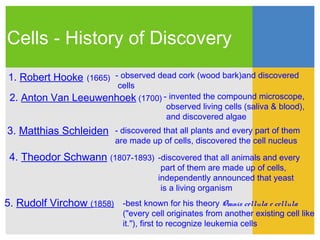
1. Robert Hooke    (1665) - observed dead cork (wood bark)and discovered
                           cells
 2. Anton Van   Leeuwenhoek (1700) - invented the compound microscope,
                                       observed living cells (saliva & blood),
                                       and discovered algae
3. Matthias Schleiden      - discovered that all plants and every part of them
                           are made up of cells, discovered the cell nucleus

 4. Theodor Schwann (1807-1893)        -discovered that all animals and every
                                        part of them are made up of cells,
                                       independently announced that yeast
                                        is a living organism
5. Rudolf Virchow (1858)     -best known for his theory Omnis cellula e cellula
                             ("every cell originates from another existing cell like
                             it."), first to recognize leukemia cells
Cell Theory
Schleiden, Schwann, and Virchow are credited
for the cell theory.


                    Cell Theory

 1.) that all living things are composed of cells
 2.) cells are the basic unit of structure
 3.) cells are the basic unit of function in living things
Microscopes
1.) Light- up to 1000x - living cells


2.) Electron - up to 1,000,000x - dead cells
    a.) SEM surface structure
    b.) TEM internal structure
Electron Microscope
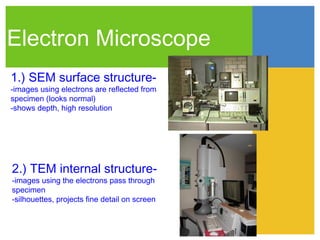
1.) SEM surface structure-
-images using electrons are reflected from
specimen (looks normal)
-shows depth, high resolution


2.) TEM internal structure-
-images using the electrons pass through
specimen
-silhouettes, projects fine detail on screen
Plant Cell
                           Cell Wall
                           Cell Membrane
      Golgi Vesicles
                          Golgi Aparatus
      Ribosomes
     Smooth ER            Cholorplast
(Endoplasmic reticulum)
         Nucleolus        Vacuole membrane
          Nucleus
       Rough ER
      (Ribosomes)         Raphide Crystal

        Large central     Druse Crystal
          vacuole
       Amyloplast         Mitochondria
      (starch grain)
                          Cytoplasm
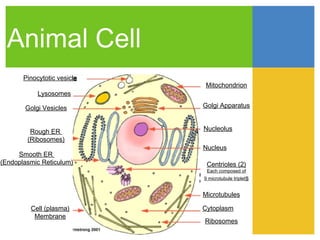
Animal Cell
       Pinocytotic vesicle
                             Mitochondrion
            Lysosomes

       Golgi Vesicles        Golgi Apparatus


         Rough ER            Nucleolus
        (Ribosomes)
                             Nucleus
     Smooth ER
(Endoplasmic Reticulum)       Centrioles (2)
                              Each composed of
                             9 microtubule triplets


                             Microtubules

         Cell (plasma)       Cytoplasm
          Membrane
                             Ribosomes
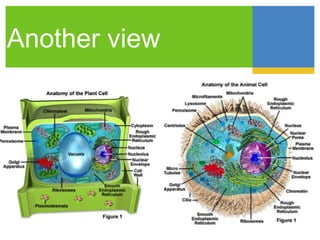
Another view
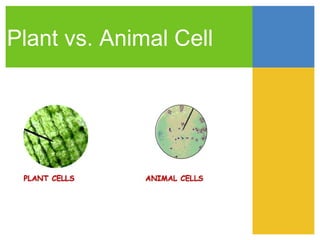
Plant vs. Animal Cell
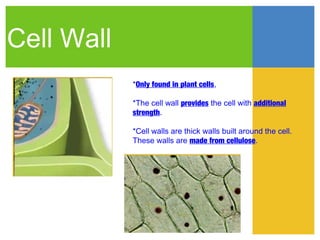
Cell Wall
            *Only found in plant cells,

            *The cell wall provides the cell with additional
            strength.

            *Cell walls are thick walls built around the cell.
            These walls are made from cellulose.
Cell Membrane

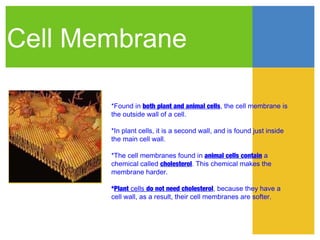
       *Found in both plant and animal cells, the cell membrane is
       the outside wall of a cell.

       *In plant cells, it is a second wall, and is found just inside
       the main cell wall.

       *The cell membranes found in animal cells contain a
       chemical called cholesterol. This chemical makes the
       membrane harder.

       *Plant cells do not need cholesterol, because they have a
       cell wall, as a result, their cell membranes are softer.
Cytoplasm

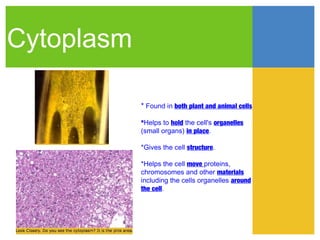
            * Found in both plant and animal cells

            *Helps to hold the cell's organelles
            (small organs) in place.

            *Gives the cell structure.

            *Helps the cell move proteins,
            chromosomes and other materials
            including the cells organelles around
            the cell.
Nucleus - Cell’s Brain
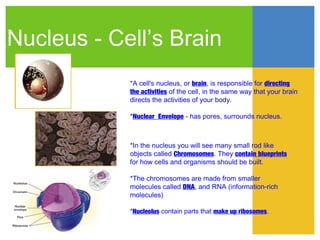
            *A cell's nucleus, or brain, is responsible for directing
            the activities of the cell, in the same way that your brain
            directs the activities of your body.

            *Nuclear Envelope - has pores, surrounds nucleus.


            *In the nucleus you will see many small rod like
            objects called Chromosomes. They contain blueprints
            for how cells and organisms should be built.

            *The chromosomes are made from smaller
            molecules called DNA, and RNA (information-rich
            molecules)

            *Nucleolus contain parts that make up ribosomes.
Endoplasmic Reticulum

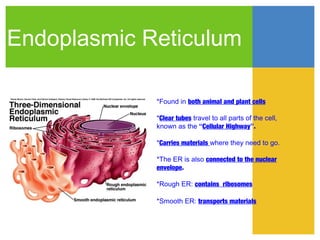
             *Found in both animal and plant cells

             *Clear tubes travel to all parts of the cell,
             known as the “Cellular Highway”.

             *Carries materials where they need to go.

             *The ER is also connected to the nuclear
             envelope.

             *Rough ER: contains ribosomes

             *Smooth ER: transports materials
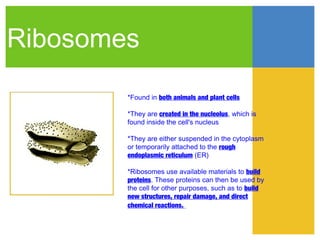
Ribosomes
        *Found in both animals and plant cells

        *They are created in the nucleolus, which is
        found inside the cell's nucleus

        *They are either suspended in the cytoplasm
        or temporarily attached to the rough
        endoplasmic reticulum (ER)

        *Ribosomes use available materials to build
        proteins. These proteins can then be used by
        the cell for other purposes, such as to build
        new structures, repair damage, and direct
        chemical reactions.
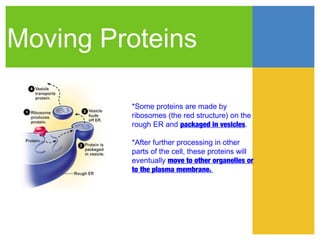
Moving Proteins

         *Some proteins are made by
         ribosomes (the red structure) on the
         rough ER and packaged in vesicles.

         *After further processing in other
         parts of the cell, these proteins will
         eventually move to other organelles or
         to the plasma membrane.
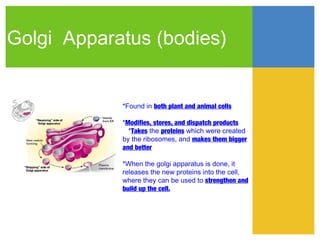
Golgi Apparatus (bodies)


            *Found in both plant and animal cells

            *Modifies, stores, and dispatch products
              *Takes the proteins which were created
            by the ribosomes, and makes them bigger
            and better

            *When the golgi apparatus is done, it
            releases the new proteins into the cell,
            where they can be used to strengthen and
            build up the cell.
Lysosome
      * Only found in animal cells

      *Lysosomes contain digestive
      enzymes that break down food for cell
      use.

      *They breakdown and digest older
      parts of a cell.
Membrane Pathways -how they work


                  *Products made in the ER move
                  through membrane pathways in a
                  cell.
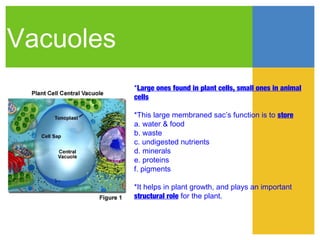
Vacuoles
           *Large ones found in plant cells, small ones in animal
           cells

           *This large membraned sac’s function is to store
           a. water & food
           b. waste
           c. undigested nutrients
           d. minerals
           e. proteins
           f. pigments

           *It helps in plant growth, and plays an important
           structural role for the plant.
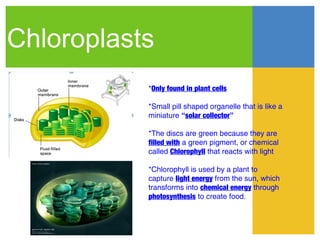
Chloroplasts
           *Only found in plant cells

           *Small pill shaped organelle that is like a
           miniature “solar collector”

           *The discs are green because they are
           filled with a green pigment, or chemical
           called Chlorophyll that reacts with light

           *Chlorophyll is used by a plant to
           capture light energy from the sun, which
           transforms into chemical energy through
           photosynthesis to create food.
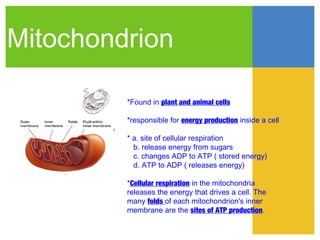
Mitochondrion

         *Found in plant and animal cells

         *responsible for energy production inside a cell

         * a. site of cellular respiration
           b. release energy from sugars
           c. changes ADP to ATP ( stored energy)
           d. ATP to ADP ( releases energy)

         *Cellular respiration in the mitochondria
         releases the energy that drives a cell. The
         many folds of each mitochondrion's inner
         membrane are the sites of ATP production.
Tour of the Cell
2. Key Terms to know about the Cell Membrane
  1. Terms:
              a.   phospholipid layers
              b.   diffusion
              c.   equilibrium
              d.   selectively permeable
  membrane
               e. passive transport
               f. facilitated diffusion
               g. osmosis
               h. hypertonic
               i. hypotonic
        j. isotonic
               k. active transport
               l. vesicle
               m. exocytosis
               n. endocytosis
        2. Structure of Cell Membrane
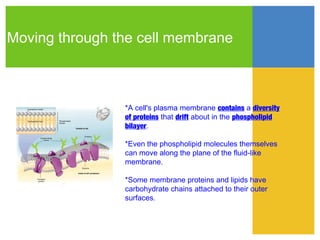
Moving through the cell membrane


                *A cell's plasma membrane contains a diversity
                of proteins that drift about in the phospholipid
                bilayer.

                *Even the phospholipid molecules themselves
                can move along the plane of the fluid-like
                membrane.

                *Some membrane proteins and lipids have
                carbohydrate chains attached to their outer
                surfaces.
Transport- Diffusion


 Dye molecules diffuse across a membrane. At equilibrium, the
 concentration of dye is the same throughout the container.
Passive Transport


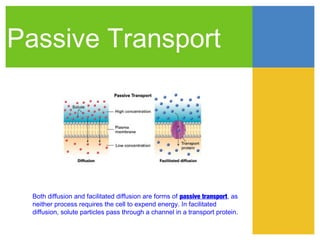
  Both diffusion and facilitated diffusion are forms of passive transport, as
  neither process requires the cell to expend energy. In facilitated
  diffusion, solute particles pass through a channel in a transport protein.
Osmosis
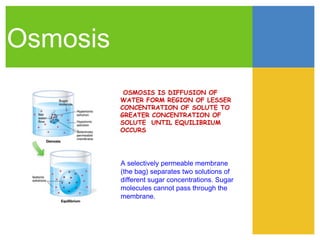
           OSMOSIS IS DIFFUSION OF
          WATER FORM REGION OF LESSER
          CONCENTRATION OF SOLUTE TO
          GREATER CONCENTRATION OF
          SOLUTE UNTIL EQUILIBRIUM
          OCCURS


          A selectively permeable membrane
          (the bag) separates two solutions of
          different sugar concentrations. Sugar
          molecules cannot pass through the
          membrane.
Active Transport


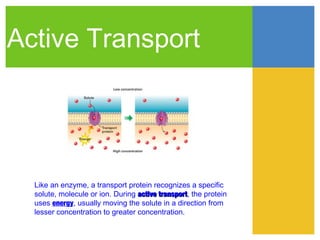
  Like an enzyme, a transport protein recognizes a specific
  solute, molecule or ion. During active transport, the protein
                                         transport
  uses energy, usually moving the solute in a direction from
  lesser concentration to greater concentration.
Transport of large molecule

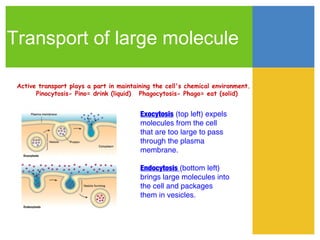
 Active transport plays a part in maintaining the cell's chemical environment.
       Pinocytosis- Pino= drink (liquid) Phagocytosis- Phago= eat (solid)


                                         Exocytosis (top left) expels
                                         molecules from the cell
                                         that are too large to pass
                                         through the plasma
                                         membrane.

                                         Endocytosis (bottom left)
                                         brings large molecules into
                                         the cell and packages
                                         them in vesicles.
The cell theory never states that cell must be small.
But, there are two reasons given for their size:
1. Efficiency- surface area is increased. Cells require
nutrients and oxygen to get rid of waste and must move
across the membrane to do so. If the cell were too big,
these nutrients and wastes would have to cover large
distances in order to get to the proper destination inside
the cell.
2. Specialization- having numerous small cells permits
specialization and different cells have different
functions.
Prokaryotic Cell
These are the simplest of all cells.
Most only have a cell wall and ribosomes.
1. DNA loop- naked in the cytoplasm, which
contains all genetic info(processes)
2. Ribosomes- freely floating in the
cytoplasm for protein synthesis(antibiotics,
like tetracycline, bind to ribosome and
interfere with protein synthesis)
3. Plasmids- contain small loop of
extrachromosomal DNA
Prokaryotic Cell
4. Cell Wall- gives shape and protection from
unfavorable outside environment for cell membrane

Two types of cell walls that classify bacteria:
Gram Positive- contain a thick peptidoglycan(protein-
carbohydrate mix) layer and no outer membrane layer
Gram Negative- have a multilayered and complex wall
made of an outer lipopolysaccharide and thin
peptidoglycan inner layer
Antibiotics like penicillin inhibit cell wall development, which prevents
reproduction of the prokaryotic cell.
Enzymes in tears, mucus, and saliva dissolve the cell wall, rupturing the cell and
killing the bacteria.
Prokaryotic Cell
5. Capsule- a jelly-like coating that surround the cell
wall; there are four functions of the capsule:
1. prevents from drying out
2. helps cells stick together on other surfaces
3. helps slide on surfaces
4. defense mechanism from being destroyed by host organisms’ cells

6. Flagella- can be one or many; provide locomotion by
spinning like a propeller; they are structurally different
from plant/animal flagella

7. Pili- short bristle-like appendages that have two
functions:
1. attach to surfaces
2. assist in the transfer of DNA from one to another
Prokaryotic Cell
Eubacteria Shapes:
1. Coccus- spherical shape allows for less
distortion in a dried out environment
2. Bacillus- rod shape has more surface area to
take up more nutrients from the environment
3. Spirillium- spiral shape
4. Spirochete- spiral shape with flagella
5. Vibrio- 1/2 spiral

Spiral shapes are very motile, they move using a
corkscrew type of movement.
Prokaryotic Cell

Movement is by way of something called
chemotaxis.

Chemotaxis is the movement of an organism
towards or away from a chemical. Chemicals
influence the organism to move toward them
are called attractants (positive chemotaxis) or
away from them are called repellents
(negative chemotaxis).
Prokaryotic Cell
Survival

When environmental conditions are unfavorable,
bacteria will become inactive.
Some species form endospores in which a thick
wall forms around the genetic material and the
rest of the cell disintegrates.
Endospores are dormant and do not reproduce
or show any signs of life, withstanding the
harshest of environmental conditions.
When conditions improve, endospores germinate
and form an active cell again.
Prokaryotic Cell
Reproduction
1. Asexual fission- single loop of DNA is copied and
the cell splits in half by pinching between the two DNA
loops.
2. Sexual conjugation- a bridge is formed between two
cells using pili. Requires the F plasmid (F for fertility)
and controls the formation of the F pilus. If the cell
contains this plasmid, it is an F+ cell and can give an
F- cell these genes, thus making it an F+ cell.
R plasmids contain the genes for making a cell
resistant to antibiotics and must integrate into main
DNA of cell to make it resistant.
Reproduction cont.
Transformation- living bacteria absorb the
genetic material of a dead or naked genetic
material in the environment

Transduction- transfer of DNA from a host to
another cell by means of a virus. Viruses
are non-living, pieces of DNA or RNA
enclosed by a protein coat that can infect
bacteria. Their DNA is small and contains
information for making proteins involved in
infection.
Metabolic Diversity
Heterotroph- dependent on outside sources of organic molecules
Photoheterotrophs- can use light to produce ATP but must obtain carbon
from another source
Chemoheterotrophs- most bacteria assume this metabolism, there are three
types:
Saprobes- decomposers that absorb the nutrients from dead or decaying
organic matter
Parasites- absorb nutrient from the body fluids of living hosts
Phagotrophs- ingest food and digest it enzymatically within cell or
multicellular bodies

Autotrophs- synthesize organic molecule from inorganic substances
Photosynthetic- harness light energy to drive organic compounds from CO2
and use an internal membrane system with light absorbing pigments
Chemosynthetic- use energy from specific inorganic substances to produce
organic substances from CO2
Chemoautotrophs- need only CO2 as their carbon source and obtain
energy from by oxidizing inorganic nutrients like H2S, NH4, Fe2O3; a unique
group for prokaryotes
O2 Requirements
Oxygen requirements also helps classify
prokaryotic organisms:
1. Obligate aerobes- must need and use
oxygen for cellular respiration- cannot be
without it
2. Facultative anaerobes- will use oxygen if
present, but can grow by fermentation
without oxygen
3. Obligate anaerobes- cannot use oxygen
and are killed by the presence of it
Archaebacteria
Primitive forms of modern day bacteria that
are thriving in different environment
conditions

1. Methanogens- use hydrogen to reduce CO2 into methane; are obligate
anaerobes that live in swamps, marshes and the guts of animals like
cows, sheep, and camels; are used as important decomposers in sewage
treatment plants
2. Extreme Halophiles- like high salinity (salt) environments; this can color
water pink because of their photosynthetic pigment bacteriorhodopsin
3. Thermoacidophiles- need an environment that is hot (140-180 degrees
fahrenheit) and acidic (pH of 2-4), they have no cell wall and can grow
aerobically or anaerobically; examples are hot springs, water heaters, and
coal piles

Cell tour

  • 1.
    Tour of theCell 1. Key Terms to know about he cell organelles a. organism b. cell theory c. micrograph d. organelle e. plasma membrane f. nucleus g. cytoplasm h. cell wall i. prokaryotic cell j. Eukaryotic cell
  • 2.
    Cells - Historyof Discovery 1. Robert Hooke (1665) - observed dead cork (wood bark)and discovered cells 2. Anton Van Leeuwenhoek (1700) - invented the compound microscope, observed living cells (saliva & blood), and discovered algae 3. Matthias Schleiden - discovered that all plants and every part of them are made up of cells, discovered the cell nucleus 4. Theodor Schwann (1807-1893) -discovered that all animals and every part of them are made up of cells, independently announced that yeast is a living organism 5. Rudolf Virchow (1858) -best known for his theory Omnis cellula e cellula ("every cell originates from another existing cell like it."), first to recognize leukemia cells
  • 3.
    Cell Theory Schleiden, Schwann,and Virchow are credited for the cell theory. Cell Theory 1.) that all living things are composed of cells 2.) cells are the basic unit of structure 3.) cells are the basic unit of function in living things
  • 4.
    Microscopes 1.) Light- upto 1000x - living cells 2.) Electron - up to 1,000,000x - dead cells a.) SEM surface structure b.) TEM internal structure
  • 5.
    Electron Microscope 1.) SEMsurface structure- -images using electrons are reflected from specimen (looks normal) -shows depth, high resolution 2.) TEM internal structure- -images using the electrons pass through specimen -silhouettes, projects fine detail on screen
  • 6.
    Plant Cell Cell Wall Cell Membrane Golgi Vesicles Golgi Aparatus Ribosomes Smooth ER Cholorplast (Endoplasmic reticulum) Nucleolus Vacuole membrane Nucleus Rough ER (Ribosomes) Raphide Crystal Large central Druse Crystal vacuole Amyloplast Mitochondria (starch grain) Cytoplasm
  • 7.
    Animal Cell Pinocytotic vesicle Mitochondrion Lysosomes Golgi Vesicles Golgi Apparatus Rough ER Nucleolus (Ribosomes) Nucleus Smooth ER (Endoplasmic Reticulum) Centrioles (2) Each composed of 9 microtubule triplets Microtubules Cell (plasma) Cytoplasm Membrane Ribosomes
  • 8.
  • 9.
  • 10.
    Cell Wall *Only found in plant cells, *The cell wall provides the cell with additional strength. *Cell walls are thick walls built around the cell. These walls are made from cellulose.
  • 11.
    Cell Membrane *Found in both plant and animal cells, the cell membrane is the outside wall of a cell. *In plant cells, it is a second wall, and is found just inside the main cell wall. *The cell membranes found in animal cells contain a chemical called cholesterol. This chemical makes the membrane harder. *Plant cells do not need cholesterol, because they have a cell wall, as a result, their cell membranes are softer.
  • 12.
    Cytoplasm * Found in both plant and animal cells *Helps to hold the cell's organelles (small organs) in place. *Gives the cell structure. *Helps the cell move proteins, chromosomes and other materials including the cells organelles around the cell.
  • 13.
    Nucleus - Cell’sBrain *A cell's nucleus, or brain, is responsible for directing the activities of the cell, in the same way that your brain directs the activities of your body. *Nuclear Envelope - has pores, surrounds nucleus. *In the nucleus you will see many small rod like objects called Chromosomes. They contain blueprints for how cells and organisms should be built. *The chromosomes are made from smaller molecules called DNA, and RNA (information-rich molecules) *Nucleolus contain parts that make up ribosomes.
  • 14.
    Endoplasmic Reticulum *Found in both animal and plant cells *Clear tubes travel to all parts of the cell, known as the “Cellular Highway”. *Carries materials where they need to go. *The ER is also connected to the nuclear envelope. *Rough ER: contains ribosomes *Smooth ER: transports materials
  • 15.
    Ribosomes *Found in both animals and plant cells *They are created in the nucleolus, which is found inside the cell's nucleus *They are either suspended in the cytoplasm or temporarily attached to the rough endoplasmic reticulum (ER) *Ribosomes use available materials to build proteins. These proteins can then be used by the cell for other purposes, such as to build new structures, repair damage, and direct chemical reactions.
  • 16.
    Moving Proteins *Some proteins are made by ribosomes (the red structure) on the rough ER and packaged in vesicles. *After further processing in other parts of the cell, these proteins will eventually move to other organelles or to the plasma membrane.
  • 17.
    Golgi Apparatus (bodies) *Found in both plant and animal cells *Modifies, stores, and dispatch products *Takes the proteins which were created by the ribosomes, and makes them bigger and better *When the golgi apparatus is done, it releases the new proteins into the cell, where they can be used to strengthen and build up the cell.
  • 18.
    Lysosome * Only found in animal cells *Lysosomes contain digestive enzymes that break down food for cell use. *They breakdown and digest older parts of a cell.
  • 19.
    Membrane Pathways -howthey work *Products made in the ER move through membrane pathways in a cell.
  • 20.
    Vacuoles *Large ones found in plant cells, small ones in animal cells *This large membraned sac’s function is to store a. water & food b. waste c. undigested nutrients d. minerals e. proteins f. pigments *It helps in plant growth, and plays an important structural role for the plant.
  • 21.
    Chloroplasts *Only found in plant cells *Small pill shaped organelle that is like a miniature “solar collector” *The discs are green because they are filled with a green pigment, or chemical called Chlorophyll that reacts with light *Chlorophyll is used by a plant to capture light energy from the sun, which transforms into chemical energy through photosynthesis to create food.
  • 22.
    Mitochondrion *Found in plant and animal cells *responsible for energy production inside a cell * a. site of cellular respiration b. release energy from sugars c. changes ADP to ATP ( stored energy) d. ATP to ADP ( releases energy) *Cellular respiration in the mitochondria releases the energy that drives a cell. The many folds of each mitochondrion's inner membrane are the sites of ATP production.
  • 23.
    Tour of theCell 2. Key Terms to know about the Cell Membrane 1. Terms: a. phospholipid layers b. diffusion c. equilibrium d. selectively permeable membrane e. passive transport f. facilitated diffusion g. osmosis h. hypertonic i. hypotonic j. isotonic k. active transport l. vesicle m. exocytosis n. endocytosis 2. Structure of Cell Membrane
  • 24.
    Moving through thecell membrane *A cell's plasma membrane contains a diversity of proteins that drift about in the phospholipid bilayer. *Even the phospholipid molecules themselves can move along the plane of the fluid-like membrane. *Some membrane proteins and lipids have carbohydrate chains attached to their outer surfaces.
  • 25.
    Transport- Diffusion Dyemolecules diffuse across a membrane. At equilibrium, the concentration of dye is the same throughout the container.
  • 26.
    Passive Transport Both diffusion and facilitated diffusion are forms of passive transport, as neither process requires the cell to expend energy. In facilitated diffusion, solute particles pass through a channel in a transport protein.
  • 27.
    Osmosis OSMOSIS IS DIFFUSION OF WATER FORM REGION OF LESSER CONCENTRATION OF SOLUTE TO GREATER CONCENTRATION OF SOLUTE UNTIL EQUILIBRIUM OCCURS A selectively permeable membrane (the bag) separates two solutions of different sugar concentrations. Sugar molecules cannot pass through the membrane.
  • 28.
    Active Transport Like an enzyme, a transport protein recognizes a specific solute, molecule or ion. During active transport, the protein transport uses energy, usually moving the solute in a direction from lesser concentration to greater concentration.
  • 29.
    Transport of largemolecule Active transport plays a part in maintaining the cell's chemical environment. Pinocytosis- Pino= drink (liquid) Phagocytosis- Phago= eat (solid) Exocytosis (top left) expels molecules from the cell that are too large to pass through the plasma membrane. Endocytosis (bottom left) brings large molecules into the cell and packages them in vesicles.
  • 30.
    The cell theorynever states that cell must be small. But, there are two reasons given for their size: 1. Efficiency- surface area is increased. Cells require nutrients and oxygen to get rid of waste and must move across the membrane to do so. If the cell were too big, these nutrients and wastes would have to cover large distances in order to get to the proper destination inside the cell. 2. Specialization- having numerous small cells permits specialization and different cells have different functions.
  • 31.
    Prokaryotic Cell These arethe simplest of all cells. Most only have a cell wall and ribosomes. 1. DNA loop- naked in the cytoplasm, which contains all genetic info(processes) 2. Ribosomes- freely floating in the cytoplasm for protein synthesis(antibiotics, like tetracycline, bind to ribosome and interfere with protein synthesis) 3. Plasmids- contain small loop of extrachromosomal DNA
  • 32.
    Prokaryotic Cell 4. CellWall- gives shape and protection from unfavorable outside environment for cell membrane Two types of cell walls that classify bacteria: Gram Positive- contain a thick peptidoglycan(protein- carbohydrate mix) layer and no outer membrane layer Gram Negative- have a multilayered and complex wall made of an outer lipopolysaccharide and thin peptidoglycan inner layer Antibiotics like penicillin inhibit cell wall development, which prevents reproduction of the prokaryotic cell. Enzymes in tears, mucus, and saliva dissolve the cell wall, rupturing the cell and killing the bacteria.
  • 33.
    Prokaryotic Cell 5. Capsule-a jelly-like coating that surround the cell wall; there are four functions of the capsule: 1. prevents from drying out 2. helps cells stick together on other surfaces 3. helps slide on surfaces 4. defense mechanism from being destroyed by host organisms’ cells 6. Flagella- can be one or many; provide locomotion by spinning like a propeller; they are structurally different from plant/animal flagella 7. Pili- short bristle-like appendages that have two functions: 1. attach to surfaces 2. assist in the transfer of DNA from one to another
  • 34.
    Prokaryotic Cell Eubacteria Shapes: 1.Coccus- spherical shape allows for less distortion in a dried out environment 2. Bacillus- rod shape has more surface area to take up more nutrients from the environment 3. Spirillium- spiral shape 4. Spirochete- spiral shape with flagella 5. Vibrio- 1/2 spiral Spiral shapes are very motile, they move using a corkscrew type of movement.
  • 35.
    Prokaryotic Cell Movement isby way of something called chemotaxis. Chemotaxis is the movement of an organism towards or away from a chemical. Chemicals influence the organism to move toward them are called attractants (positive chemotaxis) or away from them are called repellents (negative chemotaxis).
  • 36.
    Prokaryotic Cell Survival When environmentalconditions are unfavorable, bacteria will become inactive. Some species form endospores in which a thick wall forms around the genetic material and the rest of the cell disintegrates. Endospores are dormant and do not reproduce or show any signs of life, withstanding the harshest of environmental conditions. When conditions improve, endospores germinate and form an active cell again.
  • 37.
    Prokaryotic Cell Reproduction 1. Asexualfission- single loop of DNA is copied and the cell splits in half by pinching between the two DNA loops. 2. Sexual conjugation- a bridge is formed between two cells using pili. Requires the F plasmid (F for fertility) and controls the formation of the F pilus. If the cell contains this plasmid, it is an F+ cell and can give an F- cell these genes, thus making it an F+ cell. R plasmids contain the genes for making a cell resistant to antibiotics and must integrate into main DNA of cell to make it resistant.
  • 38.
    Reproduction cont. Transformation- livingbacteria absorb the genetic material of a dead or naked genetic material in the environment Transduction- transfer of DNA from a host to another cell by means of a virus. Viruses are non-living, pieces of DNA or RNA enclosed by a protein coat that can infect bacteria. Their DNA is small and contains information for making proteins involved in infection.
  • 39.
    Metabolic Diversity Heterotroph- dependenton outside sources of organic molecules Photoheterotrophs- can use light to produce ATP but must obtain carbon from another source Chemoheterotrophs- most bacteria assume this metabolism, there are three types: Saprobes- decomposers that absorb the nutrients from dead or decaying organic matter Parasites- absorb nutrient from the body fluids of living hosts Phagotrophs- ingest food and digest it enzymatically within cell or multicellular bodies Autotrophs- synthesize organic molecule from inorganic substances Photosynthetic- harness light energy to drive organic compounds from CO2 and use an internal membrane system with light absorbing pigments Chemosynthetic- use energy from specific inorganic substances to produce organic substances from CO2 Chemoautotrophs- need only CO2 as their carbon source and obtain energy from by oxidizing inorganic nutrients like H2S, NH4, Fe2O3; a unique group for prokaryotes
  • 40.
    O2 Requirements Oxygen requirementsalso helps classify prokaryotic organisms: 1. Obligate aerobes- must need and use oxygen for cellular respiration- cannot be without it 2. Facultative anaerobes- will use oxygen if present, but can grow by fermentation without oxygen 3. Obligate anaerobes- cannot use oxygen and are killed by the presence of it
  • 41.
    Archaebacteria Primitive forms ofmodern day bacteria that are thriving in different environment conditions 1. Methanogens- use hydrogen to reduce CO2 into methane; are obligate anaerobes that live in swamps, marshes and the guts of animals like cows, sheep, and camels; are used as important decomposers in sewage treatment plants 2. Extreme Halophiles- like high salinity (salt) environments; this can color water pink because of their photosynthetic pigment bacteriorhodopsin 3. Thermoacidophiles- need an environment that is hot (140-180 degrees fahrenheit) and acidic (pH of 2-4), they have no cell wall and can grow aerobically or anaerobically; examples are hot springs, water heaters, and coal piles