Essentials of Human Anatomy & Physiology


The Reproductive System
    Anatomy & Physiology


           Mr. Hildebrandt
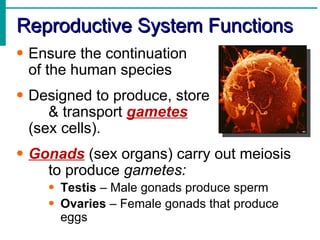
Reproductive System Functions
• Ensure the continuation
  of the human species
• Designed to produce, store
     & transport gametes
  (sex cells).
• Gonads (sex organs) carry out meiosis
    to produce gametes:
    • Testis – Male gonads produce sperm
    • Ovaries – Female gonads that produce
      eggs
Reproductive System Development
• Sexual Dimorphism (differentiation)
    begins soon after fertilization
• Dependant upon the development of
    endocrine & urinary systems
• Puberty marks reproductive maturity
• Gamete production slows when there
    is a reduction in sex hormones:
      • Males – Andropause
      • Females - Menopause
Male External Genitalia
• Scrotum: divided sac that maintains testes
 at 3°C lower than normal body temperature to
 protect sperm viability
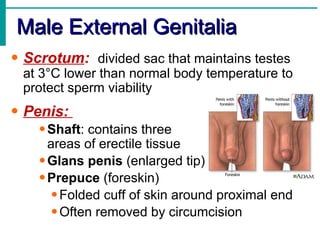
• Penis:
    • Shaft: contains three
      areas of erectile tissue
    • Glans penis (enlarged tip)
    • Prepuce (foreskin)
       • Folded cuff of skin around proximal end
       • Often removed by circumcision
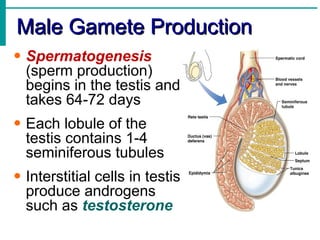
Male Gamete Production
• Spermatogenesis
  (sperm production)
  begins in the testis and
  takes 64-72 days
• Each lobule of the
  testis contains 1-4
  seminiferous tubules
• Interstitial cells in testis
  produce androgens
  such as testosterone
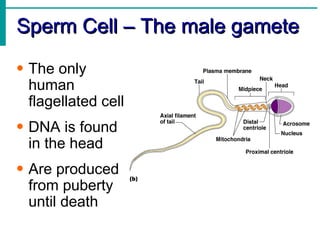
Sperm Cell – The male gamete
• The only
  human
  flagellated cell
• DNA is found
  in the head
• Are produced
  from puberty
  until death
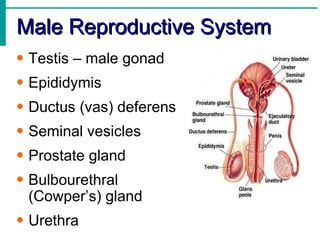
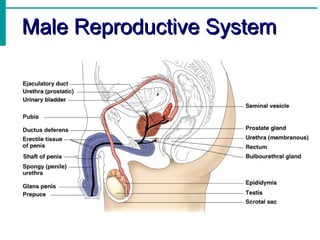
Male Reproductive System
• Testis – male gonad
• Epididymis
• Ductus (vas) deferens
• Seminal vesicles
• Prostate gland
• Bulbourethral
  (Cowper’s) gland
• Urethra
Semen – designed to survive the
 female reproductive tract
• Mixture of sperm and accessory gland
  secretions
• Advantages of additive secretions:
  • Fructose provides energy for sperm cells
  • Alkalinity of semen helps neutralize the
    acidic environment of vagina
  • Semen inhibits bacterial multiplication
  • Elements of semen enhance sperm motility
Male Reproductive System
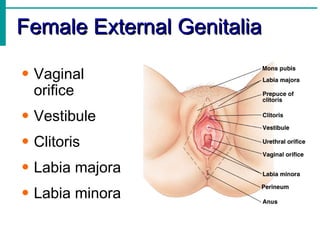
Female External Genitalia

• Vaginal
  orifice
• Vestibule
• Clitoris
• Labia majora
• Labia minora
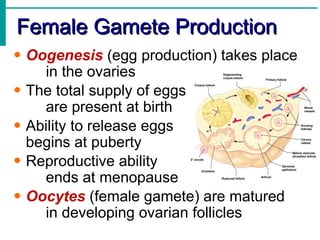
Female Gamete Production
• Oogenesis (egg production) takes place
    in the ovaries
• The total supply of eggs
    are present at birth
• Ability to release eggs
  begins at puberty
• Reproductive ability
    ends at menopause
• Oocytes (female gamete) are matured
    in developing ovarian follicles
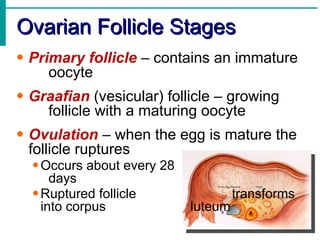
Ovarian Follicle Stages
• Primary follicle – contains an immature
     oocyte
• Graafian (vesicular) follicle – growing
      follicle with a maturing oocyte
• Ovulation – when the egg is mature the
  follicle ruptures
  • Occurs about every 28
      days
  • Ruptured follicle                transforms
    into corpus             luteum
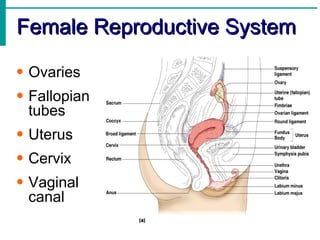
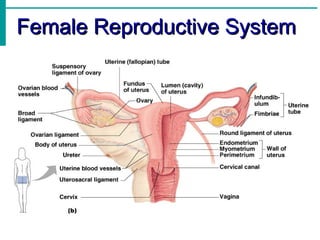
Female Reproductive System
• Ovaries
• Fallopian
  tubes
• Uterus
• Cervix
• Vaginal
  canal
Female Reproductive System
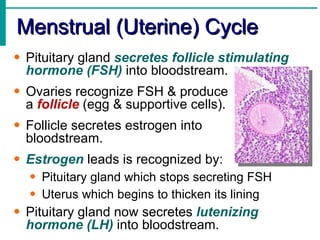
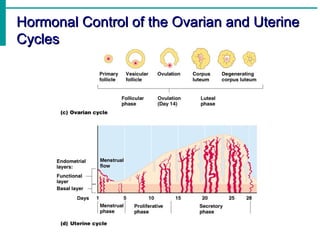
Menstrual (Uterine) Cycle
• Pituitary gland secretes follicle stimulating
  hormone (FSH) into bloodstream.
• Ovaries recognize FSH & produce
  a follicle (egg & supportive cells).
• Follicle secretes estrogen into
  bloodstream.
• Estrogen leads is recognized by:
  • Pituitary gland which stops secreting FSH
  • Uterus which begins to thicken its lining
• Pituitary gland now secretes lutenizing
  hormone (LH) into bloodstream.
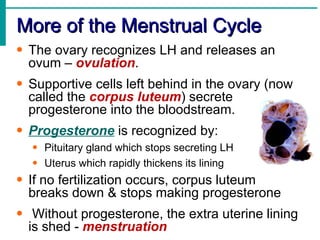
More of the Menstrual Cycle
• The ovary recognizes LH and releases an
  ovum – ovulation.
• Supportive cells left behind in the ovary (now
  called the corpus luteum) secrete
  progesterone into the bloodstream.
• Progesterone is recognized by:
  • Pituitary gland which stops secreting LH
  • Uterus which rapidly thickens its lining
• If no fertilization occurs, corpus luteum
  breaks down & stops making progesterone
• Without progesterone, the extra uterine lining
  is shed - menstruation
Hormonal Control of the Ovarian and Uterine
Cycles
Sexual Reproduction
• Requires sexual dimorphism
• A certain amount of arousal is necessary
• Copulation is the transfer of sperm to
  the female reproductive tract
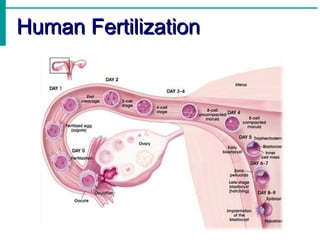
• Fertilization takes place in the female
  fallopian tubes
• Embryo implants in the female uterus
• Embryogenesis is comprised of the
  23 Carnegie stages of development
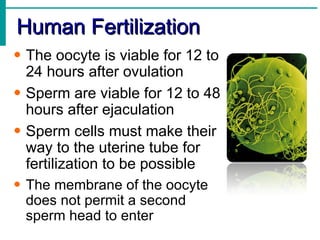
Human Fertilization
• The oocyte is viable for 12 to
  24 hours after ovulation
• Sperm are viable for 12 to 48
  hours after ejaculation
• Sperm cells must make their
  way to the uterine tube for
  fertilization to be possible
• The membrane of the oocyte
  does not permit a second
  sperm head to enter
Human Fertilization
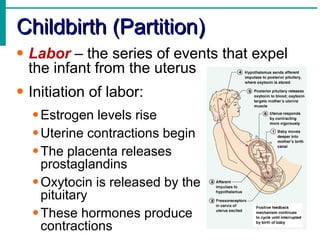
Childbirth (Partition)
• Labor – the series of events that expel
  the infant from the uterus
• Initiation of labor:
  • Estrogen levels rise
  • Uterine contractions begin
  • The placenta releases
    prostaglandins
  • Oxytocin is released by the
    pituitary
  • These hormones produce
    contractions
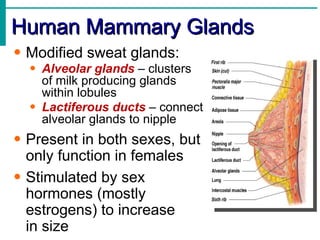
Human Mammary Glands
• Modified sweat glands:
  • Alveolar glands – clusters
    of milk producing glands
    within lobules
  • Lactiferous ducts – connect
    alveolar glands to nipple
• Present in both sexes, but
  only function in females
• Stimulated by sex
  hormones (mostly
  estrogens) to increase
  in size

Reproductive system Notes

  • 1.
    Essentials of HumanAnatomy & Physiology The Reproductive System Anatomy & Physiology Mr. Hildebrandt
  • 2.
    Reproductive System Functions •Ensure the continuation of the human species • Designed to produce, store & transport gametes (sex cells). • Gonads (sex organs) carry out meiosis to produce gametes: • Testis – Male gonads produce sperm • Ovaries – Female gonads that produce eggs
  • 3.
    Reproductive System Development •Sexual Dimorphism (differentiation) begins soon after fertilization • Dependant upon the development of endocrine & urinary systems • Puberty marks reproductive maturity • Gamete production slows when there is a reduction in sex hormones: • Males – Andropause • Females - Menopause
  • 4.
    Male External Genitalia •Scrotum: divided sac that maintains testes at 3°C lower than normal body temperature to protect sperm viability • Penis: • Shaft: contains three areas of erectile tissue • Glans penis (enlarged tip) • Prepuce (foreskin) • Folded cuff of skin around proximal end • Often removed by circumcision
  • 5.
    Male Gamete Production •Spermatogenesis (sperm production) begins in the testis and takes 64-72 days • Each lobule of the testis contains 1-4 seminiferous tubules • Interstitial cells in testis produce androgens such as testosterone
  • 6.
    Sperm Cell –The male gamete • The only human flagellated cell • DNA is found in the head • Are produced from puberty until death
  • 7.
    Male Reproductive System •Testis – male gonad • Epididymis • Ductus (vas) deferens • Seminal vesicles • Prostate gland • Bulbourethral (Cowper’s) gland • Urethra
  • 8.
    Semen – designedto survive the female reproductive tract • Mixture of sperm and accessory gland secretions • Advantages of additive secretions: • Fructose provides energy for sperm cells • Alkalinity of semen helps neutralize the acidic environment of vagina • Semen inhibits bacterial multiplication • Elements of semen enhance sperm motility
  • 9.
  • 10.
    Female External Genitalia •Vaginal orifice • Vestibule • Clitoris • Labia majora • Labia minora
  • 11.
    Female Gamete Production •Oogenesis (egg production) takes place in the ovaries • The total supply of eggs are present at birth • Ability to release eggs begins at puberty • Reproductive ability ends at menopause • Oocytes (female gamete) are matured in developing ovarian follicles
  • 12.
    Ovarian Follicle Stages •Primary follicle – contains an immature oocyte • Graafian (vesicular) follicle – growing follicle with a maturing oocyte • Ovulation – when the egg is mature the follicle ruptures • Occurs about every 28 days • Ruptured follicle transforms into corpus luteum
  • 13.
    Female Reproductive System •Ovaries • Fallopian tubes • Uterus • Cervix • Vaginal canal
  • 14.
  • 15.
    Menstrual (Uterine) Cycle •Pituitary gland secretes follicle stimulating hormone (FSH) into bloodstream. • Ovaries recognize FSH & produce a follicle (egg & supportive cells). • Follicle secretes estrogen into bloodstream. • Estrogen leads is recognized by: • Pituitary gland which stops secreting FSH • Uterus which begins to thicken its lining • Pituitary gland now secretes lutenizing hormone (LH) into bloodstream.
  • 16.
    More of theMenstrual Cycle • The ovary recognizes LH and releases an ovum – ovulation. • Supportive cells left behind in the ovary (now called the corpus luteum) secrete progesterone into the bloodstream. • Progesterone is recognized by: • Pituitary gland which stops secreting LH • Uterus which rapidly thickens its lining • If no fertilization occurs, corpus luteum breaks down & stops making progesterone • Without progesterone, the extra uterine lining is shed - menstruation
  • 17.
    Hormonal Control ofthe Ovarian and Uterine Cycles
  • 18.
    Sexual Reproduction • Requiressexual dimorphism • A certain amount of arousal is necessary • Copulation is the transfer of sperm to the female reproductive tract • Fertilization takes place in the female fallopian tubes • Embryo implants in the female uterus • Embryogenesis is comprised of the 23 Carnegie stages of development
  • 19.
    Human Fertilization • Theoocyte is viable for 12 to 24 hours after ovulation • Sperm are viable for 12 to 48 hours after ejaculation • Sperm cells must make their way to the uterine tube for fertilization to be possible • The membrane of the oocyte does not permit a second sperm head to enter
  • 20.
  • 21.
    Childbirth (Partition) • Labor– the series of events that expel the infant from the uterus • Initiation of labor: • Estrogen levels rise • Uterine contractions begin • The placenta releases prostaglandins • Oxytocin is released by the pituitary • These hormones produce contractions
  • 22.
    Human Mammary Glands •Modified sweat glands: • Alveolar glands – clusters of milk producing glands within lobules • Lactiferous ducts – connect alveolar glands to nipple • Present in both sexes, but only function in females • Stimulated by sex hormones (mostly estrogens) to increase in size