A need for strength makes the bones rigid, but if the
skeleton consisted of only one solid bone, movement
would be impossible. Nature has solved this problem
by dividing the skeleton into many bones and
creating joints where the bones intersect. Joints, also
known as articulations, are strong connections that
join the bones, teeth, and cartilage of the body to
one another. Each joint is specialized in its shape and
structural components to control the range of motion
between the parts that it connects....
A R T H R O L O G Y
Science concerned with the study of joints
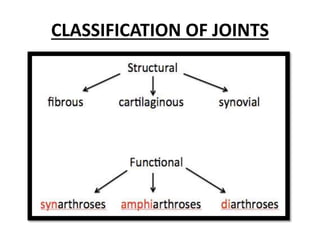
CLASSIFICATION OF JOINTS
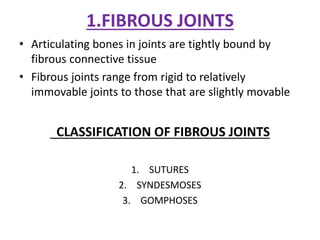
1.FIBROUS JOINTS
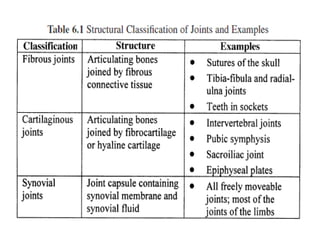
• Articulating bones in joints are tightly bound by
fibrous connective tissue
• Fibrous joints range from rigid to relatively
immovable joints to those that are slightly movable
CLASSIFICATION OF FIBROUS JOINTS
1. SUTURES
2. SYNDESMOSES
3. GOMPHOSES
CLASSIFICATION OF FIBROUS JOINTS
1.Sutures
• Immovable joint (called a synarthrosis)
• Only found between the bones of the skull.
• There is limited movement until about 20
years of age, after which they become fixed.
1.Sutures
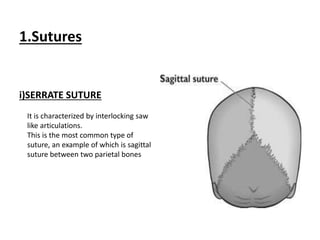
i)SERRATE SUTURE
It is characterized by interlocking saw
like articulations.
This is the most common type of
suture, an example of which is sagittal
suture between two parietal bones
1.Sutures
ii)SQUAMOUS SUTURE
The squamous suture is the
connecting joint in the skull between
the parietal bone and the lower
portion of the temporal
bone. Collagen fibers develop after
birth to bind the adjacent bones
together. The squamous suture is only
located in the joints of the skull. This
type of suture joint is one of the three
types found on the skull. It is a lap
suture, which indicates the overlap of
the skull bones. Visually, it appears
smooth and blended together, with
small scale-like edges. They are unlike
serrate sutures that have serrated
edges, or plane sutures, which do not
overlap or interlock, but instead are
just flush next to the adjacent
1.Sutures
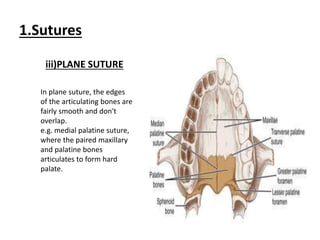
iii)PLANE SUTURE
In plane suture, the edges
of the articulating bones are
fairly smooth and don't
overlap.
e.g. medial palatine suture,
where the paired maxillary
and palatine bones
articulates to form hard
palate.
CLASSIFICATION OF FIBROUS JOINTS
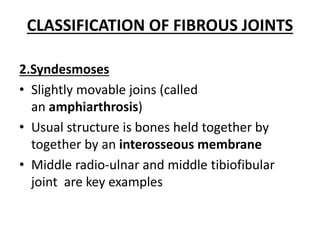
2.Syndesmoses
• Slightly movable joins (called
an amphiarthrosis)
• Usual structure is bones held together by
together by an interosseous membrane
• Middle radio-ulnar and middle tibiofibular
joint are key examples
Syndesmoses
CLASSIFICATION OF FIBROUS JOINTS
3.Gomphmoses
• Immovable joint (called a synarthrosis)
• Where the teeth articulate with their sockets
in the maxillae (upper teeth) or
the mandible (lower teeth)
• The fibrous connection that binds the tooth
and socket is the periodontal ligament
Gomphmoses
2.CARTILAGINOUS JOINTS
• Cartilaginous joints are connected entirely
by cartilage (fibro cartilage or hyaline).
• Cartilaginous joints allow more movement
between bones than a fibrous joint but less
than the highly mobile synovial joint.
• there is NO JOINT CAVITY.
i)Synchondroses
• Also known as primary cartilaginous joints, they only
involve hyaline cartilage.
• Synchondroses are cartilaginous joints that
have hyaline cartilage between the articulating bones.
Some of
• these joints are temporary, forming the epiphyseal
plates (growth plates) between the diaphyses and
epiphyses in the long bones of children . When growth
is complete, these synchondrotic joints ossify. A totally
ossified synchondrosis may also be referred to as a
synostosis.
i)Synchondroses
ii)Symphyses
• Also known as a secondary cartilaginous joint, it
can involve fibro cartilage or hyaline cartilage
• Adjoining bones of a symphysis are covered with
hyaline cartilage ,which become infiltrated with
collagenous fibers to form an intervening pad of
fibro cartilage.
• The joints are slightly movable (amphiarthroses).
• An example of a symphysis is the pubic symphysis
& intervertebral joints formed by intervertebral
disc.
ii)Symphyses
3.SYNOVIAL JOINT
• Synovial joints are most mobile type of joints.
• They possess the following characteristic features;
• There articular surfaces are covered with hyaline cartilage. This articular
cartilage is avascular, non nervous and elastic. Lubricated with synovial
fluid, the cartilage forms slippery surfaces for free movements.
• Between the articular surfaces there is a joint cavity filled with synovial
fluid. The cavity may be partially or completely subdivided by an articular
disc known as meniscus.
• The joint is surrounded by an articular capsule which is fibrous in nature
and is lined by synovial membrane. Because of its rich nerve supply the
fibrous capsule is sensitive to stretches imposed by movements.
• The synovial membrane lines the entire joint except the articular surfaces
covered by hyaline cartilage. It is this membrane that secretes the slimy
fluid called synovial fluid which lubricates the joint and nourishes the
articular cartilage.
• Varying degrees of movements are always permitted by the synovial
joints.
Function of Synovial Joint
The function of synovial joints is to provide
a wide range of precise, smooth movements, at
the same
time maintaining stability, strength, and in
certain aspects,
rigidity in the body.
STRUCTURE OF SYNOVIAL JOINT
KINDS OF SYNOVIAL JOINT
Classified into six main categories on the basis of
their structure & the motion they permit .
1. GLIDING
2. HINGE
3. PIVOT
4. CONDYLOID
5. SADDLE
6. BALL AND SOCKET
GLIDING JOINT
• Allow only side to side & back froth
movement with some slight rotation.
• Simplest type of joint movement.
• Articulating surfaces are nearly flat,or one
may be slightly concave and other slightly
convex.
• E.g intercarpal & intertarsal joints ,the
sternoclavicular joints,joint between articular
processes of adjacent vertebrae.
GLIDING JOINT
GLIDING JOINT
HINGE JOINT
• Hinge joints are monoaxial –like the hinge of a
door, they permit movement in only one plan.
• In this type of articulation, the surface of bone
is always concave, and the other convex.
• Hinge joints are most common type of
synovial joints.
• E.g. the knee, the humeroulnar articulation
within the elbow, and the joint between
phalanges.
Hinge joint
PIVOT JOINT
• A pivot joint is a type of diarthrosis.
• The movement at a pivot joint is limited to
rotation about a central axis.
• In this type of articulation ,the articular surface
on one bone is conical or rounded and fits into a
depression on another bone.
• e.g. are the proximal articulations of the radius &
ulna for rotation of the forearm, as in turning a
door knob, and the articulation between atlas &
axis that allow rotational movement of the head.
PIVOT JOINT
PIVOT JOINT
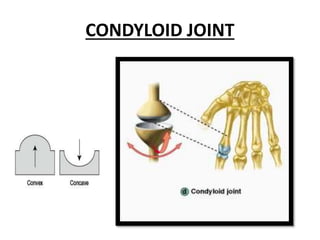
CONDYLOID JOINT
• A condyloid articulation is structured so that an
oval , convex articular surface of one bone fits
into concave depression on another bone.
• This permits angular movement in two directions
, as in up & down and side to side motions.
• Condyloid joints are therefore said to be biaxial
joints.
• e.g. The radiocarpal joint of the wrist & the
metacarpophalangeal joints
CONDYLOID JOINT
SADDLE JOINT
SADDLE JOINT
BALL & SOCKET JOINT
• The ball and socket joint (or spheroidal joint)
is a type of synovial joint in which the ball-
shaped surface of one rounded bone fits into
the cup-like depression of another bone.
• E.g. glenohumeral joint (shoulder joint) &
coxal (hip joint)
BALL & SOCKET JOINT
TYPES OF ARTICULATIONS
SYNOVIAL JOINTS MOVEMENTS
GLIDING Sliding
HINGE Bending motion in one plane
PIVOT Rotation about a central axis
CONDYLOID Movement in two planes
SADDLE Wide range of movements
BALL & SOCKET Movement in all planes & rotation

Joints

  • 1.
    A need forstrength makes the bones rigid, but if the skeleton consisted of only one solid bone, movement would be impossible. Nature has solved this problem by dividing the skeleton into many bones and creating joints where the bones intersect. Joints, also known as articulations, are strong connections that join the bones, teeth, and cartilage of the body to one another. Each joint is specialized in its shape and structural components to control the range of motion between the parts that it connects....
  • 2.
    A R TH R O L O G Y Science concerned with the study of joints
  • 3.
  • 5.
    1.FIBROUS JOINTS • Articulatingbones in joints are tightly bound by fibrous connective tissue • Fibrous joints range from rigid to relatively immovable joints to those that are slightly movable CLASSIFICATION OF FIBROUS JOINTS 1. SUTURES 2. SYNDESMOSES 3. GOMPHOSES
  • 7.
    CLASSIFICATION OF FIBROUSJOINTS 1.Sutures • Immovable joint (called a synarthrosis) • Only found between the bones of the skull. • There is limited movement until about 20 years of age, after which they become fixed.
  • 8.
    1.Sutures i)SERRATE SUTURE It ischaracterized by interlocking saw like articulations. This is the most common type of suture, an example of which is sagittal suture between two parietal bones
  • 9.
    1.Sutures ii)SQUAMOUS SUTURE The squamoussuture is the connecting joint in the skull between the parietal bone and the lower portion of the temporal bone. Collagen fibers develop after birth to bind the adjacent bones together. The squamous suture is only located in the joints of the skull. This type of suture joint is one of the three types found on the skull. It is a lap suture, which indicates the overlap of the skull bones. Visually, it appears smooth and blended together, with small scale-like edges. They are unlike serrate sutures that have serrated edges, or plane sutures, which do not overlap or interlock, but instead are just flush next to the adjacent
  • 10.
    1.Sutures iii)PLANE SUTURE In planesuture, the edges of the articulating bones are fairly smooth and don't overlap. e.g. medial palatine suture, where the paired maxillary and palatine bones articulates to form hard palate.
  • 11.
    CLASSIFICATION OF FIBROUSJOINTS 2.Syndesmoses • Slightly movable joins (called an amphiarthrosis) • Usual structure is bones held together by together by an interosseous membrane • Middle radio-ulnar and middle tibiofibular joint are key examples
  • 12.
  • 13.
    CLASSIFICATION OF FIBROUSJOINTS 3.Gomphmoses • Immovable joint (called a synarthrosis) • Where the teeth articulate with their sockets in the maxillae (upper teeth) or the mandible (lower teeth) • The fibrous connection that binds the tooth and socket is the periodontal ligament
  • 14.
  • 15.
    2.CARTILAGINOUS JOINTS • Cartilaginousjoints are connected entirely by cartilage (fibro cartilage or hyaline). • Cartilaginous joints allow more movement between bones than a fibrous joint but less than the highly mobile synovial joint. • there is NO JOINT CAVITY.
  • 16.
    i)Synchondroses • Also knownas primary cartilaginous joints, they only involve hyaline cartilage. • Synchondroses are cartilaginous joints that have hyaline cartilage between the articulating bones. Some of • these joints are temporary, forming the epiphyseal plates (growth plates) between the diaphyses and epiphyses in the long bones of children . When growth is complete, these synchondrotic joints ossify. A totally ossified synchondrosis may also be referred to as a synostosis.
  • 17.
  • 19.
    ii)Symphyses • Also knownas a secondary cartilaginous joint, it can involve fibro cartilage or hyaline cartilage • Adjoining bones of a symphysis are covered with hyaline cartilage ,which become infiltrated with collagenous fibers to form an intervening pad of fibro cartilage. • The joints are slightly movable (amphiarthroses). • An example of a symphysis is the pubic symphysis & intervertebral joints formed by intervertebral disc.
  • 20.
  • 22.
    3.SYNOVIAL JOINT • Synovialjoints are most mobile type of joints. • They possess the following characteristic features; • There articular surfaces are covered with hyaline cartilage. This articular cartilage is avascular, non nervous and elastic. Lubricated with synovial fluid, the cartilage forms slippery surfaces for free movements. • Between the articular surfaces there is a joint cavity filled with synovial fluid. The cavity may be partially or completely subdivided by an articular disc known as meniscus. • The joint is surrounded by an articular capsule which is fibrous in nature and is lined by synovial membrane. Because of its rich nerve supply the fibrous capsule is sensitive to stretches imposed by movements. • The synovial membrane lines the entire joint except the articular surfaces covered by hyaline cartilage. It is this membrane that secretes the slimy fluid called synovial fluid which lubricates the joint and nourishes the articular cartilage. • Varying degrees of movements are always permitted by the synovial joints.
  • 23.
    Function of SynovialJoint The function of synovial joints is to provide a wide range of precise, smooth movements, at the same time maintaining stability, strength, and in certain aspects, rigidity in the body.
  • 24.
  • 25.
    KINDS OF SYNOVIALJOINT Classified into six main categories on the basis of their structure & the motion they permit . 1. GLIDING 2. HINGE 3. PIVOT 4. CONDYLOID 5. SADDLE 6. BALL AND SOCKET
  • 26.
    GLIDING JOINT • Allowonly side to side & back froth movement with some slight rotation. • Simplest type of joint movement. • Articulating surfaces are nearly flat,or one may be slightly concave and other slightly convex. • E.g intercarpal & intertarsal joints ,the sternoclavicular joints,joint between articular processes of adjacent vertebrae.
  • 27.
  • 28.
  • 29.
    HINGE JOINT • Hingejoints are monoaxial –like the hinge of a door, they permit movement in only one plan. • In this type of articulation, the surface of bone is always concave, and the other convex. • Hinge joints are most common type of synovial joints. • E.g. the knee, the humeroulnar articulation within the elbow, and the joint between phalanges.
  • 30.
  • 31.
    PIVOT JOINT • Apivot joint is a type of diarthrosis. • The movement at a pivot joint is limited to rotation about a central axis. • In this type of articulation ,the articular surface on one bone is conical or rounded and fits into a depression on another bone. • e.g. are the proximal articulations of the radius & ulna for rotation of the forearm, as in turning a door knob, and the articulation between atlas & axis that allow rotational movement of the head.
  • 32.
  • 33.
  • 34.
    CONDYLOID JOINT • Acondyloid articulation is structured so that an oval , convex articular surface of one bone fits into concave depression on another bone. • This permits angular movement in two directions , as in up & down and side to side motions. • Condyloid joints are therefore said to be biaxial joints. • e.g. The radiocarpal joint of the wrist & the metacarpophalangeal joints
  • 35.
  • 37.
  • 38.
  • 39.
    BALL & SOCKETJOINT • The ball and socket joint (or spheroidal joint) is a type of synovial joint in which the ball- shaped surface of one rounded bone fits into the cup-like depression of another bone. • E.g. glenohumeral joint (shoulder joint) & coxal (hip joint)
  • 40.
  • 41.
    TYPES OF ARTICULATIONS SYNOVIALJOINTS MOVEMENTS GLIDING Sliding HINGE Bending motion in one plane PIVOT Rotation about a central axis CONDYLOID Movement in two planes SADDLE Wide range of movements BALL & SOCKET Movement in all planes & rotation