The Nervous System Anatomy & Physiology  Essentials of Human Anatomy & Physiology
Functions of the Nervous System Sensory input  – gathering information To monitor changes occurring inside and  outside the body Integration  -  To process and interpret  sensory input and decide if action is  needed Motor output A response to stimuli Activates muscles or glands
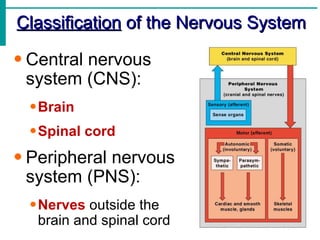
Classification  of the Nervous System Central nervous system (CNS): Brain Spinal cord Peripheral nervous system (PNS): Nerves  outside the brain and spinal cord
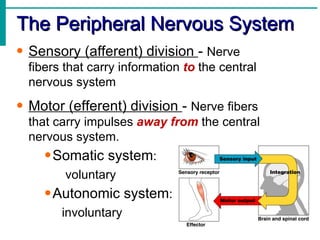
The Peripheral Nervous System Sensory (afferent) division  -  Nerve fibers that carry information  to  the central nervous system Motor (efferent) division  -  Nerve fibers that carry impulses  away from  the central nervous system.  Somatic system : voluntary Autonomic system : involuntary
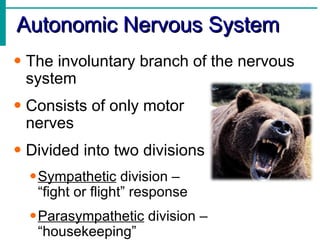
Autonomic Nervous System The involuntary branch of the nervous  system Consists of only motor  nerves Divided into two divisions Sympathetic  division –  “fight or flight” response Parasympathetic  division – “housekeeping”
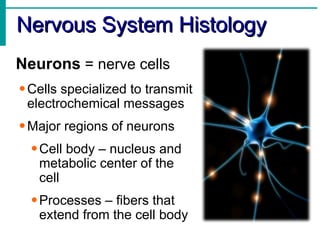
Nervous System Histology Neurons  = nerve cells Cells specialized to transmit electrochemical messages Major regions of neurons Cell body – nucleus and metabolic center of the cell Processes – fibers that extend from the cell body
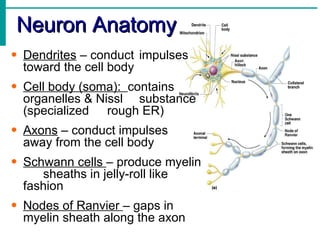
Neuron Anatomy Dendrites  – conduct  impulses  toward the cell body Cell body (soma):  contains  organelles & Nissl  substance (specialized  rough ER) Axons  – conduct impulses  away from the cell body Schwann cells  – produce myelin  sheaths in jelly-roll like  fashion Nodes of Ranvier  – gaps in  myelin sheath along the axon
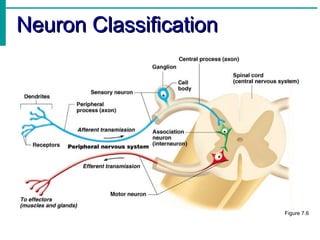
Classification of Neurons Sensory  (afferent) neurons Carry impulses from the sensory receptors Cutaneous sense organs Receptors – detect stretch or tension Interneurons  (association): “connector” Motor  (efferent) neurons Carry impulses from the central nervous system
Neuron Classification Figure 7.6
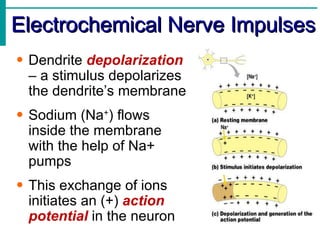
Electrochemical Nerve Impulses Dendrite  depolarization  – a stimulus depolarizes the dendrite’s membrane Sodium (Na + ) flows inside the membrane with the help of Na+ pumps This exchange of ions initiates an (+)  action potential  in the neuron
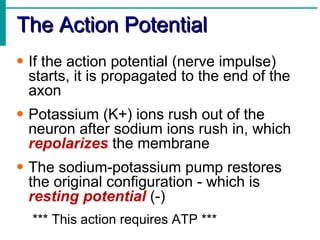
The Action Potential If the action potential (nerve impulse) starts, it is propagated to the end of the axon Potassium (K+) ions rush out of the neuron after sodium ions rush in, which  repolarizes  the membrane The sodium-potassium pump restores the original configuration - which is  resting potential  (-) *** This action requires ATP ***
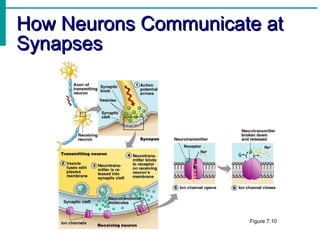
Continuation of the Nerve Impulse between Neurons Impulses are able to cross the  synapse  to another neuron Neurotransmitter is released from a neuron’s axon terminal The dendrite of the next neuron has receptors that are stimulated by the neurotransmitter An action potential is started in the dendrite
How Neurons Communicate at Synapses Figure 7.10
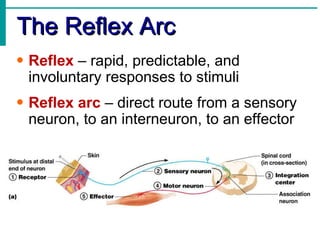
The Reflex Arc Reflex  – rapid, predictable, and involuntary responses to stimuli Reflex arc  – direct route from a sensory neuron, to an interneuron, to an effector
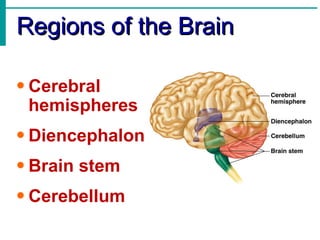
Regions of the Brain Cerebral hemispheres Diencephalon Brain stem Cerebellum
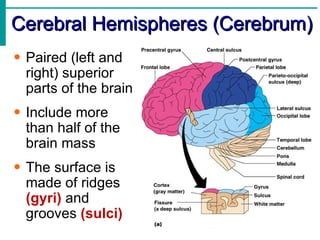
Cerebral Hemispheres (Cerebrum) Paired (left and right) superior parts of the brain Include more than half of the brain mass The surface is made of ridges  (gyri)  and grooves  (sulci)
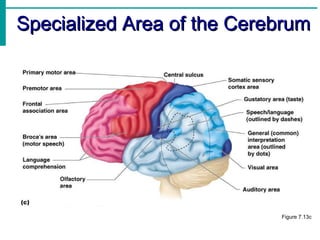
Specialized Area of the Cerebrum Figure 7.13c
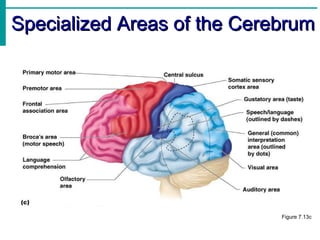
Specialized Areas of the Cerebrum Figure 7.13c
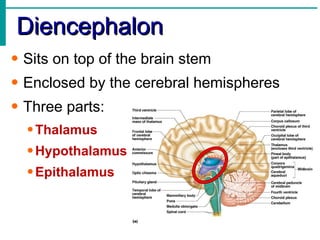
Diencephalon Sits on top of the brain stem Enclosed by the cerebral hemispheres Three parts: Thalamus Hypothalamus Epithalamus
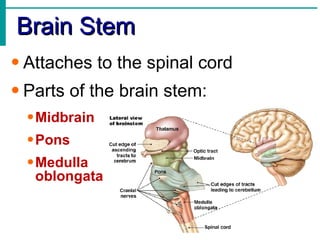
Brain Stem Attaches to the spinal cord Parts of the brain stem: Midbrain Pons Medulla   oblongata
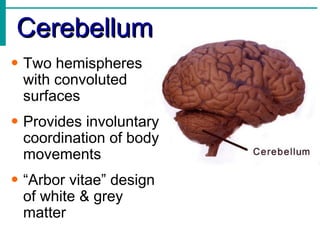
Cerebellum Two hemispheres with convoluted surfaces Provides involuntary coordination of body movements “ Arbor vitae” design of white & grey matter
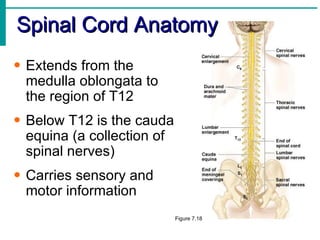
Spinal Cord Anatomy Extends from the medulla oblongata to the region of T12 Below T12 is the cauda equina (a collection of spinal nerves) Carries sensory and motor information Figure 7.18
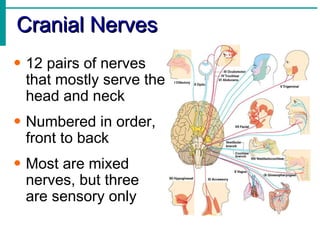
Cranial Nerves 12 pairs of nerves that mostly serve the head and neck Numbered in order, front to back Most are mixed nerves, but three  are sensory only
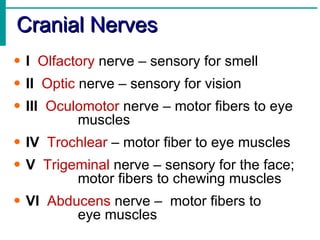
Cranial Nerves I   Olfactory  nerve – sensory for smell II   Optic  nerve – sensory for vision III   Oculomotor  nerve – motor fibers to eye  muscles IV   Trochlear  – motor fiber to eye muscles V   Trigeminal  nerve – sensory for the face;  motor fibers to chewing muscles VI   Abducens  nerve –  motor fibers to  eye muscles
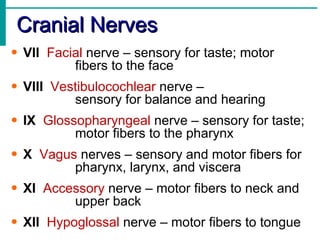
Cranial Nerves VII   Facial  nerve – sensory for taste; motor  fibers to the face VIII   Vestibulocochlear  nerve –  sensory for balance and hearing IX   Glossopharyngeal  nerve – sensory for taste;  motor fibers to the pharynx X   Vagus  nerves – sensory and motor fibers for  pharynx, larynx, and viscera XI   Accessory  nerve – motor fibers to neck and  upper back XII   Hypoglossal  nerve – motor fibers to tongue
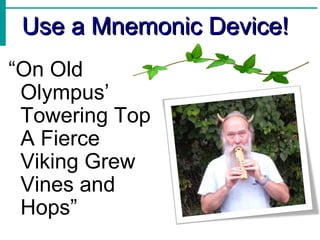
Use a Mnemonic Device! “ On Old Olympus’ Towering Top A Fierce Viking Grew Vines and Hops”
Use a Mnemonic Device! “ Some say money matters but my brother says big brains matter more.”
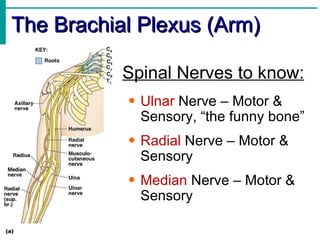
The Brachial Plexus (Arm) Spinal Nerves to know: Ulnar  Nerve – Motor & Sensory, “the funny bone” Radial  Nerve – Motor & Sensory Median  Nerve – Motor & Sensory
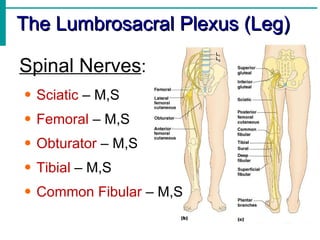
The Lumbrosacral Plexus (Leg) Spinal Nerves : Sciatic  – M,S Femoral  – M,S Obturator  – M,S Tibial  – M,S Common Fibular  – M,S
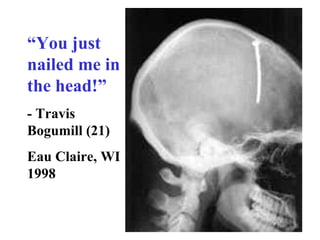
“ You just nailed me in the head!” - Travis Bogumill (21) Eau Claire, WI  1998

Nervous system notes

  • 1.
    The Nervous SystemAnatomy & Physiology Essentials of Human Anatomy & Physiology
  • 2.
    Functions of theNervous System Sensory input – gathering information To monitor changes occurring inside and outside the body Integration - To process and interpret sensory input and decide if action is needed Motor output A response to stimuli Activates muscles or glands
  • 3.
    Classification ofthe Nervous System Central nervous system (CNS): Brain Spinal cord Peripheral nervous system (PNS): Nerves outside the brain and spinal cord
  • 4.
    The Peripheral NervousSystem Sensory (afferent) division - Nerve fibers that carry information to the central nervous system Motor (efferent) division - Nerve fibers that carry impulses away from the central nervous system. Somatic system : voluntary Autonomic system : involuntary
  • 5.
    Autonomic Nervous SystemThe involuntary branch of the nervous system Consists of only motor nerves Divided into two divisions Sympathetic division – “fight or flight” response Parasympathetic division – “housekeeping”
  • 6.
    Nervous System HistologyNeurons = nerve cells Cells specialized to transmit electrochemical messages Major regions of neurons Cell body – nucleus and metabolic center of the cell Processes – fibers that extend from the cell body
  • 7.
    Neuron Anatomy Dendrites – conduct impulses toward the cell body Cell body (soma): contains organelles & Nissl substance (specialized rough ER) Axons – conduct impulses away from the cell body Schwann cells – produce myelin sheaths in jelly-roll like fashion Nodes of Ranvier – gaps in myelin sheath along the axon
  • 8.
    Classification of NeuronsSensory (afferent) neurons Carry impulses from the sensory receptors Cutaneous sense organs Receptors – detect stretch or tension Interneurons (association): “connector” Motor (efferent) neurons Carry impulses from the central nervous system
  • 9.
  • 10.
    Electrochemical Nerve ImpulsesDendrite depolarization – a stimulus depolarizes the dendrite’s membrane Sodium (Na + ) flows inside the membrane with the help of Na+ pumps This exchange of ions initiates an (+) action potential in the neuron
  • 11.
    The Action PotentialIf the action potential (nerve impulse) starts, it is propagated to the end of the axon Potassium (K+) ions rush out of the neuron after sodium ions rush in, which repolarizes the membrane The sodium-potassium pump restores the original configuration - which is resting potential (-) *** This action requires ATP ***
  • 12.
    Continuation of theNerve Impulse between Neurons Impulses are able to cross the synapse to another neuron Neurotransmitter is released from a neuron’s axon terminal The dendrite of the next neuron has receptors that are stimulated by the neurotransmitter An action potential is started in the dendrite
  • 13.
    How Neurons Communicateat Synapses Figure 7.10
  • 14.
    The Reflex ArcReflex – rapid, predictable, and involuntary responses to stimuli Reflex arc – direct route from a sensory neuron, to an interneuron, to an effector
  • 15.
    Regions of theBrain Cerebral hemispheres Diencephalon Brain stem Cerebellum
  • 16.
    Cerebral Hemispheres (Cerebrum)Paired (left and right) superior parts of the brain Include more than half of the brain mass The surface is made of ridges (gyri) and grooves (sulci)
  • 17.
    Specialized Area ofthe Cerebrum Figure 7.13c
  • 18.
    Specialized Areas ofthe Cerebrum Figure 7.13c
  • 19.
    Diencephalon Sits ontop of the brain stem Enclosed by the cerebral hemispheres Three parts: Thalamus Hypothalamus Epithalamus
  • 20.
    Brain Stem Attachesto the spinal cord Parts of the brain stem: Midbrain Pons Medulla oblongata
  • 21.
    Cerebellum Two hemisphereswith convoluted surfaces Provides involuntary coordination of body movements “ Arbor vitae” design of white & grey matter
  • 22.
    Spinal Cord AnatomyExtends from the medulla oblongata to the region of T12 Below T12 is the cauda equina (a collection of spinal nerves) Carries sensory and motor information Figure 7.18
  • 23.
    Cranial Nerves 12pairs of nerves that mostly serve the head and neck Numbered in order, front to back Most are mixed nerves, but three are sensory only
  • 24.
    Cranial Nerves I Olfactory nerve – sensory for smell II Optic nerve – sensory for vision III Oculomotor nerve – motor fibers to eye muscles IV Trochlear – motor fiber to eye muscles V Trigeminal nerve – sensory for the face; motor fibers to chewing muscles VI Abducens nerve – motor fibers to eye muscles
  • 25.
    Cranial Nerves VII Facial nerve – sensory for taste; motor fibers to the face VIII Vestibulocochlear nerve – sensory for balance and hearing IX Glossopharyngeal nerve – sensory for taste; motor fibers to the pharynx X Vagus nerves – sensory and motor fibers for pharynx, larynx, and viscera XI Accessory nerve – motor fibers to neck and upper back XII Hypoglossal nerve – motor fibers to tongue
  • 26.
    Use a MnemonicDevice! “ On Old Olympus’ Towering Top A Fierce Viking Grew Vines and Hops”
  • 27.
    Use a MnemonicDevice! “ Some say money matters but my brother says big brains matter more.”
  • 28.
    The Brachial Plexus(Arm) Spinal Nerves to know: Ulnar Nerve – Motor & Sensory, “the funny bone” Radial Nerve – Motor & Sensory Median Nerve – Motor & Sensory
  • 29.
    The Lumbrosacral Plexus(Leg) Spinal Nerves : Sciatic – M,S Femoral – M,S Obturator – M,S Tibial – M,S Common Fibular – M,S
  • 30.
    “ You justnailed me in the head!” - Travis Bogumill (21) Eau Claire, WI 1998