
PERIPHERAL NERVOUS
SYSTEM
archita srivastava
department of pharmacology
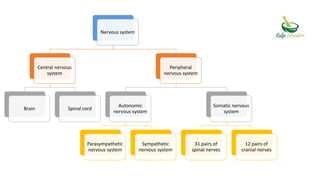
Nervous system
Central nervous
system
Brain Spinal cord
Peripheral
nervous system
Autonomic
nervous system
Parasympathetic
nervous system
Sympathetic
nervous system
Somatic nervous
system
31 pairs of
spinal nerves
12 pairs of
cranial nerves
INTRODUCTION
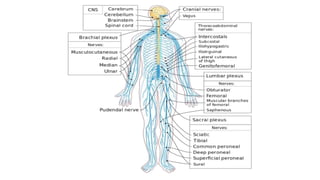
• The peripheral nervous system (PNS) consists of all the nerves branching out
of the brain and spinal cord.
• These allow electrical impulses to travel to and from the furthest regions, or
periphery, of the human body.
• The PNS is built almost entirely from nerves.
• There are two main types; spinal nerves and cranial nerves.
Tissues of the Peripheral Nervous System
• The tissues that make up the PNS are nerves and ganglia.
• Ganglia are nervous tissues that act as relay points for messages transmitted
through nerves of the PNS.
• Nerves are cable-like bundles of axons that make up the majority of PNS
tissues.
• Nerves are generally classified on the basis of the direction in which they
carry nerve impulses as sensory, motor, or mixed nerves.
• Sensory nerves transmit information from sensory receptors in the
body to the CNS. Sensory nerves are also called afferent nerves.
• Motor nerves transmit information from the CNS to muscles, organs,
and glands. Motor nerves are also called efferent nerves.
• Mixed nerves contain both sensory and motor neurons, so they can
transmit information in both directions. They have both afferent and
efferent functions.
Divisions of the Peripheral Nervous System
• The PNS is divided into two major systems
• Both systems of the PNS interact with the CNS and include sensory and motor
neurons, but they use different circuits of nerves and ganglia.
Autonomic nervous system
• The autonomic nervous system primarily senses the internal environment and
controls involuntary activities.
• It is responsible for monitoring conditions in the internal environment and
bringing about appropriate changes in them.
• In general, the autonomic nervous system is responsible for all the activities that
go on inside your body without your conscious awareness or voluntary
participation.
• Structurally, the autonomic nervous system consists of sensory and motor
nerves that run between the CNS (especially the hypothalamus in the brain) and
internal organs (such as the heart, lungs, and digestive organs) and glands (such
as the pancreas and sweat glands).
• Sensory neurons in the autonomic system detect internal body conditions
and send messages to the brain.
• Motor nerves in the autonomic system function by controlling the
contractions of smooth or cardiac muscle or glandular tissue.
• For example, when sensory nerves of the autonomic system detect a rise in
body temperature, motor nerves signal smooth muscles in blood vessels
near the body surface to undergo vasodilation, and the sweat glands in
the skin secrete more sweat to cool the body.
• The autonomic nervous system, in turn, has two subdivisions:
the sympathetic division and parasympathetic division.
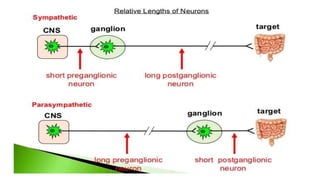
• each division have two efferent neurones b/w the CNS and Organ
• The preganglionic neurons
• The postganglionic neurons
preganglionic neurons & postganglionic
neurons
• its cell body is in the brain or
spinal cord
• its axon exits the CNS as part of
spinal and cranial nerve.
• the axon of a preganglionic
neuron is a small diameter,
mylinated and synapses with
postganglionic neurons.
• the PGN convey nerve impulse
from CNS to AG
• the postganglionic neuron lies
entirely outside the CNS.
• its cell body and dendrites are
located in an autonomic ganglia
(AG).
• the axon of a postganglionic
neuron is a small diameter,
unmylinated that terminates in
the visceral effector.
• POGN relay the impulse from AG
to visceral effector.
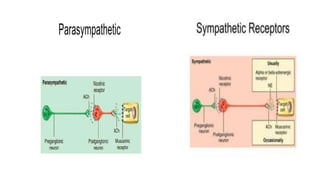
Sympathetic division
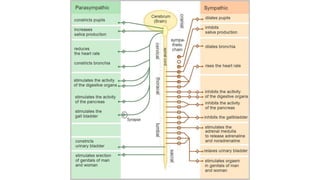
• Controls the fight-or-flight response. Changes occur in organs and glands
throughout the body that prepare the body to fight or fly in response to a
perceived danger.
• For example, the heart rate speeds up, air passages in the lungs become wider,
more blood flows to the skeletal muscles, and the digestive system
temporarily shuts down.
• Thoracolumber ( T- L)
• Neurotransmitter – Adrenaline, Non Adrenaline
Parasympathetic division
• Returns the body to normal after the fight-or-flight response has
occurred.
• For example, it slows down the heart rate, narrows air passages in the
lungs, reduces blood flow to the skeletal muscles, and stimulates
the digestive system to start working again.
• The parasympathetic division also maintains the internal homeostasis
of the body at other times.
• craniosacral
• Neurotransmitter – Acetylcholine
Somatic Nervous System
• The somatic nervous system primarily senses the external environment and
controls voluntary activities in which decisions and commands come from
the cerebral cortex of the brain
• In general, the somatic nervous system is responsible for all of conscious
perceptions of the outside world and all of the voluntary motor activities
perform in response.
• Whether it’s playing piano, driving a car, or playing basketball, you can thank
your somatic nervous system for making it possible.
• Structurally, the somatic nervous system consists of 12 pairs of cranial nerves
and 31 pairs of spinal nerves.
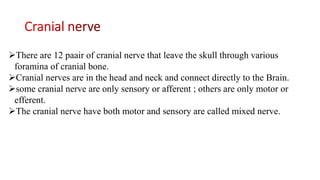
There are 12 paair of cranial nerve that leave the skull through various
foramina of cranial bone.
Cranial nerves are in the head and neck and connect directly to the Brain.
some cranial nerve are only sensory or afferent ; others are only motor or
efferent.
The cranial nerve have both motor and sensory are called mixed nerve.
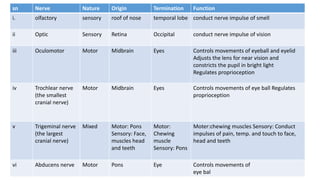
sn Nerve Nature Origin Termination Function
i. olfactory sensory roof of nose temporal lobe conduct nerve impulse of smell
ii Optic Sensory Retina Occipital conduct nerve impulse of vision
iii Oculomotor Motor Midbrain Eyes Controls movements of eyeball and eyelid
Adjusts the lens for near vision and
constricts the pupil in bright light
Regulates proprioception
iv Trochlear nerve
(the smallest
cranial nerve)
Motor Midbrain Eyes Controls movements of eye ball Regulates
proprioception
v Trigeminal nerve
(the largest
cranial nerve)
Mixed Motor: Pons
Sensory: Face,
muscles head
and teeth
Motor:
Chewing
muscle
Sensory: Pons
Moter:chewing muscles Sensory: Conduct
impulses of pain, temp. and touch to face,
head and teeth
vi Abducens nerve Motor Pons Eye Controls movements of
eye bal
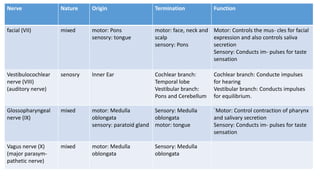
Nerve Nature Origin Termination Function
facial (VII) mixed motor: Pons
senosry: tongue
motor: face, neck and
scalp
sensory: Pons
Motor: Controls the mus- cles for facial
expression and also controls saliva
secretion
Sensory: Conducts im- pulses for taste
sensation
Vestibulocochlear
nerve (VIII)
(auditory nerve)
senosry Inner Ear Cochlear branch:
Temporal lobe
Vestibular branch:
Pons and Cerebellum
Cochlear branch: Conducte impulses
for hearing
Vestibular branch: Conducts impulses
for equilibrium.
Glossopharyngeal
nerve (IX)
mixed motor: Medulla
oblongata
sensory: paratoid gland
Sensory: Medulla
oblongata
motor: tongue
`Motor: Control contraction of pharynx
and salivary secretion
Sensory: Conducts im- pulses for taste
sensation
Vagus nerve (X)
(major parasym-
pathetic nerve)
mixed motor: Medulla
oblongata
Sensory: Medulla
oblongata
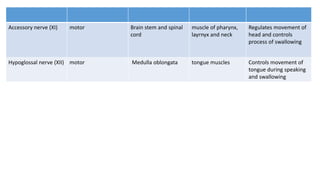
Accessory nerve (XI) motor Brain stem and spinal
cord
muscle of pharynx,
layrnyx and neck
Regulates movement of
head and controls
process of swallowing
Hypoglossal nerve (XII) motor Medulla oblongata tongue muscles Controls movement of
tongue during speaking
and swallowing
Spinal nerves of the somatic nervous system emanate from the spinal
column between vertebrae.
All of the spinal nerves are mixed nerves, containing both sensory and
motor neurons.
Spinal nerves also include motor nerves that stimulate skeletal
muscle contraction, allowing for voluntary body movements.
parasympathetic unit IV.pptx

parasympathetic unit IV.pptx

  • 1.
  • 2.
    Nervous system Central nervous system BrainSpinal cord Peripheral nervous system Autonomic nervous system Parasympathetic nervous system Sympathetic nervous system Somatic nervous system 31 pairs of spinal nerves 12 pairs of cranial nerves
  • 3.
    INTRODUCTION • The peripheralnervous system (PNS) consists of all the nerves branching out of the brain and spinal cord. • These allow electrical impulses to travel to and from the furthest regions, or periphery, of the human body. • The PNS is built almost entirely from nerves. • There are two main types; spinal nerves and cranial nerves.
  • 5.
    Tissues of thePeripheral Nervous System • The tissues that make up the PNS are nerves and ganglia. • Ganglia are nervous tissues that act as relay points for messages transmitted through nerves of the PNS. • Nerves are cable-like bundles of axons that make up the majority of PNS tissues. • Nerves are generally classified on the basis of the direction in which they carry nerve impulses as sensory, motor, or mixed nerves.
  • 6.
    • Sensory nervestransmit information from sensory receptors in the body to the CNS. Sensory nerves are also called afferent nerves. • Motor nerves transmit information from the CNS to muscles, organs, and glands. Motor nerves are also called efferent nerves. • Mixed nerves contain both sensory and motor neurons, so they can transmit information in both directions. They have both afferent and efferent functions.
  • 7.
    Divisions of thePeripheral Nervous System • The PNS is divided into two major systems • Both systems of the PNS interact with the CNS and include sensory and motor neurons, but they use different circuits of nerves and ganglia.
  • 8.
    Autonomic nervous system •The autonomic nervous system primarily senses the internal environment and controls involuntary activities. • It is responsible for monitoring conditions in the internal environment and bringing about appropriate changes in them. • In general, the autonomic nervous system is responsible for all the activities that go on inside your body without your conscious awareness or voluntary participation. • Structurally, the autonomic nervous system consists of sensory and motor nerves that run between the CNS (especially the hypothalamus in the brain) and internal organs (such as the heart, lungs, and digestive organs) and glands (such as the pancreas and sweat glands).
  • 9.
    • Sensory neuronsin the autonomic system detect internal body conditions and send messages to the brain. • Motor nerves in the autonomic system function by controlling the contractions of smooth or cardiac muscle or glandular tissue. • For example, when sensory nerves of the autonomic system detect a rise in body temperature, motor nerves signal smooth muscles in blood vessels near the body surface to undergo vasodilation, and the sweat glands in the skin secrete more sweat to cool the body. • The autonomic nervous system, in turn, has two subdivisions: the sympathetic division and parasympathetic division. • each division have two efferent neurones b/w the CNS and Organ • The preganglionic neurons • The postganglionic neurons
  • 10.
    preganglionic neurons &postganglionic neurons • its cell body is in the brain or spinal cord • its axon exits the CNS as part of spinal and cranial nerve. • the axon of a preganglionic neuron is a small diameter, mylinated and synapses with postganglionic neurons. • the PGN convey nerve impulse from CNS to AG • the postganglionic neuron lies entirely outside the CNS. • its cell body and dendrites are located in an autonomic ganglia (AG). • the axon of a postganglionic neuron is a small diameter, unmylinated that terminates in the visceral effector. • POGN relay the impulse from AG to visceral effector.
  • 13.
    Sympathetic division • Controlsthe fight-or-flight response. Changes occur in organs and glands throughout the body that prepare the body to fight or fly in response to a perceived danger. • For example, the heart rate speeds up, air passages in the lungs become wider, more blood flows to the skeletal muscles, and the digestive system temporarily shuts down. • Thoracolumber ( T- L) • Neurotransmitter – Adrenaline, Non Adrenaline
  • 14.
    Parasympathetic division • Returnsthe body to normal after the fight-or-flight response has occurred. • For example, it slows down the heart rate, narrows air passages in the lungs, reduces blood flow to the skeletal muscles, and stimulates the digestive system to start working again. • The parasympathetic division also maintains the internal homeostasis of the body at other times. • craniosacral • Neurotransmitter – Acetylcholine
  • 16.
    Somatic Nervous System •The somatic nervous system primarily senses the external environment and controls voluntary activities in which decisions and commands come from the cerebral cortex of the brain • In general, the somatic nervous system is responsible for all of conscious perceptions of the outside world and all of the voluntary motor activities perform in response. • Whether it’s playing piano, driving a car, or playing basketball, you can thank your somatic nervous system for making it possible. • Structurally, the somatic nervous system consists of 12 pairs of cranial nerves and 31 pairs of spinal nerves.
  • 17.
    There are 12paair of cranial nerve that leave the skull through various foramina of cranial bone. Cranial nerves are in the head and neck and connect directly to the Brain. some cranial nerve are only sensory or afferent ; others are only motor or efferent. The cranial nerve have both motor and sensory are called mixed nerve.
  • 18.
    sn Nerve NatureOrigin Termination Function i. olfactory sensory roof of nose temporal lobe conduct nerve impulse of smell ii Optic Sensory Retina Occipital conduct nerve impulse of vision iii Oculomotor Motor Midbrain Eyes Controls movements of eyeball and eyelid Adjusts the lens for near vision and constricts the pupil in bright light Regulates proprioception iv Trochlear nerve (the smallest cranial nerve) Motor Midbrain Eyes Controls movements of eye ball Regulates proprioception v Trigeminal nerve (the largest cranial nerve) Mixed Motor: Pons Sensory: Face, muscles head and teeth Motor: Chewing muscle Sensory: Pons Moter:chewing muscles Sensory: Conduct impulses of pain, temp. and touch to face, head and teeth vi Abducens nerve Motor Pons Eye Controls movements of eye bal
  • 19.
    Nerve Nature OriginTermination Function facial (VII) mixed motor: Pons senosry: tongue motor: face, neck and scalp sensory: Pons Motor: Controls the mus- cles for facial expression and also controls saliva secretion Sensory: Conducts im- pulses for taste sensation Vestibulocochlear nerve (VIII) (auditory nerve) senosry Inner Ear Cochlear branch: Temporal lobe Vestibular branch: Pons and Cerebellum Cochlear branch: Conducte impulses for hearing Vestibular branch: Conducts impulses for equilibrium. Glossopharyngeal nerve (IX) mixed motor: Medulla oblongata sensory: paratoid gland Sensory: Medulla oblongata motor: tongue `Motor: Control contraction of pharynx and salivary secretion Sensory: Conducts im- pulses for taste sensation Vagus nerve (X) (major parasym- pathetic nerve) mixed motor: Medulla oblongata Sensory: Medulla oblongata
  • 20.
    Accessory nerve (XI)motor Brain stem and spinal cord muscle of pharynx, layrnyx and neck Regulates movement of head and controls process of swallowing Hypoglossal nerve (XII) motor Medulla oblongata tongue muscles Controls movement of tongue during speaking and swallowing
  • 22.
    Spinal nerves ofthe somatic nervous system emanate from the spinal column between vertebrae. All of the spinal nerves are mixed nerves, containing both sensory and motor neurons. Spinal nerves also include motor nerves that stimulate skeletal muscle contraction, allowing for voluntary body movements.