HISTOLOGY REVIEW 
Human Blood 
Dr. Tim Ballard 
Department of Biology and Marine Biology
BBlloooodd 
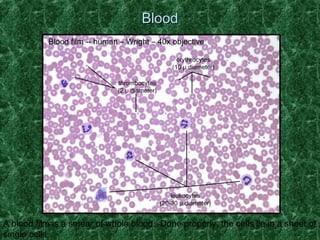
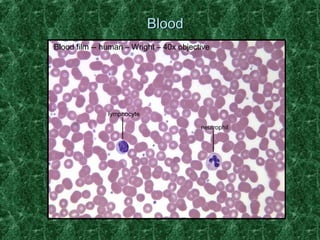
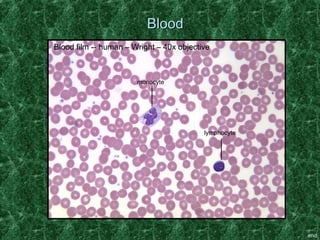
Blood film -- human – Wright – 40x objective 
thrombocytes 
(2 μ diameter) 
erythrocytes 
(10 μ diameter) 
leukocytes 
(20-30 μ diameter) 
A blood film is a smear of whole blood. Done properly, the cells lie in a sheet of 
single cells.
BBlloooodd 
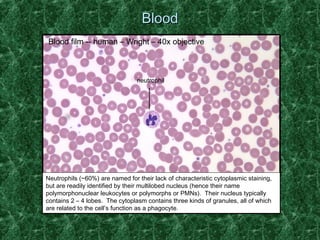
Blood film -- human – Wright – 40x objective 
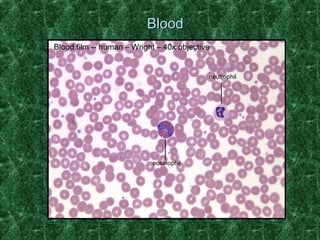
neutrophil 
Neutrophils (~60%) are named for their lack of characteristic cytoplasmic staining, 
but are readily identified by their multilobed nucleus (hence their name 
polymorphonuclear leukocytes or polymorphs or PMNs). Their nucleus typically 
contains 2 – 4 lobes. The cytoplasm contains three kinds of granules, all of which 
are related to the cell’s function as a phagocyte.
BBlloooodd 
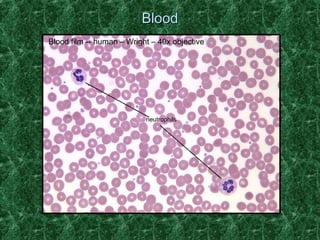
Blood film -- human – Wright – 40x objective 
neutrophils
BBlloooodd 
Blood film -- human – Wright – 40x objective 
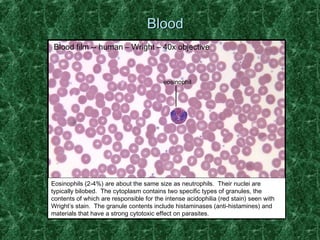
eosinophil 
Eosinophils (2-4%) are about the same size as neutrophils. Their nuclei are 
typically bilobed. The cytoplasm contains two specific types of granules, the 
contents of which are responsible for the intense acidophilia (red stain) seen with 
Wright’s stain. The granule contents include histaminases (anti-histamines) and 
materials that have a strong cytotoxic effect on parasites.
BBlloooodd 
Blood film -- human – Wright – 40x objective 
neutrophil 
eosinophil
BBlloooodd 
Blood film -- human – Wright – 40x objective 
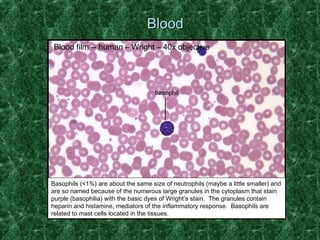
basophil 
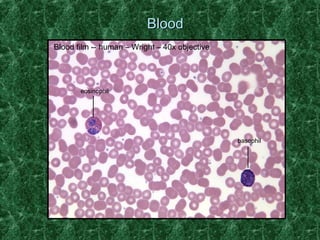
Basophils (<1%) are about the same size of neutrophils (maybe a little smaller) and 
are so named because of the numerous large granules in the cytoplasm that stain 
purple (basophilia) with the basic dyes of Wright’s stain. The granules contain 
heparin and histamine, mediators of the inflammatory response. Basophils are 
related to mast cells located in the tissues.
BBlloooodd 
Blood film -- human – Wright – 40x objective 
eosinophil 
basophil
BBlloooodd 
Blood film -- human – Wright – 40x objective 
monocyte 
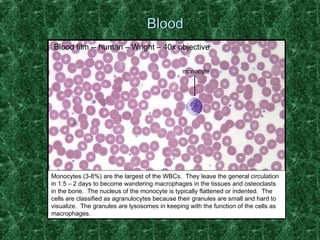
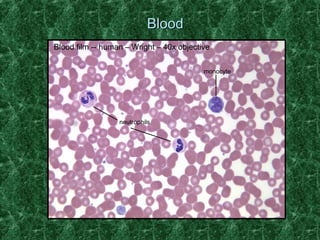
Monocytes (3-8%) are the largest of the WBCs. They leave the general circulation 
in 1.5 – 2 days to become wandering macrophages in the tissues and osteoclasts 
in the bone. The nucleus of the monocyte is typically flattened or indented. The 
cells are classified as agranulocytes because their granules are small and hard to 
visualize. The granules are lysosomes in keeping with the function of the cells as 
macrophages.
BBlloooodd 
Blood film -- human – Wright – 40x objective 
monocyte 
neutrophils
BBlloooodd 
Blood film -- human – Wright – 40x objective 
lymphocyte 
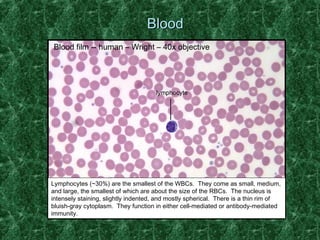
Lymphocytes (~30%) are the smallest of the WBCs. They come as small, medium, 
and large, the smallest of which are about the size of the RBCs. The nucleus is 
intensely staining, slightly indented, and mostly spherical. There is a thin rim of 
bluish-gray cytoplasm. They function in either cell-mediated or antibody-mediated 
immunity.
BBlloooodd 
Blood film -- human – Wright – 40x objective 
lymphocyte 
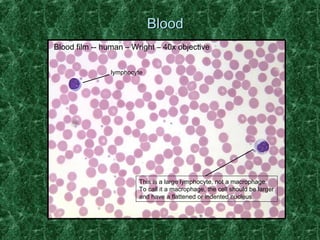
This is a large lymphocyte, not a macrophage. 
To call it a macrophage, the cell should be larger 
and have a flattened or indented nucleus.
BBlloooodd 
Blood film -- human – Wright – 40x objective 
lymphocyte 
neutrophil
BBlloooodd 
Blood film -- human – Wright – 40x objective 
monocyte 
lymphocyte 
end

Histology: Blood

  • 1.
    HISTOLOGY REVIEW HumanBlood Dr. Tim Ballard Department of Biology and Marine Biology
  • 2.
    BBlloooodd Blood film-- human – Wright – 40x objective thrombocytes (2 μ diameter) erythrocytes (10 μ diameter) leukocytes (20-30 μ diameter) A blood film is a smear of whole blood. Done properly, the cells lie in a sheet of single cells.
  • 3.
    BBlloooodd Blood film-- human – Wright – 40x objective neutrophil Neutrophils (~60%) are named for their lack of characteristic cytoplasmic staining, but are readily identified by their multilobed nucleus (hence their name polymorphonuclear leukocytes or polymorphs or PMNs). Their nucleus typically contains 2 – 4 lobes. The cytoplasm contains three kinds of granules, all of which are related to the cell’s function as a phagocyte.
  • 4.
    BBlloooodd Blood film-- human – Wright – 40x objective neutrophils
  • 5.
    BBlloooodd Blood film-- human – Wright – 40x objective eosinophil Eosinophils (2-4%) are about the same size as neutrophils. Their nuclei are typically bilobed. The cytoplasm contains two specific types of granules, the contents of which are responsible for the intense acidophilia (red stain) seen with Wright’s stain. The granule contents include histaminases (anti-histamines) and materials that have a strong cytotoxic effect on parasites.
  • 6.
    BBlloooodd Blood film-- human – Wright – 40x objective neutrophil eosinophil
  • 7.
    BBlloooodd Blood film-- human – Wright – 40x objective basophil Basophils (<1%) are about the same size of neutrophils (maybe a little smaller) and are so named because of the numerous large granules in the cytoplasm that stain purple (basophilia) with the basic dyes of Wright’s stain. The granules contain heparin and histamine, mediators of the inflammatory response. Basophils are related to mast cells located in the tissues.
  • 8.
    BBlloooodd Blood film-- human – Wright – 40x objective eosinophil basophil
  • 9.
    BBlloooodd Blood film-- human – Wright – 40x objective monocyte Monocytes (3-8%) are the largest of the WBCs. They leave the general circulation in 1.5 – 2 days to become wandering macrophages in the tissues and osteoclasts in the bone. The nucleus of the monocyte is typically flattened or indented. The cells are classified as agranulocytes because their granules are small and hard to visualize. The granules are lysosomes in keeping with the function of the cells as macrophages.
  • 10.
    BBlloooodd Blood film-- human – Wright – 40x objective monocyte neutrophils
  • 11.
    BBlloooodd Blood film-- human – Wright – 40x objective lymphocyte Lymphocytes (~30%) are the smallest of the WBCs. They come as small, medium, and large, the smallest of which are about the size of the RBCs. The nucleus is intensely staining, slightly indented, and mostly spherical. There is a thin rim of bluish-gray cytoplasm. They function in either cell-mediated or antibody-mediated immunity.
  • 12.
    BBlloooodd Blood film-- human – Wright – 40x objective lymphocyte This is a large lymphocyte, not a macrophage. To call it a macrophage, the cell should be larger and have a flattened or indented nucleus.
  • 13.
    BBlloooodd Blood film-- human – Wright – 40x objective lymphocyte neutrophil
  • 14.
    BBlloooodd Blood film-- human – Wright – 40x objective monocyte lymphocyte end