Instructional Design
Models In E-learning
CommLab India:
The Global Learning Partner You Can Depend On!
Introduction
Instructional Design Models In E-learning
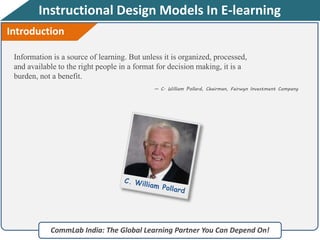
Information is a source of learning. But unless it is organized, processed,
and available to the right people in a format for decision making, it is a
burden, not a benefit.
─ C. William Pollard, Chairman, Fairwyn Investment Company
CommLab India: The Global Learning Partner You Can Depend On!
Instructional Design Models In E-learning
Dumping information in the form of bland, text-heavy manuals does not facilitate an
effective learning experience.
Information needs to be organized in a way that helps learners understand easily and retain
it for a long time.
CommLab India: The Global Learning Partner You Can Depend On!
How do you ensure your training
is organized, processed, and
available to the
right people?
Introduction
Instructional Design Models In E-learning
You need a well-defined process
CommLab India: The Global Learning Partner You Can Depend On!
Instructional Design Model
Introduction
Instructional Design Models In E-learning
CommLab India: The Global Learning Partner You Can Depend On!
What is an Instructional Design Model
An Instructional Design Model is a tool or framework to develop instructional material.
An Instructional Design Model:
• Helps instructional designers provide a structure and meaning to the learning material
• Allows them to visualize the training need and break down the process of designing
training material into steps
• Provides guidelines to ensure training addresses the learning objectives and meets
the desired expectations
Instructional Design Models In E-learning
CommLab India: The Global Learning Partner You Can Depend On!
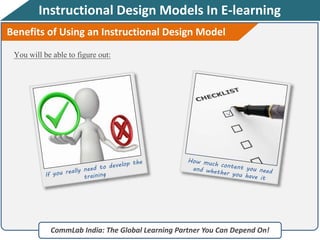
Benefits of Using an Instructional Design Model
You will be able to figure out:
Instructional Design Models In E-learning
CommLab India: The Global Learning Partner You Can Depend On!
Benefits of Using an Instructional Design Model
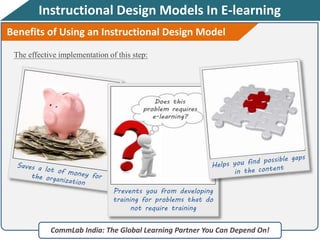
The effective implementation of this step:
Prevents you from developing
training for problems that do
not require training
Instructional Design Models In E-learning
CommLab India: The Global Learning Partner You Can Depend On!
Different Instructional Design Models
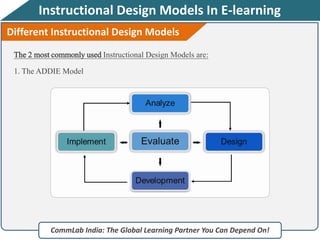
The 2 most commonly used Instructional Design Models are:
1. The ADDIE Model
Instructional Design Models In E-learning
CommLab India: The Global Learning Partner You Can Depend On!
The 2 most commonly used Instructional Design Models are:
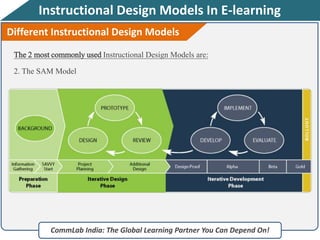
2. The SAM Model
Different Instructional Design Models
Instructional Design Models In E-learning
CommLab India: The Global Learning Partner You Can Depend On!
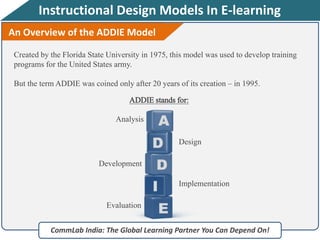
Created by the Florida State University in 1975, this model was used to develop training
programs for the United States army.
But the term ADDIE was coined only after 20 years of its creation – in 1995.
ADDIE stands for:
E
I
D
D
AAnalysis
Design
Development
Implementation
Evaluation
An Overview of the ADDIE Model
Instructional Design Models In E-learning
CommLab India: The Global Learning Partner You Can Depend On!
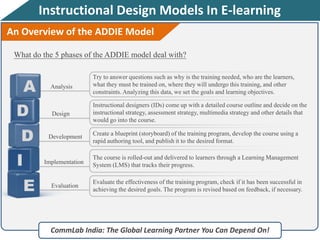
What do the 5 phases of the ADDIE model deal with?
E
I
D
D
A Analysis
Design
Development
Implementation
Evaluation
Try to answer questions such as why is the training needed, who are the learners,
what they must be trained on, where they will undergo this training, and other
constraints. Analyzing this data, we set the goals and learning objectives.
Instructional designers (IDs) come up with a detailed course outline and decide on the
instructional strategy, assessment strategy, multimedia strategy and other details that
would go into the course.
Create a blueprint (storyboard) of the training program, develop the course using a
rapid authoring tool, and publish it to the desired format.
The course is rolled-out and delivered to learners through a Learning Management
System (LMS) that tracks their progress.
Evaluate the effectiveness of the training program, check if it has been successful in
achieving the desired goals. The program is revised based on feedback, if necessary.
An Overview of the ADDIE Model
Instructional Design Models In E-learning
CommLab India: The Global Learning Partner You Can Depend On!
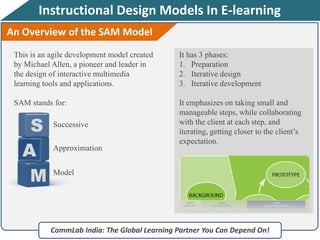
This is an agile development model created
by Michael Allen, a pioneer and leader in
the design of interactive multimedia
learning tools and applications.
SAM stands for:
M
A
S
It has 3 phases:
1. Preparation
2. Iterative design
3. Iterative development
It emphasizes on taking small and
manageable steps, while collaborating
with the client at each step, and
iterating, getting closer to the client’s
expectation.
Successive
Approximation
Model
An Overview of the SAM Model
Instructional Design Models In E-learning
CommLab India: The Global Learning Partner You Can Depend On!
What do the 3 phases of SAM deal with?
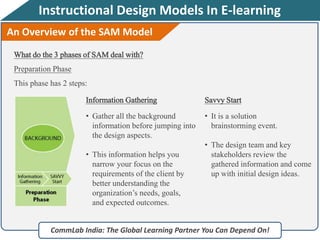
Preparation Phase
This phase has 2 steps:
Information Gathering
• Gather all the background
information before jumping into
the design aspects.
• This information helps you
narrow your focus on the
requirements of the client by
better understanding the
organization’s needs, goals,
and expected outcomes.
Savvy Start
• It is a solution
brainstorming event.
• The design team and key
stakeholders review the
gathered information and come
up with initial design ideas.
An Overview of the SAM Model
Instructional Design Models In E-learning
CommLab India: The Global Learning Partner You Can Depend On!
What do the 3 phases of SAM deal with?
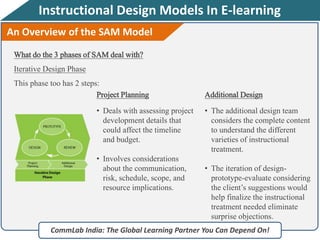
Iterative Design Phase
This phase too has 2 steps:
Project Planning
• Deals with assessing project
development details that
could affect the timeline
and budget.
• Involves considerations
about the communication,
risk, schedule, scope, and
resource implications.
Additional Design
• The additional design team
considers the complete content
to understand the different
varieties of instructional
treatment.
• The iteration of design-
prototype-evaluate considering
the client’s suggestions would
help finalize the instructional
treatment needed eliminate
surprise objections.
An Overview of the SAM Model
Instructional Design Models In E-learning
CommLab India: The Global Learning Partner You Can Depend On!
What do the 3 phases of SAM deal with?
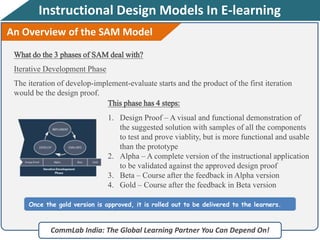
Iterative Development Phase
The iteration of develop-implement-evaluate starts and the product of the first iteration
would be the design proof.
This phase has 4 steps:
1. Design Proof – A visual and functional demonstration of
the suggested solution with samples of all the components
to test and prove viablity, but is more functional and usable
than the prototype
2. Alpha – A complete version of the instructional application
to be validated against the approved design proof
3. Beta – Course after the feedback in Alpha version
4. Gold – Course after the feedback in Beta version
Once the gold version is approved, it is rolled out to be delivered to the learners.
An Overview of the SAM Model
Instructional Design Models In E-learning
CommLab India: The Global Learning Partner You Can Depend On!
Summary
An Instructional Design Model is a tool or framework to develop instructional material. It:
• Helps provide a structure and meaning to the learning material
• Allows visualize the training need and break down the process of designing training
material into steps
• Provides guidelines to ensure training addresses the learning objectives
The effective implementation of this step:
• Saves a lot of money for the organization
• Prevents you from developing training for problems that does not require training
• Helps you find possible gaps in the content
The 2 most commonly used Instructional Design Models are:
1. The ADDIE model
2. The Successive Approximation Model
Instructional Design Models In E-learning
CommLab India: The Global Learning Partner You Can Depend On!

Instructional Design Model in E-learning

  • 1.
    Instructional Design Models InE-learning CommLab India: The Global Learning Partner You Can Depend On!
  • 2.
    Introduction Instructional Design ModelsIn E-learning Information is a source of learning. But unless it is organized, processed, and available to the right people in a format for decision making, it is a burden, not a benefit. ─ C. William Pollard, Chairman, Fairwyn Investment Company CommLab India: The Global Learning Partner You Can Depend On!
  • 3.
    Instructional Design ModelsIn E-learning Dumping information in the form of bland, text-heavy manuals does not facilitate an effective learning experience. Information needs to be organized in a way that helps learners understand easily and retain it for a long time. CommLab India: The Global Learning Partner You Can Depend On! How do you ensure your training is organized, processed, and available to the right people? Introduction
  • 4.
    Instructional Design ModelsIn E-learning You need a well-defined process CommLab India: The Global Learning Partner You Can Depend On! Instructional Design Model Introduction
  • 5.
    Instructional Design ModelsIn E-learning CommLab India: The Global Learning Partner You Can Depend On! What is an Instructional Design Model An Instructional Design Model is a tool or framework to develop instructional material. An Instructional Design Model: • Helps instructional designers provide a structure and meaning to the learning material • Allows them to visualize the training need and break down the process of designing training material into steps • Provides guidelines to ensure training addresses the learning objectives and meets the desired expectations
  • 6.
    Instructional Design ModelsIn E-learning CommLab India: The Global Learning Partner You Can Depend On! Benefits of Using an Instructional Design Model You will be able to figure out:
  • 7.
    Instructional Design ModelsIn E-learning CommLab India: The Global Learning Partner You Can Depend On! Benefits of Using an Instructional Design Model The effective implementation of this step: Prevents you from developing training for problems that do not require training
  • 8.
    Instructional Design ModelsIn E-learning CommLab India: The Global Learning Partner You Can Depend On! Different Instructional Design Models The 2 most commonly used Instructional Design Models are: 1. The ADDIE Model
  • 9.
    Instructional Design ModelsIn E-learning CommLab India: The Global Learning Partner You Can Depend On! The 2 most commonly used Instructional Design Models are: 2. The SAM Model Different Instructional Design Models
  • 10.
    Instructional Design ModelsIn E-learning CommLab India: The Global Learning Partner You Can Depend On! Created by the Florida State University in 1975, this model was used to develop training programs for the United States army. But the term ADDIE was coined only after 20 years of its creation – in 1995. ADDIE stands for: E I D D AAnalysis Design Development Implementation Evaluation An Overview of the ADDIE Model
  • 11.
    Instructional Design ModelsIn E-learning CommLab India: The Global Learning Partner You Can Depend On! What do the 5 phases of the ADDIE model deal with? E I D D A Analysis Design Development Implementation Evaluation Try to answer questions such as why is the training needed, who are the learners, what they must be trained on, where they will undergo this training, and other constraints. Analyzing this data, we set the goals and learning objectives. Instructional designers (IDs) come up with a detailed course outline and decide on the instructional strategy, assessment strategy, multimedia strategy and other details that would go into the course. Create a blueprint (storyboard) of the training program, develop the course using a rapid authoring tool, and publish it to the desired format. The course is rolled-out and delivered to learners through a Learning Management System (LMS) that tracks their progress. Evaluate the effectiveness of the training program, check if it has been successful in achieving the desired goals. The program is revised based on feedback, if necessary. An Overview of the ADDIE Model
  • 12.
    Instructional Design ModelsIn E-learning CommLab India: The Global Learning Partner You Can Depend On! This is an agile development model created by Michael Allen, a pioneer and leader in the design of interactive multimedia learning tools and applications. SAM stands for: M A S It has 3 phases: 1. Preparation 2. Iterative design 3. Iterative development It emphasizes on taking small and manageable steps, while collaborating with the client at each step, and iterating, getting closer to the client’s expectation. Successive Approximation Model An Overview of the SAM Model
  • 13.
    Instructional Design ModelsIn E-learning CommLab India: The Global Learning Partner You Can Depend On! What do the 3 phases of SAM deal with? Preparation Phase This phase has 2 steps: Information Gathering • Gather all the background information before jumping into the design aspects. • This information helps you narrow your focus on the requirements of the client by better understanding the organization’s needs, goals, and expected outcomes. Savvy Start • It is a solution brainstorming event. • The design team and key stakeholders review the gathered information and come up with initial design ideas. An Overview of the SAM Model
  • 14.
    Instructional Design ModelsIn E-learning CommLab India: The Global Learning Partner You Can Depend On! What do the 3 phases of SAM deal with? Iterative Design Phase This phase too has 2 steps: Project Planning • Deals with assessing project development details that could affect the timeline and budget. • Involves considerations about the communication, risk, schedule, scope, and resource implications. Additional Design • The additional design team considers the complete content to understand the different varieties of instructional treatment. • The iteration of design- prototype-evaluate considering the client’s suggestions would help finalize the instructional treatment needed eliminate surprise objections. An Overview of the SAM Model
  • 15.
    Instructional Design ModelsIn E-learning CommLab India: The Global Learning Partner You Can Depend On! What do the 3 phases of SAM deal with? Iterative Development Phase The iteration of develop-implement-evaluate starts and the product of the first iteration would be the design proof. This phase has 4 steps: 1. Design Proof – A visual and functional demonstration of the suggested solution with samples of all the components to test and prove viablity, but is more functional and usable than the prototype 2. Alpha – A complete version of the instructional application to be validated against the approved design proof 3. Beta – Course after the feedback in Alpha version 4. Gold – Course after the feedback in Beta version Once the gold version is approved, it is rolled out to be delivered to the learners. An Overview of the SAM Model
  • 16.
    Instructional Design ModelsIn E-learning CommLab India: The Global Learning Partner You Can Depend On! Summary An Instructional Design Model is a tool or framework to develop instructional material. It: • Helps provide a structure and meaning to the learning material • Allows visualize the training need and break down the process of designing training material into steps • Provides guidelines to ensure training addresses the learning objectives The effective implementation of this step: • Saves a lot of money for the organization • Prevents you from developing training for problems that does not require training • Helps you find possible gaps in the content The 2 most commonly used Instructional Design Models are: 1. The ADDIE model 2. The Successive Approximation Model
  • 17.
    Instructional Design ModelsIn E-learning CommLab India: The Global Learning Partner You Can Depend On!