LESSON PLAN FORMAT
(The 4As Approach)
What is a lesson plan?
• Is a framework and a road map, which each teacher
will create using an individual style.
• A good lesson plan is one that sees the “big picture”
but includes detailed information for each activity.
• Details will vary depending on the preference of the
teacher, subject being covered, and the need
and/or curiosity of students. There may be
requirements mandated by the school system
regarding the plan.
Main Parts of a Lesson Plan
• Learning Objectives
• Subject Matter / Learning Content
• Procedure / Learning Experiences
• Evaluation / Assessment
• Assignment / Agreement
Learning Objectives
• Statement describing what a student is
expected to learn from the lesson. The
learning objective provides a detailed
description of what the student will be able to
do when the instruction ends.
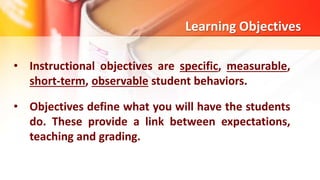
• Instructional objectives are specific, measurable,
short-term, observable student behaviors.
• Objectives define what you will have the students
do. These provide a link between expectations,
teaching and grading.
Learning Objectives
Learning Objectives
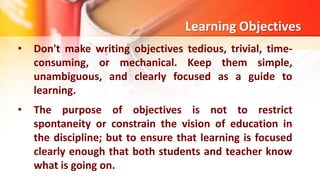
• Don't make writing objectives tedious, trivial, time-
consuming, or mechanical. Keep them simple,
unambiguous, and clearly focused as a guide to
learning.
• The purpose of objectives is not to restrict
spontaneity or constrain the vision of education in
the discipline; but to ensure that learning is focused
clearly enough that both students and teacher know
what is going on.
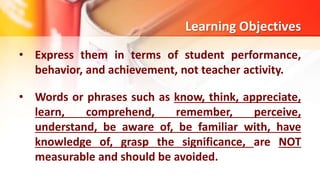
• Express them in terms of student performance,
behavior, and achievement, not teacher activity.
• Words or phrases such as know, think, appreciate,
learn, comprehend, remember, perceive,
understand, be aware of, be familiar with, have
knowledge of, grasp the significance, are NOT
measurable and should be avoided.
Learning Objectives
Learning Objectives
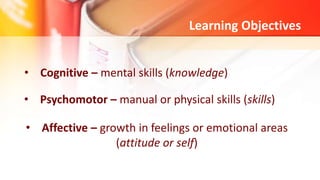
• Cognitive – mental skills (knowledge)
• Psychomotor – manual or physical skills (skills)
• Affective – growth in feelings or emotional areas
(attitude or self)
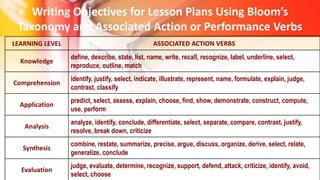
Writing Objectives for Lesson Plans Using Bloom’s
Taxonomy and Associated Action or Performance Verbs
LEARNING LEVEL ASSOCIATED ACTION VERBS
Knowledge
define, describe, state, list, name, write, recall, recognize, label, underline, select,
reproduce, outline, match
Comprehension
identify, justify, select, indicate, illustrate, represent, name, formulate, explain, judge,
contrast, classify
Application
predict, select, assess, explain, choose, find, show, demonstrate, construct, compute,
use, perform
Analysis
analyze, identify, conclude, differentiate, select, separate, compare, contrast, justify,
resolve, break down, criticize
Synthesis
combine, restate, summarize, precise, argue, discuss, organize, derive, select, relate,
generalize, conclude
Evaluation
judge, evaluate, determine, recognize, support, defend, attack, criticize, identify, avoid,
select, choose
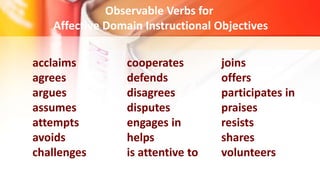
acclaims
agrees
argues
assumes
attempts
avoids
challenges
cooperates
defends
disagrees
disputes
engages in
helps
is attentive to
joins
offers
participates in
praises
resists
shares
volunteers
Observable Verbs for
Affective Domain Instructional Objectives
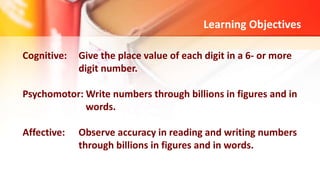
Learning Objectives
Cognitive: Give the place value of each digit in a 6- or more
digit number.
Psychomotor: Write numbers through billions in figures and in
words.
Affective: Observe accuracy in reading and writing numbers
through billions in figures and in words.
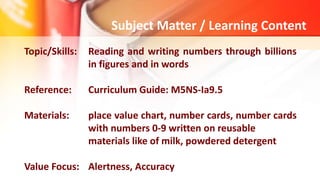
Topic/Skills: Reading and writing numbers through billions
in figures and in words
Reference: Curriculum Guide: M5NS-Ia9.5
Materials: place value chart, number cards, number cards
with numbers 0-9 written on reusable
materials like of milk, powdered detergent
Value Focus: Alertness, Accuracy
Subject Matter / Learning Content
Procedure / Learning Experiences
• Approach – deal with the general philosophies of
teaching.
APPROACHES VERSUS STRATEGIES VERSUS METHOD
• Strategy – deal with specific actions.
• Method – it is an organized effort and procedure
based on the selected strategy.
THE 4As APPROACH
A. Preparatory Activities
1. Action Song
2. Drill
3. Review
4. Motivation
B. Developmental Activities
1. Presentation (optional)
2. Activity
3. Analysis and Discussion
4. Abstraction
5. Application
THE 4As APPROACH
Procedure / Learning Experiences
4As APPROACH
• Activity
• Analysis
• Abstraction
• Application
4As APPROACH
• ACTIVITY
This will bring understanding to what the learners
already know and clarity to what learners should
learn further. At this early stage, the student should
already have a retrospect of what they will be
learning through the activity that will be presented.
4As APPROACH
• ANALYSIS
A more in-depth understanding of the lesson, it is
another phase where the students will process and
classify what is valid and not. The teacher on this
part will ask further questions and will also lead as a
facilitator rather than mere lecturing and sharing
facts and ideas. The students know gains a wider
view of the lesson but at the same time draws closer
to the main topic.
4As APPROACH
• ABSTRACTION
The teacher on this part will now focus entirely on
the lesson being presented and ask more lead
questions to lead the students in reinforcing what
they know and should know more. The student here
starts to feel more the importance of the lesson to
her and see the necessity of it to his/her life.
4As APPROACH
• APPLICATION
The word itself describes the stage as bringing the
student to a more practical way of using HOW are
they going to use what they have learned and
thinking of new ways on how it can be improved
further.
Evaluation / Assessment
• Formative assessment
- assessment for learning
- assessment as learning
2 TYPES OF ASSESSMENT
• Summative assessment
- assessment of learning
Assignment / Agreement
Assignment offers opportunities for extensive
activities in the receptive skills which there may not
be time for in the classroom. It may also be an
integral part of ongoing learning such as project
work and the use of a graded reader.

Lesson plan format.pptx

  • 1.
  • 2.
    What is alesson plan? • Is a framework and a road map, which each teacher will create using an individual style. • A good lesson plan is one that sees the “big picture” but includes detailed information for each activity. • Details will vary depending on the preference of the teacher, subject being covered, and the need and/or curiosity of students. There may be requirements mandated by the school system regarding the plan.
  • 3.
    Main Parts ofa Lesson Plan • Learning Objectives • Subject Matter / Learning Content • Procedure / Learning Experiences • Evaluation / Assessment • Assignment / Agreement
  • 4.
    Learning Objectives • Statementdescribing what a student is expected to learn from the lesson. The learning objective provides a detailed description of what the student will be able to do when the instruction ends.
  • 5.
    • Instructional objectivesare specific, measurable, short-term, observable student behaviors. • Objectives define what you will have the students do. These provide a link between expectations, teaching and grading. Learning Objectives
  • 6.
    Learning Objectives • Don'tmake writing objectives tedious, trivial, time- consuming, or mechanical. Keep them simple, unambiguous, and clearly focused as a guide to learning. • The purpose of objectives is not to restrict spontaneity or constrain the vision of education in the discipline; but to ensure that learning is focused clearly enough that both students and teacher know what is going on.
  • 7.
    • Express themin terms of student performance, behavior, and achievement, not teacher activity. • Words or phrases such as know, think, appreciate, learn, comprehend, remember, perceive, understand, be aware of, be familiar with, have knowledge of, grasp the significance, are NOT measurable and should be avoided. Learning Objectives
  • 8.
    Learning Objectives • Cognitive– mental skills (knowledge) • Psychomotor – manual or physical skills (skills) • Affective – growth in feelings or emotional areas (attitude or self)
  • 9.
    Writing Objectives forLesson Plans Using Bloom’s Taxonomy and Associated Action or Performance Verbs LEARNING LEVEL ASSOCIATED ACTION VERBS Knowledge define, describe, state, list, name, write, recall, recognize, label, underline, select, reproduce, outline, match Comprehension identify, justify, select, indicate, illustrate, represent, name, formulate, explain, judge, contrast, classify Application predict, select, assess, explain, choose, find, show, demonstrate, construct, compute, use, perform Analysis analyze, identify, conclude, differentiate, select, separate, compare, contrast, justify, resolve, break down, criticize Synthesis combine, restate, summarize, precise, argue, discuss, organize, derive, select, relate, generalize, conclude Evaluation judge, evaluate, determine, recognize, support, defend, attack, criticize, identify, avoid, select, choose
  • 10.
    acclaims agrees argues assumes attempts avoids challenges cooperates defends disagrees disputes engages in helps is attentiveto joins offers participates in praises resists shares volunteers Observable Verbs for Affective Domain Instructional Objectives
  • 11.
    Learning Objectives Cognitive: Givethe place value of each digit in a 6- or more digit number. Psychomotor: Write numbers through billions in figures and in words. Affective: Observe accuracy in reading and writing numbers through billions in figures and in words.
  • 12.
    Topic/Skills: Reading andwriting numbers through billions in figures and in words Reference: Curriculum Guide: M5NS-Ia9.5 Materials: place value chart, number cards, number cards with numbers 0-9 written on reusable materials like of milk, powdered detergent Value Focus: Alertness, Accuracy Subject Matter / Learning Content
  • 13.
    Procedure / LearningExperiences • Approach – deal with the general philosophies of teaching. APPROACHES VERSUS STRATEGIES VERSUS METHOD • Strategy – deal with specific actions. • Method – it is an organized effort and procedure based on the selected strategy.
  • 14.
    THE 4As APPROACH A.Preparatory Activities 1. Action Song 2. Drill 3. Review 4. Motivation
  • 15.
    B. Developmental Activities 1.Presentation (optional) 2. Activity 3. Analysis and Discussion 4. Abstraction 5. Application THE 4As APPROACH
  • 16.
    Procedure / LearningExperiences 4As APPROACH • Activity • Analysis • Abstraction • Application
  • 17.
    4As APPROACH • ACTIVITY Thiswill bring understanding to what the learners already know and clarity to what learners should learn further. At this early stage, the student should already have a retrospect of what they will be learning through the activity that will be presented.
  • 18.
    4As APPROACH • ANALYSIS Amore in-depth understanding of the lesson, it is another phase where the students will process and classify what is valid and not. The teacher on this part will ask further questions and will also lead as a facilitator rather than mere lecturing and sharing facts and ideas. The students know gains a wider view of the lesson but at the same time draws closer to the main topic.
  • 19.
    4As APPROACH • ABSTRACTION Theteacher on this part will now focus entirely on the lesson being presented and ask more lead questions to lead the students in reinforcing what they know and should know more. The student here starts to feel more the importance of the lesson to her and see the necessity of it to his/her life.
  • 20.
    4As APPROACH • APPLICATION Theword itself describes the stage as bringing the student to a more practical way of using HOW are they going to use what they have learned and thinking of new ways on how it can be improved further.
  • 21.
    Evaluation / Assessment •Formative assessment - assessment for learning - assessment as learning 2 TYPES OF ASSESSMENT • Summative assessment - assessment of learning
  • 22.
    Assignment / Agreement Assignmentoffers opportunities for extensive activities in the receptive skills which there may not be time for in the classroom. It may also be an integral part of ongoing learning such as project work and the use of a graded reader.