CALL
Computer-Assisted Language Learning
1. What is CALL?
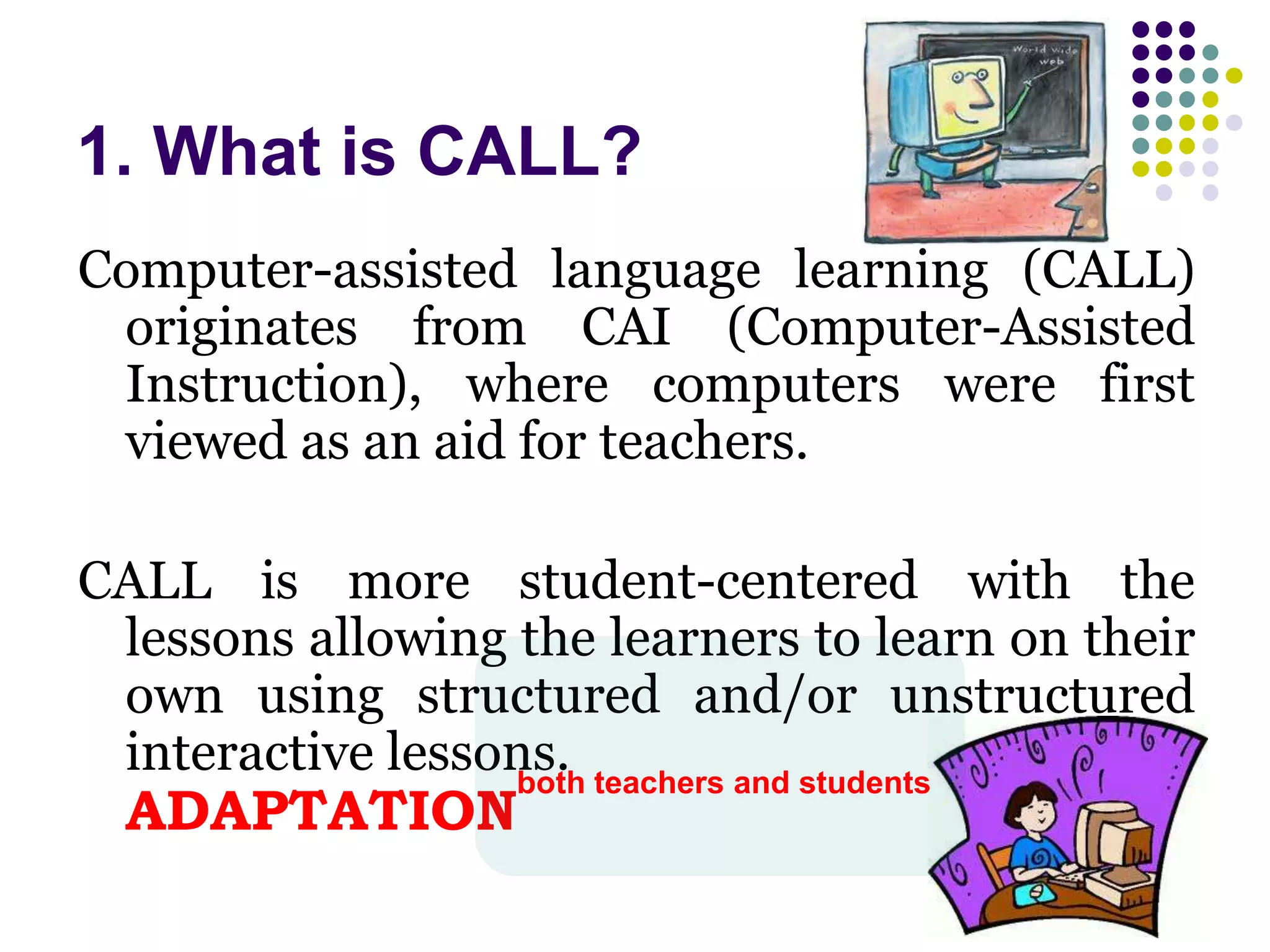
Computer-assisted language learning (CALL)
originates from CAI (Computer-Assisted
Instruction), where computers were first
viewed as an aid for teachers.
CALL is more student-centered with the
lessons allowing the learners to learn on their
own using structured and/or unstructured
interactive lessons.
ADAPTATION
both teachers and students
Typology and periods
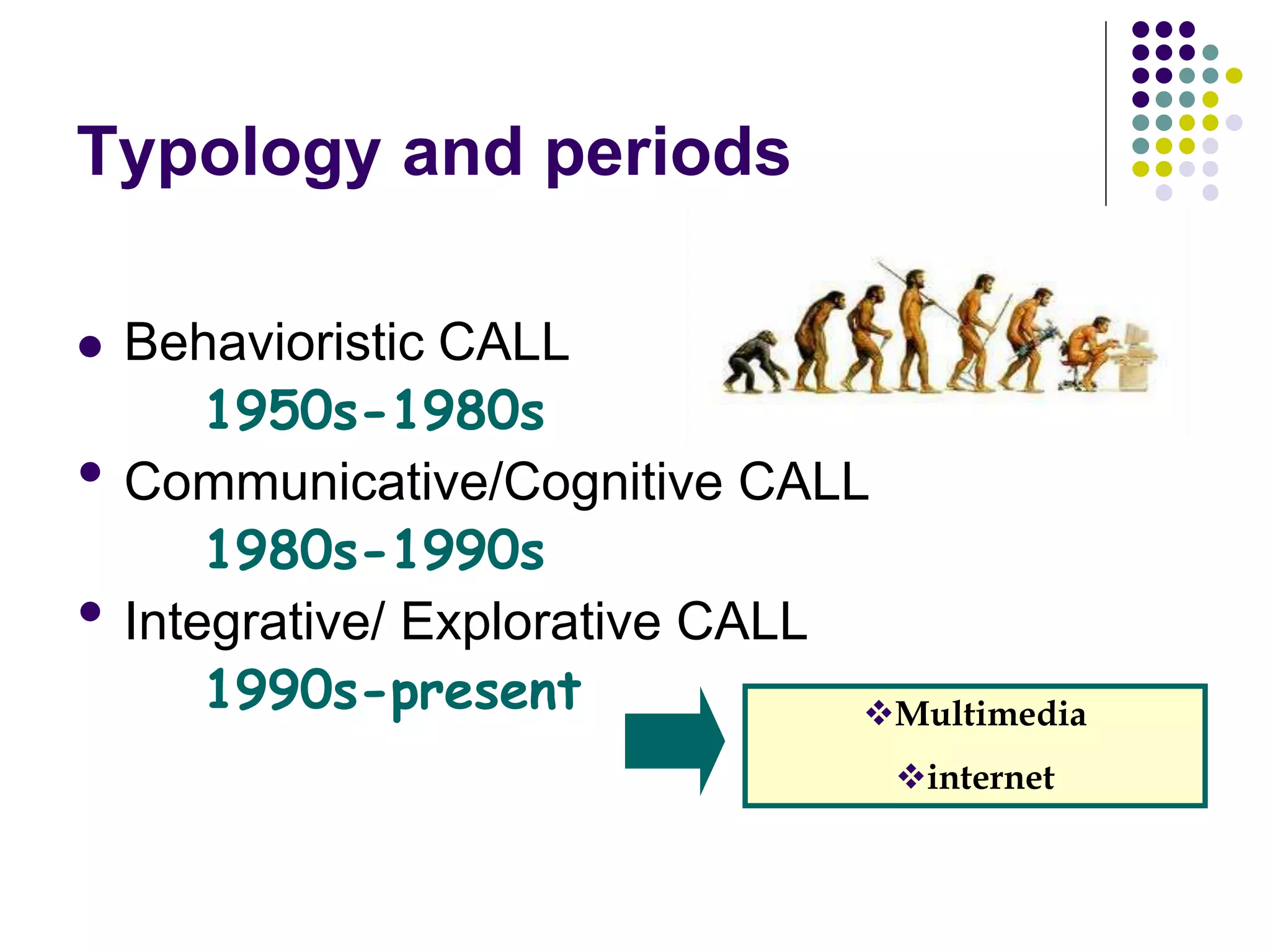
 Behavioristic CALL
1950s-1980s
• Communicative/Cognitive CALL
1980s-1990s
• Integrative/ Explorative CALL
1990s-present Multimedia
internet
Behaviorist CALL
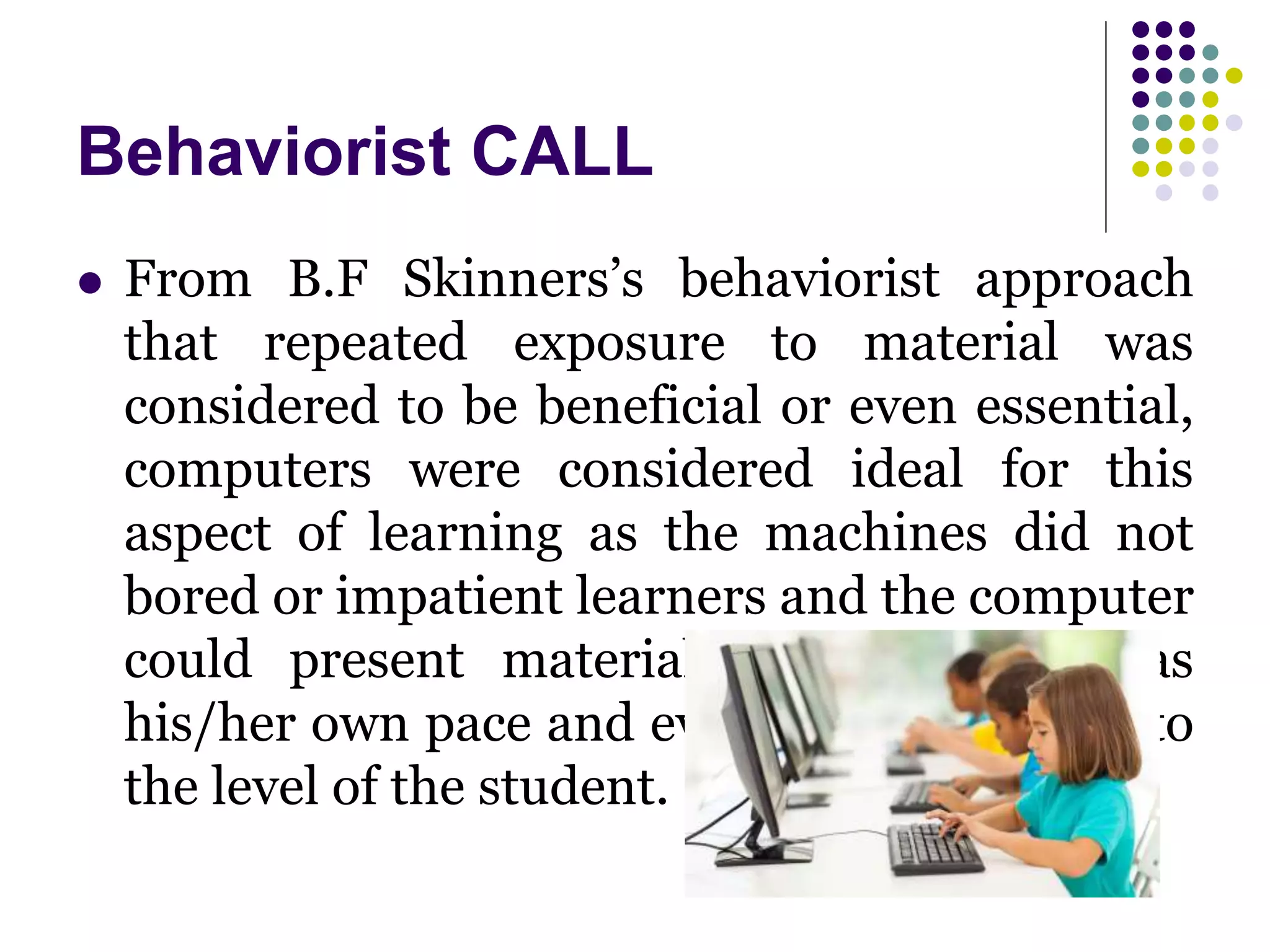
 From B.F Skinners’s behaviorist approach
that repeated exposure to material was
considered to be beneficial or even essential,
computers were considered ideal for this
aspect of learning as the machines did not
bored or impatient learners and the computer
could present material to the student as
his/her own pace and even adapt the drills to
the level of the student.
Communicative CALL
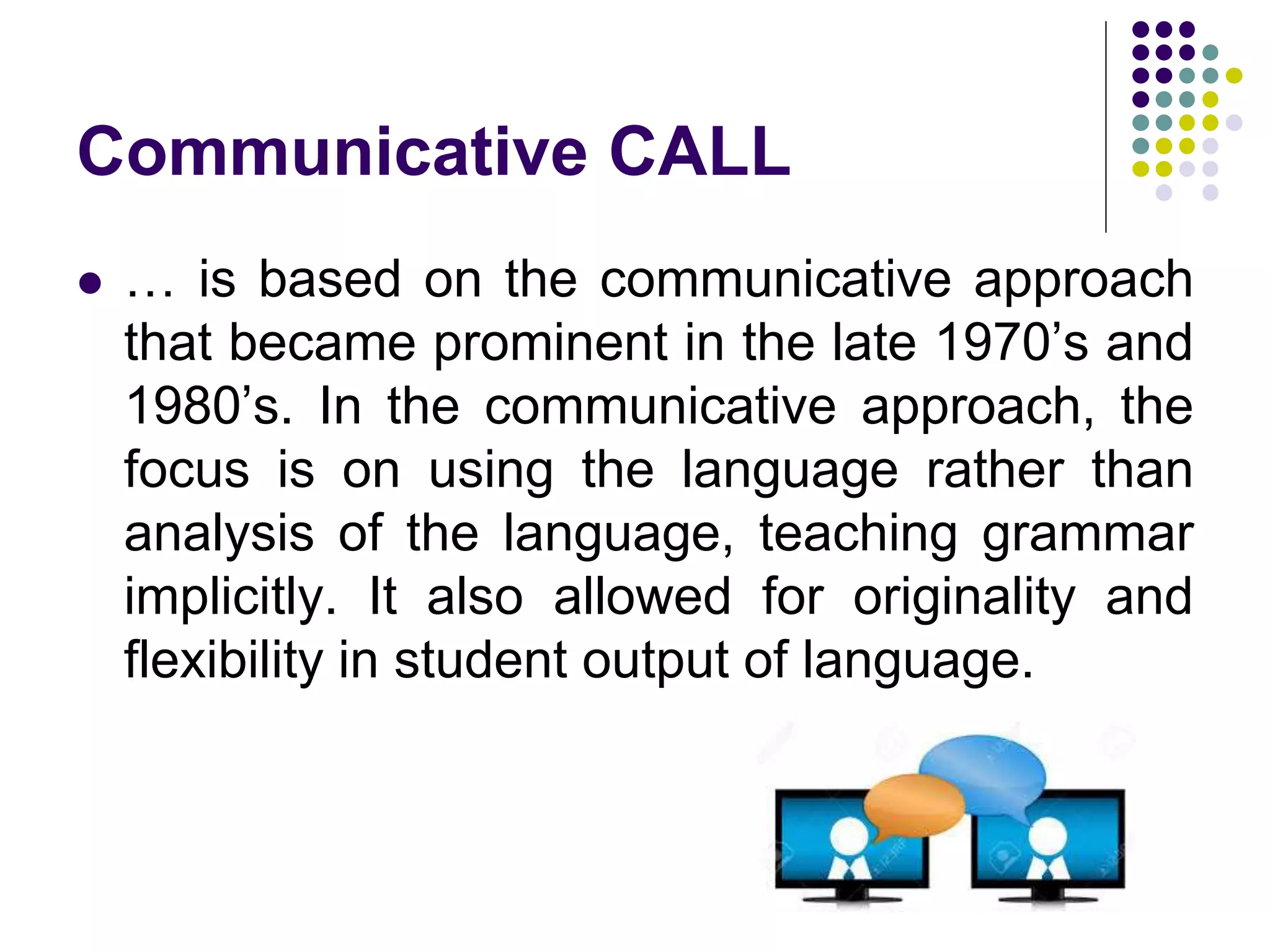
 … is based on the communicative approach
that became prominent in the late 1970’s and
1980’s. In the communicative approach, the
focus is on using the language rather than
analysis of the language, teaching grammar
implicitly. It also allowed for originality and
flexibility in student output of language.
Integrative or explorative
CALL
 starting from the 1990’s, tries to address
these criticisms by integrating the teaching of
language skills into tasks or projects to
provide direction and coherence.
 It also coincides with the development of
multimedia technology (providing text,
graphics, sound and animation) as well as
computer-mediated communication.
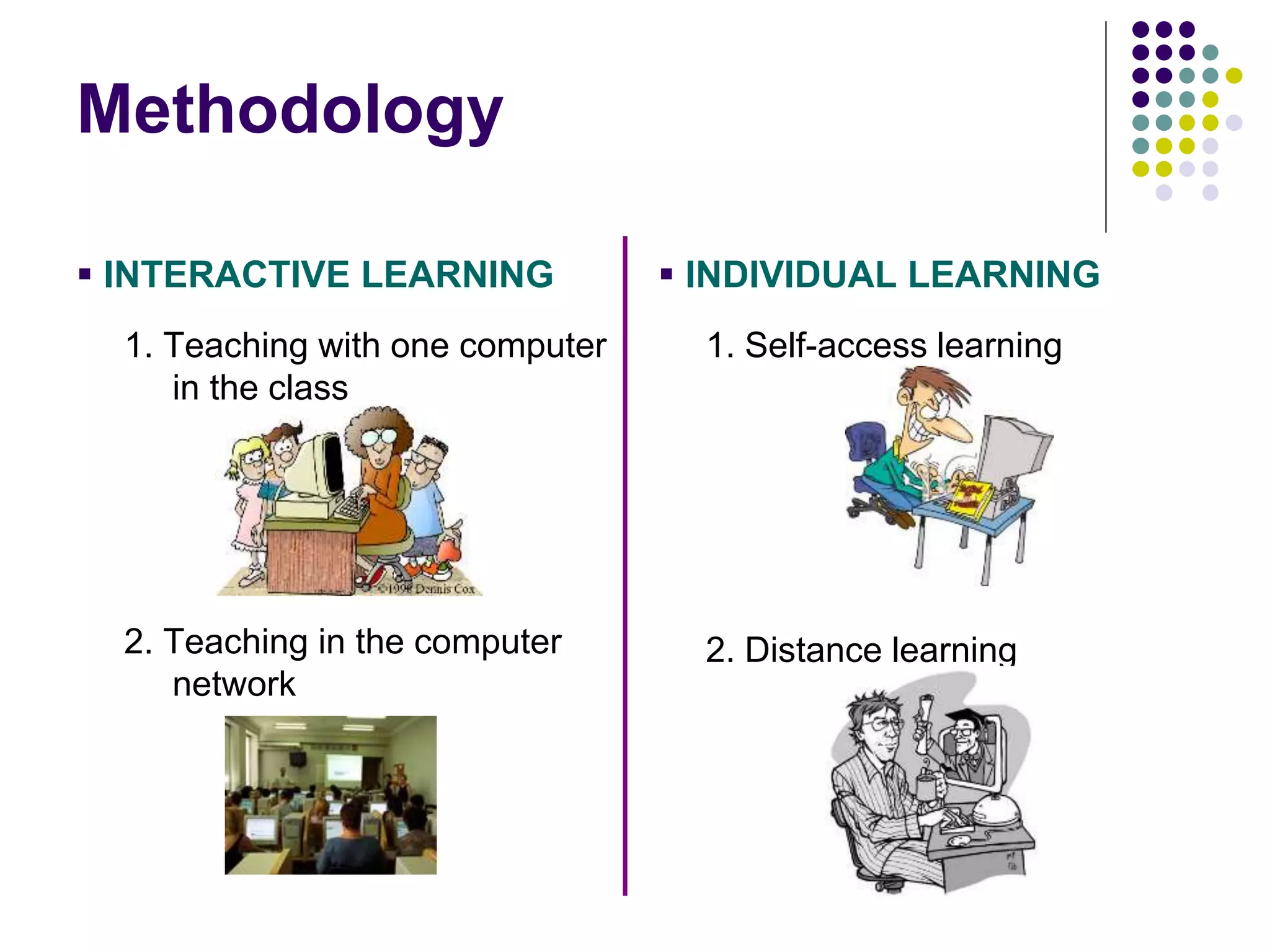
Methodology
 INTERACTIVE LEARNING
1. Teaching with one computer
in the class
2. Teaching in the computer
network
 INDIVIDUAL LEARNING
1. Self-access learning
2. Distance learning
• It is a tool that helps teachers to
facilitate language learning
process.
• CALL can be used to reinforce
what has been learned in the
classrooms.
• It can also be used as remedial to
help learners with limited
language proficiency.
REFERENCES
 www.ict4lt.org/en/warschauer.htm
 www.uned.es/ca-tudela/revista/n002/raul_santiago.htm
 www.wik.ed.uiuc.edu/index.php/CALL:Computer_Assiste
d_Language_Learning
 Bax,S. (2003). CALL – past, present and future. System,
31 (1): 13-28.
 www.kn.pacbell.com/wired/fil/pages/listweb20s.html
 www.classroom20.com/
Thank you
for your attention!

Computer Assisted Language Learning

  • 1.
  • 2.
    1. What isCALL? Computer-assisted language learning (CALL) originates from CAI (Computer-Assisted Instruction), where computers were first viewed as an aid for teachers. CALL is more student-centered with the lessons allowing the learners to learn on their own using structured and/or unstructured interactive lessons. ADAPTATION both teachers and students
  • 3.
    Typology and periods Behavioristic CALL 1950s-1980s • Communicative/Cognitive CALL 1980s-1990s • Integrative/ Explorative CALL 1990s-present Multimedia internet
  • 4.
    Behaviorist CALL  FromB.F Skinners’s behaviorist approach that repeated exposure to material was considered to be beneficial or even essential, computers were considered ideal for this aspect of learning as the machines did not bored or impatient learners and the computer could present material to the student as his/her own pace and even adapt the drills to the level of the student.
  • 5.
    Communicative CALL  …is based on the communicative approach that became prominent in the late 1970’s and 1980’s. In the communicative approach, the focus is on using the language rather than analysis of the language, teaching grammar implicitly. It also allowed for originality and flexibility in student output of language.
  • 6.
    Integrative or explorative CALL starting from the 1990’s, tries to address these criticisms by integrating the teaching of language skills into tasks or projects to provide direction and coherence.  It also coincides with the development of multimedia technology (providing text, graphics, sound and animation) as well as computer-mediated communication.
  • 7.
    Methodology  INTERACTIVE LEARNING 1.Teaching with one computer in the class 2. Teaching in the computer network  INDIVIDUAL LEARNING 1. Self-access learning 2. Distance learning
  • 8.
    • It isa tool that helps teachers to facilitate language learning process. • CALL can be used to reinforce what has been learned in the classrooms. • It can also be used as remedial to help learners with limited language proficiency.
  • 9.
    REFERENCES  www.ict4lt.org/en/warschauer.htm  www.uned.es/ca-tudela/revista/n002/raul_santiago.htm www.wik.ed.uiuc.edu/index.php/CALL:Computer_Assiste d_Language_Learning  Bax,S. (2003). CALL – past, present and future. System, 31 (1): 13-28.  www.kn.pacbell.com/wired/fil/pages/listweb20s.html  www.classroom20.com/
  • 10.

Editor's Notes

  • #5  Because repeated exposure to material was considered to be beneficial or even essential, computers were considered ideal for this aspect of learning as the machines did not get bored or impatient with learners and the computer could present material to the student as his/her own pace and even adapt the drills to the level of the student.