(Class-2)
Learning Process- Behaviorism, Cognitivism and
Constructivism
Col Zulfiquer Ahmed Amin
M Phil, MPH, PGD (Health Economics), MBBS
Armed Forces Medical Institute (AFMI)
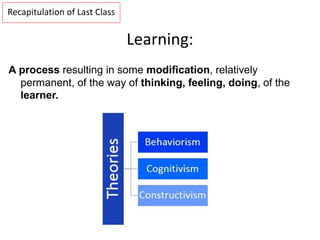
Learning:
Recapitulation of Last Class
A process resulting in some modification, relatively
permanent, of the way of thinking, feeling, doing, of the
learner.
1. When stimuli and response are paired; same stimuli always create
same response. It is neither reflexive, nor response to reward-
punishment stimuli (Contiguity Theory).
2. Because, response has turned out to be reflexive against a learned
stimuli; having no connection to reward-punishment stimuli
(Classical Theory).
3. Because, we behave in a way to avail a reward or to avert a
punishment, without any reflex (Operant Theory).
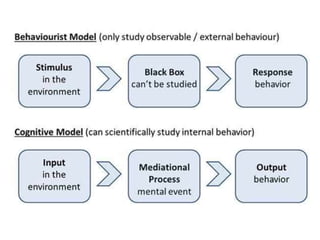
As per theory of Behaviorism, our behavior is determined by
external stimulus:
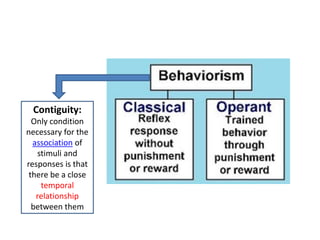
Contiguity:
Only condition
necessary for the
association of
stimuli and
responses is that
there be a close
temporal
relationship
between them
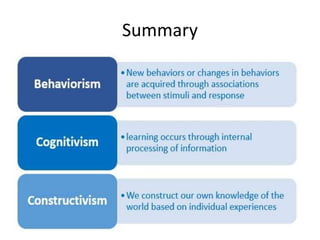
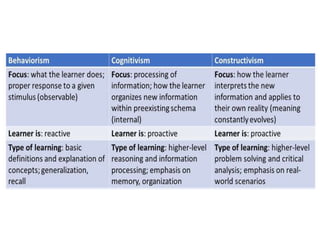
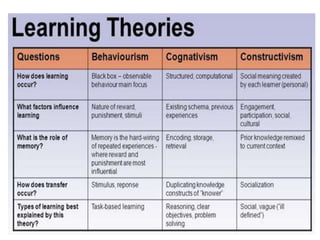
1. Behaviorism: Learning is a response to external
stimuli.
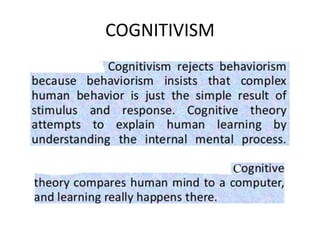
2. Cognitivism: Learning is a process of acquiring, storing
and retrieving information like a computer.
3. Constructivism: Learning is a process of building an
understanding basing on past experiences and present
inputs.
Over-view on the key three theories of Learning:
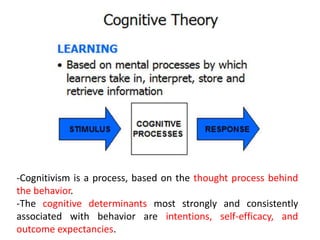
-Cognitivism is a process, based on the thought process behind
the behavior.
-The cognitive determinants most strongly and consistently
associated with behavior are intentions, self-efficacy, and
outcome expectancies.
COGNITIVISM
-The cognitive view takes the learner to be an
active processor of information.
-It means that the cognitive theory tries to create
the people to be active to think.
THE EDUCATIONAL IMPLICATION OF COGNITIVE THEORIES
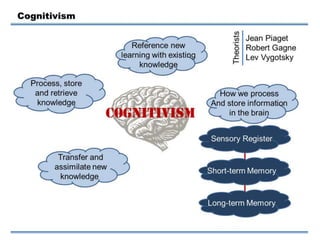
Cognitivism involves the study of mental processes that
occurs inside the brain such as:
-Sensation,
-Perception,
-Attention,
-Encoding, and
-Memory.
PRINCIPLES OF COGNITIVISM
Sensation is something physical that comes
from an external stimulus. We will probably
remember this sensation, for example a
child can be burnt by touching a candle, but he
or she will not touch a candle again because he
or she will remember the sensation.
The perception consists on a representation that
comes from the sensation. It is the process of
organizing the information, making an
interpretation of it and finally doing a
representation. Perception is subjective, so for
every person the same thing will
mean different.
Attention: ‘Attention’ stresses in the
concentrating to one thing, that is the most
important than the others.
When we are selectively attending to one
activity, we tend to ignore other stimulation.
The ability to shift attention immediately when a
word or voice from a peripheral stream of
speech "grabs" your attention (e.g., someone in
a noisy room says your name)- ‘Cocktail-party
phenomenon’
Encoding: When information comes into our memory system
(from sensory input), it needs to be changed into a form that
the system can cope with, so that it can be stored.
There are three main ways in which information can be
encoded (changed):
1. Visual (Picture)
2. Acoustic (Sound)
3. Semantic (Meaning)
For example, how do you remember a telephone number you
have looked up in the phone book? If you can see it then you
are using visual coding, but if you are repeating it to yourself
you are using acoustic coding (by sound).
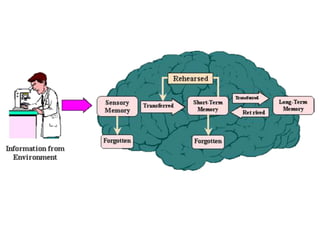
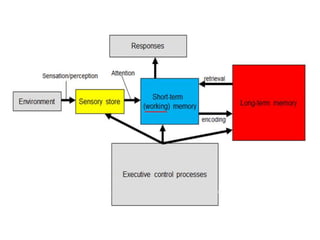
Memory is the ability to keep and remind the
information in our mind. It consists of:
-Short term memory,
-Long term memory, and
-Sensory.
1
2
3
There are three domains (Areas) of educational activities or learning:
-Cognitive: Mental skills (knowledge).
-Affective: Growth in feelings or emotional areas (attitude or self).
-Psychomotor: Manual or physical skills (skills).
Cognitive Domain
The cognitive domain involves knowledge and the development of
intellectual skills. This includes the recall or recognition of specific
facts, procedural patterns, and concepts that serve in the
development of intellectual abilities and skills. There are six major
categories of cognitive processes, starting from the simplest to the
most complex.
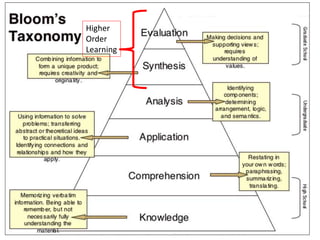
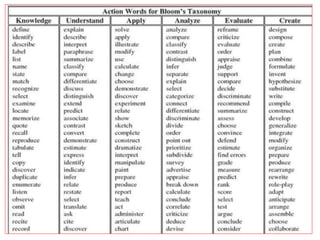
Bloom's Taxonomy of Learning Domains
-Bloom's taxonomy is a classification system developed by a
team, led by Benjamin Bloom used to define and distinguish
different levels of human cognition—i.e., thinking, learning, and
understanding.
-It is a derivative of theory of cognitivism.
-The goal of an educator using Bloom's taxonomy is to encourage
higher-order thought in their students by building up from
lower-level cognitive skills.
Higher
Order
Learning
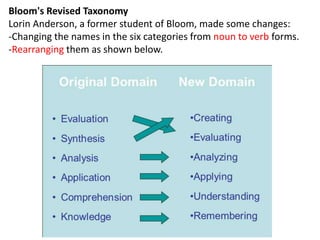
Bloom's Revised Taxonomy
Lorin Anderson, a former student of Bloom, made some changes:
-Changing the names in the six categories from noun to verb forms.
-Rearranging them as shown below.
Constructivism
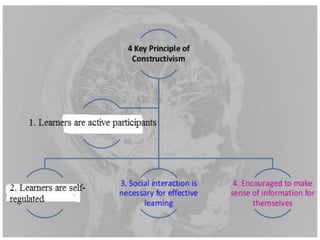
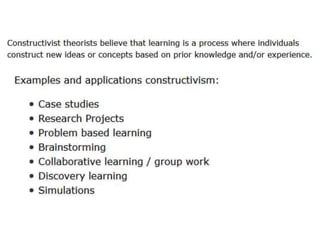
Constructivism says that people construct their own
understanding and knowledge of the world, through
experiencing things and reflecting on those experiences.
Constructivism is a learning strategy that draws on
students' existing knowledge, beliefs, and skills. With a
constructivist approach, students synthesize new
understanding from prior learning and new information.
Cognitive Theory
Cognitive theory states that humans learn and make decisions
based on what is the most logical thing to learn and do. In simpler
terms, humans think like computers in such a way that logic is the
top mechanism used in learning. It presupposes that the learning
process is merely based on intellect, without any emotional factors.
Constructivist Theory
Constructivism believes that learning is a combination of logic and
humanistic approaches.
Differences Between Cognitivism and Constructivism
Another difference in cognitivism and constructivism is that
cognitivism is not concerned with the willfulness, creativity, and
autonomy of the learners that constructivism considers in its focus
on the learning processes.
In constructivism, learners build their own meaning from new
knowledge. In cognitivism, learners have their knowledge built by
someone else.
The constructivist teacher sets up problems and
monitors student exploration, guides student inquiry,
and promotes new patterns of thinking.
• Learning is an active process in which the learner uses sensory
input and constructs meaning out of it.
• People learn to learn as they learn: learning consists both of
constructing meaning and constructing systems of meaning.
For example, if we learn the chronology of dates of a series of
historical events, we are simultaneously learning the meaning
of a chronology. Each meaning we construct makes us better
able to give meaning to other sensations which can fit a
similar pattern.
• The crucial action of constructing meaning is mental: it
happens in the mind.
• Learning involves language: the language we use influences
learning.
Learning Principles in Constructivism
• Learning is a social activity: our learning is intimately associated
with our connection with other human beings, our teachers, our
peers, our family as well as casual acquaintances, including the
people before us or next to us at the exhibit.
• Learning is contextual: we do not learn isolated facts and theories
separate from the rest of our lives: we learn in relationship to
what else we know, what we believe, our prejudices and our fears.
• One needs knowledge to learn: it is not possible to assimilate new
knowledge without having some structure developed from
previous knowledge to build on. The more we know, the more we
can learn.
• Motivation is a key component in learning. Unless we know “the
reasons why”, we may not be very involved in using the
knowledge that may be instilled in us.
How to apply ‘constructvism’ in the classroom?
-Encourage and support student initiative and autonomy.
-Try to use raw data and primary sources.
-Create a thinking and problem-solving environment.
-Supporting to build student understanding.
-Frame tasks using processes such as classifying, analyzing,
predicting and creating.
-Encourage communication between the teacher and the students
and also between the students.
-Encourage student critical thinking and inquiry by asking them
thoughtful, open-ended questions, and encourage them to ask
questions to each other.
-Provide enough time for students to construct their own meaning
when learning something new.
‘Learning-Effectiveness’ by various methods:
• Lecture = 5%
• Reading = 10%
• Audiovisual = 20%
• Demonstration = 30%
• Discussion Group = 50%
• Practice by doing = 75%
• Teach others / immediate use of learning =
90%
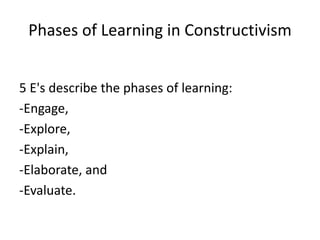
Phases of Learning in Constructivism
5 E's describe the phases of learning:
-Engage,
-Explore,
-Explain,
-Elaborate, and
-Evaluate.
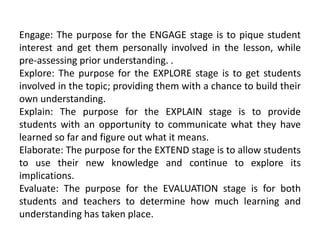
Engage: The purpose for the ENGAGE stage is to pique student
interest and get them personally involved in the lesson, while
pre-assessing prior understanding. .
Explore: The purpose for the EXPLORE stage is to get students
involved in the topic; providing them with a chance to build their
own understanding.
Explain: The purpose for the EXPLAIN stage is to provide
students with an opportunity to communicate what they have
learned so far and figure out what it means.
Elaborate: The purpose for the EXTEND stage is to allow students
to use their new knowledge and continue to explore its
implications.
Evaluate: The purpose for the EVALUATION stage is for both
students and teachers to determine how much learning and
understanding has taken place.
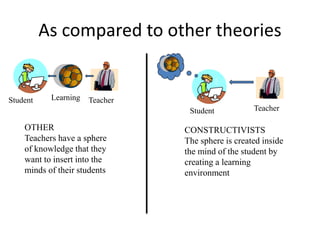
As compared to other theories
Student TeacherLearning
OTHER
Teachers have a sphere
of knowledge that they
want to insert into the
minds of their students
Student Teacher
CONSTRUCTIVISTS
The sphere is created inside
the mind of the student by
creating a learning
environment
Summary
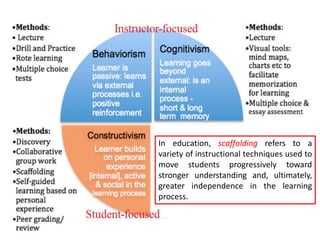
In education, scaffolding refers to a
variety of instructional techniques used to
move students progressively toward
stronger understanding and, ultimately,
greater independence in the learning
process.
Learning Process: Behaviorism, Cognitivism and Constructivism

Learning Process: Behaviorism, Cognitivism and Constructivism

  • 1.
    (Class-2) Learning Process- Behaviorism,Cognitivism and Constructivism Col Zulfiquer Ahmed Amin M Phil, MPH, PGD (Health Economics), MBBS Armed Forces Medical Institute (AFMI)
  • 2.
    Learning: Recapitulation of LastClass A process resulting in some modification, relatively permanent, of the way of thinking, feeling, doing, of the learner.
  • 3.
    1. When stimuliand response are paired; same stimuli always create same response. It is neither reflexive, nor response to reward- punishment stimuli (Contiguity Theory). 2. Because, response has turned out to be reflexive against a learned stimuli; having no connection to reward-punishment stimuli (Classical Theory). 3. Because, we behave in a way to avail a reward or to avert a punishment, without any reflex (Operant Theory). As per theory of Behaviorism, our behavior is determined by external stimulus:
  • 4.
    Contiguity: Only condition necessary forthe association of stimuli and responses is that there be a close temporal relationship between them
  • 5.
    1. Behaviorism: Learningis a response to external stimuli. 2. Cognitivism: Learning is a process of acquiring, storing and retrieving information like a computer. 3. Constructivism: Learning is a process of building an understanding basing on past experiences and present inputs. Over-view on the key three theories of Learning:
  • 6.
    -Cognitivism is aprocess, based on the thought process behind the behavior. -The cognitive determinants most strongly and consistently associated with behavior are intentions, self-efficacy, and outcome expectancies.
  • 7.
  • 11.
    -The cognitive viewtakes the learner to be an active processor of information. -It means that the cognitive theory tries to create the people to be active to think. THE EDUCATIONAL IMPLICATION OF COGNITIVE THEORIES
  • 12.
    Cognitivism involves thestudy of mental processes that occurs inside the brain such as: -Sensation, -Perception, -Attention, -Encoding, and -Memory. PRINCIPLES OF COGNITIVISM
  • 13.
    Sensation is somethingphysical that comes from an external stimulus. We will probably remember this sensation, for example a child can be burnt by touching a candle, but he or she will not touch a candle again because he or she will remember the sensation.
  • 14.
    The perception consistson a representation that comes from the sensation. It is the process of organizing the information, making an interpretation of it and finally doing a representation. Perception is subjective, so for every person the same thing will mean different.
  • 15.
    Attention: ‘Attention’ stressesin the concentrating to one thing, that is the most important than the others. When we are selectively attending to one activity, we tend to ignore other stimulation. The ability to shift attention immediately when a word or voice from a peripheral stream of speech "grabs" your attention (e.g., someone in a noisy room says your name)- ‘Cocktail-party phenomenon’
  • 16.
    Encoding: When informationcomes into our memory system (from sensory input), it needs to be changed into a form that the system can cope with, so that it can be stored. There are three main ways in which information can be encoded (changed): 1. Visual (Picture) 2. Acoustic (Sound) 3. Semantic (Meaning) For example, how do you remember a telephone number you have looked up in the phone book? If you can see it then you are using visual coding, but if you are repeating it to yourself you are using acoustic coding (by sound).
  • 17.
    Memory is theability to keep and remind the information in our mind. It consists of: -Short term memory, -Long term memory, and -Sensory.
  • 19.
  • 20.
  • 21.
  • 22.
    There are threedomains (Areas) of educational activities or learning: -Cognitive: Mental skills (knowledge). -Affective: Growth in feelings or emotional areas (attitude or self). -Psychomotor: Manual or physical skills (skills). Cognitive Domain The cognitive domain involves knowledge and the development of intellectual skills. This includes the recall or recognition of specific facts, procedural patterns, and concepts that serve in the development of intellectual abilities and skills. There are six major categories of cognitive processes, starting from the simplest to the most complex.
  • 23.
    Bloom's Taxonomy ofLearning Domains -Bloom's taxonomy is a classification system developed by a team, led by Benjamin Bloom used to define and distinguish different levels of human cognition—i.e., thinking, learning, and understanding. -It is a derivative of theory of cognitivism. -The goal of an educator using Bloom's taxonomy is to encourage higher-order thought in their students by building up from lower-level cognitive skills.
  • 24.
  • 25.
    Bloom's Revised Taxonomy LorinAnderson, a former student of Bloom, made some changes: -Changing the names in the six categories from noun to verb forms. -Rearranging them as shown below.
  • 27.
    Constructivism Constructivism says thatpeople construct their own understanding and knowledge of the world, through experiencing things and reflecting on those experiences. Constructivism is a learning strategy that draws on students' existing knowledge, beliefs, and skills. With a constructivist approach, students synthesize new understanding from prior learning and new information.
  • 29.
    Cognitive Theory Cognitive theorystates that humans learn and make decisions based on what is the most logical thing to learn and do. In simpler terms, humans think like computers in such a way that logic is the top mechanism used in learning. It presupposes that the learning process is merely based on intellect, without any emotional factors. Constructivist Theory Constructivism believes that learning is a combination of logic and humanistic approaches. Differences Between Cognitivism and Constructivism
  • 30.
    Another difference incognitivism and constructivism is that cognitivism is not concerned with the willfulness, creativity, and autonomy of the learners that constructivism considers in its focus on the learning processes. In constructivism, learners build their own meaning from new knowledge. In cognitivism, learners have their knowledge built by someone else.
  • 31.
    The constructivist teachersets up problems and monitors student exploration, guides student inquiry, and promotes new patterns of thinking.
  • 32.
    • Learning isan active process in which the learner uses sensory input and constructs meaning out of it. • People learn to learn as they learn: learning consists both of constructing meaning and constructing systems of meaning. For example, if we learn the chronology of dates of a series of historical events, we are simultaneously learning the meaning of a chronology. Each meaning we construct makes us better able to give meaning to other sensations which can fit a similar pattern. • The crucial action of constructing meaning is mental: it happens in the mind. • Learning involves language: the language we use influences learning. Learning Principles in Constructivism
  • 33.
    • Learning isa social activity: our learning is intimately associated with our connection with other human beings, our teachers, our peers, our family as well as casual acquaintances, including the people before us or next to us at the exhibit. • Learning is contextual: we do not learn isolated facts and theories separate from the rest of our lives: we learn in relationship to what else we know, what we believe, our prejudices and our fears. • One needs knowledge to learn: it is not possible to assimilate new knowledge without having some structure developed from previous knowledge to build on. The more we know, the more we can learn. • Motivation is a key component in learning. Unless we know “the reasons why”, we may not be very involved in using the knowledge that may be instilled in us.
  • 34.
    How to apply‘constructvism’ in the classroom? -Encourage and support student initiative and autonomy. -Try to use raw data and primary sources. -Create a thinking and problem-solving environment. -Supporting to build student understanding. -Frame tasks using processes such as classifying, analyzing, predicting and creating. -Encourage communication between the teacher and the students and also between the students. -Encourage student critical thinking and inquiry by asking them thoughtful, open-ended questions, and encourage them to ask questions to each other. -Provide enough time for students to construct their own meaning when learning something new.
  • 35.
    ‘Learning-Effectiveness’ by variousmethods: • Lecture = 5% • Reading = 10% • Audiovisual = 20% • Demonstration = 30% • Discussion Group = 50% • Practice by doing = 75% • Teach others / immediate use of learning = 90%
  • 36.
    Phases of Learningin Constructivism 5 E's describe the phases of learning: -Engage, -Explore, -Explain, -Elaborate, and -Evaluate.
  • 37.
    Engage: The purposefor the ENGAGE stage is to pique student interest and get them personally involved in the lesson, while pre-assessing prior understanding. . Explore: The purpose for the EXPLORE stage is to get students involved in the topic; providing them with a chance to build their own understanding. Explain: The purpose for the EXPLAIN stage is to provide students with an opportunity to communicate what they have learned so far and figure out what it means. Elaborate: The purpose for the EXTEND stage is to allow students to use their new knowledge and continue to explore its implications. Evaluate: The purpose for the EVALUATION stage is for both students and teachers to determine how much learning and understanding has taken place.
  • 39.
    As compared toother theories Student TeacherLearning OTHER Teachers have a sphere of knowledge that they want to insert into the minds of their students Student Teacher CONSTRUCTIVISTS The sphere is created inside the mind of the student by creating a learning environment
  • 40.
  • 42.
    In education, scaffoldingrefers to a variety of instructional techniques used to move students progressively toward stronger understanding and, ultimately, greater independence in the learning process.