A guide by Chip Heath & Dan Heath
Quick Training Guide
To
Instructional Design (ID)
Kabiru IBRAHIM
Curriculum Developer
To equip you with the necessary tools/skills for effective design and delivery of engaging
and intuitive learning contents.
Why ⇒
Instructional Designers, Content and Curriculum Developers, Learning and
Development teams, and individuals considering career in talent development.
Who ⇒
Learning /Training Objectives
● Explore at least two Instructional Design models
● Analyze the learning needs
● Create learning contents using at least one of the Instructional Design models
By the end of this training, you will be able to:
Training Outline
● Introduction to ID
○ Definition of ID
○ Importance of ID
● Popular ID models
○ ADDIE
○ SAM
○ Other common ones
● General Content Creation Framework
● Assessment
Introduction to ID
● How do you learn?
● Which subject did you like most in College and Why?
● Which subject did you hate most in College and Why?
● Can you make any deduction from your answers to the last two questions above?
Introduction to ID
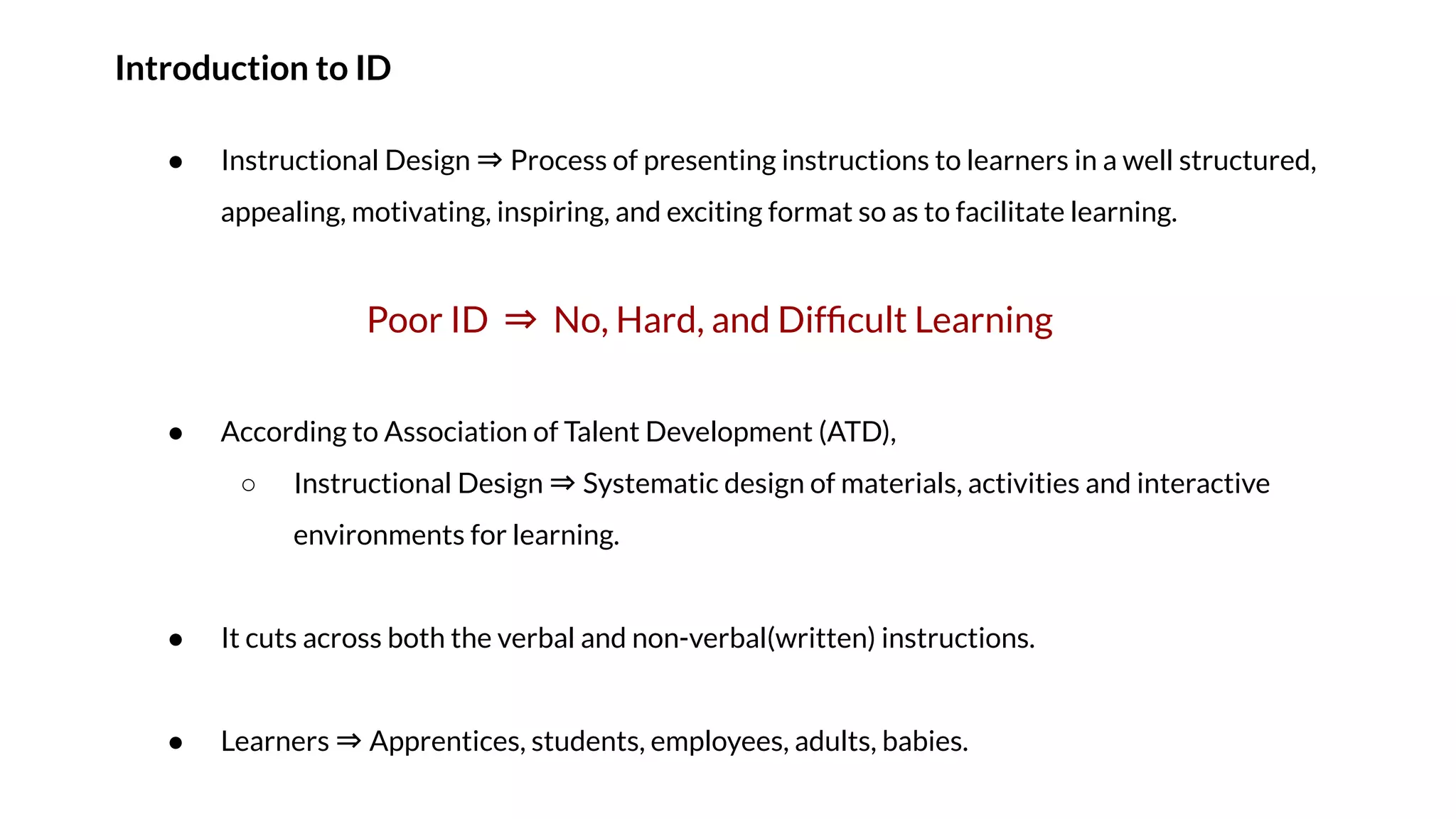
● Instructional Design ⇒ Process of presenting instructions to learners in a well structured,
appealing, motivating, inspiring, and exciting format so as to facilitate learning.
Poor ID ⇒ No, Hard, and Difficult Learning
● According to Association of Talent Development (ATD),
○ Instructional Design ⇒ Systematic design of materials, activities and interactive
environments for learning.
● It cuts across both the verbal and non-verbal(written) instructions.
● Learners ⇒ Apprentices, students, employees, adults, babies.
Introduction to ID
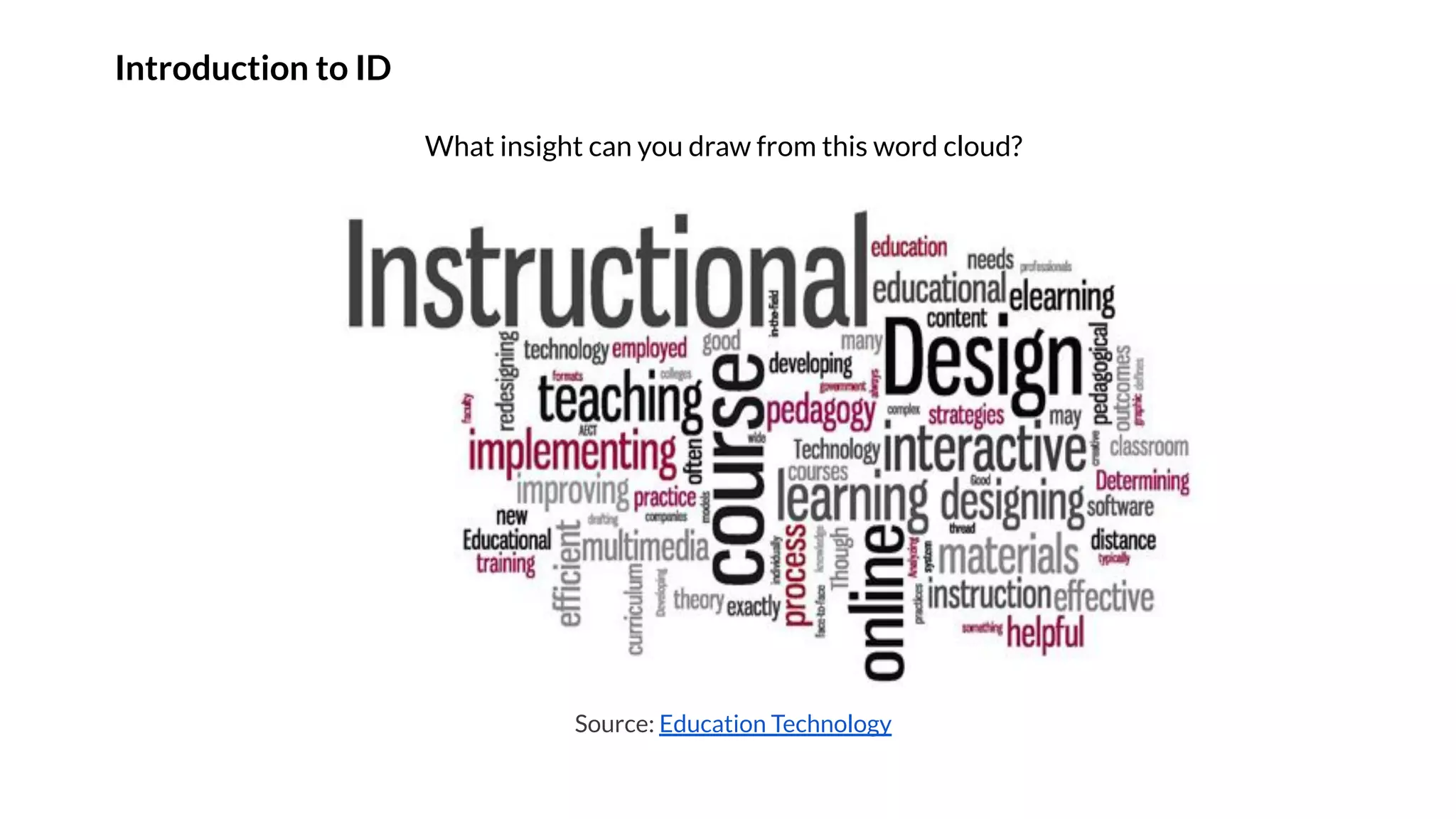
Source: Education Technology
What insight can you draw from this word cloud?
Introduction to ID
● The category of learner plays a major role in determining the way the instruction would be
structured - information architecturing.
● Important Guiding Question is ⇒ Who are my learners?
○ Knowledge of their learning profile
○ What is their level of access to the information I want to train them on?
Introduction to ID
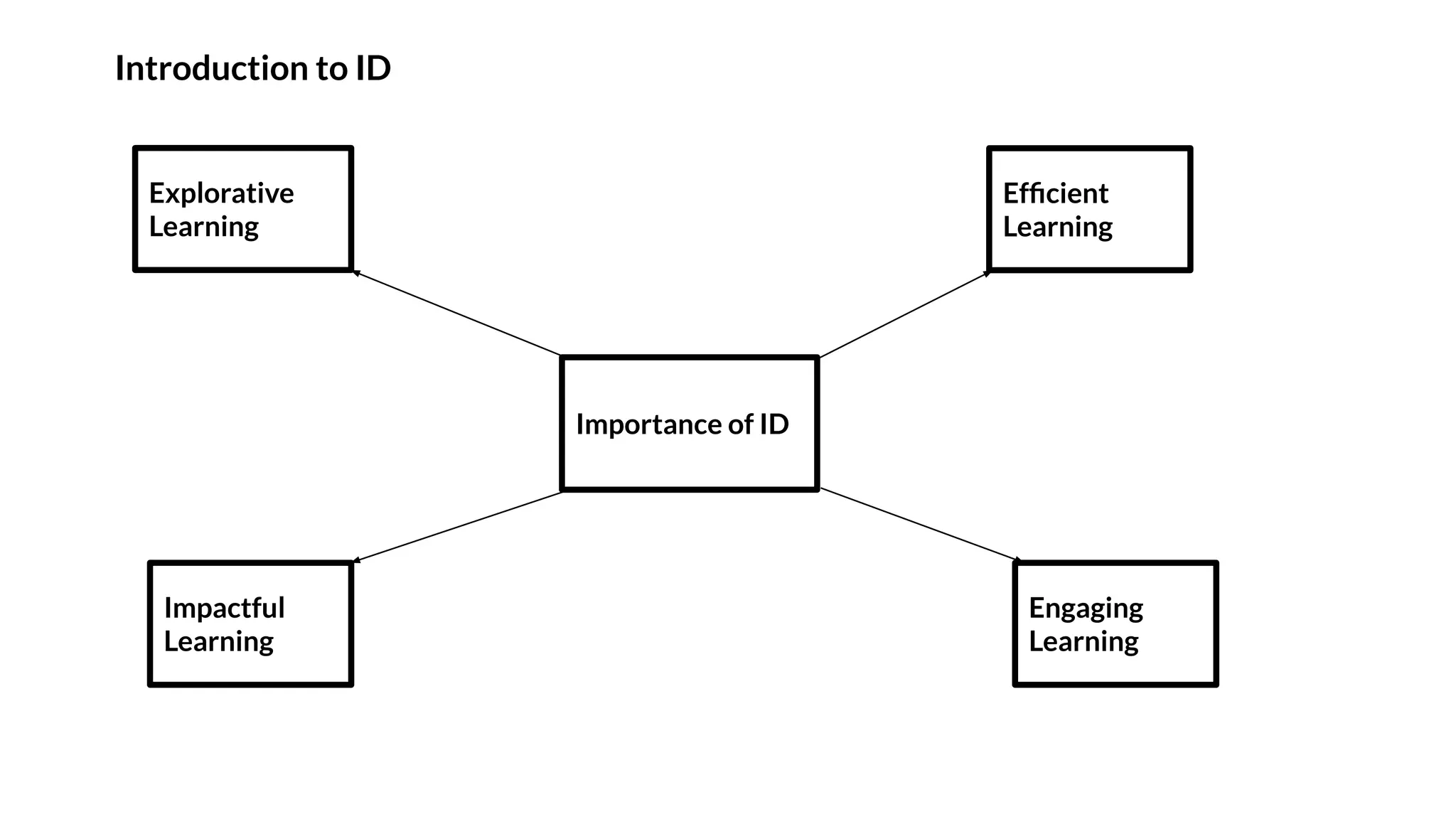
Importance of ID
Efficient
Learning
Engaging
Learning
Impactful
Learning
Explorative
Learning
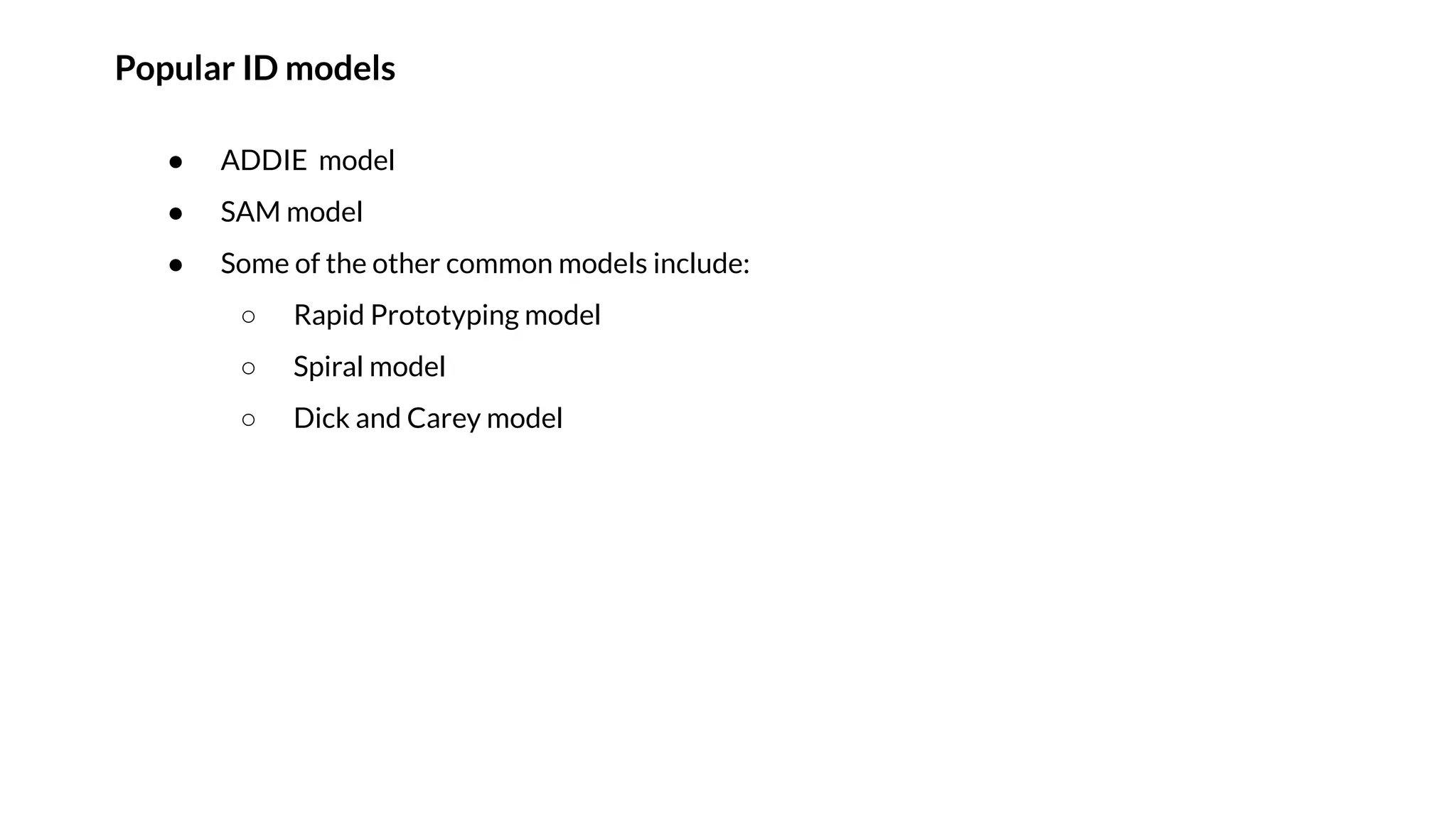
Popular ID models
● ADDIE model
● SAM model
● Some of the other common models include:
○ Rapid Prototyping model
○ Spiral model
○ Dick and Carey model
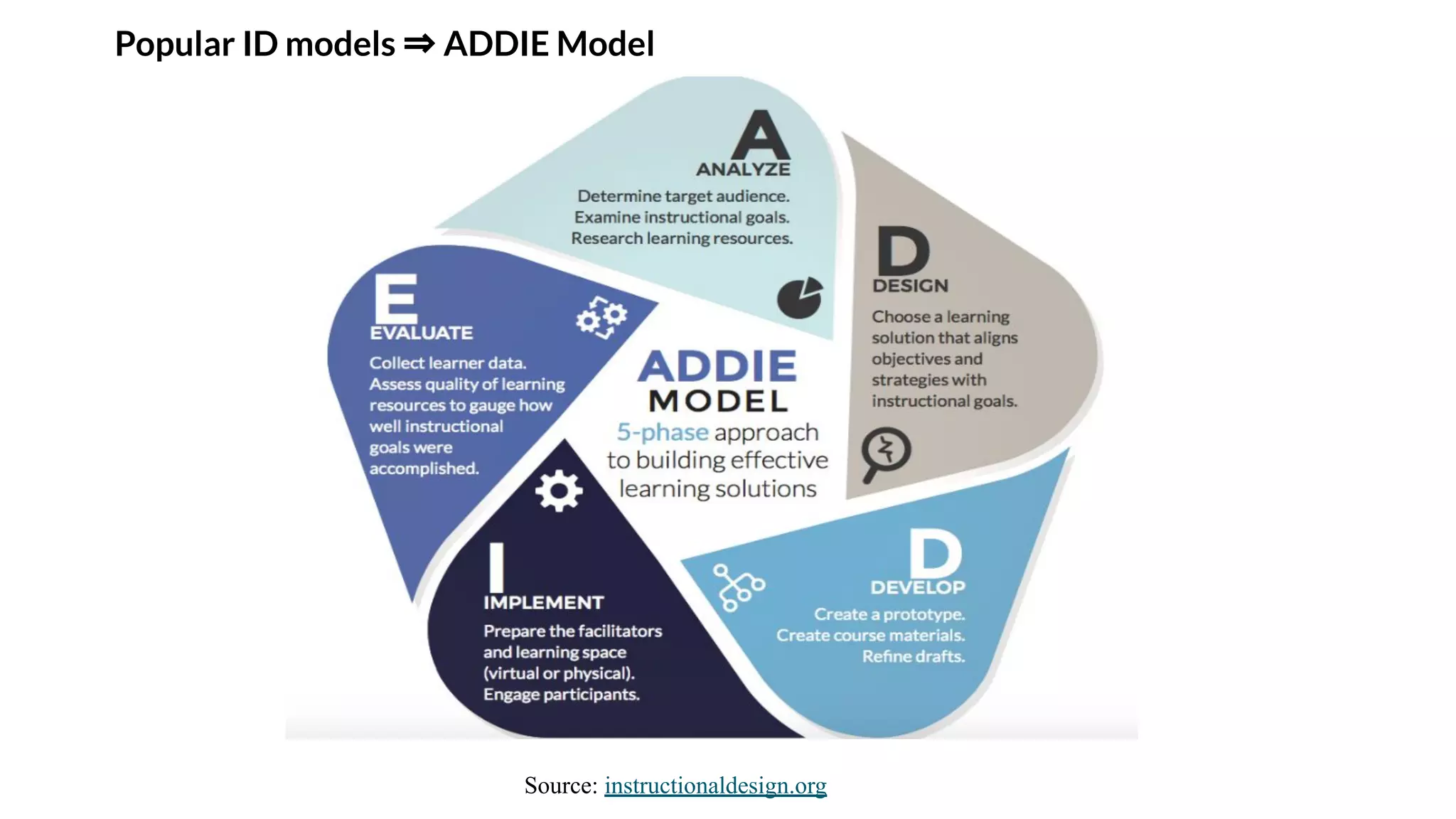
Popular ID models ⇒ ADDIE Model
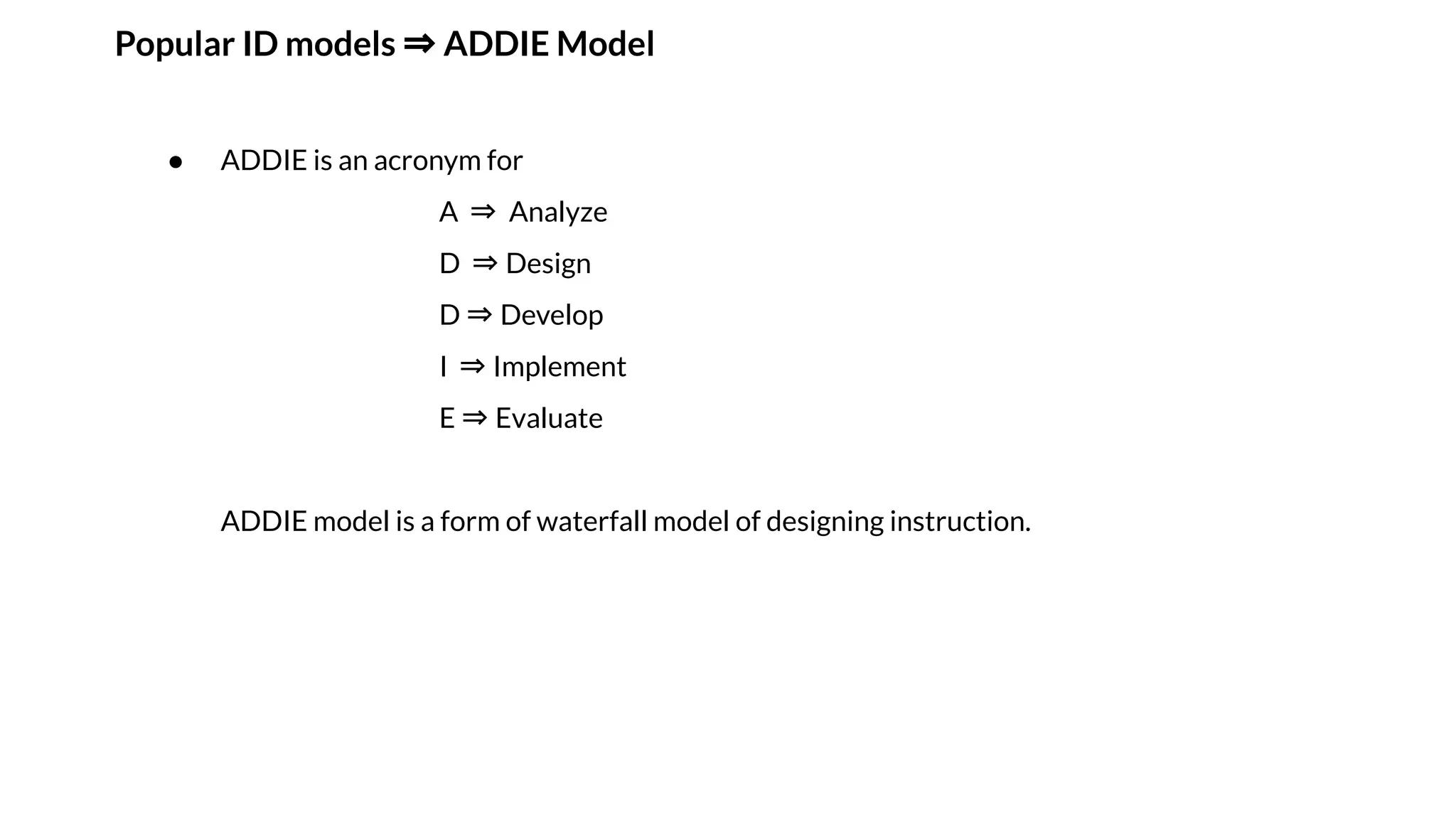
● ADDIE is an acronym for
A ⇒ Analyze
D ⇒ Design
D ⇒ Develop
I ⇒ Implement
E ⇒ Evaluate
ADDIE model is a form of waterfall model of designing instruction.
Popular ID models ⇒ ADDIE Model
Source: instructionaldesign.org
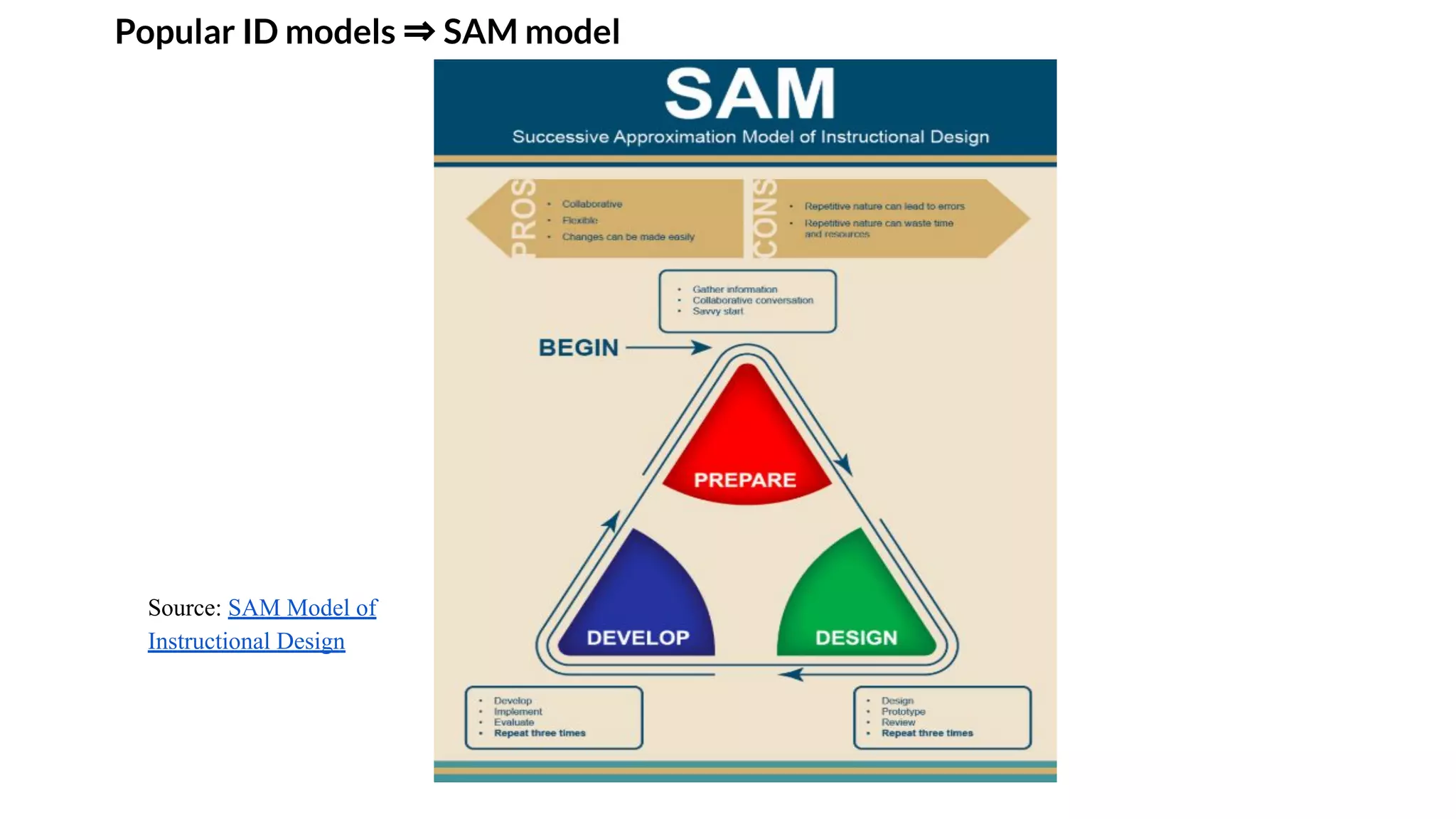
Popular ID models ⇒ SAM model
● SAM is an acronym for
S ⇒ Successive
A ⇒ Approximation
M ⇒ Model
SAM model explores Agile methodology in designing instruction as it allows several iterative
processes before the final release of the developed content.
Popular ID models ⇒ SAM model
Source: SAM Model of
Instructional Design
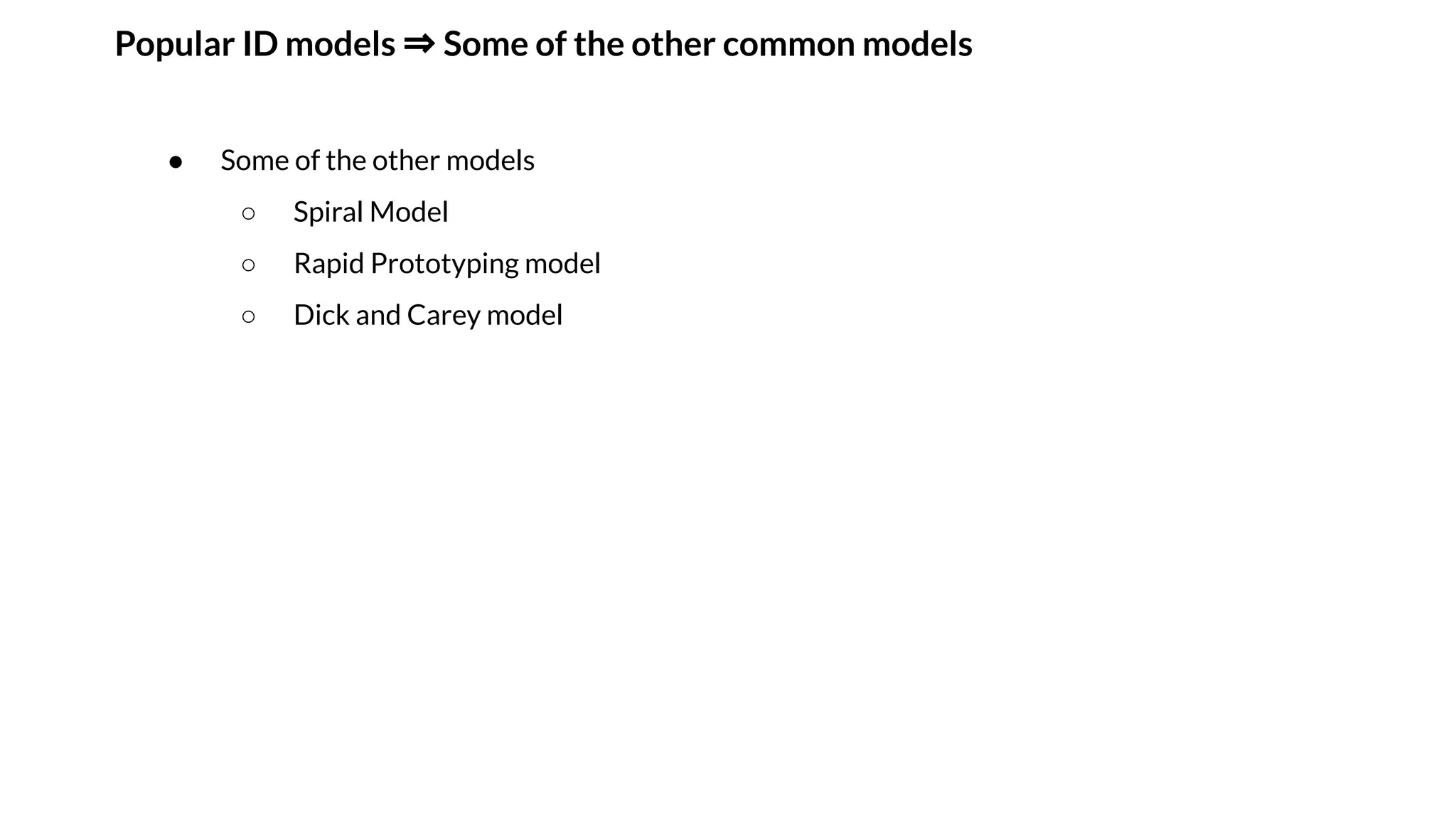
Popular ID models ⇒ Some of the other common models
● Some of the other models
○ Spiral Model
○ Rapid Prototyping model
○ Dick and Carey model
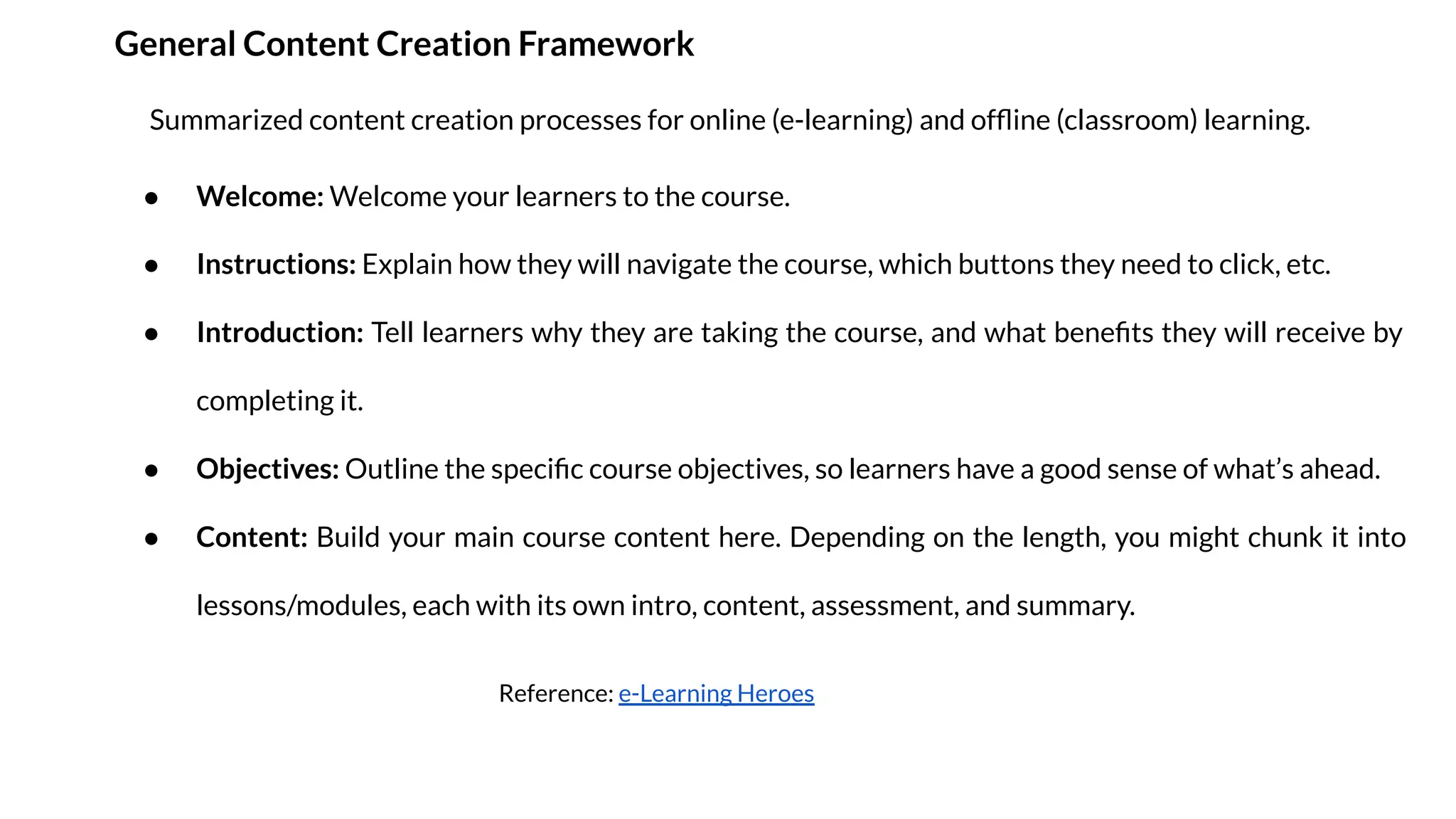
General Content Creation Framework
● Welcome: Welcome your learners to the course.
● Instructions: Explain how they will navigate the course, which buttons they need to click, etc.
● Introduction: Tell learners why they are taking the course, and what benefits they will receive by
completing it.
● Objectives: Outline the specific course objectives, so learners have a good sense of what’s ahead.
● Content: Build your main course content here. Depending on the length, you might chunk it into
lessons/modules, each with its own intro, content, assessment, and summary.
Summarized content creation processes for online (e-learning) and offline (classroom) learning.
Reference: e-Learning Heroes
General Content Creation Framework
● Assessment: Give learners an assessment to see whether they have actually learned the
material.
● Summary: Revisit the course objectives you stated up front.
● Resources: Offer additional content or resources that reinforce the course material.
● Exit: Give final instructions on how to exit the course.
Reference: e-Learning Heroes
Assessment ⇒ Quizzes
Question 1.
Which one of these descriptions is NOT an example of an advantage of using Instructional Design?
- Provides Learners’ Advocacy
- Assists in coordination
- Requires lead time
- Supports the development of alternative delivery
Assessment ⇒ Quizzes
Question 2.
Within Instructional Design, when does revision typically occur?
- Throughout the process
- At the end of the design process
- Only after strategies are implement.
- At the end of instruction.
Assessment ⇒ Quizzes
Question 3.
There would be no need or purpose of applying Instructional Design to a cooking class.
- True
- false
Assessment ⇒ Quizzes
Question 4.
What are the three basic elements of Instructional Design?
- Overview, review, Test
- Objectives, Summary, Assess
- Analysis, strategies, evaluation
- Objective, content, review
Assessment ⇒ Quizzes
Question 5.
Instructional Design is limited to the classroom and is only applicable in a school learning
environment.
- True
- False
Assessment ⇒ Quizzes
Question 6.
Which of the Instructional Design models is suitable for the elementary and high school teaching?
- SAM
- ADDIE
- Rapid prototyping
- Spiral model
References and Further Reading
1. https://www.instructionaldesign.org/models/addie/
2. https://community.articulate.com/series/getting-started/articles/instructional-design-basics-
for-e-learning-development
3. https://educationaltechnology.net/definitions-instructional-design/
4. https://www.instructionaldesign.org/models/
5. https://www.k12academics.com/educational-psychology/applications-teaching
6. https://www.behance.net/gallery/50091457/SAM-Model-of-Instructional-Design

Instructional Design (ID) Training Guide

  • 1.
    A guide byChip Heath & Dan Heath Quick Training Guide To Instructional Design (ID) Kabiru IBRAHIM Curriculum Developer
  • 2.
    To equip youwith the necessary tools/skills for effective design and delivery of engaging and intuitive learning contents. Why ⇒ Instructional Designers, Content and Curriculum Developers, Learning and Development teams, and individuals considering career in talent development. Who ⇒
  • 3.
    Learning /Training Objectives ●Explore at least two Instructional Design models ● Analyze the learning needs ● Create learning contents using at least one of the Instructional Design models By the end of this training, you will be able to:
  • 4.
    Training Outline ● Introductionto ID ○ Definition of ID ○ Importance of ID ● Popular ID models ○ ADDIE ○ SAM ○ Other common ones ● General Content Creation Framework ● Assessment
  • 5.
    Introduction to ID ●How do you learn? ● Which subject did you like most in College and Why? ● Which subject did you hate most in College and Why? ● Can you make any deduction from your answers to the last two questions above?
  • 6.
    Introduction to ID ●Instructional Design ⇒ Process of presenting instructions to learners in a well structured, appealing, motivating, inspiring, and exciting format so as to facilitate learning. Poor ID ⇒ No, Hard, and Difficult Learning ● According to Association of Talent Development (ATD), ○ Instructional Design ⇒ Systematic design of materials, activities and interactive environments for learning. ● It cuts across both the verbal and non-verbal(written) instructions. ● Learners ⇒ Apprentices, students, employees, adults, babies.
  • 7.
    Introduction to ID Source:Education Technology What insight can you draw from this word cloud?
  • 8.
    Introduction to ID ●The category of learner plays a major role in determining the way the instruction would be structured - information architecturing. ● Important Guiding Question is ⇒ Who are my learners? ○ Knowledge of their learning profile ○ What is their level of access to the information I want to train them on?
  • 9.
    Introduction to ID Importanceof ID Efficient Learning Engaging Learning Impactful Learning Explorative Learning
  • 10.
    Popular ID models ●ADDIE model ● SAM model ● Some of the other common models include: ○ Rapid Prototyping model ○ Spiral model ○ Dick and Carey model
  • 11.
    Popular ID models⇒ ADDIE Model ● ADDIE is an acronym for A ⇒ Analyze D ⇒ Design D ⇒ Develop I ⇒ Implement E ⇒ Evaluate ADDIE model is a form of waterfall model of designing instruction.
  • 12.
    Popular ID models⇒ ADDIE Model Source: instructionaldesign.org
  • 13.
    Popular ID models⇒ SAM model ● SAM is an acronym for S ⇒ Successive A ⇒ Approximation M ⇒ Model SAM model explores Agile methodology in designing instruction as it allows several iterative processes before the final release of the developed content.
  • 14.
    Popular ID models⇒ SAM model Source: SAM Model of Instructional Design
  • 15.
    Popular ID models⇒ Some of the other common models ● Some of the other models ○ Spiral Model ○ Rapid Prototyping model ○ Dick and Carey model
  • 16.
    General Content CreationFramework ● Welcome: Welcome your learners to the course. ● Instructions: Explain how they will navigate the course, which buttons they need to click, etc. ● Introduction: Tell learners why they are taking the course, and what benefits they will receive by completing it. ● Objectives: Outline the specific course objectives, so learners have a good sense of what’s ahead. ● Content: Build your main course content here. Depending on the length, you might chunk it into lessons/modules, each with its own intro, content, assessment, and summary. Summarized content creation processes for online (e-learning) and offline (classroom) learning. Reference: e-Learning Heroes
  • 17.
    General Content CreationFramework ● Assessment: Give learners an assessment to see whether they have actually learned the material. ● Summary: Revisit the course objectives you stated up front. ● Resources: Offer additional content or resources that reinforce the course material. ● Exit: Give final instructions on how to exit the course. Reference: e-Learning Heroes
  • 18.
    Assessment ⇒ Quizzes Question1. Which one of these descriptions is NOT an example of an advantage of using Instructional Design? - Provides Learners’ Advocacy - Assists in coordination - Requires lead time - Supports the development of alternative delivery
  • 19.
    Assessment ⇒ Quizzes Question2. Within Instructional Design, when does revision typically occur? - Throughout the process - At the end of the design process - Only after strategies are implement. - At the end of instruction.
  • 20.
    Assessment ⇒ Quizzes Question3. There would be no need or purpose of applying Instructional Design to a cooking class. - True - false
  • 21.
    Assessment ⇒ Quizzes Question4. What are the three basic elements of Instructional Design? - Overview, review, Test - Objectives, Summary, Assess - Analysis, strategies, evaluation - Objective, content, review
  • 22.
    Assessment ⇒ Quizzes Question5. Instructional Design is limited to the classroom and is only applicable in a school learning environment. - True - False
  • 23.
    Assessment ⇒ Quizzes Question6. Which of the Instructional Design models is suitable for the elementary and high school teaching? - SAM - ADDIE - Rapid prototyping - Spiral model
  • 24.
    References and FurtherReading 1. https://www.instructionaldesign.org/models/addie/ 2. https://community.articulate.com/series/getting-started/articles/instructional-design-basics- for-e-learning-development 3. https://educationaltechnology.net/definitions-instructional-design/ 4. https://www.instructionaldesign.org/models/ 5. https://www.k12academics.com/educational-psychology/applications-teaching 6. https://www.behance.net/gallery/50091457/SAM-Model-of-Instructional-Design