Presented by:
James A. Dumaboc
Dona C. Minguita
To:
Elaine May S. Patiño Ph.D
March 23, 2024
What is Instructional Design Models?
Instructional design models help instructional
designers to make sense of abstract learning theory and
enable real world application. Instructional design
models organize and visualize learning theories and
principles to guide instructional designers through a
learning development process. Stated differently, an
instructional design model can be considered a
framework to develop learning materials. Many of
them have common instructional design principles and
patterns.
“The great growling engine of change is technology."
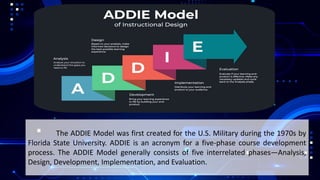
The ADDIE Model was first created for the U.S. Military during the 1970s by
Florida State University. ADDIE is an acronym for a five-phase course development
process. The ADDIE Model generally consists of five interrelated phases—Analysis,
Design, Development, Implementation, and Evaluation.
I
The analysis phase of the ADDIE Model the instructional problem
is identified. The instructional goals, success metrics, and overall
objectives are also established. Information regarding the learner
such as the learning environment, preferences, demographics, and
existing knowledge and skills are also identified during this phase.
ANALYSIS
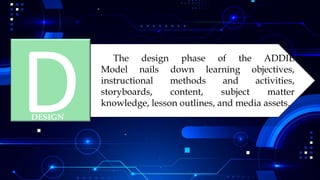
The design phase of the ADDIE
Model nails down learning objectives,
instructional methods and activities,
storyboards, content, subject matter
knowledge, lesson outlines, and media assets.
DESIGN
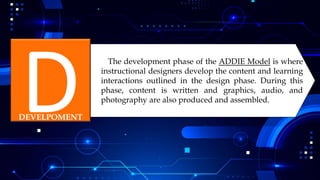
The development phase of the ADDIE Model is where
instructional designers develop the content and learning
interactions outlined in the design phase. During this
phase, content is written and graphics, audio, and
photography are also produced and assembled.
DEVELPOMENT
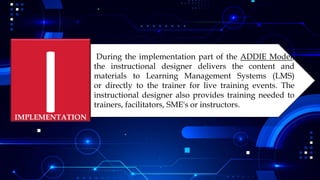
During the implementation part of the ADDIE Model,
the instructional designer delivers the content and
materials to Learning Management Systems (LMS)
or directly to the trainer for live training events. The
instructional designer also provides training needed to
trainers, facilitators, SME's or instructors.
IMPLEMENTATION
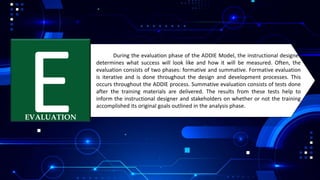
During the evaluation phase of the ADDIE Model, the instructional designer
determines what success will look like and how it will be measured. Often, the
evaluation consists of two phases: formative and summative. Formative evaluation
is iterative and is done throughout the design and development processes. This
occurs throughout the ADDIE process. Summative evaluation consists of tests done
after the training materials are delivered. The results from these tests help to
inform the instructional designer and stakeholders on whether or not the training
accomplished its original goals outlined in the analysis phase.
EVALUATION
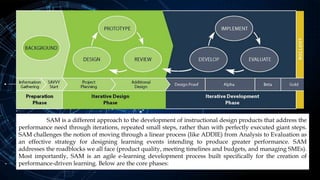
SAM is a different approach to the development of instructional design products that address the
performance need through iterations, repeated small steps, rather than with perfectly executed giant steps.
SAM challenges the notion of moving through a linear process (like ADDIE) from Analysis to Evaluation as
an effective strategy for designing learning events intending to produce greater performance. SAM
addresses the roadblocks we all face (product quality, meeting timelines and budgets, and managing SMEs).
Most importantly, SAM is an agile e-learning development process built specifically for the creation of
performance-driven learning. Below are the core phases:
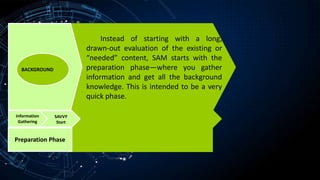
Instead of starting with a long,
drawn-out evaluation of the existing or
“needed” content, SAM starts with the
preparation phase—where you gather
information and get all the background
knowledge. This is intended to be a very
quick phase.
BACKGROUND
Preparation Phase
Information
Gathering
SAVVY
Start
Iterative Design
Phase
Project Planning
Additional Design
This phase begins with the
Savvy Start, the initial collaborative
brainstorming meeting that
establishes the foundation for a
successful project. The Savvy Start
focuses primarily on performance
and will serve as the project kickoff
meeting and the main environment
for all project team members to
converse. Throughout the Savvy Start
and the Iterative Design Phase, your
team will be rotating through design,
prototype, and review.
DESIGN
REVIEW
PROTOTYPE
IMPLEMENT
EVALUATE
DEVELOP
ROLL
OUT
Iterative Development Phase
Design Proof Alpha Beta Gold
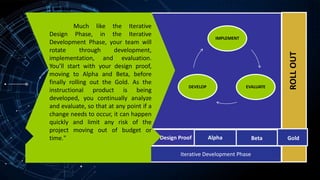
Much like the Iterative
Design Phase, in the Iterative
Development Phase, your team will
rotate through development,
implementation, and evaluation.
You’ll start with your design proof,
moving to Alpha and Beta, before
finally rolling out the Gold. As the
instructional product is being
developed, you continually analyze
and evaluate, so that at any point if a
change needs to occur, it can happen
quickly and limit any risk of the
project moving out of budget or
time."
The TPACK Model
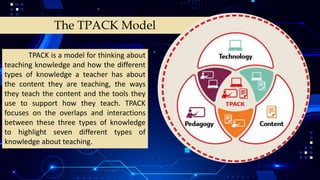
TPACK is a model for thinking about
teaching knowledge and how the different
types of knowledge a teacher has about
the content they are teaching, the ways
they teach the content and the tools they
use to support how they teach. TPACK
focuses on the overlaps and interactions
between these three types of knowledge
to highlight seven different types of
knowledge about teaching.
Technology Knowledge
According to Koehler and Mishra, “Knowledge about certain ways of thinking
about and working with technology, tools and resources. And working with technology
can apply to all technology tools and resources. This includes understanding information
technology broadly enough to apply it productively at work and in everyday life, being
able to recognize when information technology can assist or impede the achievement of
a goal, and being able continually to adapt to changes in information technology.
Pedagogical Knowledge
Pedagogical Knowledge is, according to Koehler and Mishra, “Teachers’ deep
knowledge about the processes and practices or methods of teaching and learning. They
encompass, among other things, overall educational purposes, values, and aims. This
generic form of knowledge applies to understanding how students learn, general
classroom management skills, lesson planning, and student assessment.”
Content Knowledge
Content Knowledge is, according to Koehler and Mishra, “Teachers’ knowledge
about the subject matter to be learned or taught. The content to be covered in middle
school science or history is different from the content to be covered in an undergraduate
course on art appreciation or a graduate seminar on astrophysics. As Shulman (1986)
noted, this knowledge would include knowledge of concepts, theories, ideas,
organizational frameworks, knowledge of evidence and proof, as well as established
practices and approaches toward developing such knowledge.
COMPARISON OF ADDIE, SAM, AND TPACK MODELS
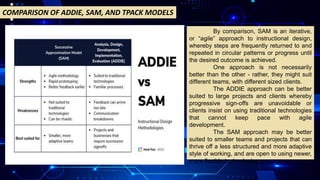
By comparison, SAM is an iterative,
or “agile” approach to instructional design,
whereby steps are frequently returned to and
repeated in circular patterns or progress until
the desired outcome is achieved.
One approach is not necessarily
better than the other - rather, they might suit
different teams, with different sized clients.
The ADDIE approach can be better
suited to large projects and clients whereby
progressive sign-offs are unavoidable or
clients insist on using traditional technologies
that cannot keep pace with agile
development.
The SAM approach may be better
suited to smaller teams and projects that can
thrive off a less structured and more adaptive
style of working, and are open to using newer,
more flexible technologies.
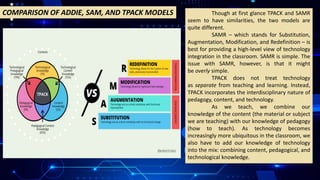
COMPARISON OF ADDIE, SAM, AND TPACK MODELS Though at first glance TPACK and SAMR
seem to have similarities, the two models are
quite different.
SAMR – which stands for Substitution,
Augmentation, Modification, and Redefinition – is
best for providing a high-level view of technology
integration in the classroom. SAMR is simple. The
issue with SAMR, however, is that it might
be overly simple.
TPACK does not treat technology
as separate from teaching and learning. Instead,
TPACK incorporates the interdisciplinary nature of
pedagogy, content, and technology.
As we teach, we combine our
knowledge of the content (the material or subject
we are teaching) with our knowledge of pedagogy
(how to teach). As technology becomes
increasingly more ubiquitous in the classroom, we
also have to add our knowledge of technology
into the mix: combining content, pedagogical, and
technological knowledge.
TPACK is a framework that can be effective in guiding teachers to incorporate
technology into teaching and learning in meaningful ways. TPACK views tech integration
as the intersection of knowledge areas – pedagogy, content, and technology. Consider
using this framework as we continue to develop our philosophy around technology in
your classroom. Teaching in a 21st century classroom, one must incorporate the used of
technology. The use of technology during whole-class instruction can foster student
engagement for auditory and visual learners. Integrating simple technologies
PowerPoints, games, internet homework assignments, or online grading systems can be
difference makers in students' growth in the classroom.
CONCLUSION
References:
https://www.aihr.com/blog/addie-model/
https://www.instructionaldesigncentral.com/instructionaldesignmodels
https://www.mheducation.ca/blog/what-is-tpack-theory-and-how-can-it-
be-used-in-the-classroom/
https://www.howtoo.co/posts/the-complete-guide-to-the-successive-
approximation-model-sam-of-instructional-design

a collaborative effort on exploring addie,sam,tpack model

  • 1.
    Presented by: James A.Dumaboc Dona C. Minguita To: Elaine May S. Patiño Ph.D March 23, 2024
  • 2.
    What is InstructionalDesign Models? Instructional design models help instructional designers to make sense of abstract learning theory and enable real world application. Instructional design models organize and visualize learning theories and principles to guide instructional designers through a learning development process. Stated differently, an instructional design model can be considered a framework to develop learning materials. Many of them have common instructional design principles and patterns.
  • 3.
    “The great growlingengine of change is technology." The ADDIE Model was first created for the U.S. Military during the 1970s by Florida State University. ADDIE is an acronym for a five-phase course development process. The ADDIE Model generally consists of five interrelated phases—Analysis, Design, Development, Implementation, and Evaluation.
  • 4.
    I The analysis phaseof the ADDIE Model the instructional problem is identified. The instructional goals, success metrics, and overall objectives are also established. Information regarding the learner such as the learning environment, preferences, demographics, and existing knowledge and skills are also identified during this phase. ANALYSIS
  • 5.
    The design phaseof the ADDIE Model nails down learning objectives, instructional methods and activities, storyboards, content, subject matter knowledge, lesson outlines, and media assets. DESIGN
  • 6.
    The development phaseof the ADDIE Model is where instructional designers develop the content and learning interactions outlined in the design phase. During this phase, content is written and graphics, audio, and photography are also produced and assembled. DEVELPOMENT
  • 7.
    During the implementationpart of the ADDIE Model, the instructional designer delivers the content and materials to Learning Management Systems (LMS) or directly to the trainer for live training events. The instructional designer also provides training needed to trainers, facilitators, SME's or instructors. IMPLEMENTATION
  • 8.
    During the evaluationphase of the ADDIE Model, the instructional designer determines what success will look like and how it will be measured. Often, the evaluation consists of two phases: formative and summative. Formative evaluation is iterative and is done throughout the design and development processes. This occurs throughout the ADDIE process. Summative evaluation consists of tests done after the training materials are delivered. The results from these tests help to inform the instructional designer and stakeholders on whether or not the training accomplished its original goals outlined in the analysis phase. EVALUATION
  • 9.
    SAM is adifferent approach to the development of instructional design products that address the performance need through iterations, repeated small steps, rather than with perfectly executed giant steps. SAM challenges the notion of moving through a linear process (like ADDIE) from Analysis to Evaluation as an effective strategy for designing learning events intending to produce greater performance. SAM addresses the roadblocks we all face (product quality, meeting timelines and budgets, and managing SMEs). Most importantly, SAM is an agile e-learning development process built specifically for the creation of performance-driven learning. Below are the core phases:
  • 10.
    Instead of startingwith a long, drawn-out evaluation of the existing or “needed” content, SAM starts with the preparation phase—where you gather information and get all the background knowledge. This is intended to be a very quick phase. BACKGROUND Preparation Phase Information Gathering SAVVY Start
  • 11.
    Iterative Design Phase Project Planning AdditionalDesign This phase begins with the Savvy Start, the initial collaborative brainstorming meeting that establishes the foundation for a successful project. The Savvy Start focuses primarily on performance and will serve as the project kickoff meeting and the main environment for all project team members to converse. Throughout the Savvy Start and the Iterative Design Phase, your team will be rotating through design, prototype, and review. DESIGN REVIEW PROTOTYPE
  • 12.
    IMPLEMENT EVALUATE DEVELOP ROLL OUT Iterative Development Phase DesignProof Alpha Beta Gold Much like the Iterative Design Phase, in the Iterative Development Phase, your team will rotate through development, implementation, and evaluation. You’ll start with your design proof, moving to Alpha and Beta, before finally rolling out the Gold. As the instructional product is being developed, you continually analyze and evaluate, so that at any point if a change needs to occur, it can happen quickly and limit any risk of the project moving out of budget or time."
  • 13.
    The TPACK Model TPACKis a model for thinking about teaching knowledge and how the different types of knowledge a teacher has about the content they are teaching, the ways they teach the content and the tools they use to support how they teach. TPACK focuses on the overlaps and interactions between these three types of knowledge to highlight seven different types of knowledge about teaching.
  • 14.
    Technology Knowledge According toKoehler and Mishra, “Knowledge about certain ways of thinking about and working with technology, tools and resources. And working with technology can apply to all technology tools and resources. This includes understanding information technology broadly enough to apply it productively at work and in everyday life, being able to recognize when information technology can assist or impede the achievement of a goal, and being able continually to adapt to changes in information technology.
  • 15.
    Pedagogical Knowledge Pedagogical Knowledgeis, according to Koehler and Mishra, “Teachers’ deep knowledge about the processes and practices or methods of teaching and learning. They encompass, among other things, overall educational purposes, values, and aims. This generic form of knowledge applies to understanding how students learn, general classroom management skills, lesson planning, and student assessment.”
  • 16.
    Content Knowledge Content Knowledgeis, according to Koehler and Mishra, “Teachers’ knowledge about the subject matter to be learned or taught. The content to be covered in middle school science or history is different from the content to be covered in an undergraduate course on art appreciation or a graduate seminar on astrophysics. As Shulman (1986) noted, this knowledge would include knowledge of concepts, theories, ideas, organizational frameworks, knowledge of evidence and proof, as well as established practices and approaches toward developing such knowledge.
  • 17.
    COMPARISON OF ADDIE,SAM, AND TPACK MODELS By comparison, SAM is an iterative, or “agile” approach to instructional design, whereby steps are frequently returned to and repeated in circular patterns or progress until the desired outcome is achieved. One approach is not necessarily better than the other - rather, they might suit different teams, with different sized clients. The ADDIE approach can be better suited to large projects and clients whereby progressive sign-offs are unavoidable or clients insist on using traditional technologies that cannot keep pace with agile development. The SAM approach may be better suited to smaller teams and projects that can thrive off a less structured and more adaptive style of working, and are open to using newer, more flexible technologies.
  • 18.
    COMPARISON OF ADDIE,SAM, AND TPACK MODELS Though at first glance TPACK and SAMR seem to have similarities, the two models are quite different. SAMR – which stands for Substitution, Augmentation, Modification, and Redefinition – is best for providing a high-level view of technology integration in the classroom. SAMR is simple. The issue with SAMR, however, is that it might be overly simple. TPACK does not treat technology as separate from teaching and learning. Instead, TPACK incorporates the interdisciplinary nature of pedagogy, content, and technology. As we teach, we combine our knowledge of the content (the material or subject we are teaching) with our knowledge of pedagogy (how to teach). As technology becomes increasingly more ubiquitous in the classroom, we also have to add our knowledge of technology into the mix: combining content, pedagogical, and technological knowledge.
  • 19.
    TPACK is aframework that can be effective in guiding teachers to incorporate technology into teaching and learning in meaningful ways. TPACK views tech integration as the intersection of knowledge areas – pedagogy, content, and technology. Consider using this framework as we continue to develop our philosophy around technology in your classroom. Teaching in a 21st century classroom, one must incorporate the used of technology. The use of technology during whole-class instruction can foster student engagement for auditory and visual learners. Integrating simple technologies PowerPoints, games, internet homework assignments, or online grading systems can be difference makers in students' growth in the classroom. CONCLUSION
  • 20.