INTEGRATINGTHEFOURLANGUAGE
SKILLS
Yamith JoseFandiño Parra
Didactics for foreign languages
April, 2018
Facultad de Ciencias de la Educación
Licenciatura en Español y Lenguas Extranjeras
CONTENTS
• Opening activities.
• What is the integrated skill approach (ISA)?
• How can teacher integrate skills in a basic way?
• Five models in the ISA.
• Summary.
• Closing activity.
OPENINGACTIVITIES
• Watch the following video segment and answer the
following questions:
- What topic is developed in this lesson?
- What activities are used in this lesson?
- How many language skills are worked in this lesson?
OPENINGACTIVITIES
• Read the following quotation. What kind of
instruction do you think the authors are
encouraging?
From the 1970’s, most ELT professionals have noticed that
that the teaching of language skills can not be conducted
through separate and discrete structural elements. In real
life, people do not use reading, listening, writing skills in
isolation. All these skills together serve as a bridge that
connects a person with a society (Pysarchyk &
Yamshynska, 2015, p. 78).
WHATISTHEINTEGRATEDSKILLSAPPROACH?
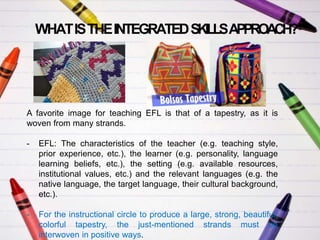
A favorite image for teaching EFL is that of a tapestry, as it is
woven from many strands.
- EFL: The characteristics of the teacher (e.g. teaching style,
prior experience, etc.), the learner (e.g. personality, language
learning beliefs, etc.), the setting (e.g. available resources,
institutional values, etc.) and the relevant languages (e.g. the
native language, the target language, their cultural background,
etc.).
- For the instructional circle to produce a large, strong, beautiful,
colorful tapestry, the just-mentioned strands must be
interwoven in positive ways.
WHATISTHEINTEGRATEDSKILLSAPPROACH?
Besides the four strands mentioned above, other important
strands exist in the tapestry.
In a practical sense, one of the most crucial of these
strands consists of the four primary skills (listening,
reading, speaking and writing) and associated skills
(vocabulary, spelling, pronunciation, syntax, meaning and
usage).
Optimal EFL communication is present when all the
skills are interwoven during instruction.
WHATISTHEINTEGRATEDSKILLSAPPROACH?
SEGREGATED SKILL INSTRUCTION
It is a traditional instruction approach, in which the mastery of discrete
language skills like reading or speaking is seen as the key to
successful learning. Additionally, there is typically a separation of
language learning from content learning.
Focus on the forms of language predisposed curriculum designers to
segment courses into the separate languageskills.
Administrative considerations still make it easier to program separate
courses.
Certain specific purposes for which students are studying English may best
be labeled by one of the four skills, especially at the high intermediate
to advanced levels.
WHATISTHEINTEGRATEDSKILLAPPROACH?
INTEGRATEDSKILLINSTRUCTION
It is an innovating approach that consists of the linking of the
language skills for the purpose of real communication. This
instructional approach favors integrated skills, that is, the skills
are interlocked, exactly as they are in everyday life. This is so as it
is understood that practice with any given skill reinforces other
skills.
Production and reception are two sidesof thesamecoin. Often one skill
will reinforceanother.
Written and spoken language bear arelationship to eachother.
Most of natural performance involves not only the integration of one or
more skills, but connections between language and the way we think,
feel and act
HOWCANTEACHERSINTEGRATESKILLSINA
BASICWAY?
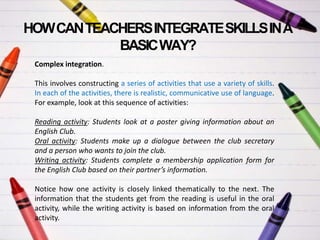
Simple integration.
The easiest form of integration is within the same medium
(either oral or written), from receptive to productive skills.
Receptive skill Productive skill
Oral medium listening speaking
Written medium reading writing
In other words, we would use a listening text as a model for the
students’ speaking, and a reading text as a model for the
students’ writing. This is common practice among teachers, and
we will call it simple integration.
HOWCANTEACHERSINTEGRATESKILLSINA
BASICWAY?
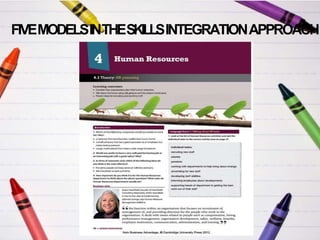
Complex integration.
This involves constructing a series of activities that use a variety of skills.
In each of the activities, there is realistic, communicative use of language.
For example, look at this sequence of activities:
Reading activity: Students look at a poster giving information about an
English Club.
Oral activity: Students make up a dialogue between the club secretary
and a person who wants to join the club.
Writing activity: Students complete a membership application form for
the English Club based on their partner’s information.
Notice how one activity is closely linked thematically to the next. The
information that the students get from the reading is useful in the oral
activity, while the writing activity is based on information from the oral
activity.
FIVEMODELSINTHESKILLSINTEGRATIONAPPROACH
Content-basedinstruction
It integrates the learning of some specific subject matter content
with the learning of a second language. The second language is
simply the medium to convey informational content of interest and
relevance to the learner.
Learners focus on useful, practical non-language objectives as the
subject matter is perceived to be relevant to long-term goals.
As you plan a lesson around a particular subtopic of your subject-
matter area, students integrate all four skills as they read, discuss,
solve problems, analyze data, and write opinions and reports.
FIVEMODELSINTHESKILLSINTEGRATIONAPPROACH
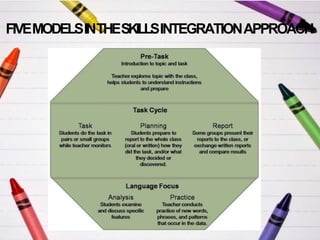
Task-basedlanguage teaching
The priority is not the forms of language, but rather the
functional purposes for which language must be used such as
exchanging opinions, expressing feelings, asking for permission,
etc.
The importance of organizing a course around real world
communicative tasks that learners need to engage in outside the
classroom: a job interview, a recipe, public announcements, e-
mails, invitations,etc.
The course goals center on learners’ pragmatic language
competence by maintaining appropriateness according to
purposes and contexts asthe center of attention.
-
FIVEMODELSINTHESKILLSINTEGRATIONAPPROACH
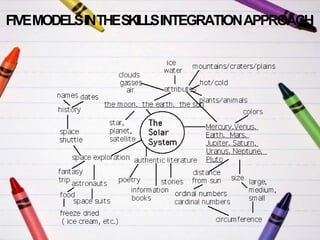
Theme-basedteaching
Courses focus on topics, situations, or "themes" as one of their
organizing parameters.
Language skills are enhanced, but through focal attention to topic and
peripheral attention to language.
Challenging topics engage the curiosity and increase motivation of
students as they grapple with an array of real-life issues ranging from
simple to complex.
FIVEMODELSINTHESKILLSINTEGRATIONAPPROACH
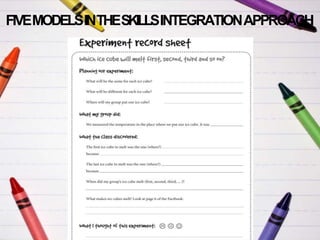
Experientiallearning
Experiential learning gives students concrete experiences through
which they "discover" language principles by trial and error, by
processing feedback and by building hypotheses about language.
Teachers do not simply tell students about how language works;
instead, they give students opportunities to use language as they
grapple with the problem-solving complexities of a variety of
concreteexperiences.
Experiential learning techniques tend to be learner-centered such as
hands-on projects, field trips and other “on-site” visits, role plays and
simulations, cross-cultural experiences (camps, dinner groups, etc.),
etc.
FIVEMODELSINTHESKILLSINTEGRATIONAPPROACH
Theepisode hypothesis
-
Language presentation is enhanced when students receive
interconnected sentences in interest-provoking episodes rather
than in adisconnected series of sentences.
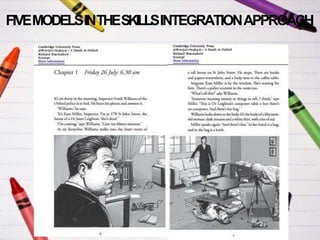
Episodes can be presented in either written or spoken form and
students, in turn, can respond tothem by speaking or writing.
Students can be encouraged to write their own episodes,
complete an episode whose resolution or climax is not
presented, or dramatize written episodes.
FIVEMODELSINTHESKILLSINTEGRATIONAPPROACH
-
The integrated skill approach (ISA) exposes EFL learners to authentic
language and challenges them to interact naturalistically in the
language.
In the ISA, learners rapidly gain a true picture of the richness and
complexity of the English language as employed for communication.
English becomes a real means of interaction and sharing among
people.
Integrating the language skills also promotes the learning of real
content, not just the dissection of language forms.
Finally, the ISA (whether found in content-based or task-based
language instruction or some hybrid form) can be highly motivating
to students of all ages and backgrounds.
SUMMARY
Read the following statements. Check if they are TRUE or FALSE.
-
___ Optimal EFL communication is present when the skills are segregated
during instruction.
___ In the integrated skill approach, there is typically a separation of
language learning from content learning.
___ In simple integration, the teacher prepares class activities within the
same medium (either oral or written) and starting with receptive first to then
go to productive skills.
___ In task-based language teaching, the priority is not presenting the
forms of language, but rather working with real world communicative tasks
that learners need to be able to engage in authentic interactions outside
the classroom.
___ Experiential learning gives students opportunities to work with
interconnected sentences in interest-provoking episodes.
CLOSINGACTIVITY
REFERENCES
Brown, H. D. (2007). Teaching by Principles: An Interactive Approach to
Language Pedagogy (3rd edition). USA: Pearson Longman.
Pysarchyk, O. L., & Yamshynska, N. V. (2015). The importance of
integrating reading and writing for EFL teaching. Advanced education,
3, 77-83.
Oxford, R. (2001)., Integrated Skills in the ESL/EFL Classroom. The
journal of TESOL France, 8, 5-12.
Thank you!
Yamith José Fandiño
yfandino@unisalle.edu.co

Integrating the four language skills

  • 1.
    INTEGRATINGTHEFOURLANGUAGE SKILLS Yamith JoseFandiño Parra Didacticsfor foreign languages April, 2018 Facultad de Ciencias de la Educación Licenciatura en Español y Lenguas Extranjeras
  • 2.
    CONTENTS • Opening activities. •What is the integrated skill approach (ISA)? • How can teacher integrate skills in a basic way? • Five models in the ISA. • Summary. • Closing activity.
  • 3.
    OPENINGACTIVITIES • Watch thefollowing video segment and answer the following questions: - What topic is developed in this lesson? - What activities are used in this lesson? - How many language skills are worked in this lesson?
  • 4.
    OPENINGACTIVITIES • Read thefollowing quotation. What kind of instruction do you think the authors are encouraging? From the 1970’s, most ELT professionals have noticed that that the teaching of language skills can not be conducted through separate and discrete structural elements. In real life, people do not use reading, listening, writing skills in isolation. All these skills together serve as a bridge that connects a person with a society (Pysarchyk & Yamshynska, 2015, p. 78).
  • 5.
    WHATISTHEINTEGRATEDSKILLSAPPROACH? A favorite imagefor teaching EFL is that of a tapestry, as it is woven from many strands. - EFL: The characteristics of the teacher (e.g. teaching style, prior experience, etc.), the learner (e.g. personality, language learning beliefs, etc.), the setting (e.g. available resources, institutional values, etc.) and the relevant languages (e.g. the native language, the target language, their cultural background, etc.). - For the instructional circle to produce a large, strong, beautiful, colorful tapestry, the just-mentioned strands must be interwoven in positive ways.
  • 6.
    WHATISTHEINTEGRATEDSKILLSAPPROACH? Besides the fourstrands mentioned above, other important strands exist in the tapestry. In a practical sense, one of the most crucial of these strands consists of the four primary skills (listening, reading, speaking and writing) and associated skills (vocabulary, spelling, pronunciation, syntax, meaning and usage). Optimal EFL communication is present when all the skills are interwoven during instruction.
  • 7.
    WHATISTHEINTEGRATEDSKILLSAPPROACH? SEGREGATED SKILL INSTRUCTION Itis a traditional instruction approach, in which the mastery of discrete language skills like reading or speaking is seen as the key to successful learning. Additionally, there is typically a separation of language learning from content learning. Focus on the forms of language predisposed curriculum designers to segment courses into the separate languageskills. Administrative considerations still make it easier to program separate courses. Certain specific purposes for which students are studying English may best be labeled by one of the four skills, especially at the high intermediate to advanced levels.
  • 8.
    WHATISTHEINTEGRATEDSKILLAPPROACH? INTEGRATEDSKILLINSTRUCTION It is aninnovating approach that consists of the linking of the language skills for the purpose of real communication. This instructional approach favors integrated skills, that is, the skills are interlocked, exactly as they are in everyday life. This is so as it is understood that practice with any given skill reinforces other skills. Production and reception are two sidesof thesamecoin. Often one skill will reinforceanother. Written and spoken language bear arelationship to eachother. Most of natural performance involves not only the integration of one or more skills, but connections between language and the way we think, feel and act
  • 9.
    HOWCANTEACHERSINTEGRATESKILLSINA BASICWAY? Simple integration. The easiestform of integration is within the same medium (either oral or written), from receptive to productive skills. Receptive skill Productive skill Oral medium listening speaking Written medium reading writing In other words, we would use a listening text as a model for the students’ speaking, and a reading text as a model for the students’ writing. This is common practice among teachers, and we will call it simple integration.
  • 10.
    HOWCANTEACHERSINTEGRATESKILLSINA BASICWAY? Complex integration. This involvesconstructing a series of activities that use a variety of skills. In each of the activities, there is realistic, communicative use of language. For example, look at this sequence of activities: Reading activity: Students look at a poster giving information about an English Club. Oral activity: Students make up a dialogue between the club secretary and a person who wants to join the club. Writing activity: Students complete a membership application form for the English Club based on their partner’s information. Notice how one activity is closely linked thematically to the next. The information that the students get from the reading is useful in the oral activity, while the writing activity is based on information from the oral activity.
  • 11.
  • 12.
    FIVEMODELSINTHESKILLSINTEGRATIONAPPROACH Content-basedinstruction It integrates thelearning of some specific subject matter content with the learning of a second language. The second language is simply the medium to convey informational content of interest and relevance to the learner. Learners focus on useful, practical non-language objectives as the subject matter is perceived to be relevant to long-term goals. As you plan a lesson around a particular subtopic of your subject- matter area, students integrate all four skills as they read, discuss, solve problems, analyze data, and write opinions and reports.
  • 13.
  • 14.
    Task-basedlanguage teaching The priorityis not the forms of language, but rather the functional purposes for which language must be used such as exchanging opinions, expressing feelings, asking for permission, etc. The importance of organizing a course around real world communicative tasks that learners need to engage in outside the classroom: a job interview, a recipe, public announcements, e- mails, invitations,etc. The course goals center on learners’ pragmatic language competence by maintaining appropriateness according to purposes and contexts asthe center of attention. - FIVEMODELSINTHESKILLSINTEGRATIONAPPROACH
  • 15.
  • 16.
    Theme-basedteaching Courses focus ontopics, situations, or "themes" as one of their organizing parameters. Language skills are enhanced, but through focal attention to topic and peripheral attention to language. Challenging topics engage the curiosity and increase motivation of students as they grapple with an array of real-life issues ranging from simple to complex. FIVEMODELSINTHESKILLSINTEGRATIONAPPROACH
  • 17.
  • 18.
    Experientiallearning Experiential learning givesstudents concrete experiences through which they "discover" language principles by trial and error, by processing feedback and by building hypotheses about language. Teachers do not simply tell students about how language works; instead, they give students opportunities to use language as they grapple with the problem-solving complexities of a variety of concreteexperiences. Experiential learning techniques tend to be learner-centered such as hands-on projects, field trips and other “on-site” visits, role plays and simulations, cross-cultural experiences (camps, dinner groups, etc.), etc. FIVEMODELSINTHESKILLSINTEGRATIONAPPROACH
  • 19.
  • 20.
    Theepisode hypothesis - Language presentationis enhanced when students receive interconnected sentences in interest-provoking episodes rather than in adisconnected series of sentences. Episodes can be presented in either written or spoken form and students, in turn, can respond tothem by speaking or writing. Students can be encouraged to write their own episodes, complete an episode whose resolution or climax is not presented, or dramatize written episodes. FIVEMODELSINTHESKILLSINTEGRATIONAPPROACH
  • 21.
    - The integrated skillapproach (ISA) exposes EFL learners to authentic language and challenges them to interact naturalistically in the language. In the ISA, learners rapidly gain a true picture of the richness and complexity of the English language as employed for communication. English becomes a real means of interaction and sharing among people. Integrating the language skills also promotes the learning of real content, not just the dissection of language forms. Finally, the ISA (whether found in content-based or task-based language instruction or some hybrid form) can be highly motivating to students of all ages and backgrounds. SUMMARY
  • 22.
    Read the followingstatements. Check if they are TRUE or FALSE. - ___ Optimal EFL communication is present when the skills are segregated during instruction. ___ In the integrated skill approach, there is typically a separation of language learning from content learning. ___ In simple integration, the teacher prepares class activities within the same medium (either oral or written) and starting with receptive first to then go to productive skills. ___ In task-based language teaching, the priority is not presenting the forms of language, but rather working with real world communicative tasks that learners need to be able to engage in authentic interactions outside the classroom. ___ Experiential learning gives students opportunities to work with interconnected sentences in interest-provoking episodes. CLOSINGACTIVITY
  • 23.
    REFERENCES Brown, H. D.(2007). Teaching by Principles: An Interactive Approach to Language Pedagogy (3rd edition). USA: Pearson Longman. Pysarchyk, O. L., & Yamshynska, N. V. (2015). The importance of integrating reading and writing for EFL teaching. Advanced education, 3, 77-83. Oxford, R. (2001)., Integrated Skills in the ESL/EFL Classroom. The journal of TESOL France, 8, 5-12.
  • 24.
    Thank you! Yamith JoséFandiño yfandino@unisalle.edu.co