






Learning Objectives
Fundamentals
of
A learning objective is a statement, in
specific and measurable terms, that
describes what learners will be
able to do on completion of the
training.
Correct and Incorrect Usage of LOs
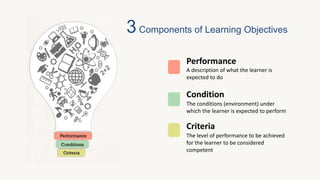
3Components of Learning Objectives
Performance
A description of what the learner is
expected to do
Condition
The conditions (environment) under
which the learner is expected to perform
Criteria
The level of performance to be achieved
for the learner to be considered
competent
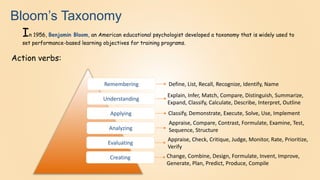
Bloom’s Taxonomy
In 1956, Benjamin Bloom, an American educational psychologist developed a taxonomy that is widely used to
set performance-based learning objectives for training programs.
Action verbs:
Remembering
Understanding
Applying
Analyzing
Evaluating
Creating
Define, List, Recall, Recognize, Identify, Name
Explain, Infer, Match, Compare, Distinguish, Summarize,
Expand, Classify, Calculate, Describe, Interpret, Outline
Classify, Demonstrate, Execute, Solve, Use, Implement
Appraise, Compare, Contrast, Formulate, Examine, Test,
Sequence, Structure
Appraise, Check, Critique, Judge, Monitor, Rate, Prioritize,
Verify
Change, Combine, Design, Formulate, Invent, Improve,
Generate, Plan, Predict, Produce, Compile
Why Use Learning Objectives?
Learning objectives set the stage for training development. They
help training managers or learning and design professionals decide
the course of action to take to complete the training program.
Using learning objectives helps define the:
 Scope of the course
 Instructional strategy
 Evaluation methodology
 Course cost and duration
How to Set Learning Objectives
While writing learning objectives , ensure alignment between
the learning objectives, content, and assessments.
Based on the learning objectives, we choose the training
content and design assessments to make sure learners are
tested on what they are expected to learn and not something
different.
• Learning objectives should clearly define the knowledge
and skills learners would acquire at the end of the course.
• Training content is chosen and geared towards helping
learners meet the learning objectives.
• Assessments will measure the extent to which the
learning objectives are met.
3Steps to Write Learning Objectives
A Stem is the introductory phrase that addresses learners and sets the context – it tells them when they will achieve the
objectives
It is an introductory phrase that addresses
learners and sets the context – it tells them
when they will achieve the objectives.
We need to add the action verb that
specifies the expected performance.
We need to specify the process, procedure,
or action learners will be able to perform
after the course.
Before we leave, let us quickly recap what we have learned.
A learning objective is a statement, in specific and measurable terms, that
describes what learners will be able to do on completion of the training.
Components of learning objectives:
• Performance
• Condition
• Criteria
6 levels of the cognitive domain:
• Remembering
• Understanding
• Applying
Steps to write learning objectives:
• Create a stem
• Add a verb
• Determine the outcome
• Analyzing
• Evaluating
• Creating
Fundamentals of Learning Objectives

Fundamentals of Learning Objectives

  • 1.
  • 2.
    A learning objectiveis a statement, in specific and measurable terms, that describes what learners will be able to do on completion of the training.
  • 3.
  • 4.
    3Components of LearningObjectives Performance A description of what the learner is expected to do Condition The conditions (environment) under which the learner is expected to perform Criteria The level of performance to be achieved for the learner to be considered competent
  • 5.
    Bloom’s Taxonomy In 1956,Benjamin Bloom, an American educational psychologist developed a taxonomy that is widely used to set performance-based learning objectives for training programs. Action verbs: Remembering Understanding Applying Analyzing Evaluating Creating Define, List, Recall, Recognize, Identify, Name Explain, Infer, Match, Compare, Distinguish, Summarize, Expand, Classify, Calculate, Describe, Interpret, Outline Classify, Demonstrate, Execute, Solve, Use, Implement Appraise, Compare, Contrast, Formulate, Examine, Test, Sequence, Structure Appraise, Check, Critique, Judge, Monitor, Rate, Prioritize, Verify Change, Combine, Design, Formulate, Invent, Improve, Generate, Plan, Predict, Produce, Compile
  • 6.
    Why Use LearningObjectives? Learning objectives set the stage for training development. They help training managers or learning and design professionals decide the course of action to take to complete the training program. Using learning objectives helps define the:  Scope of the course  Instructional strategy  Evaluation methodology  Course cost and duration
  • 7.
    How to SetLearning Objectives While writing learning objectives , ensure alignment between the learning objectives, content, and assessments. Based on the learning objectives, we choose the training content and design assessments to make sure learners are tested on what they are expected to learn and not something different. • Learning objectives should clearly define the knowledge and skills learners would acquire at the end of the course. • Training content is chosen and geared towards helping learners meet the learning objectives. • Assessments will measure the extent to which the learning objectives are met.
  • 8.
    3Steps to WriteLearning Objectives A Stem is the introductory phrase that addresses learners and sets the context – it tells them when they will achieve the objectives It is an introductory phrase that addresses learners and sets the context – it tells them when they will achieve the objectives. We need to add the action verb that specifies the expected performance. We need to specify the process, procedure, or action learners will be able to perform after the course.
  • 10.
    Before we leave,let us quickly recap what we have learned. A learning objective is a statement, in specific and measurable terms, that describes what learners will be able to do on completion of the training. Components of learning objectives: • Performance • Condition • Criteria 6 levels of the cognitive domain: • Remembering • Understanding • Applying Steps to write learning objectives: • Create a stem • Add a verb • Determine the outcome • Analyzing • Evaluating • Creating