













Content
Chunking in
E-learning
What is
content
in the
eLearning
context?
Content in the context of an eLearning course is any material – text, audio, videos, images,
etc. that can be used by instructional designers as raw material to
design and develop an eLearning course.
EN
Content Chunking and its
Importance
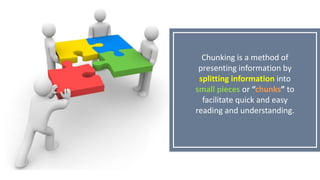
Chunking is a method of
presenting information by
splitting information into
small pieces or “chunks” to
facilitate quick and easy
reading and understanding.
Helps learners understand the
subject matter easily
Enables the use of different
media to present the content
Is useful when working with
limited screen spaces of
various devices
Content Chunking
The Stepping Stone for Content Chunking –
Content Comprehension
Content Comprehension is the key factor before chunking content. Five steps are involved in the
content comprehension process. Let’s see
Step 1 - Gather
all inputs
 Gather all the material
available, including inputs
from stakeholders
Step 2
Analyze the
content
 Closely analyze and assess the inputs to
ascertain what is relevant and useful
Step 3 - Set Broad
Learning Objectives
Setting learning objectives clearly
mentions what learners are going to
learn and what they will achieve on
completion of the course.
Step 4
Research and
Summarize
 Researching the content and
segregating them based on the
Learning Objectives
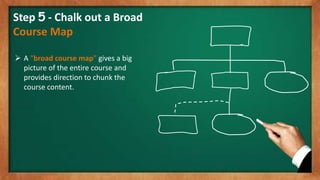
Step 5 - Chalk out a Broad
Course Map
 A “broad course map” gives a big
picture of the entire course and
provides direction to chunk the
course content.
How to Chunk
Content?
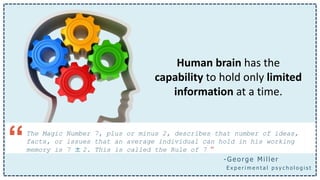
Human brain has the
capability to hold only limited
information at a time.
The Magic Number 7, plus or minus 2, describes that number of ideas,
facts, or issues that an average individual can hold in his working
memory is 7 ± 2. This is called the Rule of 7 ”“ - George Miller
E x p e r i m e n t a l p s y c h o l o g i s t
Content chunking has to
be done at two levels
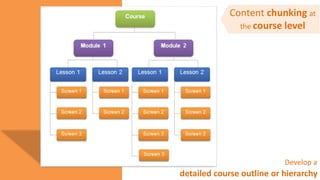
Content chunking at
the course level
detailed course outline or hierarchy
Develop a
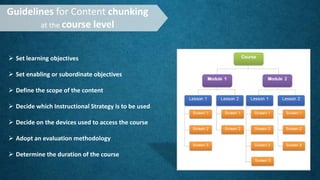
Guidelines for Content chunking
at the course level
 Set learning objectives
 Set enabling or subordinate objectives
 Define the scope of the content
 Decide which Instructional Strategy is to be used
 Decide on the devices used to access the course
 Adopt an evaluation methodology
 Determine the duration of the course
Content chunking
at the screen level
will be the storyboard.
The output of screen
level content chunking
Guidelines for Content chunking
at the screen level
 One Learning Point on each screen
 “Need-to-know” content on-screen
 Reusable Learning Object (RLO)
Effective chunking is the key to effective course development.
 Chunking is done at the course level
and finally at the screen level.
 Multiple media are used in an
eLearning course.
 Chunking is done keeping in mind the
overall learning goals of the course.
Content Chunking in E-learning

Content Chunking in E-learning

  • 1.
  • 2.
  • 3.
    Content in thecontext of an eLearning course is any material – text, audio, videos, images, etc. that can be used by instructional designers as raw material to design and develop an eLearning course. EN
  • 4.
    Content Chunking andits Importance
  • 5.
    Chunking is amethod of presenting information by splitting information into small pieces or “chunks” to facilitate quick and easy reading and understanding.
  • 6.
    Helps learners understandthe subject matter easily Enables the use of different media to present the content Is useful when working with limited screen spaces of various devices Content Chunking
  • 7.
    The Stepping Stonefor Content Chunking – Content Comprehension
  • 8.
    Content Comprehension isthe key factor before chunking content. Five steps are involved in the content comprehension process. Let’s see
  • 9.
    Step 1 -Gather all inputs  Gather all the material available, including inputs from stakeholders
  • 10.
    Step 2 Analyze the content Closely analyze and assess the inputs to ascertain what is relevant and useful
  • 11.
    Step 3 -Set Broad Learning Objectives Setting learning objectives clearly mentions what learners are going to learn and what they will achieve on completion of the course.
  • 12.
    Step 4 Research and Summarize Researching the content and segregating them based on the Learning Objectives
  • 13.
    Step 5 -Chalk out a Broad Course Map  A “broad course map” gives a big picture of the entire course and provides direction to chunk the course content.
  • 14.
  • 15.
    Human brain hasthe capability to hold only limited information at a time. The Magic Number 7, plus or minus 2, describes that number of ideas, facts, or issues that an average individual can hold in his working memory is 7 ± 2. This is called the Rule of 7 ”“ - George Miller E x p e r i m e n t a l p s y c h o l o g i s t
  • 16.
    Content chunking hasto be done at two levels
  • 17.
    Content chunking at thecourse level detailed course outline or hierarchy Develop a
  • 18.
    Guidelines for Contentchunking at the course level  Set learning objectives  Set enabling or subordinate objectives  Define the scope of the content  Decide which Instructional Strategy is to be used  Decide on the devices used to access the course  Adopt an evaluation methodology  Determine the duration of the course
  • 19.
    Content chunking at thescreen level will be the storyboard. The output of screen level content chunking
  • 20.
    Guidelines for Contentchunking at the screen level  One Learning Point on each screen  “Need-to-know” content on-screen  Reusable Learning Object (RLO)
  • 22.
    Effective chunking isthe key to effective course development.  Chunking is done at the course level and finally at the screen level.  Multiple media are used in an eLearning course.  Chunking is done keeping in mind the overall learning goals of the course.

Editor's Notes

  • #12 Setting learning objectives clearly mention what learners are going to learn and what they will achieve on completion of the course.