Session 1 :
Introduction to
Instructional System
Design
Instructional System Design Bootcamp
transformia.co.id
Visit Our Website
What do you know
about Instructional
System Design?
Instructional System Design Bootcamp
Instructional
System Design
Instructional System Design (ISD) refers to a
systematic process that is used to create educational
and training programs in a consistent and reliable
fashion. It encompasses a set of procedures for
designing, developing, implementing, and evaluating
instruction. The aim of ISD is to ensure that all
educational programs are effective, efficient, and
appealing to learners.
Instructional System Design Bootcamp
The History
The history of ISD can be traced back to the 1940s and 1950s,
evolving from the work of educational psychologists and
instructional theorists who began to apply systematic
approaches to the design, development, and delivery of
training and educational programs.
The roots of ISD are often attributed to the military training
programs developed during World War II. The military needed
to train large numbers of recruits quickly and effectively. This
necessitated the development of a methodical approach
that could be uniformly applied to ensure effective learning
outcomes.
what method or
model that you
used to create
learning program in
your session?
Instructional System Design Bootcamp
The most well-known and foundational
model in ISD is ADDIE. Although the
origins of the ADDIE model are somewhat
unclear, it is often attributed to the U.S.
military's systematic approach to
training development in the 1970s. The
model became widely accepted as a
generic template for curriculum
development and instructional design.
Instructional System Design Bootcamp
What Is ADDIE?
ADDIE is an acronym representing a systematic
approach to instructional design and is one of the
foundational models in the field. It stands for
Analysis, Design, Development, Implementation,
and Evaluation. This model provides a structured
framework for creating effective and efficient
training and educational programs. Each phase of
the model has a specific purpose:
Instructional System Design Bootcamp
How you can ensure
that your learning
program have
impacted to your
audience?
Instructional System Design Bootcamp
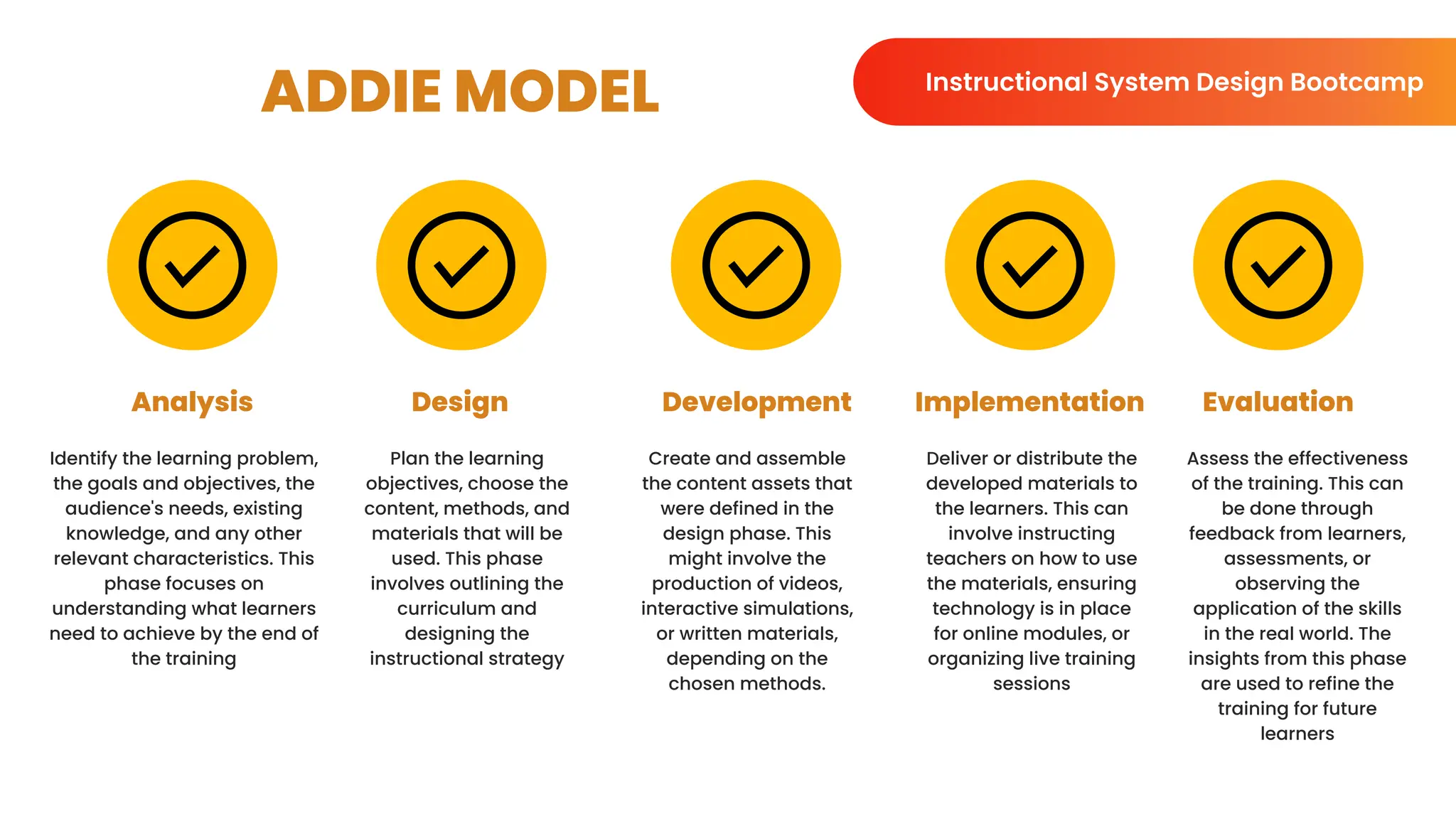
ADDIE MODEL
Identify the learning problem,
the goals and objectives, the
audience's needs, existing
knowledge, and any other
relevant characteristics. This
phase focuses on
understanding what learners
need to achieve by the end of
the training
Analysis
Plan the learning
objectives, choose the
content, methods, and
materials that will be
used. This phase
involves outlining the
curriculum and
designing the
instructional strategy
Design
Create and assemble
the content assets that
were defined in the
design phase. This
might involve the
production of videos,
interactive simulations,
or written materials,
depending on the
chosen methods.
Development
Deliver or distribute the
developed materials to
the learners. This can
involve instructing
teachers on how to use
the materials, ensuring
technology is in place
for online modules, or
organizing live training
sessions
Implementation
Assess the effectiveness
of the training. This can
be done through
feedback from learners,
assessments, or
observing the
application of the skills
in the real world. The
insights from this phase
are used to refine the
training for future
learners
Evaluation
Instructional System Design Bootcamp
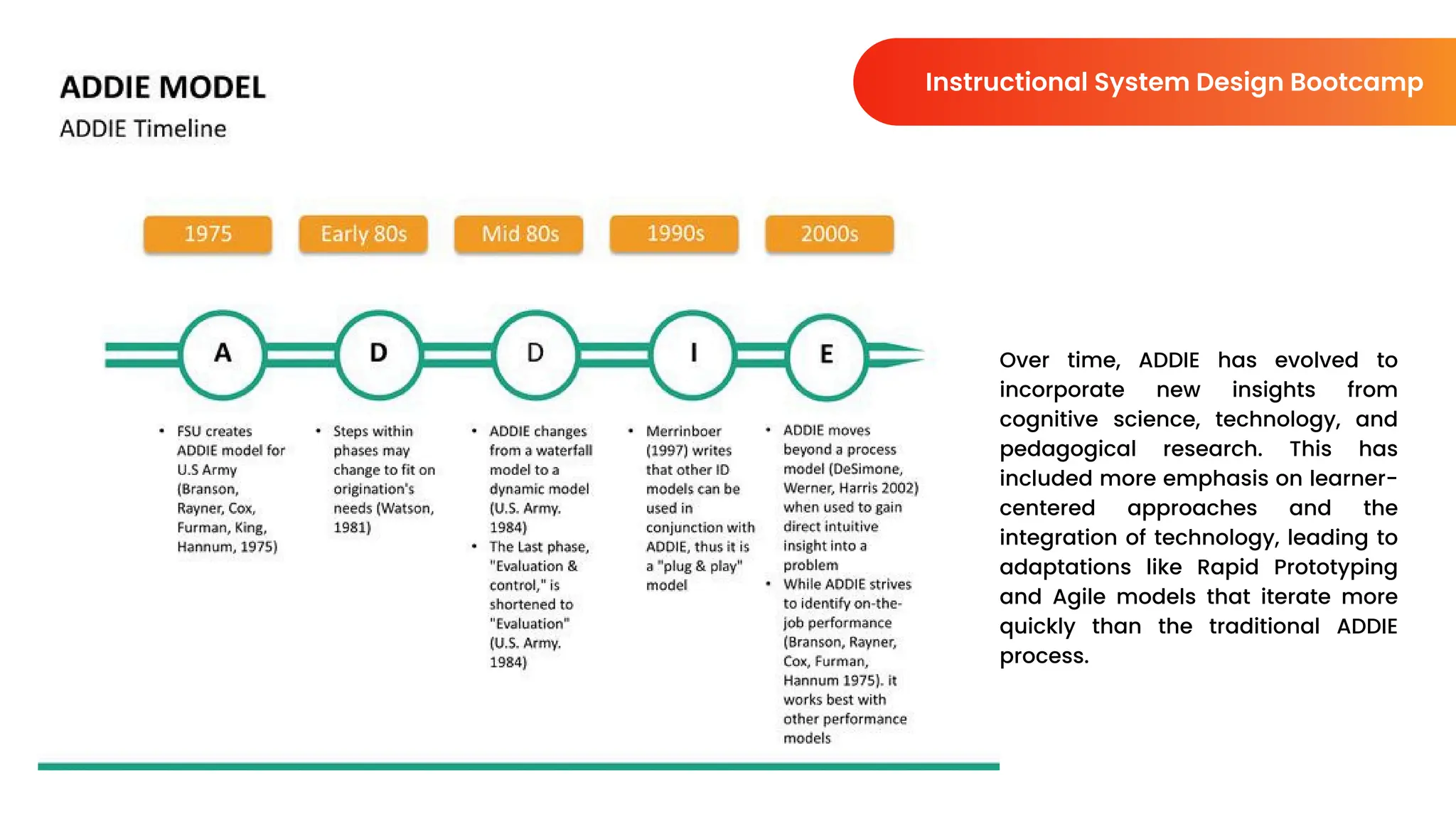
Over time, ADDIE has evolved to
incorporate new insights from
cognitive science, technology, and
pedagogical research. This has
included more emphasis on learner-
centered approaches and the
integration of technology, leading to
adaptations like Rapid Prototyping
and Agile models that iterate more
quickly than the traditional ADDIE
process.
Instructional System Design Bootcamp
By following a defined process,
ADDIE helps streamline the
creation of training programs,
ensuring that resources are used
efficiently throughout the
development
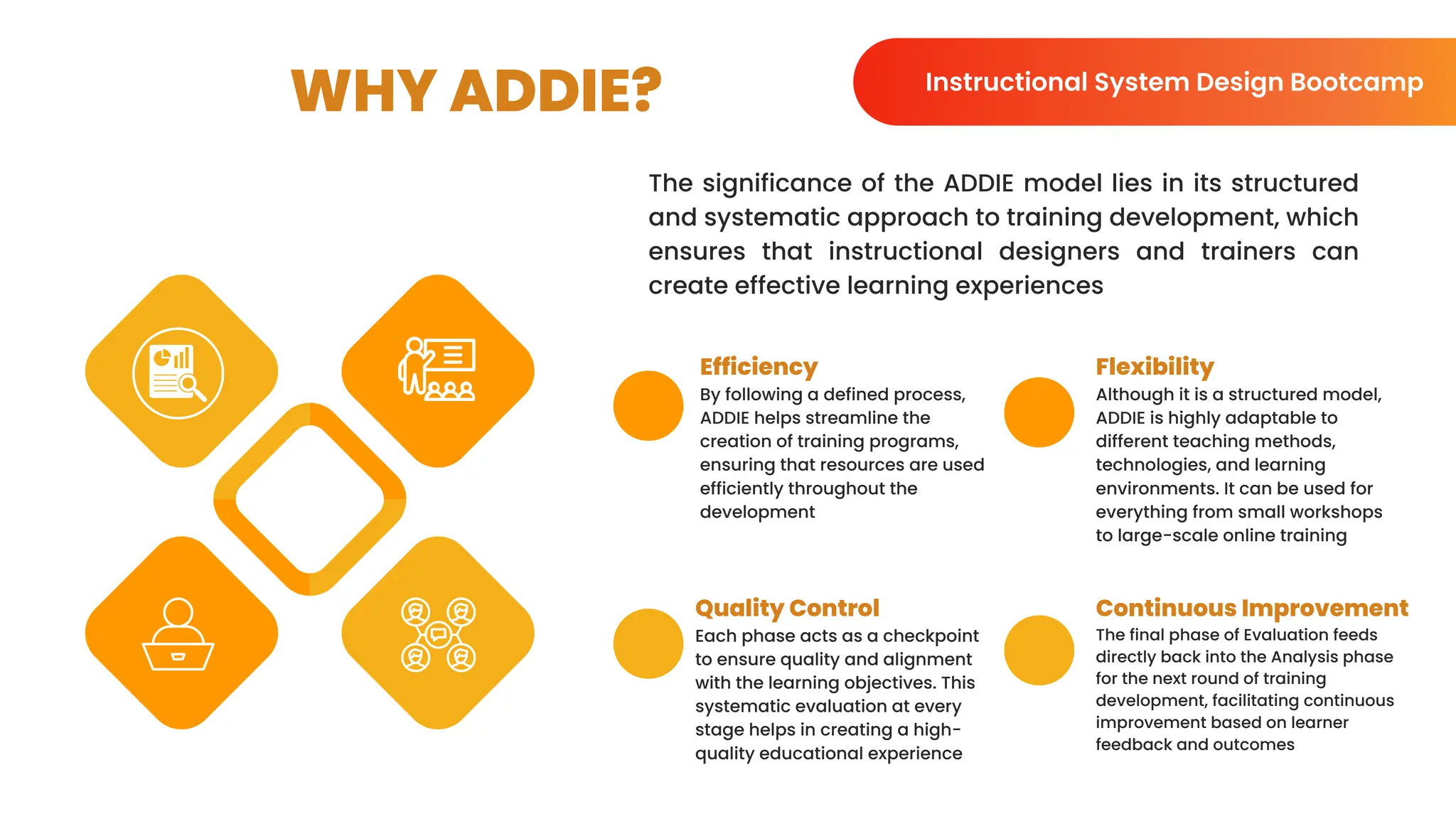
WHY ADDIE?
The significance of the ADDIE model lies in its structured
and systematic approach to training development, which
ensures that instructional designers and trainers can
create effective learning experiences
Efficiency
Quality Control
Each phase acts as a checkpoint
to ensure quality and alignment
with the learning objectives. This
systematic evaluation at every
stage helps in creating a high-
quality educational experience
Flexibility
Although it is a structured model,
ADDIE is highly adaptable to
different teaching methods,
technologies, and learning
environments. It can be used for
everything from small workshops
to large-scale online training
Continuous Improvement
The final phase of Evaluation feeds
directly back into the Analysis phase
for the next round of training
development, facilitating continuous
improvement based on learner
feedback and outcomes
Instructional System Design Bootcamp
Please write 2
another reason why
ADDIE Model is
important from
your perspective!
Instructional System Design Bootcamp
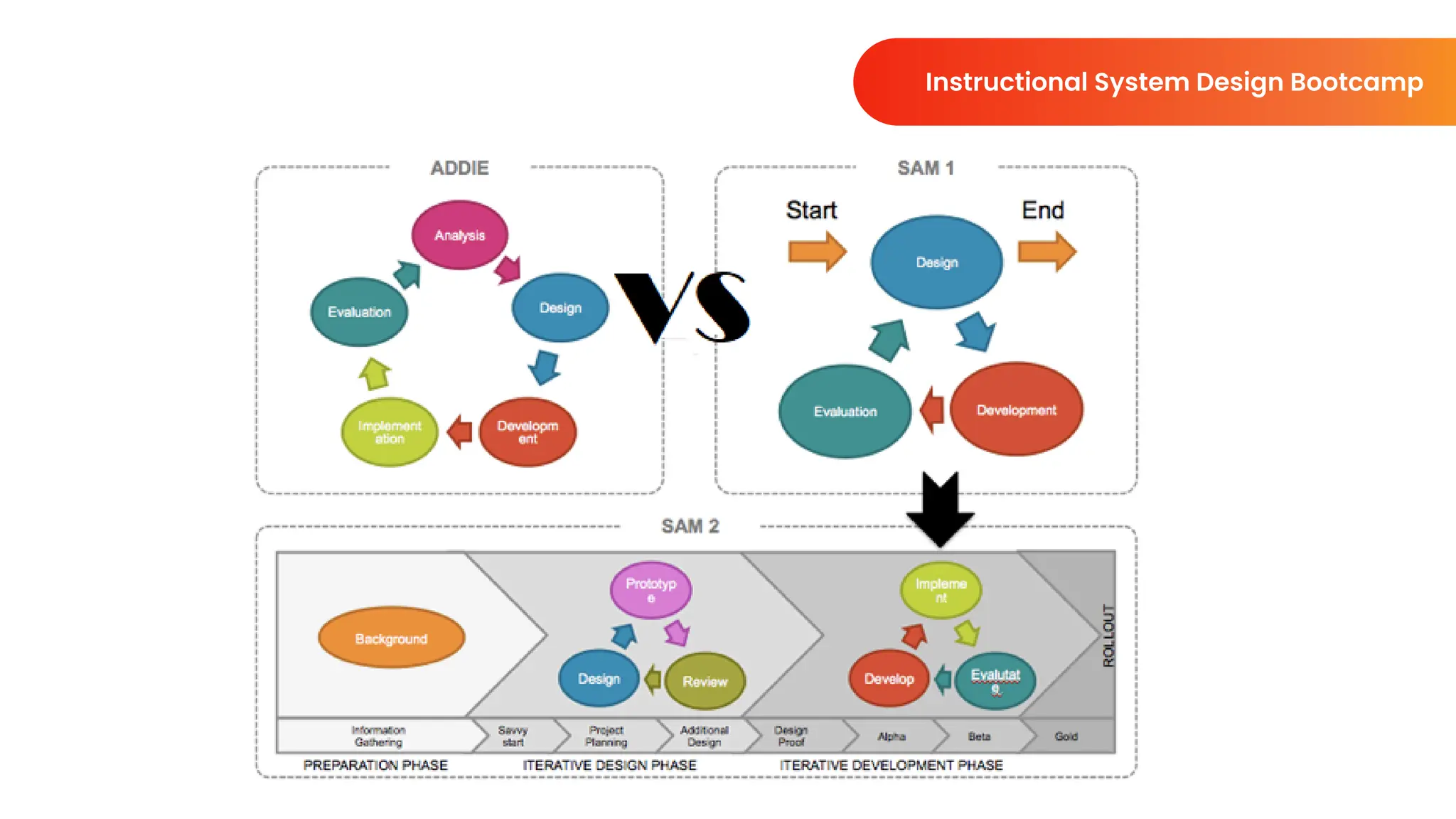
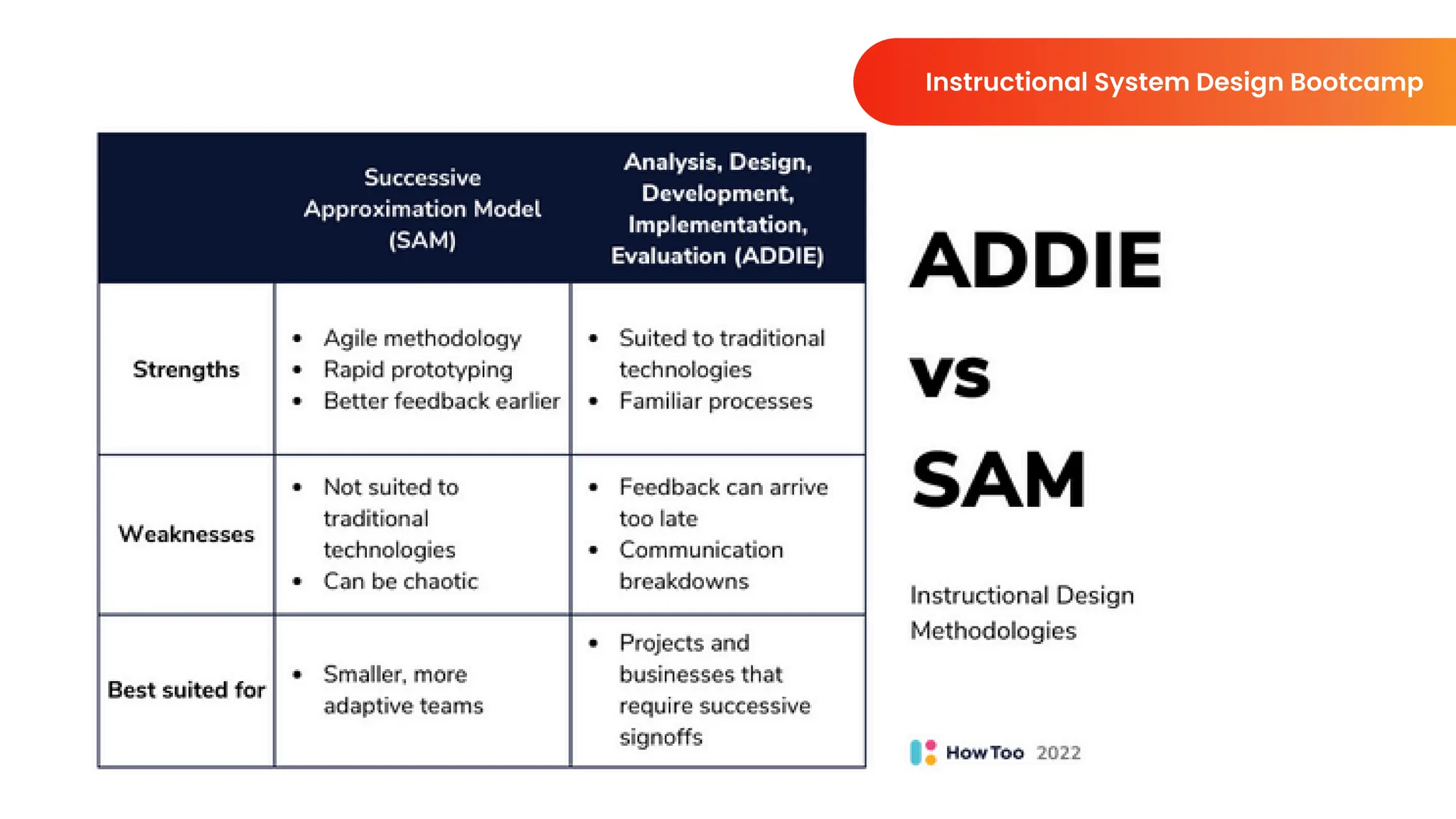
ADDIE VS SAM
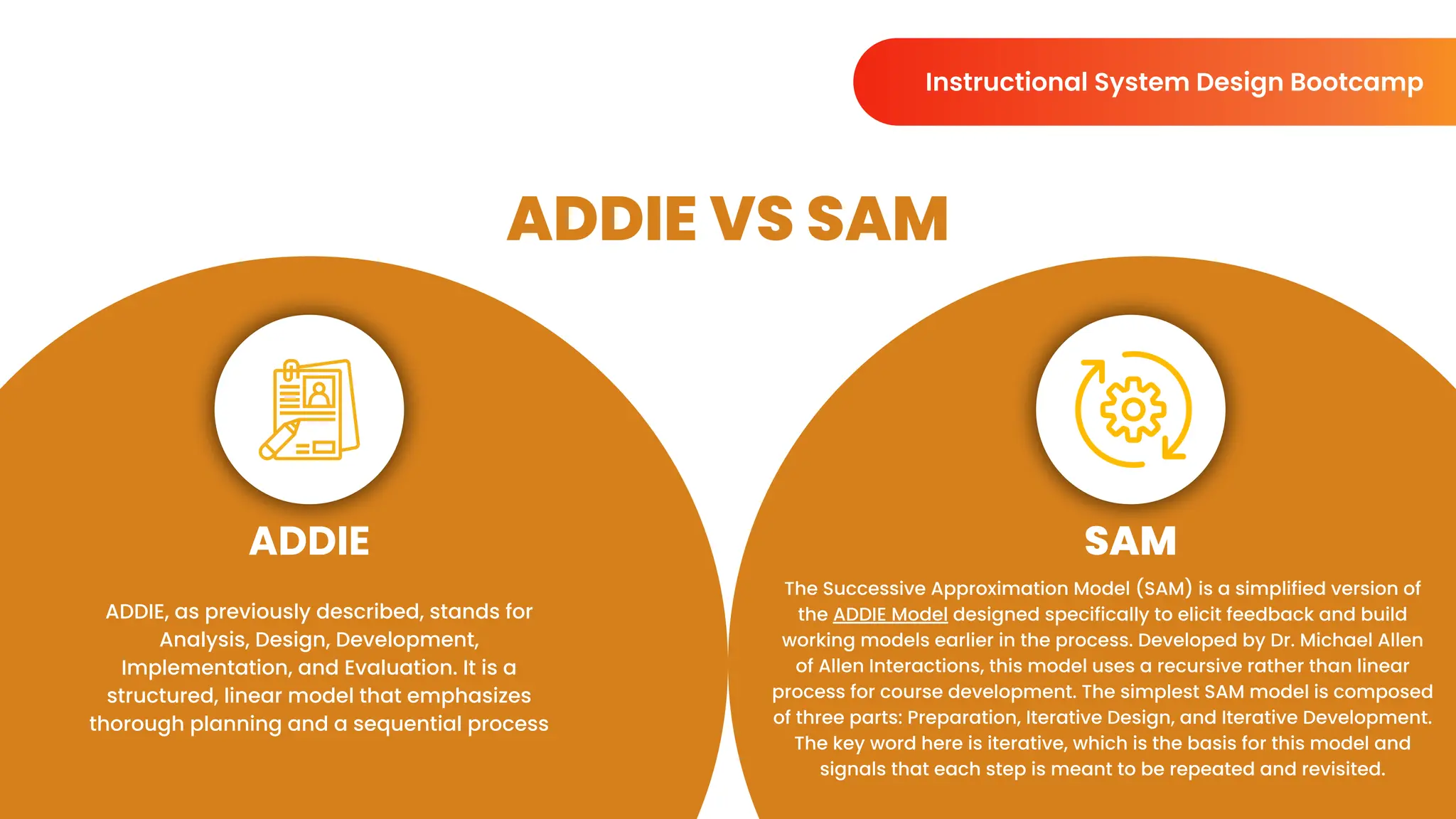
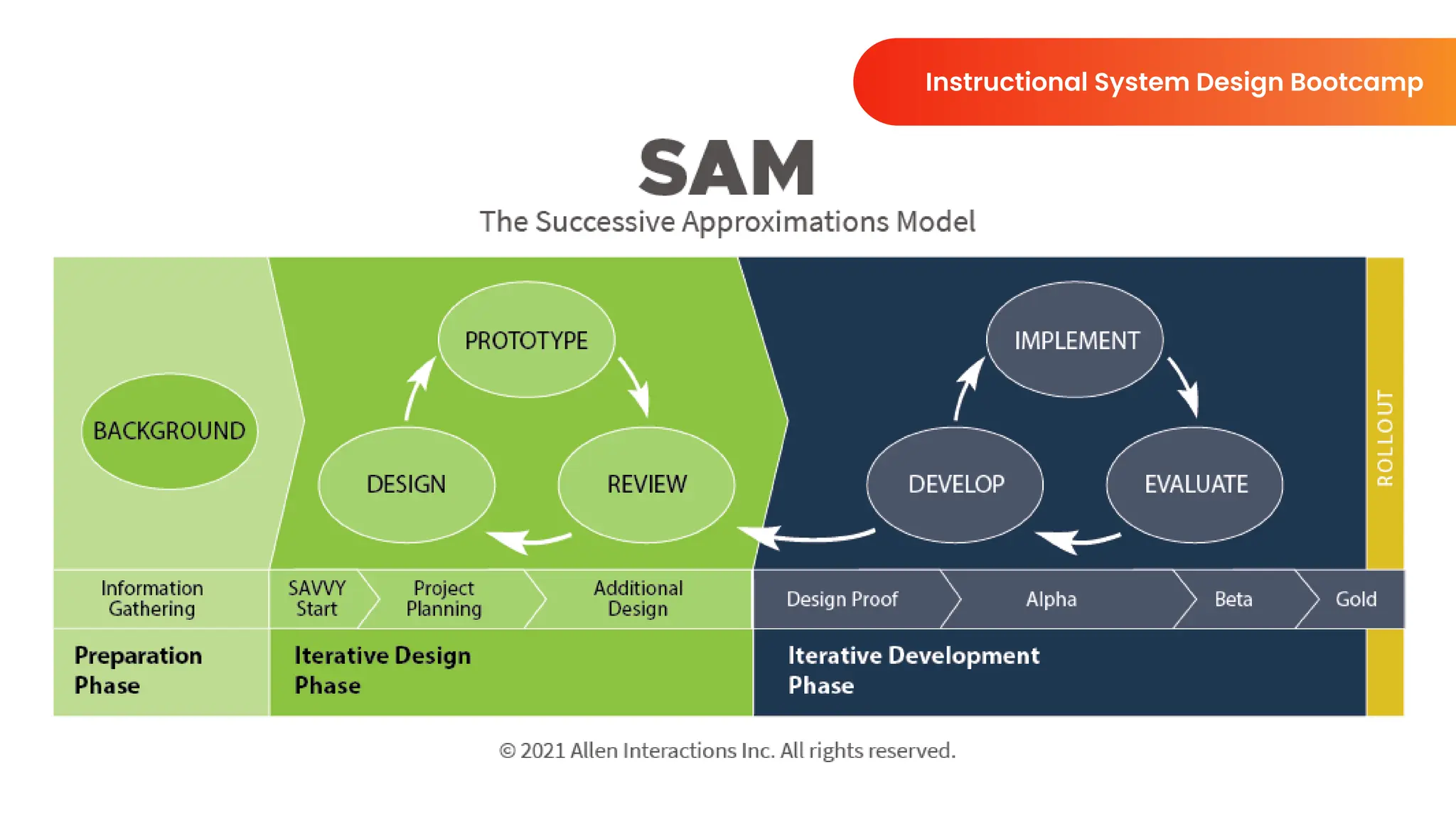
The Successive Approximation Model (SAM) is a simplified version of
the ADDIE Model designed specifically to elicit feedback and build
working models earlier in the process. Developed by Dr. Michael Allen
of Allen Interactions, this model uses a recursive rather than linear
process for course development. The simplest SAM model is composed
of three parts: Preparation, Iterative Design, and Iterative Development.
The key word here is iterative, which is the basis for this model and
signals that each step is meant to be repeated and revisited.
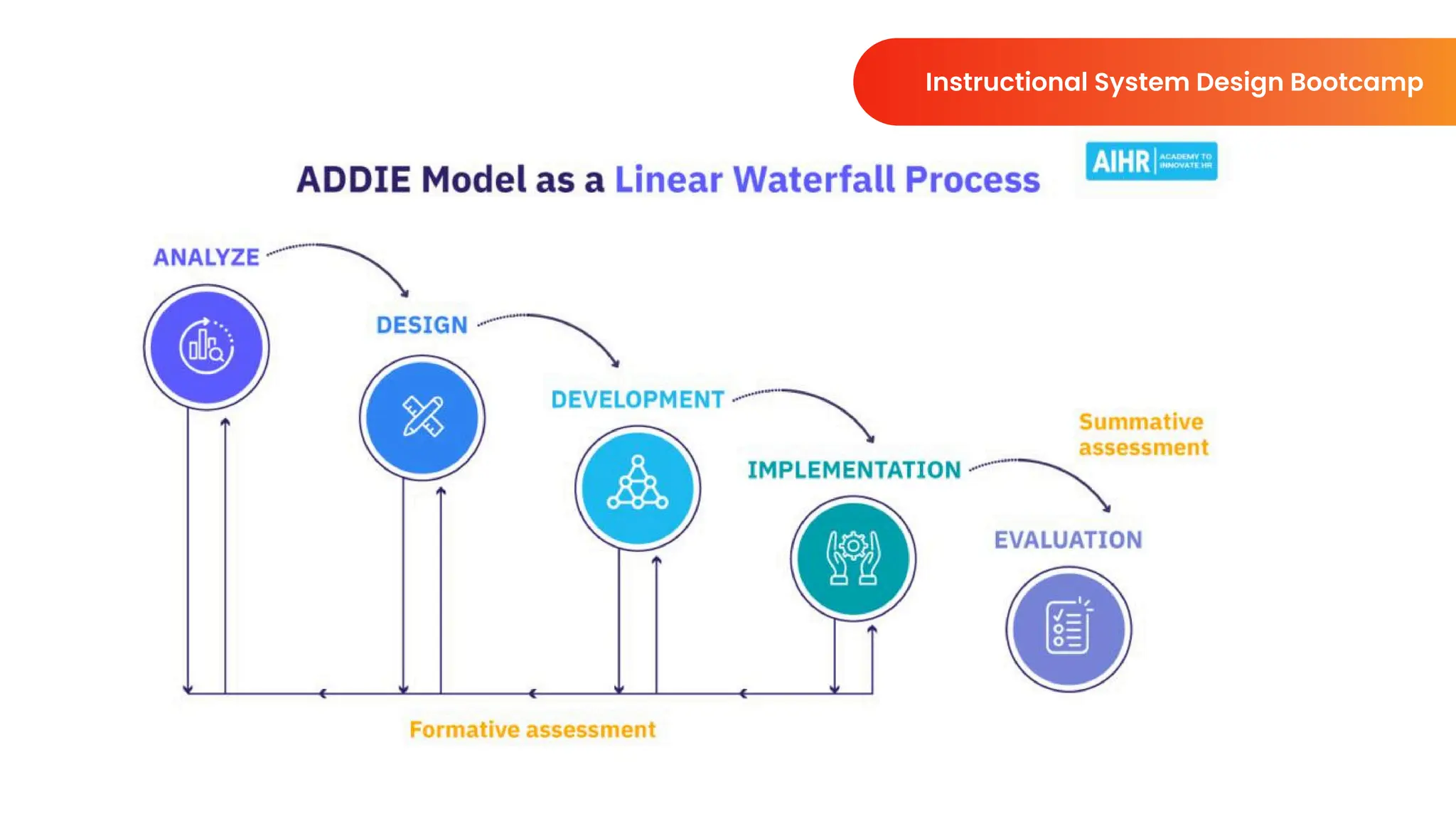
ADDIE, as previously described, stands for
Analysis, Design, Development,
Implementation, and Evaluation. It is a
structured, linear model that emphasizes
thorough planning and a sequential process
ADDIE SAM
Instructional System Design Bootcamp
What the difference
ADDIE and SAM?
Instructional System Design Bootcamp
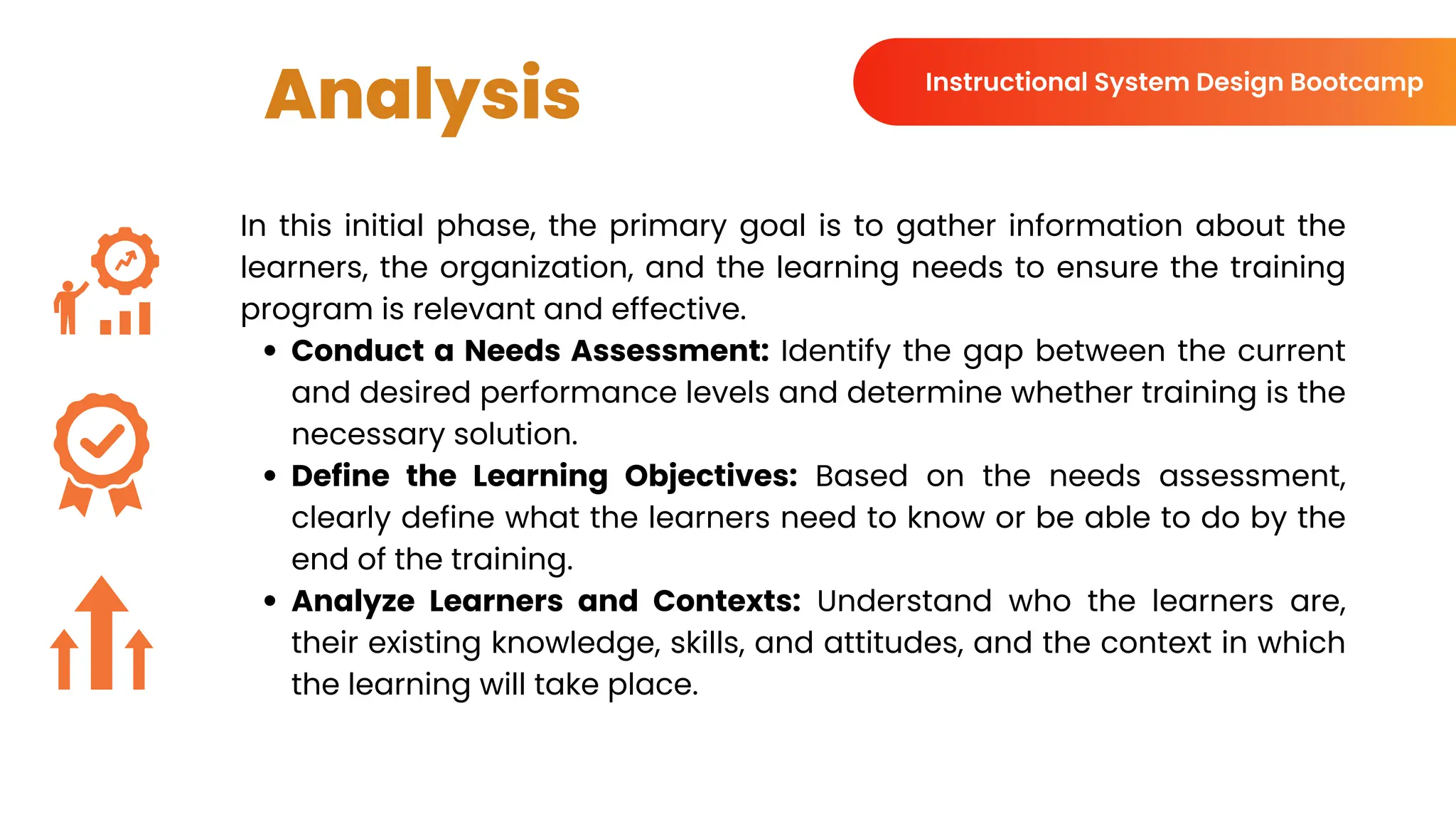
Analysis
In this initial phase, the primary goal is to gather information about the
learners, the organization, and the learning needs to ensure the training
program is relevant and effective.
Conduct a Needs Assessment: Identify the gap between the current
and desired performance levels and determine whether training is the
necessary solution.
Define the Learning Objectives: Based on the needs assessment,
clearly define what the learners need to know or be able to do by the
end of the training.
Analyze Learners and Contexts: Understand who the learners are,
their existing knowledge, skills, and attitudes, and the context in which
the learning will take place.
Instructional System Design Bootcamp
QnA
"What do you usually do to analyze your
audience's needs in your program?"
"What issues or obstacles do you
encounter when analyzing your program
to ensure it is properly created?"
Instructional System Design Bootcamp
Design
This phase focuses on planning the instructional strategy and designing
the training program.
Develop Instructional Strategy: Decide on the approach,
methodology, and media for delivering the content.
Design the Curriculum: Create a detailed blueprint of the course
structure, including the modules, lessons, and the flow of content.
Develop Assessment Instruments: Design pre-assessments, post-
assessments, and practice exercises to measure learner progress and
effectiveness of the training.
Instructional System Design Bootcamp
QnA
"What do you usually do to design your
learning program?"
"What issues or obstacles do you
encounter when designing your program
to ensure it is properly created?"
Instructional System Design Bootcamp
Develop
In the development phase, instructional designers and developers create
and assemble the actual content and learning materials based on the
design blueprint.
Develop Course Materials: Produce the content, visuals, and any
multimedia elements outlined in the design phase.
Prototype Development: Build a prototype or a first draft of the
training materials to test functionality and usability.
Review and Revise: Conduct a pilot test with a small group from the
target audience, gather feedback, and make necessary adjustments.
Instructional System Design Bootcamp
QnA
"What do you usually do to develop your
learning program?"
"What issues or obstacles do you encounter
when developing your program to ensure it
is properly created?"
Instructional System Design Bootcamp
Implement
During implementation, the training program is delivered to the target
audience.
Prepare the Learning Environment: Set up the tools and technology
required for delivering the training, such as Learning Management
Systems (LMS).
Facilitate Training: Conduct the training sessions, whether they are
in-person, online, or blended.
Support the Learners: Provide ongoing support through additional
resources, coaching, or mentoring to help learners apply what they
have learned.
Instructional System Design Bootcamp
QnA
"What do you usually do to implement
your learning program?"
"What issues or obstacles do you encounter
when implementing your program to ensure
it is properly created?"
Instructional System Design Bootcamp
Evaluate
This final phase assesses the effectiveness and impact of the training
program.
Formative Evaluation: Conduct ongoing evaluations during the
design and development phases to ensure the content meets
learning objectives.
Summative Evaluation: After the training is completed, measure the
outcomes against the learning objectives and business impacts.
Revise and Enhance: Use the insights gained from evaluations to
make continuous improvements to the training program.
Instructional System Design Bootcamp
QnA
"What do you usually do to evaluate your
learning program?"
"What issues or obstacles do you encounter
when evaluating your program to ensure it
is properly created?"
Instructional System Design Bootcamp
Session 1 :
Introduction to
Instructional System
Design
Instructional System Design Bootcamp
transformia.co.id
Visit Our Website

Session 1 Introduction to Instructional System Design.pdf

  • 1.
    Session 1 : Introductionto Instructional System Design Instructional System Design Bootcamp transformia.co.id Visit Our Website
  • 2.
    What do youknow about Instructional System Design? Instructional System Design Bootcamp
  • 3.
    Instructional System Design Instructional SystemDesign (ISD) refers to a systematic process that is used to create educational and training programs in a consistent and reliable fashion. It encompasses a set of procedures for designing, developing, implementing, and evaluating instruction. The aim of ISD is to ensure that all educational programs are effective, efficient, and appealing to learners. Instructional System Design Bootcamp
  • 4.
    The History The historyof ISD can be traced back to the 1940s and 1950s, evolving from the work of educational psychologists and instructional theorists who began to apply systematic approaches to the design, development, and delivery of training and educational programs. The roots of ISD are often attributed to the military training programs developed during World War II. The military needed to train large numbers of recruits quickly and effectively. This necessitated the development of a methodical approach that could be uniformly applied to ensure effective learning outcomes.
  • 5.
    what method or modelthat you used to create learning program in your session? Instructional System Design Bootcamp
  • 6.
    The most well-knownand foundational model in ISD is ADDIE. Although the origins of the ADDIE model are somewhat unclear, it is often attributed to the U.S. military's systematic approach to training development in the 1970s. The model became widely accepted as a generic template for curriculum development and instructional design. Instructional System Design Bootcamp
  • 7.
    What Is ADDIE? ADDIEis an acronym representing a systematic approach to instructional design and is one of the foundational models in the field. It stands for Analysis, Design, Development, Implementation, and Evaluation. This model provides a structured framework for creating effective and efficient training and educational programs. Each phase of the model has a specific purpose: Instructional System Design Bootcamp
  • 8.
    How you canensure that your learning program have impacted to your audience? Instructional System Design Bootcamp
  • 9.
    ADDIE MODEL Identify thelearning problem, the goals and objectives, the audience's needs, existing knowledge, and any other relevant characteristics. This phase focuses on understanding what learners need to achieve by the end of the training Analysis Plan the learning objectives, choose the content, methods, and materials that will be used. This phase involves outlining the curriculum and designing the instructional strategy Design Create and assemble the content assets that were defined in the design phase. This might involve the production of videos, interactive simulations, or written materials, depending on the chosen methods. Development Deliver or distribute the developed materials to the learners. This can involve instructing teachers on how to use the materials, ensuring technology is in place for online modules, or organizing live training sessions Implementation Assess the effectiveness of the training. This can be done through feedback from learners, assessments, or observing the application of the skills in the real world. The insights from this phase are used to refine the training for future learners Evaluation Instructional System Design Bootcamp
  • 10.
    Over time, ADDIEhas evolved to incorporate new insights from cognitive science, technology, and pedagogical research. This has included more emphasis on learner- centered approaches and the integration of technology, leading to adaptations like Rapid Prototyping and Agile models that iterate more quickly than the traditional ADDIE process. Instructional System Design Bootcamp
  • 11.
  • 12.
    By following adefined process, ADDIE helps streamline the creation of training programs, ensuring that resources are used efficiently throughout the development WHY ADDIE? The significance of the ADDIE model lies in its structured and systematic approach to training development, which ensures that instructional designers and trainers can create effective learning experiences Efficiency Quality Control Each phase acts as a checkpoint to ensure quality and alignment with the learning objectives. This systematic evaluation at every stage helps in creating a high- quality educational experience Flexibility Although it is a structured model, ADDIE is highly adaptable to different teaching methods, technologies, and learning environments. It can be used for everything from small workshops to large-scale online training Continuous Improvement The final phase of Evaluation feeds directly back into the Analysis phase for the next round of training development, facilitating continuous improvement based on learner feedback and outcomes Instructional System Design Bootcamp
  • 13.
    Please write 2 anotherreason why ADDIE Model is important from your perspective! Instructional System Design Bootcamp
  • 14.
    ADDIE VS SAM TheSuccessive Approximation Model (SAM) is a simplified version of the ADDIE Model designed specifically to elicit feedback and build working models earlier in the process. Developed by Dr. Michael Allen of Allen Interactions, this model uses a recursive rather than linear process for course development. The simplest SAM model is composed of three parts: Preparation, Iterative Design, and Iterative Development. The key word here is iterative, which is the basis for this model and signals that each step is meant to be repeated and revisited. ADDIE, as previously described, stands for Analysis, Design, Development, Implementation, and Evaluation. It is a structured, linear model that emphasizes thorough planning and a sequential process ADDIE SAM Instructional System Design Bootcamp
  • 15.
  • 16.
    What the difference ADDIEand SAM? Instructional System Design Bootcamp
  • 17.
  • 18.
  • 19.
    Analysis In this initialphase, the primary goal is to gather information about the learners, the organization, and the learning needs to ensure the training program is relevant and effective. Conduct a Needs Assessment: Identify the gap between the current and desired performance levels and determine whether training is the necessary solution. Define the Learning Objectives: Based on the needs assessment, clearly define what the learners need to know or be able to do by the end of the training. Analyze Learners and Contexts: Understand who the learners are, their existing knowledge, skills, and attitudes, and the context in which the learning will take place. Instructional System Design Bootcamp
  • 20.
    QnA "What do youusually do to analyze your audience's needs in your program?" "What issues or obstacles do you encounter when analyzing your program to ensure it is properly created?" Instructional System Design Bootcamp
  • 21.
    Design This phase focuseson planning the instructional strategy and designing the training program. Develop Instructional Strategy: Decide on the approach, methodology, and media for delivering the content. Design the Curriculum: Create a detailed blueprint of the course structure, including the modules, lessons, and the flow of content. Develop Assessment Instruments: Design pre-assessments, post- assessments, and practice exercises to measure learner progress and effectiveness of the training. Instructional System Design Bootcamp
  • 22.
    QnA "What do youusually do to design your learning program?" "What issues or obstacles do you encounter when designing your program to ensure it is properly created?" Instructional System Design Bootcamp
  • 23.
    Develop In the developmentphase, instructional designers and developers create and assemble the actual content and learning materials based on the design blueprint. Develop Course Materials: Produce the content, visuals, and any multimedia elements outlined in the design phase. Prototype Development: Build a prototype or a first draft of the training materials to test functionality and usability. Review and Revise: Conduct a pilot test with a small group from the target audience, gather feedback, and make necessary adjustments. Instructional System Design Bootcamp
  • 24.
    QnA "What do youusually do to develop your learning program?" "What issues or obstacles do you encounter when developing your program to ensure it is properly created?" Instructional System Design Bootcamp
  • 25.
    Implement During implementation, thetraining program is delivered to the target audience. Prepare the Learning Environment: Set up the tools and technology required for delivering the training, such as Learning Management Systems (LMS). Facilitate Training: Conduct the training sessions, whether they are in-person, online, or blended. Support the Learners: Provide ongoing support through additional resources, coaching, or mentoring to help learners apply what they have learned. Instructional System Design Bootcamp
  • 26.
    QnA "What do youusually do to implement your learning program?" "What issues or obstacles do you encounter when implementing your program to ensure it is properly created?" Instructional System Design Bootcamp
  • 27.
    Evaluate This final phaseassesses the effectiveness and impact of the training program. Formative Evaluation: Conduct ongoing evaluations during the design and development phases to ensure the content meets learning objectives. Summative Evaluation: After the training is completed, measure the outcomes against the learning objectives and business impacts. Revise and Enhance: Use the insights gained from evaluations to make continuous improvements to the training program. Instructional System Design Bootcamp
  • 28.
    QnA "What do youusually do to evaluate your learning program?" "What issues or obstacles do you encounter when evaluating your program to ensure it is properly created?" Instructional System Design Bootcamp
  • 29.
    Session 1 : Introductionto Instructional System Design Instructional System Design Bootcamp transformia.co.id Visit Our Website