By- 
 Mr ASHOK BISHNOI 
 Lecturer,JINR
Staff development programme- 
To meet the educational need of nursing student 
there must be provision for regular Staff 
development programme 
COMPONENTS- 
 Orientation 
 In-service education 
 Continuing education includes self instruction. 
 Attending short term course, workshop, seminar, 
presentation etc.
In service education
Definition- 
‘It is planned learning experience 
provided by the employing agency for 
employees,,
Nature and scope- 
It is a vehicle by which goals &the multiple articulated 
means available to achieve . 
It aim to developing ability for efficient working & the 
capacity for learning. 
To improve once competency in life.
Aims- 
Acquisition of newer knowledge. 
 Improvement of performance. 
To develop specific skill required for practice. 
 Improves the staff member chances for promotion. 
To develop right concept for client care. 
To maintain high standard for nursing. 
To observe & bring change in staff behavior.
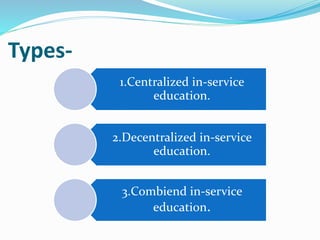
Types- 
1.Centralized in-service 
education. 
2.Decentralized in-service 
education. 
3.Combiend in-service 
education.
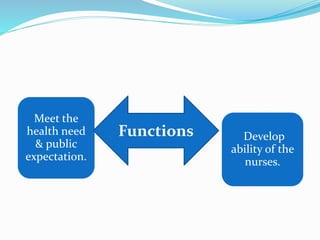
Meet the 
health need 
& public 
expectation. 
Develop 
ability of the 
nurses. 
Functions
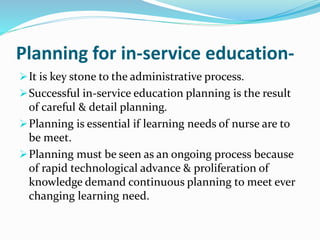
Planning for in-service education- 
It is key stone to the administrative process. 
Successful in-service education planning is the result 
of careful & detail planning. 
Planning is essential if learning needs of nurse are to 
be meet. 
Planning must be seen as an ongoing process because 
of rapid technological advance & proliferation of 
knowledge demand continuous planning to meet ever 
changing learning need.
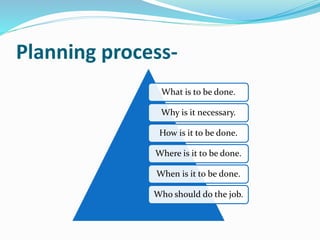
Planning process- 
What is to be done. 
Why is it necessary. 
How is it to be done. 
Where is it to be done. 
When is it to be done. 
Who should do the job.
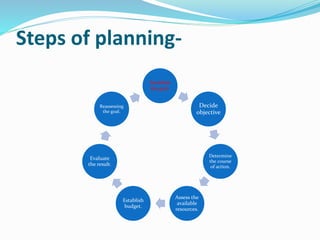
Steps of planning- 
Establish 
the goal. 
Decide 
objective 
Determine 
the course 
of action. 
Assess the 
available 
resources. 
Reassessing 
the goal. 
Establish 
budget. 
Evaluate 
the result.
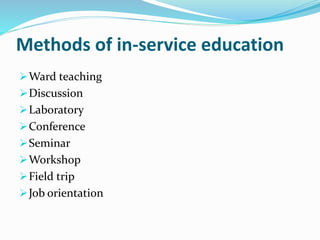
Methods of in-service education 
Ward teaching 
Discussion 
Laboratory 
Conference 
Seminar 
Workshop 
Field trip 
Job orientation
Evaluation of in-service programme- 
By- 
Knowledge 
Attitude 
practice 
Pre test & post test 
Written test/objective. assay 
Check list 
Rating scale 
Practical test(direct obese.)
Introduction:- 
 The field of adult learning was introduce by Malcom 
Knowles, 
 It a new area of study which involve understanding 
how adult learns best compared to children & Teens 
team.
Definition of learning:- 
‘Learning is a permanent change in human 
capabilities that is not a result of the growth 
process”
Definition:- 
“It is the practice of teaching & 
educating adults at work place during 
in service education programme”
Scope of adult learning:- 
The need for adult education & continuing education 
is due to Following factor- 
 Changing social trends. 
 Population mobility 
 Changing roles of hospital 
 Health status 
 Employment & empowerment of women
 The scope is in nursing practices very significant & nurses 
are committed for life long learning to themselves & it need 
to be continued throughout the professional life. 
 If the nurse lack motivation in learning new concept , she 
will continue practicing the old trends in nursing practice 
which are suppose to change with time & social trends. 
 Continuing education among nurses is essential for quality 
performance which requires knowledge in border aspect of 
various field apart from nursing subject eg. Psychology, 
Sociology, Biochemistry, Biophysics, Microbiology 
Pathology, Current affairs..
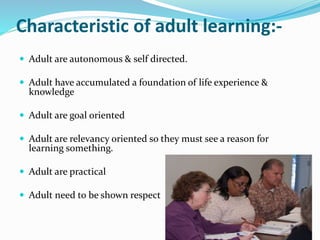
Characteristic of adult learning:- 
 Adult are autonomous & self directed. 
 Adult have accumulated a foundation of life experience & 
knowledge 
 Adult are goal oriented 
 Adult are relevancy oriented so they must see a reason for 
learning something. 
 Adult are practical 
 Adult need to be shown respect
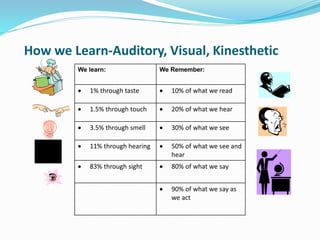
How we Learn-Auditory, Visual, Kinesthetic 
We learn: We Remember: 
 1% through taste  10% of what we read 
 1.5% through touch  20% of what we hear 
 3.5% through smell  30% of what we see 
 11% through hearing  50% of what we see and 
hear 
 83% through sight  80% of what we say 
 90% of what we say as 
we act
Principles of adult learning:- 
1. Adults must want to learn They learn effectively only when they have a 
strong inner motivation to develop a new skill or acquire a particular type of 
knowledge. 
2. Adults will learn only what they feel they need to learn Adults are 
practical in their approach to learning; they want to know, “How is this going 
to help me right now?” 
Be practical, be direct. 
3. Adults learn by doing Children learn by doing, but active participation is 
more important among adults. 
4. Adult learning focuses on problems and the problems must be 
realistic Children learn skills sequentially. Adults start with a problem and 
then work to find a solution.
5 Experience affects adult learning Adults have more 
experience than children. This can be an asset and a 
liability. 
6 Adults learn best in an informal situation Children 
have to follow a curriculum. Often, adults learn only what 
they feel they need to know. 
7 Adults want guidance Adults want information that will 
help them improve their situation or that of their children. 
They do not want to be told what to do. They want to 
choose options based on their individual needs.
THANK 
YOU

In service education

  • 1.
    By-  MrASHOK BISHNOI  Lecturer,JINR
  • 2.
    Staff development programme- To meet the educational need of nursing student there must be provision for regular Staff development programme COMPONENTS-  Orientation  In-service education  Continuing education includes self instruction.  Attending short term course, workshop, seminar, presentation etc.
  • 3.
  • 4.
    Definition- ‘It isplanned learning experience provided by the employing agency for employees,,
  • 5.
    Nature and scope- It is a vehicle by which goals &the multiple articulated means available to achieve . It aim to developing ability for efficient working & the capacity for learning. To improve once competency in life.
  • 6.
    Aims- Acquisition ofnewer knowledge.  Improvement of performance. To develop specific skill required for practice.  Improves the staff member chances for promotion. To develop right concept for client care. To maintain high standard for nursing. To observe & bring change in staff behavior.
  • 7.
    Types- 1.Centralized in-service education. 2.Decentralized in-service education. 3.Combiend in-service education.
  • 8.
    Meet the healthneed & public expectation. Develop ability of the nurses. Functions
  • 9.
    Planning for in-serviceeducation- It is key stone to the administrative process. Successful in-service education planning is the result of careful & detail planning. Planning is essential if learning needs of nurse are to be meet. Planning must be seen as an ongoing process because of rapid technological advance & proliferation of knowledge demand continuous planning to meet ever changing learning need.
  • 10.
    Planning process- Whatis to be done. Why is it necessary. How is it to be done. Where is it to be done. When is it to be done. Who should do the job.
  • 11.
    Steps of planning- Establish the goal. Decide objective Determine the course of action. Assess the available resources. Reassessing the goal. Establish budget. Evaluate the result.
  • 12.
    Methods of in-serviceeducation Ward teaching Discussion Laboratory Conference Seminar Workshop Field trip Job orientation
  • 13.
    Evaluation of in-serviceprogramme- By- Knowledge Attitude practice Pre test & post test Written test/objective. assay Check list Rating scale Practical test(direct obese.)
  • 15.
    Introduction:-  Thefield of adult learning was introduce by Malcom Knowles,  It a new area of study which involve understanding how adult learns best compared to children & Teens team.
  • 16.
    Definition of learning:- ‘Learning is a permanent change in human capabilities that is not a result of the growth process”
  • 17.
    Definition:- “It isthe practice of teaching & educating adults at work place during in service education programme”
  • 18.
    Scope of adultlearning:- The need for adult education & continuing education is due to Following factor-  Changing social trends.  Population mobility  Changing roles of hospital  Health status  Employment & empowerment of women
  • 19.
     The scopeis in nursing practices very significant & nurses are committed for life long learning to themselves & it need to be continued throughout the professional life.  If the nurse lack motivation in learning new concept , she will continue practicing the old trends in nursing practice which are suppose to change with time & social trends.  Continuing education among nurses is essential for quality performance which requires knowledge in border aspect of various field apart from nursing subject eg. Psychology, Sociology, Biochemistry, Biophysics, Microbiology Pathology, Current affairs..
  • 20.
    Characteristic of adultlearning:-  Adult are autonomous & self directed.  Adult have accumulated a foundation of life experience & knowledge  Adult are goal oriented  Adult are relevancy oriented so they must see a reason for learning something.  Adult are practical  Adult need to be shown respect
  • 21.
    How we Learn-Auditory,Visual, Kinesthetic We learn: We Remember:  1% through taste  10% of what we read  1.5% through touch  20% of what we hear  3.5% through smell  30% of what we see  11% through hearing  50% of what we see and hear  83% through sight  80% of what we say  90% of what we say as we act
  • 23.
    Principles of adultlearning:- 1. Adults must want to learn They learn effectively only when they have a strong inner motivation to develop a new skill or acquire a particular type of knowledge. 2. Adults will learn only what they feel they need to learn Adults are practical in their approach to learning; they want to know, “How is this going to help me right now?” Be practical, be direct. 3. Adults learn by doing Children learn by doing, but active participation is more important among adults. 4. Adult learning focuses on problems and the problems must be realistic Children learn skills sequentially. Adults start with a problem and then work to find a solution.
  • 24.
    5 Experience affectsadult learning Adults have more experience than children. This can be an asset and a liability. 6 Adults learn best in an informal situation Children have to follow a curriculum. Often, adults learn only what they feel they need to know. 7 Adults want guidance Adults want information that will help them improve their situation or that of their children. They do not want to be told what to do. They want to choose options based on their individual needs.
  • 25.