Mr. Visanth V S
Asso.Professor
IGSCON, Amethi
Performance appraisal is a method of evaluating the
behavior of employees in the work spot, normally
including both the quantitative and qualitative aspects of
job performance.
Performance here refers to the degree of
accomplishment of the tasks that make up an
individual's job. It indicates how well an individual is
fulfilling the job demands.
The performance of an employee is compared with the
job standards. The job standards are already fixed by the
management for an effective appraisal.
• Performance appraisal refers to all the
formal procedures used in working
organizations to evaluate the personalities
and contribution of group members.
• To determine job competence
• To select qualified individuals for promotion or transfer
• To establish and improve – Communication between
supervisors and subordinates – Staff performance
• To determine – Training and developmental needs of staff –
Salary standards and to award merit.
• To discover the aspirations and talents of staff
• To check the efficacy of staff development programmes
• To identify unsatisfactory staff for demotion or termination
• To aid the manager in coaching and counseling
• To provide feedback to enhance staff development and
motivate personnel towards heights of achievement
• Individual Rewards
• Feedback for Sub-Ordinate
• Recognition of Superior Performance
• Documentation of Weak Performance
• Personnel Decision-Making
• To establish standards of job performance
• To improve organizational development by
identifying training and development needs
• To earmark candidates for supervisory and management
developments
• Future Goal Commitments (Planned Achievements)
• It minimizes the communication gap between the
employer and employee.
• The grievances of an employee are eliminated through
performance appraisal.
• The job satisfaction of an employee increases morale.
• HR Planning
• used to transfer a person who is misfit for a job to the
right placement
1. The philosophy, purpose, and objectives of the organization
are clearly stated so that performance appraisal tools can be
designed to reflect these.
2. The purposes of performance appraisal are identified,
communicated, and understood.
3. Job descriptions are written in such a manner that standards
of job performance can be identified for each job.
4. The appraisal tool used is suited to the purposes for which it
will be utilized and is accompanied by clear instructions for
its use.
5. Evaluators are trained in the use of the tool.
• Objectives & results of appraisal should be
identified/known to all parties
• The appraisal process & tools are developed with input
from all levels of employees affected by job
responsibilities
• The supervisor has received education & training in the
use of appraisal process & tool
• The appraisal process is valued by organization
• The appraisal process occurs consistently
• Assess performance in relation to behaviorally stated
work goals.
• Observe a representative sample of employees’ total
work activities.
• Compare supervisor’s evaluation with employee’s self-
evaluation
• Cite specific examples of satisfactory and unsatisfactory
performance
• Indicate which job areas have highest priority for
improvements
• Purpose of evaluation is to improve work performance
and job satisfaction
• Evaluation interview should be scheduled in proper time
& environment
Decision Making(Taking Corrective Actions)
Discussing Results
Comparing With Standards
Measuring Actual Performance
Communicating Standards & Expectations
Establishing Performance Standards
 Immediate Supervisor
Higher Management
Self-Appraisals
Peers (Co-Workers)
Evaluation Teams
Customers
“360° Appraisals”
360o
Appraisal
Top
Management
Immediate
superiors
Customers
Self
Peers
Subordinates
Performance quality: Quantity and quality of
work, neatness, orderliness, reliability, accuracy,
knowledge of work execution etc..
Mental abilities: The ability to learn,
adaptability, reasoning power, judgment,
memory etc
Supervisory qualities: leadership and
organizational ability, communication skill,
cooperation etc.
 Personal qualities: honesty, self-control,
self-confidence, initiative, attitude towards
others, team work, appearance etc...
Capacity for further development:
Intelligence, acceptance of responsibility
and other features, inherent in leadership.
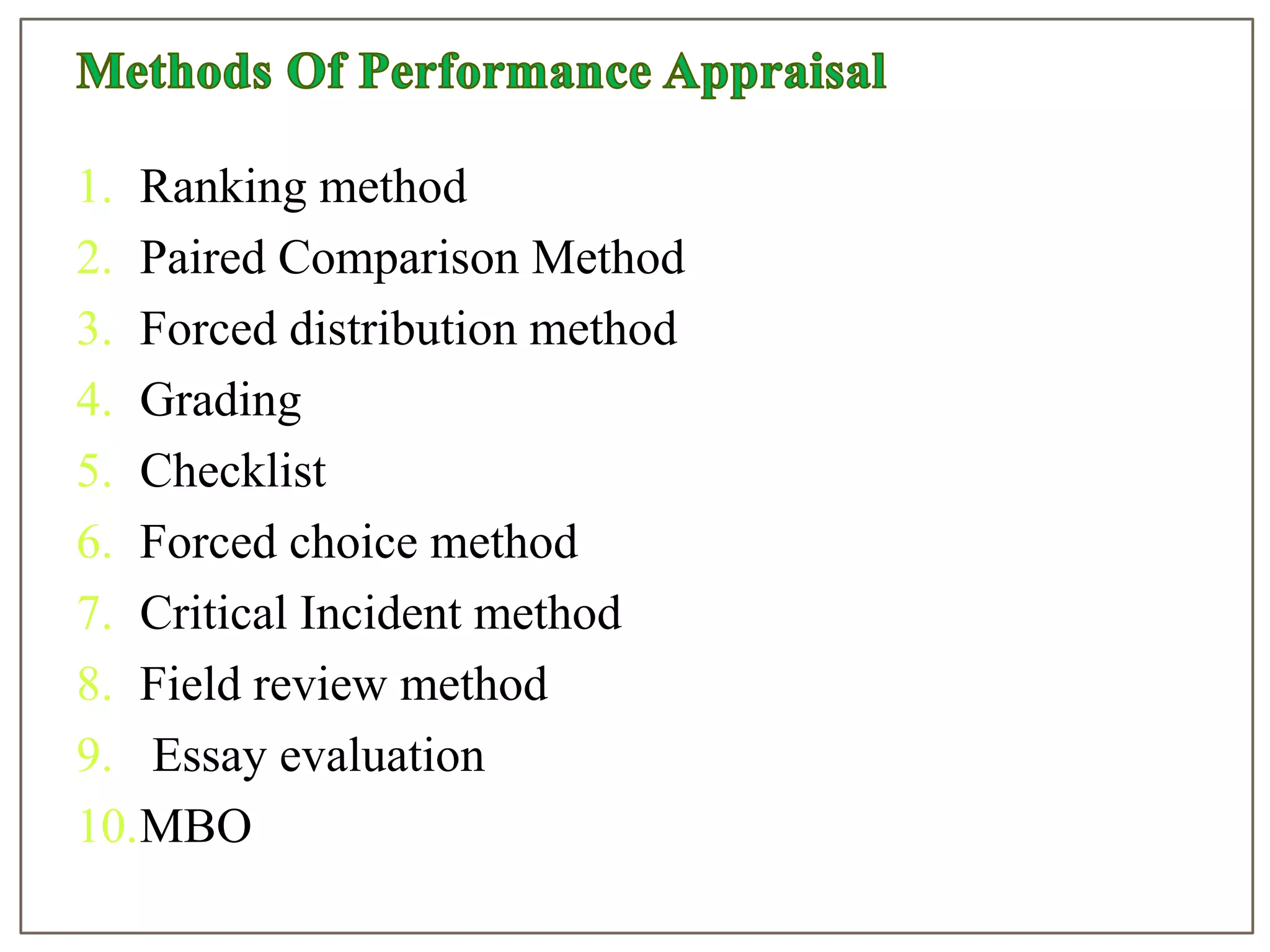
1. Ranking method
2. Paired Comparison Method
3. Forced distribution method
4. Grading
5. Checklist
6. Forced choice method
7. Critical Incident method
8. Field review method
9. Essay evaluation
10.MBO
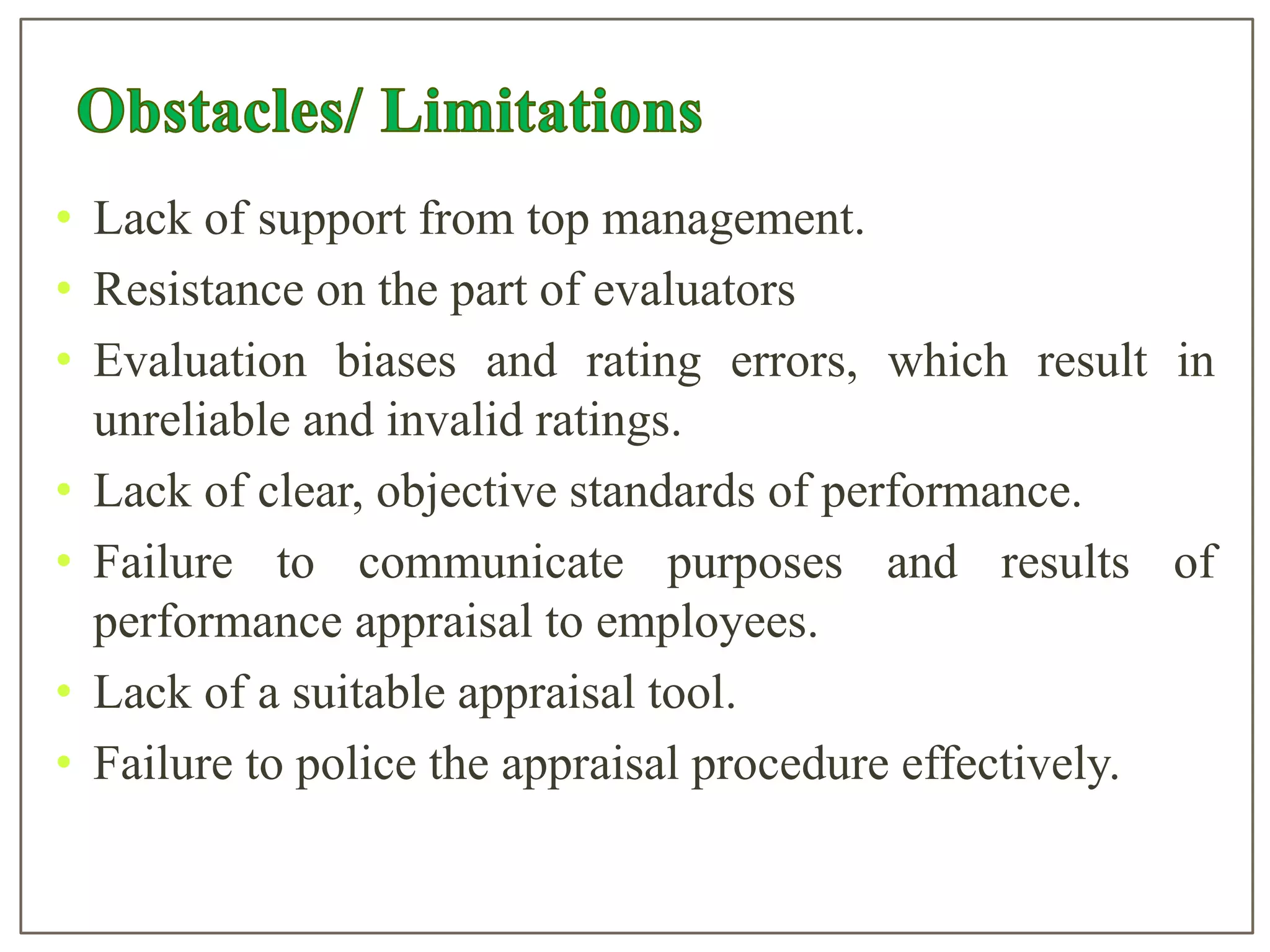
• Lack of support from top management.
• Resistance on the part of evaluators
• Evaluation biases and rating errors, which result in
unreliable and invalid ratings.
• Lack of clear, objective standards of performance.
• Failure to communicate purposes and results of
performance appraisal to employees.
• Lack of a suitable appraisal tool.
• Failure to police the appraisal procedure effectively.
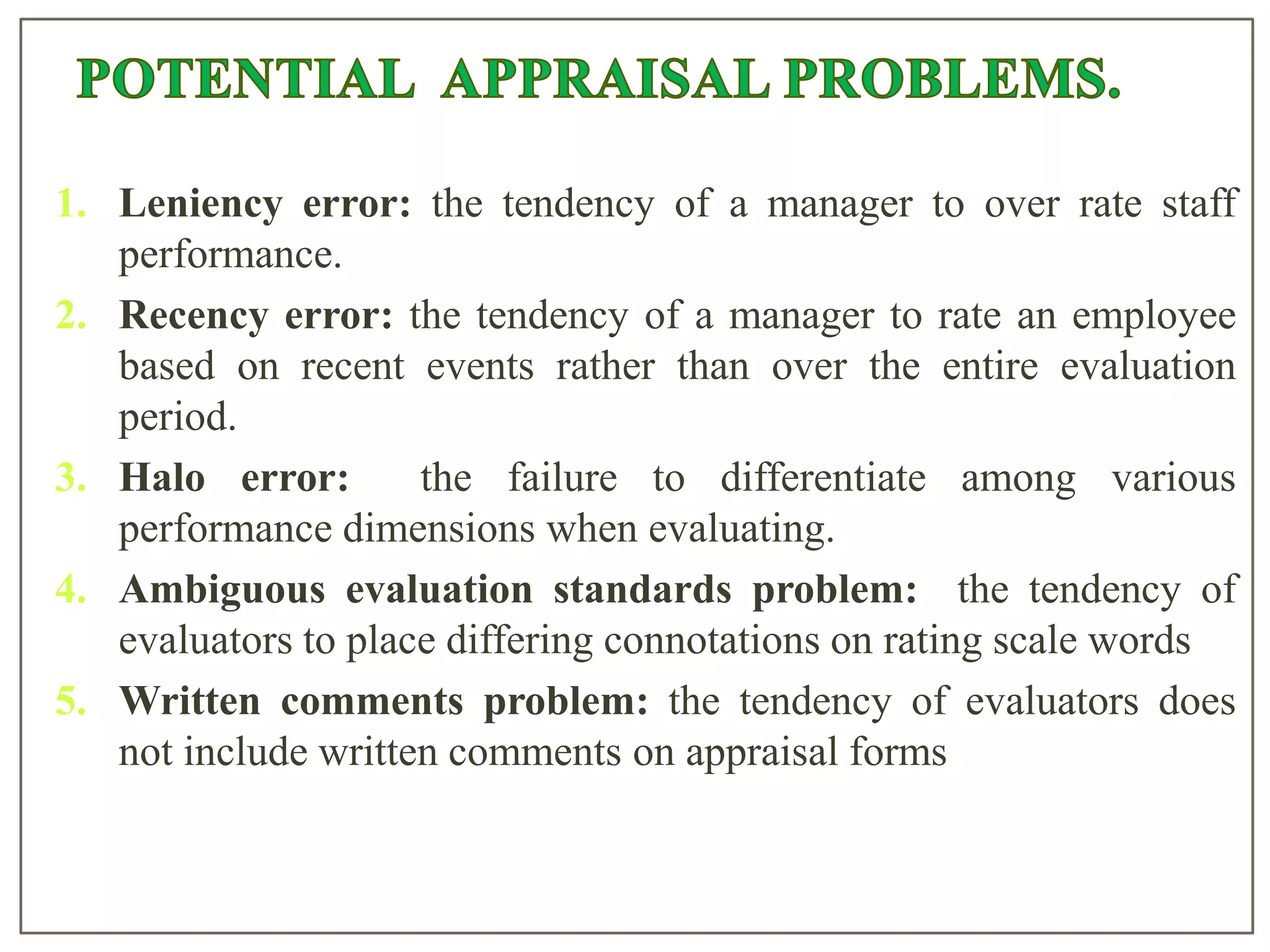
1. Leniency error: the tendency of a manager to over rate staff
performance.
2. Recency error: the tendency of a manager to rate an employee
based on recent events rather than over the entire evaluation
period.
3. Halo error: the failure to differentiate among various
performance dimensions when evaluating.
4. Ambiguous evaluation standards problem: the tendency of
evaluators to place differing connotations on rating scale words
5. Written comments problem: the tendency of evaluators does
not include written comments on appraisal forms
Performance appraisal- Nursing Management

Performance appraisal- Nursing Management

  • 1.
    Mr. Visanth VS Asso.Professor IGSCON, Amethi
  • 2.
    Performance appraisal isa method of evaluating the behavior of employees in the work spot, normally including both the quantitative and qualitative aspects of job performance. Performance here refers to the degree of accomplishment of the tasks that make up an individual's job. It indicates how well an individual is fulfilling the job demands. The performance of an employee is compared with the job standards. The job standards are already fixed by the management for an effective appraisal.
  • 3.
    • Performance appraisalrefers to all the formal procedures used in working organizations to evaluate the personalities and contribution of group members.
  • 4.
    • To determinejob competence • To select qualified individuals for promotion or transfer • To establish and improve – Communication between supervisors and subordinates – Staff performance • To determine – Training and developmental needs of staff – Salary standards and to award merit. • To discover the aspirations and talents of staff • To check the efficacy of staff development programmes • To identify unsatisfactory staff for demotion or termination • To aid the manager in coaching and counseling • To provide feedback to enhance staff development and motivate personnel towards heights of achievement
  • 5.
    • Individual Rewards •Feedback for Sub-Ordinate • Recognition of Superior Performance • Documentation of Weak Performance • Personnel Decision-Making • To establish standards of job performance • To improve organizational development by identifying training and development needs
  • 6.
    • To earmarkcandidates for supervisory and management developments • Future Goal Commitments (Planned Achievements) • It minimizes the communication gap between the employer and employee. • The grievances of an employee are eliminated through performance appraisal. • The job satisfaction of an employee increases morale. • HR Planning • used to transfer a person who is misfit for a job to the right placement
  • 7.
    1. The philosophy,purpose, and objectives of the organization are clearly stated so that performance appraisal tools can be designed to reflect these. 2. The purposes of performance appraisal are identified, communicated, and understood. 3. Job descriptions are written in such a manner that standards of job performance can be identified for each job. 4. The appraisal tool used is suited to the purposes for which it will be utilized and is accompanied by clear instructions for its use. 5. Evaluators are trained in the use of the tool.
  • 8.
    • Objectives &results of appraisal should be identified/known to all parties • The appraisal process & tools are developed with input from all levels of employees affected by job responsibilities • The supervisor has received education & training in the use of appraisal process & tool • The appraisal process is valued by organization • The appraisal process occurs consistently • Assess performance in relation to behaviorally stated work goals.
  • 9.
    • Observe arepresentative sample of employees’ total work activities. • Compare supervisor’s evaluation with employee’s self- evaluation • Cite specific examples of satisfactory and unsatisfactory performance • Indicate which job areas have highest priority for improvements • Purpose of evaluation is to improve work performance and job satisfaction • Evaluation interview should be scheduled in proper time & environment
  • 10.
    Decision Making(Taking CorrectiveActions) Discussing Results Comparing With Standards Measuring Actual Performance Communicating Standards & Expectations Establishing Performance Standards
  • 11.
     Immediate Supervisor HigherManagement Self-Appraisals Peers (Co-Workers) Evaluation Teams Customers “360° Appraisals”
  • 12.
  • 13.
    Performance quality: Quantityand quality of work, neatness, orderliness, reliability, accuracy, knowledge of work execution etc.. Mental abilities: The ability to learn, adaptability, reasoning power, judgment, memory etc Supervisory qualities: leadership and organizational ability, communication skill, cooperation etc.
  • 14.
     Personal qualities:honesty, self-control, self-confidence, initiative, attitude towards others, team work, appearance etc... Capacity for further development: Intelligence, acceptance of responsibility and other features, inherent in leadership.
  • 15.
    1. Ranking method 2.Paired Comparison Method 3. Forced distribution method 4. Grading 5. Checklist 6. Forced choice method 7. Critical Incident method 8. Field review method 9. Essay evaluation 10.MBO
  • 16.
    • Lack ofsupport from top management. • Resistance on the part of evaluators • Evaluation biases and rating errors, which result in unreliable and invalid ratings. • Lack of clear, objective standards of performance. • Failure to communicate purposes and results of performance appraisal to employees. • Lack of a suitable appraisal tool. • Failure to police the appraisal procedure effectively.
  • 17.
    1. Leniency error:the tendency of a manager to over rate staff performance. 2. Recency error: the tendency of a manager to rate an employee based on recent events rather than over the entire evaluation period. 3. Halo error: the failure to differentiate among various performance dimensions when evaluating. 4. Ambiguous evaluation standards problem: the tendency of evaluators to place differing connotations on rating scale words 5. Written comments problem: the tendency of evaluators does not include written comments on appraisal forms