QUALITY ASSURANCE
By-
Mr. ASHOK BISHNOI
Assist. Professor, JINR
Quality Assurance
 A system for monitoring outcome of professional
intervention and departmental activities, which are
compared with established standards to evaluate
and document appropriateness of practies.
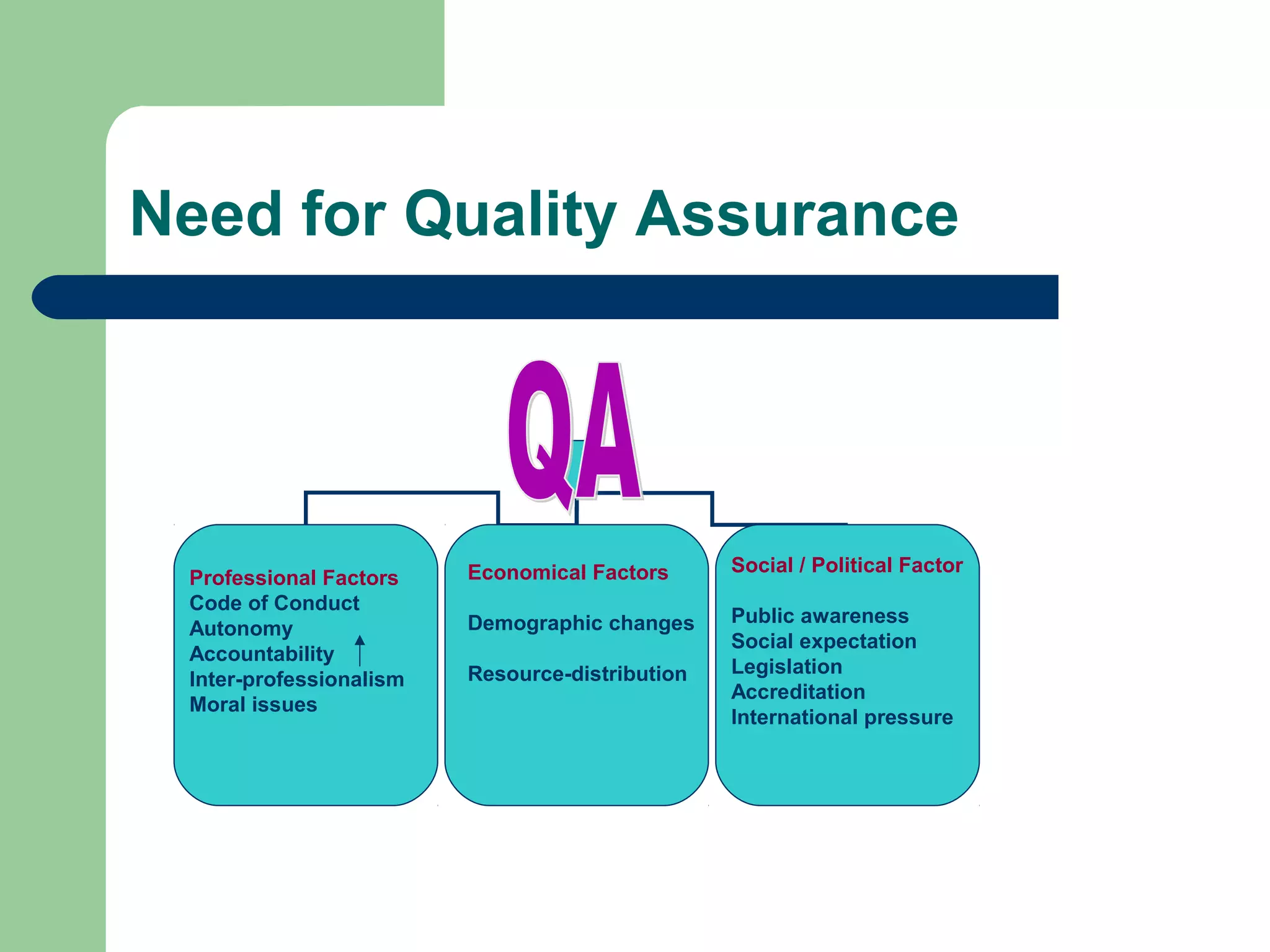
Need for Quality Assurance
Professional Factors
Code of Conduct
Autonomy
Accountability
Inter-professionalism
Moral issues
Social / Political Factor
Public awareness
Social expectation
Legislation
Accreditation
International pressure
Economical Factors
Demographic changes
Resource-distribution
STANDARDS
 Professionally developed expressions
 It is a degree of excellence.
 It is a model for imitations.
Definition of Standards
 A standard is a means of determining what
something should be in case of nursing
practice.
 Standards are the establish criteria for the
practice of nursing.
 Standards are statement for nursing practice.
 Standards specifies what is necessary for
high quality practice (ANA1973)
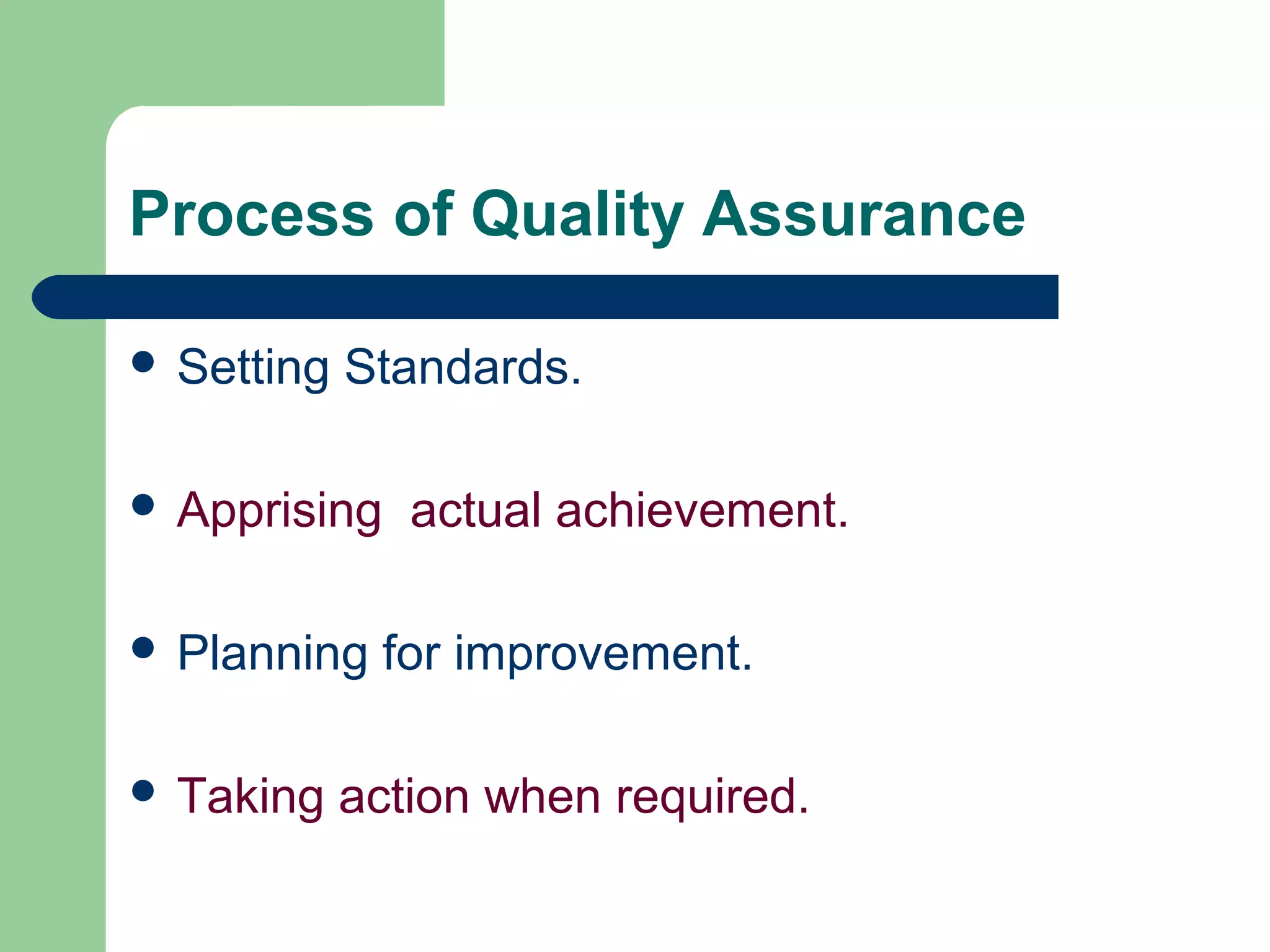
Process of Quality Assurance
 Setting Standards.
 Apprising actual achievement.
 Planning for improvement.
 Taking action when required.
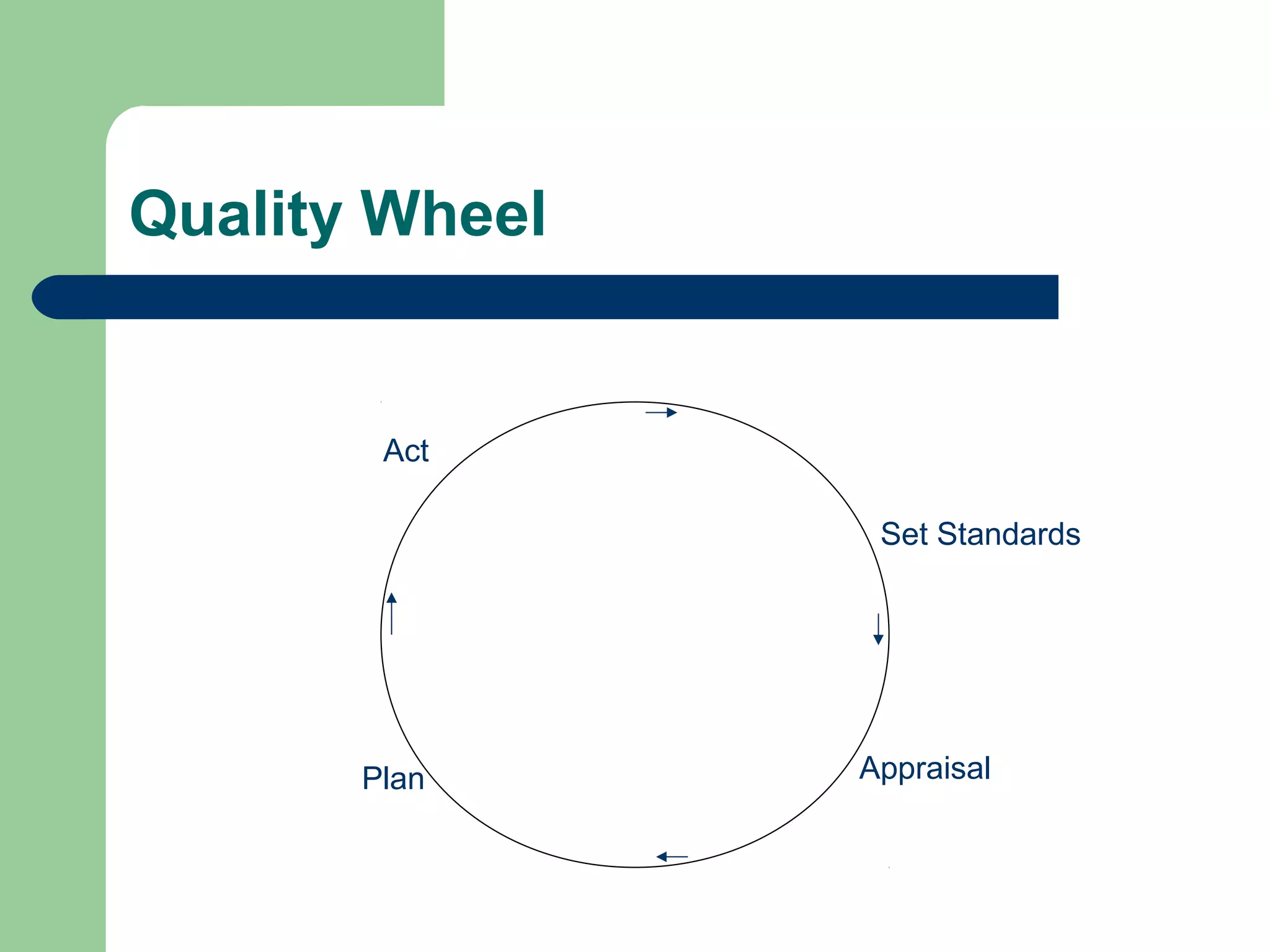
Quality Wheel
Act
Set Standards
Plan Appraisal
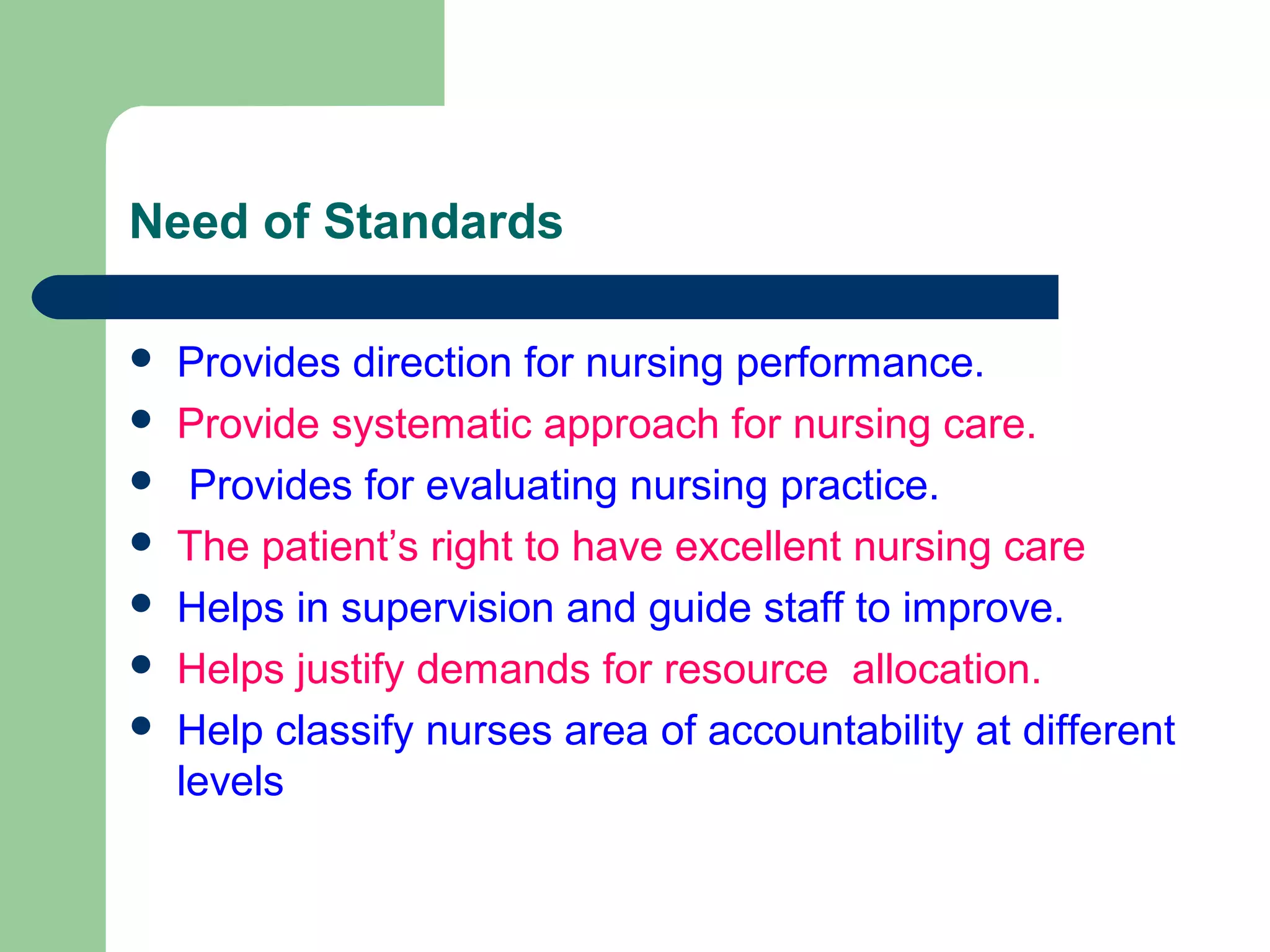
Need of Standards
 Provides direction for nursing performance.
 Provide systematic approach for nursing care.
 Provides for evaluating nursing practice.
 The patient’s right to have excellent nursing care
 Helps in supervision and guide staff to improve.
 Helps justify demands for resource allocation.
 Help classify nurses area of accountability at different
levels
Need of a Standards
 Nurses need to define and describe their
practice because of their statutory , legal and
social responsibility to give best possible
care to patient and client.
Purposes of Standards
 Evaluating the quality of practice.
 To coordinate and unify.
 Identify the element of independent function of practice.
 Provide a basis for planning and evaluating programs
 Inform the society of our concern for the improvement of
nursing practice.
 Assist public in understanding what to expect from nursing
practice.
 Provide a means by which member of different health
profession can coordinate their efforts in the improvement of
health care.
 Health employers to understand what expect from the
practitioner .
 Stimulate and encourage nursing personnel to promote and
support education, studies and research
In general
Nursing care standard are important to :
 Improve the quality of nursing care,
 Decrease the cost of nursing care.
 Promote a basis for determining
Types of Standards
 Normative standards : These standards are
descriptive of practices which are considered
ideal by authority . These standards describe
higher quality of practices. e.g. standards set
by professional association.
 Empirical standards : These standards
description of practices which are in actual
practice in large number of setting and which
agreed upon and achievable .e.g. standards
set by law enforcement bodies and
regulatory bodies- like health department and
licensures bodies.
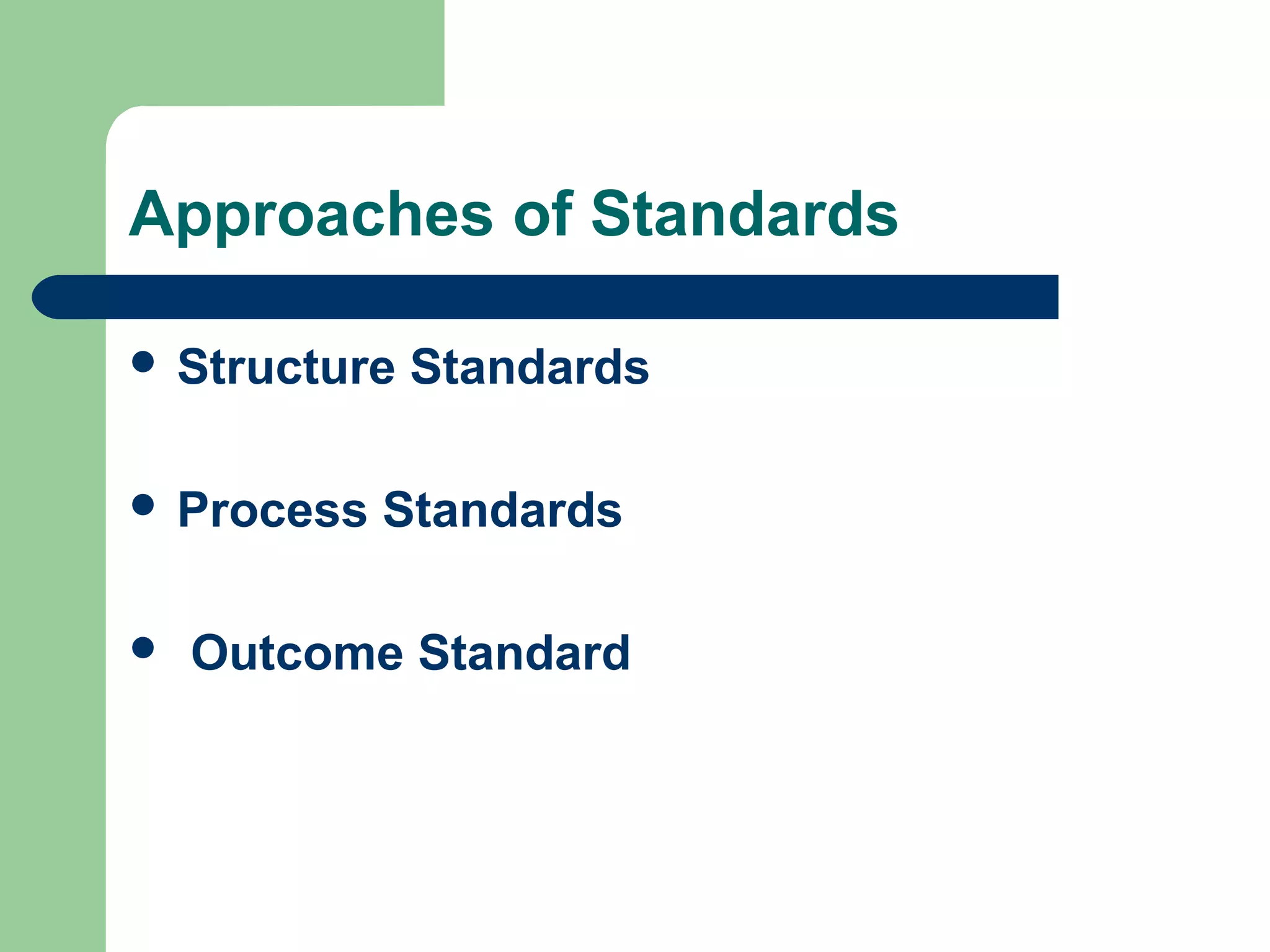
Approaches of Standards
 Structure Standards
 Process Standards
 Outcome Standard
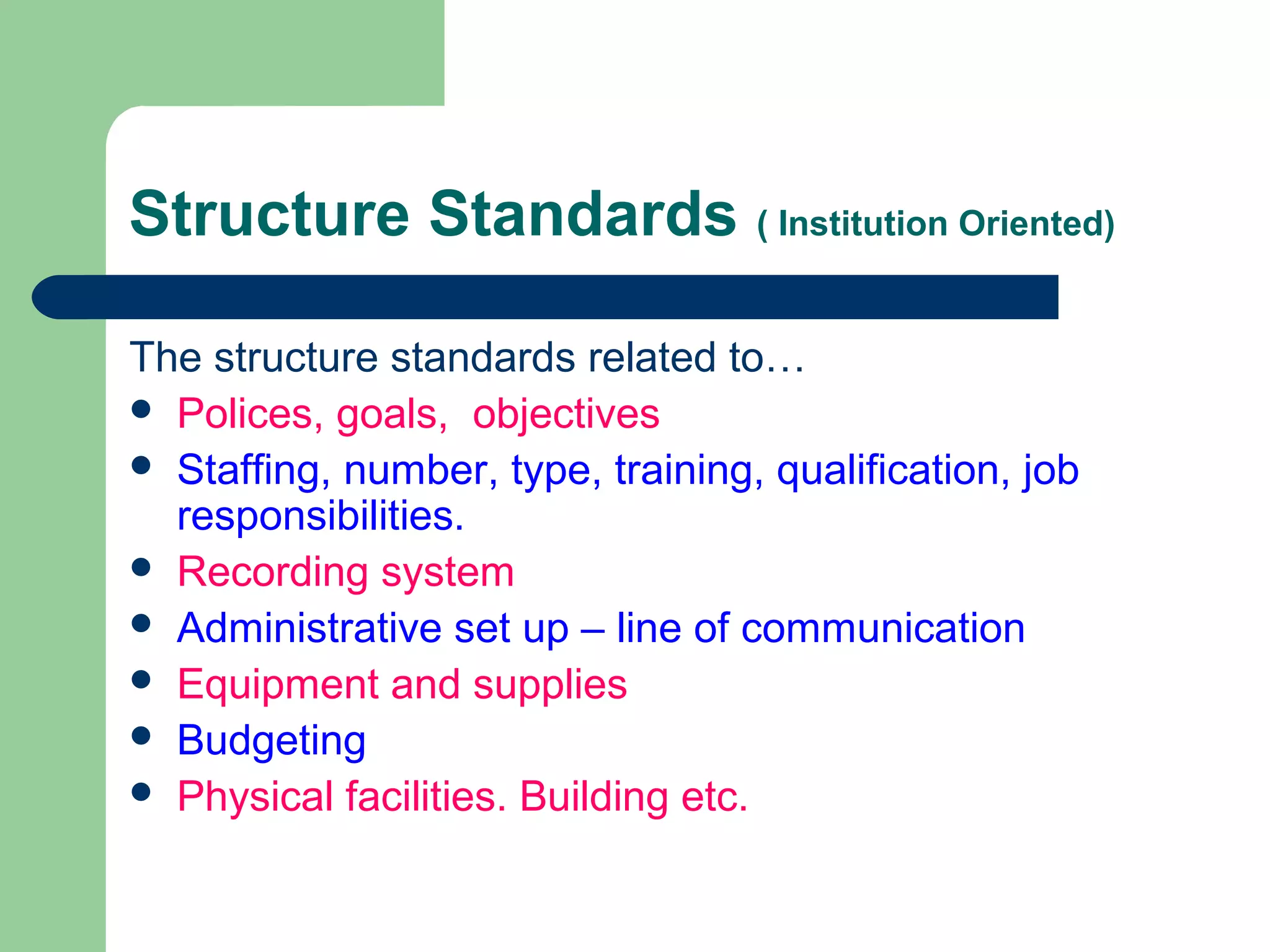
Structure Standards ( Institution Oriented)
The structure standards related to…
 Polices, goals, objectives
 Staffing, number, type, training, qualification, job
responsibilities.
 Recording system
 Administrative set up – line of communication
 Equipment and supplies
 Budgeting
 Physical facilities. Building etc.
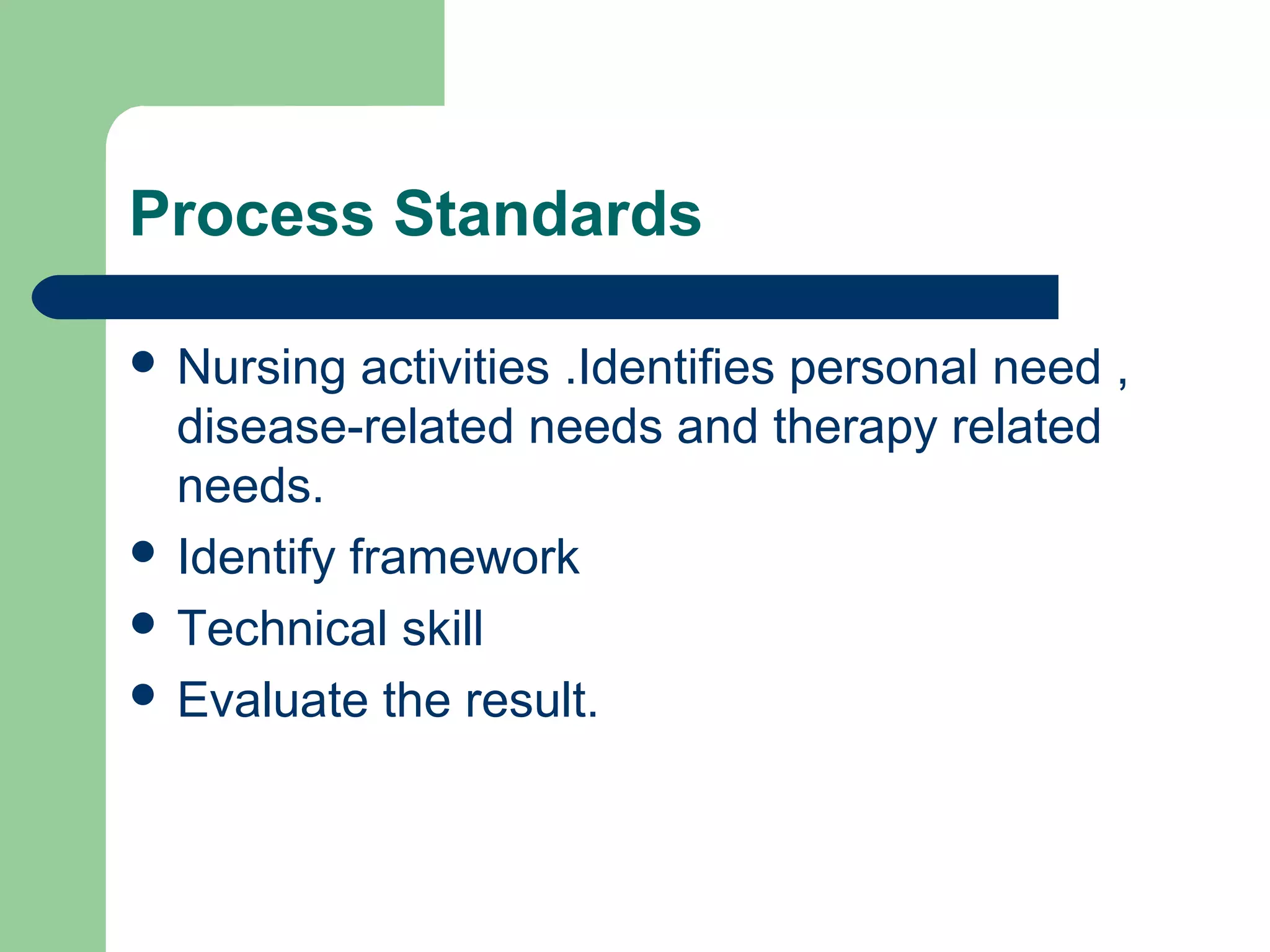
Process Standards
 Nursing activities .Identifies personal need ,
disease-related needs and therapy related
needs.
 Identify framework
 Technical skill
 Evaluate the result.
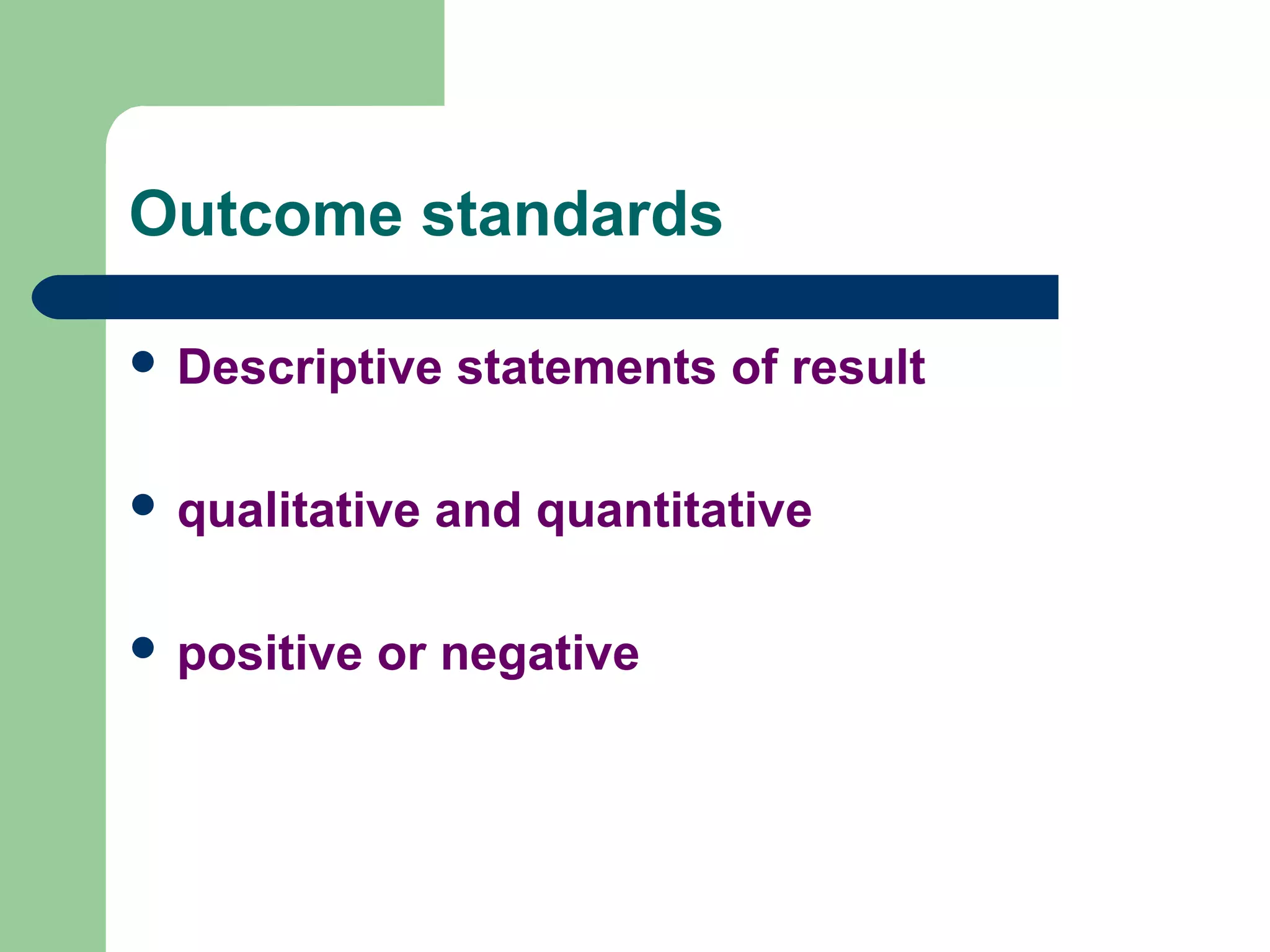
Outcome standards
 Descriptive statements of result
 qualitative and quantitative
 positive or negative
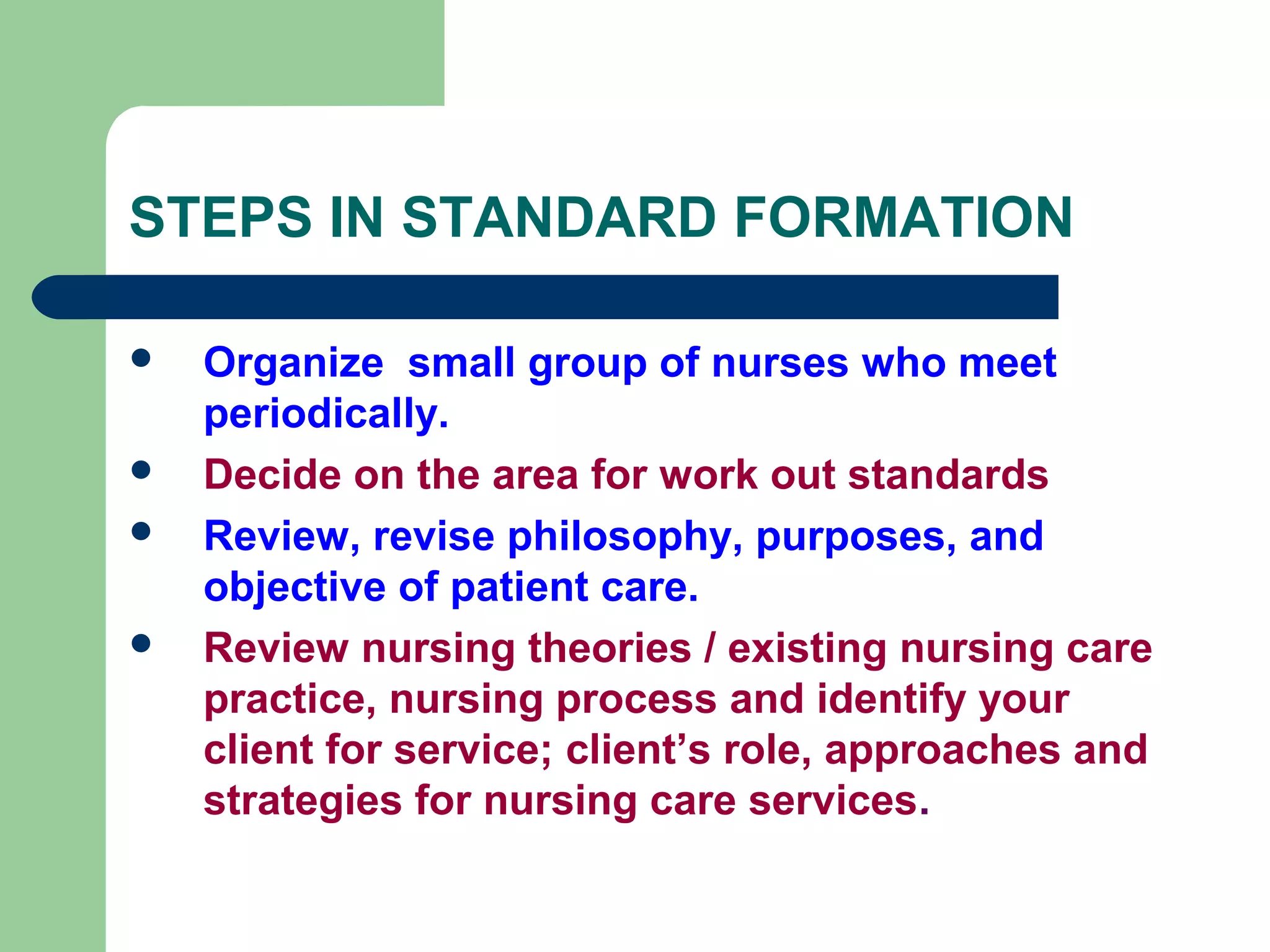
STEPS IN STANDARD FORMATION
 Organize small group of nurses who meet
periodically.
 Decide on the area for work out standards
 Review, revise philosophy, purposes, and
objective of patient care.
 Review nursing theories / existing nursing care
practice, nursing process and identify your
client for service; client’s role, approaches and
strategies for nursing care services.
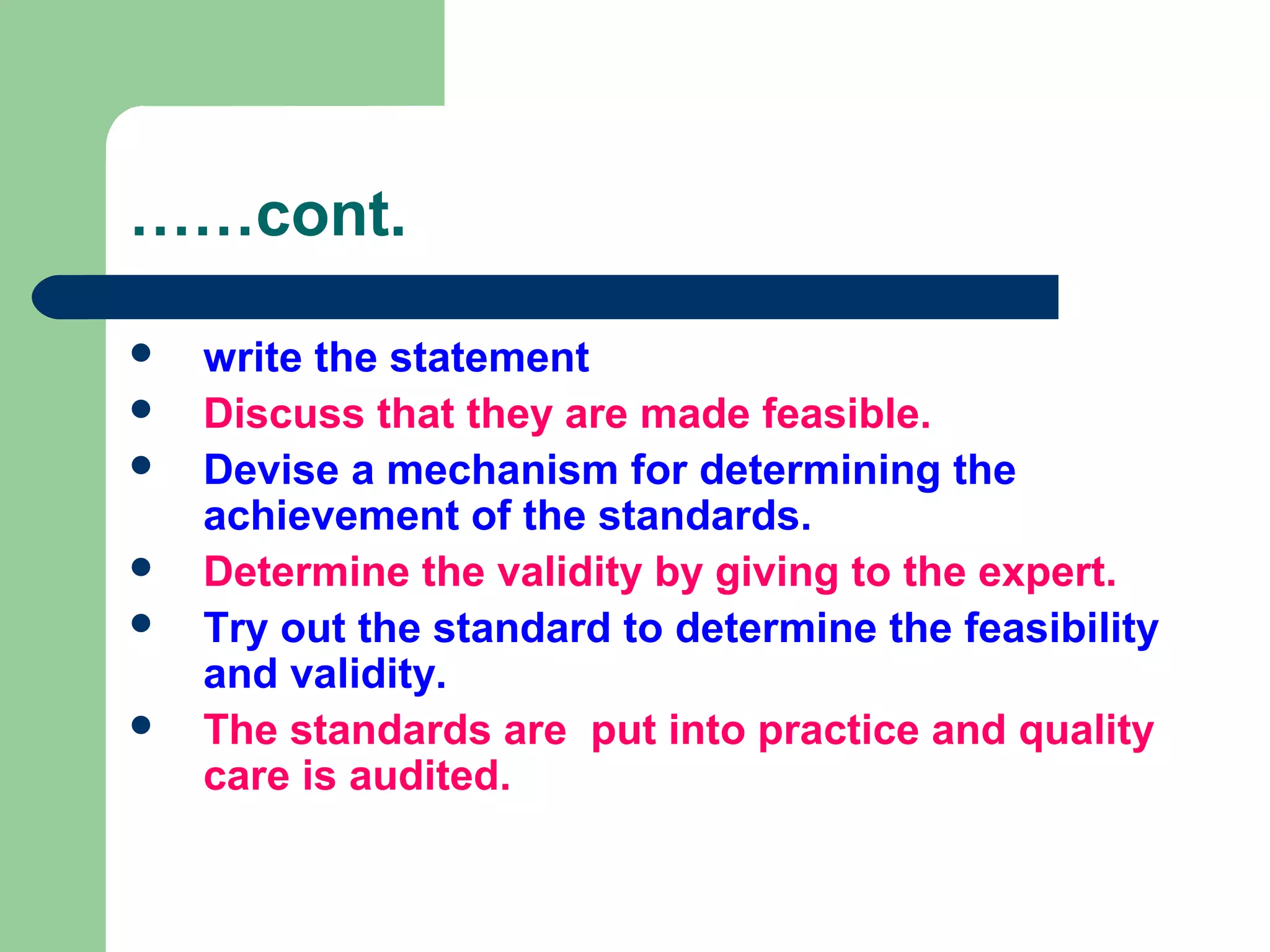
……cont.
 write the statement
 Discuss that they are made feasible.
 Devise a mechanism for determining the
achievement of the standards.
 Determine the validity by giving to the expert.
 Try out the standard to determine the feasibility
and validity.
 The standards are put into practice and quality
care is audited.
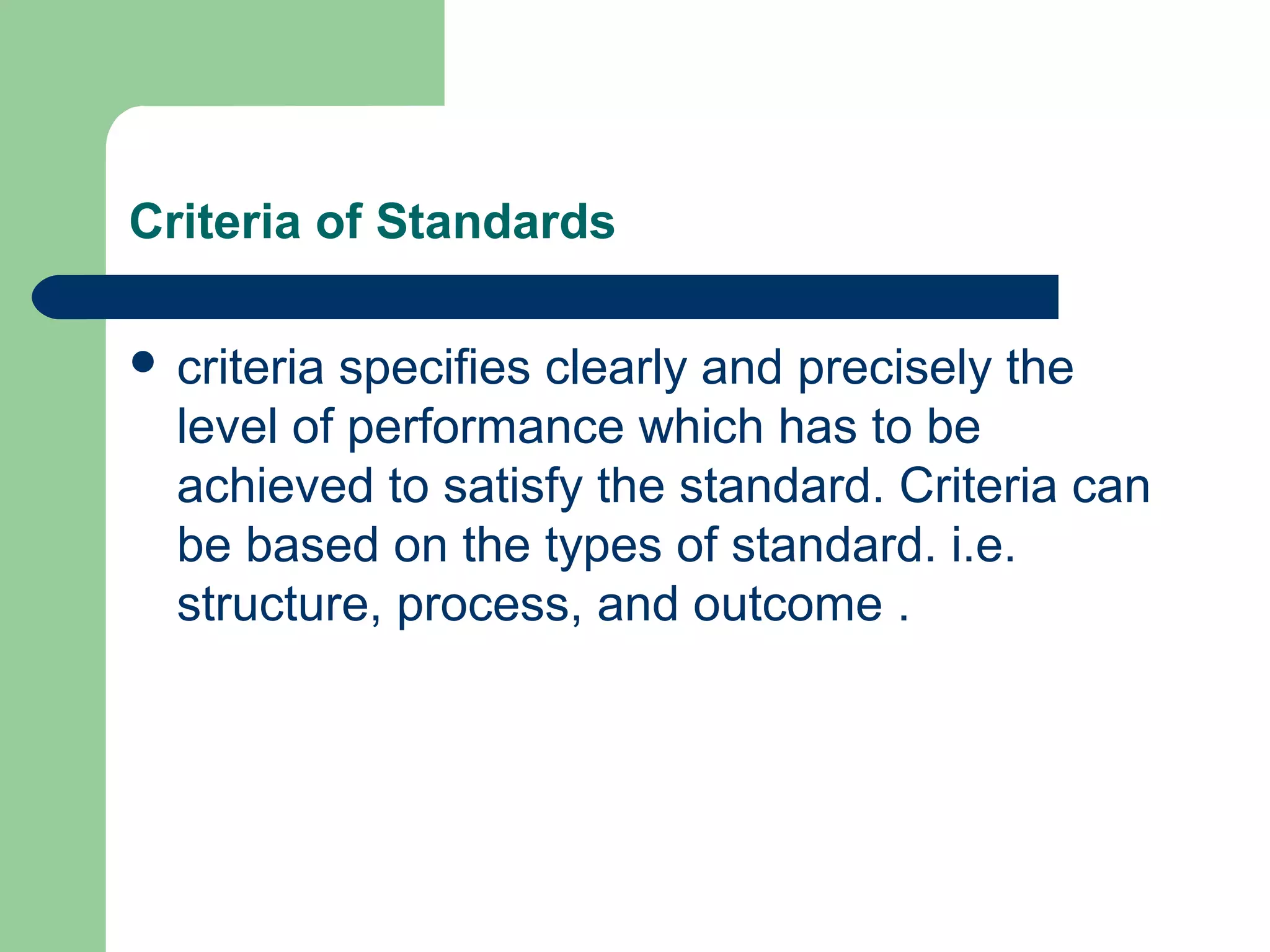
Criteria of Standards
 criteria specifies clearly and precisely the
level of performance which has to be
achieved to satisfy the standard. Criteria can
be based on the types of standard. i.e.
structure, process, and outcome .
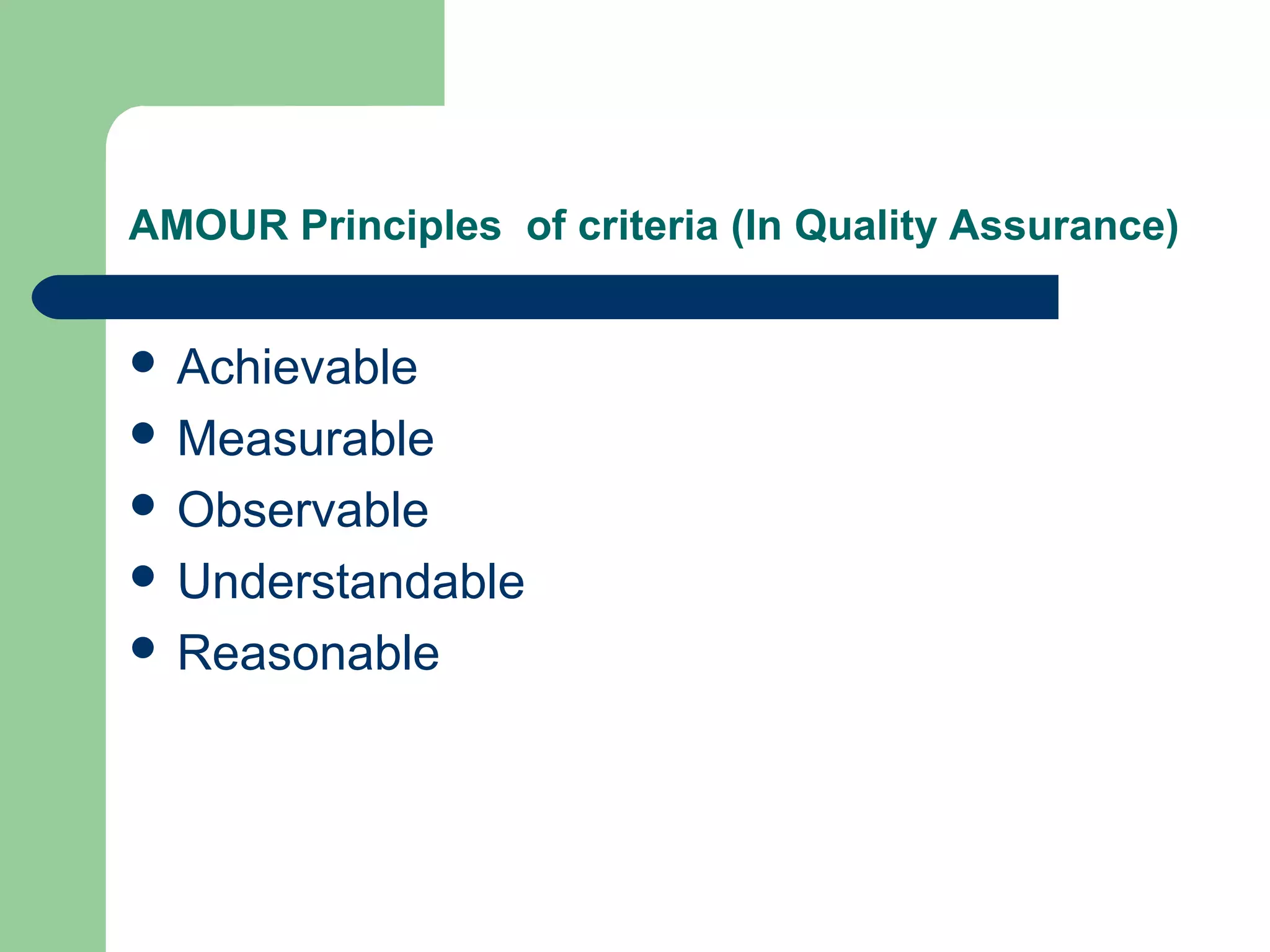
AMOUR Principles of criteria (In Quality Assurance)
 Achievable
 Measurable
 Observable
 Understandable
 Reasonable
EVALUATION OF NURSING CARE
Two major functions of evaluation of nursing
services are:
 To ascertain the nature and effects of nursing
care.
 To decide whether or not the observed effects
attain acceptable standards of nursing care.
PRINCIPLES OF EVALUATION
 Relevance
 Comprehensiveness
 Problem solving
 Validity
 Generalizability
 Appropriateness
 Effectiveness
 Efficient
TOOLS AND TECHNIQUE USED FOR
EVALUATING NURSING CARE
 Patient care Centered tool /Methods
 Nursing audit.
Patient care centered tool / technique
methods
 Observation
 By giving opinion : questionnaire to patient
relatives and or staff.
 Interviewing patient and relatives.
 Nursing round
NURSING AUDIT
 Nursing audit is the nurse’s formal, systematic
written appraisal of the quality of nursing
services indicated in the care records of
discharged patient .
 Structure audit : physical facilities, equipment and
supplies, the personnel.
 Process audit : Focused on the order in which
events occur, i.e. procedure of giving care.
 Outcome audit : Looks at the status of the patient
as a result of care provided.
Uses/ Advantages of Nursing Audit
 biographical index
 assured of good services
 staff improvement in quality of nursing
 cooperation
 self evaluation.
 better planning
 reduce medico-legal complications
 broaden and strengthen nursing service
Disadvantages
 It is considered as a source of
punishment by professional group.
 Medico-legal important-they feel that
these will be used in court of law as any
document can be called for in court of
law for clear, adequate and efficient
evidences.
Using Results of Nursing Audit
For Nursing care service.
 Modifying nursing care plans and the nursing care
process
 Implementing a program for improving
documentation
 Focusing supervisory attention upon areas of
weakness identified
 Focusing on nursing round and term conferences
 Designing responsible orientation and in service
education program
Using Results of Nursing Audit
For Nursing Administration
 Provide evaluation of particular program
 Support requests for accreditation
 Serves as basis for planning new
program
 Serve to identify area of strength and
weakness
 Determine the influence of varied
staffing pattern.
 May be used as data
Using Results of Nursing Audit
For Nursing Supervisor and Head Nurse
 Identify area of needed patient care
improvement
 Provide basis for planning in-service education
program
 Identify/ supervision needs of a staff member
who give direct care to the patient.
Using Results of Nursing Audit
For Staff Nursing
 Provide a self examination of care in their
specific nursing unit or setting
 Identify particular type of care in which
practice may be improved merely by
increase attention and conscientiousness.
 Identify type of care in which improvement
will depends on the staffing acquiring
additional knowledge and skill.
STEPS IN DEVELOPING QUALITY ASSURANCE
 Approval of the program
 Taskforce or committee to be appointed
 Orientation program to be agreed for the committee
member to familiarize with the purpose principles,
methods etc.
 Examine their belief and behavior concerning
quality control through workshop.
 Explore the difference in nursing values through
open confrontation
Two major categories of approaches
 General Approach : It examines the
ability of the agency to meet criteria or
standards.
 Specific Approaches : These are
methods used to evaluate provider and
client interaction
Beneficiaries of Quality Assurance Program
 The recipients of care who receive safe
effective satisfying services.
 The care providers because evaluating offers
opportunity to promote personal and
professional growth.
 The agencies – which obtain data for planning
cost containment and legal protection.
 The profession – quality assurance program
promotes development of standards and
protocol and generations of new knowledge.
Factor Affecting Quality Assurance
 Lack of Resources- Infrastructure equipment.
 Personal Problem
 Improper Maintenance
 Absence of well informed populace
 Absence of Accreditation
 Absence of conducting patient satisfaction
survey.
 Lack of nursing care records.
 Miscellaneous Factors
 Indian publication nursing are very few
 Lack of adequate nurse administrator
ROLE AND RESPONSIBLITES OF A NURSE
ADMINISTRATION IN DEVELOPING QUALITY
ASSURANCE SYSTEM
 Deciding upon the philosophy .
 Make certain that you as well as your nurses
know what you wish to evaluate and why
 Formulate objectives
 Set standards
 Enlist expert guidance
 plan carefully and select the evaluation tools
suitable to the unit
 Work cooperatively
 Publish the report of the result of evaluation of
care
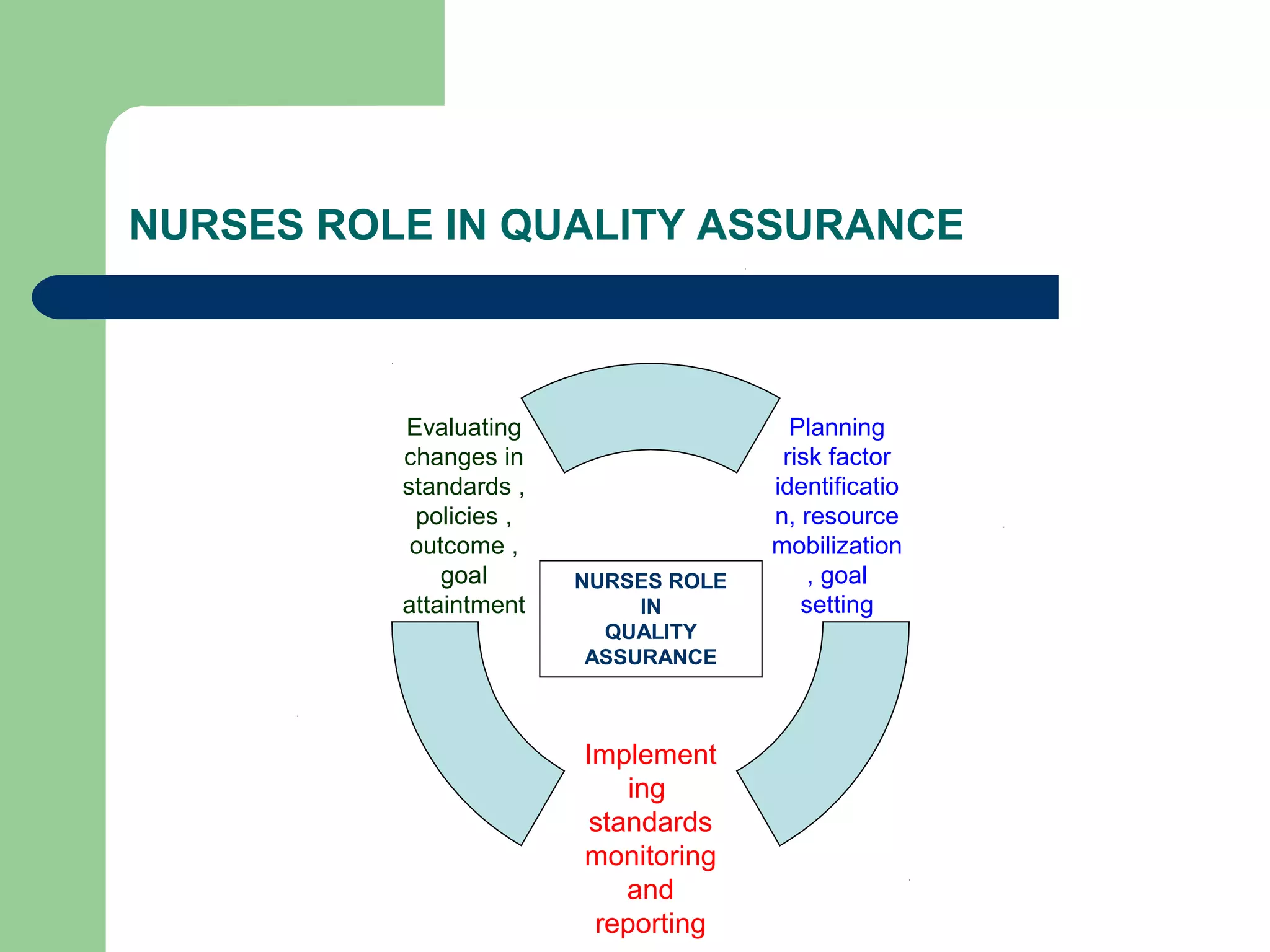
NURSES ROLE IN QUALITY ASSURANCE
Planning
risk factor
identificatio
n, resource
mobilization
, goal
setting
Implement
ing
standards
monitoring
and
reporting
Evaluating
changes in
standards ,
policies ,
outcome ,
goal
attaintment
NURSES ROLE
IN
QUALITY
ASSURANCE
CONCLUSION
Sound evaluation tool alone will not be
sufficient to improve the quality. To attain the
goal of providing optimum quality care
nurses themselves make them to ready by
critical thinking and by developing and
implementation a quality assurance program
in their hospital so as to provide a scientific
care which is combined with humanitarian
approach.
ppt on Quality assuranse

ppt on Quality assuranse

  • 1.
    QUALITY ASSURANCE By- Mr. ASHOKBISHNOI Assist. Professor, JINR
  • 2.
    Quality Assurance  Asystem for monitoring outcome of professional intervention and departmental activities, which are compared with established standards to evaluate and document appropriateness of practies.
  • 3.
    Need for QualityAssurance Professional Factors Code of Conduct Autonomy Accountability Inter-professionalism Moral issues Social / Political Factor Public awareness Social expectation Legislation Accreditation International pressure Economical Factors Demographic changes Resource-distribution
  • 4.
    STANDARDS  Professionally developedexpressions  It is a degree of excellence.  It is a model for imitations.
  • 5.
    Definition of Standards A standard is a means of determining what something should be in case of nursing practice.  Standards are the establish criteria for the practice of nursing.  Standards are statement for nursing practice.  Standards specifies what is necessary for high quality practice (ANA1973)
  • 6.
    Process of QualityAssurance  Setting Standards.  Apprising actual achievement.  Planning for improvement.  Taking action when required.
  • 7.
  • 8.
    Need of Standards Provides direction for nursing performance.  Provide systematic approach for nursing care.  Provides for evaluating nursing practice.  The patient’s right to have excellent nursing care  Helps in supervision and guide staff to improve.  Helps justify demands for resource allocation.  Help classify nurses area of accountability at different levels
  • 9.
    Need of aStandards  Nurses need to define and describe their practice because of their statutory , legal and social responsibility to give best possible care to patient and client.
  • 10.
  • 11.
    Purposes of Standards Evaluating the quality of practice.  To coordinate and unify.  Identify the element of independent function of practice.  Provide a basis for planning and evaluating programs  Inform the society of our concern for the improvement of nursing practice.  Assist public in understanding what to expect from nursing practice.  Provide a means by which member of different health profession can coordinate their efforts in the improvement of health care.  Health employers to understand what expect from the practitioner .  Stimulate and encourage nursing personnel to promote and support education, studies and research
  • 12.
    In general Nursing carestandard are important to :  Improve the quality of nursing care,  Decrease the cost of nursing care.  Promote a basis for determining
  • 13.
    Types of Standards Normative standards : These standards are descriptive of practices which are considered ideal by authority . These standards describe higher quality of practices. e.g. standards set by professional association.
  • 14.
     Empirical standards: These standards description of practices which are in actual practice in large number of setting and which agreed upon and achievable .e.g. standards set by law enforcement bodies and regulatory bodies- like health department and licensures bodies.
  • 15.
    Approaches of Standards Structure Standards  Process Standards  Outcome Standard
  • 16.
    Structure Standards (Institution Oriented) The structure standards related to…  Polices, goals, objectives  Staffing, number, type, training, qualification, job responsibilities.  Recording system  Administrative set up – line of communication  Equipment and supplies  Budgeting  Physical facilities. Building etc.
  • 17.
    Process Standards  Nursingactivities .Identifies personal need , disease-related needs and therapy related needs.  Identify framework  Technical skill  Evaluate the result.
  • 18.
    Outcome standards  Descriptivestatements of result  qualitative and quantitative  positive or negative
  • 19.
    STEPS IN STANDARDFORMATION  Organize small group of nurses who meet periodically.  Decide on the area for work out standards  Review, revise philosophy, purposes, and objective of patient care.  Review nursing theories / existing nursing care practice, nursing process and identify your client for service; client’s role, approaches and strategies for nursing care services.
  • 20.
    ……cont.  write thestatement  Discuss that they are made feasible.  Devise a mechanism for determining the achievement of the standards.  Determine the validity by giving to the expert.  Try out the standard to determine the feasibility and validity.  The standards are put into practice and quality care is audited.
  • 21.
    Criteria of Standards criteria specifies clearly and precisely the level of performance which has to be achieved to satisfy the standard. Criteria can be based on the types of standard. i.e. structure, process, and outcome .
  • 22.
    AMOUR Principles ofcriteria (In Quality Assurance)  Achievable  Measurable  Observable  Understandable  Reasonable
  • 23.
    EVALUATION OF NURSINGCARE Two major functions of evaluation of nursing services are:  To ascertain the nature and effects of nursing care.  To decide whether or not the observed effects attain acceptable standards of nursing care.
  • 24.
    PRINCIPLES OF EVALUATION Relevance  Comprehensiveness  Problem solving  Validity  Generalizability  Appropriateness  Effectiveness  Efficient
  • 25.
    TOOLS AND TECHNIQUEUSED FOR EVALUATING NURSING CARE  Patient care Centered tool /Methods  Nursing audit.
  • 26.
    Patient care centeredtool / technique methods  Observation  By giving opinion : questionnaire to patient relatives and or staff.  Interviewing patient and relatives.  Nursing round
  • 27.
    NURSING AUDIT  Nursingaudit is the nurse’s formal, systematic written appraisal of the quality of nursing services indicated in the care records of discharged patient .  Structure audit : physical facilities, equipment and supplies, the personnel.  Process audit : Focused on the order in which events occur, i.e. procedure of giving care.  Outcome audit : Looks at the status of the patient as a result of care provided.
  • 28.
    Uses/ Advantages ofNursing Audit  biographical index  assured of good services  staff improvement in quality of nursing  cooperation  self evaluation.  better planning  reduce medico-legal complications  broaden and strengthen nursing service
  • 29.
    Disadvantages  It isconsidered as a source of punishment by professional group.  Medico-legal important-they feel that these will be used in court of law as any document can be called for in court of law for clear, adequate and efficient evidences.
  • 30.
    Using Results ofNursing Audit For Nursing care service.  Modifying nursing care plans and the nursing care process  Implementing a program for improving documentation  Focusing supervisory attention upon areas of weakness identified  Focusing on nursing round and term conferences  Designing responsible orientation and in service education program
  • 31.
    Using Results ofNursing Audit For Nursing Administration  Provide evaluation of particular program  Support requests for accreditation  Serves as basis for planning new program  Serve to identify area of strength and weakness  Determine the influence of varied staffing pattern.  May be used as data
  • 32.
    Using Results ofNursing Audit For Nursing Supervisor and Head Nurse  Identify area of needed patient care improvement  Provide basis for planning in-service education program  Identify/ supervision needs of a staff member who give direct care to the patient.
  • 33.
    Using Results ofNursing Audit For Staff Nursing  Provide a self examination of care in their specific nursing unit or setting  Identify particular type of care in which practice may be improved merely by increase attention and conscientiousness.  Identify type of care in which improvement will depends on the staffing acquiring additional knowledge and skill.
  • 34.
    STEPS IN DEVELOPINGQUALITY ASSURANCE  Approval of the program  Taskforce or committee to be appointed  Orientation program to be agreed for the committee member to familiarize with the purpose principles, methods etc.  Examine their belief and behavior concerning quality control through workshop.  Explore the difference in nursing values through open confrontation
  • 35.
    Two major categoriesof approaches  General Approach : It examines the ability of the agency to meet criteria or standards.  Specific Approaches : These are methods used to evaluate provider and client interaction
  • 36.
    Beneficiaries of QualityAssurance Program  The recipients of care who receive safe effective satisfying services.  The care providers because evaluating offers opportunity to promote personal and professional growth.  The agencies – which obtain data for planning cost containment and legal protection.  The profession – quality assurance program promotes development of standards and protocol and generations of new knowledge.
  • 37.
    Factor Affecting QualityAssurance  Lack of Resources- Infrastructure equipment.  Personal Problem  Improper Maintenance  Absence of well informed populace  Absence of Accreditation  Absence of conducting patient satisfaction survey.  Lack of nursing care records.  Miscellaneous Factors  Indian publication nursing are very few  Lack of adequate nurse administrator
  • 38.
    ROLE AND RESPONSIBLITESOF A NURSE ADMINISTRATION IN DEVELOPING QUALITY ASSURANCE SYSTEM  Deciding upon the philosophy .  Make certain that you as well as your nurses know what you wish to evaluate and why  Formulate objectives  Set standards  Enlist expert guidance  plan carefully and select the evaluation tools suitable to the unit  Work cooperatively  Publish the report of the result of evaluation of care
  • 39.
    NURSES ROLE INQUALITY ASSURANCE Planning risk factor identificatio n, resource mobilization , goal setting Implement ing standards monitoring and reporting Evaluating changes in standards , policies , outcome , goal attaintment NURSES ROLE IN QUALITY ASSURANCE
  • 40.
    CONCLUSION Sound evaluation toolalone will not be sufficient to improve the quality. To attain the goal of providing optimum quality care nurses themselves make them to ready by critical thinking and by developing and implementation a quality assurance program in their hospital so as to provide a scientific care which is combined with humanitarian approach.