Training
and
supervision of
healthworkers
Prepared by
Krupa Mathew. M
Assistant professor
1
LEARNING OBJECTIVES
The students will be able to:
• define training and supervision
• mention the objectives of training and supervision
• state various training programmes of health workers
• discuss training of Local Dais and Multi purpose
Health workers
• describe training of of ANMs, AWWs and ASHAs
2
2
INTRODUCTION
 In health care setting just an education
improves the knowledge of the person, training
entrances the attitude, skills and abilities of
employees to perform specific job better.
 Training and supervision have, in all places,
been a vital aspect of higher education. One of
the purpose is to help the individual in
becoming a useful member of society
3
TRAINING
Training is the act of increasing the knowledge and
skills of an employee for doing a particular job.
The Training is a systematic activity performed to
modify the skills, attitudes and the behavior of an
employee to perform a particular job.
The main purpose of training is to ensure that all
employees have the technical skills needed to perform
the job efficiently and smoothly.
4
OBJECTIVES OF TRAINING
 Increase Motivation and Engagement.
Quick learning
Higher productivity
Standardization of procedures
Less supervision
Economical Operations
Higher Morale
Preparation of Future Managers
Better Management
5
TRAINING OF AUXILLARY NURSE
MIDWIFE(ANM)
6
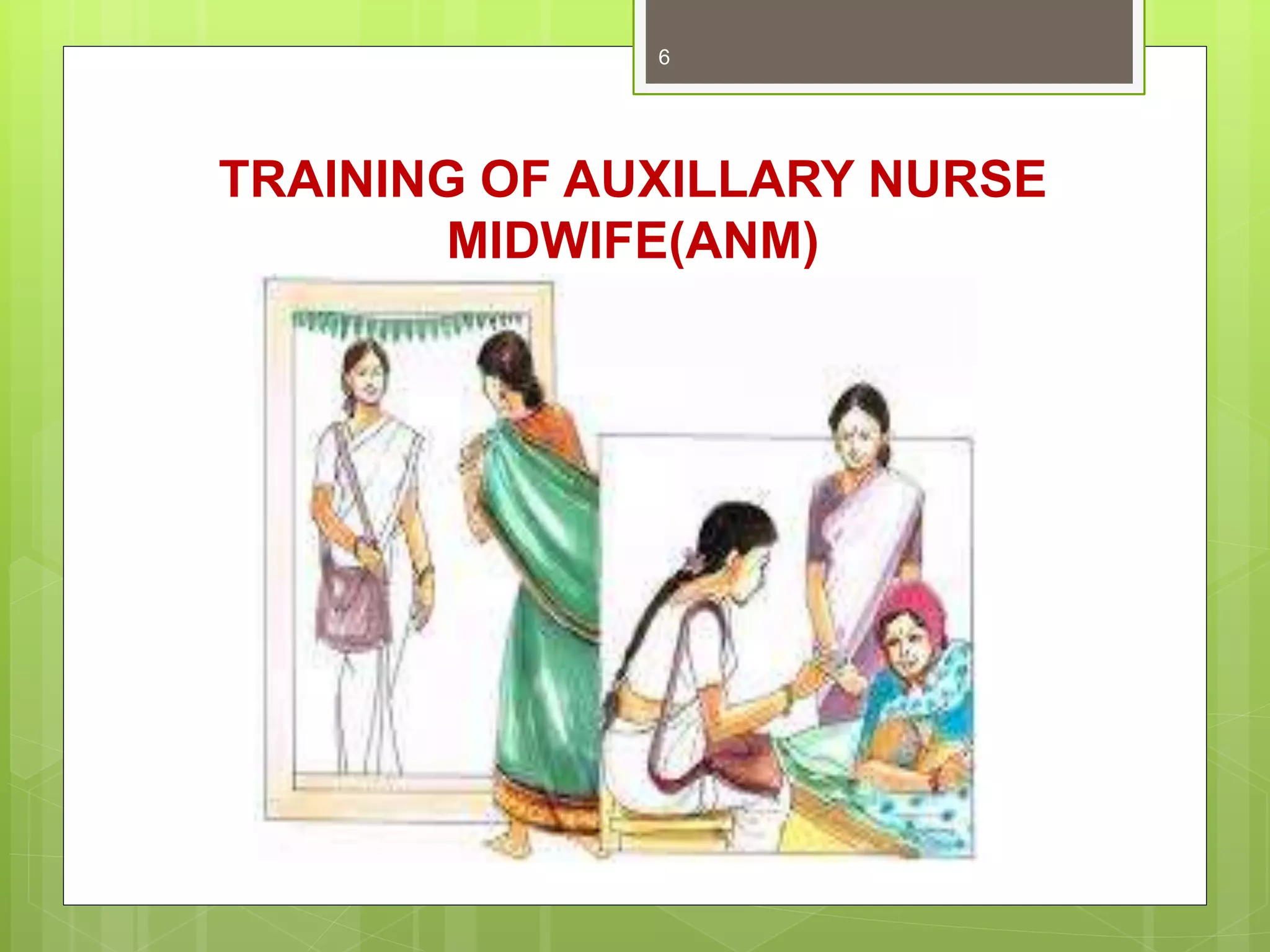
 ANMs is a village level female health worker in
India who is the first contact person between the
community and health services
 ANMs are playing important and vital role in
Maternal Child Health and Family welfare services
in the rural areas.
 Therefore it is essential that the proper training to
be given to them so that quality services will be
provided to the rural population.
 They are posted in Subcentre, Primary Health
Centre and Rural Family Welfare Centres and
other Health Centres.
7
The training duration of ANM course is
two years with minimum qualification is
10th pass.
Senior ANM with 5 years of experience is
given 6 months promotional training to
become Lady Health Visitor/Health
Assistant(Female).
The Lady Health Visitor/Health Assistant
are giving supportive supervision and
technical guidance to ANMs in sub-
centres.
8
TRAINING OF MULTI PURPOSE
HEALTH WORKERS
9
TRAINING OF MULTI PURPOSE
HEALTH WORKERS
 This is approved during 6th Five Year Plan and by 1984 it
became 100% Centrally Sponsored Scheme.
 Training duration is one year.
 On successful completion, they posed at the sub centre along
with an ANM/Health worker
The functions of MPHW are mainly in the areas of National
Health Programmes like
 Malaria
 Leprosy
 Tuberculosis
 limited involvement in Universal Immunization Programme
 Diarrhoea Control Program and in family welfare services
10
TRAINING OF VILLAGE HEALTH
GUIDE
11
TRAINING OF VILLAGE HEALTH GUIDE
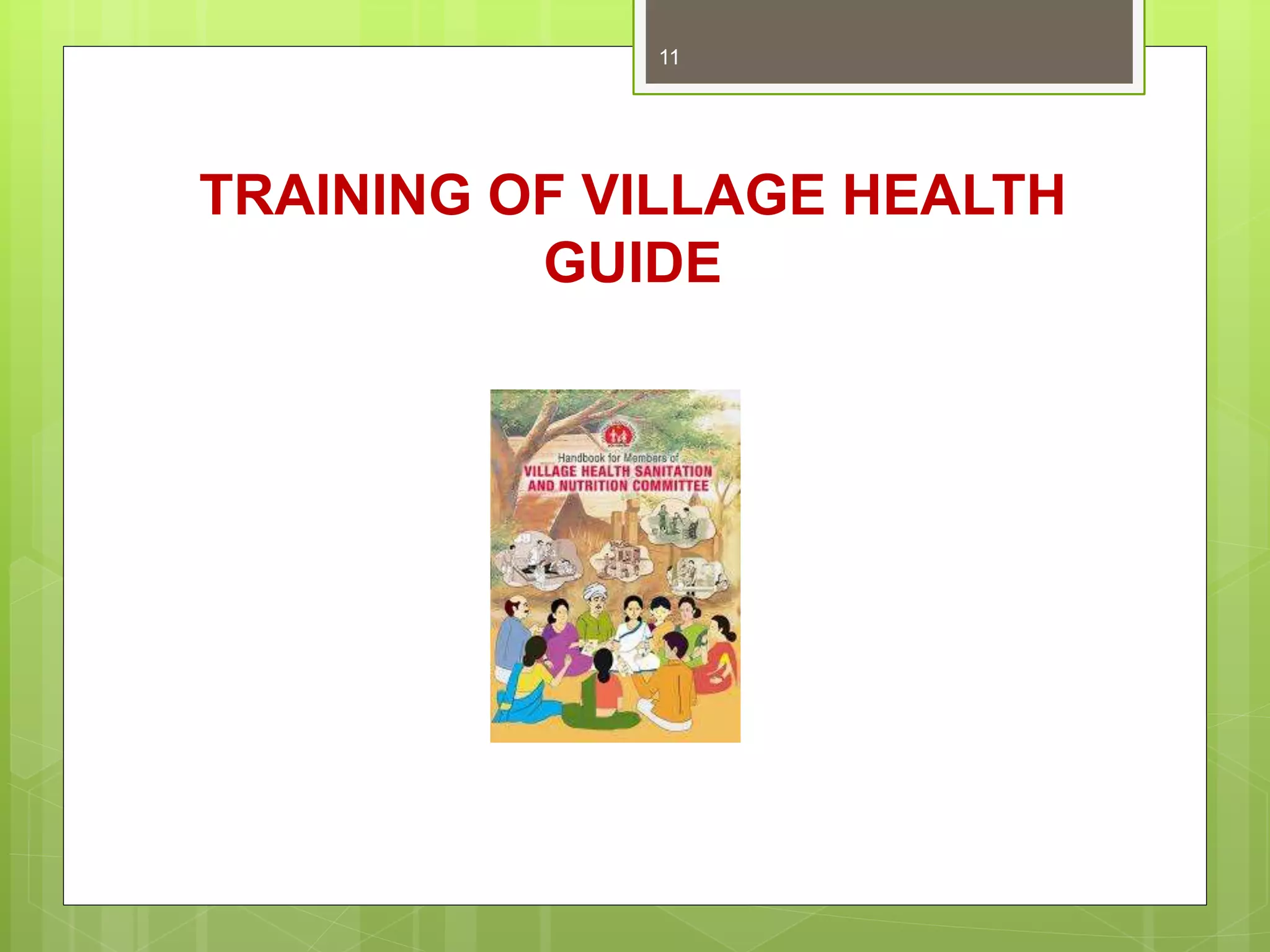
The village health guides are mostly women and
this scheme was started on 1977. They are chosen
by the community in which they work.
The village health guide must be a permanent
resident of the local community and have minimum
formal education VI class.
Training is conducted every month. The criteria's
includes she must be a woman of the village who
will visit everyone, represent every one by village
communities themselves
12
After selection they undergo training in
nearest PHC for 200 hours in 3 months.
Each village health guide covers 1000 rural
population.
13
TRAINING OF LOCAL DAIS
 They are expected to play vital role in propagating small
family norms, emphasis is given on asepsis so that home
deliveries are conducted under safe hygiene to reduce
maternal and child mortality.
 Training: The training is for 30 working days. She is a
paid a stipend of Rs.300 during her training period.
 Training is given at the PHC, Sub-centre or MCH centre for
2 days in a week, and on the remaining four days of the
week they accompany the health worker
 After successful completion of training, each dais is
provided with a delivery kit and a certificate
14
TRAINING OF ANGANWADI
WORKERS
15
 Under the ICDS(Integrated Child Development Services)
scheme, there is an anganwadi for a population of 1000,
there are about 100 such workers in each ICDS project.
 Training: Training in various aspects of health, nutrition
and child development for 4 months.
 She is a part-time worker and is paid an honorarium of
Rs.200-250 per month for the services rendered, which
include health check-up, immunization, supplementary
nutrition, health education, non-formal pre-school education
and referral services.
 The beneficiaries are especially nursing mothers, other
women(15-45 years) and children below the age of 6 years.
16
TRAINING OF ACCREDITED
SOCIAL HEALTH ACTIVIST (ASHA)
17
ASHA training comes under the National Rural
Health Mission.
ASHA must be a woman resident of the village.
Married/divorced preferably in the age group of
25-45 years. She should be literate woman
qualified up to 10th standard. ASHA will be
chosen through community groups, self-help
groups, Anganwadi Institutions, Village Health
Committee and the Gram sabha
18
At the village level it is recognised that ASHA cannot
function without adequate Institutional support,
Women Committees, village health and sanitation
committee of the Gram Panchayat, peripheral health
workers especially ANMs and Anganwadi workers.
She will counsel women on birth preparedness,
importance of safe delivery, breast feeding,
complementary feeding, immunization, contraception
and prevention of common infectious diseases like
RTI and STD
19
SUPERVISION
Supervision means overseeing the employees at
work. It has been defined as the authoritative
direction of work of one’s subordinates
It means observing the subordinates at work to
see that they are working according to plans and
policies of the organization and keeping the
time schedule, and to help them in solving their
work problems
20
OBJECTIVES OF SUPERVISION
To help the staff to do their job skillfully and
effectively to give maximum output with
minimum resources-cost effectiveness
Help to develop the individual capacity to the
fullest extent with a view to channelize the same
in favour of work
Guide or assist in meeting predetermined work
objectives or targets. In nursing preventive,
promotive, curative and rehabilitative care to
people
21
OBJECTIVES OF SUPERVISION
 Help to promote effectiveness of the
subordinates/staff ensuring that the subordinate staff
or supervise does what he/she supposed to do.
 Help to motivate subordinates to maintain high
morale
 Help the members of the team to recognize problems,
identify solutions and to take actions
 Help to develop team spirit and promote team work
for effective functioning
 Help to improve the attitudes of the members towards
the work program.
22
Principles of Supervision
Supervision should not be overburdened to any
individual or group.
Supervision causing unreasonable pressure for
achievements results in low performance and low
confidence in the supervisor.
Supervise diagnosis do not overestimate his
understanding and memory.
Human behavior with due consideration to human
weaknesses. This should be kept in minds of
supervisors.
23
Supervisors should create atmosphere of cordially
and mutual trust.
Supervision should be planned and adopted to the
changing conditions. It calls for good planned and
organization.
Supervisor must possess sound professional
knowledge.
Supervision to be exercised without giving the
subordinate a sense that they are being supervised.
Supervision strives to make the unit a good
learning situation. It should be a teaching-learning
process.
24
Supervision should foster the ability of each staff
member to think and act for herself/himself.
Supervision should encourages worker’s participation
in decision making.
Supervision needs good communication.
Supervision is a process of cooperation and
coordination.
Supervision should create suitable climate for
productive work.
Supervision should respect the personality of the staff.
Supervision should stimulate the workers/staff
ambitions to grow in effectiveness.
Supervision should focus on continued stag growth and
development.
Supervision is responsible for checking and guidance.
Good leadership is part of good supervision
25
Technique of Supervision
 Individual and group conference
 Anecdotal record
 Supervision of nursing procedure
 Reassurance
 Incidental teaching
 Observation (Check List) and rating scale
 Written Policies
26
27

Training and supervision of health workers

  • 1.
  • 2.
    LEARNING OBJECTIVES The studentswill be able to: • define training and supervision • mention the objectives of training and supervision • state various training programmes of health workers • discuss training of Local Dais and Multi purpose Health workers • describe training of of ANMs, AWWs and ASHAs 2 2
  • 3.
    INTRODUCTION  In healthcare setting just an education improves the knowledge of the person, training entrances the attitude, skills and abilities of employees to perform specific job better.  Training and supervision have, in all places, been a vital aspect of higher education. One of the purpose is to help the individual in becoming a useful member of society 3
  • 4.
    TRAINING Training is theact of increasing the knowledge and skills of an employee for doing a particular job. The Training is a systematic activity performed to modify the skills, attitudes and the behavior of an employee to perform a particular job. The main purpose of training is to ensure that all employees have the technical skills needed to perform the job efficiently and smoothly. 4
  • 5.
    OBJECTIVES OF TRAINING Increase Motivation and Engagement. Quick learning Higher productivity Standardization of procedures Less supervision Economical Operations Higher Morale Preparation of Future Managers Better Management 5
  • 6.
    TRAINING OF AUXILLARYNURSE MIDWIFE(ANM) 6
  • 7.
     ANMs isa village level female health worker in India who is the first contact person between the community and health services  ANMs are playing important and vital role in Maternal Child Health and Family welfare services in the rural areas.  Therefore it is essential that the proper training to be given to them so that quality services will be provided to the rural population.  They are posted in Subcentre, Primary Health Centre and Rural Family Welfare Centres and other Health Centres. 7
  • 8.
    The training durationof ANM course is two years with minimum qualification is 10th pass. Senior ANM with 5 years of experience is given 6 months promotional training to become Lady Health Visitor/Health Assistant(Female). The Lady Health Visitor/Health Assistant are giving supportive supervision and technical guidance to ANMs in sub- centres. 8
  • 9.
    TRAINING OF MULTIPURPOSE HEALTH WORKERS 9
  • 10.
    TRAINING OF MULTIPURPOSE HEALTH WORKERS  This is approved during 6th Five Year Plan and by 1984 it became 100% Centrally Sponsored Scheme.  Training duration is one year.  On successful completion, they posed at the sub centre along with an ANM/Health worker The functions of MPHW are mainly in the areas of National Health Programmes like  Malaria  Leprosy  Tuberculosis  limited involvement in Universal Immunization Programme  Diarrhoea Control Program and in family welfare services 10
  • 11.
    TRAINING OF VILLAGEHEALTH GUIDE 11
  • 12.
    TRAINING OF VILLAGEHEALTH GUIDE The village health guides are mostly women and this scheme was started on 1977. They are chosen by the community in which they work. The village health guide must be a permanent resident of the local community and have minimum formal education VI class. Training is conducted every month. The criteria's includes she must be a woman of the village who will visit everyone, represent every one by village communities themselves 12
  • 13.
    After selection theyundergo training in nearest PHC for 200 hours in 3 months. Each village health guide covers 1000 rural population. 13
  • 14.
    TRAINING OF LOCALDAIS  They are expected to play vital role in propagating small family norms, emphasis is given on asepsis so that home deliveries are conducted under safe hygiene to reduce maternal and child mortality.  Training: The training is for 30 working days. She is a paid a stipend of Rs.300 during her training period.  Training is given at the PHC, Sub-centre or MCH centre for 2 days in a week, and on the remaining four days of the week they accompany the health worker  After successful completion of training, each dais is provided with a delivery kit and a certificate 14
  • 15.
  • 16.
     Under theICDS(Integrated Child Development Services) scheme, there is an anganwadi for a population of 1000, there are about 100 such workers in each ICDS project.  Training: Training in various aspects of health, nutrition and child development for 4 months.  She is a part-time worker and is paid an honorarium of Rs.200-250 per month for the services rendered, which include health check-up, immunization, supplementary nutrition, health education, non-formal pre-school education and referral services.  The beneficiaries are especially nursing mothers, other women(15-45 years) and children below the age of 6 years. 16
  • 17.
    TRAINING OF ACCREDITED SOCIALHEALTH ACTIVIST (ASHA) 17
  • 18.
    ASHA training comesunder the National Rural Health Mission. ASHA must be a woman resident of the village. Married/divorced preferably in the age group of 25-45 years. She should be literate woman qualified up to 10th standard. ASHA will be chosen through community groups, self-help groups, Anganwadi Institutions, Village Health Committee and the Gram sabha 18
  • 19.
    At the villagelevel it is recognised that ASHA cannot function without adequate Institutional support, Women Committees, village health and sanitation committee of the Gram Panchayat, peripheral health workers especially ANMs and Anganwadi workers. She will counsel women on birth preparedness, importance of safe delivery, breast feeding, complementary feeding, immunization, contraception and prevention of common infectious diseases like RTI and STD 19
  • 20.
    SUPERVISION Supervision means overseeingthe employees at work. It has been defined as the authoritative direction of work of one’s subordinates It means observing the subordinates at work to see that they are working according to plans and policies of the organization and keeping the time schedule, and to help them in solving their work problems 20
  • 21.
    OBJECTIVES OF SUPERVISION Tohelp the staff to do their job skillfully and effectively to give maximum output with minimum resources-cost effectiveness Help to develop the individual capacity to the fullest extent with a view to channelize the same in favour of work Guide or assist in meeting predetermined work objectives or targets. In nursing preventive, promotive, curative and rehabilitative care to people 21
  • 22.
    OBJECTIVES OF SUPERVISION Help to promote effectiveness of the subordinates/staff ensuring that the subordinate staff or supervise does what he/she supposed to do.  Help to motivate subordinates to maintain high morale  Help the members of the team to recognize problems, identify solutions and to take actions  Help to develop team spirit and promote team work for effective functioning  Help to improve the attitudes of the members towards the work program. 22
  • 23.
    Principles of Supervision Supervisionshould not be overburdened to any individual or group. Supervision causing unreasonable pressure for achievements results in low performance and low confidence in the supervisor. Supervise diagnosis do not overestimate his understanding and memory. Human behavior with due consideration to human weaknesses. This should be kept in minds of supervisors. 23
  • 24.
    Supervisors should createatmosphere of cordially and mutual trust. Supervision should be planned and adopted to the changing conditions. It calls for good planned and organization. Supervisor must possess sound professional knowledge. Supervision to be exercised without giving the subordinate a sense that they are being supervised. Supervision strives to make the unit a good learning situation. It should be a teaching-learning process. 24
  • 25.
    Supervision should fosterthe ability of each staff member to think and act for herself/himself. Supervision should encourages worker’s participation in decision making. Supervision needs good communication. Supervision is a process of cooperation and coordination. Supervision should create suitable climate for productive work. Supervision should respect the personality of the staff. Supervision should stimulate the workers/staff ambitions to grow in effectiveness. Supervision should focus on continued stag growth and development. Supervision is responsible for checking and guidance. Good leadership is part of good supervision 25
  • 26.
    Technique of Supervision Individual and group conference  Anecdotal record  Supervision of nursing procedure  Reassurance  Incidental teaching  Observation (Check List) and rating scale  Written Policies 26
  • 27.