By-
Mr. ASHOK BISHNOI
Director, JINC
Hospital
 The word ‘hospital’ is closely related to the
word ‘hospitality’ and is derived from the
word ‘hospice’ which means a place for
refuse a house for rest. This is should be the
underline factor in planning a hospital.
MEANING OF HOSPITAL:-
According to steadman’s medical dictionary:-
“Hospital is an institution for the care, cure, and
treatment of the sick and wounded, for the study
of the disease and for the training of the doctors
and nurses”
DEFINITION :-
1. Provide optimum health service to all
2. Provide care, cure, and preventive services
to all
3. Protect the human rights of clients while
clients taking care in its jurisdiction/ in all
areas of its services.
OBJECTIVES :-
4. Provide training for professionals, i.e.
doctors, nurses, pharmacists, dentist other
technical staff.
5. Provide in-service and continuing education.
6. Participate/ conduct research (and investigation
in basic and applied biomedical, social sciences)
7. Define the role of leadership in community.
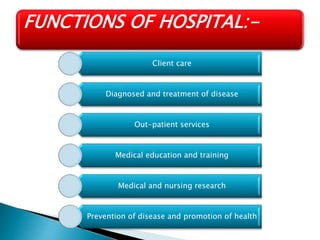
Client care
Diagnosed and treatment of disease
Out-patient services
Medical education and training
Medical and nursing research
Prevention of disease and promotion of health
FUNCTIONS OF HOSPITAL:-
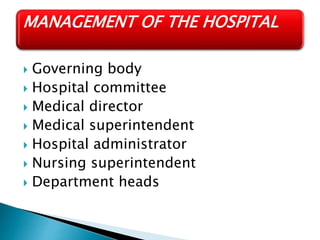
 Governing body
 Hospital committee
 Medical director
 Medical superintendent
 Hospital administrator
 Nursing superintendent
 Department heads
MANAGEMENT OF THE HOSPITAL
The most commonly accepted upon different
criteria for classification of the hospital are
according to:
1. Length of stay of patient
2. Clinical basis
3. Ownership/ control basis
4. Objectives
5. Size
6. Management
7. Systems
CLASSIFICATION OF HOSPITALS:-
 A patient stays for a short term in a hospital for
treatment of disease that is acute in nature, such as
pneumonia, peptic ulcer, and gastroenteritis, etc.
 A patient may stay for long- term in a hospital
for treatment of disease that is chronic in nature such as
tuberculosis, leprosy, cancer.
 These are hospital licensed as general
hospital; treat all kinds of disease, but major
focus on treating speed disease or condition
such as heart disease, or cancer
3. Ownership/ control basis:-
a. PUBLIC HOSPITAL:-
 Are those run by the central or state government. These may be
general hospital or specialized hospitals or both.
b. VOLUNTARY HOSPITAL:-
 They are run with public and private funds on a non-commercial
basis.
c. PRIVATE NURSING HOSPITALS/ NURSING HOMES:-
 Are generally owned by an individual doctor or groups of doctors.
They accept patient suffering from injury, chronic, disability etc. But
do not admit patient suffering from communicable disease,
alcoholism, drug addiction or mental illness.
d. CORPORATE HOSPITAL:-
 Which are public limited companies formed under the companies
act. They are normally run on commercial lines. They can be either
general or specialized or both. ( e.g. Hinduja Hospital)
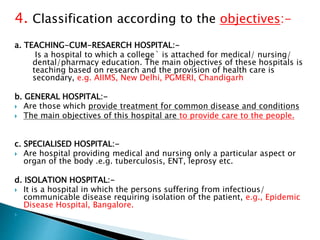
4. Classification according to the objectives:-
a. TEACHING-CUM-RESAERCH HOSPITAL:-
Is a hospital to which a college` is attached for medical/ nursing/
dental/pharmacy education. The main objectives of these hospitals is
teaching based on research and the provision of health care is
secondary, e.g. AIIMS, New Delhi, PGMERI, Chandigarh
b. GENERAL HOSPITAL:-
 Are those which provide treatment for common disease and conditions
 The main objectives of this hospital are to provide care to the people.
c. SPECIALISED HOSPITAL:-
 Are hospital providing medical and nursing only a particular aspect or
organ of the body .e.g. tuberculosis, ENT, leprosy etc.
d. ISOLATION HOSPITAL:-
 It is a hospital in which the persons suffering from infectious/
communicable disease requiring isolation of the patient, e.g., Epidemic
Disease Hospital, Bangalore.

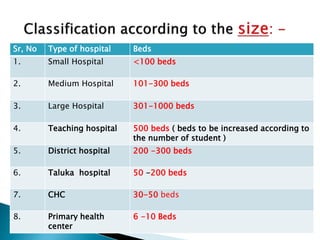
Sr, No Type of hospital Beds
1. Small Hospital <100 beds
2. Medium Hospital 101-300 beds
3. Large Hospital 301-1000 beds
4. Teaching hospital 500 beds ( beds to be increased according to
the number of student )
5. District hospital 200 -300 beds
6. Taluka hospital 50 -200 beds
7. CHC 30-50 beds
8. Primary health
center
6 -10 Beds
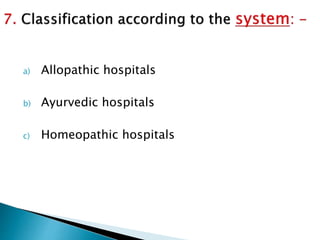
a) Allopathic hospitals
b) Ayurvedic hospitals
c) Homeopathic hospitals
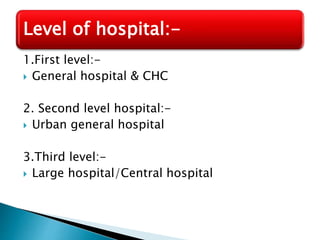
1.First level:-
 General hospital & CHC
2. Second level hospital:-
 Urban general hospital
3.Third level:-
 Large hospital/Central hospital
Level of hospital:-
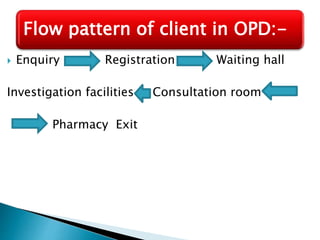
 Enquiry Registration Waiting hall
Investigation facilities Consultation room
Pharmacy Exit
Flow pattern of client in OPD:-
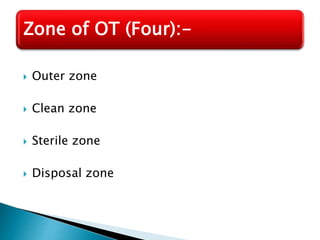
 Outer zone
 Clean zone
 Sterile zone
 Disposal zone
Zone of OT (Four):-
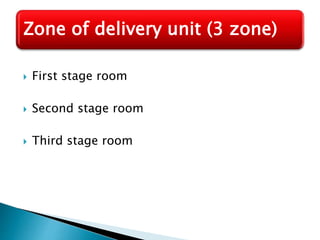
 First stage room
 Second stage room
 Third stage room
Zone of delivery unit (3 zone)
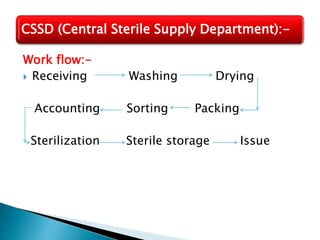
Work flow:-
 Receiving Washing Drying
Accounting Sorting Packing
Sterilization Sterile storage Issue
CSSD (Central Sterile Supply Department):-
 OPD Record>5 year
 IPD Record> 10 year
 Medico legal -15 year
MRD (Medical Record Department:-
6. Classification according to the management: -
a. Union government/ government of India.
 All hospital administered by the government of India, e.g. hospital run
by the railways, military/deference or public sector undertaking of the
central government.
b. State government.
 All hospital administered by the state union territory. Government
authorities and public sector undertaking operated by the state/union
territories,
c. Local bodies.
 All hospital administered by local bodies, i.e. municipal corporation,
municipality, zila perished, panchayat, e.g. corporation maternity homes.
d. Autonomous bodies.
 All hospital establishment under special act of parliament or state
legislation and founded by the central/state government/union territory,
e.g. AIIMS, New Delhi, PGI.
e. Private
 All private hospital owned by an individual or by a private organization,
e.g, Manipal hospital, Banglore, Hinduja hospital, Mumbai.
f. Voluntary agencies
 All hospitals operated by a voluntary body/a trust/charitable society
under central/state government laws. This includes hospital run by the
missionary bodies and co-operatives. e.g. CMC, Vellore.

Hospital

  • 1.
  • 2.
     The word‘hospital’ is closely related to the word ‘hospitality’ and is derived from the word ‘hospice’ which means a place for refuse a house for rest. This is should be the underline factor in planning a hospital. MEANING OF HOSPITAL:-
  • 3.
    According to steadman’smedical dictionary:- “Hospital is an institution for the care, cure, and treatment of the sick and wounded, for the study of the disease and for the training of the doctors and nurses” DEFINITION :-
  • 4.
    1. Provide optimumhealth service to all 2. Provide care, cure, and preventive services to all 3. Protect the human rights of clients while clients taking care in its jurisdiction/ in all areas of its services. OBJECTIVES :-
  • 5.
    4. Provide trainingfor professionals, i.e. doctors, nurses, pharmacists, dentist other technical staff. 5. Provide in-service and continuing education. 6. Participate/ conduct research (and investigation in basic and applied biomedical, social sciences) 7. Define the role of leadership in community.
  • 6.
    Client care Diagnosed andtreatment of disease Out-patient services Medical education and training Medical and nursing research Prevention of disease and promotion of health FUNCTIONS OF HOSPITAL:-
  • 7.
     Governing body Hospital committee  Medical director  Medical superintendent  Hospital administrator  Nursing superintendent  Department heads MANAGEMENT OF THE HOSPITAL
  • 8.
    The most commonlyaccepted upon different criteria for classification of the hospital are according to: 1. Length of stay of patient 2. Clinical basis 3. Ownership/ control basis 4. Objectives 5. Size 6. Management 7. Systems CLASSIFICATION OF HOSPITALS:-
  • 9.
     A patientstays for a short term in a hospital for treatment of disease that is acute in nature, such as pneumonia, peptic ulcer, and gastroenteritis, etc.  A patient may stay for long- term in a hospital for treatment of disease that is chronic in nature such as tuberculosis, leprosy, cancer.
  • 10.
     These arehospital licensed as general hospital; treat all kinds of disease, but major focus on treating speed disease or condition such as heart disease, or cancer
  • 11.
    3. Ownership/ controlbasis:- a. PUBLIC HOSPITAL:-  Are those run by the central or state government. These may be general hospital or specialized hospitals or both. b. VOLUNTARY HOSPITAL:-  They are run with public and private funds on a non-commercial basis. c. PRIVATE NURSING HOSPITALS/ NURSING HOMES:-  Are generally owned by an individual doctor or groups of doctors. They accept patient suffering from injury, chronic, disability etc. But do not admit patient suffering from communicable disease, alcoholism, drug addiction or mental illness. d. CORPORATE HOSPITAL:-  Which are public limited companies formed under the companies act. They are normally run on commercial lines. They can be either general or specialized or both. ( e.g. Hinduja Hospital)
  • 12.
    4. Classification accordingto the objectives:- a. TEACHING-CUM-RESAERCH HOSPITAL:- Is a hospital to which a college` is attached for medical/ nursing/ dental/pharmacy education. The main objectives of these hospitals is teaching based on research and the provision of health care is secondary, e.g. AIIMS, New Delhi, PGMERI, Chandigarh b. GENERAL HOSPITAL:-  Are those which provide treatment for common disease and conditions  The main objectives of this hospital are to provide care to the people. c. SPECIALISED HOSPITAL:-  Are hospital providing medical and nursing only a particular aspect or organ of the body .e.g. tuberculosis, ENT, leprosy etc. d. ISOLATION HOSPITAL:-  It is a hospital in which the persons suffering from infectious/ communicable disease requiring isolation of the patient, e.g., Epidemic Disease Hospital, Bangalore. 
  • 13.
    Sr, No Typeof hospital Beds 1. Small Hospital <100 beds 2. Medium Hospital 101-300 beds 3. Large Hospital 301-1000 beds 4. Teaching hospital 500 beds ( beds to be increased according to the number of student ) 5. District hospital 200 -300 beds 6. Taluka hospital 50 -200 beds 7. CHC 30-50 beds 8. Primary health center 6 -10 Beds
  • 14.
    a) Allopathic hospitals b)Ayurvedic hospitals c) Homeopathic hospitals
  • 15.
    1.First level:-  Generalhospital & CHC 2. Second level hospital:-  Urban general hospital 3.Third level:-  Large hospital/Central hospital Level of hospital:-
  • 16.
     Enquiry RegistrationWaiting hall Investigation facilities Consultation room Pharmacy Exit Flow pattern of client in OPD:-
  • 17.
     Outer zone Clean zone  Sterile zone  Disposal zone Zone of OT (Four):-
  • 18.
     First stageroom  Second stage room  Third stage room Zone of delivery unit (3 zone)
  • 19.
    Work flow:-  ReceivingWashing Drying Accounting Sorting Packing Sterilization Sterile storage Issue CSSD (Central Sterile Supply Department):-
  • 20.
     OPD Record>5year  IPD Record> 10 year  Medico legal -15 year MRD (Medical Record Department:-
  • 21.
    6. Classification accordingto the management: - a. Union government/ government of India.  All hospital administered by the government of India, e.g. hospital run by the railways, military/deference or public sector undertaking of the central government. b. State government.  All hospital administered by the state union territory. Government authorities and public sector undertaking operated by the state/union territories, c. Local bodies.  All hospital administered by local bodies, i.e. municipal corporation, municipality, zila perished, panchayat, e.g. corporation maternity homes. d. Autonomous bodies.  All hospital establishment under special act of parliament or state legislation and founded by the central/state government/union territory, e.g. AIIMS, New Delhi, PGI. e. Private  All private hospital owned by an individual or by a private organization, e.g, Manipal hospital, Banglore, Hinduja hospital, Mumbai. f. Voluntary agencies  All hospitals operated by a voluntary body/a trust/charitable society under central/state government laws. This includes hospital run by the missionary bodies and co-operatives. e.g. CMC, Vellore.

Editor's Notes

  • #8 The governing body is the highest decision making authority of a hospital. It formulates policies and provides direction to the hospital for effective and efficient function of the hospital. The governing body should review the status of the hospital services at least once a week with a minimum of 7 members present at each meeting. Hospital committee:- The governing body appoints a hospital committee to look after the day to day functioning of the hospital or any particular area. Medical director:- In larger hospital the medical director overseas the functioning of the hospital and look after the intake and turnover of staff. Medical superintendent:- It ensures that the policies of the governing body are effectively implemented to maintain standards and provide quality patient care. He/she responsible for the overall performance of the medical staff and is helped by the hospital administer, nursing superintendent and department heads. Hospital administrator:- The hospital administrator for all administrative and support services in the hospital. He/she provides leadership and coordinates all support service as finance. Housekeeping, legal matters, human recourses development, marketing. Nursing superintendent:- It is responsible for all nursing services. These involve planning patient care, obtaining regular ward/patient reports/data from nurses and reviewing them. Department heads:- Heads of various departments are responsible for the smooth and uninterrupted functioning of their areas. They ensure a good working condition of the equipment and project future needs to the hospital administrator.