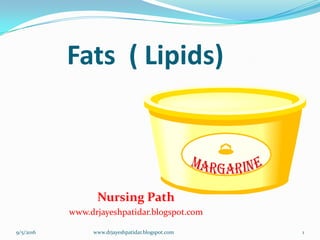
Fats ( Lipids)
Nursing Path
www.drjayeshpatidar.blogspot.com
9/5/2016 1www.drjayeshpatidar.blogspot.com
Nutrient
 Carbohydrates
 Fats
 Proteins
 Vitamins
 Minerals
9/5/2016 2www.drjayeshpatidar.blogspot.com
FATS (Lipids)
 Composition
 Classification of fats
 Fatty Acids
 RDA of FAT
 Functions of Fat
 Digestion & Metabolism
9/5/2016 3www.drjayeshpatidar.blogspot.com
INTRODUCTION
 Fat => 9 Kcal/gm
 Vitamin A, D , E , K
 Insulation
9/5/2016
4
www.drjayeshpatidar.blogspot.com
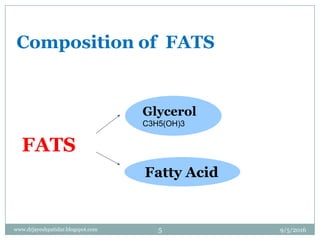
FATS
Glycerol
C3H5(OH)3
Fatty Acid
Composition of FATS
9/5/20165www.drjayeshpatidar.blogspot.com
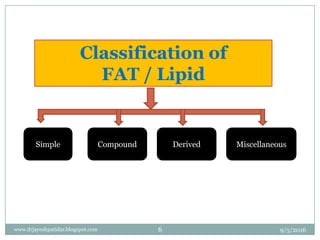
Classification of
FAT / Lipid
Simple Compound Derived Miscellaneous
9/5/20166www.drjayeshpatidar.blogspot.com
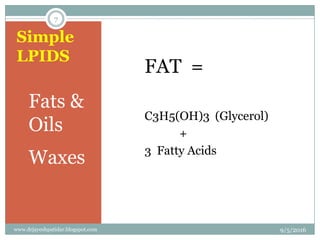
Simple
LPIDS
FAT =
C3H5(OH)3 (Glycerol)
+
3 Fatty Acids
1 Fats &
Oils
2 Waxes
9/5/2016
7
www.drjayeshpatidar.blogspot.com
Compound
FAT
Fat
+
P /Carbo
/ Protein
 Fat + Phosphorus
=Phospholipid
Fat + Carbohydrate
=Glycolipid
Fat + Protein
= Lipoproteins
9/5/2016
8
www.drjayeshpatidar.blogspot.com
Derived Lipid
 Derived Lipid Produced from Fat & its Substances
Glycerol + Fatty Acids
 Glycerol :
 It makeup about 10% of Fat
 It is water soluble base Triglycerides
 During digestion Glycerol is removed & Available for Glucose
formation
 Fatty Acids :
 It is refined Fuel of Fat- Cell burns for Energy
 They may be Saturated or Unsaturated
 E.g. Oleic acid, Linoleic acid, Linolenic acid, Arachidonic acid,
Palmitic acid, Myristic acid, Steric acid.
9/5/2016
9
www.drjayeshpatidar.blogspot.com
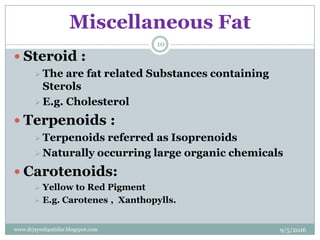
Miscellaneous Fat
 Steroid :
 The are fat related Substances containing
Sterols
 E.g. Cholesterol
 Terpenoids :
 Terpenoids referred as Isoprenoids
 Naturally occurring large organic chemicals
 Carotenoids:
 Yellow to Red Pigment
 E.g. Carotenes , Xanthopylls.
9/5/2016
10
www.drjayeshpatidar.blogspot.com
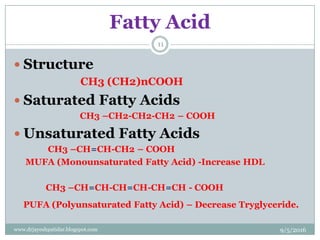
Fatty Acid
 Structure
CH3 (CH2)nCOOH
 Saturated Fatty Acids
CH3 –CH2-CH2-CH2 – COOH
 Unsaturated Fatty Acids
CH3 –CH=CH-CH2 – COOH
MUFA (Monounsaturated Fatty Acid) -Increase HDL
CH3 –CH=CH-CH=CH-CH=CH - COOH
PUFA (Polyunsaturated Fatty Acid) – Decrease Tryglyceride.
9/5/2016
11
www.drjayeshpatidar.blogspot.com
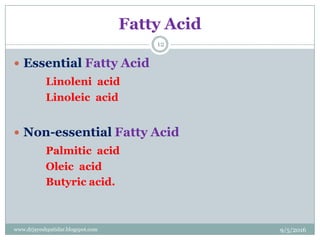
Fatty Acid
 Essential Fatty Acid
Linoleni acid
Linoleic acid
 Non-essential Fatty Acid
Palmitic acid
Oleic acid
Butyric acid.
9/5/2016
12
www.drjayeshpatidar.blogspot.com
Trans Fat :
o Fat formed when oils are partially
hydrogenated
o Increase risk of Heart Disease
Triglycerides:
o They are ester of Glycerol with Fatty acid
o It is main form of Fat in food
o 80-90% of body lipid are Triglyceride
o They help to maintain body Temperature
o Excess calorie convert in to Triglyceride
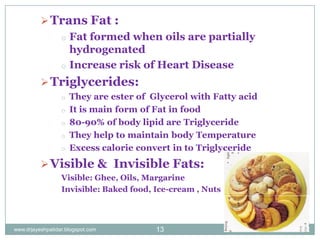
Visible & Invisible Fats:
Visible: Ghee, Oils, Margarine
Invisible: Baked food, Ice-cream , Nuts
9/5/201613www.drjayeshpatidar.blogspot.com
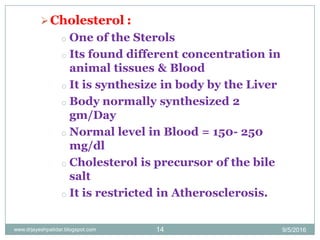
Cholesterol :
o One of the Sterols
o Its found different concentration in
animal tissues & Blood
o It is synthesize in body by the Liver
o Body normally synthesized 2
gm/Day
o Normal level in Blood = 150- 250
mg/dl
o Cholesterol is precursor of the bile
salt
o It is restricted in Atherosclerosis.
9/5/201614www.drjayeshpatidar.blogspot.com
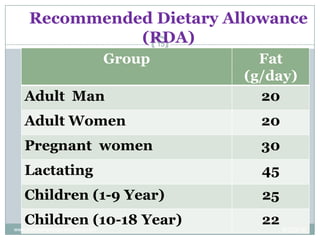
Recommended Dietary Allowance
(RDA)
Group Fat
(g/day)
Adult Man 20
Adult Women 20
Pregnant women 30
Lactating 45
Children (1-9 Year) 25
Children (10-18 Year) 22
9/5/2016
15
www.drjayeshpatidar.blogspot.com
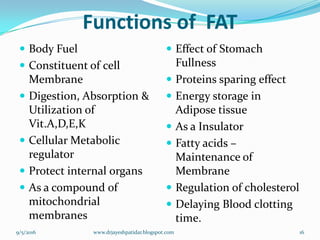
Functions of FAT
 Body Fuel
 Constituent of cell
Membrane
 Digestion, Absorption &
Utilization of
Vit.A,D,E,K
 Cellular Metabolic
regulator
 Protect internal organs
 As a compound of
mitochondrial
membranes
 Effect of Stomach
Fullness
 Proteins sparing effect
 Energy storage in
Adipose tissue
 As a Insulator
 Fatty acids –
Maintenance of
Membrane
 Regulation of cholesterol
 Delaying Blood clotting
time.
9/5/2016 16www.drjayeshpatidar.blogspot.com
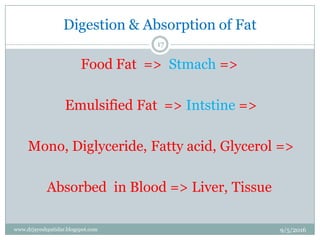
Digestion & Absorption of Fat
Food Fat => Stmach =>
Emulsified Fat => Intstine =>
Mono, Diglyceride, Fatty acid, Glycerol =>
Absorbed in Blood => Liver, Tissue
9/5/2016
17
www.drjayeshpatidar.blogspot.com
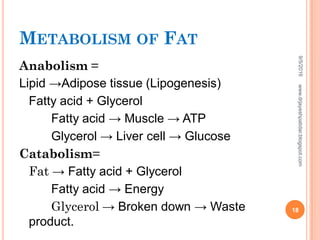
METABOLISM OF FAT
Anabolism =
Lipid →Adipose tissue (Lipogenesis)
Fatty acid + Glycerol
Fatty acid → Muscle → ATP
Glycerol → Liver cell → Glucose
Catabolism=
Fat → Fatty acid + Glycerol
Fatty acid → Energy
Glycerol → Broken down → Waste
product.
9/5/2016
18
www.drjayeshpatidar.blogspot.com
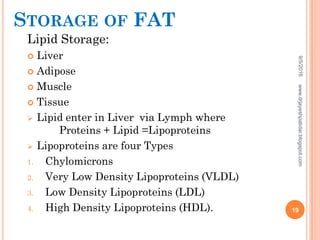
STORAGE OF FAT
Lipid Storage:
 Liver
 Adipose
 Muscle
 Tissue
 Lipid enter in Liver via Lymph where
Proteins + Lipid =Lipoproteins
 Lipoproteins are four Types
1. Chylomicrons
2. Very Low Density Lipoproteins (VLDL)
3. Low Density Lipoproteins (LDL)
4. High Density Lipoproteins (HDL).
9/5/2016
19
www.drjayeshpatidar.blogspot.com
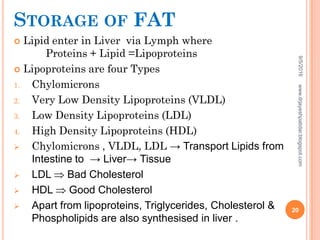
STORAGE OF FAT
 Lipid enter in Liver via Lymph where
Proteins + Lipid =Lipoproteins
 Lipoproteins are four Types
1. Chylomicrons
2. Very Low Density Lipoproteins (VLDL)
3. Low Density Lipoproteins (LDL)
4. High Density Lipoproteins (HDL)
 Chylomicrons , VLDL, LDL → Transport Lipids from
Intestine to → Liver→ Tissue
 LDL  Bad Cholesterol
 HDL  Good Cholesterol
 Apart from lipoproteins, Triglycerides, Cholesterol &
Phospholipids are also synthesised in liver .
9/5/2016
20
www.drjayeshpatidar.blogspot.com
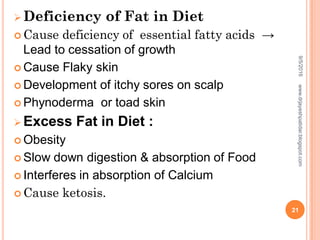
 Deficiency of Fat in Diet
 Cause deficiency of essential fatty acids →
Lead to cessation of growth
 Cause Flaky skin
 Development of itchy sores on scalp
 Phynoderma or toad skin
 Excess Fat in Diet :
 Obesity
 Slow down digestion & absorption of Food
 Interferes in absorption of Calcium
 Cause ketosis.
9/5/2016
21
www.drjayeshpatidar.blogspot.com
ThankYou
9/5/2016 22www.drjayeshpatidar.blogspot.com

Fats as a nutrient

  • 1.
    Fats ( Lipids) NursingPath www.drjayeshpatidar.blogspot.com 9/5/2016 1www.drjayeshpatidar.blogspot.com
  • 2.
    Nutrient  Carbohydrates  Fats Proteins  Vitamins  Minerals 9/5/2016 2www.drjayeshpatidar.blogspot.com
  • 3.
    FATS (Lipids)  Composition Classification of fats  Fatty Acids  RDA of FAT  Functions of Fat  Digestion & Metabolism 9/5/2016 3www.drjayeshpatidar.blogspot.com
  • 4.
    INTRODUCTION  Fat =>9 Kcal/gm  Vitamin A, D , E , K  Insulation 9/5/2016 4 www.drjayeshpatidar.blogspot.com
  • 5.
    FATS Glycerol C3H5(OH)3 Fatty Acid Composition ofFATS 9/5/20165www.drjayeshpatidar.blogspot.com
  • 6.
    Classification of FAT /Lipid Simple Compound Derived Miscellaneous 9/5/20166www.drjayeshpatidar.blogspot.com
  • 7.
    Simple LPIDS FAT = C3H5(OH)3 (Glycerol) + 3Fatty Acids 1 Fats & Oils 2 Waxes 9/5/2016 7 www.drjayeshpatidar.blogspot.com
  • 8.
    Compound FAT Fat + P /Carbo / Protein Fat + Phosphorus =Phospholipid Fat + Carbohydrate =Glycolipid Fat + Protein = Lipoproteins 9/5/2016 8 www.drjayeshpatidar.blogspot.com
  • 9.
    Derived Lipid  DerivedLipid Produced from Fat & its Substances Glycerol + Fatty Acids  Glycerol :  It makeup about 10% of Fat  It is water soluble base Triglycerides  During digestion Glycerol is removed & Available for Glucose formation  Fatty Acids :  It is refined Fuel of Fat- Cell burns for Energy  They may be Saturated or Unsaturated  E.g. Oleic acid, Linoleic acid, Linolenic acid, Arachidonic acid, Palmitic acid, Myristic acid, Steric acid. 9/5/2016 9 www.drjayeshpatidar.blogspot.com
  • 10.
    Miscellaneous Fat  Steroid:  The are fat related Substances containing Sterols  E.g. Cholesterol  Terpenoids :  Terpenoids referred as Isoprenoids  Naturally occurring large organic chemicals  Carotenoids:  Yellow to Red Pigment  E.g. Carotenes , Xanthopylls. 9/5/2016 10 www.drjayeshpatidar.blogspot.com
  • 11.
    Fatty Acid  Structure CH3(CH2)nCOOH  Saturated Fatty Acids CH3 –CH2-CH2-CH2 – COOH  Unsaturated Fatty Acids CH3 –CH=CH-CH2 – COOH MUFA (Monounsaturated Fatty Acid) -Increase HDL CH3 –CH=CH-CH=CH-CH=CH - COOH PUFA (Polyunsaturated Fatty Acid) – Decrease Tryglyceride. 9/5/2016 11 www.drjayeshpatidar.blogspot.com
  • 12.
    Fatty Acid  EssentialFatty Acid Linoleni acid Linoleic acid  Non-essential Fatty Acid Palmitic acid Oleic acid Butyric acid. 9/5/2016 12 www.drjayeshpatidar.blogspot.com
  • 13.
    Trans Fat : oFat formed when oils are partially hydrogenated o Increase risk of Heart Disease Triglycerides: o They are ester of Glycerol with Fatty acid o It is main form of Fat in food o 80-90% of body lipid are Triglyceride o They help to maintain body Temperature o Excess calorie convert in to Triglyceride Visible & Invisible Fats: Visible: Ghee, Oils, Margarine Invisible: Baked food, Ice-cream , Nuts 9/5/201613www.drjayeshpatidar.blogspot.com
  • 14.
    Cholesterol : o Oneof the Sterols o Its found different concentration in animal tissues & Blood o It is synthesize in body by the Liver o Body normally synthesized 2 gm/Day o Normal level in Blood = 150- 250 mg/dl o Cholesterol is precursor of the bile salt o It is restricted in Atherosclerosis. 9/5/201614www.drjayeshpatidar.blogspot.com
  • 15.
    Recommended Dietary Allowance (RDA) GroupFat (g/day) Adult Man 20 Adult Women 20 Pregnant women 30 Lactating 45 Children (1-9 Year) 25 Children (10-18 Year) 22 9/5/2016 15 www.drjayeshpatidar.blogspot.com
  • 16.
    Functions of FAT Body Fuel  Constituent of cell Membrane  Digestion, Absorption & Utilization of Vit.A,D,E,K  Cellular Metabolic regulator  Protect internal organs  As a compound of mitochondrial membranes  Effect of Stomach Fullness  Proteins sparing effect  Energy storage in Adipose tissue  As a Insulator  Fatty acids – Maintenance of Membrane  Regulation of cholesterol  Delaying Blood clotting time. 9/5/2016 16www.drjayeshpatidar.blogspot.com
  • 17.
    Digestion & Absorptionof Fat Food Fat => Stmach => Emulsified Fat => Intstine => Mono, Diglyceride, Fatty acid, Glycerol => Absorbed in Blood => Liver, Tissue 9/5/2016 17 www.drjayeshpatidar.blogspot.com
  • 18.
    METABOLISM OF FAT Anabolism= Lipid →Adipose tissue (Lipogenesis) Fatty acid + Glycerol Fatty acid → Muscle → ATP Glycerol → Liver cell → Glucose Catabolism= Fat → Fatty acid + Glycerol Fatty acid → Energy Glycerol → Broken down → Waste product. 9/5/2016 18 www.drjayeshpatidar.blogspot.com
  • 19.
    STORAGE OF FAT LipidStorage:  Liver  Adipose  Muscle  Tissue  Lipid enter in Liver via Lymph where Proteins + Lipid =Lipoproteins  Lipoproteins are four Types 1. Chylomicrons 2. Very Low Density Lipoproteins (VLDL) 3. Low Density Lipoproteins (LDL) 4. High Density Lipoproteins (HDL). 9/5/2016 19 www.drjayeshpatidar.blogspot.com
  • 20.
    STORAGE OF FAT Lipid enter in Liver via Lymph where Proteins + Lipid =Lipoproteins  Lipoproteins are four Types 1. Chylomicrons 2. Very Low Density Lipoproteins (VLDL) 3. Low Density Lipoproteins (LDL) 4. High Density Lipoproteins (HDL)  Chylomicrons , VLDL, LDL → Transport Lipids from Intestine to → Liver→ Tissue  LDL  Bad Cholesterol  HDL  Good Cholesterol  Apart from lipoproteins, Triglycerides, Cholesterol & Phospholipids are also synthesised in liver . 9/5/2016 20 www.drjayeshpatidar.blogspot.com
  • 21.
     Deficiency ofFat in Diet  Cause deficiency of essential fatty acids → Lead to cessation of growth  Cause Flaky skin  Development of itchy sores on scalp  Phynoderma or toad skin  Excess Fat in Diet :  Obesity  Slow down digestion & absorption of Food  Interferes in absorption of Calcium  Cause ketosis. 9/5/2016 21 www.drjayeshpatidar.blogspot.com
  • 22.