SEMINAR ON
CONTINUING NURSING
EDUCATION
ANEEZ. K
IST YEAR MSc. NURSING
EMCH CON
“Let us never consider ourselves as finished
nurses….. We must be learning all our lives”
-Florence Nightingale
The idea of continuing education in
nursing is as old as organized nursing, but
the concept of lifelong learning for the
practitioner has developed slowly
The history of continuing education in
nursing has shown that educational
institutions generally have been slow
to accept responsibility for assisting
the practitioner who wishes to add to
her nursing knowledge and skill
SIGNIFICANCE
 Rapid technological advances related to
knowledge explosion have greatly altered the
practice of nursing.
 The gap between scientific knowledge and its
application grows wider each year as a result
of multiple influences.
 Elimination of certain illnesses, particularly
the communicable diseases.
SIGNIFICANCE CONT…
Surgeries are being performed successfully in
areas that would not have been attempted 10-
20 years ago
Complex and intricate machinery can extend
lives
All these advances require more highly skilled
nursing care in a great variety of settings
Continuing education is an accepted way of life
BENEFITS
Providing safer care and positive patient
outcome
Increase their knowledge
Contribute to professional growth
Promote critical thinking.
Provide a venue for networking with other
professionals
STEPS
 Establishing goals compatible with the purpose
or mission of the organization.
 Deciding upon specific objectives consistent
with these goals.
 Determining the course of action required to
meet the specific objectives.
 Assessing the available resources for
establishing the program.
Establishing a workable budget,
appropriate for the program.
Evaluating the results at stated
intervals.
Reassessing he goals and updating the
plan periodically.
BARRIERS
Compelling analogy of the airline pilot
Time constraints
Financial constraints,
Personal or organizational resistance,
Inflexible organizational policies,
Staffing issues, and
Family commitments.
IMPORTANCE
License renewal
Improve the nursing qualities
Increase their knowledge
Contribute to professional growth
STRATEGIES FOR SUCCESS
Attending off site conferences
Local onsite programmes
Record maintenance of CE
programmes
Other strategies
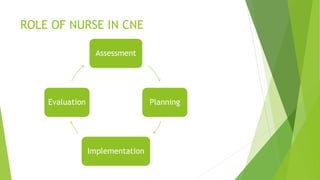
ROLE OF NURSE IN CNE
Assessment
Planning
Implementation
Evaluation
REFERENCES
 American Nurses Association. Scope and Standards of Practice for Nursing
Professional Development. Washington, DC: American Nurses Publishing; 2000.
 Gopee N. Facilitating the implementation of lifelong learning in nursing. Br J
Nurse. 2005; 14:761-767.
 Gephardt L. Continuing education: even for the non-practicing nurse. ASBN.
2007; 11:10-11.
 Krugman M. Continuing nursing education accreditation: what you need to
know. Colo Nurse. 2008; 108:9.
 Estabrooks CA. Will evidence-based nursing make practice perfect? Can J
Nurse Res. 1998; 30:15
 Balas EA, Boren SA. Managing Clinical Knowledge for Healthcare
Improvements. Stuttgart, Germany: Schattauer Publishing; 2000.
 Bellack P, O'Neill EH. Recreating nursing practice for a new century:
recommendations and implications of the Pew Health Professions
Commission's final report. Nurse Health Care Perspect. 2000; 21:14-21
 Gallaher L. Continuing education in nursing: a concept analysis. Nurse
Education Today. 2007; 27:466
Continuing Nursing Education

Continuing Nursing Education

  • 1.
    SEMINAR ON CONTINUING NURSING EDUCATION ANEEZ.K IST YEAR MSc. NURSING EMCH CON
  • 2.
    “Let us neverconsider ourselves as finished nurses….. We must be learning all our lives” -Florence Nightingale
  • 3.
    The idea ofcontinuing education in nursing is as old as organized nursing, but the concept of lifelong learning for the practitioner has developed slowly
  • 4.
    The history ofcontinuing education in nursing has shown that educational institutions generally have been slow to accept responsibility for assisting the practitioner who wishes to add to her nursing knowledge and skill
  • 5.
    SIGNIFICANCE  Rapid technologicaladvances related to knowledge explosion have greatly altered the practice of nursing.  The gap between scientific knowledge and its application grows wider each year as a result of multiple influences.  Elimination of certain illnesses, particularly the communicable diseases.
  • 6.
    SIGNIFICANCE CONT… Surgeries arebeing performed successfully in areas that would not have been attempted 10- 20 years ago Complex and intricate machinery can extend lives All these advances require more highly skilled nursing care in a great variety of settings Continuing education is an accepted way of life
  • 7.
    BENEFITS Providing safer careand positive patient outcome Increase their knowledge Contribute to professional growth Promote critical thinking. Provide a venue for networking with other professionals
  • 8.
    STEPS  Establishing goalscompatible with the purpose or mission of the organization.  Deciding upon specific objectives consistent with these goals.  Determining the course of action required to meet the specific objectives.  Assessing the available resources for establishing the program.
  • 9.
    Establishing a workablebudget, appropriate for the program. Evaluating the results at stated intervals. Reassessing he goals and updating the plan periodically.
  • 10.
    BARRIERS Compelling analogy ofthe airline pilot Time constraints Financial constraints, Personal or organizational resistance, Inflexible organizational policies, Staffing issues, and Family commitments.
  • 11.
    IMPORTANCE License renewal Improve thenursing qualities Increase their knowledge Contribute to professional growth
  • 12.
    STRATEGIES FOR SUCCESS Attendingoff site conferences Local onsite programmes Record maintenance of CE programmes Other strategies
  • 13.
    ROLE OF NURSEIN CNE Assessment Planning Implementation Evaluation
  • 14.
    REFERENCES  American NursesAssociation. Scope and Standards of Practice for Nursing Professional Development. Washington, DC: American Nurses Publishing; 2000.  Gopee N. Facilitating the implementation of lifelong learning in nursing. Br J Nurse. 2005; 14:761-767.  Gephardt L. Continuing education: even for the non-practicing nurse. ASBN. 2007; 11:10-11.  Krugman M. Continuing nursing education accreditation: what you need to know. Colo Nurse. 2008; 108:9.  Estabrooks CA. Will evidence-based nursing make practice perfect? Can J Nurse Res. 1998; 30:15
  • 15.
     Balas EA,Boren SA. Managing Clinical Knowledge for Healthcare Improvements. Stuttgart, Germany: Schattauer Publishing; 2000.  Bellack P, O'Neill EH. Recreating nursing practice for a new century: recommendations and implications of the Pew Health Professions Commission's final report. Nurse Health Care Perspect. 2000; 21:14-21  Gallaher L. Continuing education in nursing: a concept analysis. Nurse Education Today. 2007; 27:466