MRS. A.SHOBA GRACIAH,MSC (N),
DEPARTMENT OF NURSING EDUCATION,
PROFESSOR,
GANGA COLLEGE OF NURSING,
COIMBATORE.
OBJECTIVES
On completion of the session, the students will be able to :
- define inservice education
- enlist the aims & characteristics of inservice education
- mention the nature & scope of inservice education
- tell about adult learning
- explain the principles of adult learning
- describe the planning of inservice education programme
- enumerate the methods of staff education programme
- discuss about the evaluation of inservice education programme
In service education is the continuation of
education when the employee is in service.It is an
organized educational programme to assist the
individuals in an organization in attaining new skills and
knowledge, gaining increased level of competence and
growing professionally. In service education may be part
of any program of staff development.
INTRODUCTION
DEFINITION
In service education is a planned education activities intended to
build upon the educational and experimental basis of the professional
nurse for the enhancement of practice, education, administration and
research or theoretical development aimed at improving the health of
the public.
- The American Nurses Association
DEFINITION
- cont…
The education given to a nurse while in service for her
professional growth is called in-service education.
- N.N. Yalayasamy
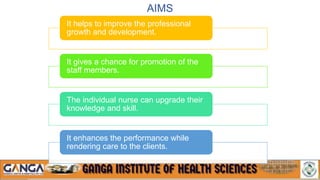
AIMS
It helps to improve the professional
growth and development.
It gives a chance for promotion of the
staff members.
The individual nurse can upgrade their
knowledge and skill.
It enhances the performance while
rendering care to the clients.
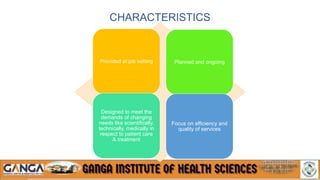
CHARACTERISTICS
Provided at job setting Planned and ongoing
Designed to meet the
demands of changing
needs like scientifically,
technically, medically in
respect to patient care
& treatment
Focus on efficiency and
quality of services
PURPOSE
• Helps to improve professional competence.
• Keep the nursing personnel abreast of the latest trends and development of
new techniques.
• Helps to update the knowledge and skills at all levels.
• Nurses can update knowledge regarding current research & development
• Develops interest and job satisfaction among the staff.
• Encourage the employees in achieving staff development and self
confidence.
• Develops leadership skills, motivation and better attitudes
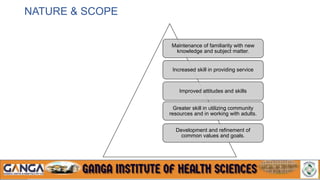
NATURE & SCOPE
Maintenance of familiarity with new
knowledge and subject matter.
Increased skill in providing service
Improved attitudes and skills
Greater skill in utilizing community
resources and in working with adults.
Development and refinement of
common values and goals.
NEED FOR INSERVICE EDUCATION
Inservice education needs for :
- development of manual, behavioural and communication
skills essential for execution of their jobs.
- development of decision making and managerial skills.
- introduction to their routine job, which are expanding new,
higher, complicated.
- development of leadership skills
- development of analytical and innovative thinking for
investigating the potentialities and efficiency of their job.
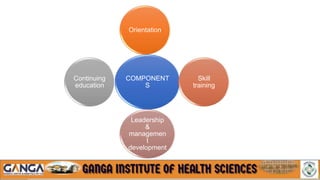
COMPONENT
S
Orientation
Skill
training
Leadership
&
managemen
t
development
Continuing
education
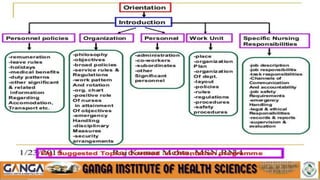
1.ORIENTATION
Orientation means providing new employees with basic
information about the employer
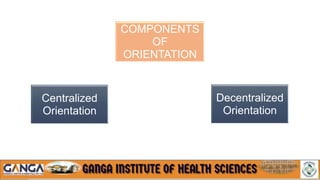
COMPONENTS
OF
ORIENTATION
Centralized
Orientation
Decentralized
Orientation
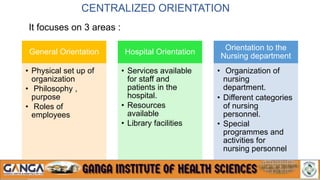
CENTRALIZED ORIENTATION
General Orientation
• Physical set up of
organization
• Philosophy ,
purpose
• Roles of
employees
Hospital Orientation
• Services available
for staff and
patients in the
hospital.
• Resources
available
• Library facilities
Orientation to the
Nursing department
• Organization of
nursing
department.
• Different categories
of nursing
personnel.
• Special
programmes and
activities for
nursing personnel
It focuses on 3 areas :
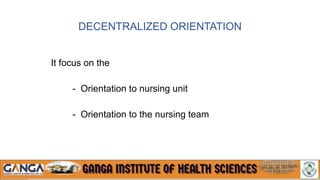
DECENTRALIZED ORIENTATION
It focus on the
- Orientation to nursing unit
- Orientation to the nursing team
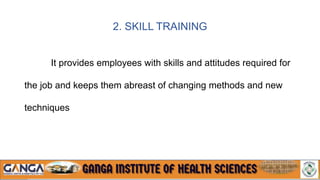
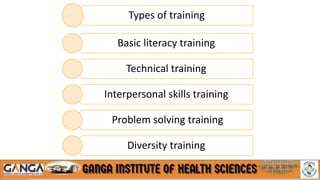
2. SKILL TRAINING
It provides employees with skills and attitudes required for
the job and keeps them abreast of changing methods and new
techniques
Types of training
Basic literacy training
Technical training
Interpersonal skills training
Problem solving training
Diversity training
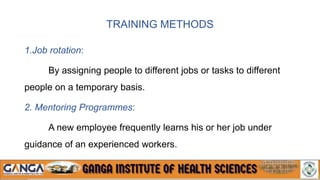
TRAINING METHODS
1.Job rotation:
By assigning people to different jobs or tasks to different
people on a temporary basis.
2. Mentoring Programmes:
A new employee frequently learns his or her job under
guidance of an experienced workers.
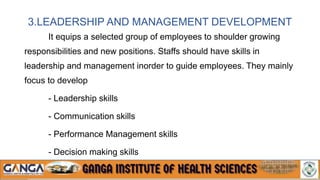
3.LEADERSHIP AND MANAGEMENT DEVELOPMENT
It equips a selected group of employees to shoulder growing
responsibilities and new positions. Staffs should have skills in
leadership and management inorder to guide employees. They mainly
focus to develop
- Leadership skills
- Communication skills
- Performance Management skills
- Decision making skills
4. CONTINUING EDUCATION
Continuing education is all the learning activities that occur
offer an individual has completed his basic education.
AIMS OF CONTINUING EDUCATION
o Improvement of professional practice
o To motivate the staff to seek the latest knowledge
o To keep the nurses with the latest development of technologies
o It develops interest, job satisfaction and confidence
PRINCIPLES
OF
ADULT LEARNING
INTRODUCTION
Adult education is a formal and informal system of
education for older and mature persons . It is carried out on a
part time basis and entirely voluntary . It involves conscious effort
towards developing the individual capabilities of adults by public
or private agencies through informational, cultural, remedial,
vocational, recreational, and professional methods.
Malcolm Knowles coined the word “ andragogy ” in 1970.
Andragogy is the art and science of helping adults learn.
ADULT
An individual who performs roles associated by our culture with adults
(worker, spouse, parent, soldier, responsible citizen) An individual who perceives
himself or herself for the responsibilities for his / her own actions.
LEARNING
- Learning is a change in behavior.
- Change in knowledge or skill.
- Acquiring new information & knowledge as part of everyday adult life.
- Adults seek out learning
ANDRAGOGY- The art and science of helping adults learn.
Adult learn differently , depending upon experience , aptitude ,
attitude.
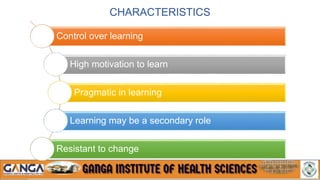
CHARACTERISTICS
Control over learning
High motivation to learn
Pragmatic in learning
Learning may be a secondary role
Resistant to change
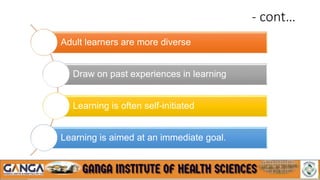
- cont…
Adult learners are more diverse
Draw on past experiences in learning
Learning is often self-initiated
Learning is aimed at an immediate goal.
IMPORTANCE
• Life long learning
• Professional development
• Skill and technology improvement
• Social benefits
• Helps adults be self-directed
• Encourages transformational learning
• Promotes emancipatory learning and social action
PRINCIPLES OF ADULT EDUCATION
1. Need assessment which means that based on the requirement of
the students, the teaching and learning curriculum are organized.
2. Providing security in the learning environment among candidates,
which means protecting from natural hazards and fire.
3. Developing good relationship with learners and the teachers.
4. Reinforcing or rewarding for better performance to motivate the
learner to learn further in better way and perform well.
- cont..
5.Teaching by demonstration techniques or providing real or
simulation environment (Learning by doing)where the learners
study by real life applications rather than sticking only to theory.
6.Give respect to the students in their decision making in
learning. Teaching should be a two way communication, thus
making learning interactive.
7. Includes cognitive, affective & psychomotor aspects of learning
8. Adults have immediacy for learning
- cont..
9. Having clear roles & role development.
10.Enhancing team work.
11.Being engaged
12.Developing the sense of accountability
METHODS OF TEACHING ADULTS
1. Learner-dominated approach:
- Trial and Error method:
The learner concentrates his efforts by repeating an
activity a number of times and acquires skill.
- Individual investigation method:
It involves thinking or learning by insight,
supplemented by use of library, use of laboratory, Survey and
field trips.
- Project method: It combines first two methods
- cont…
2. Teacher –dominated methods:
- Lecture method
- Counselling
- Case work- teacher goes into the history of an individuals
case and teaches him the way to lead happy and satisfy life.
- Demonstration
3. Co-operative methods:
- Group discussion & group project
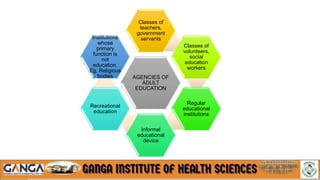
AGENCIES OF
ADULT
EDUCATION
Classes of
teachers,
government
servants
Classes of
volunteers,
social
education
workers
Regular
educational
institutions
Informal
educational
device
Recreational
education
Institutions
whose
primary
function is
not
education.
Eg. Religious
bodies
CHALLENGES
• Lack of confidence in learning capacity
• Fear of looking weak in the group
• Want to avoid making mistakes
• Reduced speed of learning
• More resistant to change
• Highly conservative
• Difficulty accepting views of others
• Wide inter-individual differences
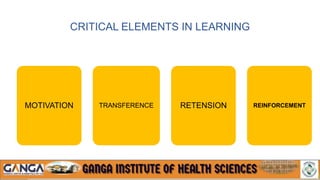
CRITICAL ELEMENTS IN LEARNING
MOTIVATION TRANSFERENCE RETENSION REINFORCEMENT
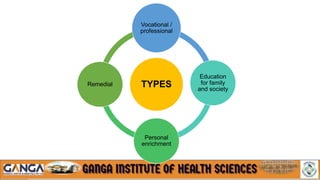
TYPES
Vocational /
professional
Education
for family
and society
Personal
enrichment
Remedial
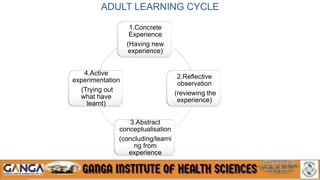
ADULT LEARNING CYCLE
1.Concrete
Experience
(Having new
experience)
2.Reflective
observation
(reviewing the
experience)
3.Abstract
conceptualisation
(concluding/learni
ng from
experience
4.Active
experimentation
(Trying out
what have
learnt)
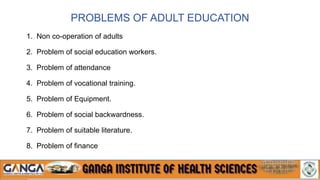
PROBLEMS OF ADULT EDUCATION
1. Non co-operation of adults
2. Problem of social education workers.
3. Problem of attendance
4. Problem of vocational training.
5. Problem of Equipment.
6. Problem of social backwardness.
7. Problem of suitable literature.
8. Problem of finance
METHODS OF GIVING INSERVICE EDUCATION
 Ward teaching
 Discussion
 Laboratory
 Conference
 Seminar
 Workshop
 Field trip
 Job orientation
DEFINITION OF EVALUATION
Evaluation is the process of determining to what extent the
educational objectives are being realized.
- Ralph Tyler
Evaluation is systematic examination of educational and
social programme.
- Conbach et.
BENEFITS OF EVALUATION IN
INSERVICE EDUCATION
• Promote knowledge and skill efficiency to train and develop
staff .
• Identify cost effective and valuable training programmes
leading to better focused learning and development.
• Use and reinforce techniques learned to help improve qualities
and client service within the organization.
• Helps to define future development objectives.
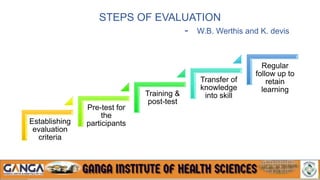
STEPS OF EVALUATION
- W.B. Werthis and K. devis
Establishing
evaluation
criteria
Pre-test for
the
participants
Training &
post-test
Transfer of
knowledge
into skill
Regular
follow up to
retain
learning
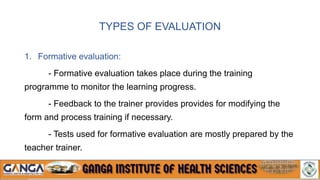
TYPES OF EVALUATION
1. Formative evaluation:
- Formative evaluation takes place during the training
programme to monitor the learning progress.
- Feedback to the trainer provides provides for modifying the
form and process training if necessary.
- Tests used for formative evaluation are mostly prepared by the
teacher trainer.
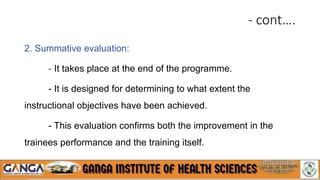
- cont….
2. Summative evaluation:
- It takes place at the end of the programme.
- It is designed for determining to what extent the
instructional objectives have been achieved.
- This evaluation confirms both the improvement in the
trainees performance and the training itself.
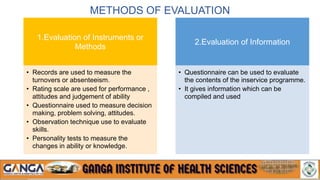
METHODS OF EVALUATION
1.Evaluation of Instruments or
Methods
• Records are used to measure the
turnovers or absenteeism.
• Rating scale are used for performance ,
attitudes and judgement of ability
• Questionnaire used to measure decision
making, problem solving, attitudes.
• Observation technique use to evaluate
skills.
• Personality tests to measure the
changes in ability or knowledge.
2.Evaluation of Information
• Questionnaire can be used to evaluate
the contents of the inservice programme.
• It gives information which can be
compiled and used
- cont…
3.Steering Committee
• A committee is formed with 3 to
4 members of trainee
participants .These members
interact with other participants
informally about different
aspects of the programme.
• The views of participants are
then compiled and to be given
to the programme coordinator.
4. Trainees Diaries
• The participants are given
diaries at the beginning of the
course and they are asked to
write their views and opinions
everyday.
• The diaries are collected at the
end of the total programme
PREPARATION OF REPORT
The report should be prepared with the following elements:
- Date and duration of Education programme.
- Coordinator and resource persons.
- Purpose of the topic of the education programme
- The group of individuals with basic qualification and number of
individuals in the group.
- Planning components of inservice education.
- Evaluation tools used for the evaluation of knowledge and skills .
- A brief summary of all the areas to be recorded in the report and
submitted to a higher authority.
REFERENCE
Online :
https://www.slideshare.net/ganeshnaik72/inservice-education-
203071020
https://www.slideshare.net/FIROZQURESHI/adult-education-
63953739
Inservice education.pptx

Inservice education.pptx

  • 1.
    MRS. A.SHOBA GRACIAH,MSC(N), DEPARTMENT OF NURSING EDUCATION, PROFESSOR, GANGA COLLEGE OF NURSING, COIMBATORE.
  • 2.
    OBJECTIVES On completion ofthe session, the students will be able to : - define inservice education - enlist the aims & characteristics of inservice education - mention the nature & scope of inservice education - tell about adult learning - explain the principles of adult learning - describe the planning of inservice education programme - enumerate the methods of staff education programme - discuss about the evaluation of inservice education programme
  • 4.
    In service educationis the continuation of education when the employee is in service.It is an organized educational programme to assist the individuals in an organization in attaining new skills and knowledge, gaining increased level of competence and growing professionally. In service education may be part of any program of staff development. INTRODUCTION
  • 5.
    DEFINITION In service educationis a planned education activities intended to build upon the educational and experimental basis of the professional nurse for the enhancement of practice, education, administration and research or theoretical development aimed at improving the health of the public. - The American Nurses Association
  • 6.
    DEFINITION - cont… The educationgiven to a nurse while in service for her professional growth is called in-service education. - N.N. Yalayasamy
  • 7.
    AIMS It helps toimprove the professional growth and development. It gives a chance for promotion of the staff members. The individual nurse can upgrade their knowledge and skill. It enhances the performance while rendering care to the clients.
  • 8.
    CHARACTERISTICS Provided at jobsetting Planned and ongoing Designed to meet the demands of changing needs like scientifically, technically, medically in respect to patient care & treatment Focus on efficiency and quality of services
  • 9.
    PURPOSE • Helps toimprove professional competence. • Keep the nursing personnel abreast of the latest trends and development of new techniques. • Helps to update the knowledge and skills at all levels. • Nurses can update knowledge regarding current research & development • Develops interest and job satisfaction among the staff. • Encourage the employees in achieving staff development and self confidence. • Develops leadership skills, motivation and better attitudes
  • 10.
    NATURE & SCOPE Maintenanceof familiarity with new knowledge and subject matter. Increased skill in providing service Improved attitudes and skills Greater skill in utilizing community resources and in working with adults. Development and refinement of common values and goals.
  • 11.
    NEED FOR INSERVICEEDUCATION Inservice education needs for : - development of manual, behavioural and communication skills essential for execution of their jobs. - development of decision making and managerial skills. - introduction to their routine job, which are expanding new, higher, complicated. - development of leadership skills - development of analytical and innovative thinking for investigating the potentialities and efficiency of their job.
  • 12.
  • 13.
    1.ORIENTATION Orientation means providingnew employees with basic information about the employer
  • 14.
  • 15.
    CENTRALIZED ORIENTATION General Orientation •Physical set up of organization • Philosophy , purpose • Roles of employees Hospital Orientation • Services available for staff and patients in the hospital. • Resources available • Library facilities Orientation to the Nursing department • Organization of nursing department. • Different categories of nursing personnel. • Special programmes and activities for nursing personnel It focuses on 3 areas :
  • 16.
    DECENTRALIZED ORIENTATION It focuson the - Orientation to nursing unit - Orientation to the nursing team
  • 18.
    2. SKILL TRAINING Itprovides employees with skills and attitudes required for the job and keeps them abreast of changing methods and new techniques
  • 19.
    Types of training Basicliteracy training Technical training Interpersonal skills training Problem solving training Diversity training
  • 20.
    TRAINING METHODS 1.Job rotation: Byassigning people to different jobs or tasks to different people on a temporary basis. 2. Mentoring Programmes: A new employee frequently learns his or her job under guidance of an experienced workers.
  • 21.
    3.LEADERSHIP AND MANAGEMENTDEVELOPMENT It equips a selected group of employees to shoulder growing responsibilities and new positions. Staffs should have skills in leadership and management inorder to guide employees. They mainly focus to develop - Leadership skills - Communication skills - Performance Management skills - Decision making skills
  • 22.
    4. CONTINUING EDUCATION Continuingeducation is all the learning activities that occur offer an individual has completed his basic education.
  • 23.
    AIMS OF CONTINUINGEDUCATION o Improvement of professional practice o To motivate the staff to seek the latest knowledge o To keep the nurses with the latest development of technologies o It develops interest, job satisfaction and confidence
  • 28.
  • 29.
    INTRODUCTION Adult education isa formal and informal system of education for older and mature persons . It is carried out on a part time basis and entirely voluntary . It involves conscious effort towards developing the individual capabilities of adults by public or private agencies through informational, cultural, remedial, vocational, recreational, and professional methods.
  • 30.
    Malcolm Knowles coinedthe word “ andragogy ” in 1970. Andragogy is the art and science of helping adults learn.
  • 31.
    ADULT An individual whoperforms roles associated by our culture with adults (worker, spouse, parent, soldier, responsible citizen) An individual who perceives himself or herself for the responsibilities for his / her own actions. LEARNING - Learning is a change in behavior. - Change in knowledge or skill. - Acquiring new information & knowledge as part of everyday adult life. - Adults seek out learning
  • 32.
    ANDRAGOGY- The artand science of helping adults learn. Adult learn differently , depending upon experience , aptitude , attitude.
  • 33.
    CHARACTERISTICS Control over learning Highmotivation to learn Pragmatic in learning Learning may be a secondary role Resistant to change
  • 34.
    - cont… Adult learnersare more diverse Draw on past experiences in learning Learning is often self-initiated Learning is aimed at an immediate goal.
  • 35.
    IMPORTANCE • Life longlearning • Professional development • Skill and technology improvement • Social benefits • Helps adults be self-directed • Encourages transformational learning • Promotes emancipatory learning and social action
  • 36.
    PRINCIPLES OF ADULTEDUCATION 1. Need assessment which means that based on the requirement of the students, the teaching and learning curriculum are organized. 2. Providing security in the learning environment among candidates, which means protecting from natural hazards and fire. 3. Developing good relationship with learners and the teachers. 4. Reinforcing or rewarding for better performance to motivate the learner to learn further in better way and perform well.
  • 37.
    - cont.. 5.Teaching bydemonstration techniques or providing real or simulation environment (Learning by doing)where the learners study by real life applications rather than sticking only to theory. 6.Give respect to the students in their decision making in learning. Teaching should be a two way communication, thus making learning interactive. 7. Includes cognitive, affective & psychomotor aspects of learning 8. Adults have immediacy for learning
  • 38.
    - cont.. 9. Havingclear roles & role development. 10.Enhancing team work. 11.Being engaged 12.Developing the sense of accountability
  • 39.
    METHODS OF TEACHINGADULTS 1. Learner-dominated approach: - Trial and Error method: The learner concentrates his efforts by repeating an activity a number of times and acquires skill. - Individual investigation method: It involves thinking or learning by insight, supplemented by use of library, use of laboratory, Survey and field trips. - Project method: It combines first two methods
  • 40.
    - cont… 2. Teacher–dominated methods: - Lecture method - Counselling - Case work- teacher goes into the history of an individuals case and teaches him the way to lead happy and satisfy life. - Demonstration 3. Co-operative methods: - Group discussion & group project
  • 41.
    AGENCIES OF ADULT EDUCATION Classes of teachers, government servants Classesof volunteers, social education workers Regular educational institutions Informal educational device Recreational education Institutions whose primary function is not education. Eg. Religious bodies
  • 42.
    CHALLENGES • Lack ofconfidence in learning capacity • Fear of looking weak in the group • Want to avoid making mistakes • Reduced speed of learning • More resistant to change • Highly conservative • Difficulty accepting views of others • Wide inter-individual differences
  • 43.
    CRITICAL ELEMENTS INLEARNING MOTIVATION TRANSFERENCE RETENSION REINFORCEMENT
  • 44.
  • 45.
    ADULT LEARNING CYCLE 1.Concrete Experience (Havingnew experience) 2.Reflective observation (reviewing the experience) 3.Abstract conceptualisation (concluding/learni ng from experience 4.Active experimentation (Trying out what have learnt)
  • 46.
    PROBLEMS OF ADULTEDUCATION 1. Non co-operation of adults 2. Problem of social education workers. 3. Problem of attendance 4. Problem of vocational training. 5. Problem of Equipment. 6. Problem of social backwardness. 7. Problem of suitable literature. 8. Problem of finance
  • 48.
    METHODS OF GIVINGINSERVICE EDUCATION  Ward teaching  Discussion  Laboratory  Conference  Seminar  Workshop  Field trip  Job orientation
  • 50.
    DEFINITION OF EVALUATION Evaluationis the process of determining to what extent the educational objectives are being realized. - Ralph Tyler Evaluation is systematic examination of educational and social programme. - Conbach et.
  • 51.
    BENEFITS OF EVALUATIONIN INSERVICE EDUCATION • Promote knowledge and skill efficiency to train and develop staff . • Identify cost effective and valuable training programmes leading to better focused learning and development. • Use and reinforce techniques learned to help improve qualities and client service within the organization. • Helps to define future development objectives.
  • 52.
    STEPS OF EVALUATION -W.B. Werthis and K. devis Establishing evaluation criteria Pre-test for the participants Training & post-test Transfer of knowledge into skill Regular follow up to retain learning
  • 53.
    TYPES OF EVALUATION 1.Formative evaluation: - Formative evaluation takes place during the training programme to monitor the learning progress. - Feedback to the trainer provides provides for modifying the form and process training if necessary. - Tests used for formative evaluation are mostly prepared by the teacher trainer.
  • 54.
    - cont…. 2. Summativeevaluation: - It takes place at the end of the programme. - It is designed for determining to what extent the instructional objectives have been achieved. - This evaluation confirms both the improvement in the trainees performance and the training itself.
  • 55.
    METHODS OF EVALUATION 1.Evaluationof Instruments or Methods • Records are used to measure the turnovers or absenteeism. • Rating scale are used for performance , attitudes and judgement of ability • Questionnaire used to measure decision making, problem solving, attitudes. • Observation technique use to evaluate skills. • Personality tests to measure the changes in ability or knowledge. 2.Evaluation of Information • Questionnaire can be used to evaluate the contents of the inservice programme. • It gives information which can be compiled and used
  • 56.
    - cont… 3.Steering Committee •A committee is formed with 3 to 4 members of trainee participants .These members interact with other participants informally about different aspects of the programme. • The views of participants are then compiled and to be given to the programme coordinator. 4. Trainees Diaries • The participants are given diaries at the beginning of the course and they are asked to write their views and opinions everyday. • The diaries are collected at the end of the total programme
  • 58.
    PREPARATION OF REPORT Thereport should be prepared with the following elements: - Date and duration of Education programme. - Coordinator and resource persons. - Purpose of the topic of the education programme - The group of individuals with basic qualification and number of individuals in the group. - Planning components of inservice education. - Evaluation tools used for the evaluation of knowledge and skills . - A brief summary of all the areas to be recorded in the report and submitted to a higher authority.
  • 59.