INSERVICE EDUCATION
-JOMILY JOYSON
LECTURER( OBG )
INTRODUCTION
• For any organization to be effective needs 5M’s that is men,
money, material, methods and machines. It is more of men duly
qualified than any other factors which determines the quality and
quantity of performance. Even the contribution of other M’s to
perform depends upon their manipulation by men/staff.
• The staff is the key to the development and success of
organization. In the nursing organization one of the important
duties of nursing managers is staff development for improving the
quality of nursing care.
In service education is a part staff development. It is an organized
educational programme to assist the individuals in an organization in
attaining new skills and knowledge, gaining increased level of
competence and growing professionally.
What is In-Service Education?
• “Planned educational experience provided on the job setting and
closely identified with service in order to help a person perform
more effectively.”
-NATIONAL LEAGUE OF NURSES
• “All educational activities planned and organized by the employer
for the employees to assist them in learning and furthering the
knowledge and skill required for the achievements of the specific
purpose of the employing agencies or the organization.”
-ANA
AIMS
•It helps to improve professional growth and development.
•It gives a chance for promotion for the staff members.
•The individual nurses upgrade their knowledge and skills.
•It enhances to improve the performance while rendering
care to the clients.
CHARACTERISTICS
• It is provided with job setting
• It is planned and ongoing.
• It is designed to meet their demands of changing needs like
scientifically, technically, medically in respect to patient care and
treatment.
• Inservice education mainly focus on efficiency and quality of
services.
NATURE AND SCOPE OF INSERVICE
EDUCATION
• Maintenance of familiarity with new knowledge and subject matter.
Increased skill in providing service
• Improved attitudes and skills
• Greater skill in utilizing community resources and in working with adults.
• Development and refinement of common values and goals.
• Inservice education is education intended to support and assist the
professional development. For effective implementation of in-service
education programme the basic knowledge of employee need to be kept in
mind.
CONCEPT OF
IN-SERVICE
EDUCATION
PLANNED EDUCATION
ACTIVITIES
PERSONS TO
IMPROVE
PERFORMANCE
EFFECTIVELY
PROVIDED IN
JOB SETTING
CLOSELY IDENTIFIED
WITH SERVICES
Steps in developing In-service education
programme
PLANNING
IMPLEMENTATION
EVALUATION
ASSESSMENT
PARTICIPANTS, RESOURCES,
COMMUNITYAND PROFESSIONAL
NEEDSTO BE IDENTIFIED
OBJECTIVES, CONTENT, METHOD
TO BE PREPARED
PATICIPANT’S PROGRAMME
RECORDING
PARTICIPANT’S PROGRAMME
FOLLOW UP
TYPES OF IN-SERVICE TRAINING
Centralized in-service training
Decentralized in-service training
Combined in-service training
• Centralized in-service training:
• Centralization refers to the condition whereby the administrative
authority for education and training remains within the central
body. This central body has complete power over all resources:
money, information, people, technology. It decides the content of
curriculum, controls the budget, is responsible for employment,
the building of educational facilities, discipline policies, etc.
• In nursing service department ,one department will be held
responsible for improvement of knowledge , skills, practice of
their nursing.
• Decentralized in-service training
• Decentralization, on the other hand, refers to the extent to which
authority has been passed down to the various departments.
However, the locus of power remains with the central body.
• This is planned for the staff members who work together giving
care for the clients with similar conditions and share similar goals.
• Combined in-service training
• In this , the higher nursing authorities and all other departments
together plans for the staff development programme and further
plans their programme based on the needs arises.
ORGANIZATION OF IN-SERVICE
EDUCATION
NEEDS FOR INSERVICE EDUCATION
• Needs for development of manual, behavioral and communication
skills essential for execution of their jobs.
• Needs for development of decision making and managerial skills.
• Needs for introduction to their routine job, which are expanding
new, higher, complicated.
• Needs for development of leadership skills.
• Needs for development of analytical and innovative thinking for
investigating the potentialities and efficiency of their job.
COMPONENTS
1. ORIENTATION
2. SKILL TRAINING
3. LEADERSHIP AND MANAGEMENT DEVELOPMENT
4. CONTINUING EDUCATION
ORIENTATION
Orientation means providing new employees with basic information
about the employer
COMPONENTS OF ORIENTATION
Centralized Orientation
Decentralized Orientation
CENTRALIZED ORIENTATION
1. Generalized Orientation : It focus on 3 areas.
General Orientation
• Physical set up of organization
• Philosophy
• Purpose and roles of employees
 Hospital Orientation
• Services available for staff and patients in the hospital.
• Resources available
• Library facilities
 Orientation to the Nursing department
• Organization of nursing department.
• Different categories of nursing personnel.
• Special programs and activities for nursing personnel
DECENTRALIZED ORIENTATION
It focus on the
1. Orientation to nursing unit
2.Orientation to the nursing team
SKILL TRAINING
It provides employees with skills and attitudes required for the job
and keeps them abreast of changing methods and new techniques.
Types of training:
1. Basic literacy training
2. Technical training
3. Interpersonal skills training
4. Problem solving training
5. Diversity training.
Training methods:
1. Job rotation: By assigning people to different jobs or tasks to different
people on a temporary basis.
2. Mentoring Programme: A new employee frequently learns his or her job
under guidance of an experienced workers.
LEADERSHIPAND MANAGEMENT
DEVELOPMENT
• It equips a selected group of employees to shoulder growing responsibilities
and new positions.
• Staffs should have skills in leadership and management in order to guide
employees. They mainly focus to develop:
Leadership skills
Communication skills
Performance Management skills
Decision making skills
CONTINUING EDUCATION
Continuing education is all the learning activities that occur offer an individual
has completed his basic education.
AIMS OF CONTINUING EDUCATION
 Improvement of professional practice.
 To motivate the staff to seek the latest knowledge
 To keep the nurses with the latest development of technologies.
 It develops interest, job satisfaction and confidence.
ADULT LEARNING
• “Learning is a permanent change in human capabilities that is not
a result of the growth process”
• Adult learning -“It is the practice of teaching & educating adults at
work place during in service education programme”
• The need for adult education & continuing education is due to
Following factor-
1. Changing social trends. 2. Population mobility 3.Changing roles
of hospital 4. Health status 5. Employment & empowerment of
women
PRINCIPLES OF ADULT LEARNING
 SELF-DIRECTING AND AUTONOMOUS
 LEARN BY DOING
 RELEVANCE
 EXPERIENCE
 ALL OF THE SENSES
 PRACTICE
 PERSONAL DEVELOPMENT
Self-Directing and Autonomous
• The first is that adults are autonomous and self directing, meaning that they live under
a large degree of self-governance and to their own laws, beliefs and values.
• They need to know the benefits, values and purposes of a learning program.
Learn by doing
• Adults learn through direct experience; therefore, their training and learning
interventions must include active and practical participation and offer implementable
techniques and methodologies that will immediately improve their every day lives.
Relevance
• The content of a training program must be meaningful and relevant to the adult
learners, their lives and their business. They have to very clearly see why and how this
is important to them personally and how it applies to their life.
• The immediate use of the learning needs to be clearly understood by the learner.
Experience
• Adult learners need to be able to draw upon their past experiences to aid
their learning. Training needs to be contextualized to use language that
they are familiar with.
All of the Senses
• Adult learners need multi-sensory learning and teaching
methodologies. We must ensure that our learning interventions have
appropriately proportioned delivery techniques that meet the needs of
audio, visual, reading/writing, kinesthetic, dependent and independent
learning preferences.
 Practice
• Adult learners are often engaged in learning because a problem needs to
be solved. Practicing skills in a controlled environment allows them to
grow self-efficacy in new tasks that prepare them to act autonomously
outside of the learning environment.
Personal Development
• The intrinsic, personal desires and ambitions of an adult learner need to be
considered when planning and delivering adult learning programs.
• As learners get older, their cause for participation in learning programs often
moves from external drivers (such as getting a promotion), to internal drivers,
like simply learning out of pure pleasure or interest in learning something
new.
Involvement
• Effective adult learning programs have planned for learner feedback and
consultation. Adults need to feel as though they have a sense of
responsibility, control and decision-making over their learning.
• They need to be involved in the planning, evaluation and consultation of their
own learning process to be fully on board with its successful execution.
PLANNING FOR IN-SERVICE EDUCATION
It is key stone to the administrative process.
Successful in-service education planning is the result of
careful & detail planning.
Planning is essential if learning needs of nurse are to be meet.
Planning must be seen as an ongoing process because of rapid
technological advance & proliferation of knowledge demand
continuous planning to meet ever changing learning need.
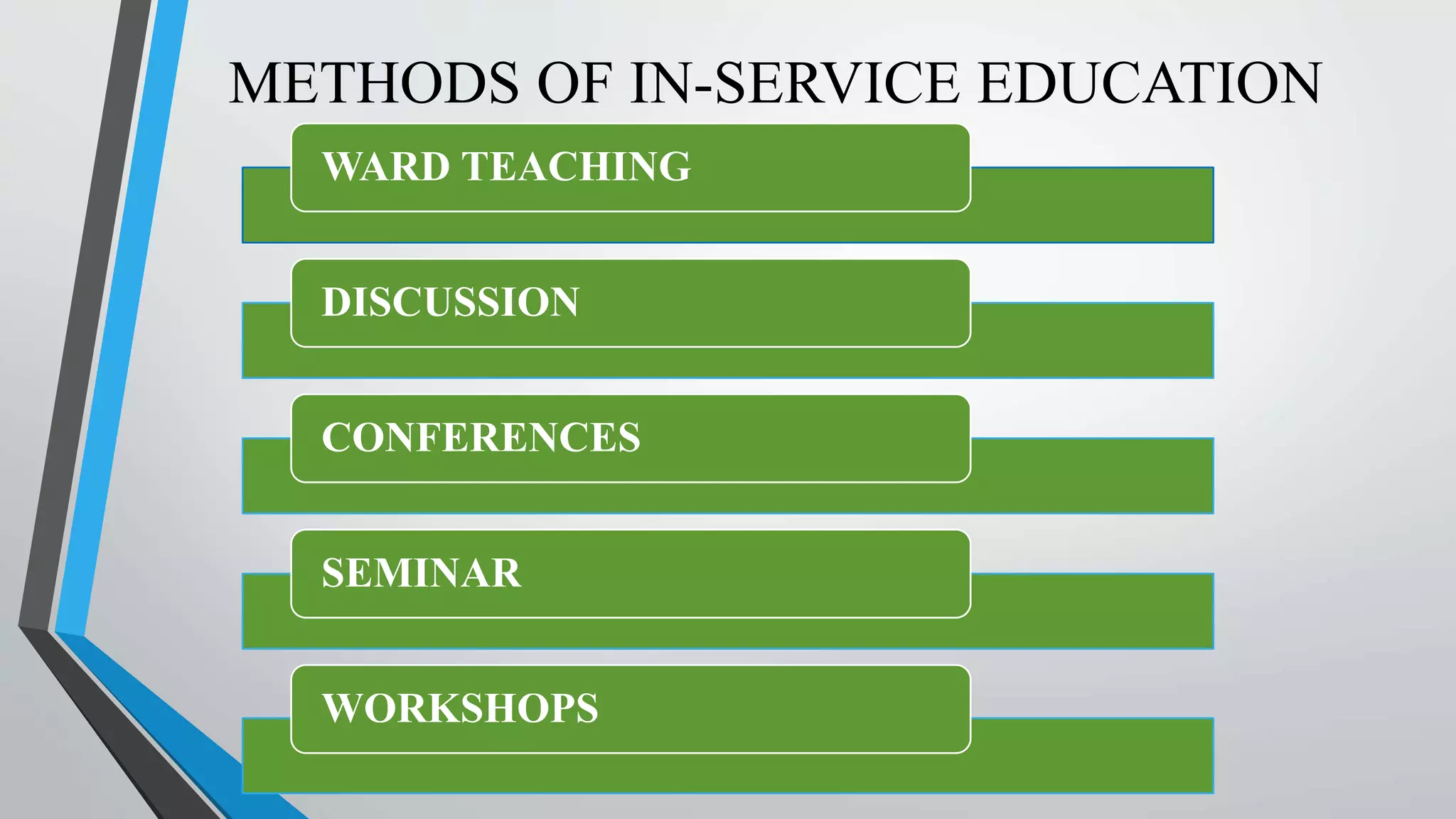
METHODS OF IN-SERVICE EDUCATION
WARD TEACHING
DISCUSSION
CONFERENCES
SEMINAR
WORKSHOPS
EVALUATION OF STAFF EDUCATION
PROGRAMME
DEFINITION OF EVALUATION
• Evaluation is the process of determining to what extent the educational
objectives are being realized. - Ralph Tyler.
• Evaluation is systematic examination of educational and social programme. -
Conbach et.
TYPES OF EVALUATION
Formative evaluation:
Formative evaluation takes place during the training programme to monitor
the learning progress. Feedback to the trainer provides for modifying the
form and process training if necessary. Tests used for formative evaluation
are mostly prepared by the teacher trainer
Summative evaluation:
It takes place at the end of the programme. It is designed to determine the
what extent which the instructional objectives have been achieved. This
evaluation confirms both the improvement in the trainees performance and
the training itself.
PREPARATION OF REPORT
The report should be prepared with the following elements:
• Date and duration of Education programme.
• Coordinator and resource persons.
• Purpose of the topic of the education programme.
• The group of individuals with basic qualification and number of individuals in
the group.
• Planning components of Inservice education.
• Evaluation tools used for the evaluation of knowledge and skills .
• A brief summary of all the areas to be recorded in the report and submitted to
a higher authority.
Inservice education

Inservice education

  • 1.
  • 2.
    INTRODUCTION • For anyorganization to be effective needs 5M’s that is men, money, material, methods and machines. It is more of men duly qualified than any other factors which determines the quality and quantity of performance. Even the contribution of other M’s to perform depends upon their manipulation by men/staff. • The staff is the key to the development and success of organization. In the nursing organization one of the important duties of nursing managers is staff development for improving the quality of nursing care.
  • 3.
    In service educationis a part staff development. It is an organized educational programme to assist the individuals in an organization in attaining new skills and knowledge, gaining increased level of competence and growing professionally.
  • 4.
    What is In-ServiceEducation? • “Planned educational experience provided on the job setting and closely identified with service in order to help a person perform more effectively.” -NATIONAL LEAGUE OF NURSES • “All educational activities planned and organized by the employer for the employees to assist them in learning and furthering the knowledge and skill required for the achievements of the specific purpose of the employing agencies or the organization.” -ANA
  • 5.
    AIMS •It helps toimprove professional growth and development. •It gives a chance for promotion for the staff members. •The individual nurses upgrade their knowledge and skills. •It enhances to improve the performance while rendering care to the clients.
  • 6.
    CHARACTERISTICS • It isprovided with job setting • It is planned and ongoing. • It is designed to meet their demands of changing needs like scientifically, technically, medically in respect to patient care and treatment. • Inservice education mainly focus on efficiency and quality of services.
  • 7.
    NATURE AND SCOPEOF INSERVICE EDUCATION • Maintenance of familiarity with new knowledge and subject matter. Increased skill in providing service • Improved attitudes and skills • Greater skill in utilizing community resources and in working with adults. • Development and refinement of common values and goals. • Inservice education is education intended to support and assist the professional development. For effective implementation of in-service education programme the basic knowledge of employee need to be kept in mind.
  • 8.
    CONCEPT OF IN-SERVICE EDUCATION PLANNED EDUCATION ACTIVITIES PERSONSTO IMPROVE PERFORMANCE EFFECTIVELY PROVIDED IN JOB SETTING CLOSELY IDENTIFIED WITH SERVICES
  • 9.
    Steps in developingIn-service education programme PLANNING IMPLEMENTATION EVALUATION ASSESSMENT PARTICIPANTS, RESOURCES, COMMUNITYAND PROFESSIONAL NEEDSTO BE IDENTIFIED OBJECTIVES, CONTENT, METHOD TO BE PREPARED PATICIPANT’S PROGRAMME RECORDING PARTICIPANT’S PROGRAMME FOLLOW UP
  • 10.
    TYPES OF IN-SERVICETRAINING Centralized in-service training Decentralized in-service training Combined in-service training
  • 11.
    • Centralized in-servicetraining: • Centralization refers to the condition whereby the administrative authority for education and training remains within the central body. This central body has complete power over all resources: money, information, people, technology. It decides the content of curriculum, controls the budget, is responsible for employment, the building of educational facilities, discipline policies, etc. • In nursing service department ,one department will be held responsible for improvement of knowledge , skills, practice of their nursing.
  • 12.
    • Decentralized in-servicetraining • Decentralization, on the other hand, refers to the extent to which authority has been passed down to the various departments. However, the locus of power remains with the central body. • This is planned for the staff members who work together giving care for the clients with similar conditions and share similar goals.
  • 13.
    • Combined in-servicetraining • In this , the higher nursing authorities and all other departments together plans for the staff development programme and further plans their programme based on the needs arises.
  • 14.
  • 15.
    NEEDS FOR INSERVICEEDUCATION • Needs for development of manual, behavioral and communication skills essential for execution of their jobs. • Needs for development of decision making and managerial skills. • Needs for introduction to their routine job, which are expanding new, higher, complicated. • Needs for development of leadership skills. • Needs for development of analytical and innovative thinking for investigating the potentialities and efficiency of their job.
  • 16.
    COMPONENTS 1. ORIENTATION 2. SKILLTRAINING 3. LEADERSHIP AND MANAGEMENT DEVELOPMENT 4. CONTINUING EDUCATION
  • 17.
    ORIENTATION Orientation means providingnew employees with basic information about the employer COMPONENTS OF ORIENTATION Centralized Orientation Decentralized Orientation
  • 18.
    CENTRALIZED ORIENTATION 1. GeneralizedOrientation : It focus on 3 areas. General Orientation • Physical set up of organization • Philosophy • Purpose and roles of employees  Hospital Orientation • Services available for staff and patients in the hospital. • Resources available • Library facilities  Orientation to the Nursing department • Organization of nursing department. • Different categories of nursing personnel. • Special programs and activities for nursing personnel
  • 19.
    DECENTRALIZED ORIENTATION It focuson the 1. Orientation to nursing unit 2.Orientation to the nursing team
  • 20.
    SKILL TRAINING It providesemployees with skills and attitudes required for the job and keeps them abreast of changing methods and new techniques. Types of training: 1. Basic literacy training 2. Technical training 3. Interpersonal skills training 4. Problem solving training 5. Diversity training.
  • 21.
    Training methods: 1. Jobrotation: By assigning people to different jobs or tasks to different people on a temporary basis. 2. Mentoring Programme: A new employee frequently learns his or her job under guidance of an experienced workers.
  • 22.
    LEADERSHIPAND MANAGEMENT DEVELOPMENT • Itequips a selected group of employees to shoulder growing responsibilities and new positions. • Staffs should have skills in leadership and management in order to guide employees. They mainly focus to develop: Leadership skills Communication skills Performance Management skills Decision making skills
  • 23.
    CONTINUING EDUCATION Continuing educationis all the learning activities that occur offer an individual has completed his basic education. AIMS OF CONTINUING EDUCATION  Improvement of professional practice.  To motivate the staff to seek the latest knowledge  To keep the nurses with the latest development of technologies.  It develops interest, job satisfaction and confidence.
  • 25.
    ADULT LEARNING • “Learningis a permanent change in human capabilities that is not a result of the growth process” • Adult learning -“It is the practice of teaching & educating adults at work place during in service education programme” • The need for adult education & continuing education is due to Following factor- 1. Changing social trends. 2. Population mobility 3.Changing roles of hospital 4. Health status 5. Employment & empowerment of women
  • 26.
    PRINCIPLES OF ADULTLEARNING  SELF-DIRECTING AND AUTONOMOUS  LEARN BY DOING  RELEVANCE  EXPERIENCE  ALL OF THE SENSES  PRACTICE  PERSONAL DEVELOPMENT
  • 27.
    Self-Directing and Autonomous •The first is that adults are autonomous and self directing, meaning that they live under a large degree of self-governance and to their own laws, beliefs and values. • They need to know the benefits, values and purposes of a learning program. Learn by doing • Adults learn through direct experience; therefore, their training and learning interventions must include active and practical participation and offer implementable techniques and methodologies that will immediately improve their every day lives. Relevance • The content of a training program must be meaningful and relevant to the adult learners, their lives and their business. They have to very clearly see why and how this is important to them personally and how it applies to their life. • The immediate use of the learning needs to be clearly understood by the learner.
  • 28.
    Experience • Adult learnersneed to be able to draw upon their past experiences to aid their learning. Training needs to be contextualized to use language that they are familiar with. All of the Senses • Adult learners need multi-sensory learning and teaching methodologies. We must ensure that our learning interventions have appropriately proportioned delivery techniques that meet the needs of audio, visual, reading/writing, kinesthetic, dependent and independent learning preferences.  Practice • Adult learners are often engaged in learning because a problem needs to be solved. Practicing skills in a controlled environment allows them to grow self-efficacy in new tasks that prepare them to act autonomously outside of the learning environment.
  • 29.
    Personal Development • Theintrinsic, personal desires and ambitions of an adult learner need to be considered when planning and delivering adult learning programs. • As learners get older, their cause for participation in learning programs often moves from external drivers (such as getting a promotion), to internal drivers, like simply learning out of pure pleasure or interest in learning something new. Involvement • Effective adult learning programs have planned for learner feedback and consultation. Adults need to feel as though they have a sense of responsibility, control and decision-making over their learning. • They need to be involved in the planning, evaluation and consultation of their own learning process to be fully on board with its successful execution.
  • 30.
    PLANNING FOR IN-SERVICEEDUCATION It is key stone to the administrative process. Successful in-service education planning is the result of careful & detail planning. Planning is essential if learning needs of nurse are to be meet. Planning must be seen as an ongoing process because of rapid technological advance & proliferation of knowledge demand continuous planning to meet ever changing learning need.
  • 31.
    METHODS OF IN-SERVICEEDUCATION WARD TEACHING DISCUSSION CONFERENCES SEMINAR WORKSHOPS
  • 32.
    EVALUATION OF STAFFEDUCATION PROGRAMME DEFINITION OF EVALUATION • Evaluation is the process of determining to what extent the educational objectives are being realized. - Ralph Tyler. • Evaluation is systematic examination of educational and social programme. - Conbach et.
  • 33.
    TYPES OF EVALUATION Formativeevaluation: Formative evaluation takes place during the training programme to monitor the learning progress. Feedback to the trainer provides for modifying the form and process training if necessary. Tests used for formative evaluation are mostly prepared by the teacher trainer Summative evaluation: It takes place at the end of the programme. It is designed to determine the what extent which the instructional objectives have been achieved. This evaluation confirms both the improvement in the trainees performance and the training itself.
  • 34.
    PREPARATION OF REPORT Thereport should be prepared with the following elements: • Date and duration of Education programme. • Coordinator and resource persons. • Purpose of the topic of the education programme. • The group of individuals with basic qualification and number of individuals in the group. • Planning components of Inservice education. • Evaluation tools used for the evaluation of knowledge and skills . • A brief summary of all the areas to be recorded in the report and submitted to a higher authority.