Introduction
Supervision is one of the most important management
functions in an organization. In every organization there is
provision for supervision. In a scalar system each level in
the hierarchical organization is subject to the supervision of
the immediately above level and each employee is subject to
the control of immediate superior person.
Definition
It is the process by which workers are
helped by a designated staff member to learn
according to their needs, to make the best use of
their knowledge and skills and to improve their
abilities so that they do their jobs more effectively
and with increasing satisfaction to themselves and
the agency (Williamson)
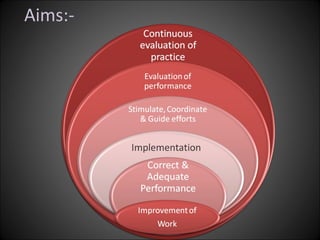
Aims:-
OBJECTIVES
• Help the staff to do their job skillfully and
effectively
• Help the staff develop the individual capacity
• Guide and/or assist in meeting predetermined
work objectives or targets in nursing preventive,
promotive, curative and rehabilitative care to
people.
• Help to promote effectiveness of the
subordinates/staffs.
• Help to motivate subordinates to maintain
high morale.
• Help the members of the team to recognize
problems, identify solutions and to take
action.
• Help to develop team spirit and promote team
work
• Help to improve the attitudes of the members
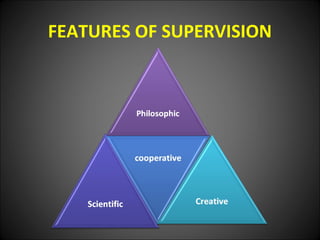
FEATURES OF SUPERVISION
FACTORS OF
EFFECTIVE
SUPERVISION
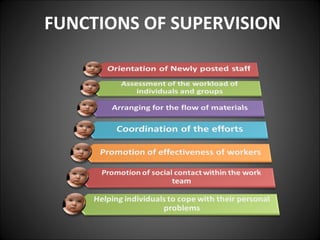
FUNCTIONS OF SUPERVISION
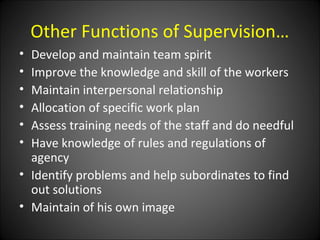
Other Functions of Supervision…
• Develop and maintain team spirit
• Improve the knowledge and skill of the workers
• Maintain interpersonal relationship
• Allocation of specific work plan
• Assess training needs of the staff and do needful
• Have knowledge of rules and regulations of
agency
• Identify problems and help subordinates to find
out solutions
• Maintain of his own image
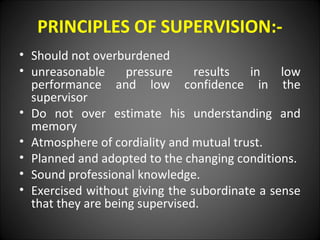
PRINCIPLES OF SUPERVISION:-
• Should not overburdened
• unreasonable pressure results in low
performance and low confidence in the
supervisor
• Do not over estimate his understanding and
memory
• Atmosphere of cordiality and mutual trust.
• Planned and adopted to the changing conditions.
• Sound professional knowledge.
• Exercised without giving the subordinate a sense
that they are being supervised.
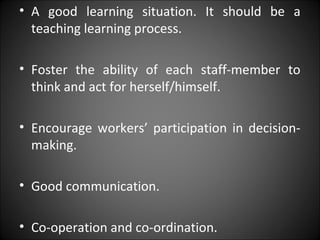
• A good learning situation. It should be a
teaching learning process.
• Foster the ability of each staff-member to
think and act for herself/himself.
• Encourage workers’ participation in decision-
making.
• Good communication.
• Co-operation and co-ordination.
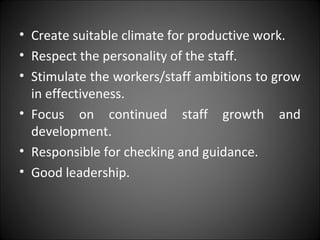
• Create suitable climate for productive work.
• Respect the personality of the staff.
• Stimulate the workers/staff ambitions to grow
in effectiveness.
• Focus on continued staff growth and
development.
• Responsible for checking and guidance.
• Good leadership.
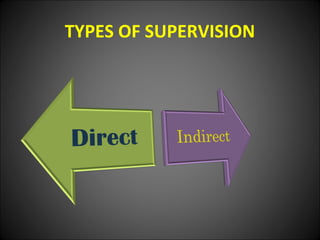
TYPES OF SUPERVISION
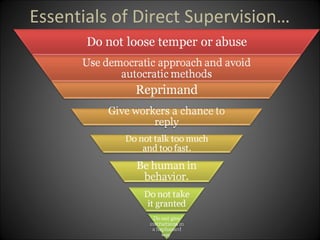
Essentials of Direct Supervision…
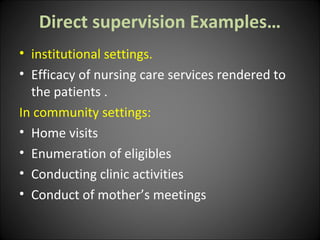
Direct supervision Examples…
• institutional settings.
• Efficacy of nursing care services rendered to
the patients .
In community settings:
• Home visits
• Enumeration of eligibles
• Conducting clinic activities
• Conduct of mother’s meetings
Indirect Supervision - Examples
Institutional Settings:
• Patient’s records and reports
• Patient’s history sheets, treatment records, results of
investigations and diagnostic procedures
• General order books
• Round books
• Dangerous drug records and registers
• Nursing care plans
• Nurse’s notes
• Call books
• Admission and discharge registers; death register
Community settings:-
• Work diary of the individual workers
• Performance reports of the individual workers
• Eligible couple and child registers
• Copies of monthly reports sent to the
authorities
• Other records available in specific settings
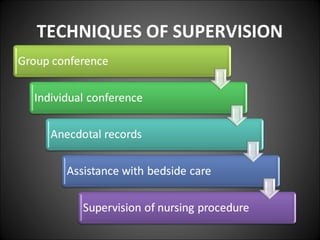
TECHNIQUES OF SUPERVISION
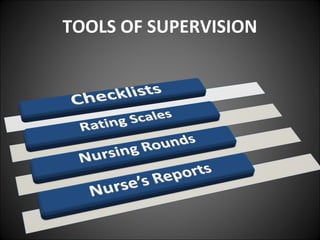
TOOLS OF SUPERVISION
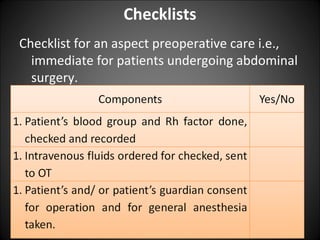
Checklists
Checklist for an aspect preoperative care i.e.,
immediate for patients undergoing abdominal
surgery.
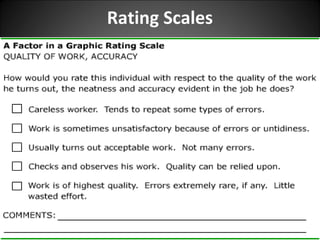
Rating Scales
Nursing Rounds
Example in Maternity Units:
• Give me your ward census
• How many normal deliveries have taken place up to
this morning?
• How many among them are primis and how many
multis?
• How many of them have had episiotomies?
• Has there has been any forceps delivery today?
• Has there been any caesarean section today?
• Have the new babies been put to breast? How soon
after delivery did you put the newborns to breast?
• How many mothers are under observations? Show
them to me. Show me your observation charts on FHS.
Nurse’s Reports
Day and night reports written by charge
nurses daily during morning, evening and
night also save as tools of supervision
particularly in the indirect method of
supervision. Here we can get the charge
nurse’s knowledge and awareness about their
patients- their condition, what has been done
for them and who require priority attention.
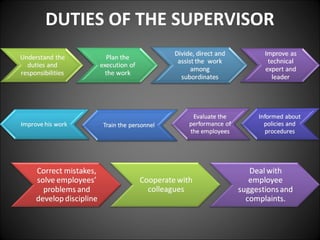
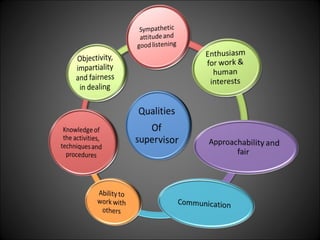
DUTIES OF THE SUPERVISOR
Supervision santhosh

Supervision santhosh

  • 2.
    Introduction Supervision is oneof the most important management functions in an organization. In every organization there is provision for supervision. In a scalar system each level in the hierarchical organization is subject to the supervision of the immediately above level and each employee is subject to the control of immediate superior person.
  • 3.
    Definition It is theprocess by which workers are helped by a designated staff member to learn according to their needs, to make the best use of their knowledge and skills and to improve their abilities so that they do their jobs more effectively and with increasing satisfaction to themselves and the agency (Williamson)
  • 4.
  • 5.
    OBJECTIVES • Help thestaff to do their job skillfully and effectively • Help the staff develop the individual capacity • Guide and/or assist in meeting predetermined work objectives or targets in nursing preventive, promotive, curative and rehabilitative care to people. • Help to promote effectiveness of the subordinates/staffs.
  • 6.
    • Help tomotivate subordinates to maintain high morale. • Help the members of the team to recognize problems, identify solutions and to take action. • Help to develop team spirit and promote team work • Help to improve the attitudes of the members
  • 7.
  • 8.
  • 9.
  • 11.
    Other Functions ofSupervision… • Develop and maintain team spirit • Improve the knowledge and skill of the workers • Maintain interpersonal relationship • Allocation of specific work plan • Assess training needs of the staff and do needful • Have knowledge of rules and regulations of agency • Identify problems and help subordinates to find out solutions • Maintain of his own image
  • 12.
    PRINCIPLES OF SUPERVISION:- •Should not overburdened • unreasonable pressure results in low performance and low confidence in the supervisor • Do not over estimate his understanding and memory • Atmosphere of cordiality and mutual trust. • Planned and adopted to the changing conditions. • Sound professional knowledge. • Exercised without giving the subordinate a sense that they are being supervised.
  • 13.
    • A goodlearning situation. It should be a teaching learning process. • Foster the ability of each staff-member to think and act for herself/himself. • Encourage workers’ participation in decision- making. • Good communication. • Co-operation and co-ordination.
  • 14.
    • Create suitableclimate for productive work. • Respect the personality of the staff. • Stimulate the workers/staff ambitions to grow in effectiveness. • Focus on continued staff growth and development. • Responsible for checking and guidance. • Good leadership.
  • 15.
  • 16.
    Essentials of DirectSupervision…
  • 17.
    Direct supervision Examples… •institutional settings. • Efficacy of nursing care services rendered to the patients . In community settings: • Home visits • Enumeration of eligibles • Conducting clinic activities • Conduct of mother’s meetings
  • 18.
    Indirect Supervision -Examples Institutional Settings: • Patient’s records and reports • Patient’s history sheets, treatment records, results of investigations and diagnostic procedures • General order books • Round books • Dangerous drug records and registers • Nursing care plans • Nurse’s notes • Call books • Admission and discharge registers; death register
  • 19.
    Community settings:- • Workdiary of the individual workers • Performance reports of the individual workers • Eligible couple and child registers • Copies of monthly reports sent to the authorities • Other records available in specific settings
  • 22.
  • 23.
  • 24.
    Checklists Checklist for anaspect preoperative care i.e., immediate for patients undergoing abdominal surgery.
  • 25.
  • 26.
    Nursing Rounds Example inMaternity Units: • Give me your ward census • How many normal deliveries have taken place up to this morning? • How many among them are primis and how many multis? • How many of them have had episiotomies? • Has there has been any forceps delivery today? • Has there been any caesarean section today? • Have the new babies been put to breast? How soon after delivery did you put the newborns to breast? • How many mothers are under observations? Show them to me. Show me your observation charts on FHS.
  • 27.
    Nurse’s Reports Day andnight reports written by charge nurses daily during morning, evening and night also save as tools of supervision particularly in the indirect method of supervision. Here we can get the charge nurse’s knowledge and awareness about their patients- their condition, what has been done for them and who require priority attention.
  • 28.
    DUTIES OF THESUPERVISOR