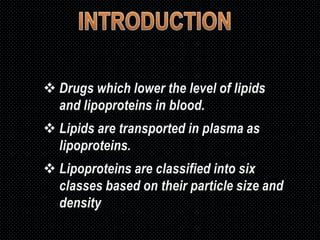
 Drugs which lower the level of lipids
and lipoproteins in blood.
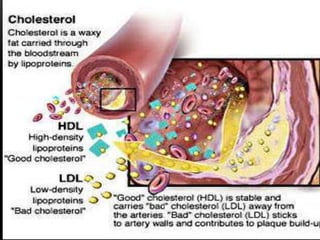
 Lipids are transported in plasma as
lipoproteins.
 Lipoproteins are classified into six
classes based on their particle size and
density
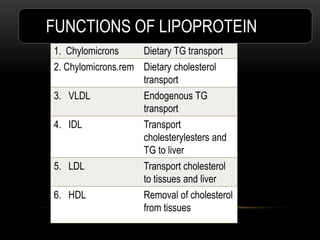
LIPOPROTEIN FUNCTION
1. Chylomicrons Dietary TG transport
2. Chylomicrons.rem Dietary cholesterol
transport
3. VLDL Endogenous TG
transport
4. IDL Transport
cholesterylesters and
TG to liver
5. LDL Transport cholesterol
to tissues and liver
6. HDL Removal of cholesterol
from tissues
FUNCTIONS OF LIPOPROTEIN
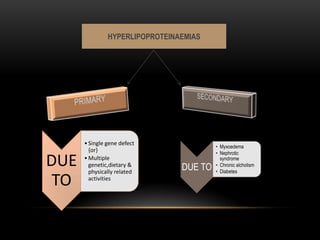
HYPERLIPOPROTEINAEMIAS
DUE
TO
•Single gene defect
{or}
•Multiple
genetic,dietary &
physically related
activities
DUE TO
• Myxoedema
• Nephrotic
syndrome
• Chronic alcholism
• Diabetes
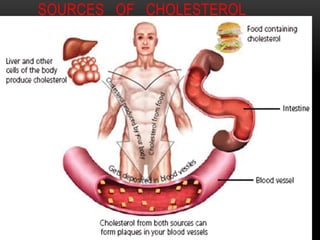
SOURCES OF CHOLESTEROL
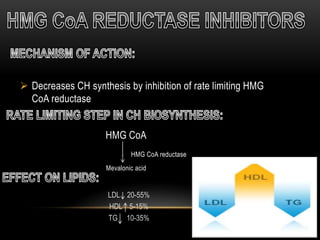
HMG CoA
HMG CoA reductase
Mevalonic acid
 Decreases CH synthesis by inhibition of rate limiting HMG
CoA reductase
LDL 20-55%
HDL 5-15%
TG 10-35%



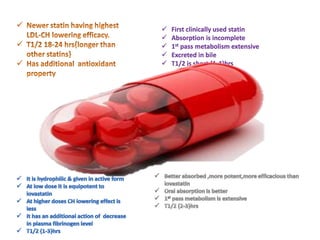
 First clinically used statin
 Absorption is incomplete
 1st pass metabolism extensive
 Excreted in bile
 T1/2 is short {1-4}hrs
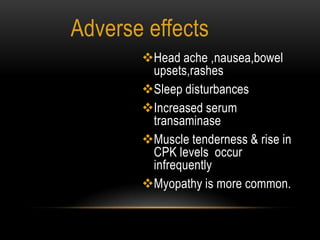
Head ache ,nausea,bowel
upsets,rashes
Sleep disturbances
Increased serum
transaminase
Muscle tenderness & rise in
CPK levels occur
infrequently
Myopathy is more common.
Adverse effects
1st choice of drugs for Primary hyper lipidaemia
with raised LDL & total CH levels.
Secondary hypercholesterolaemia.
Used in patients with MI,angina,stroke to lower
cholesterol levels.
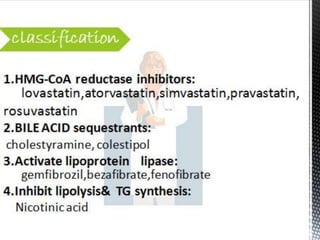
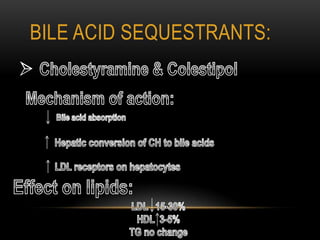
BILE ACID SEQUESTRANTS:
• These are basic ion exchange resins supplied in
chloride form
• They are neither digested nor absorbed in gut
• They bind to bile acids in the intestine
• They increase faecal excretion of bile salts and CH
• resins can retard atherosclerosis
• Not popular clinically because they are
unpalatable,have to be taken in large doses,causes
flatulence and interfere with absorption of many
other drugs
• Have poor patient acceptability
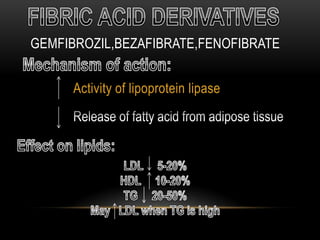
GEMFIBROZIL,BEZAFIBRATE,FENOFIBRATE
Activity of lipoprotein lipase
• Effectively lowers Plasma TG level by enhancing breakdown &
suppressing hepatic synthesis of TG‘s
ADDITIONAL ACTION: decreases level of clotting factor VII phospholipid
complex & promotion of fibrinolysis
PHARMACOKINETICS: completely absorbed orally ,Metabolized by
glucuronidation & excreated in urine
ADVERSE EFFECT:
 Epigastric distress
 Skin rashes
 impotence
USES:
 Drug of choice in patient with increased TG levels
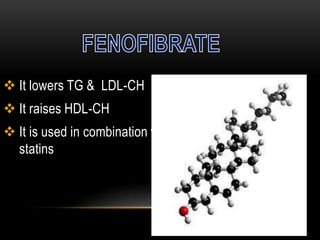
 It lowers TG & LDL-CH
 It raises HDL-CH
 It is used in combination with
statins
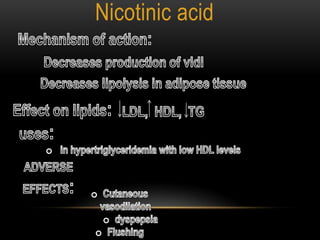
Nicotinic acid
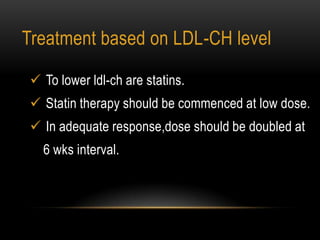
 To lower ldl-ch are statins.
 Statin therapy should be commenced at low dose.
 In adequate response,dose should be doubled at
6 wks interval.
Treatment based on LDL-CH level
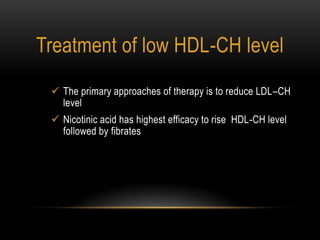
Treatment of low HDL-CH level
 The primary approaches of therapy is to reduce LDL–CH
level
 Nicotinic acid has highest efficacy to rise HDL-CH level
followed by fibrates
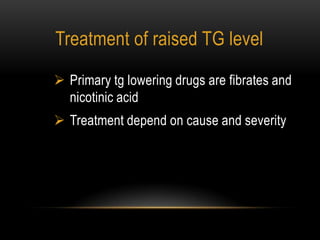
 Primary tg lowering drugs are fibrates and
nicotinic acid
 Treatment depend on cause and severity
Treatment of raised TG level
HYPOLIPIDEMIC DRUGS
HYPOLIPIDEMIC DRUGS

HYPOLIPIDEMIC DRUGS

  • 2.
     Drugs whichlower the level of lipids and lipoproteins in blood.  Lipids are transported in plasma as lipoproteins.  Lipoproteins are classified into six classes based on their particle size and density
  • 3.
    LIPOPROTEIN FUNCTION 1. ChylomicronsDietary TG transport 2. Chylomicrons.rem Dietary cholesterol transport 3. VLDL Endogenous TG transport 4. IDL Transport cholesterylesters and TG to liver 5. LDL Transport cholesterol to tissues and liver 6. HDL Removal of cholesterol from tissues FUNCTIONS OF LIPOPROTEIN
  • 4.
    HYPERLIPOPROTEINAEMIAS DUE TO •Single gene defect {or} •Multiple genetic,dietary& physically related activities DUE TO • Myxoedema • Nephrotic syndrome • Chronic alcholism • Diabetes
  • 5.
  • 8.
    HMG CoA HMG CoAreductase Mevalonic acid  Decreases CH synthesis by inhibition of rate limiting HMG CoA reductase LDL 20-55% HDL 5-15% TG 10-35%
  • 9.
        First clinicallyused statin  Absorption is incomplete  1st pass metabolism extensive  Excreted in bile  T1/2 is short {1-4}hrs
  • 10.
    Head ache ,nausea,bowel upsets,rashes Sleepdisturbances Increased serum transaminase Muscle tenderness & rise in CPK levels occur infrequently Myopathy is more common. Adverse effects
  • 11.
    1st choice ofdrugs for Primary hyper lipidaemia with raised LDL & total CH levels. Secondary hypercholesterolaemia. Used in patients with MI,angina,stroke to lower cholesterol levels.
  • 12.
  • 13.
    • These arebasic ion exchange resins supplied in chloride form • They are neither digested nor absorbed in gut • They bind to bile acids in the intestine • They increase faecal excretion of bile salts and CH • resins can retard atherosclerosis • Not popular clinically because they are unpalatable,have to be taken in large doses,causes flatulence and interfere with absorption of many other drugs • Have poor patient acceptability
  • 14.
  • 15.
    • Effectively lowersPlasma TG level by enhancing breakdown & suppressing hepatic synthesis of TG‘s ADDITIONAL ACTION: decreases level of clotting factor VII phospholipid complex & promotion of fibrinolysis PHARMACOKINETICS: completely absorbed orally ,Metabolized by glucuronidation & excreated in urine ADVERSE EFFECT:  Epigastric distress  Skin rashes  impotence USES:  Drug of choice in patient with increased TG levels
  • 16.
     It lowersTG & LDL-CH  It raises HDL-CH  It is used in combination with statins
  • 17.
  • 18.
     To lowerldl-ch are statins.  Statin therapy should be commenced at low dose.  In adequate response,dose should be doubled at 6 wks interval. Treatment based on LDL-CH level
  • 19.
    Treatment of lowHDL-CH level  The primary approaches of therapy is to reduce LDL–CH level  Nicotinic acid has highest efficacy to rise HDL-CH level followed by fibrates
  • 20.
     Primary tglowering drugs are fibrates and nicotinic acid  Treatment depend on cause and severity Treatment of raised TG level